Money moves once, at the end
A spa booking holds a therapist and a room. It does not charge anybody. Nothing reaches a folio, an account or a card until the appointment is marked Completed, which is the single moment in the module where money moves.
That is worth being precise about, because it decides what your staff can safely do. Bookings can be made, moved, confirmed and cancelled all week without a single ledger entry, so a cancelled treatment normally costs nothing and a mistake made at the appointment book is a mistake about time rather than about money. It also means an appointment left sitting at In progress at the end of the day is a treatment that has been delivered and not paid for.
There is one exception, and it is deliberate: a deposit is real money taken at the time of booking. Everything else waits.
The five answers
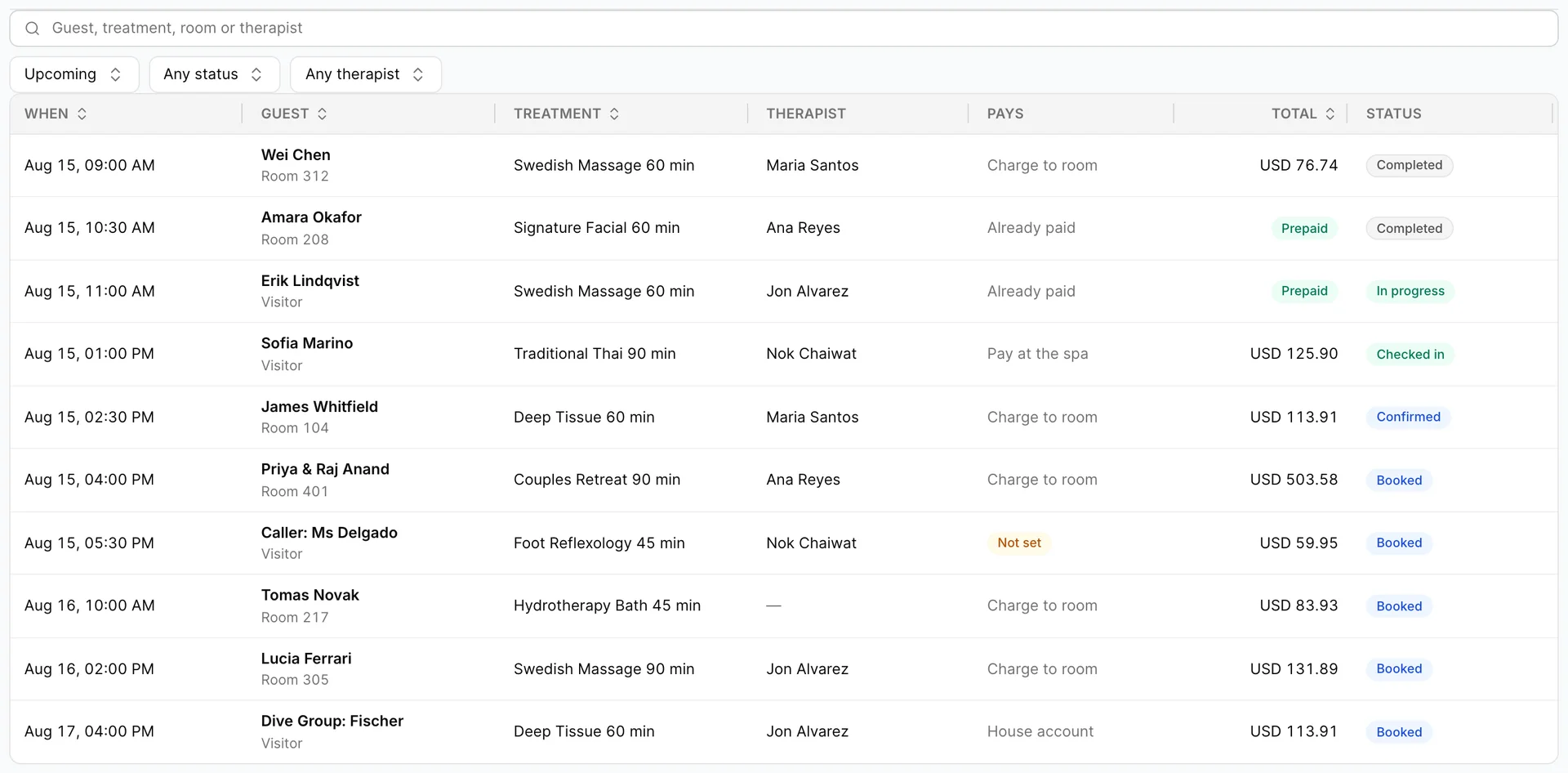
Every appointment carries one of five answers to "who pays", chosen at booking and visible in the Pays column of the appointments list. Four of them are real destinations for money. The fifth is an admission that nobody has asked yet, and it is the one worth scanning for at the start of a shift.
| Pays | What happens at completion | What it needs |
|---|---|---|
| Charge to room | The treatment posts to the guest's folio, where it waits for checkout with everything else. | A reservation attached to the booking. |
| Pay at the spa | An account is opened, the treatment posts to it, the payment closes it and an invoice number comes back. | Somebody at the desk to take the money. |
| House account | The treatment posts to a named open account, settled later by whoever owns it. | An account chosen on the booking. |
| Already paid | Nothing posts. The treatment is redeemed from a course, an allowance or a package sold with the room. | The entitlement, which the system checks itself. |
| Not set | Nothing. The appointment cannot be completed at all. | Somebody to answer the question. |
The fifth answer has two names, depending on where you meet it. You choose Decide later when you take the booking, and the appointments list shows the result as an orange Not set badge. They are the same appointment in the same state.
The answer is set when the booking is taken, and taking a booking covers how it is chosen for you. To change it afterwards, open the appointment, choose Edit appointment from the menu beside the status, and work forward to the payment step. The change is recorded in the appointment's history, and it is only possible until the treatment is completed, because completion is the moment the money moves.
Charge to room
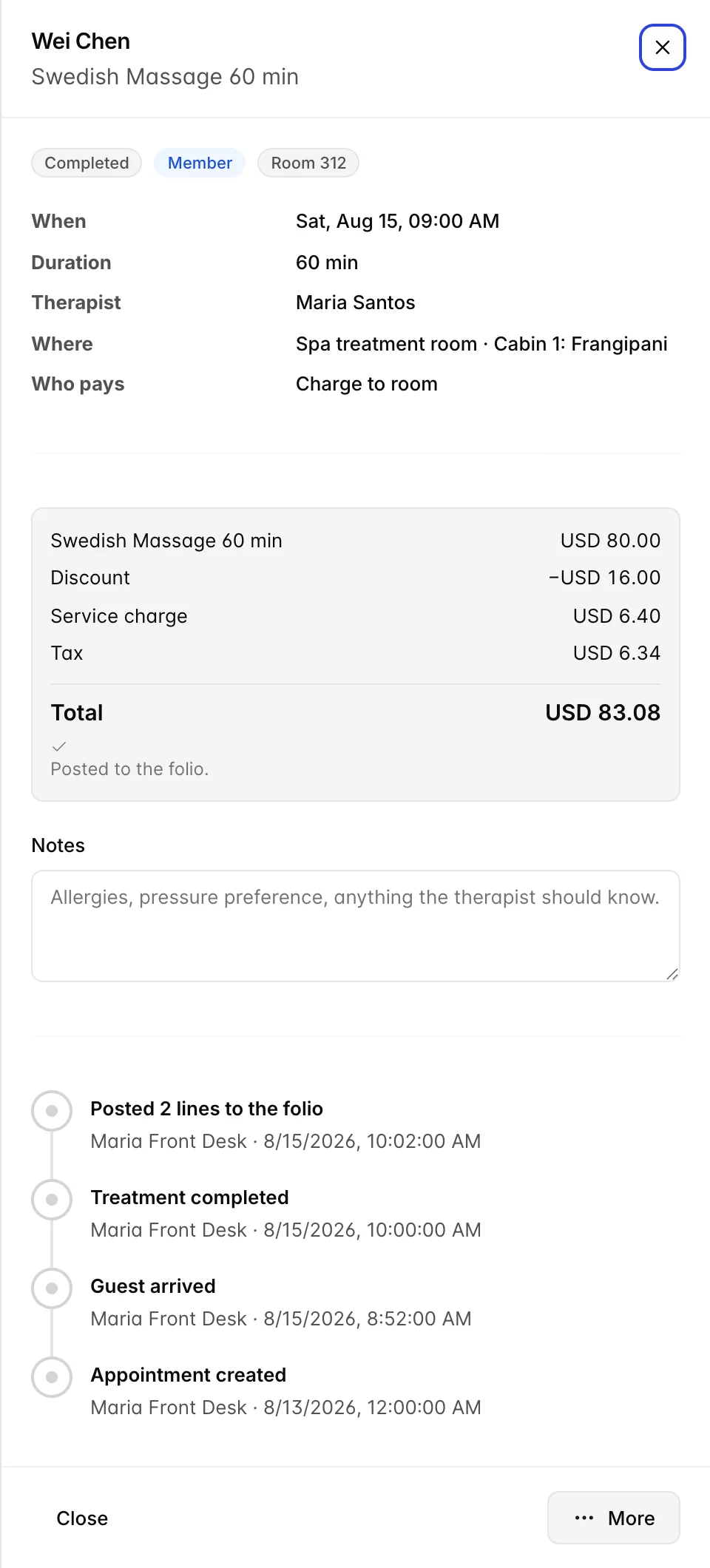
This is the ordinary case for a hotel guest, and the thing to understand about it is that the spa does not keep the charge. It posts to the same folio the restaurant and the minibar post to, under the treatment's own catalogue item, with the property's tax treatment applied. By the time the guest reaches the front desk on Thursday, the massage is simply a line on their bill, and nobody at the desk needs to know the spa exists.
The ticked line under the total is the confirmation. Until it appears, nothing has posted, whatever the status badge says.
Two things stop it. A booking with no reservation attached has no folio to post to, which is why the option is not offered for a walk-in. And a guest who has already checked out has no open folio either; the booking screen says so as soon as you reach the payment step, and the fix is to take payment at the spa or put the treatment on a house account.
Pay at the spa
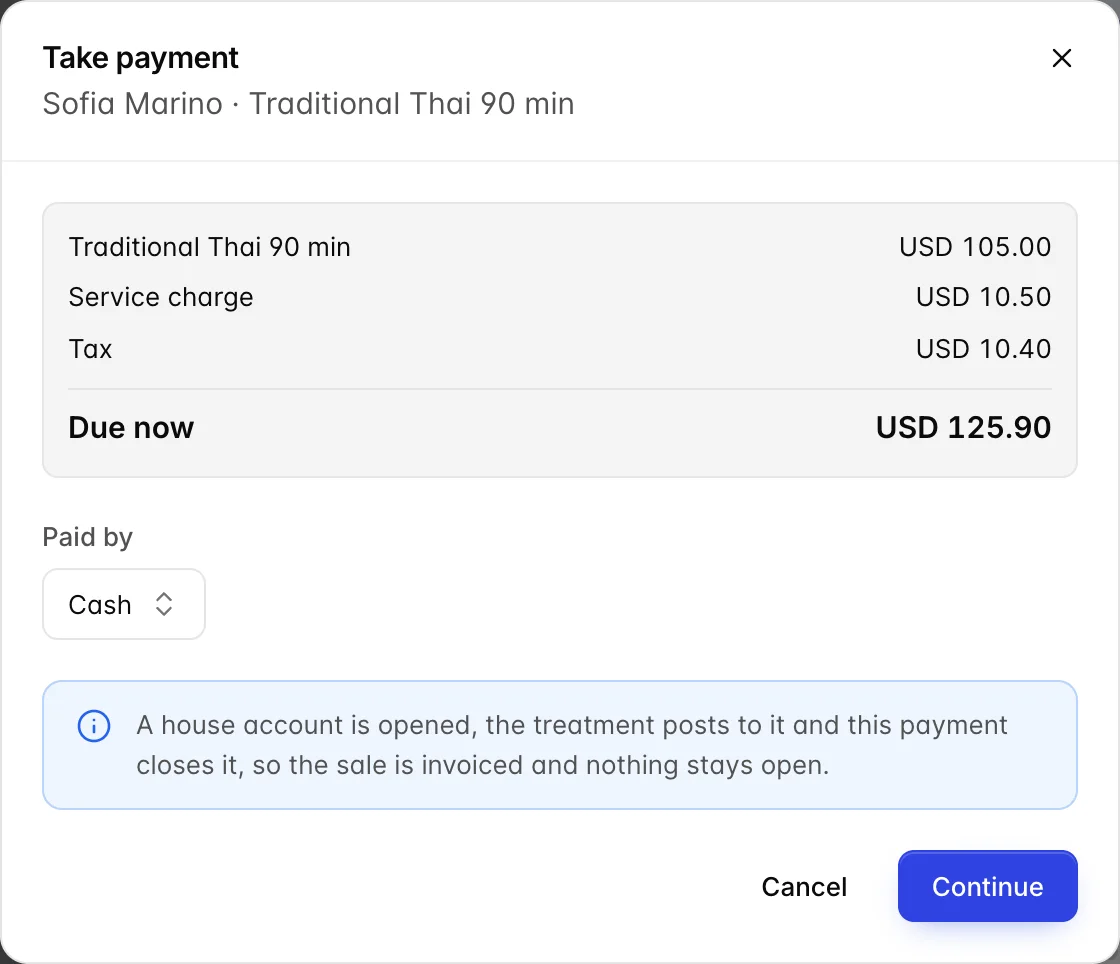
Completing a treatment for somebody who is paying at the desk opens the payment dialog instead of posting silently, because there is money to take before the appointment can close.
Behind the one button, four things happen in order: an account is opened in the guest's name, the treatment and its service charge post to it, the payment is applied, and the account is closed. The result is an invoice number, which is what makes this a sale your accountant can find rather than cash in a drawer. It is the same settlement screen the front desk uses, so a card taken at the spa reconciles against the same terminal batch as a card taken at reception, and cash counted here counts in the same drawer.
Due now is the tax-inclusive figure, which is the number to read out to the guest. Cash and card both continue to the capture screen, where cash is counted and change worked out and a card takes its approval code. Every other method, a transfer or a voucher, offers a Reference field instead: optional, and the difference between a payment you can explain in three months and one you cannot.
If the guest's profile has an email address, the receipt can be sent there on the spot.
Deposits
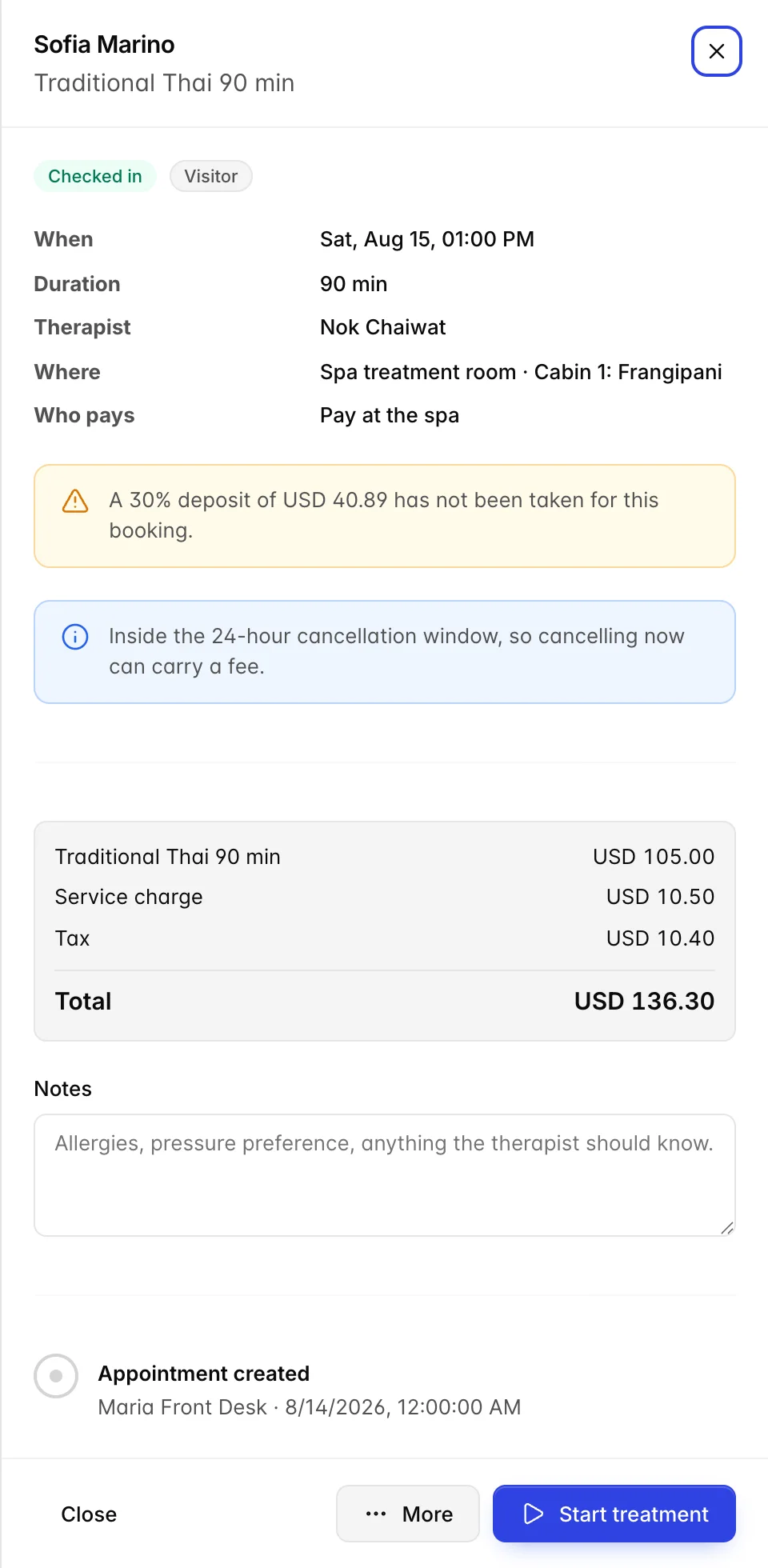
A deposit exists for one reason: an outside guest booking a Saturday afternoon has nothing to lose by not turning up. If your property has switched deposits on in spa settings, Prostay asks for one the moment such a booking is confirmed, and reminds you on the appointment itself until it has been taken.
Only one kind of booking is asked: an outside guest who is paying at the spa, on an appointment that has not yet been completed, cancelled or marked as a no-show. A guest charging to their room is not asked, because the property is already holding a reservation and a card.
The blue banner underneath in the picture is a different warning, and it appears on any appointment inside your cancellation window. It is there so that whoever is about to cancel knows a fee is in play before they click, rather than after.
A deposit is not a posted charge. There is no folio yet and the treatment has not happened, so the money is held against the appointment. It becomes a real payment at settlement, where it appears on the invoice alongside the balance, so the closed account carries two payments against one bill and the guest hands over only the remainder.
House accounts
A house account is the answer for a payer who is not a room and is not standing in front of you: a corporate wellness client, a wedding party, a dive school sending guests over every Tuesday, a travel agent settling monthly. The treatment posts to the account when it is completed, exactly as a room charge posts to a folio, and the account is settled on its own schedule by whoever owns it.
The account has to be chosen on the booking. If none is chosen the booking cannot be finished, which is deliberate: an account charge with no account is a treatment nobody will ever be billed for.
Already paid
Some treatments are paid for before they are booked: a course of six massages bought in advance, a membership allowance, a spa package sold with the room rate. Those appointments are marked Already paid, and completing one posts nothing at all. It draws the treatment down from the balance it belongs to.
This is the one payer the desk cannot override, and the refusal is enforced by the server rather than by hiding a button. That matters more than it sounds. The failure it prevents is the expensive one: a guest who has already paid for six massages being charged again for the fourth, discovering it at checkout, and being right.
What has been drawn down and what is left is covered in memberships and prepaid courses.
Decide later, and what it costs
Decide later is an honest answer to a phone call where the company might be paying. It books the appointment properly: the therapist and the room are held like any other booking, and it appears on the book and the Today list.
The cost lands at the end. The appointment cannot be completed until somebody answers, so the question resurfaces at the worst possible moment, with the guest at the desk and a therapist waiting to start the next treatment. The drawer says so plainly, and points at Edit appointment as the place to answer it, but that is a conversation you would rather have had yesterday. The appointments list flags these with an orange Not set badge, and filtering that column at the start of the day takes about ten seconds.
Where the numbers come from
Four numbers make up what a guest pays, and none of them is invented by the spa.
- The treatment price is the catalogue price of the item, set under Items & Services, the same everywhere in Prostay.
- The discount, if the guest is a member, is folded into the price of the treatment line rather than posted as a separate negative line, so the folio reads at the price the guest was quoted.
- The service charge is added automatically when the treatment is set up to carry one, and posts as its own line so it can be reported and distributed separately.
- Tax is applied when the charge posts, following the tax treatment of the catalogue item. It is why the total on the booking screen is smaller than the total on the invoice, and why the booking screen says so.
The result on a normal treatment is two or three lines on the bill, not one. A guest asking why their massage appears twice is usually looking at the treatment and its service charge.
Gratuities
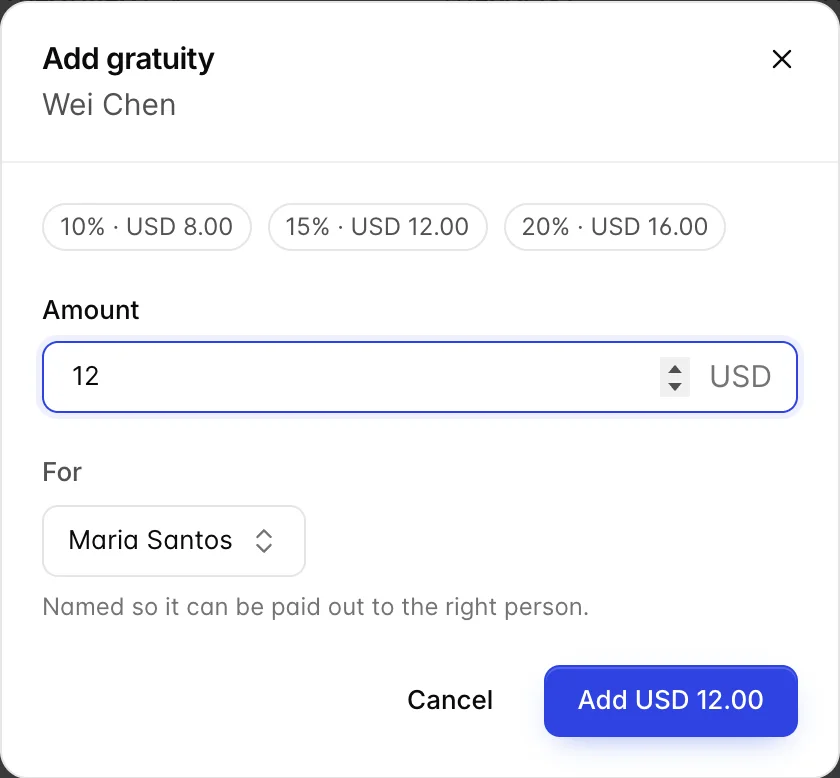
A tip is added from the appointment itself, either while the treatment is under way or after it has finished. The suggestion chips come from the percentages in your spa settings, and the amount can be typed over.
Two things make this more than an extra amount on the bill. The gratuity posts as its own line under its own catalogue item, so it can be treated differently from treatment revenue for tax and reporting. And it names a therapist, which is what lets payroll pay it to a person. A tip folded into the treatment total is a tip nobody can distribute.
Leaving the therapist as Shared across the spa is a legitimate answer for a tip left at the desk for the team.
When something is charged wrongly
Void posted charges, on the appointment's overflow menu, reverses what the spa posted. The charge stays on the folio as a voided line with a reversal against it, because a bill that quietly loses a line is a bill nobody can audit. Use it when the treatment posted to the wrong payer or did not happen at all; the appointment can then be corrected and completed again.
A cancellation inside the window and a no-show both charge a fee if your settings say so, at the percentage set there, and both are recorded against the appointment with the reason. The appointment tells you before you confirm which of the two you are about to do, and what it will cost the guest.
Everything money-related is written into the appointment's history at the bottom of the drawer: who took the deposit, who posted, who voided, who added the tip and when. When a guest disputes a charge three days later, that list is the answer.