Two different promises
Both live under Members, and both end up making a treatment cheaper or free, but they are not variations of one idea.
- A membership is an ongoing relationship. The guest pays dues on a cycle and, for as long as it is running, everything they book is priced differently. It has a start and an end, it can be frozen while they are away, and it can lapse without anybody doing anything.
- A course is a block of one treatment, paid for up front and used up. Six Swedish massages. It has a quantity, an expiry date, and no states beyond having some left or not.
The practical difference is what happens when a guest stops paying attention. A course sits there until it expires and nobody is worse off. A membership keeps changing the price of every booking, which is why so much of this article is about the four ways one can stop counting.
What a plan can be made to do
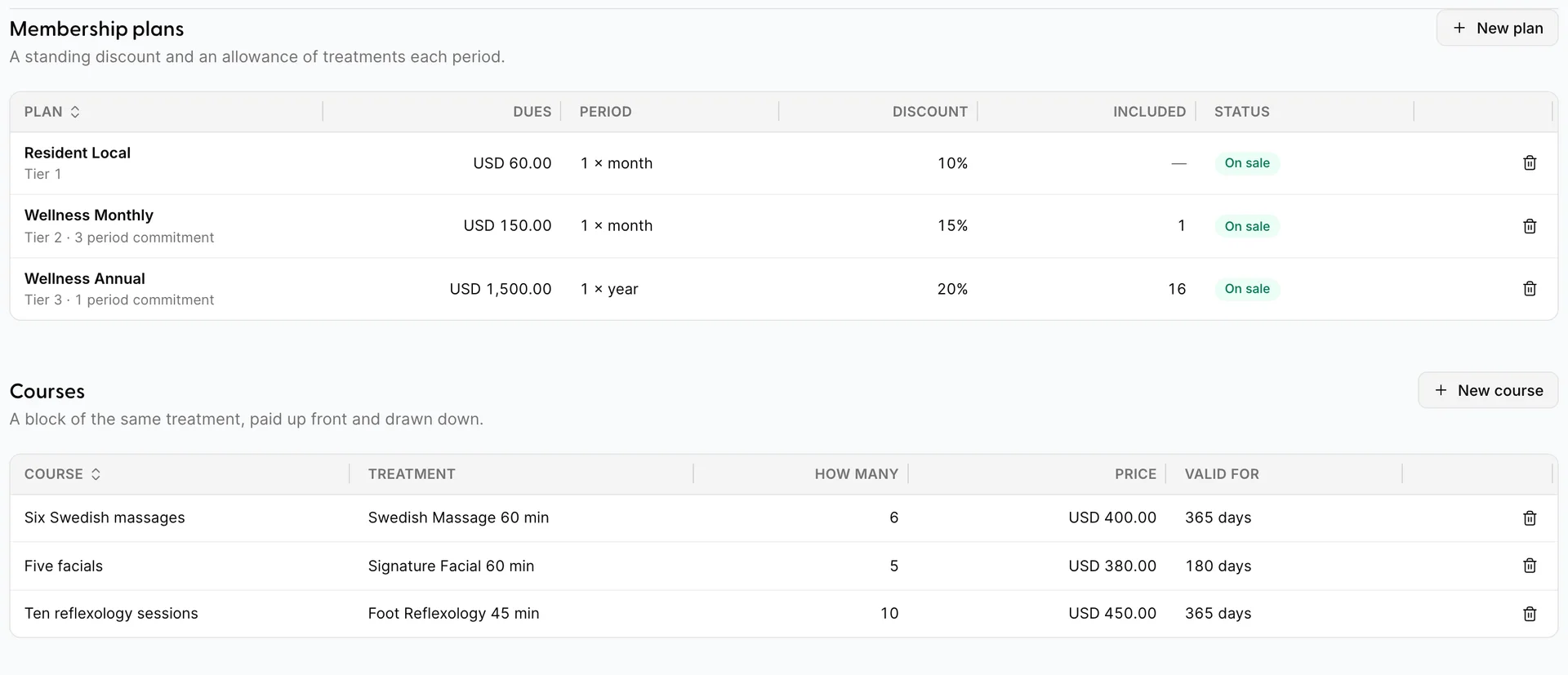
A plan is a set of named properties, each with exactly one effect. There is no rule builder, and there is no condition language: a manager who wants "20% off, but not on Saturday afternoons" sets a discount and a blackout, and both of those are things the spa already knows how to evaluate.
The fields fall into four groups.
| Group | What it sets |
|---|---|
| The deal | Dues and how often they fall due, a joining fee, whether the first period is charged pro rata, a minimum term and the fee for leaving inside it, and the prefix the member number is built from. |
| The benefits | A discount on treatments and a separate one on retail, either of which can be narrowed to particular treatments or categories. Treatments included every period, with or without roll-over. Guest passes. Facility access without a treatment. Priority booking, which is a number of days. |
| The limits | Blackouts, either a weekly window or a date range, during which benefits do not apply. A cap on how many bookings a member can hold at once, and how far ahead they may book. |
| The lifecycle | Whether it renews by default, how many days before the end the renewal is flagged, whether it expires on its end date, whether it can be frozen and for how long, and whether a failed dues payment suspends it. |
You do not have to hold all of that in your head to know what a plan does. The sale dialog reads the finished plan back as a list of plain sentences, one per property that is switched on, and that list is the quickest way to check a plan you have just built.
Courses
A course is defined by three answers: which treatment, how many of them and how long the guest has to use them. Ten reflexology sessions, valid for 365 days, is a whole course definition.
Selling one creates a balance against the guest. From then on, booking that treatment for that guest draws one off the balance and posts nothing, because the money arrived when the course was sold. The balance is visible under Prepaid courses, with what is left, the expiry date and what was paid.

A course only entitles the guest to the treatment it names. A block of Swedish massages does nothing for a facial, and it does nothing for the 90 minute version of the same massage, because that is a different item on the menu.
An expiry date inside the next thirty days is flagged Soon, which is the one prompt on this screen. It exists because a guest who arrives to find their last two sessions expired last week is an argument at the desk, and a quiet word a month earlier is not.
Selling one
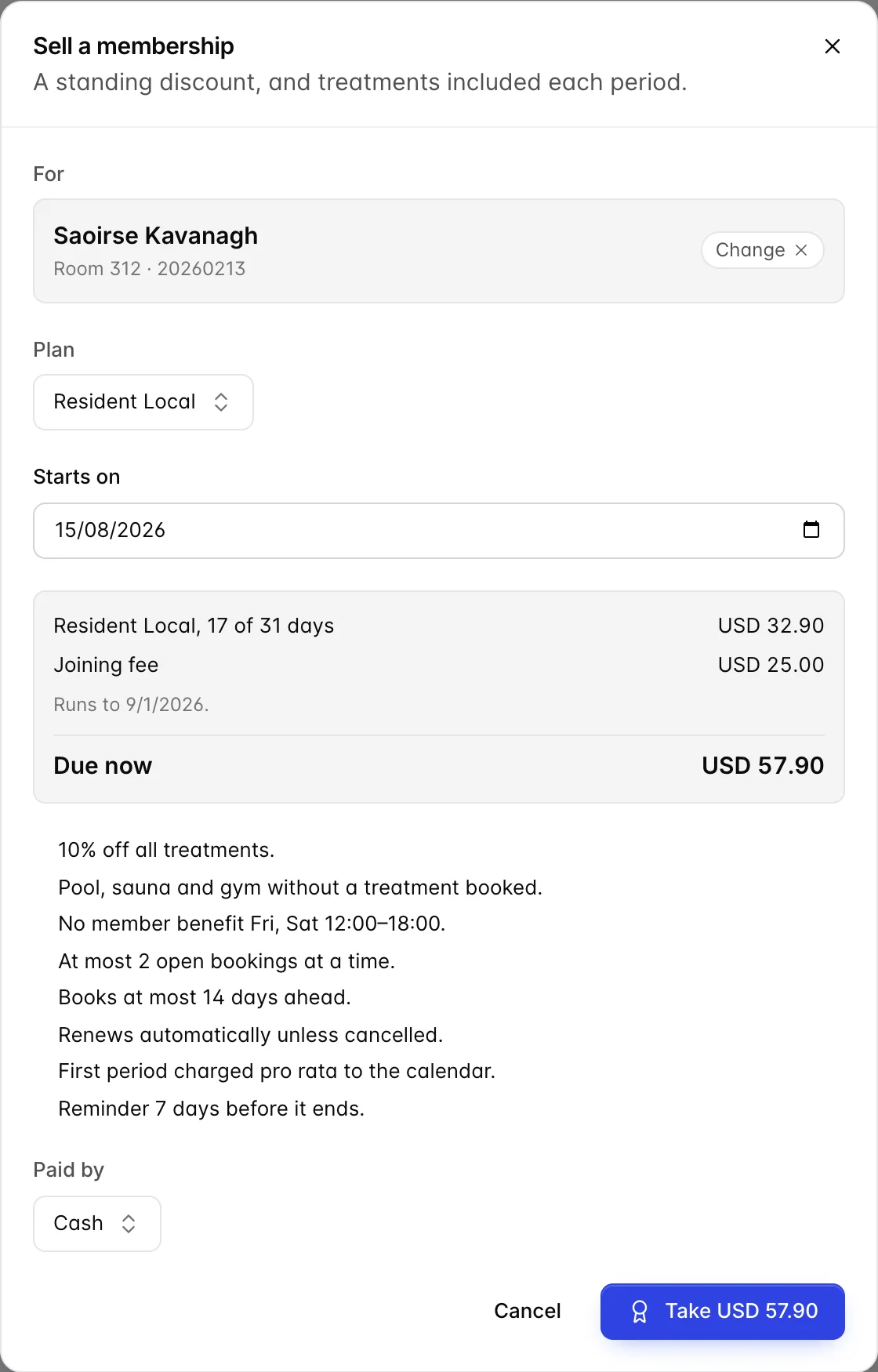
Sell a membership and Sell a course ask the same three questions: who, which one, and how they are paying. The guest can be somebody staying with you, somebody who has been before, or a name you type in on the spot.
What appears above the button is the whole of what they pay today, and on a plan that prorates it is not the dues figure. The first period is cut down to the days remaining in it, so the line reads as a fraction of a month, and the joining fee is added underneath. The hint below says when the membership runs to, and, if the plan has a minimum term, when the commitment ends and what leaving early costs.
Underneath the price, the plan is spelled out line by line: the discount, the facilities, any blackout, the booking limits, whether it renews by itself. Read it to the guest and you have described what they are buying without opening the plan editor.
Paid by takes cash or a card at the desk, or charges the whole thing to the room of a guest who is staying. Nothing about a membership is free to sell: the dues, the joining fee and a course all post as real charges the moment the sale is confirmed.
Reading the Members list
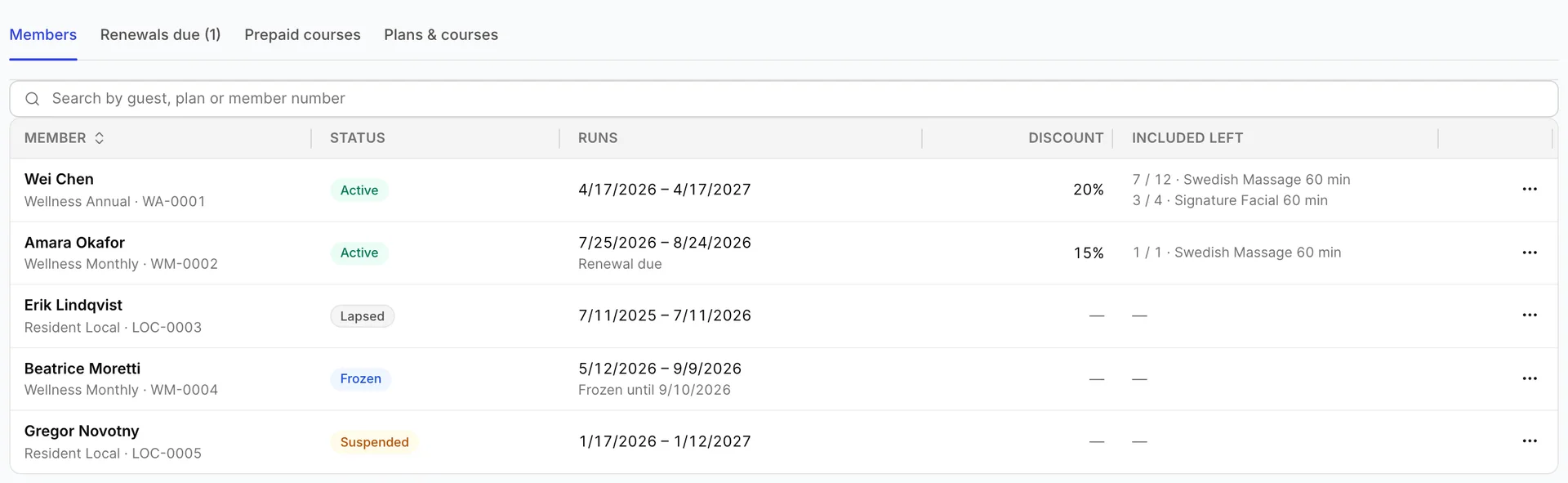
Five columns, and two of them are worth trusting more than you might expect.
Status is not simply what somebody last clicked. It is the stored status read together with today's date, which is the only way to get Lapsed: nobody cancels a membership by letting it run out, so a membership whose end date has passed has to be worked out rather than looked up. Before that reading went in, a membership that ended in the spring was still handing out its discount months later.
Discount and Included left show what the member is getting today, not what the plan says on paper. A lapsed, frozen or suspended row shows neither, which is the point: a row reading "10%" next to a Lapsed badge is exactly the confusion worth removing.
What a member gets when they book
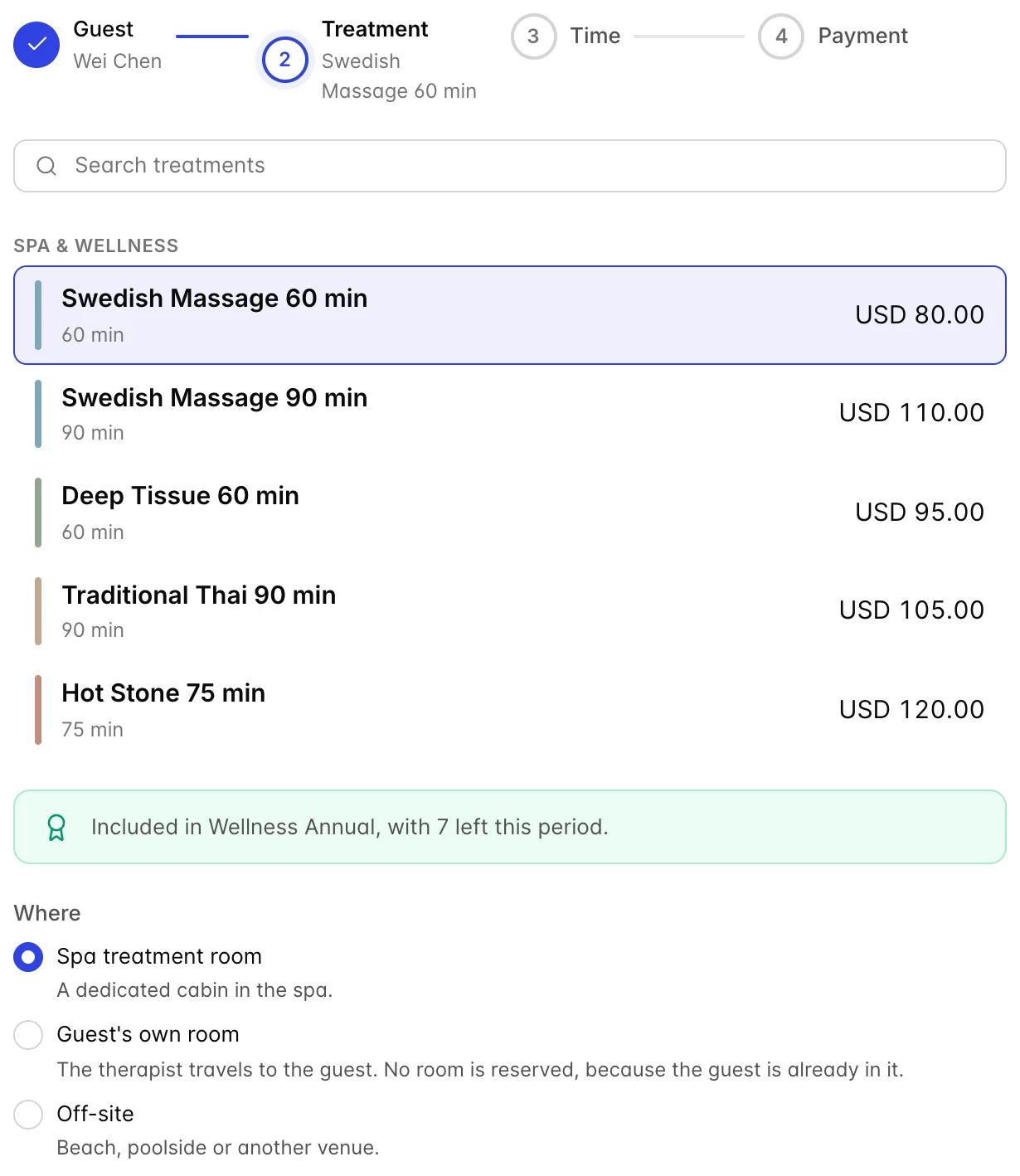
None of this is something the person taking the booking has to remember. Choose the guest, choose the treatment, and the wizard says what applies underneath the price: a course being drawn down, a treatment included this period, or a percentage off.
The payment step then follows it. On a treatment that costs the guest nothing, it counts down for you, reading "with 6 left after this one. Nothing will be posted", selects Already paid and greys out the other four answers. There is no way to book an included treatment and charge for it by accident.
The discount, when there is one, is folded into the price of the treatment line rather than posted as a separate negative line, so the folio reads at the price the guest was quoted. Who pays for a treatment covers what happens to that line afterwards.
The order benefits are applied in
When a guest has more than one thing going, the spa resolves it in a fixed order and stops at the first answer.
- A course balance for this exact treatment. It wins outright. The treatment is already bought, so a blackout has nothing to bite on and the membership discount is not needed.
- A blackout. If the member's benefits are blacked out at that time, nothing applies and the treatment is full price.
- An included treatment with some left this period. Free, and marked as already paid.
- The percentage discount. The fallback, and the only one that applies to everything rather than to a named treatment.
The first rule is the one that surprises people. A guest whose membership lapsed in July, who still has four of six massages left on a course they bought in June, books those four at no charge and gets no member discount on anything else. The course is not a membership benefit; it is a treatment they have already paid for.
Frozen, suspended, lapsed, cancelled
Four ways a membership stops counting, and they are not interchangeable.
| State | How it happens | How it ends |
|---|---|---|
| Frozen | Somebody freezes it from the row menu, for a number of days the plan allows. It is a date range, not a switch. | On its own, when the date passes, or immediately with Resume. The row says which date. |
| Suspended | A dues payment failed on a plan set to suspend when that happens. | Reinstate, once the money is sorted out. |
| Lapsed | The end date passed. Nobody did anything, which is the whole problem with it. | Renew, which moves the dates forward. |
| Cancelled | Deliberate, from the row menu, with a reason. | It does not. Sell a new one. |
Cancelling inside the minimum term says so before it commits, names the early exit fee and warns that the discount stops immediately. Nothing is refunded from that dialog, and treatments already taken are unaffected: a member who took two included massages this month and cancels today keeps the massages.
Renewals

Renewals due is the list of memberships inside their plan's reminder window, which is a number of days each plan sets for itself. A monthly plan reminding fourteen days out and an annual reminding thirty is a sensible pair, and it means the tab is a worklist rather than a wall.
The tab also shows whether each one is set to renew by itself. Renewing from here moves the dates forward and charges the dues; a membership left to lapse simply stops, and the guest finds out when their next treatment comes out at full price.
Where the money goes
Everything sold here posts as a real charge, to the folio or to a walk-in account settled on the spot, exactly like a treatment does.
- Dues post as one item, Spa Membership Dues, whichever plan they came from, so a month of memberships adds up in one place on the sales reports. The plan is named on the line, along with the day count when the period was charged pro rata.
- The joining fee is a second line of its own, Spa Membership Joining Fee, so what a spa earned from people joining is never mixed in with what it earned from them staying.
- A course posts once, at the price on the course, on the day it is sold.
- Redemptions post nothing at all. A treatment taken from a course or an allowance moves no money, because the money moved earlier. It still appears on the appointment and in the reports as a treatment given, which is what keeps therapist utilisation honest.
When a benefit does not appear
| What you see | What it usually is |
|---|---|
| Full price for somebody you know is a member | Check the status on the Members list rather than the plan. Lapsed, frozen and suspended all look like "not a member" to the booking wizard, and lapsed is the common one. |
| The discount applies to some treatments and not others | The plan limits it to named treatments or categories. |
| Full price at the weekend, member price midweek | A weekly blackout on the plan. |
| The course is not offered | It entitles the guest to one treatment. Check you are booking that exact item, and that the balance has not expired. |
| "Included" ran out mid-period | The allowance is per period. Roll-over, if the plan has it, is capped, so unused treatments do not accumulate forever. |
| The wizard will not let you finish the booking | A plan limit: too many bookings held at once, or too far ahead. The message names which. |