
A house account is the account a hotel opens when charges need somewhere to go and there is no guest in a room to attach them to. A dive group settling a week of boat trips, an agency running a familiarisation trip, a wedding planner tasting menus, a staff meal, a lost key charged back to a tour operator. Every property has them, most open them casually, and a surprising number never look at the balance again until the accountant asks why the receivables figure in the hotel accounting software has been climbing all year.
The mechanics are simple enough that the risk hides in plain sight. You open the account, charges accumulate, somebody promises to pay later, and later turns out to be a moving target. The controls that keep this from becoming bad debt are unglamorous and mostly happen before the first charge is posted. This article covers what a house account is, how it differs from the folio and the city ledger, who should be allowed to authorise one, what belongs on it, how to invoice and collect it, and where a property management system either helps or quietly makes it worse.
What a House Account Actually Is
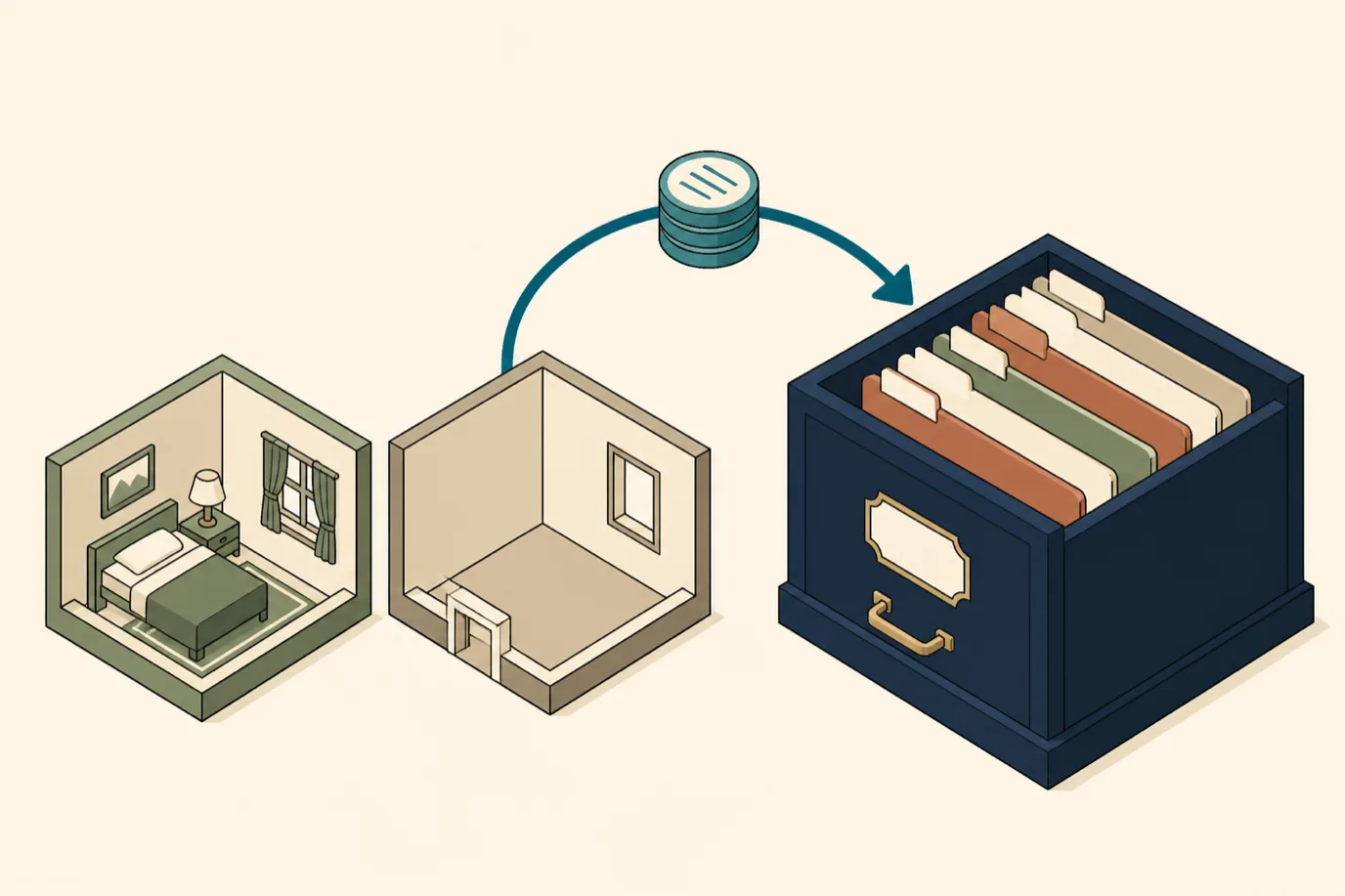
A house account is a billing account in the PMS that holds charges without a guest occupying a room. It works like a folio, with line items, taxes, payments and a running balance, but nobody is checked in against it and no occupancy statistic moves. When it closes, it either gets paid on the spot or becomes a receivable owed by whoever agreed to settle it.
The term causes confusion because the industry uses it for two related but different things, and vendors have never agreed on the wording. Oracle documents it as a house posting account, created from Bookings, then Reservations, then House Posting Account, and describes it as a pseudo, non-inventory room type reservation used for non-residential billing, internal administration and adjustments to checked-out reservations. There is even an option to mark one as always checked in, so it lives permanently. Other systems call the same idea a non-guest folio, a posting master or simply a house account. Meanwhile plenty of hotels say house account when what they mean is the company that gets invoiced monthly.
Both meanings share the important part. The charges exist, the room does not, and somebody outside the building has to pay. That combination is what makes house accounts worth controlling: they are the only place in a hotel where revenue can be created without a reservation, a check-in or a card on file.
If the wider vocabulary here is unfamiliar, the hotel terminology glossary defines the ledgers and the front office terms this article leans on.
House Account, Guest Folio and City Ledger
These three get used interchangeably in conversation and mean genuinely different things on a balance sheet. The distinction decides who chases the money.
| Guest folio | House account | City ledger | |
|---|---|---|---|
| What it is | One guest's running bill | One billing account with no room attached | The book of everything owed by non-residents |
| Is someone in a room? | Yes | No | No, they have left or never stayed |
| Who owns it | Front office | Front office while open | Accounts, usually the controller |
| Settled when | At checkout | When the account is closed | On invoice terms, after the fact |
| Sits in | Guest ledger | Guest ledger while open | Accounts receivable |
The movement between them is the part worth understanding. While a house account is open and unsettled, it sits with the guest ledger, which is the front office book. The moment it closes with a balance to be invoiced, that balance moves to the city ledger, which is your accounts receivable. In double entry that transfer is a debit to city ledger and a credit to guest ledger. No revenue is created or destroyed; responsibility simply moves from the front desk to accounts.
This is exactly where money gets lost. The transfer is a manual decision in most systems, and if nobody makes it, the balance sits in a front office ledger that the accounts team does not reconcile and the front office assumes somebody else owns. Balances that should have moved and did not are the single most common finding in a hotel receivables review, which is why the reconciliation playbook treats ledger transfers as a weekly check rather than a monthly one.
The Four Jobs a House Account Does
Most properties use house accounts for four distinct purposes, and the risk profile is different for each.
Non-resident revenue. Day guests, spa visitors, restaurant tabs run by locals, meeting rooms rented for an afternoon, a dive centre selling trips to people staying elsewhere. Real revenue, no room night. This is the cleanest use and the one that most obviously should not create a fake reservation, because a pseudo booking would distort occupancy, ADR and every derived figure. If you have ever wondered why your ADR moved without a rate decision, a colleague posting non-room revenue against a dummy reservation is one candidate. The same reasoning applies to day-use rooms, where the USALI 12th revised edition finally clarified the treatment.
Agency and wholesale billing. Tour operators, DMCs and wholesalers who send guests on vouchers and settle centrally, often monthly. The guest checks out owing nothing because the operator is paying a net rate. These accounts carry the largest balances and the longest terms, and they are the ones most likely to be disputed line by line. Anything sold through allotments tends to end up here.
Group and event masters. The master account that carries room and tax for a block while delegates pay their own extras, plus the banquet charges from the banquet event order. Group masters are where the largest single write-offs happen, because the charges land late, the organiser disputes the setup fee, and by the time it is resolved the event is a distant memory. Cutoff and attrition mechanics are covered in group block management, and the wider category in the MICE guide.
Internal and administrative. Staff meals, management entertainment, complimentary breakfasts for a service recovery, marketing hospitality, a rebate that needs somewhere to sit after a guest has already departed. These never get invoiced to anybody. They get coded to an expense account and their entire purpose is to keep non-revenue transactions out of guest folios where they would corrupt the revenue figures. Where these lines land in your chart of accounts determines whether your departmental profit means anything.
Mixing these four on one account is a common and expensive mistake. An account named after a company that carries staff meals, a comped breakfast and a genuine agency invoice cannot be sent to anybody, because a third of it is not theirs.
Deciding Who Gets to Pay Later
Opening a house account and granting credit are two different decisions, and hotels routinely collapse them into one. Anyone can open an account to hold charges. Only one person should be able to decide that the balance can leave the building unpaid.
The standard control is a credit application completed before arrival, not at checkout. It asks for the legal entity name, the registered address, a tax or VAT number, the billing contact with a direct email, a purchase order requirement if there is one, and trade references. It is approved by whoever owns collections: the financial controller in a larger property, the general manager in an independent. Approval sets two things in writing, a credit limit and payment terms, and both belong on the account record rather than in somebody's memory.
Three practical rules make the difference between a credit policy and a piece of paper.
The first is that front desk cannot grant credit. If a company arrives without an approved account, the guest pays and claims it back, or somebody with authority approves it on the spot and takes responsibility. This sounds harsh until you have watched a receptionist accept a business card as proof of a billing arrangement.
The second is that the credit limit has to do something. A limit that generates a warning nobody reads is decoration. It should trigger a decision when the account approaches it, mid-stay for a long group, and the decision is either a partial payment now or a stop on further posting.
The third is that terms mean the invoice date, not the departure date. Net 30 from an invoice you send three weeks late is really Net 51, and your collection period will show it. This is the quiet reason many hotels believe their customers pay slowly when the delay is actually inside their own billing.
For one-off bookers with no history, the answer is usually not credit at all. A deposit or a card guarantee handles the risk better and faster, and the trade-offs are set out in pre-authorisation versus deposits.
What Belongs on the Account, and What Does Not
Most billing disputes are not about the amount. They are about whether a line was ever supposed to be on the company's invoice. Companies agree to pay for a defined thing, usually room and tax, and then receive a bill including a minibar, three bar rounds and a pay-per-view charge.
The fix is routing decided before arrival, not argued after departure. In practice this means a split folio: room and tax to the house account, everything else to the guest's own card. Systems handle this in different ways. Some let you set a default payment type on the account so charges route automatically. Better implementations let you flag individual charge types as excluded from direct billing entirely, so a minibar posting cannot reach a company account even if somebody tries.
Write down what the account covers, per account, in a form the front desk can read at 11pm on a Saturday. A note field on the account is enough. It should answer: room only, room and breakfast, or room and all extras; whether city tax is billed to the company or the guest, which varies by municipality and is covered in the tourist tax guide; whether a purchase order number must appear on the invoice; and who signs off banquet charges.
The purchase order point deserves emphasis because it is invisible until it costs you a month. Many corporate clients will not pay an invoice that lacks a valid PO number, and they will not tell you, they will simply not pay it. Nobody chases, because the account is not yet overdue. By the time you call, you are 45 days in and the person who raised the PO has left.
No-show and cancellation charges are the other recurring fight. A company that agreed to pay for rooms did not necessarily agree to pay for a room its employee failed to use. Whether you can bill it comes down entirely to what the rate plan and the credit agreement said, which is the same logic set out in hotel no-shows and cancellation rules.
Where the Charges Go Missing
Revenue does not usually vanish from house accounts through fraud. It leaks through timing.
The classic case is the charge that arrives after the account closes. A restaurant posts a Saturday dinner on Monday morning, by which time the group master was settled and invoiced on Sunday. The charge now has nowhere to sit, and the path of least resistance is to write it off as a posting error. Outlet postings need to reach the folio the same day, which is a point of sale integration question rather than a discipline question. How that plumbing actually behaves is covered in POS to PMS charge posting.
Banquet charges are worse, because they are compiled by hand from a BEO after the event. Coffee breaks that were added on the day, the extra flip chart, the four bottles of wine the client authorised verbally at 10pm. If these are not captured within 24 hours, they are gone. Not disputed, gone, because nobody wrote them down.
The third leak is voided and adjusted lines. A charge posted to the wrong account, moved, then moved back, leaves a trail that has to be auditable. If your system lets a line be edited rather than voided and reposted, you have no defence in a dispute and no explanation for the controller.
The night audit is where these problems should surface, since it is the one routine that reconciles outlets against the PMS every single day. An audit that checks in-house folios but skips open house accounts is checking half the ledger. Making open house accounts a standing item on the audit checklist is a five-minute change that catches most of this, and it belongs in the night auditor's nightly sequence.
Closing the Account and Issuing the Invoice
Closing is a specific event, not a gradual fading away. The account stops accepting charges, the balance is agreed, and an invoice number is issued. After that, the balance is a receivable and belongs to accounts.
Conventional timing is the day of departure for individual and voucher accounts, and within about three working days for groups, which allows banquet charges to be verified without letting the trail go cold. Longer than that and two things happen: the client's memory of what was agreed fades, and your collection clock has already been running.
The invoice itself has more failure modes than most hoteliers expect. It needs the correct legal entity, not the trading name the salesperson used. It needs the tax treatment right, which for cross-border corporate business can mean a reverse charge rather than local VAT. It needs the PO number if one was required. It needs enough line detail to answer a query without a follow-up call, which usually means attaching the folio rather than sending a one-line total. And it needs to go to a billing address, not to the person who made the booking, because those are rarely the same inbox.
From 2026 this stops being a matter of preference in much of Europe. France, Germany and Italy are phasing in structured electronic invoicing for business-to-business transactions, which means a PDF attached to an email will not satisfy the requirement. Any hotel with corporate accounts in those markets needs its invoices to leave the building in a machine-readable format, on a defined schedule, with archiving. The detail and the dates are in the e-invoicing mandates guide. If your house account process ends with somebody exporting a PDF and attaching it to Outlook, that is the process that has to change first.
Aging, and What Each Bucket Is Worth
An aged trial balance sorts every open invoice by how long it has been outstanding. It is the single most useful report in hotel receivables and the one most often run monthly when it should be run weekly.
The buckets are conventional: not yet due, 1 to 30 days, 31 to 60, 61 to 90, and over 90. What matters is that they are not equally valuable. Commercial credit data consistently shows collection probability falling off a cliff with age, and the pattern is stable enough across industries to plan around.
| Age of balance | Typical write-off rate | What it means for you |
|---|---|---|
| 0 to 30 days | 1 to 2 percent | Normal. A reminder is admin, not collections. |
| 31 to 60 days | 3 to 5 percent | Something is wrong. Usually a missing PO or a disputed line. |
| 61 to 90 days | 8 to 12 percent | Escalate to a named person. Stop extending new credit. |
| 91 to 120 days | 25 to 40 percent | Collection is now genuinely at risk. Formal demand. |
| Over 120 days | 40 to 60 percent | Assume half is gone. Decide between legal action and write-off. |
Two working targets follow from this. Keep the over-90 bucket below roughly 15 percent of total receivables, and treat anything above 20 percent as a signal that collections has stopped functioning rather than that customers have become difficult. And keep days sales outstanding within about 10 to 15 days of your stated terms. If you invoice on Net 30 and your DSO is 44, that is normal friction. If it is 71, your problem is upstream of the customer, usually in how long invoices take to leave.
The figures above come from general commercial credit benchmarks rather than hotel-specific published data, which is thin. The direction is what matters and it is not controversial: the age of a balance predicts whether you will collect it far better than the size of the balance or the size of the customer.

A Collection Schedule That Actually Works
Collections fails when it is somebody's job in principle and nobody's job on Tuesday. A fixed schedule, attached to named people, outperforms good intentions by a wide margin.
- Day 0, invoice issued. Sent to the billing contact, folio attached, PO number on it. Confirm it arrived rather than assuming it did.
- Day 7, delivery check. A short email confirming the invoice is in their system and approved for payment. This one step catches missing PO numbers and wrong entities while they are still trivial to fix.
- Day 30, terms reached. Polite reminder, statement of the account attached, showing every open item rather than just the one invoice.
- Day 45, a phone call. Not an email. You are looking for a specific reason and a specific promised date, and you write both down.
- Day 60, escalate. Your GM or controller to their finance manager. New bookings on credit stop here, which is the moment the conversation usually becomes productive.
- Day 90, formal demand. Written, referencing the credit agreement and any interest clause. Decide now whether this goes to a collections agency.
Two details do most of the work. Send statements, not just invoice copies, because a statement shows the customer everything open at once and prevents the game of paying the most recent invoice while three older ones sit forgotten. And make the day 7 check non-negotiable. Almost every 90-day balance was, at day 7, a problem somebody could have fixed in five minutes.
The interest clause is worth knowing about even if you rarely invoke it. In the EU, the Late Payment Directive gives businesses a statutory right to interest and a fixed recovery amount on overdue commercial invoices, and most member states have equivalents in national law. Most hotels raise it in the day 60 conversation rather than actually issuing an interest invoice. It only works if the right to charge it was in the signed credit terms.
Knowing When to Stop Chasing
Every hotel has a receivables list containing balances from three years ago that nobody will ever collect and nobody will admit are dead. They sit there because writing them off requires someone to say out loud that the money is gone.
Carrying them has real costs. Your receivables figure overstates the asset, which flatters the balance sheet and misleads anyone valuing the business. Your aging report becomes unreadable, because a permanent tail of ancient balances buries the recent ones that could still be collected. And your collections effort gets spread across accounts with no realistic prospect instead of the ones at day 45.
A workable policy has three parts. Set a threshold below which chasing costs more than the balance, and be honest that for most hotels this sits somewhere between 50 and 150 in local currency once you count the staff time. Set a review point, usually 180 days, at which every remaining balance is individually assessed and either escalated, settled at a discount, or written off. And require approval for the write-off itself at a level above the person who granted the credit, because otherwise the control loop is closed by the same hand at both ends.
Under accrual accounting you should also be carrying a provision for doubtful debts rather than recognising the loss only at write-off, which is what auditors testing balances over 60 days will look for. The broader treatment sits in hospitality accounting, and the reporting standard that governs how any of it appears in your departmental accounts is covered in USALI explained.
Write-offs also feed back into credit policy, which is the part most hotels skip. A customer whose balance you wrote off should not be able to open a new account next season without someone senior knowing the history.
What Your PMS Should Be Doing Here
House accounts expose the difference between a system that stores data and one that enforces a process. When you are evaluating a PMS, or working out why the current one is not helping, these are the capabilities that matter.
It should let you open an account without a reservation. If the only way to hold non-room charges is to create a dummy booking, your occupancy and ADR are being polluted by an accounting workaround, and every derived metric inherits the error.
It should hold a credit limit and payment terms on the account and act on them, at minimum by warning at the point of posting. It should keep an auditable ledger where lines are voided rather than edited. It should route charges by rule, so room and tax reach the company while extras stay with the guest, and it should let you exclude charge types from company billing entirely.
It should issue an invoice number once, on close, and not renumber if the account is reopened, because renumbering breaks the audit trail and confuses the customer's accounts payable team. It should produce an aged balance view without an export to a spreadsheet, and it should generate statements rather than only invoice copies. Anything that requires a manual export becomes a monthly task, and monthly is not often enough.
Finally it should reconcile. Open house accounts belong in the night audit, and the total of open accounts plus in-house folios should tie to the guest ledger figure every night. Where hotels run several properties, the same discipline has to work across all of them, which is a common weak point in multi-property setups where each property invents its own account naming.
Prostay implements this under Reservations, then House Accounts, and it is worth walking through because it shows what the checklist above looks like in practice. You open an account with a name, a contact, an optional company, a credit limit and a payment due date. There is no reservation behind it and no room is consumed, so a week of dive trips sold to people staying down the road never touches your occupancy or your ADR.
Charges post from the same product catalogue the front desk already uses, so a house account line and a folio line are the same kind of object with the same tax treatment. Payments are recorded as either a payment against charges or a deposit taken up front, by cash, card or bank transfer, which keeps the two apart in the numbers instead of blurring them into one payments total. The account carries a running ledger showing date, description, quantity, charge and payment for every line, and it tells you whether the account is in credit or has a balance due.
Two details matter more than they look. Going over the credit limit raises a warning rather than blocking the posting, which is the right default: the person who should decide whether to keep serving a group at 11pm is a manager, not a validation rule. And closing the account issues an invoice number once. Reopen it to add a late banquet charge and close it again, and the number does not change, so your audit trail and the customer's accounts payable file still agree. A postings report totals what was charged and collected across a date range and breaks open balances into not yet due, 1 to 30, 31 to 60, 61 to 90 and over 90 days, exportable to CSV, which is the aged view the collection schedule above runs on.
The Controls That Prevent Most of This
None of this requires a finance department. It requires about six habits, most of which cost minutes rather than money.
Approve credit before arrival, in writing, with a limit and terms, and keep that approval away from the people taking bookings. Record on the account what it covers and what it does not, in language the front desk can act on at midnight. Close accounts on a schedule, same day for individuals and within three days for groups, so charges are captured while they can still be verified. Invoice immediately on close, to the right legal entity, with the folio attached and any PO number in place.
Then run the aged trial balance weekly and look at it with someone who has authority to act. Chase on the day 7, 30, 45, 60 and 90 rhythm rather than when someone remembers. And review anything past 180 days properly, with a decision at the end of it rather than another month of hoping.
The pattern behind all of it is the same. House accounts fail slowly and quietly, and every control above is really a mechanism for making the failure visible early, while somebody can still pick up a phone and fix it in five minutes. Left alone, a house account is just a place where revenue goes to become a question nobody wants to ask.