Here is a number worth sitting with: in most hotels, somewhere between a fifth and a third of all energy is spent conditioning spaces nobody is in. Unsold rooms held at comfort temperature all winter. Empty conference rooms cooled through August. Corridors lit like operating theatres at four in the morning for no one. The utility bill that lands every month, typically 3 to 6 percent of revenue and the second-largest controllable cost after payroll, quietly includes all of it, and because the waste is invisible, nobody fights it. A guest complains when the shower runs cold; no guest has ever complained that floor three was heated for nobody all of February.
This guide is about attacking that bill the operator's way: measurement first, the free operational wins second, capital spending last and only where it pays. The single most powerful tool in the whole program is one your property already owns, the occupancy data in your property management system, because a hotel that knows exactly which rooms are sold tonight and which floors are empty next week can run its building to match, instead of running everything everywhere at full comfort out of habit. And because half of energy discipline is coordination, housekeeping reporting the radiator left roaring in a checkout, maintenance actually closing the loop, a shared operations channel like Prostay Nexus is where the daily version of this program lives. No lectures about the planet follow; this is a cost article. The planet benefits anyway.
The Second-Largest Cost Nobody Owns
Energy has a strange status on the hotel P&L. Labor has a manager arguing about it weekly. OTA commissions have a revenue meeting dedicated to shrinking them. Energy has a direct debit. It arrives aggregated, a month late, in units nobody on the team thinks in, and it gets filed under fixed costs, which is exactly what it is not: energy is a variable cost wearing a fixed cost's clothes, and treating it as weather rather than as decisions is why it drifts upward year after year.
The ownership gap is structural. The general manager sees the bill but not the building; maintenance sees the building but not the bill; housekeeping touches every room every day and is asked about none of it. The first move of any energy program is therefore organisational, not technical: one named person owns the number, sees the bills, walks the building, and reports the trend monthly alongside occupancy and payroll. At a small property that is the owner or GM with two hours a month; at a larger one it is a real part of the maintenance manager's job description. Everything else in this article fails without this step, because savings that nobody monitors evaporate within two seasons, a pattern so common in the industry it has a name: snapback.
Measure First: Energy per Occupied Room and the Baseline
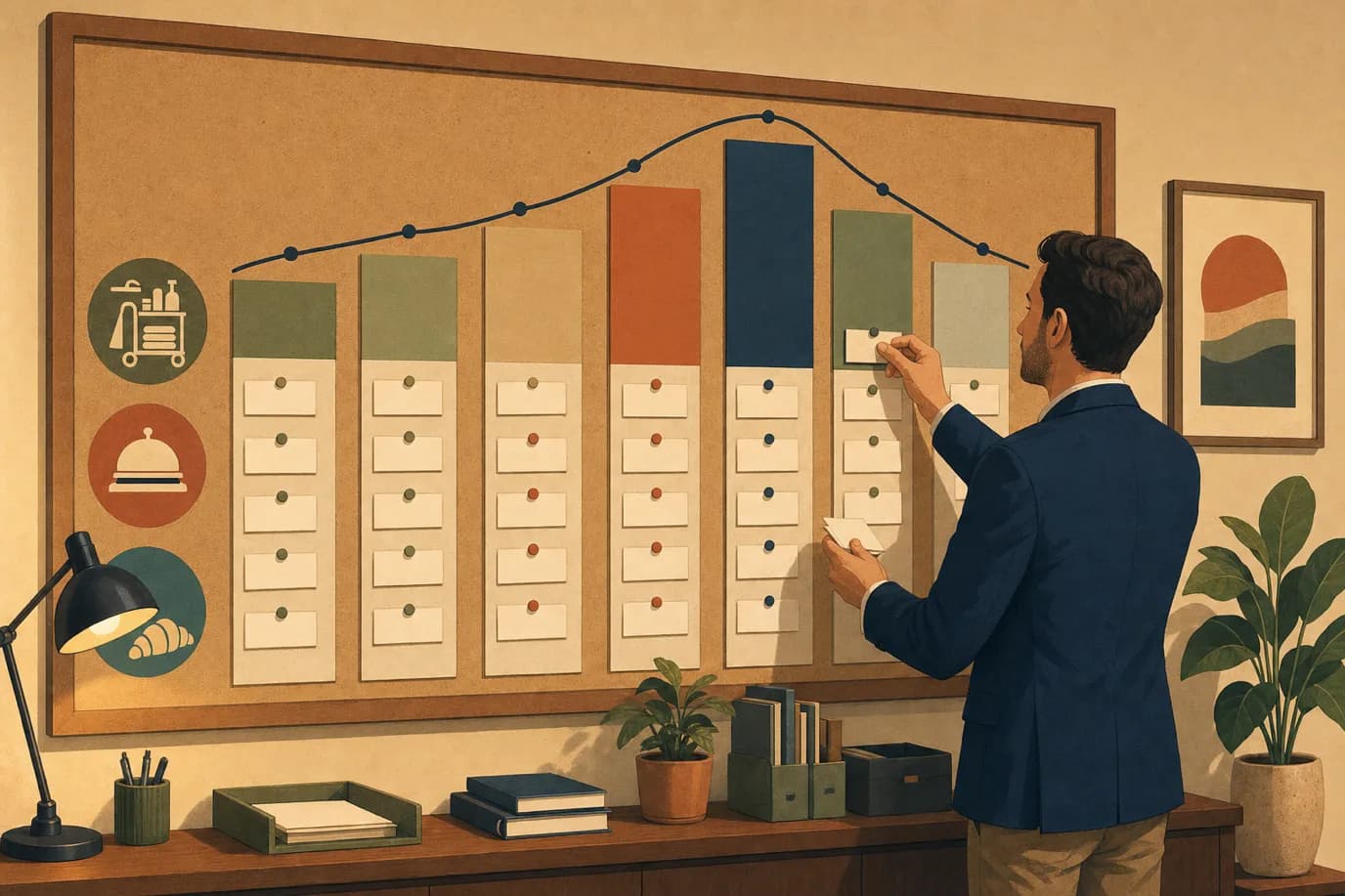
You cannot manage a number you have never computed. Pull twelve months of utility bills, electricity, gas, oil, district heat, water while you are at it, and build the baseline: total consumption and total cost by month, laid against occupied room-nights from the PMS. Two numbers fall out. Energy cost per occupied room, typically somewhere between 5 and 15 euros per room-night for full-service properties, is your headline: it makes the invisible bill concrete, comparable and trackable. And the monthly shape tells you how much of your consumption is occupancy-driven versus baseline: a hotel whose January consumption at 30 percent occupancy is barely below its August consumption at 90 percent has just learned that most of its energy does not follow guests at all, which is another way of saying most of it is negotiable.
If the building has a single meter, that is fine for the start; the bills plus the PMS give you more insight than most properties ever assemble. As the program matures, submetering the big consumers, kitchen, laundry, pool, spa, one guest floor as a sample, converts arguments into data. But do not let metering ambitions delay the start: the baseline spreadsheet is an afternoon's work, and it is the afternoon that makes every later decision possible, including the decision about what not to bother with.
While the bills are on the table, read the tariff, because some of the cheapest savings involve no building work at all. Many properties sit on contracts renewed by inertia at rates a competitive quote would beat, and an hour with a broker or a comparison exercise at renewal is often worth several points of the annual bill. Check the structure too: commercial tariffs frequently include peak demand charges, where the single highest half-hour of the month sets a fee, and a hotel that fires laundry, kitchen prep and pool heating simultaneously at nine a.m. is paying for a peak that simple sequencing would flatten. Time-of-use rates reward shifting flexible loads, laundry above all, into cheap hours. None of this changes what the building consumes; it changes what the consumption costs, which the P&L finds equally interesting.
Where the Energy Actually Goes: The Big Four
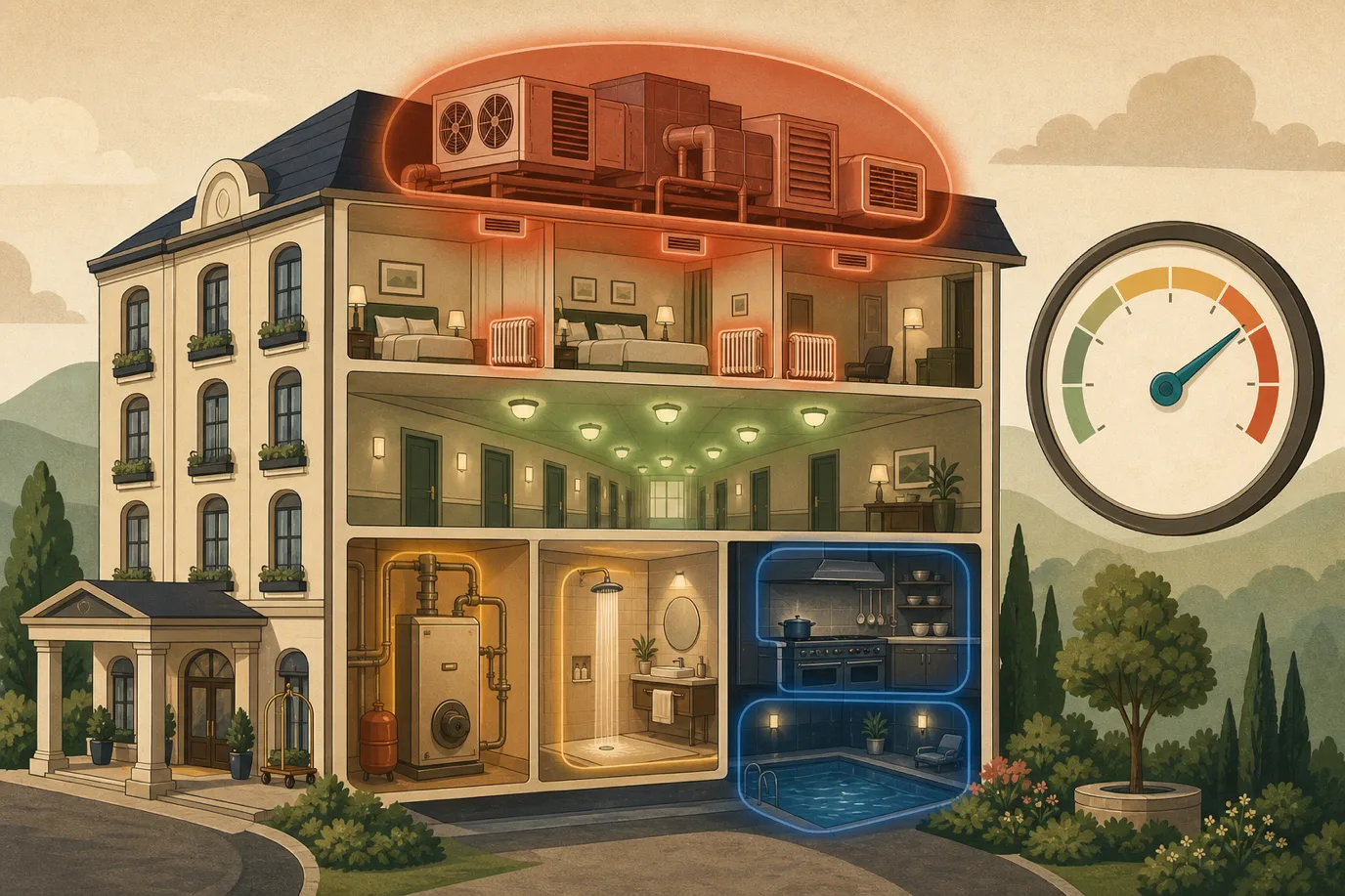
Hotel energy splits into a remarkably consistent pattern. Heating, ventilation and air conditioning take the biggest share, typically 40 to 50 percent, which is why everything in the next two sections is about them. Domestic hot water runs 15 to 25 percent, driven by showers, and by laundry if it is done in-house. Lighting takes 10 to 20 percent, less if the LED conversion is finished, more if it is not. The remainder belongs to the specialists: kitchen equipment, refrigeration, pools and spas (ferocious consumers for their size), lifts, and the quiet swarm of always-on devices from minibars to corridor vending.
The split sets the strategy. A property that has not addressed HVAC control has no business starting anywhere else, because a 10 percent improvement on half the bill beats a 50 percent improvement on a twentieth of it. It also explains why the glamorous measures are usually the wrong first measures: solar panels photograph beautifully on the roof of a building that is still heating empty floors, and the panels will spend their first years powering the waste.
Run the Building by Occupancy, Not by Habit
Here is the core idea of modern hotel energy management, and it costs nothing: the PMS knows the future. It knows tonight's sold rooms, tomorrow's arrivals, next week's dead Tuesday and next month's 40 percent January. The building, meanwhile, is usually run as if every night were a full house, because the boiler schedule was set years ago and nobody told it about seasonality. Closing that gap between what the PMS knows and what the building does is worth more than any single piece of equipment you can buy.
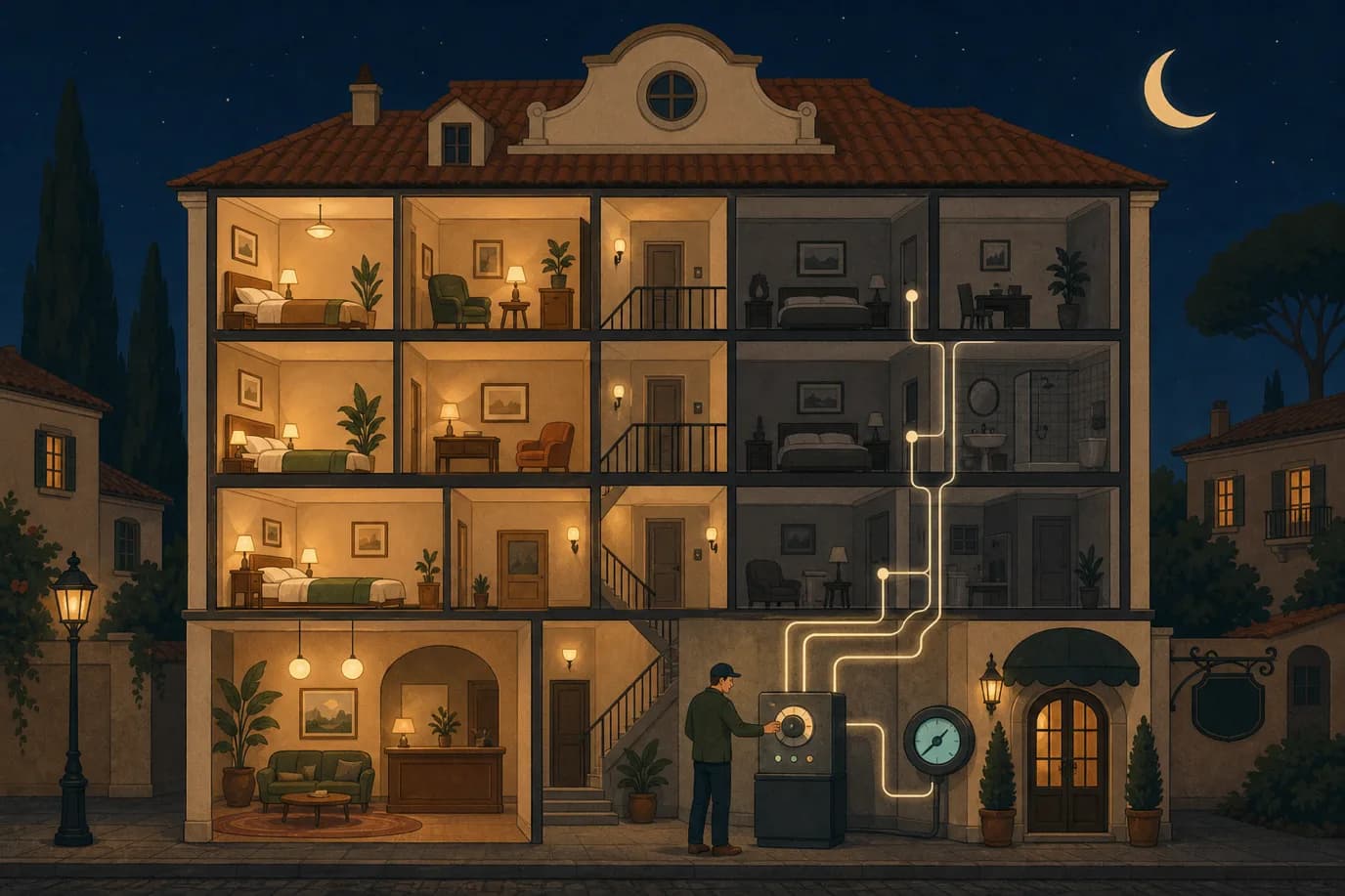
The practical moves scale with property size. Unsold rooms get set back, not switched off: a few degrees below comfort in winter, above in summer, far enough to save meaningfully, close enough to recover in the hour before an arrival. Empty floors and wings in the low season get closed properly, heating to protection levels only, hot water loops isolated, corridor conditioning minimised, and the rooms taken out of sale in the PMS so the two systems agree. Function spaces get conditioned when booked, not by default; the banqueting calendar should drive the ballroom's climate the way the room calendar drives the floors. None of this touches a single guest, which is the whole point: the program's first law is that comfort in sold spaces is untouchable, and everything else is negotiable.
Room Assignment as an Energy Decision
The subtlest free win lives at the front desk. At 40 percent occupancy, forty rooms scattered randomly across four floors force the whole building to run; the same forty rooms clustered on two floors let the other two idle at setback. Room assignment is usually made for operational convenience or guest preference, and both should keep winning where they apply, but the tiebreaker default, fill by floor, fill by wing, keep the top floor closed until the house needs it, costs the desk nothing and compounds nightly through the shoulder seasons. The same logic applies across the week: holding Monday-to-Wednesday arrivals toward the same wing keeps the building's conditioned footprint matched to its sold footprint. It is the kind of measure that sounds too small to matter until you multiply it by three hundred nights.
The pushback is always the same, and worth answering: does clustering not wear some rooms faster than others? It does, and the fix belongs in the same configuration, a rotation rule that shifts the preferred wing seasonally or monthly, so the building fills efficiently on any given night while the year's wear still spreads across the whole inventory. The desk keeps its overrides for the guest who loves room 412 and the regular who wants quiet; the default simply stops scattering forty guests across a building sized for a hundred and sixty.
HVAC: Setpoints, Setbacks and the Maintenance Dividend
Inside the sold rooms and public areas, the wins are about discipline rather than sacrifice. Setpoints drift: a lobby set to 21 in some forgotten winter stays at 21 through July afternoons, and every degree of unnecessary heating or cooling costs roughly 5 to 8 percent of the space's HVAC energy. Audit every thermostat in the building once, write the agreed setpoints down, and restrict who can change them; guest rooms can offer a comfortable adjustment band without granting the power to run the window open and the heating at maximum simultaneously, the classic February special.
Then there is maintenance, the least glamorous and most reliable energy investment in hospitality. Clogged filters make every fan work harder; scaled boiler surfaces transfer heat worse every month; failed door seals on walk-in fridges run the compressors continuously; unbalanced systems heat one wing to complaints while cooling another to complaints. A property with a real preventive maintenance rhythm, filters on schedule, coils cleaned, systems rebalanced, boilers serviced before the season, routinely runs 10 to 15 percent leaner on HVAC than the same building maintained reactively, and the same visits reduce the guest-facing failures that show up in reviews. If the maintenance calendar lives where operations can see it and soft weeks are used for the disruptive jobs, the energy program and the maintenance program become the same program, which is exactly what they should be.
The Quick Wins: Lighting, Hot Water and Laundry
Lighting first, because it is the easiest cheque to cash: if any meaningful share of the building is still on halogen or fluorescent, the LED conversion typically pays for itself within a year or two and improves the spaces while doing it, warmer scenes in the lobby, better colour in the bathrooms. Pair it with controls where people do not linger: occupancy sensors in back-of-house corridors, stairwells, storerooms and staff areas, daylight sensors where glazing does the morning's work, timers on facade and signage lighting that respect closing time. The four a.m. corridor deserves light when someone walks it, not before.
Hot water and laundry are one system wearing two uniforms. On the water side: sane storage temperatures that respect legionella rules without boiling the tank, insulated pipes and loops (an afternoon of pipe lagging is one of the highest-return jobs in the building), low-flow showerheads good enough that guests never notice, and leak discipline, because a dripping hot tap is paying for water and the energy inside it. On the laundry side: full loads only, lower-temperature programs where hygiene standards allow, heat recovery on commercial machines if volume justifies it, and the towel and linen reuse program run honestly, actually skipping the wash when the guest opts in, which a surprising number of properties fail to do. Reuse programs cut laundry loads meaningfully when they are real, and guests accept them as normal; what they notice is when the card on the towel rail is theatre.
If the property has a pool or spa, it deserves its own line in the program, because water is the most expensive thing in the building to keep warm. A pool cover used religiously overnight cuts the pool's heating load dramatically, evaporation being the main thief, and it is routinely the highest-return hundred euros in the whole energy plan. Beyond the cover: sane water temperatures held to the standard rather than nudged upward after one complaint, circulation pumps on schedules or variable-speed drives instead of running flat out around the clock, spa facilities heated for their opening hours rather than for the possibility of them, and saunas on timers that match actual demand patterns instead of glowing all day for two evening users. Wellness areas earn their energy when guests are in them; the discipline is simply refusing to condition the fantasy of guests who are not.
The Night Walk: The Cheapest Energy Audit Available
Before hiring anyone to audit anything, do this: walk the entire building at two in the morning with a notepad. Every light that is on, ask why. Every sound of running equipment, ask what it serves at this hour. Touch the radiators in the empty meeting rooms, feel the air conditioning in the closed restaurant, check the kitchen's heat lamps and extraction running over no food, find the storeroom that has been heated since the building opened for the benefit of the spare mattresses. The night walk is where the building confesses. Most properties that do it for the first time come back with a list that cuts consumption noticeably using nothing but switches, schedules and two hours of a manager's insomnia, and repeating it quarterly keeps the building honest, because waste regrows in the dark like everything else.

When to Spend Money: Capital Upgrades That Pay Back
Only after the free tier is exhausted does spending make sense, and the ladder orders itself by payback. Smart thermostats and networked room controls, occupancy sensing plus PMS integration so unsold rooms set back automatically, typically return their cost in two to four years and remove the human diligence the manual version depends on. Heat pumps replacing fossil boilers are the decade's big structural move: paybacks vary with tariffs and climate, three to eight years is the honest range, and subsidy programs in many countries shorten it materially, but the retrofit needs engineering, not enthusiasm, especially around hot water demand peaks. Solar makes straightforward sense on properties with big daytime loads, pools, spas, all-day F&B, and roof to spare. Building management systems earn their keep from roughly mid-size properties upward, with the caveat every consultant whispers: a BMS nobody on staff understands becomes an expensive way to automate the old waste. Whatever the investment, write the expected saving down before signing, then hold the monthly review to it after; capital projects measured against their own promises stay honest, and the ones that are never measured never pay.
Staff Habits and Guest Communication Without the Preaching
The human layer decides whether any of this persists. Housekeeping is your sensor network: thirty rooms a day per attendant, every radiator touched, every window checked, every bathroom leak seen first, and a one-line reporting habit, radiator roaring in 204, window left open in a checkout, seal failing on the third-floor ice machine, feeds maintenance better than any dashboard. The desk owns the clustering default and the function-space schedule. The kitchen owns startup discipline, because firing every appliance at seven for a service that starts at twelve is the culinary version of heating the empty floor. None of this needs a culture program; it needs the expectations written into the routines the teams already run, and it needs the monthly number shared, because teams that see the energy-per-occupied-room trend fall treat it as a game worth winning, especially if a slice of the saving funds something they want.
With guests, the rule is quiet competence. State the reuse program plainly and honour it. Keep the sustainability claims to things actually done, certifications where they exist, and let the building itself argue the case: rooms that feel fresh, showers that run hot instantly, corridors lit warmly rather than glaringly. What guests punish is the cost cut cosplaying as environmentalism, the stingy heating described as green, the removed amenity celebrated as planet-saving. If a measure degrades the stay, it fails this article's first law and it will fail in the reviews too.
The Monthly Review: Keeping the Savings Won
The entire program compresses into one recurring meeting: fifteen minutes, once a month, the owner of the number presenting three lines, consumption against the same month last year, energy per occupied room against trend, and the status of the current fix list. Weather-adjust mentally or with degree-day data so a cold January does not read as failure, celebrate what fell, and assign what crept back. Savings unmonitored regress to habit within two seasons; savings reviewed monthly compound instead, because every review surfaces the next small item, and the list, remarkably, never quite empties.
Where Prostay Fits
Occupancy-driven building operation stands on data quality, and the data is the PMS's native product. Prostay knows tonight's house, tomorrow's arrivals and next month's forecast, which is exactly the information the setback schedules, floor-closing decisions and function-space conditioning feed on; the same occupancy forecast that drives your housekeeping roster is the one that should drive the boiler's ambitions. Room status flows both ways: rooms taken out of sale for a closed wing stay honest in the inventory, and the desk's cluster-by-floor assignment habit is a configuration, not a memory exercise. The coordination layer runs through Prostay Nexus, where housekeeping's radiator-roaring-in-204 note becomes a maintenance task with an owner instead of a corridor conversation, and where the monthly number can land where every department head actually reads. Energy management is a data-plus-discipline program, and the software's job is to supply the data and carry the discipline.
The utility bill will never be glamorous, and that is precisely its charm as a project: no OTA can commission it away, no competitor can undercut it, and every euro it shrinks drops straight to the bottom line at one hundred percent margin. Compute the number, walk the building at two a.m., let the PMS tell the boiler what is actually sold, and review the trend monthly. The second-largest controllable cost responds to control, and most hotels have simply never applied any.