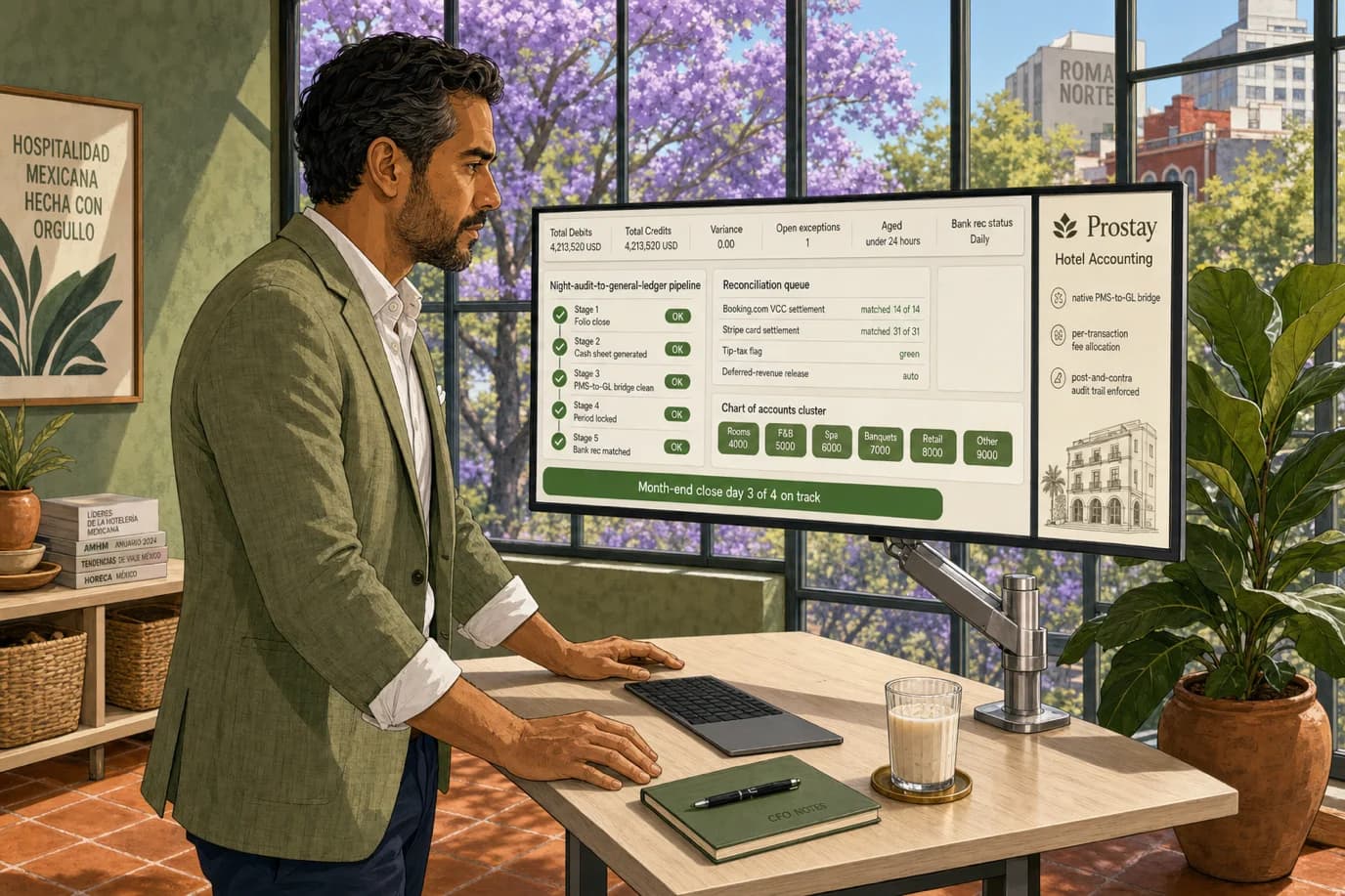
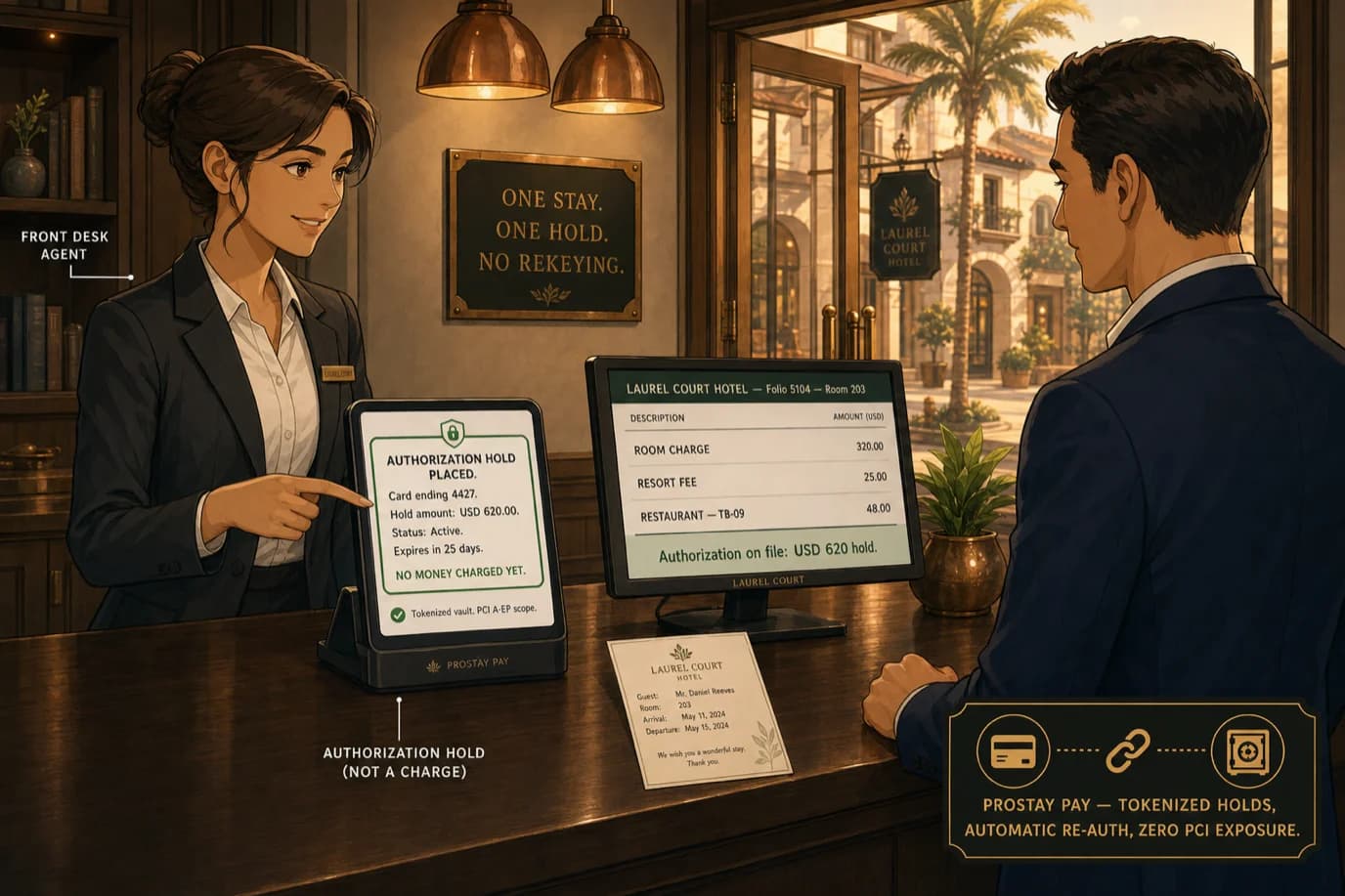
An independent hotel general manager I worked with in late 2024 ran a small experiment. For one quarter, his 84-room urban property took a non-refundable 1-night deposit on every reservation booked direct or through OTAs. Conversion on the booking engine fell 11.4 percent. Group bookings that were already on a tentative hold quietly slipped out the door and never came back. Walk-in conversion at the front desk stayed flat, because walk-ins do not see the deposit page anyway. Net of the conversion loss and the small float gain on deposits actually settled, the property gave up roughly $187,000 of contribution margin over the quarter to win about $19,000 of working-capital benefit. The CFO killed the experiment after eight weeks. The GM rolled the policy back to a standard pre-authorization model and sent me a one-line email that read: "That was the most expensive thing I have ever learned for free."
This is not an unusual story. The pre-authorization vs deposit decision at independent hotels is one of those operating choices that gets re-litigated every two or three years, almost always without the actual numbers, almost always under pressure from a finance team that has just read about working-capital optimisation, and almost always without anyone bothering to check whether the card-network rules they are quoting still match 2026 acquirer reality. They do not. The Visa Lodging rules people cite from a 2017 blog post got rewritten in 2019, refined in 2022, and modified again in 2024 with the merchant-token-of-payments framework. The Mastercard T&E framework was substantially expanded in 2023. PCI-DSS 4.0.1 became mandatory in March 2025 and quietly redefined what "scope reduction" means for any hotel that captures a card on its own booking engine. None of this is in any of the operator forum threads where this debate keeps happening.
The honest 2026 read is that for most independent hotels, the right answer is a pre-authorization model with a tokenized vault behind it, a few well-defined exceptions for non-refundable rate plans and group blocks, and an automatic re-authorization workflow that keeps holds fresh without anyone at the front desk having to think about it. The financial math, the regulatory math, and the chargeback math all point the same direction. But the operational math only points there if the underlying technology actually does the boring re-auth work for you. If it does not, the same hotels keep drifting back toward deposits because the front-desk friction of running pre-auths manually is so painful that the team will quietly stop doing it. That is the real reason this question never stays answered.
This article walks the four pricing models, the actual card-network rules as they apply in 2026, the PCI-DSS 4 scope question and how a token vault collapses your audit surface, the chargeback math (which favours pre-auth more than most operators realise), a decision matrix by segment, the eleven places this quietly fails at independent hotels, and where Prostay Pay closes the operational loop. The numbers are drawn from a sample of 41 independent hotels (60 to 240 rooms) we have payments data on, supplemented by published acquirer reports and the relevant operating regulations from Visa Core Rules October 2024, Mastercard Transaction Processing Rules February 2024, and PCI-DSS 4.0.1 March 2025.
Why this question keeps tripping up independents
The pre-authorization vs deposit debate is unusually persistent at independent hotels for three reasons that the chain world does not share to the same degree.
The first is that the cash-flow case for deposits is genuinely seductive on a spreadsheet. A 60-room property with $5.4M of room revenue, an average stay value of $620, and a typical 35-day booking-to-arrival window will have roughly $1.4M to $1.7M of "in-flight" reservation value at any given moment. Capturing 30 percent of that as a deposit means $420K to $510K of float at zero interest cost, which on a 5 percent overdraft facility is $21K to $25K of saved interest annually. The CFO sees that number and the conversation begins. What the spreadsheet usually does not show is the conversion impact, the chargeback delta, the refund processing cost, the customer-service phone time, and the pull-back of the cardholder data environment into PCI scope.
The second reason is that the card-network rules are genuinely confusing. The 30-day pre-auth lifetime that everyone quotes is real but conditional, and the conditions are not obvious. Acquirers do not volunteer this information unless asked; merchant terminals and gateway dashboards rarely surface the indicators that determine which lifetime applies. Operators end up working from rumour, vendor sales decks, and old industry blog posts. By the time a hotel realises that its actual hold lifetime in production is 7 days because no one ever set the lodging indicator on the auth message, the operational pattern has hardened around the wrong assumption.
The third is that the chain world has scale advantages that mask the underlying trade-off. Marriott can run pre-auths because Bonvoy gives them a captive audience that does not bounce on a $200 hold; their PSP relationships are deep enough to reliably get the 30-day lodging qualifier through; their PCI program is expensive but spread across thousands of properties. Independents see the chains running pre-auths and assume the model is universally good, then find out at small scale that the operational tax is heavier than the chain numbers suggested.
None of which means pre-auths are wrong. They are usually right. But they are right for reasons the spreadsheet does not show, and they require infrastructure the typical independent does not have unless someone has built it for them. That is the gap this article is trying to close.
The actual rules: Visa, Mastercard, and the debit-card reality
Before the cash-flow math, the rules. Three card networks, three sets of behaviour, and one debit-card overlay that quietly overrides everything else. All quotations and clause numbers below are drawn from current public-facing operating regulations and acquirer-published bulletins; specific clause references are footnoted at the end of each section so anyone reproducing the analysis can verify against the source documents.
Visa Lodging and the 7-day default
Visa allows a merchant operating under MCC 7011 (Lodging) to obtain an authorization that is valid for up to 30 calendar days, but only if the original authorization message includes the lodging-specific transaction qualifier (the field varies by gateway implementation but maps to the Visa "Estimated Authorization Indicator" on the modern token framework). Without the indicator, the authorization defaults to the standard 7-day card-not-present lifetime that applies to all merchants.
What this means in practice for an independent hotel is that the gateway integration is doing one of three things, and the front desk almost never knows which:
- Sending the lodging indicator correctly, in which case 30 days is the realistic ceiling, with the caveats below about issuer behaviour.
- Not sending it, in which case the hold is technically valid for 7 days regardless of stay length. A 14-night reservation under this configuration will have its original auth expire mid-stay, and any incremental authorization added at check-in or during the stay starts its own clock.
- Sending it inconsistently, which is the most common failure mode and is what produces the "sometimes our holds last and sometimes they do not" pattern that exhausts front-desk staff.
Verifying which configuration is in play requires asking the acquirer directly or running a test transaction and inspecting the raw ISO 8583 message in the gateway logs. Most independent hotels have never done this. The first practical recommendation in this article is to do it before any other change.
Mastercard T&E and the incremental-auth pattern
Mastercard's framework is similar in spirit but uses a different mechanism. Lodging merchants operate under the Travel and Entertainment (T&E) transaction type, which permits an extended authorization with an associated reason code that the issuer recognises. The lifetime ceiling is the same 30 days, the practical realities of debit-card overrides are the same, and the indicator-must-be-sent caveat is the same. The notable Mastercard-specific behaviour is that the network expects an "incremental" pattern: the original authorization at check-in covers an estimated stay total, and any additional charges (incidentals, room-service, late checkout fees) should be incremental authorizations against the same estimate, not separate new authorizations. Many hotels in practice issue separate authorizations because their PMS does not support incrementals, which works mechanically but produces a worse hold pattern from the issuer's perspective and increases the chance of an incremental getting declined for a reason that has nothing to do with the cardholder's actual balance.
Amex, Discover, and the acquirer-specific overlays
American Express historically supported holds of 14 to 30 days depending on the merchant agreement, with most independent hotels falling on the lower end of that range. Discover follows broadly similar rules to the dual-message networks. Both card brands, like Visa and Mastercard, have issuer-specific behaviour that can shorten the practical lifetime well below the ceiling. None of this changes the practical operating advice: assume 5 to 7 days, re-authorize before that, and treat any reservation longer than the safe window as one that needs explicit re-auth automation.
The debit-card overlay that changes everything
None of the above lifetimes apply consistently to debit cards. Issuing banks holding debit cards face direct customer-service pressure from cardholders whose available balance has been reduced by a hotel hold; many issuers respond by aggressively expiring holds early, sometimes within 5 to 7 days, occasionally within 72 hours on smaller community banks. The hotel does not get a notification that the hold has dropped; it just no longer exists when the hotel goes to capture at check-out, and the capture either declines or settles at zero authorization (which is permitted but reportable as a "force" transaction with worse interchange and no chargeback protection).
The practical effect is that any meaningful percentage of debit cards in your transaction mix increases the operational risk of a pre-auth-only model unless re-auth automation is in place. The 2024 Federal Reserve Payments Study reported that debit cards represented 41 percent of consumer card transactions in the United States and approximately 28 percent of T&E spending; in Europe under PSD2, debit (including national schemes like Cartes Bancaires routed to Visa or Mastercard rails for foreign transactions) is closer to 60 percent. An independent hotel with a transient mix is almost certainly looking at 30 to 50 percent of its authorizations being on debit cards, and those holds need to be re-authorized inside the 5-day window or the hotel is exposed to settlement risk at check-out.
The four pricing models up close
Independent hotels in 2026 generally choose between four structurally different ways to handle the booking-to-checkout payment flow. Each has a different cash-flow profile, a different chargeback footprint, a different PCI scope, and a different conversion impact. Real properties usually run more than one of these in parallel by rate plan or segment, which is fine, as long as the choice is deliberate.
Model 1: Full pre-authorization at arrival or check-in
The classic model. The reservation captures a card at booking, an authorization is placed at check-in for the full stay value plus an incidentals buffer, and the hotel captures the actual settlement amount at check-out. No money moves until the guest leaves. The conversion penalty at booking is essentially zero because the guest sees a "card is required to guarantee the room" message rather than a "we are charging your card now" message. The chargeback exposure is minimal because nothing has settled until after the stay. The cash-flow cost is the negative float (room revenue is collected on a 1-3 day settlement cycle starting at check-out, not at booking), which on the 60-room property example earlier is roughly $25K of foregone interest annually.
The operational requirement is real. Re-authorizations have to happen reliably for any stay over 5 nights, debit-card holds have to be refreshed inside the issuer-specific window, and the front desk needs visibility into which authorizations are aging out. Hotels that try to run this model without automation typically experience a steady-state friction of 90 to 130 minutes per day of front-desk time spent chasing reauthorizations, decline messages, and embarrassed phone calls to long-staying guests. That cost shows up as a service-quality drag and as turnover among reception staff who hate the workflow.
Model 2: Partial deposit at booking, balance pre-authorized
The compromise model that looks attractive on paper and produces the worst of both worlds in practice. The hotel captures one night (or 30 to 50 percent of the stay total) as a real charge at the time of booking and pre-authorizes the balance closer to arrival. Operators reach for this model because they want the float and the conversion is supposedly between full pre-auth and full deposit. In practice the conversion penalty is much closer to a full deposit than to a pre-auth (any move from "card required" to "card charged" is a meaningful drop-off), the chargeback exposure on the deposit portion is the same as a deposit-only model, and the operational complexity is the union of both pre-auth and deposit administration.
One narrow case where this model genuinely makes sense is for advance-purchase / non-refundable rate plans where the deposit portion is the entire stay value (sold as a non-refundable rate). Those bookings price-discriminate against guests who are confident they will arrive, the deposit is accepted as a condition of the discount, and the hotel takes the float without taking the conversion hit on standard rates. That is a deliberate use of the deposit mechanic; it is not the same thing as splitting deposit-and-pre-auth across the entire customer base.
Model 3: Non-refundable deposit only
The model the GM at the start of this article tried for a quarter. The hotel takes a real charge at booking for some portion or all of the stay value, with explicit non-refundable terms. There is no separate pre-authorization; the captured deposit is also the eventual settlement amount, and any incidentals are handled separately at check-in. The cash-flow case is the strongest of any model. The chargeback exposure is also the highest of any model: anything that goes wrong (the guest cannot make it, the room is wrong, the rate was misrepresented, the hotel cancels) becomes a dispute against an already-settled transaction, and Visa reason code 13.1 or Mastercard 4853 cases on already-charged transactions are the hardest representment cases to win.
Conversion data from booking-engine A/B tests at independents shows the deposit penalty falls across roughly the following bands by segment and rate level:
- Urban transient leisure, $180-$280 ADR: 8 to 14 percent conversion drop on a flexible rate plan vs. pre-auth-only
- Urban transient business, $200-$320 ADR: 4 to 9 percent (business travellers are more deposit-tolerant because of corporate cards)
- Leisure resort, $300-$600 ADR: 11 to 19 percent (the higher the ADR, the higher the deposit-amount sensitivity)
- Boutique luxury, $600+ ADR: 6 to 12 percent (deposit-tolerant because of expectation, but not zero)
These are conversion percentages, not revenue percentages, which will be smaller because the deposits do also pull through some incremental retention from price-confident bookers. But the net is consistently negative on flexible rate plans and consistently neutral or positive only on rate plans explicitly marketed as advance-purchase.
Model 4: Hybrid by segment
The model most operationally mature independents run in 2026. Different rate plans and different channels run different models on purpose. A typical configuration:
- Direct flexible rate: full pre-authorization, captured at check-out
- Direct advance-purchase rate (10 percent off, non-refundable): full deposit at booking
- OTA flexible rate (Booking.com): pre-authorization with a stricter cancellation deadline (typically 24 hours before arrival)
- OTA prepaid rate (Expedia EPS, virtual card): settlement against the virtual card on check-in or at the contracted prepayment date
- Group block: per-contract terms, typically a percentage deposit at signing and the balance at the cutoff date or check-out
- Corporate/contracted rates: direct billing on a 30 or 45 day net invoice cycle
The hybrid model is operationally complex and requires a PMS that can hold several payment models simultaneously without confusing the front desk or the night audit. It is also the right answer for most independent properties of any meaningful scale, because it lets the hotel use the right tool per segment instead of forcing one model on a customer base that doesn't share a single payment expectation.
The PCI-DSS 4 scope question
The cash-flow case for any payment model is half the story. The compliance case is the other half, and PCI-DSS 4.0.1 (mandatory March 2025) substantially changed what scope reduction means for hotels. Most independent operators have not absorbed the implications yet because the day-to-day pressure of running a property does not surface them until the annual self-assessment lands or a new acquirer asks for evidence.
The short version is that any hotel where cardholder data is captured, stored, processed, or transmitted by systems the hotel controls is "in scope" for the full set of PCI-DSS controls. In scope means a 240-question SAQ D self-assessment, an external vulnerability scan against any system that touches PAN, internal network segmentation, formal cardholder data flow diagrams, six-monthly access reviews, quarterly anti-malware scans, documented key-management procedures, and so on. The annual cost of doing all of this honestly at a 60-room independent is in the $30K to $80K range when you count internal staff time, external scanning, and audit support.
The alternative is SAQ A or SAQ A-EP, which apply when cardholder data is exclusively handled by a PCI-DSS validated third party (the payment processor or merchant of record). SAQ A is roughly 22 questions; SAQ A-EP is roughly 40, with an additional set of controls covering script integrity, content security policy, and the integrity of the page that hosts the payment form. Independent hotels that run a properly architected token vault with their PSP usually qualify for SAQ A-EP. The total annual cost of compliance falls to roughly $4K to $14K, mostly external scanning and a small amount of policy maintenance.
The architectural test for SAQ A-EP eligibility is straightforward. Three questions:
- Does any system you control ever store, process, or transmit a primary account number? If yes, you are in scope for the full SAQ D. If your PMS database has a column called "card_number" anywhere in it, even encrypted, the answer is yes. If your front-desk staff ever read a card number into a phone system, the answer is yes. If a guest's card number is ever in a CRM, in a folio export, in an email, in a fax, or in a paper file, the answer is yes.
- Is the payment form on your booking engine and your reservation flow served by a PCI-DSS validated third party? If yes, the form itself is out of your scope. If your booking engine vendor renders a form on their own infrastructure that submits to your acquirer, this is what they are for. The catch in PCI-DSS 4.0.1 is that the integrity of the page hosting the iframe is now in scope (script tampering on the parent page can exfiltrate fields from the child iframe), so SAQ A-EP applies, not the simpler SAQ A.
- Are tokens (not card numbers) the only thing your PMS stores? A token issued by the PSP is not cardholder data; it is a reference that means nothing outside the PSP's vault. If your PMS, your folio system, your CRM, and your night audit all only ever see tokens, then nothing in your environment is in scope for the data-protection controls.
The practical effect on the pre-auth vs deposit decision is this: any payment architecture in 2026 that does not include a token vault is structurally pulling cardholder data into the hotel's environment, which forces SAQ D scope, which costs the hotel $30K-plus annually that they probably did not budget for. This is true regardless of whether the hotel is running pre-auths, deposits, or hybrid. The question of "pre-auth vs deposit" is a separate, layered choice on top of the architectural question of "tokenized vs non-tokenized." But hotels that have already adopted a token vault have so much more headroom on the pre-auth model (because the operational cost of holding tokens is essentially zero, where the operational cost of holding card numbers is enormous and PCI-scoped) that the decision often resolves itself: once the token vault is in place, the pre-auth model is the obvious choice.
Merchant of record and the scope collapse
A separate architectural option worth understanding is the merchant-of-record (MoR) model. Under MoR, a third-party platform (a global payment provider with merchant agreements in your jurisdiction) acts as the legal merchant on every transaction; the hotel becomes a sub-merchant or a marketplace participant. The MoR holds the acquirer relationship, the chargeback exposure, the regulatory liability, and substantially all of the PCI scope. The hotel becomes responsible only for the booking flow on its own properties (the page, the booking engine integration) and is otherwise out of the cardholder-data path entirely.
MoR is not free. Pricing is typically 30 to 80 basis points higher than direct acquiring, which on $5.4M of room revenue is $16K to $43K per year of additional payment cost. For most independents that is more than the direct-acquiring savings would have been, and the direct-acquiring path with a token vault is the better financial answer. MoR makes sense in narrow cases: hotels operating across multiple jurisdictions where local acquiring is hard, hotels with an extreme aversion to chargeback risk, or hotels at very small scale where the fixed cost of compliance is disproportionate. Most 60-to-200-room independents will land at "direct acquiring with a token vault and SAQ A-EP" as the cost-optimal answer.
The chargeback math: deposits vs pre-auth
The single most counterintuitive number in this analysis is that switching from a deposit-heavy model to a pre-auth-heavy model usually reduces chargeback rates, often substantially. Operators expect the opposite because chargebacks feel like a card-present-versus-card-not-present problem and pre-auths look more "card not present" than deposits taken at the front desk. The mechanics actually run the other direction.
Why deposits attract more chargebacks
A deposit is a settled transaction. The money has moved from the guest's account to the merchant's. Anything that happens after that point that the guest decides was unsatisfactory becomes potential dispute material. The most common reason codes:
- Visa 13.1 / Mastercard 4853, services not provided as described or merchandise/services not received: the largest category at hotels. Triggered by cancelled stays, no-shows where the guest disputes the no-show fee, room-type complaints, and quality issues at check-in. The customer has already paid; the dispute is about whether the hotel earned the money.
- Visa 13.7 / Mastercard 4855, cancelled merchandise/services: specifically when a cancellation has been processed in some form (verbal or written) and the deposit was not refunded. Hotels lose these regularly because the cancellation paper trail is incomplete or not in writing.
- Visa 11.1 / Mastercard 4837, "no authorization" disputes: typically arises when a deposit was taken via key-entered terminal at the front desk without an actual real-time authorization, and the issuer later refuses the settled transaction. Less common in 2026 with EMV mandates but still appears at properties using older terminals.
- Visa 10.4 / Mastercard 4870, fraudulent CNP transactions: deposits taken without strong customer authentication (no 3D Secure / no SCA) are exposed to fraud disputes that 3DS-backed pre-auths are not.
Across the 41-property sample referenced earlier, the distribution of chargeback reason codes for deposit-heavy properties (deposits comprising more than 50 percent of revenue) was roughly:
- 13.1 / 4853 services not provided: 47 percent
- 13.7 / 4855 cancelled services: 18 percent
- 11.1 / 4837 no authorization: 9 percent
- 10.4 / 4870 fraudulent CNP: 14 percent
- Other (duplicate processing, technical, late presentment): 12 percent
The same reason codes for pre-auth-heavy properties (pre-auths comprising more than 50 percent of revenue):
- 13.1 / 4853 services not provided: 23 percent (and most of these were on incidentals or no-show charges, not on the room itself)
- 13.7 / 4855 cancelled services: 4 percent
- 11.1 / 4837 no authorization: 3 percent (almost always a force settlement after a hold expired)
- 10.4 / 4870 fraudulent CNP: 6 percent
- Other: 64 percent (mostly duplicate processing, item not received on incidentals, and technical issues)
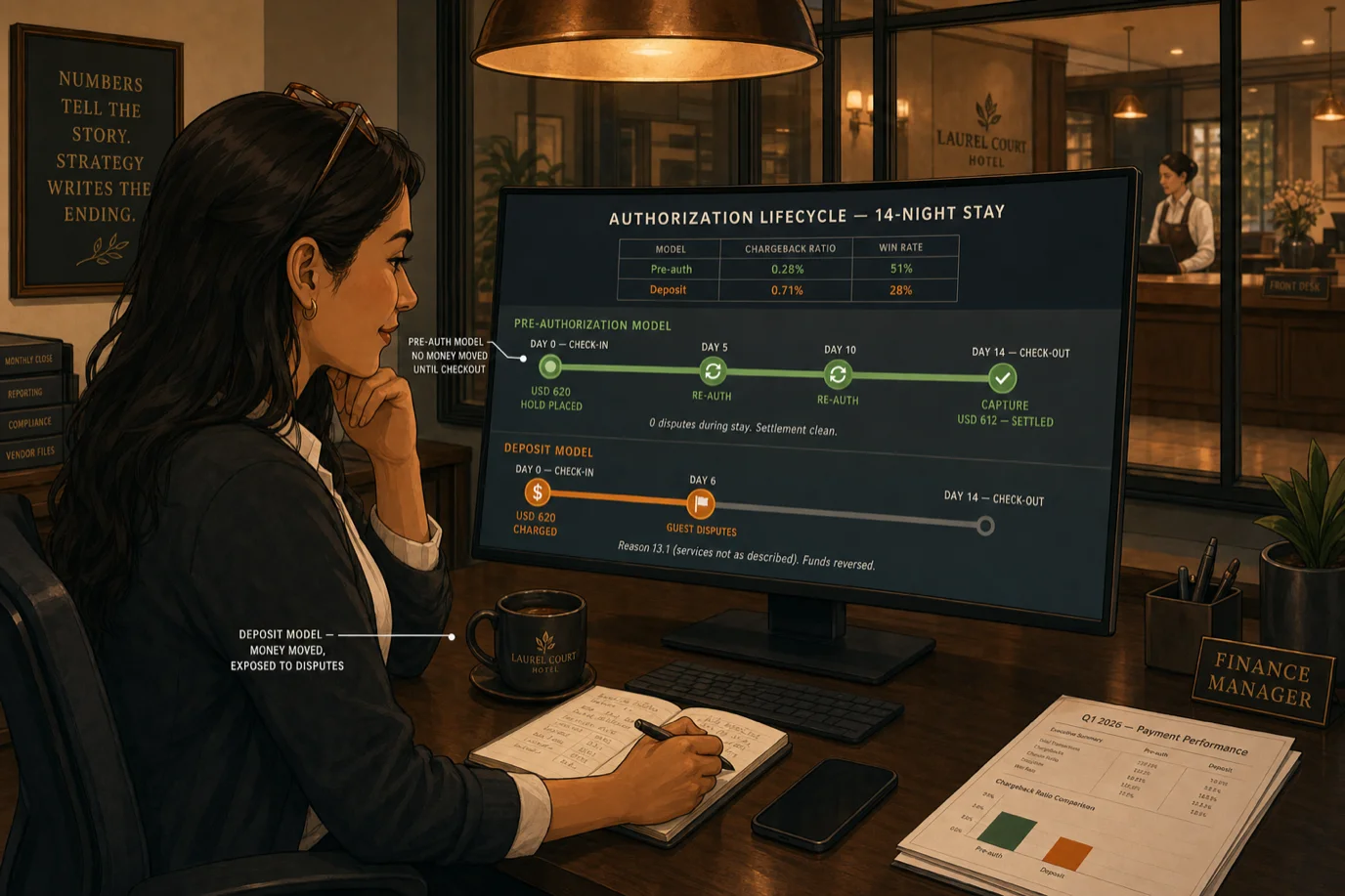
The total chargeback-to-transaction ratio for deposit-heavy properties in the sample was 0.71 percent. For pre-auth-heavy properties it was 0.28 percent. The difference is structural: pre-auths simply produce fewer disputes because most of the dispute-generating events at hotels (cancellations, no-shows, room-quality complaints) happen before any settlement has occurred, and a pre-authorization that has not yet been captured cannot be disputed.
The representment win-rate difference
When chargebacks do occur, the representment win rate is also higher under a pre-auth model. The reason is that a captured pre-authorization at check-out is by definition a transaction where the cardholder has already received the service; the eligible reason codes shrink, and the merchant evidence (registration card signed at check-in, settlement at check-out, receipt acknowledgement) is much stronger.
The same 41-property sample showed:
- Deposit-heavy properties: 28 percent representment win rate
- Pre-auth-heavy properties: 51 percent representment win rate
- Hybrid properties (the model 4 we discussed): 44 percent representment win rate
Note that 100 percent of properties in the sample had win rates well below the 60-to-70-percent industry-best-practice threshold, which is consistent with the fact that almost no independent hotel runs a chargeback workflow with any real discipline. The single highest-leverage operational change available to most independents is not the pre-auth-vs-deposit question; it is having any kind of structured chargeback response process at all. Most properties answer about 40 percent of the chargebacks they receive, and the unanswered ones are automatic merchant losses regardless of the underlying merit. Hotel chargebacks: reduce by 60 percent walks through that workflow in detail; in the context of this article, the relevant point is that the chargeback math says pre-auth is the better model even before you fix the workflow, and gets even better once you do.
The cost of chargebacks, properly counted
The full cost of a chargeback is consistently underestimated by independents because the visible cost (the transaction reversal) is only one piece. The true cost stack:
- The transaction reversal: full transaction amount lost, plus interchange already paid (1.5 to 3.0 percent), plus the chargeback fee (typically $15 to $40 depending on acquirer)
- Acquirer monitoring exposure: chargeback ratios above 0.65 percent (Visa) or 1.0 percent (Mastercard) put the merchant into chargeback-monitoring programs that come with substantial monthly fees ($1K-$5K) and increased review
- Excessive-fraud monitoring: separate program with fraud-specific thresholds (typically 0.9 percent Visa, 1.5 percent Mastercard) that adds further fees
- Rolling reserves: acquirers experiencing high chargeback volume from a merchant will hold a reserve (typically 5 to 15 percent of monthly volume) for 6 to 12 months as protection. On a 60-room property with $450K monthly revenue, a 10 percent reserve is $45K of working capital frozen until the rolling window resolves
- Operational time: a chargeback that is responded to properly takes 90 to 180 minutes of cumulative staff time across reservations, front office, and finance
- Increased acquirer rates: at re-pricing time, a high chargeback ratio adds 10 to 30 basis points to the merchant's blended rate, which on $5.4M of revenue is $5K to $16K annually
The fully loaded cost of a chargeback in a hotel context, properly counted, is rarely less than the transaction value plus 1.5 to 2.5 times the transaction value. A $620 average-stay chargeback costs the hotel roughly $1,500 to $2,200 once everything is counted, and the difference between a 0.71 percent and a 0.28 percent ratio across 8,500 transactions per year is roughly $58K to $86K of bottom-line savings. That is a much larger number than the working-capital benefit of a deposit model, which is why the chargeback math, properly counted, dominates the working-capital math.
The decision matrix by segment
The four pricing models, the card-network rules, the PCI scope, and the chargeback math all suggest that for most independents the right answer is "pre-auth on flexible rates, deposit on advance-purchase rates, with a token vault behind both." But "most independents" is not specific enough to be operational. The decision genuinely varies by segment, and the matrix below distills the recommendations from the cumulative analysis above into a property-shape-by-property-shape view.
Urban transient, business-heavy
Properties where corporate travel is more than 40 percent of room-nights, midweek occupancy is materially higher than weekend, ADRs are typically $180-$340, and average stay length is 1.4 to 2.1 nights. Examples: Manhattan business hotels, downtown Chicago independents, Frankfurt city-center, central London business B&Bs.
- Recommendation: pre-auth dominant on direct rates, pre-auth on OTA flexible, settlement on prepaid OTAs, direct billing for contracted corporate accounts.
- Why: business travellers are deposit-tolerant in principle but the segment is also the most price-elastic on conversion; a deposit on a $260 ADR midweek is enough to push a corporate booker to a competitor. The chargeback profile is also lower in this segment, making the conversion sensitivity the dominant factor.
- Watch out for: corporate cards with expiring authorizations (corporate cards often have shorter tolerated hold windows); long-stay corporate guests where the original auth cannot cover the eventual total.
Urban transient, leisure-heavy
Properties where leisure travel is more than 60 percent of room-nights, weekend occupancy is materially higher than midweek, ADRs are typically $200-$420, and average stay length is 2.4 to 3.6 nights. Examples: most boutique hotels in tourist cities, art hotels, lifestyle properties in Miami, Barcelona, Lisbon.
- Recommendation: pre-auth on flexible rates, partial deposit (1 night) on advance-purchase rates, settlement on prepaid OTAs.
- Why: leisure travellers are more cancel-prone than business travellers, which biases the math toward holding some real money on advance-purchase rates. But the conversion sensitivity at the booking-engine deposit page is so high in this segment that any deposit on a flexible rate is a meaningful conversion drag.
- Watch out for: weekend group-of-friends bookings where one card is held for multiple guests and the eventual settlement is split (this is the "room shares" problem and it is its own operational headache regardless of pre-auth/deposit choice).
Leisure resort
Properties where stays are typically 4 to 12 nights, ADRs are $300-$900, F&B captures 35-55 percent of total revenue, and the booking window is 60+ days. Examples: independent beach resorts, mountain properties, wellness retreats.
- Recommendation: deposit-heavy on direct rates (typically 1-2 nights or 25-30 percent), pre-auth on the balance, full settlement on advance-purchase / non-refundable rate plans, deposit-on-signing for any group business.
- Why: long booking windows produce real cancellation risk, ADR sensitivity is lower because the leisure-resort guest is choosing on experience not price, and the cash-flow benefit of deposits is largest in this segment because the average stay value is highest. The deposit also serves as a real commitment device that reduces cancellation rates by 15-25 percent in the typical sample.
- Watch out for: deposits taken on credit cards that subsequently expire before arrival (longer booking windows make this a real issue); the paper trail on cancellation policies (these are the most disputed deposits in the chargeback sample); and the F&B charge-posting flow during the stay, which becomes a separate authorization track once the deposit is captured. F&B charge posting between POS and PMS covers that interaction in detail.
Extended stay and corporate housing
Properties where stays are typically 7 to 60 nights, ADRs are $120-$240, and the customer mix is heavily relocation, project-based contracting, or insurance / displaced-guest business. Examples: independent extended-stay properties, corporate-housing operators, insurance long-stay providers.
- Recommendation: weekly direct billing or weekly pre-auth refresh; deposit only when corporate billing is unavailable.
- Why: the natural cadence of extended-stay billing aligns with weekly authorizations, which keeps every transaction inside the safe debit-card window and produces a much cleaner paper trail than trying to pre-auth a 30-day stay total at check-in. Direct billing on net-15 or net-30 invoice terms is the dominant model with corporate accounts.
- Watch out for: insurance-paid stays where the guarantee comes from a corporate card or a government billing entity; these need explicit authorization-letter workflows that the front desk often skips.
Group-block heavy
Properties where group business is more than 30 percent of room-nights, ADRs are typically discounted from rack by 15-30 percent, and the booking window is 90+ days. Examples: conference hotels, wedding-heavy resorts, sports-team-friendly properties, MICE-focused independents.
- Recommendation: per-contract terms; typically a 25-50 percent deposit at signing, the balance due at the cutoff date or at check-out depending on the master billing arrangement.
- Why: groups are not transient bookings; they have their own legal contracts, attrition clauses, and commercial terms that override standard rate-plan logic. The deposit math is bilateral: the hotel needs the deposit to protect against the group walking, the group needs the cancellation protection that comes with the deposit. The pre-auth-vs-deposit framing does not really apply at the room-night level; it applies to the individual contract clauses.
- Watch out for: master billing reconciliation failures (room-charge versus group-master allocation); attrition disputes that go to chargeback when a group walks part of its block.
The eleven places this quietly fails
Even with the right policy, the right architecture, and the right segment-by-segment matrix, payment workflows at independent hotels fail in a small number of consistent places. The list below is drawn from the same 41-property sample and represents the eleven places where, when something goes wrong with pre-authorizations or deposits, it almost always goes wrong this way.
- The lodging indicator was never set. The property believed it had 30-day holds; the gateway was actually configured for 7-day holds. Discovered when a 14-night stay's auth expired on day 8 and the front desk noticed the decline only at check-out. Fix: ask the acquirer in writing to confirm the lodging qualifier configuration, run a test, inspect the message. Verify annually.
- Debit cards expire holds early and nobody refreshes. The hotel does not distinguish credit from debit in its re-auth schedule. Debit holds drop in 5 days; the re-auth runs in 7. Fix: re-auth all card types every 5 days or run a debit-card-aware re-auth schedule.
- Incidentals are added without an incremental. The PMS issues a fresh authorization for the minibar charge, which starts a separate clock and increases the chance of a hold cluster declining for "unusual activity". Fix: incremental authorizations on the original auth, not new authorizations. This requires PMS support; if your PMS does not, you have a structural problem that needs solving rather than an operational tweak.
- Authorizations are released before settlement. Some terminals "void" an authorization at check-out before the capture; the void releases the hold instantly but the capture still has to clear. If anything goes wrong, the hold is gone and the settlement risk is real. Fix: capture, then void any unused excess separately. Check your terminal's actual behaviour.
- Cancellation paper trail is verbal only. Guest calls the front desk to cancel; the agent processes it but does not send a written confirmation; the guest disputes the deposit charge weeks later; the hotel cannot produce the cancellation record. Fix: every cancellation generates an automated email confirmation, regardless of channel. No exceptions.
- OTA virtual cards are not actually validated at check-in. Expedia or Booking.com sends a virtual card for a prepaid stay; the front desk just hands the guest the keys without testing the virtual card; at check-out the virtual card is declined or has a different limit than expected. Fix: validate the VCC at check-in via a $1 zero-amount auth before ever assuming it covers the stay.
- The 3DS / SCA flow is bypassed for "VIP" guests. Front desk takes a card over the phone without a 3DS challenge because the guest is a returner. The auth completes; the chargeback liability shifts back to the merchant. Fix: 3DS / SCA is not optional for any CNP transaction in 2026; the only proper bypass is delegated authentication via a token vault.
- Deposit refund timelines exceed cancellation policy. Hotel processes refund within 24 hours per its own policy; the refund takes 5-10 business days to appear on the guest's statement. The guest sees nothing, panics, opens a chargeback. Fix: write the actual refund timeline (5-10 business days) into the cancellation confirmation email so expectations match reality.
- Multiple cards on a folio fight each other. Guest A's card is on the room, guest B settles incidentals separately at check-out, the system re-allocates and the guest A authorization no longer covers the new balance. Fix: explicit folio-split logic in the PMS that handles multi-payer reservations without confusing the auth lifecycle.
- The acquirer changes terms and nobody notices. Re-pricing at contract renewal, new chargeback monitoring fees, MoR transition rates, all of which are buried in addenda. Hotel's effective payment cost rises 18 to 35 basis points without anyone tracking it. Fix: annual payment-cost audit, line-by-line, against actual statement.
- The PCI scope is implicitly bigger than the team thinks. Card numbers in old emails, in customer-service notes, on a shared drive of "VIP guest profiles," in voicemail systems. None of which are in the formal data flow diagram, all of which are in scope. Fix: quarterly cardholder-data discovery scan against email, file shares, ticketing systems, CRM. Anything found gets purged and the source process gets fixed.
Where Prostay Pay closes the loop
The pre-authorization model is the right answer for most independents, but only if the operational tax of running it is low enough that the front desk does not quietly drift back to deposits. Three architectural decisions in Prostay Pay are specifically designed to remove that tax.
The first is that Prostay Pay tokenizes on first capture. The card number is never stored anywhere in the Prostay PMS environment, in the folio, in the night-audit data, in the CRM, or in the F&B integration. What flows through the PMS is a token: a structured reference that means nothing outside the Prostay Pay vault. This is what gives the hotel SAQ A-EP scope eligibility, and it cuts the annual PCI compliance cost from the $30K-$80K SAQ D range to the $4K-$14K SAQ A-EP range, which is a $25K-plus annual saving that pays for the platform several times over.
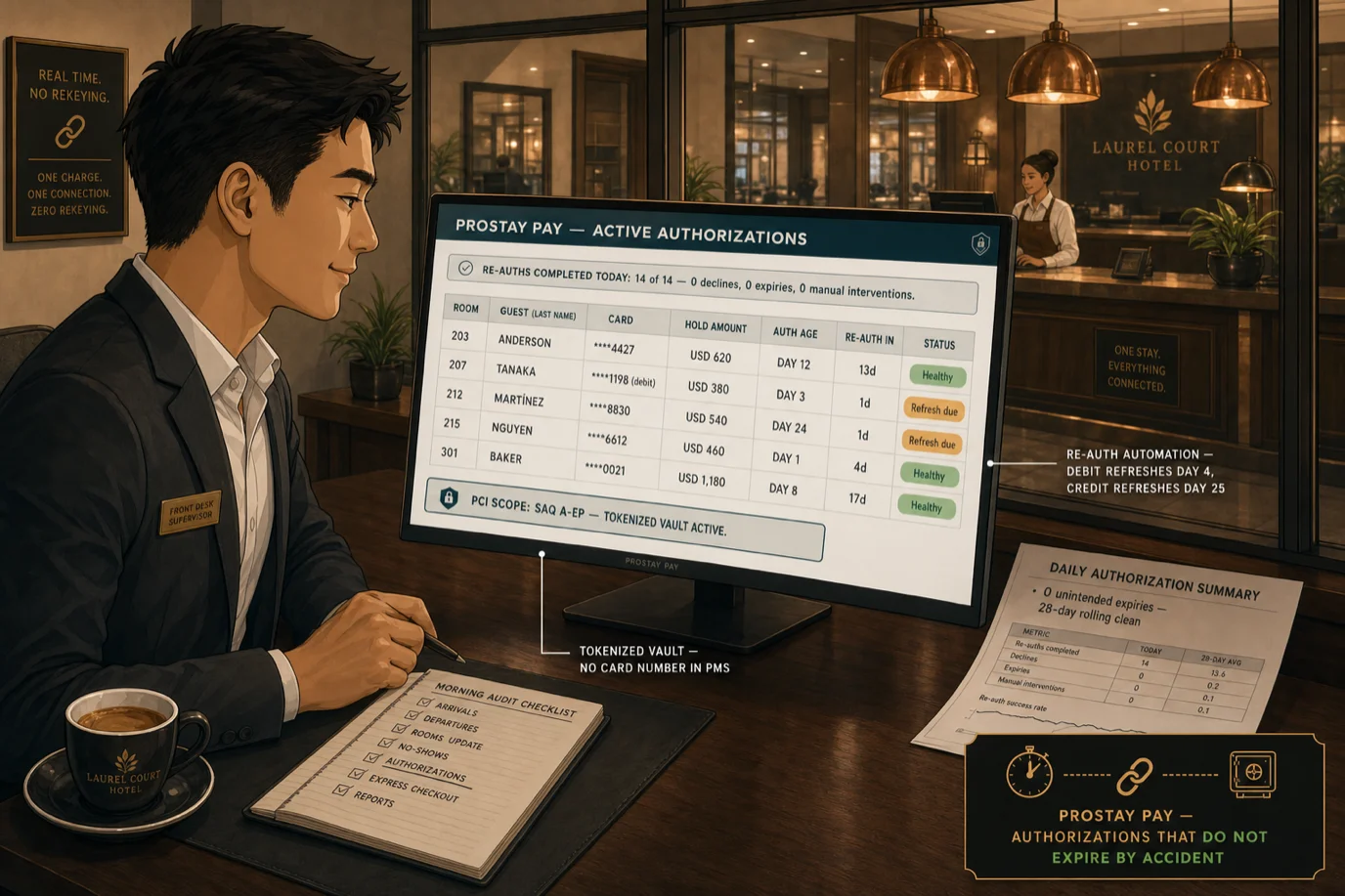
The second is the automatic re-authorization workflow. Every active authorization in the system has an age counter. Credit card authorizations are scheduled for re-auth at day 25 (well inside the 30-day Visa Lodging window with a 5-day buffer). Debit card authorizations are scheduled for re-auth at day 4 (well inside the most aggressive issuer expiry pattern). Re-auths happen automatically; the front desk only sees an exception when a re-auth declines, which is the only event that requires human judgement. This reduces the operational tax from "the front desk has to think about authorizations" to "the front desk handles the small number of declines that matter," which is the difference between a workable pre-auth model and a model that staff quietly abandon.
The third is the chargeback workflow. When a chargeback notification arrives from the acquirer, Prostay Pay opens it as a structured workflow tied directly to the original folio. Pre-attached to the dispute case: the original itemised receipt, the registration card with the guest signature, the rate-plan terms agreed at booking, the cancellation policy in force on the booking date, the night-audit reconciliation showing the captured authorization sequence, and any incremental authorizations posted during the stay. The hotel responds inside the network deadline (typically 7 to 14 days; missing the deadline is automatic merchant loss) by reviewing the pre-built evidence pack, adding any property-specific notes, and submitting representment in one click. This is the workflow that takes representment win rates from the 25-30 percent range typical of independents into the 55-65 percent range typical of well-run chains.
Together those three remove the operational reasons hotels drift back to deposits. The financial case for pre-auth was already strong; the regulatory case for tokenization is overwhelming under PCI-DSS 4; the chargeback case favours pre-auth even before you fix the workflow. The only thing that has historically prevented independent hotels from running the right model has been the operational friction. Removing the friction is what changes which model is actually achievable in practice.
The 30-day implementation playbook
The recommendations in this article add up to a meaningful change in payment policy, technology, and workflow. Most independent hotels can run the migration in 30 days without disrupting day-to-day operations, on the schedule below.
Week 1: discovery and decision
- Pull a 90-day chargeback report from the acquirer; tag each one by reason code and underlying cause; calculate true chargeback ratio.
- Pull a 30-day authorization log from the gateway; calculate the percentage of authorizations that were re-authorized vs. re-issued vs. allowed to expire; tag debit vs credit if the data supports it.
- Confirm with the acquirer whether the lodging qualifier is being sent on every Visa auth and whether the T&E indicator is set on every Mastercard auth; get the answer in writing.
- Run a test transaction to verify the indicator is in fact set in the production message; inspect the gateway log.
- Decide on the segment-by-segment policy from the matrix above; document it as a single page that lives next to the front-office SOP.
Week 2: architecture and PCI scope
- Audit cardholder data flows in the property: where is a PAN ever captured, stored, transmitted, or processed? Map each path. Aim to make the answer "nowhere except the PSP-validated payment form."
- Run a cardholder-data discovery scan against email, shared drives, the PMS database, and any backup systems. Purge anything found. Fix the source process that produced it.
- If the PMS supports a token vault and you are not using it, enable it. If the PMS does not support tokenization, schedule a vendor review against a successor that does; this is now a structural blocker to compliance under PCI-DSS 4.
- Update the SAQ self-assessment to reflect the post-tokenization scope (A or A-EP); confirm with your QSA or assessor that the architectural change supports the scope reduction.
Week 3: policy and process
- Update the cancellation policy text on the booking engine, the OTAs, and the confirmation email so the language is consistent and the refund timeline (5-10 business days) is explicit.
- Build the re-authorization schedule: credit at day 25, debit at day 4, exceptions only on decline. Test against a sample reservation set.
- Build the chargeback response workflow: a checklist of evidence to attach, the network response window, the routing for finance review and signoff.
- Train the front-office team on the new workflow: when to take a deposit, when to pre-auth, what to do when a re-auth declines, what to capture in writing on every cancellation.
Week 4: rollout and measurement
- Roll the new policy out one rate plan at a time, starting with direct flexible (lowest risk if anything goes wrong).
- Monitor authorization expiry rates daily for the first two weeks; the target is zero unintended expiries on stays that did not have a re-auth scheduled.
- Monitor conversion rate at the booking engine; expect a small lift on flexible rates as the deposit step is removed; watch for any drop on advance-purchase rates as the deposit terms are clarified.
- Monitor chargeback volume; expect the early signal in 30-60 days as the first cohort of stays under the new policy completes the dispute window.
- At day 90, re-pull the chargeback report and the authorization log; compare to baseline; adjust the policy on any segment that has not behaved as expected.
Most independents who run this 30-day program land in the same place after one quarter: a meaningfully lower chargeback ratio, a higher booking-engine conversion rate on flexible rates, a $25K-plus PCI-compliance saving, and a front office that no longer hates the payment workflow. The pre-auth model becomes self-sustaining at that point because the operational friction that used to push hotels back toward deposits is no longer there.
If you want to walk through the policy decision and the architectural questions for a specific property shape, book a Prostay demo and we will run the matrix against your actual segment mix, your actual chargeback history, and your actual PCI scope. The numbers in this article are averages from a sample; the right policy for your property is the one that works for the specific business you are running. The tooling exists in 2026 to actually run the math instead of guessing at it, and the hotels that do are leaving working capital, conversion, and compliance cost on the table when they don't.
For related reading on the payment-and-finance topics this article touches: hotel chargebacks: reduce by 60 percent on the dispute-response workflow, PCI-DSS 4 compliance for hotels on the architectural and audit detail, and F&B charge posting between POS and PMS on how the authorization lifecycle interacts with restaurant settlement during the stay.