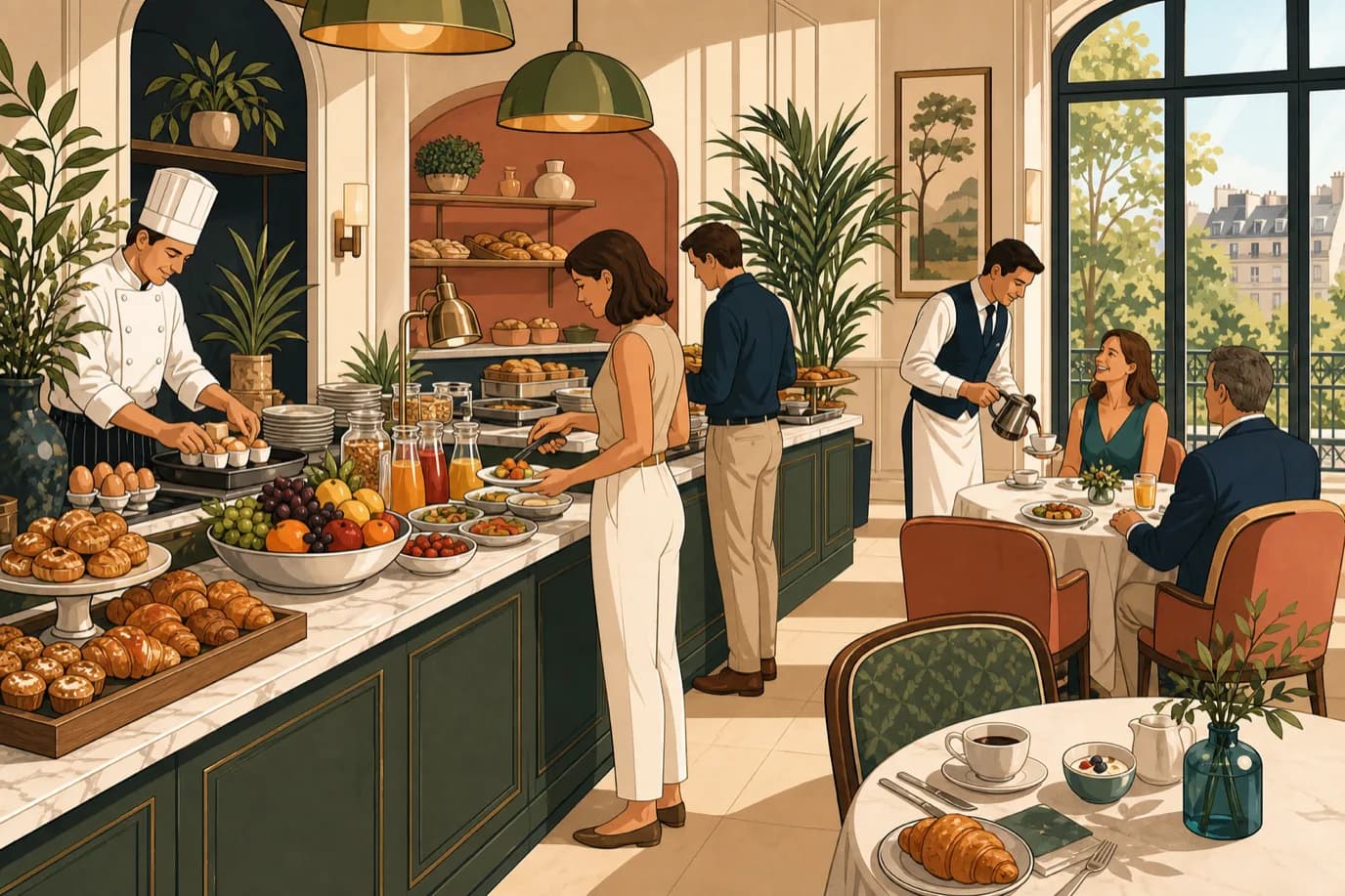
Stand at the door of your breakfast room at eight on any weekday morning and you are watching the most commercially underrated hour in your hotel. Nearly every guest in the house passes through it. It is the last thing most of them experience before checkout, which means it is the freshest memory when the review gets written that afternoon. It is a filter on every major booking site, a line item in every corporate rate negotiation, and, on review platforms, a scored category of its own. And in a remarkable number of properties it is run as an afterthought: a format inherited from the previous owner, a price set by rounding, a buffet planned by habit, and a food cost nobody has looked at since the menu was laminated.
Breakfast deserves the same commercial discipline as the rooms upstairs. This guide applies it: how to choose the format your volume actually supports, the real arithmetic of the buffet, whether to include breakfast in the rate or sell it as an add-on and at what price, where the profit leaks through waste and stale hours, which menu items guests remember and which they merely tolerate, and how to sell breakfast at every step from the booking engine to the front desk. The thesis throughout is simple: breakfast is not a courtesy, it is a product, and products are designed.
Why Breakfast Punches Far Above Its Weight
No other hotel service touches as many guests per euro of effort. A spa reaches a minority, the bar reaches the evening crowd, but breakfast reaches close to the whole house, every single day, at a moment when guests are unguarded and forming the impressions they will publish. Review analyses across platforms consistently rank breakfast among the most mentioned topics in hotel reviews, ahead of almost everything except cleanliness and staff, and booking platforms have institutionalised the signal: breakfast-included is a first-class filter on Booking.com and Expedia, and Google surfaces breakfast ratings directly in hotel search results. A weak breakfast quietly taxes your review score, and a strong one compounds it, which feeds ranking, which feeds occupancy; the full loop is the same one described in our guide to improving hotel reviews.
The commercial reach goes beyond sentiment. Breakfast decides bookings directly through filters and rate-plan comparisons, anchors corporate contracts where it is routinely a required inclusion, and drives measurable ancillary behaviour: guests who eat breakfast in-house spend more across the stay, linger into the lobby cafe, and are notably more likely to book the property again, because a good morning is the memory that survives. Treated as a product line inside your wider food and beverage operation, breakfast is very often the highest-margin meal of the day once it is priced and captured properly, and the rest of this guide is about doing exactly that.
Choosing the Format: Buffet, Continental, A la Carte or Grab-and-Go
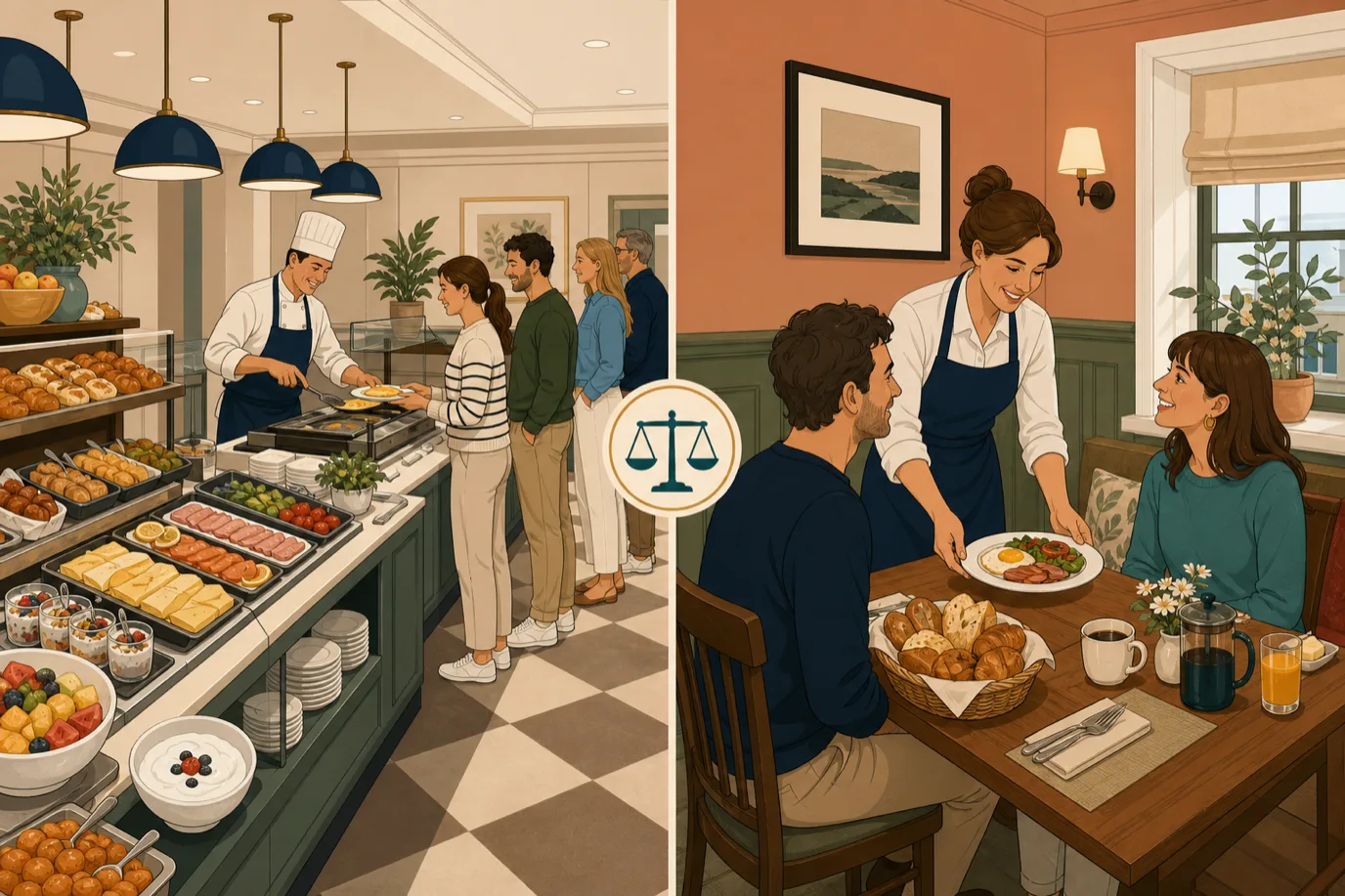
Format is the first real decision, and it should be made by arithmetic rather than aspiration. The four base formats, the full buffet, the continental spread, the a la carte or set-menu service, and the grab-and-go, differ mainly in how they behave at different volumes. What ruins breakfast economics is running a format one size too big for your actual covers: the 30-cover hotel imitating a 200-cover buffet produces waste, sad half-empty trays and reviews that say tired, while the 200-cover hotel running a la carte produces a queue at the kitchen and reviews that say slow.
The Buffet: Loved by Guests, Feared by Accountants
Guests adore buffets for reasons psychology explains well: perceived abundance, zero waiting, full control, and no menu anxiety in a foreign language at 7 a.m. Above roughly 40 to 50 covers a morning, the buffet is also operationally rational, because one team can serve a hundred guests with the same headcount that table service would need for thirty. The arithmetic that matters is per-cover food cost against capture: a well-run European buffet lands somewhere between 3.50 and 8 euros of food cost per guest, and the spread between a disciplined operation and a careless one is almost entirely waste, overproduction in deep pans, expensive items unguarded, and a full restock at 9:40 that goes to the bin at 10:05.
Run the buffet like a production line with feedback. Cook small and replenish often, so food is fresher and the bin is emptier. Position the expensive items, smoked salmon, berries, barista coffee, at staffed or made-to-order stations where a human presence naturally moderates portioning. Track covers against production on a daily sheet, so Tuesday's kitchen cooks for Tuesday's house count instead of for August. These are unglamorous controls, but they are the difference between the buffet as a profit engine and the buffet as a charity for the bin.
Formats for Small Properties: Winning Without a Buffet Line
Below the buffet threshold, stop imitating and start differentiating. A twelve-room property cannot out-buffet a conference hotel, but it can serve the best plated breakfast in the neighbourhood: a short menu built on a few genuinely good local products, bread from the actual bakery, eggs cooked when ordered, one daily special the host can describe with pride. Guests review specificity, not square metres of chafing dish; the phrase best breakfast of the trip appears in reviews of tiny properties far more often than in reviews of grand ones. Alternatives that work at small scale include the room-delivered breakfast basket, a partnership with the cafe next door billed back to the room, and a quality grab-and-go bag for dawn departures, any of which beats a skeleton buffet on both cost and sentiment. This is the same positioning logic that applies to everything at a bed and breakfast: small properties win by being unmistakably themselves.
Pricing Breakfast: Included, Add-On or Standalone
The included-versus-add-on debate has a boring, correct answer: offer both, as rate plans, and let demand sort itself. A room-only rate keeps your entry price sharp for the OTA comparison grid; a breakfast-included rate 8 to 15 euros or dollars per person above it captures the filter traffic and the planners who want one number; and the difference between the two is now a visible, taxable, forecastable revenue line instead of a cost dissolved invisibly into ADR. Guests who skip breakfast stop subsidising guests who eat it, and you gain a price signal telling you exactly what your market thinks breakfast is worth.
Three pricing disciplines protect the line. First, keep the gap honest: if breakfast walks in at 22 euros at the desk but 12 as a rate-plan difference, the desk price is theatre and everyone knows it; a modest walk-in premium over the prebooked price is enough to reward commitment without feeling punitive. Second, mind the children: family formats, kids under six free, six-to-twelve half price, cost little and remove a friction that family bookers actively filter for. Third, treat breakfast as an upsell object across the whole journey, in the booking engine as a ticked add-on, in the pre-arrival email at the moment plans firm up, and at check-in as a one-line offer with the room key. Prebooked breakfast is worth more than walk-in breakfast even at a lower price, because the kitchen can produce against a known number, which is the whole game in the next section. The mechanics of add-on pricing follow the same rules as any hotel upselling programme: right moment, small ask, obvious value.
Food Cost and Waste: Where Breakfast Profit Leaks
Breakfast has only a handful of failure modes, and all of them are measurable. Overproduction is the largest: kitchens cook to tradition rather than to the house count, and the gap goes to the bin with the margin inside it. The fix is a production sheet driven by tonight's occupancy and tomorrow's prebooked covers, numbers your property management system already knows, pushed to the kitchen the evening before. The second leak is the expensive-item free-for-all, solved by portioning and station placement rather than by rationing anyone visibly. The third is beverage cost hiding in plain sight, juice machines and pod coffee quietly outcosting the eggs; measure per-cover beverage cost once and you will look at the orange juice differently. The fourth is plate waste, trimmed by smaller plates and spoons, a change guests never consciously register.
Put a numerate frame around all of it: food cost per cover, covers per occupied room (your capture rate), revenue per cover for add-on sales, and waste weight per service if you want the operational truth. Reviewed weekly beside your other hotel KPIs, these four numbers turn breakfast from folklore into a managed P&L line, and they respond quickly: properties that instrument breakfast typically find 15 to 25 percent of food cost recoverable within a season without any guest noticing anything except, occasionally, fresher croissants.
The Menu: What Guests Actually Remember
Review mining across markets keeps returning the same short list of what makes a breakfast memorable, and it is cheaper than intuition suggests. Coffee quality sits first by a distance: a real machine or a barista station converts more goodwill per euro than any other single investment in the meal, and weak coffee is the single most quoted breakfast complaint in reviews. Eggs come second, ideally cooked to order even in a small way, because a person at a pan reads as care. Fresh over industrial third: one excellent local bread, real butter, one regional cheese or ham with a name beats fifteen anonymous items; guests photograph and cite the specific, never the generic. Honest fruit fourth, cut that morning, not swimming in syrup.
Two structural notes complete the menu. Dietary coverage, plant-based milk, gluten-free bread, a couple of genuinely good vegan items, has crossed from courtesy to expectation, and its absence now appears in reviews as a defect rather than a preference unmet. And menu design economics apply at the buffet exactly as in the restaurant: place the high-cost items where portioning is naturally moderated, lead the line with the cheap, filling, beautiful things, and put the signature item, the thing you want mentioned in reviews, where every guest walks past it. The underlying discipline is classic menu engineering, applied to a room where the guest serves themselves.

Operations: Staffing, Hours and the 9:58 Problem
Breakfast operations live and die at the edges of the service window. The opening edge is a logistics problem: the team that starts at six must have yesterday's production sheet, tomorrow's covers and a mise en place that survives the 7:30 rush, which is a scheduling question your staff scheduling already answers if breakfast covers are forecast like occupancy. The closing edge is a hospitality problem with a name: the 9:58 problem, the guest who arrives two minutes before close to find cleared trays, stacked chairs and a team radiating impatience. That guest writes reviews. The rule that fixes it costs nothing: the last guest gets a complete breakfast, not a complete buffet, via selective replenishment in the final half hour and a standing instruction that nobody clears around a seated guest.
Weekday and weekend are different products and should be staffed as such: the business Tuesday peaks hard at 7:30 and wants speed, silence and sockets; the leisure Sunday spreads long and wants a second coffee and no pressure, and extending weekend hours by half an hour is one of the cheapest review-score purchases available to a leisure property. Room service breakfast, where offered, is the same product through a different pipe, priced with its tray charge and run through the systems described in our room service guide. And everything sold at breakfast, the walk-in covers, the à la carte extras, the bottle of water for the road, belongs in the point of sale posted to the room or settled at the table, because unposted breakfast revenue is the quietest leak in the whole meal.
Selling Breakfast: Booking Engine, Front Desk and In-Stay
Capture rate, the share of in-house guests who eat your breakfast rather than the cafe's down the street, is the single most powerful number in breakfast economics, because the fixed costs are already paid and every marginal cover arrives at food-cost-only margins. Selling breakfast is therefore a funnel exercise. At booking, the breakfast-included rate plan and a one-click add-on in the booking engine do the heavy lifting; a good photograph of actual eggs and actual coffee outperforms a stock image measurably. Between booking and arrival, the pre-arrival email offers breakfast at the prebooked price with one tap. At check-in, the front desk asks one question, would you like to add breakfast for tomorrow, at the exact moment the guest is standing in your lobby smelling nothing of the cafe next door. In-stay, the QR card in the room and a line in the checkout-eve message catch the undecided.
Each step converts modestly; together they routinely move capture rates by 15 to 30 points, which at buffet economics is the difference between a subsidised amenity and a meaningful profit centre. Packages extend the same logic upward, breakfast folded into romance, family and weekend bundles where its perceived value exceeds its marginal cost, exactly as described in our guide to hotel packages. The tracking matters as much as the selling: when breakfast is a rate plan and an add-on rather than folklore, every step of this funnel is measurable, and the morning report can say not just how many rooms slept but how many breakfasts were sold, at what price, through which door.
Breakfast and Reviews: The Most Mentioned Meal in Hospitality
Breakfast earns a structural share of your review content, so it deserves a structural share of your review strategy. Read three months of your own reviews and tag every breakfast mention: the pattern that emerges is your actual priority list, and it is rarely what the kitchen assumes. Coffee complaints outrank variety complaints almost everywhere; the 9:58 problem appears verbatim; the specific named item, the homemade granola, the local honey, recurs in the five-star reviews. Fix the recurring complaint, amplify the recurring compliment, and reply to breakfast mentions specifically rather than generically, because future guests read the replies as closely as the reviews. The wider craft is covered in our guide to review management, but breakfast is where it pays fastest, simply because the topic comes up so often.
Breakfast is the rare hotel product where the commercial loop is fully visible: a format matched to volume keeps the cost honest, rate plans and add-ons make the revenue explicit, production sheets and portioning protect the margin, a handful of memorable items earns the mentions, and the mentions feed the filters and scores that fill the rooms whose guests come down tomorrow at eight. Design it once, measure it weekly, and the most routine hour of your operation becomes one of its most reliable earners. And if the plumbing underneath, rate plans, add-ons, covers forecast from occupancy, breakfast revenue on the morning report, sounds like more than your current systems give you, a Prostay demo will show you how a modern platform makes breakfast, like most things in a hotel, mostly a matter of switching it on.