
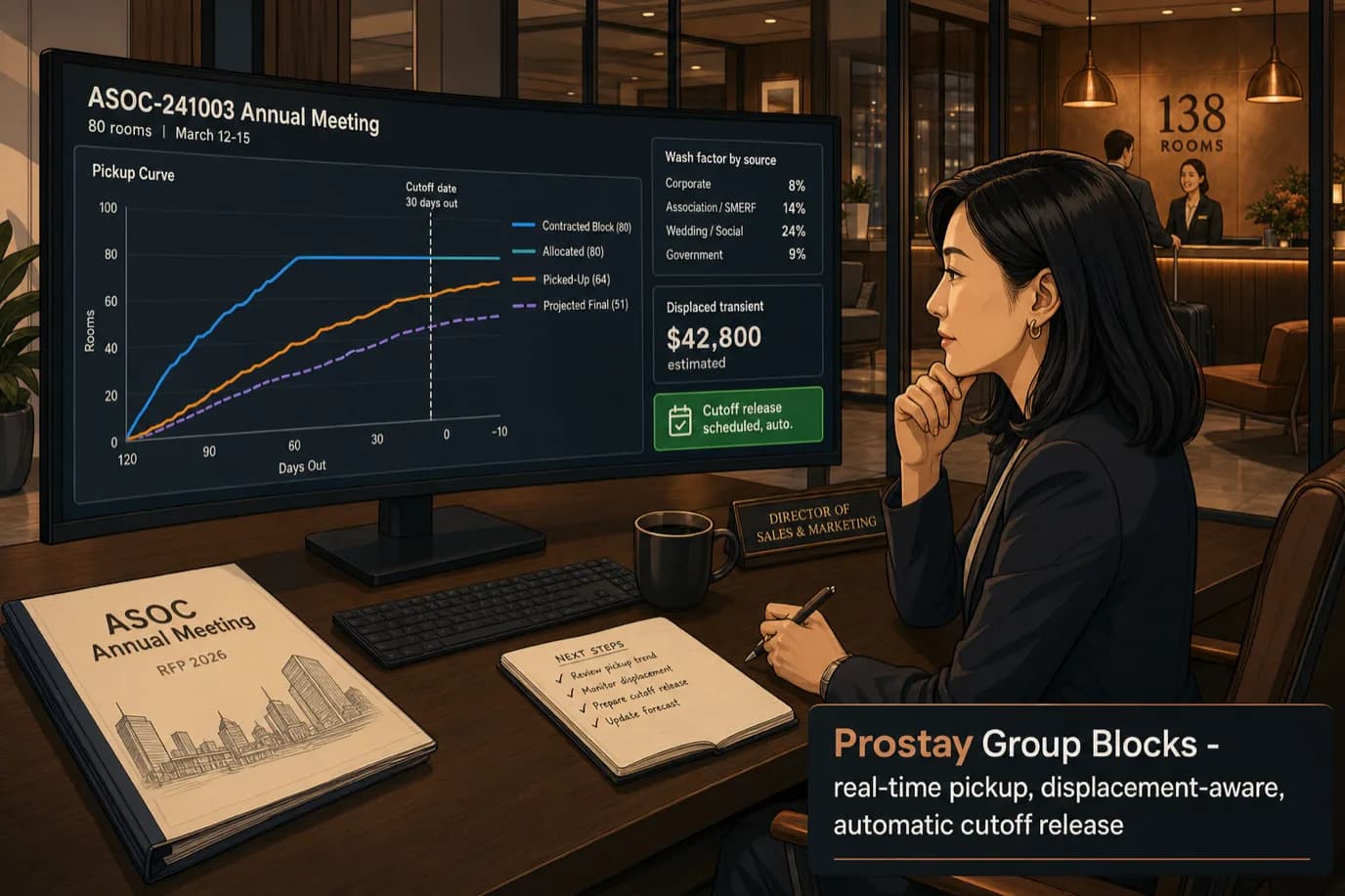
The DOSM at a 138-room urban property in Madrid told me a story over coffee in February 2026 that I have heard a version of at every independent I have worked with. Her group sales team had closed an association block in October. 80 rooms over four nights, contracted at $148 against a same-week BAR of $215, with a 30-day cutoff and an attrition clause that read like the standard template. Pickup was 64 rooms by the cutoff date. At arrival, 51 rooms checked in. Two of the four nights ran the property at 91 percent and 96 percent occupancy respectively, with transient demand turned away on both. The hotel collected the contracted rate on the 51 picked-up rooms, $0 on the 13 rooms that washed before cutoff, and exactly $0 in attrition fees because the resale clause in the contract was written in such a way that it was technically defensible only if the group had been notified of resale within 48 hours, which the front office had not done. The DOSM ran the math after the fact. The block contributed $30,144 of room revenue across the four nights. The displaced transient (rooms turned away at the front desk plus rooms that did not search-and-book once the rate plans hardened) was, conservatively, $42,800. The block lost the property roughly $12,700 in contribution margin, before counting the F&B that did not happen because the group's per-attendee F&B minimums were structured around their inflated headcount and the actual consumption was 38 percent below contract.
She showed me a printout of the post-event recap she had prepared for the GM. The line at the bottom read: "Net contribution: positive." The recap was driven by the standard PMS group-block report, which counted picked-up rooms times the contracted rate, subtracted nothing for displacement, and presented the F&B line at the contracted minimum rather than the realised consumption. The number was wrong. The number is almost always wrong. And the reason is not that the DOSM was sloppy. The reason is that the standard tooling at independent hotels was built to record what the group did, not to evaluate what the group actually contributed against the alternative use of the same inventory.
This article is the operational read on how group block management should actually work at independent hotels in 2026. It walks the canonical six-stage lifecycle (RFP → contract → cutoff → wash → pickup → attrition), the six numbers most PMS tools get structurally wrong, the nine operational failure modes that quietly leak revenue at every independent we have worked with, the contract terms worth defending in soft markets, the displacement math that should drive your group pricing, and a 30-day playbook to clean up a group operation that has drifted. The figures cited below are drawn from a sample of 27 independent hotels (60 to 240 rooms) across Europe and North America we have group-block data on, supplemented by published association data (PCMA Convene benchmarks, EIC industry reports, AH&LA group reports) and the relevant industry-standard contract templates from ASAE and Cvent. Prostay ships group block management as a first-class workflow inside the PMS, with displacement analysis, automatic cutoff release, group F&B billing through the master folio, and the post-event recap that uses the right numbers without anyone having to do the manual stitching that the DOSM in Madrid was doing on a spreadsheet at 11 PM the night before the GM presentation.
Why group blocks remain the messiest line on the revenue statement
Group business is structurally different from transient business in ways that most PMS tools and most operating habits at independents do not fully accommodate. The differences compound. Three of them matter most.
The first is that group revenue is not a price-times-volume calculation. A group of 60 rooms at $135 on a date that would have sold 38 transient rooms at $220 has a different contribution than the same group on a date that would have sold 12 transient rooms at $185. The headline group revenue number is the same in both cases. The actual contribution to the property differs by roughly $5,800 over the same four nights. Hotels that do not separate group revenue from group contribution end up making pricing decisions on group rate negotiations using the wrong objective function, and the systematic effect is to under-price groups on high-demand dates and over-price groups on low-demand dates. Both errors compound at scale.
The second is that group blocks live in a separate inventory bucket from transient demand, and that bucket has its own time-decay properties. A block of 60 rooms held against a date 90 days out is not 60 sold rooms. It is 60 rooms in shadow inventory, and the longer the block sits there before cutoff without firm pickup, the more it costs the property in foregone transient demand. The standard PMS treatment is to show the allocated rooms as held, the picked-up rooms as committed, and the difference as available for transient. What the standard treatment misses is that the held rooms are blocking the rate ladder from compressing upward, which would otherwise have nudged transient pickup toward higher rate plans. The longer a block sits unfilled, the more the rate plan stays artificially soft, and the more the eventual transient mix is biased toward the lower-priced bookings that would have been pushed out by the natural rate compression. Quantifying this is hard, which is why most PMS tools do not, but at scale it is one of the largest hidden costs of group business.
The third is that group business carries a different chargeback and dispute profile. The booking party is usually paying a different account than the consuming party, contracts are negotiated months in advance under conditions that have changed by arrival, and the master folio splits between room charges, F&B, A/V, room blocks for keynote speakers, and incidentals are nontrivial to maintain cleanly. When a dispute happens, it tends to be large (a $24,000 master folio is not unusual) and the documentation requirements (contract, signed BEO, pre-con notes, daily settlement signoffs, change orders) are far more demanding than transient documentation. Properties that do not hold group business to a higher operational discipline lose representment cases they could have won, which on a single $24,000 dispute can be the difference between a profitable group and a loss-making one.
None of which means group blocks are bad. They are usually right, especially for independents in shoulder markets with a meaningful association or corporate calendar. But the operational tax of running them well is real, and most independents have not budgeted for it. The honest 2026 read is that group blocks need more discipline than they currently get at independent hotels, and the right tooling collapses about 60 percent of the manual work into automation that the front desk and the night audit do not have to think about.
The canonical group lifecycle: RFP to attrition
The group block lifecycle has six stages. Each stage has decisions that determine the eventual contribution. Each stage has its own failure modes. Each stage has numbers the PMS should be tracking. The version below is a synthesis of the ASAE / Cvent standard model and the operational pattern observed at the 27-property sample.
Stage 1: RFP and the pre-contract evaluation
An RFP arrives from the planner (direct or via Cvent, HelmsBriscoe, ConferenceDirect, or one of the smaller third-party intermediaries). The planner has specified dates, total room nights, peak night room count, F&B minimums, A/V budget, and a target rate. The hotel has roughly 24 to 72 hours to respond competitively before the planner moves on. The decisions to make in this window are the rate, the rate type (run of house, by category, with or without upgrade), the cutoff date, the attrition percentage, the F&B minimum, the commission policy if a third party is involved, and any non-rate concessions (welcome drink, complimentary upgrades for the planner, suite night, room rebate after performance).
The most common operational failure at this stage is that the rate decision is made by reflex against the planner's target rather than against the property's own displacement number for those dates. A planner who asks for $135 on dates where transient demand was running at 71 percent occupancy at $215 BAR last year is asking for a $40-per-room contribution sacrifice that compounds over the block. Properties that accept this rate without running the displacement math are systematically donating contribution to groups that do not actually need the discount to convert. Properties that run the math and counter at $172 with a tightened cutoff and a 95 percent attrition find that 6 out of 10 planners accept the higher rate without further negotiation, because the alternative properties on the planner's shortlist will not be meaningfully cheaper at scale.
Stage 2: Contract and the clauses that actually matter
The contract is signed. From an operational point of view the contract has six clauses that materially determine outcome. The rate (and any rate guarantees / rate caps for additional nights at the same rate). The cutoff date. The attrition clause (forgiveness percentage, billing percentage on attrition, resale clause). The F&B minimum (and the structure: per-attendee or absolute floor, and what counts toward it). The cancellation clause (which is different from attrition: cancellation kills the entire event, attrition just under-fills the block). The payment terms (deposit at signing, milestones, final settlement).
Of these, the resale clause inside the attrition section is the one most often poorly written and most often litigated. A correctly drafted resale clause in 2026 reads: the property is permitted to resell rooms vacated under the attrition clause to transient demand, at any rate the property determines. The booking party is credited against attrition only when a resold room settles at or above the contracted group rate. The credit is calculated on a per-room-per-night basis at the lesser of the resold rate or the contracted rate. The property is under no obligation to notify the booking party of resale activity in real time, with a final reconciliation at settlement. Hotels that allow language requiring 48-hour notice of resale, or per-room credit at the resold rate even when below contract, or "best efforts to resell" language without a defined obligation, are giving up substantial revenue protection in soft markets.
Stage 3: Pickup monitoring and the pickup curve
Once the contract is signed and the block is in inventory, the operational job is to track pickup against the contracted block, project final pickup against the cutoff, and notify the planner when pickup is materially deviating from expectations. A healthy pickup curve at most properties looks like: 5 to 10 percent of the block picked up in the first 30 days post-contract, 30 to 40 percent at 60 days out, 60 to 75 percent at 30 days out (the typical cutoff), and 95 percent or more by arrival. Curves that deviate sharply downward in the 60-to-30-day window are a signal the block is going to wash heavily, and the hotel should be on the phone to the planner that week, not waiting for the cutoff date.
The number to track is not just count of rooms but rate of acceleration. A block that has 22 percent pickup at 45 days out and is gaining 0.4 percent per day is on track for ~60 percent at cutoff. A block at 22 percent at 45 days out gaining 0.1 percent per day is on track for ~31 percent at cutoff and is probably going to wash to under 50 percent of contract. The acceleration calculation needs to live in the PMS or in a daily revenue meeting, not in the DOSM's head.
Stage 4: Cutoff and the shadow inventory release
At the contracted cutoff date, unbooked rooms in the block release back to general inventory. The mechanical event is straightforward. The operational event is not. Three things have to happen at cutoff that most independent hotels execute partially or unreliably:
- The unbooked rooms have to actually release, which requires the PMS to support a scheduled cutoff release rather than a manual one. Manual cutoff releases get missed when the date falls on a Sunday, when the night auditor is new, or when the block extends across a system change.
- The forecast has to recompute with the released inventory now in the transient demand pool. Properties whose forecast does not auto-update at cutoff continue to plan staffing, F&B preparation, and rate management against an inventory that no longer exists.
- The released rate has to be set deliberately, not defaulted to the same rate ladder that was in place before cutoff. Rooms released within 30 days of arrival should be priced as compression-period inventory, not as 90-day-out inventory.
Properties that do not nail the cutoff event leak revenue twice: once on the rooms that wash because the block was held too long, and once on the released rooms that get sold at a softer rate than the late-window demand could have absorbed.
Stage 5: Arrival and the on-the-day reconciliation
On arrival day, the picked-up rooms check in. Some don't. The reservations that were on the block but failed to materialise become attrition events, and the contractual treatment depends on the attrition clause. The operational discipline at arrival is to record which rooms actually checked in, which rooms were no-show, which rooms were resold to transient demand the same day, and at what rate. That data becomes the basis of the eventual settlement. Properties with weak arrival-day discipline lose attrition fees they were entitled to and give up resale credits the contract did not require them to give.
Stage 6: Settlement and the post-event recap
The master folio settles. The attrition fees, if any, are calculated and billed. The F&B reconciliation closes (consumed F&B against minimum). The post-event recap captures the contribution numbers honestly, which means displacement-adjusted, F&B-realised, with all the costs of running the block (sales commission, F&B operational cost, opportunity cost of held inventory) properly allocated. Most independents do not run a recap with this level of rigor. The ones that do find that 30 to 40 percent of their group blocks were marginal contributors at best, which is the data that lets them tighten contract terms on the next round of negotiations and walk away from the bottom 10 to 15 percent of inquiries that historically would have been signed reflexively.
The six numbers most PMS tools get wrong
Group block performance is a math problem before it is an operational problem, and most independent PMS tools track six numbers that are subtly but importantly miscounted. Each one biases the eventual recap in a direction that flatters the block and obscures the contribution gap. Here is what each number should be, what most tools actually compute, and how to correct it.
Number 1: Wash factor by source, not property average
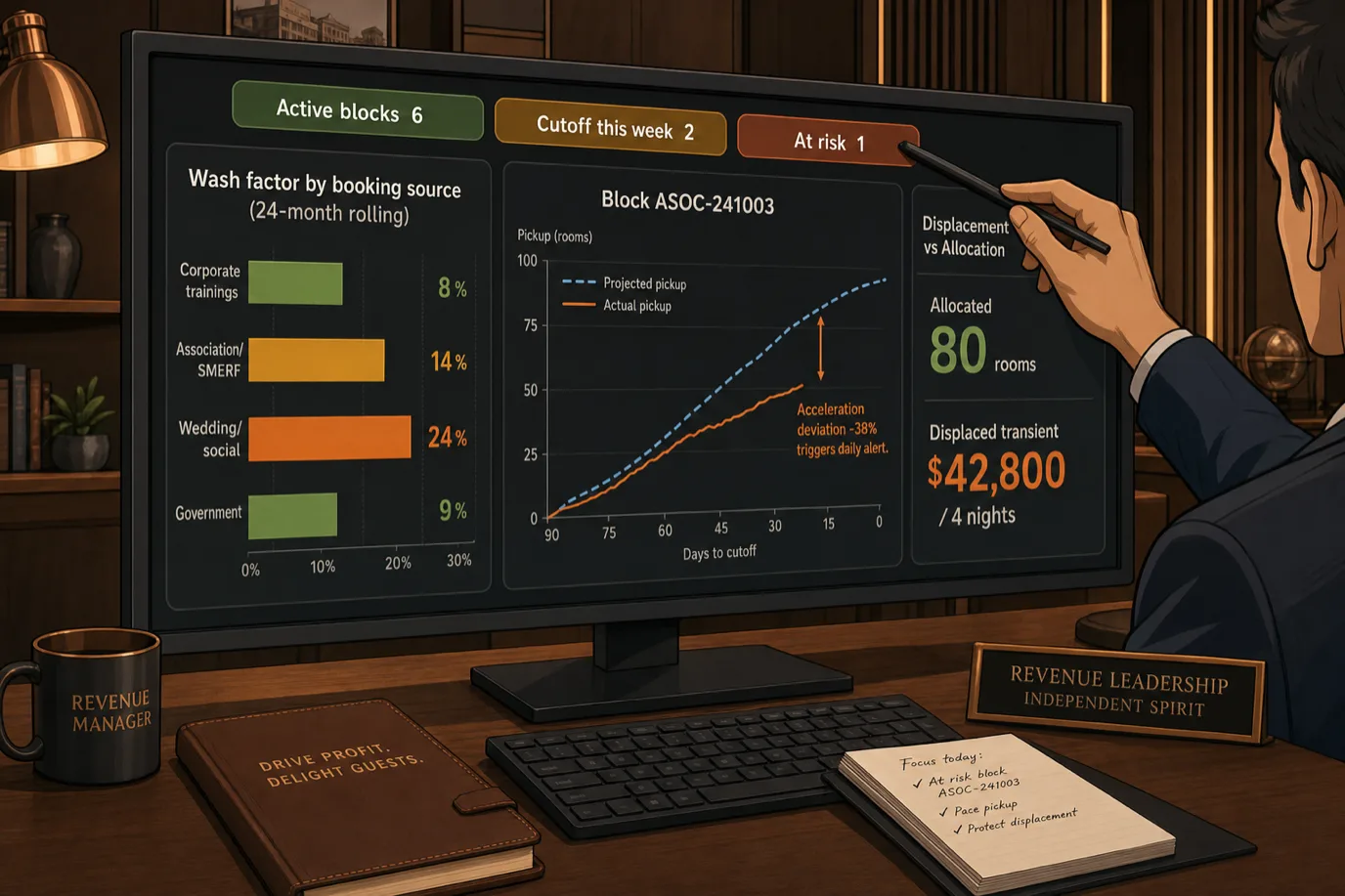
Most PMS tools report a single property-wide wash factor (typically calculated as 1 minus the ratio of consumed rooms to contracted rooms, averaged across all groups in the period). The number is between 8 percent and 22 percent at most independents, and it gets quoted at every contract negotiation as if it were a property constant. It is not a constant. It varies enormously by booking source, group type, season, and lead time. The corporate-training block booked 75 days out for a 60-room group from a top-100 enterprise client has a typical wash of 6 to 9 percent. The wedding block booked 280 days out for a couple's family-and-friends contract has a typical wash of 22 to 31 percent. Treating both as 14 percent (the property average) systematically under-prices the corporate group and over-prices the wedding.
The correct number to track is wash factor by booking source over a 24-month rolling window, with at least four segments (corporate, association/SMERF, wedding/social, government). Properties that do this find that their average is misleading by 40 to 60 percent on individual segments, and they can adjust attrition clauses, rate negotiations, and block sizing accordingly. The math is not difficult. The operational discipline is to actually run it.
Number 2: Pickup curve acceleration, not just pickup count
The standard PMS pickup report shows the count of reservations made against the block over time. What it usually does not show is the acceleration: the day-over-day change in pickup rate. A block running at 4 percent daily pickup at 45 days out is going to land at a very different place than a block running at 1.2 percent daily pickup at the same point. The acceleration number is the predictive variable. The pickup count is just history.
The correct calculation is daily new pickup divided by remaining days to cutoff, projected forward to the cutoff date as a final-pickup estimate. A simple version of this can be a 7-day rolling average of new pickup, multiplied by remaining days. A more sophisticated version weights recent days more heavily and adjusts for known volatility events (a holiday, a major calendar item). Either is dramatically better than what most PMS tools produce, which is a static pickup count that the DOSM has to mentally extrapolate.
Number 3: Displaced transient, not allocated rooms
Most PMS tools show the rooms held in the block as "allocated" and treat them as inventory committed away from transient. That accounting is mechanically correct but economically misleading. The relevant number is not allocation. It is displaced transient demand. Allocated rooms that would not have sold to transient anyway (because demand is soft on those dates) have zero displacement. Allocated rooms on a date that would have run 91 percent occupancy at $228 BAR have nearly full displacement at the marginal rate.
The correct calculation is: unconstrained transient demand for the date and rate band, minus the constrained demand that would have booked given the rate ladder, summed over the affected room-nights, valued at the marginal rate. The most accurate version of this requires a forecasting model that can distinguish constrained from unconstrained demand. The pragmatic version uses the unconstrained transient pickup curve from the same date band 12, 26, and 52 weeks back, adjusted for booking pace, as a proxy for what would have happened without the block. The displacement number changes the conclusion of the contribution analysis on most blocks. Hotel demand forecasting in 2026 walks the unconstrained-vs-constrained calculation in detail.
Number 4: Group rate effective, not headline
The contracted group rate is one number. The effective group rate (after concessions, comp rooms, suite night allocations, and rebates) is another. A $148 rate with 1 in 40 comp on cumulated room nights, a 5 percent rebate to the planner, and a complimentary suite for the speaker has an effective rate closer to $129. That difference is 14 percent on a substantial revenue line. Most PMS tools report the headline rate. Few report the all-in effective rate. Almost none report the effective rate net of contracted but unconsumed F&B credits.
The correct number is the all-in effective rate, calculated as: (total room revenue actually settled) / (total room nights consumed), with all concessions in dollars subtracted and all rebates in dollars added back as a separate line. Tracking this across booking sources lets the property see which third-party intermediaries are systematically negotiating effective rates 8 to 12 percent below what the contract suggests, which is data the DOSM needs to push back at the next round of contract negotiations.
Number 5: Attrition fee realised, not attrition fee billed
The PMS will produce an attrition fee billed amount based on the contract. The realised amount, after disputes, partial payments, write-offs, and the operational cost of collection, is consistently lower. At the 27-property sample, the average attrition fee realised was 71 percent of attrition fee billed, with a long tail of disputed cases that took 90+ days to settle. Properties that report attrition fee billed in their group recap are systematically over-stating contribution. Properties that report attrition fee realised, with a separate disputed-attrition line, get a more honest picture and can identify booking sources that systematically dispute attrition (and therefore deserve tighter contract language on the next round).
Number 6: Group F&B contribution, not F&B revenue
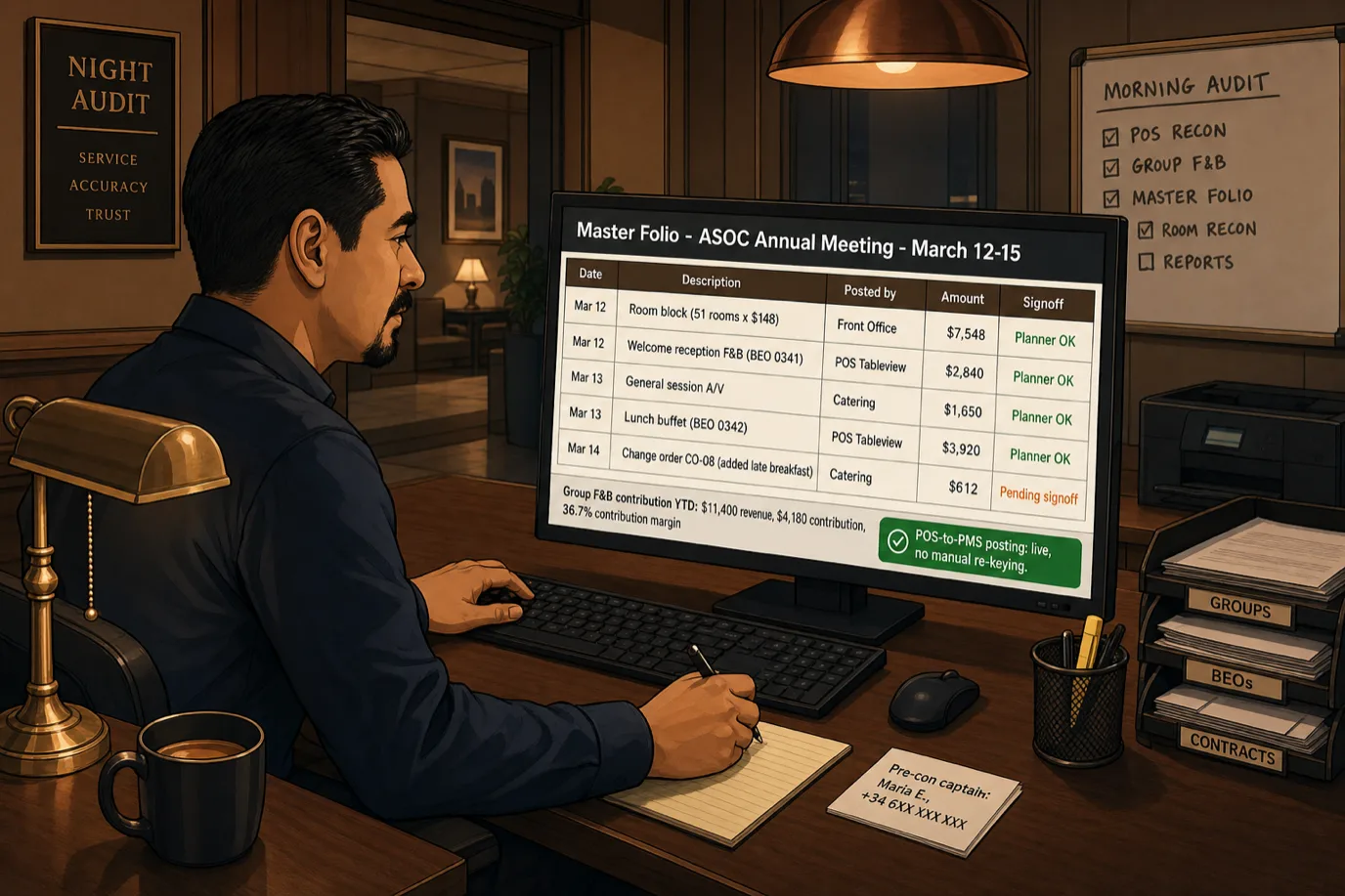
Most PMS tools show group F&B at the revenue line. F&B revenue without F&B cost is not a useful number. A $14,000 F&B minimum that ran at $11,400 of consumed F&B with a 38 percent food-cost ratio and a 55 percent labor-cost ratio contributed roughly $700 to the bottom line, not $14,000. Properties that include F&B revenue in the group contribution number without subtracting F&B operational cost are systematically over-stating group performance, sometimes by 25 to 40 percent on F&B-heavy events.
The correct number is group F&B contribution, calculated as F&B revenue minus food cost minus directly-attributable labor cost minus A/V cost. The labor allocation is not trivial (event labor is often shared with regular outlet labor on the same day), but the principle is to apply the same operational rigor to group F&B contribution that the property already applies to outlet F&B. The F&B charge posting from the POS through to the master folio matters here, and F&B charge posting from POS to PMS covers the integration mechanics that make this number recoverable.
The nine operational failure modes
The numbers above are the math layer. Below the math layer is the operational layer, which is where most groups actually leak revenue at independent hotels. Across the 27-property sample we have group data on, nine failure modes appeared with enough frequency to call them the typical pattern. Three of them are contract issues. Three are PMS or workflow issues. Three are people-and-process issues. They compound. A property running clean on six of the nine is unusual. A property running clean on all nine is rare.
Failure 1: Cutoff released late or not at all
The contracted cutoff date is in the system. The release does not actually happen on that date. The block continues to hold inventory beyond cutoff, the rooms are not in the transient pool when they should be, and the rate ladder stays artificially compressed for an extra 3 to 14 days. The cause is almost always that the release is a manual step in the PMS, the night auditor responsible did not catch it, and no automated check flagged the missed release.
The fix is to make cutoff release a scheduled event, not a manual one. The PMS should release the unbooked rooms at midnight on the contracted cutoff date, post a transient-released event to the audit log, recompute the forecast, and notify the revenue team that the rate ladder may need adjustment for the now-late-window inventory. None of this is technically hard. It is a configuration decision that most independents have not pushed their PMS vendor to make on their behalf.
Failure 2: Attrition clause with soft resale language
The contract includes a resale clause that requires the hotel to notify the booking party of resold rooms within 48 hours, or that credits the booking party at the resold rate even when below contract, or that uses "best efforts to resell" language without a defined operational obligation. Each of those clauses gives the booking party an exit on attrition fees that the contract should not have provided.
The fix is to defend the resale language at contract time. The standard 2026 language reads (paraphrased): the property may resell vacated rooms at any rate, the booking party is credited only on a per-room-per-night basis when the resold rate equals or exceeds the contract rate, the credit is the lesser of the resold rate or the contracted rate, and reconciliation occurs at final settlement. Planners with options will push back. Most planners do not actually have that much room to walk if the property has real alternatives on the date. Walking away from a 2 percent of contracts where the planner refuses standard language is usually a positive contribution-to-effort trade.
Failure 3: F&B minimum structured around inflated headcount
The F&B minimum in the contract is structured per-attendee at the planner's expected headcount. The planner has overstated headcount to look generous in the proposal. The actual attendance is materially lower. The F&B consumed is significantly under the contracted minimum. The contract may or may not require the planner to make up the difference. Even if it does, the F&B operational cost was sized for the higher headcount, and the food waste alone is substantial.
The fix is to structure F&B minimums as absolute floors rather than per-attendee, with renegotiation rights at a defined trigger point if attendance deviates from the contracted assumption by more than 15 percent at a milestone date. This shifts headcount risk back to the planner, which is where it belongs. Planners who refuse this structure are signaling that they themselves do not believe their headcount is real, which is information.
Failure 4: Pickup monitoring weekly, not daily
The DOSM looks at pickup once a week in a Friday revenue meeting. By the time a block's pickup curve has visibly flattened, it is too late to call the planner and intervene meaningfully. Daily monitoring with automated alerts on acceleration deviation catches blocks that are off track in time to do something about it.
The fix is a daily pickup-acceleration report that highlights blocks in any of three categories: blocks running 25 percent or more below projected pickup, blocks within 14 days of cutoff with pickup below 50 percent of contract, and blocks with high-value contracts (over $50K of room-night value) regardless of pickup status. This should be 5 minutes of attention from the DOSM each morning, not a weekly project.
Failure 5: Master folio discipline too loose
The master folio for the group accumulates room charges, F&B, A/V, and incidentals throughout the event, and at settlement the booking party sees a number that does not reconcile cleanly to what they remember signing for. Disputes arise. The hotel ends up writing off line items it could have collected if the documentation had been cleaner.
The fix is daily folio reconciliation during the event, not just at settlement. The contracted line items (room block, F&B minimum, A/V package, contracted comp rooms) should be visible to the planner via a daily folio summary that they signs off on each evening. Off-contract additions (the planner's late requests for more A/V, the keynote speaker's room change, the F&B order added at 4 PM) should be captured on a numbered change order with the planner's signature before posting. This is operational discipline, not a tooling problem, but the tooling has to support it. F&B charge posting from POS to PMS covers the POS integration that lets group F&B post cleanly to the master folio without manual re-keying.
Failure 6: No displacement analysis pre- or post-contract
The hotel signs blocks at planner-target rates without running the displacement math. The post-event recap reports gross revenue without displacement adjustment. Both decisions look fine in isolation. Together they create a cumulative gap between what group business actually contributes and what the property thinks it contributes, which is typically 12 to 22 percent on flexible-rate blocks at compression-period dates.
The fix is to run displacement analysis at two points: pre-contract, to inform the rate negotiation, and post-event, to recap honestly. Both calculations rely on having an unconstrained transient demand model for the property, which most independents do not have but which a forecasting tool that knows the difference between historical bookings and historical demand can produce.
Failure 7: Rate shopping not monitored around block dates
The block was contracted at $148 in October for a March arrival. By February the BAR for the same dates is at $228 because demand surfaced that nobody anticipated. The block is now contracted at a rate that is 35 percent below the unconstrained rate, the planner is congratulating themselves, and the hotel has no automatic mechanism to push back. Some contracts include "best available rate" or "rate guarantee" clauses that protect against this in either direction, but most do not.
The fix is to monitor BAR drift on contracted dates and flag any block where the contracted rate has fallen more than 20 percent below current BAR. The hotel cannot unilaterally raise the contracted rate, but it can tighten the cutoff date, push back on extension requests, and adjust attrition negotiation posture on the next round. Properties that monitor this find that 8 to 14 percent of their group blocks at any given moment are at rates that materially under-price the dates, and operational responses (cutoff tightening, attrition discipline) can recover 4 to 8 percent of the gap.
Failure 8: No named on-property contact during event
The DOSM negotiated the block, the conferences manager owns the BEO, the catering manager owns F&B, the front office owns rooming list, and on the day of the event the planner has six different people they might need to talk to. The planner ends up talking to the front desk supervisor about an A/V issue, the catering manager about a rooming list update, and the night auditor about a billing question, with no single owner accountable for the event going right.
The fix is a named on-property captain for every group of more than 10 rooms, identified in the pre-con meeting and on the printed BEO, with a phone they actually answer and a single email address that routes to them. This is a process change, not a tooling change, but it has the highest correlation with positive post-event reviews and re-booking intent of any operational change observable in the sample.
Failure 9: Post-event recap using the wrong numbers
The post-event recap reports revenue at headline rates, F&B at top-line revenue, attrition at billed (not realised), and no displacement adjustment. The number at the bottom is consistently 15 to 30 percent higher than the actual contribution. The DOSM uses the inflated number to defend the contract terms on the next negotiation. The cycle continues.
The fix is the recap built on the six numbers from the previous section: wash factor by source, pickup curve final, displaced transient, effective rate, attrition realised, and F&B contribution net of cost. The recap is then comparable to other revenue lines (transient, OTA channel, direct) on a contribution basis, which is the only basis on which strategic decisions about group business should be made.
Contract clauses worth defending in soft markets
Most independent hotels use a contract template that originated in either the ASAE / Cvent standard set or in a regional hotel association template, with property-specific modifications layered in over years. The template is usually fine. The negotiation pattern is where revenue gets given away. There are six clauses where the right-hand side of the negotiation routinely understates the property's hand, and where independents could be defending more aggressively.
The cutoff date is the first. Standard templates suggest 30 days. Planners routinely ask for 14 days, and DOSMs routinely sign at 21 or 14 because the planner is "the customer" and short cutoffs feel reasonable. Short cutoffs are a free option for the planner: they get to hold inventory closer to arrival without committing, which costs the hotel rate compression on the late-window transient demand. The right answer is 21 to 30 days for transient-demand markets and 14 to 21 days only on dates with no transient upside. A planner who insists on 14 days on a high-demand date is asking for a concession the hotel should be priced for, not a free option.
The attrition forgiveness percentage is the second. Standard contracts come in at 80 percent (the group can wash 20 percent without penalty). Soft-market planners push to 70 percent or 65 percent. Tight-market planners push to 90 percent. The right number depends on the segment and the date band. For corporate-training blocks at top-tier clients, 85 to 90 percent is realistic because these planners actually deliver close to contract. For wedding blocks, 75 percent is appropriate because the wash factor is higher and the property absorbs more risk. For association blocks on peak dates, 90 percent is defensible because the alternative properties are unlikely to undercut. Going below 75 percent is giving away contract protection that the property is unlikely to recoup elsewhere.
The attrition billing percentage on rooms not picked up is the third. Standard contracts bill at 80 to 100 percent of the contracted rate. Some contracts soften this to 50 percent if the room was resold at the same or higher rate. The right number is 100 percent at the contracted rate for rooms not resold and a defined credit only for rooms resold at or above contract. Anything else is a free option for the planner.
The F&B minimum structure is the fourth. Standard contracts come in as per-attendee minimums at the planner's projected headcount. The right structure for the property is an absolute floor (the F&B minimum is a defined dollar amount, not a function of attendance), with a renegotiation right if attendance deviates by more than 15 percent at a milestone date. This shifts headcount risk to the planner, which is the correct allocation.
The cancellation clause is the fifth. Standard contracts use a sliding scale (10 percent of contract value if cancelled more than 90 days out, 25 percent at 90 to 60 days, 50 percent at 60 to 30 days, 75 percent at 30 to 14 days, 100 percent inside 14 days). The numbers are reasonable. The language often is not. The clause should explicitly call out that cancellation fees are due in full at the cancellation date, not at the originally contracted arrival date, and should specify the dispute process for force-majeure claims. Force-majeure language is where pandemic-era blocks lost the most revenue, and 2026 contracts should be tighter.
The payment terms and deposits structure is the sixth. Standard contracts ask for 25 percent at signing, 25 percent at 90 days out, 50 percent at 30 days out, with the master folio settling at check-out. The structure is reasonable, but the deposit at signing is the protection against a no-show planner. Properties that defer the deposit to "after the rooming list is final" or "30 days before arrival" are unprotected against the planner walking away in the 60-day window, which happens more often than independents acknowledge. Holding the line at 25 percent at signing is worth the negotiation friction.
The displacement math by segment
Displacement is the single largest variable in determining whether a group block is a positive or negative contribution to the property. The math is conceptually straightforward. The mechanics depend on the segment.
Segment 1: Corporate training blocks
Corporate training blocks are the most predictable group segment. The booking party is a known enterprise client. The headcount is realistic. The wash factor is low (typically 6 to 10 percent). The F&B is structured around in-room or contracted breakfast and a working lunch. These blocks book 60 to 120 days out, run on weekday dates that often have softer transient demand, and are usually right-sized for the property's capacity.
The displacement on corporate blocks is typically low (the dates are not compression dates), which means the rate negotiation can be more aggressive in favor of converting the block. The right operating posture for corporate training is to compete hard on rate to convert, defend tight cutoffs, and run a clean post-event recap to support the next year's contract. These are usually the highest-contribution blocks in the property.
Segment 2: Association and SMERF blocks
Association blocks (industry conferences, professional groups) and SMERF blocks (social, military, educational, religious, fraternal) are the most variable. Wash factor ranges from 12 to 22 percent. Booking lead times are long (180 to 365 days). The dates are often shoulder dates with mixed transient demand. The F&B is event-heavy and contributes meaningfully if priced and operated well.
The displacement on association blocks depends heavily on the date band. Spring and fall dates in conference markets are often compression dates with high displacement. Summer and winter dates in the same markets are often soft with low displacement. The right operating posture is to run displacement analysis on each block at contract time, accept the block at planner-target rate when displacement is low, and counter at displacement-adjusted rate when displacement is high. Properties that do not do this systematically over-deliver to associations on high-demand dates.
Segment 3: Wedding and social blocks
Wedding and social blocks have the highest wash factor (18 to 28 percent), the longest lead time (typically 280 days for weddings, 180 days for other social), and the most volatile pickup curves. The booking party is a couple or a family, and they are systematically over-projecting headcount because that is what social booking parties do.
The displacement on wedding blocks is segment-specific. Saturday weddings on summer or fall dates in a leisure market have very high displacement against transient leisure demand. Friday weddings on shoulder dates have lower displacement. The right operating posture for wedding blocks is to size the block conservatively (75 to 80 percent of the planner's request, with explicit notice that additional rooms can be added at contract rate up to a deadline), structure F&B as absolute floor not per-attendee, and protect the cutoff aggressively. Wedding blocks contribute well when these terms hold. They leak revenue badly when they do not.
Segment 4: Government and contract blocks
Government and federal contract blocks have a different shape. Rates are often set by per-diem regulations (in the United States, the GSA per-diem rate for the location), wash factors are typically low (8 to 12 percent), and the booking discipline is high. The downside is that the rate is rate-capped and not negotiable upward, which means the property cannot capture compression upside on these blocks even if demand surfaces.
The displacement on government blocks is straightforward: they are usually positive on shoulder and weekday dates, negative on weekend and compression dates. The right operating posture is to accept government blocks aggressively on shoulder dates (where they fill rooms that would otherwise sell at lower rates) and decline on compression dates (where the per-diem rate is well below what transient demand would support). Properties that do not segment government acceptance by date band are leaking revenue on the compression-date acceptances.
A 30-day operational playbook
The above is a lot of theory. Most properties reading this article are running group business in 2026 that already has some of these problems baked in, and the question is what to do about it without disrupting the calendar. The 30-day playbook below is the sequence we use with properties that want to clean up group operations without rewriting every active contract.
Days 1 to 7: Baseline and audit
The first week is data work. Pull the last 24 months of group blocks from the PMS into a spreadsheet (or a real reporting tool if available). For each block, capture: contracted block size, picked-up rooms, consumed rooms, contracted rate, effective rate, F&B contracted minimum, F&B consumed, attrition billed, attrition realised, and the 7-day-prior pickup count. From this dataset, calculate wash factor by booking source over the 24-month window, and split into at least four segments.
While the data work is happening, audit five to ten of the most recent contracts for each of the nine failure modes from earlier. The audit is not about assigning blame. It is about identifying which failure modes are recurring at this property, so the rest of the playbook focuses on fixing what is actually broken rather than what an article suggested might be broken.
By end of day 7, the property should have: a wash factor table by source, a list of the three to five most common failure modes at this property, and a rough estimate of the contribution gap between reported and actual group performance over the past 12 months.
Days 8 to 14: Quick wins and system fixes
Week two is the quick-win window. Three changes that have high ROI and low operational disruption:
The first is automating the cutoff release. If the PMS supports scheduled cutoff releases, configure them on every active block. If the PMS does not support this natively, build a daily check (a query, a script, a calendar reminder) that surfaces blocks reaching cutoff in the next 7 days and ensures the release happens. This catches the failure-1 leak immediately on every active block.
The second is starting daily pickup-acceleration monitoring. The DOSM or revenue manager spends 5 minutes each morning looking at three numbers: blocks 25 percent or more behind projected pickup, blocks within 14 days of cutoff with under 50 percent pickup, and blocks with over $50K of room-night value regardless of pickup. Any block in any of those buckets gets a phone call or a written outreach to the planner that day.
The third is updating the standard contract template with the defended language from the contract clauses section. The new template applies to all RFPs from this point forward. Existing contracts are not retroactively renegotiated, but new business from week two onwards is on better terms.
Days 15 to 21: Displacement analysis and recap discipline
Week three introduces displacement analysis to the contract evaluation flow and to the post-event recap. Both calculations rely on having an unconstrained transient demand model for the property. If that does not exist, the pragmatic version uses historical transient pickup at the same date band 12, 26, and 52 weeks back as a proxy.
The displacement analysis at contract time becomes a one-page worksheet that the DOSM completes before responding to the RFP. The post-event recap becomes a one-page template that the DOSM completes after settlement, replacing whatever recap currently exists. Both worksheets carry the same six numbers (wash factor, pickup curve final, displaced transient, effective rate, attrition realised, F&B contribution net), so the pre-contract estimate and the post-event actual are directly comparable. Variance between estimate and actual becomes the data that calibrates the next contract negotiation.
Days 22 to 30: People, process, and the pre-con
Week four addresses the people-and-process failures: named on-property captains for every group of more than 10 rooms, daily folio reconciliation during multi-day events, and a tightened pre-con meeting that covers each of the contracted clauses, the BEO, and the named captain. The pre-con becomes the single forcing function that surfaces operational gaps before they become disputes at settlement.
By end of day 30, the property should have: scheduled cutoff releases on every active block, daily pickup monitoring, an updated contract template, displacement analysis built into pre- and post-contract worksheets, named on-property captains, and a tightened pre-con discipline. The compounding effect across the next 6 to 12 months is typically a 6 to 14 percent improvement in group contribution on a comparable book of business, with the largest gains on the segments that were leaking the most before the cleanup.
The decision matrix by segment
Different property segments have different group-block economics, and the right operating posture varies. The matrix below summarises the practical recommendations for each segment based on the 27-property sample and the operational pattern observed.
For an urban transient property of 80 to 180 rooms with a meaningful corporate calendar (typical $200 to $320 ADR, 65 to 75 percent annual occupancy, mixed compression and shoulder dates), the right group operating posture is: aggressive corporate training acceptance on weekdays and shoulder dates, selective association acceptance with displacement analysis driving rate, careful wedding acceptance with conservative block sizing, and government acceptance on shoulder dates only. Cutoff dates 21 to 30 days, attrition forgiveness 80 to 85 percent, F&B as absolute floor. The DOSM target should be 18 to 26 percent of total room nights from group business, with a contribution-per-occupied-room within 8 percent of the transient comparable.
For a leisure resort of 100 to 240 rooms with seasonal demand (typical $300 to $600 ADR, 55 to 70 percent annual occupancy, peak summer or winter dates), the right posture is: very selective wedding acceptance on peak dates with high rates, aggressive association acceptance on shoulder seasons, careful corporate retreat acceptance with attention to F&B and A/V contribution, no government per-diem acceptance on peak dates. Cutoff dates 30 days minimum on peak seasons, attrition forgiveness 75 to 80 percent on peak (lower than urban because the wash factor is structurally higher), F&B as absolute floor with renegotiation rights. Group target 12 to 22 percent of total room nights, with weddings concentrated on shoulder season Saturdays where displacement is moderate.
For a boutique luxury property of 30 to 80 rooms (typical $600+ ADR, 60 to 70 percent occupancy, brand-aware clientele), the right posture is: highly selective acceptance of any group business at all, with rates that protect the brand position and contribution per room above the transient average. Most groups should be declined. The ones accepted should be high-touch corporate retreats, small destination weddings at the upper end of the rate band, and association blocks for organisations whose membership matches the property's positioning. Cutoff dates 30 days, attrition forgiveness 80 to 90 percent, F&B as absolute floor at meaningful minimums. Group target 8 to 14 percent of total room nights at most.
For an extended-stay property of 80 to 200 rooms (typical $140 to $220 ADR, 75 to 85 percent occupancy, longer average length of stay), the right posture is: aggressive corporate-relocation and project-based group acceptance, careful crew block acceptance with attention to operational impact (housekeeping crews need different room-prep workflows), selective association acceptance only on shoulder dates. Wash factor on extended-stay groups is structurally lower because the booking party is usually project-locked. Cutoff dates can be tighter (14 to 21 days) because the dates are usually known well in advance. F&B is less material so the F&B clause negotiation is less important. Group target 22 to 35 percent of total room nights.
For a budget select-service property of 80 to 180 rooms (typical $90 to $150 ADR, 65 to 75 percent occupancy), the right posture is: competitive on corporate training and association blocks at limited rates, accept government per-diem aggressively, decline weddings except for very small blocks with attractive F&B contribution, accept crew blocks aggressively (airline, sports). The economics here are driven by occupancy not rate, which means group blocks that fill base load are valuable even at modest rate concessions. The math reverses on compression dates where transient demand could fill the rooms at higher rates. Cutoff 21 days standard, attrition 75 to 80 percent, F&B less material because most F&B is in-room or breakfast-only. Group target 25 to 40 percent.
Where Prostay closes the group block loop
The operational pattern described above breaks at two specific places at most independent hotels. The first is at the data layer: the PMS does not natively track the six numbers that matter, the wash-factor-by-source calculation does not exist, the pickup-acceleration view is not in the standard reporting, and the displacement analysis requires a separate forecasting tool that has to be manually reconciled with the group block data. The second is at the workflow layer: the cutoff release is manual, the daily pickup monitoring is somebody's calendar reminder, the master folio reconciliation is a spreadsheet the night auditor maintains in parallel with the PMS, and the post-event recap is hand-built. Both breaks compound. A property that has cleaned up the data layer but not the workflow layer ends up with great reports that nobody acts on. A property that has cleaned up the workflow layer but not the data layer ends up acting on the wrong numbers reliably.
Prostay is built to close both gaps at the PMS level rather than as a bolted-on group module. Group block management is a first-class object in the system. The contract terms (rate, cutoff, attrition forgiveness, attrition billing percentage, F&B minimum, payment milestones) live alongside the block inventory. Pickup is tracked in real time against the contracted block with daily acceleration calculations. Cutoff releases are scheduled events that fire automatically with audit-log entries. The master folio for the group accumulates room charges and posts F&B charges from the integrated POS without re-keying. The post-event recap pulls from the same data that drove daily operations, so the displacement-adjusted contribution number is one click away rather than a two-hour spreadsheet build.
The displacement analysis runs on the same forecasting model the property uses for transient revenue management. Because the model already tracks unconstrained vs constrained demand, the displacement number for a contemplated block is a calculation the PMS can produce at the time of the RFP response, not a question the DOSM has to answer with a gut estimate. The chargeback workflow ties to the master folio: a dispute on a group transaction surfaces the contract, the BEO, the change orders, the daily folio reconciliation signoffs, and the settlement record together, which is the documentation that drives representment win rates from the typical independent's 30 percent up to the disciplined-property 60 to 70 percent range. Hotel chargebacks: reduce by 60 percent walks the broader chargeback workflow that group blocks need to plug into.
Where this matters most operationally is the place that the DOSM in the Madrid example was sitting at 11 PM the night before her GM presentation. The post-event recap should not be a manual stitching job. The numbers should be the right numbers from the start. The pre-con meeting should look at the contract clauses with displacement context, not just the contracted rate. The daily pickup monitoring should be 5 minutes of attention, not a meeting agenda item that gets dropped when the week is busy. None of this is a software feature. It is the operating posture that good independents are starting to adopt and that the right tooling supports rather than fights against.
What to do on Monday morning
The honest summary of this article is short. Group block management at independent hotels in 2026 is a place where most properties are leaving 6 to 14 percent of group contribution on the table because the standard tooling, the standard contract templates, and the standard operational habits have all drifted. The fix is the six numbers from the math section, the contract clauses worth defending, the nine failure modes you can audit your own property against, the displacement math that should drive pricing, the segment-specific posture that should drive acceptance, and the 30-day playbook that closes the operational gaps without disrupting active contracts.
If your property is currently running group business and you have read this far, three things to do on Monday morning. First, pull the last 12 months of group blocks and calculate wash factor by booking source. The number will surprise you on at least one segment. Second, audit your last five contracts against the six clause categories from the contract section, and identify which language you can defend tighter on the next round. Third, set a daily 5-minute calendar item to look at pickup acceleration on every active block, and make sure cutoff releases are scheduled events on every block reaching cutoff in the next 30 days.
That gets the property 60 percent of the operational improvement available. The remaining 40 percent is the data and workflow integration that a properly built PMS handles automatically, and that the team in front of Prostay is happy to walk through if the post-Monday-morning audit suggests there is a structural gap to close. Request a demo when you want to see the group block workflow run live against your own data.