
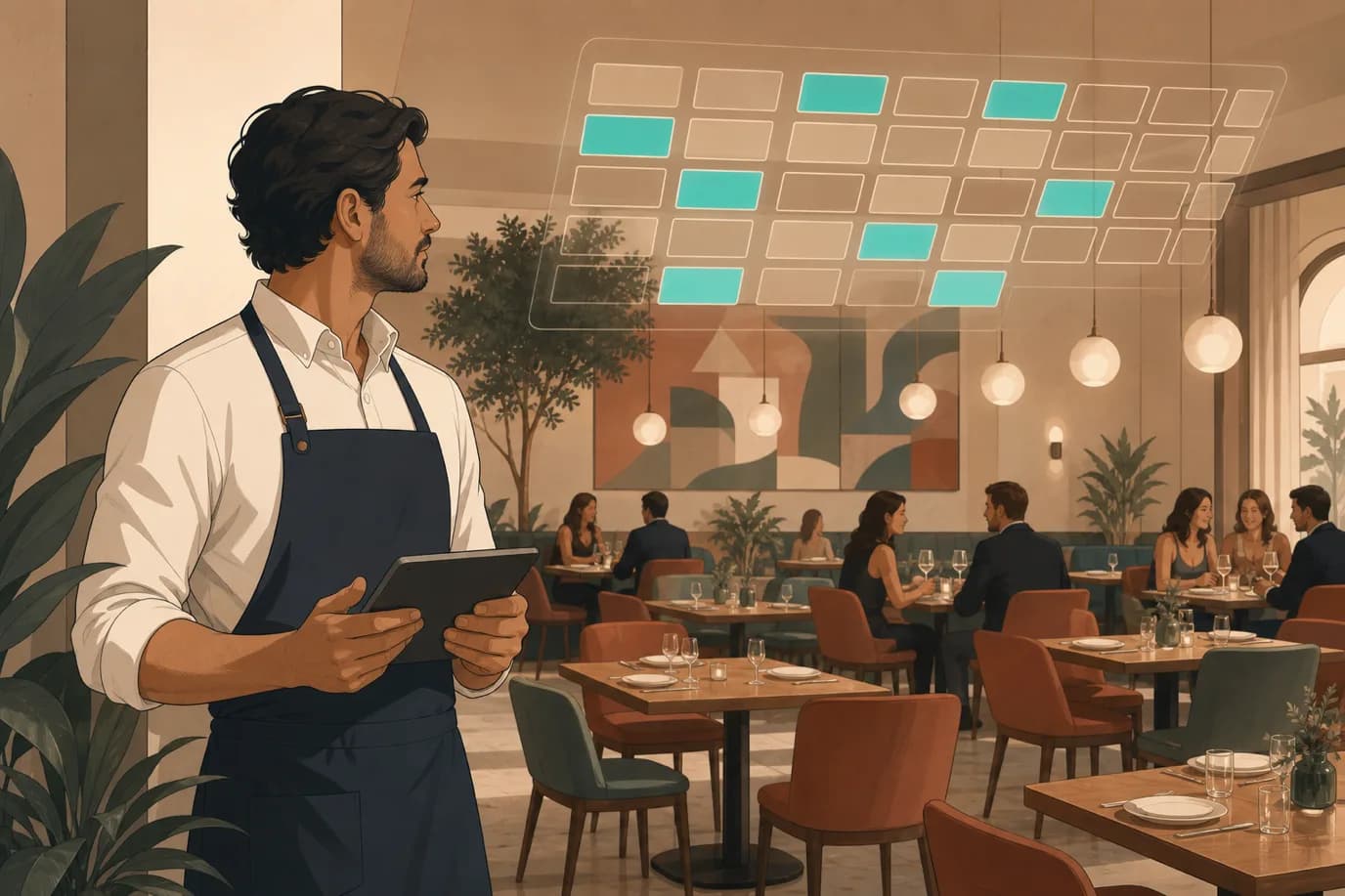
Most restaurants track two numbers religiously: covers and average check. Both can rise while the business gets quietly worse. Push the average check up by 8% and lose a table turn on a Friday night, and you have traded a busy, profitable room for a slower, emptier one that looks better on the daily report. That blind spot exists because covers and average check both ignore time, and time is the only inventory a dining room actually sells.
RevPASH, revenue per available seat hour, closes it. Borrowed from hotel revenue management, where RevPAR long ago replaced arguments about rate versus occupancy, it treats a seat for an hour as a perishable unit: unsold at 7 p.m., it is gone forever, exactly like an empty room night. This guide covers the formula and the arithmetic that makes it click, how to read the number hour by hour rather than as a daily average, what realistic benchmarks look like, and the four levers that actually move it, plus the specific way it behaves in a hotel restaurant where breakfast, in-house guests and banquets distort every simple version of the metric.
What RevPASH Is and Why Covers and Average Check Mislead You
Covers count people. Average check counts spend per person. Neither counts capacity or time, so both can be flattered by a shrinking business. A dining room that serves 40 guests at 60 looks identical, on average check, to one that serves 40 guests at 60 in half the hours, and the second is twice the business. RevPASH is the composite that resolves this, because it moves only when something real changes: you filled more seats, guests spent more, or tables turned faster.
The mental model that makes it stick is the hotel one. Hoteliers stopped arguing about whether rate or occupancy mattered more when RevPAR made the trade-off visible in one figure, the reasoning our explainer on what RevPAR is lays out, and the same argument settled by our comparison of RevPAR versus ADR plays out nightly in restaurants between managers who want higher checks and managers who want faster turns. RevPASH is the referee: it does not care which lever you pull, only whether the seat-hour earned more.
The RevPASH Formula, With Worked Numbers
The calculation is deliberately simple: RevPASH equals total revenue divided by available seat hours, where available seat hours are seats multiplied by hours open.
Take a 90-seat restaurant open from noon to 10 p.m., so ten hours and 900 available seat hours. Revenue of 10,800 gives a RevPASH of 12.00. Now split the day, because the daily figure is where the useful information goes to hide. If dinner from 6 p.m. to 10 p.m. produced 8,200, that is 360 seat hours at a RevPASH of 22.78, while the six hours from noon to 6 p.m. produced 2,600 across 540 seat hours, a RevPASH of 4.81. One restaurant, two completely different businesses, and only the split version tells you where to spend your attention.
Two disciplines keep the number trustworthy. Count only the seats you genuinely staff and sell: including a terrace you open twice a summer, or a private room that sits dark, depresses the metric for reasons that have nothing to do with performance. And be consistent about what revenue you include, food and beverage from that room, excluding banquet or room-service revenue that does not occupy those seats, or your trend line will measure your bookkeeping rather than your dining room. Once it is clean, RevPASH slots naturally alongside the operational measures in our hotel KPI guide, as the F&B counterpart to the rooms metrics.

Reading RevPASH Hour by Hour
The daily RevPASH is a headline; the hourly curve is the diagnosis. Plot it for a normal week and the shape tells you what kind of problem you have. A tall, narrow peak with long flat shoulders is a demand-shifting problem: your kitchen and dining room can clearly perform, but only for ninety minutes a day. A broad, low plateau across a full service is usually a turn-time or table-mix problem, since the seats are occupied but not earning. A peak that flattens at the top, rising to a ceiling and refusing to go higher no matter how busy the door is, is a capacity or pacing constraint, and it is the most valuable finding of all because it means you are turning away money at your best hour.
Two comparisons matter more than any absolute figure. Compare like hours across like days, this Thursday's 8 p.m. against the last four Thursdays at 8 p.m., because a restaurant's weekly rhythm is stronger than most managers assume. And measure the spread between your peak hour and your trough hour: that gap is your realistic upside, expressed in the only unit that pays wages. All of it depends on hour-level revenue data, which is why the metric lives or dies on a point of sale that timestamps every check and can report by hour, service and section rather than only by day.
Benchmarks: What Good Looks Like
RevPASH scales with your price point, which makes cross-restaurant comparison close to meaningless and is the reason the metric is often taught badly. A bistro with a 25 average check and 75-minute turns and a fine-dining room with a 120 check and a single leisurely sitting can land within a point of each other despite running opposite business models. Anyone quoting a universal RevPASH target is selling you something.
Use it against yourself instead, with three internal benchmarks. Your own trailing trend, same service, same weekday, over eight to twelve weeks, which strips out seasonality and shows whether operational changes are working. Your peak-hour ceiling, the best RevPASH you have ever recorded in that service, which is proof of what the room can do rather than a theory. And your trough-to-peak ratio, where any hour running below roughly a third of your peak is an hour worth attacking rather than accepting. For hotel restaurants there is a fourth: the same service on high-occupancy versus low-occupancy nights, which quantifies how much of your F&B business actually comes from in-house guests, a number most hotels guess at and our guide to food and beverage revenue in hotels explores in depth.
Lever 1: Turn Time Without Rushing Guests
Turn time is the fastest lever and the one most often mishandled, because managers try to shorten the meal when the money is in the dead time around it. Break the turn into its parts: seating, ordering, kitchen pace, the wait for the bill, payment, clearing and resetting. Guests notice a rushed meal instantly, but nobody has ever complained that their bill arrived promptly or that the table was reset efficiently. That is where the minutes are, and they are worth real money: on a 900 seat-hour day at a 22 dinner RevPASH, shaving eight minutes of dead time off each turn across a busy service routinely adds a few hundred in revenue without touching the guest experience.
Two practices do most of the work. Pay at the table, so the ten-minute round trip to a terminal disappears, and the transaction closes while the guest is still seated and comfortable. And a clear reset standard with a named owner per section, so a vacated table does not sit dirty for six minutes because everyone assumed someone else had it. Both changes are operational rather than technological, but both are far easier when the POS closes checks from a handheld and pushes table status to the floor in real time, the integrated setup described in our guide to POS and PMS integration.
Lever 2: Table Mix and Seating Discipline
The largest hidden loss in most busy dining rooms is seating a party of two at a table for four. Every such decision converts two saleable seat-hours into zero, and on a full Saturday a room that does it fifteen times has silently closed a section. Auditing party-size distribution against table inventory is unglamorous work that regularly pays better than any marketing campaign: most restaurants are built with too many four-tops because that is what furniture showrooms sell, while their actual demand is dominated by twos.
The fixes are physical and procedural. Flexible tables that combine and separate, so the room reshapes to the night's actual party mix rather than the mix someone imagined during the fit-out. A seating policy that protects the large tables for large parties during peak hours instead of giving them to whoever arrives first. And communal or bar seating for walk-in twos, which converts the most common party size into revenue at a density a four-top can never reach. Pacing belongs here too: booking every table for 8 p.m. produces a kitchen crisis and a lower RevPASH than staggering the same covers across 7, 7:30 and 8, and the staffing side of that calculation is covered in our guide to hotel staff scheduling.

Lever 3: Menu Mix and Spend Per Hour
Raising the average check raises RevPASH only if it does not cost you a turn, which is why the menu lever is about spend per hour rather than spend per guest. A 90 tasting menu that occupies a table for three hours can earn less per seat-hour than a 45 à la carte meal served in ninety minutes. The right question is never what a dish costs or even what it contributes, but what it contributes per minute of table time.
That reframes menu engineering usefully. Items that are high-margin and quick to fire deserve prominence, particularly at peak hours. Items that are slow to prepare or slow to eat belong in the quieter services where the seat-hour has no alternative buyer. And the add-ons that lift spend without adding table time, an aperitif taken while ordering, a coffee and digestif that would otherwise be skipped, are pure RevPASH gains, which is why the systematic approach in our menu engineering guide pairs so naturally with this metric. Cost control sits underneath all of it: RevPASH measures revenue, not profit, so a rising figure means little if food cost is drifting, the discipline our guide to restaurant inventory management exists to enforce.
Lever 4: Shifting Demand Into Empty Hours
The trough hours are where the largest absolute gains live, because they start near zero. A 4.81 RevPASH afternoon in the worked example above has vastly more headroom than a 22.78 dinner, and moving it even to 8 is worth more than squeezing another point out of peak service. The tools are the same time-based pricing instincts hotels apply to rooms: early seating offers with a real reason to come at 6 p.m. rather than 8, a distinct afternoon proposition rather than a sad version of the dinner menu, and events that give a dead Tuesday a purpose. The pricing logic mirrors our dynamic pricing strategy guide, applied to seat-hours instead of room-nights, and the demand-reading discipline is the same one in our guide to hotel demand forecasting.
One caution that separates this lever from a discount habit: a promotion that fills a trough hour at a low check is usually good business, because the alternative was an empty seat, but the same promotion bleeding into peak hours destroys value by displacing full-price demand. Fence the offers by time as strictly as a hotel fences a mobile-only rate.
RevPASH in a Hotel Restaurant
Hotel F&B breaks naive RevPASH in three specific ways, and each has a clean fix. Breakfast is the first: it is high-volume, low-check, often included in the room rate, and it will crush a combined figure while telling you nothing. Measure breakfast separately, and if it is included, either exclude it or credit it at the internal transfer value the rate allocates, the accounting question our hotel breakfast guide works through. Second, banquets and events use different space and often different staff, so keep banquet revenue out of the dining-room calculation entirely or it will mask a weak restaurant behind a strong events month. Third, in-house demand means your covers correlate with occupancy, so always read RevPASH alongside the night's occupancy: a flat figure on a high-occupancy night is a genuine capture problem, and the tools for fixing it, in-room promotion, check-in mentions, pre-arrival messaging, are the same ones covered in our guide to hotel upselling.
The practical requirement behind all three is that restaurant and hotel data sit in one system: checks posting to room folios, F&B revenue landing in the same ledger as rooms, and reporting that can slice a Tuesday dinner by hour and by whether the guest was staying with you. That single-platform picture is the argument our guide to hotel F&B operations makes at length, and the reason hour-level metrics like this one are trivial to produce on a connected stack and nearly impossible on a disconnected one, as our hotel automation guide explains.
Key Takeaways
RevPASH is revenue divided by seats multiplied by hours open, and it matters because it is the only common restaurant metric that prices time. Covers and average check can both improve while the business shrinks; RevPASH cannot. Calculate it per hour and per service, never only per day, count only the seats you actually sell, and compare it against your own trailing trend, your peak-hour ceiling and your trough-to-peak spread rather than against other restaurants, whose price points make the comparison meaningless.
The four levers are dead time in the turn, table mix and pacing, menu mix measured per minute of table time, and demand shifted into trough hours with time-fenced offers. In hotels, separate breakfast and banquets from the dining-room figure and always read it against occupancy. All of it needs hour-level data from a POS that timestamps checks and posts revenue where finance can see it. If you want to see RevPASH by hour, by section and by service against your own numbers, with F&B posting straight to the folio and the ledger, a Prostay demo is the fastest way to look.