
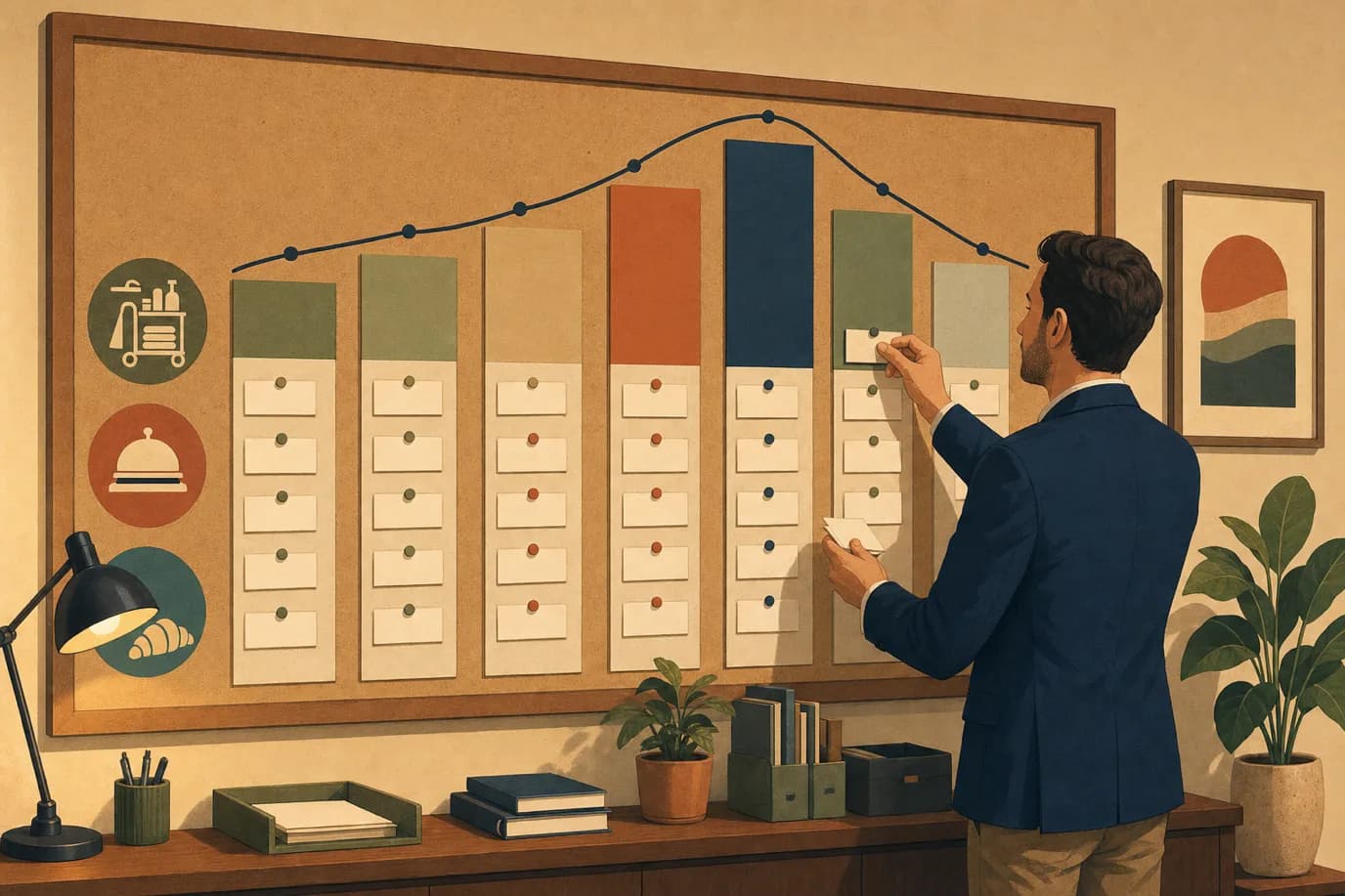
Walk into the back office of most independent hotels on a Thursday afternoon and you will find someone building next week's schedule the same way: open last week's grid, move a few names around for holidays and requests, print, pin to the board. It takes twenty minutes and it feels like admin. It is not admin. Payroll is the largest controllable cost in any hotel, usually 30 percent of revenue or more, and the weekly schedule is the document where that cost is actually decided. Every other cost conversation in the industry, energy, linen, OTA commissions, is an argument about single-digit percentages. The schedule moves the biggest line on the P&L every single week, and most properties produce it by photocopying the past.
This guide is about doing it properly: building the schedule from your occupancy forecast instead of from habit, department by department, with the standards that turn tomorrow's arrivals into today's staffing decision. The raw material already exists in your property management system, which knows exactly how many departures, stayovers and check-ins each day will bring. And because scheduling failures surface first as communication failures, the desk that did not know a group was arriving, the housekeeper who found out about the room block from a guest, the coordination layer matters too, which is where a shared operations hub like Prostay Nexus earns its place. But the tools come second. The discipline comes first, and it starts with admitting what the copy-paste schedule actually costs.
The Most Expensive Document in Your Hotel
Put numbers on it. A 50-room property running typical service levels might carry 25 to 35 people across housekeeping, front desk, breakfast, maintenance and management, and spend somewhere between 30 and 40 percent of every revenue euro on them. Against that, consider what the schedule controls: whether six housekeepers show up on a day with eleven checkouts, whether the front desk runs one agent short through a forty-arrival evening, whether the same two people drift into overtime every week because the rota was thin on paper and reality made it thinner.
Each of those failures has a price, and the prices compound in both directions. Overstaffing is the quiet one: nobody complains, the shift is pleasant, and you pay for hours that produced nothing, week after week, invisible because the payroll report arrives monthly and aggregated. Understaffing is the loud one: check-in queues, rooms not ready at three, a breakfast service that runs out of everything, and its costs land in the review score and the turnover statistics rather than the payroll line, which makes them easy to misattribute. The industry's brutal turnover numbers, with many properties losing the majority of their hourly staff within a year and housekeeping churning fastest of all, are usually discussed as a hiring problem. A large share of it is a scheduling problem: unpredictable hours, last-minute changes and chronically understaffed shifts are the top reasons hourly hotel workers give for leaving, and every departure costs real money in recruiting, training and the months of reduced productivity while the new hire ramps up.
The Copy-Paste Schedule, and Why It Fails in Both Directions
The copy-paste schedule survives because it contains real information: last week's grid encodes years of accumulated judgment about who works well together, who covers which section, roughly how many people a normal day needs. The problem is the word normal. The copied schedule staffs every week for an average week, and average weeks barely exist. Occupancy at most properties swings 20 to 40 points between the softest and strongest days of a single week, and the copied schedule flattens all of it into the same crew, arriving at the same times, regardless.
Run the two failure cases. On the soft Tuesday, the full housekeeping crew arrives at eight for a morning with nine checkouts; by eleven the corridors are quiet, the pace slows to fill the shift, and the labor hours per occupied room quietly double. Nothing looks wrong. On the compressed Friday, the same crew faces thirty-eight checkouts and a full house arriving from three; rooms are not ready, the desk absorbs the anger, two attendants stay late into overtime, and the property pays premium wages to deliver its worst service of the week. Same schedule, both directions wrong. The copy-paste grid does not even fail consistently, which is why it evades diagnosis: some weeks it happens to fit, and the weeks it does not are remembered as bad luck rather than as the output of a method that ignores the only input that matters.
Schedule From the Forecast, Not From Last Week
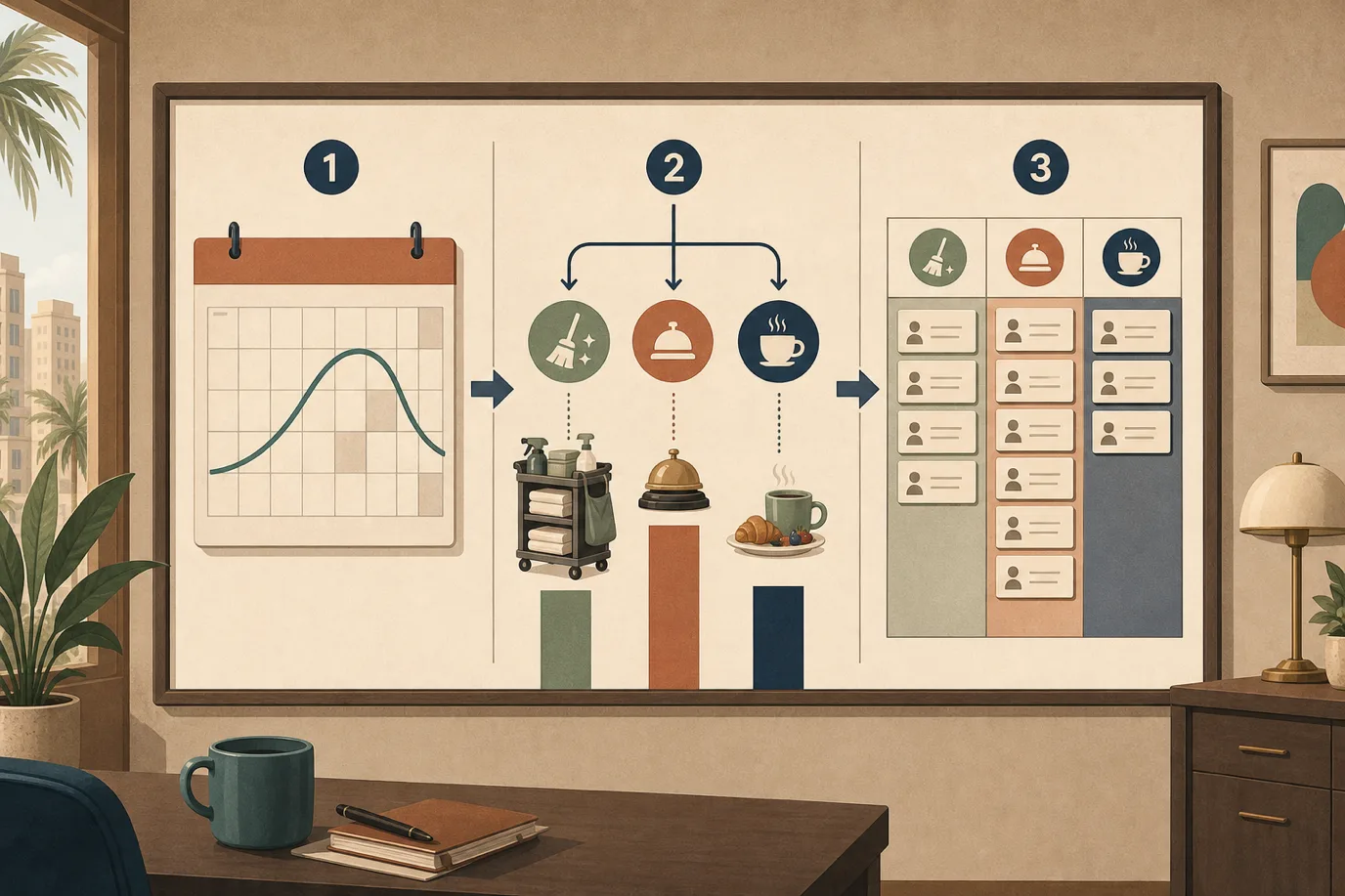
The alternative is neither complicated nor new; large chains have run it for decades under the name labor management. Scaled to an independent property it is three steps. First, get the forecast: your PMS already shows rooms on the books for each of the next fourteen days, and adding expected pickup, the bookings that typically still arrive for a date at that lead time, turns it into a working occupancy forecast. You do not need data science; on-the-books plus the pickup pattern from the same period last year is accurate enough to schedule against, and it beats last week's grid by a distance.
Second, convert the forecast into demand per department, because departments do not experience occupancy, they experience its derivatives. Housekeeping demand is departures plus stayovers, two very different workloads. Front desk demand is arrivals and departures by hour. Breakfast demand is last night's occupancy times your capture rate. A 90 percent occupied Tuesday where nobody checks out is a light housekeeping day and a heavy breakfast one; the forecast has to be read department by department, not as a single number.
Third, convert demand into hours using standards, and only then put names into shifts. This is the step that changes the conversation around the schedule: instead of arguing about whether Tuesday feels like a five-person day, you are applying an agreed formula to an agreed forecast, and the argument, when there is one, is about the standard, which is a much better argument to have.
Department Standards: Turning Occupancy Into Hours
A standard is just a productivity assumption made explicit. The housekeeping version is credits: a full-time room attendant handles 13 to 16 checkout cleans per eight-hour shift, more if the rooms are small and clustered, fewer if they are large or spread across buildings, and roughly double that count for stayover refreshes. The front desk version is transactions per agent-hour: one agent comfortably handles 15 to 20 check-ins per hour when arrivals flow evenly, fewer when every arrival needs parking explained and restaurant bookings made. Breakfast has covers per server; laundry has kilos per hour; even maintenance has a standard, in preventive tickets per week. Set them from your own history rather than industry tables where you can: three months of your PMS housekeeping reports will tell you what your team actually achieves, which beats any benchmark. Write the standards down, revisit them twice a year, and resist the temptation to inflate them, a standard the team cannot meet does not cut labor cost, it cuts corners.
Housekeeping: The Biggest Department and the Biggest Waste
Housekeeping deserves its own section because it is the largest department in almost every hotel and the place where forecast-based scheduling pays back fastest. The core insight is that housekeeping workload is not occupancy, it is checkouts. A full house of stayovers is a light day; a half-full house that entirely turns over is a heavy one. Your PMS knows tomorrow's departures precisely, tonight, which means the housekeeping schedule is the one place where you are not even forecasting, you are reading.
Start times are the second lever. The traditional pattern starts the full crew at eight, but if checkout is at eleven and check-in at three, the morning hours have only stayovers and yesterday's leftovers to work on, and the real crunch runs from eleven to three. Stagger the starts: a small early team for stayovers, early departures and public areas, the bulk of the crew from ten or eleven, and the day ends with rooms ready when arrivals actually begin rather than with a becalmed morning and a frantic afternoon. Sequence the cleans against the arrivals list too: the PMS knows which specific room types are needed first, and a board that prioritises arriving-guest rooms over empty-tonight rooms buys the desk hours of slack. And track the quiet killers, the out-of-order room that sat unsellable for nine days because nobody owned the reopening date, the deep-clean program that only happens in the weeks someone remembers, because both are scheduling problems wearing maintenance costumes.
Front Desk: Staff the Curve, Not the Clock
The front desk is traditionally scheduled in three flat shifts, morning, evening, night, as if demand were flat. It is not. Demand at the desk is two humps: a departure hump from seven to eleven and an arrival hump from three to eight, with a long valley in between and a deep one overnight. Flat shifts overstaff the valleys and understaff the humps, which is how a property with perfectly adequate total desk hours still ends up with a queue at five in the afternoon.
Schedule the curve instead. Overlap shifts across the arrival hump rather than changing over in the middle of it; put the second agent on a mid shift that covers eleven to seven instead of a mirror of the morning; move check-in preparation, registration cards, key packs, billing checks on departing folios, into the valley hours so the humps are pure guest time. Look at your own arrivals-by-hour report before believing any generic pattern: a property near an airport with red-eye arrivals has a different curve from a countryside hotel where everyone arrives by car at six. The report exists in your PMS; most properties have simply never opened it for scheduling purposes. Where volumes are small, pair the desk curve with cross-training, covered below, because the honest answer to the two-hour afternoon valley at a 30-room property is not a bored agent, it is an agent who also runs the housekeeping board or works the bar.
Food and Beverage, Maintenance and the Night Shift
Breakfast staffing follows last night's occupancy times your capture rate, the share of in-house guests who actually show up, which is remarkably stable per segment once you measure it: business guests capture differently from leisure families, groups differently from independents. The PMS knows tonight's occupancy and mix, so tomorrow's breakfast crew is another read rather than a guess, and the same logic scales for a restaurant or bar with in-house-driven demand. Groups deserve special handling everywhere in the schedule: a forty-person tour arriving Thursday changes housekeeping's Friday, breakfast's Friday and Saturday, and the desk's Thursday evening, and that information sits in the group block weeks ahead. A weekly fifteen-minute scheduling huddle across department heads, with the group calendar open, prevents most of the surprises that end in overtime.
Maintenance and the night shift are the fixed-looking departments that reward a second look. Preventive maintenance is schedulable by definition, and the soft weeks the forecast identifies are precisely when the deep cleans, filter changes and room-by-room inspections should be booked, turning low occupancy from a cost problem into a capacity gift. The night audit, meanwhile, is one person almost everywhere, but what that person can safely do besides the audit, security rounds, breakfast setup, folio preparation, depends on the property, and loading the night shift with day-shift leftovers is a quiet way to improve the whole rota's economics without adding an hour anywhere.
Cross-Training: Turning Fixed Labor Into Flexible Labor
Every department scheduled in isolation carries its own buffer: the extra housekeeper in case of a spike, the second desk agent in case of a rush, the spare server in case the capture rate jumps. Stack those buffers across four departments and a small property is carrying two or three full-time positions of pure insurance. Cross-training collapses the buffers into one shared pool. The desk agent who can run breakfast service, the breakfast server trained on stayover cleans, the housekeeper who handles laundry, each trained overlap means one paid hour can answer more than one kind of demand, and the schedule needs less padding everywhere.
The payoff shows up in the ugly moments that define small-property operations: the housekeeper who calls in sick on a thirty-checkout morning, the surprise late-evening group check-in, the breakfast rush that outruns the forecast. With trained overlap, the answer is a reshuffle; without it, the answer is overtime, corners cut, or a manager doing three jobs badly. It also compounds retention: staff with broader skills see a path upward, and the industry's own studies keep finding that development opportunity ranks alongside pay in why hourly staff stay. Two cautions from properties that have done it well: pay for the added skill, a trained-across employee is worth more and knows it, and schedule the training itself into soft weeks rather than treating it as something that happens in mythical spare time.
The pool extends beyond your payroll, too. A deliberately built bench of part-timers, the student who wants Friday and Saturday evenings, the retired housekeeper happy to cover school-holiday weeks, the neighbouring property you swap banquet staff with, is the difference between flexing for a spike and paying overtime for it. The bench only works if you invest in it during the quiet months: people who never get hours drift away, so give every bench member a small regular rhythm of shifts, keep them trained on your systems, and they will still answer the phone on the morning you genuinely need them. Properties that treat casual staff as an emergency purchase get emergency prices and emergency quality; properties that treat the bench as part of the roster get flexibility at straight-time rates.

Fair Schedules Are Cheaper Schedules
Scheduling discussions usually frame cost and staff wellbeing as a trade-off. In hotels the evidence runs the other way: the practices that make schedules fair are the same ones that make them cheap, because the biggest hidden labor cost is turnover and the biggest driver of hourly turnover after pay is schedule chaos. Publishing two weeks ahead, on the same day every week, cuts call-outs because people can actually plan childcare and second jobs around their shifts. Honouring availability and rotating the unpopular shifts visibly, instead of letting them pool on whoever complains least, removes the grievance that sours whole teams. Keeping hours steady, rather than swinging someone from forty hours to eighteen and back, keeps your part-timers from drifting to the hotel across town that promises consistency.
None of this is charity. Every avoided departure saves a recruiting cycle, weeks of training, and the months where a section runs slow while the new hire learns the building. Every avoided call-out saves the premium of same-day cover or the service cost of running short. The forecast-based method helps here too, in a way that is easy to miss: schedules built from a formula feel fair in a way that schedules built from a manager's mood do not, and when hours do have to flex down in a soft period, showing the forecast makes it an explanation rather than an accusation.
Rest Rules, Notice Periods and the Law You Forgot
Scheduling is also a compliance surface, and the rules have been tightening. The EU Working Time Directive's floors, eleven consecutive hours of daily rest, a 24-hour weekly rest on top, the 48-hour average cap, bind every European property, and national law often goes further. A spreading family of predictive scheduling laws in US cities and elsewhere requires advance notice of schedules, with penalty pay for late changes. Minors on the breakfast shift, maximum consecutive workdays, split-shift rules in some countries: the details vary, but the pattern is uniform, the copy-paste schedule drifts into violations precisely because nobody is checking each week's grid against the rules, and the fines arrive with back-pay claims attached. A schedule built deliberately each week is also the schedule where compliance gets checked deliberately each week.
The Four Numbers That Tell You If It Is Working
Forecast-based scheduling needs a feedback loop, and four numbers provide it. Labor cost percentage, total labor cost against revenue, is the strategic gauge: watch the monthly trend, and investigate whenever it rises faster than revenue explains. Labor hours per occupied room is the operational gauge and the one to watch weekly, because it strips out wage levels and shows pure scheduling efficiency; if HPOR is creeping up at stable occupancy, hours are leaking somewhere, and the department split will say where. Overtime share of total hours is the early-warning light: chronic overtime in one department is not dedication, it is a forecasting or standards failure surfacing as premium pay. And ninety-day new-hire retention is the long-cycle gauge of whether your schedules are sustainable for the humans working them, because the schedule is usually the first thing a new hire learns to resent. All four come out of data you already have, payroll plus the PMS, and fifteen minutes with them each week is the difference between managing labor and discovering it.
Where Prostay Fits
Everything above runs on information the property management system already holds. The occupancy forecast, the departures and stayovers by day, the arrivals by hour, the group blocks, the housekeeping board with its credits and priorities: in Prostay these are live screens rather than monthly exports, which means the person building Thursday's schedule is reading the same numbers the revenue side prices from. The housekeeping module sequences cleans against actual arrivals and tracks who is carrying how many credits, which is the standards conversation made visible. And the coordination failures that turn good schedules into bad days, the group nobody told breakfast about, the maintenance block the desk did not know, the shift swap that never reached the right person, are exactly what a shared operations hub like Prostay Nexus exists to catch, with every department reading from one stream instead of five whiteboards. The schedule is a plan; the platform is how the plan survives contact with the week.
The copy-paste schedule is comfortable, fast and roughly right often enough to survive. But roughly right, applied weekly to your largest controllable cost, is an expensive habit, and the alternative is not software or consultants, it is a different twenty minutes: forecast first, hours second, names last. The properties that make that switch stop discovering their labor cost on the payroll report and start deciding it, one week ahead, where it has always actually been decided.