Ask a hotelier what they are short of and the answer is nearly always people. Watch the shift instead, and a different answer appears: the receptionist retypes a booking from one screen into another, updates two extranets by hand, prints a registration card, chases housekeeping on the radio, and reminds a guest by email that breakfast exists. None of that is hospitality. All of it is coordination, and coordination is exactly what software automates. Most hotels do not have a staffing shortage; they have an automation shortage that the staffing shortage exposes.
This guide is the full map of hotel automation in 2026: what can actually be automated across reservations, the guest journey, operations, pricing and finance; what should stay stubbornly human; the time and revenue numbers that justify the project; the order to roll it out without breaking a live operation; and the structural choice, one integrated platform or a stack of bolted-on tools, that decides how much of the promise you actually collect. The short version of the thesis: automation is not about replacing people, it is about letting a modern property management system do the retyping so your people can do the welcoming.
What Hotel Automation Actually Means
Strip away the vendor language and hotel automation is one idea: events in one system trigger actions in another without a person in between. A booking lands on an OTA and appears in the calendar, adjusts availability everywhere, schedules its own confirmation email, joins tonight's arrivals list and tomorrow's housekeeping board, and posts its own deposit, untouched. A guest checks out, and the room flips to dirty, the folio closes, the invoice issues, the journal entry posts, and the review request queues itself for the afternoon.
Two boundaries keep the term honest. Automation is not a robot in the lobby; the hardware experiments make headlines, but the returns live in the unglamorous software layer. And automation is not the same as AI, although they now overlap: classic automation follows rules you configure (when X happens, do Y), while the newer AI layer handles judgment inside the rules, drafting a reply in the guest's language, quoting a rate for an odd-length stay in WhatsApp, deciding which room assignment fits a preference. The strongest 2026 stacks use both: rules for the plumbing, AI for the conversations, of the kind our guide to artificial intelligence in hospitality covers in depth.
The Automation Map: What a Hotel Can Automate in 2026
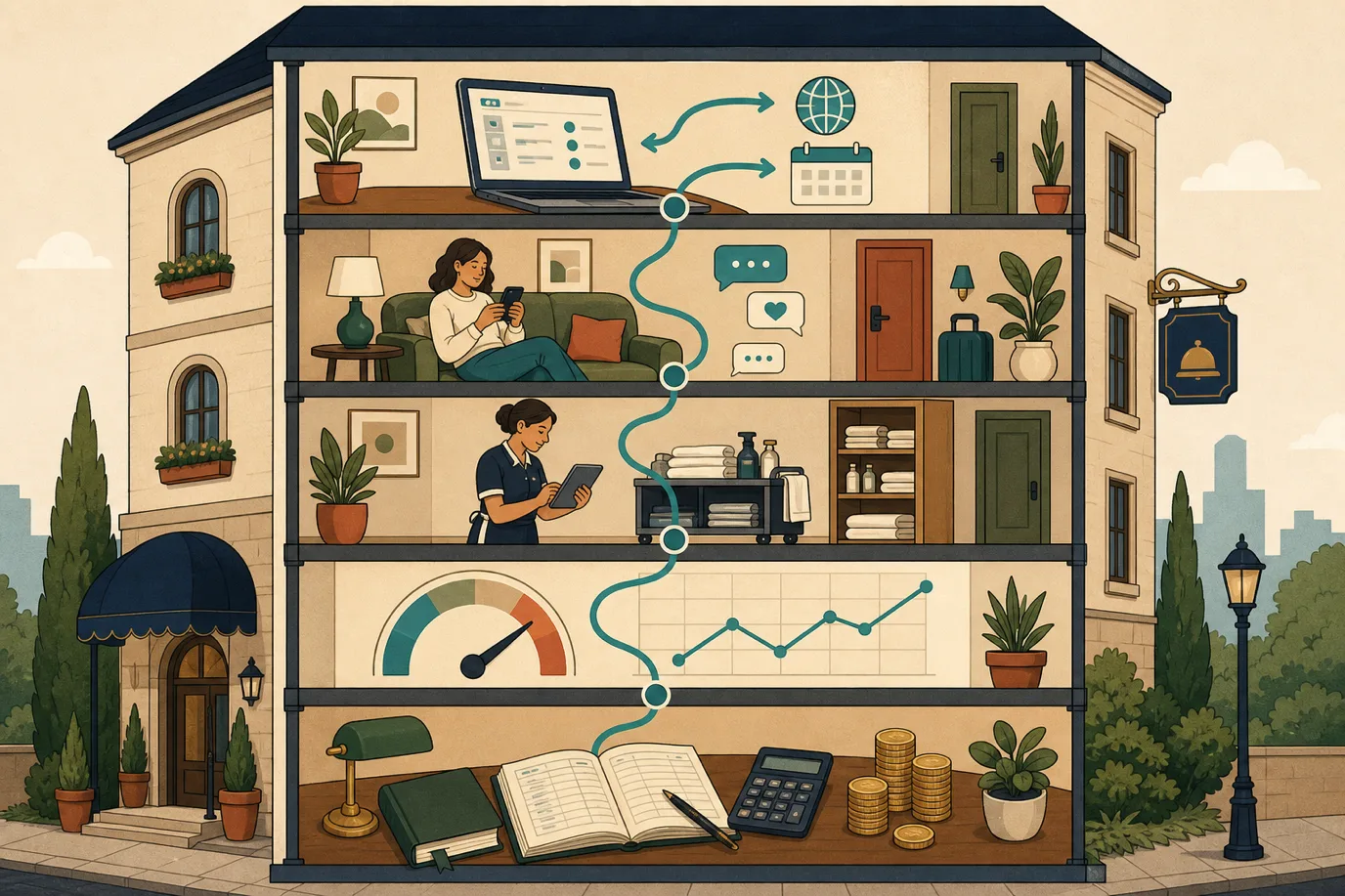
It helps to see the whole board before choosing moves. Five layers, ordered roughly by how much manual work each removes.
Reservations and Distribution
Distribution is where automation pays first, because manual distribution is both the most tedious and the most expensive work in the building: every hand-updated extranet is minutes lost, and every sync lag is a potential double booking. An integrated channel manager makes rates, availability and restrictions flow to every OTA the moment they change, and pulls every booking straight into the PMS, no retyping, no overbooking window, no rate disparity between channels. The failure modes it eliminates are expensive enough that we wrote a separate anatomy of them in our guide to channel manager sync issues.
The same layer automates the direct channel: a booking engine that sells in real time from live inventory, takes payment, offers add-ons at the moment of booking and writes the reservation into the system, turning the website from a brochure into a sales desk that works while you sleep.
The Guest Journey: Booking to Checkout
Guest communication is the most visible automation and the easiest to get wrong, so the principle matters: automate the predictable, personalise the exceptional. The predictable cycle, instant confirmation, a pre-arrival message a few days out with directions and one well-chosen upsell, day-of-arrival check-in instructions, a mid-stay how-is-everything, a checkout summary and a review request, runs on triggers and reaches every guest every time, which no front desk juggling phones can promise. Done well it reads as attentiveness, and the pre-arrival window converts remarkably well, as our pre-arrival email playbook shows.
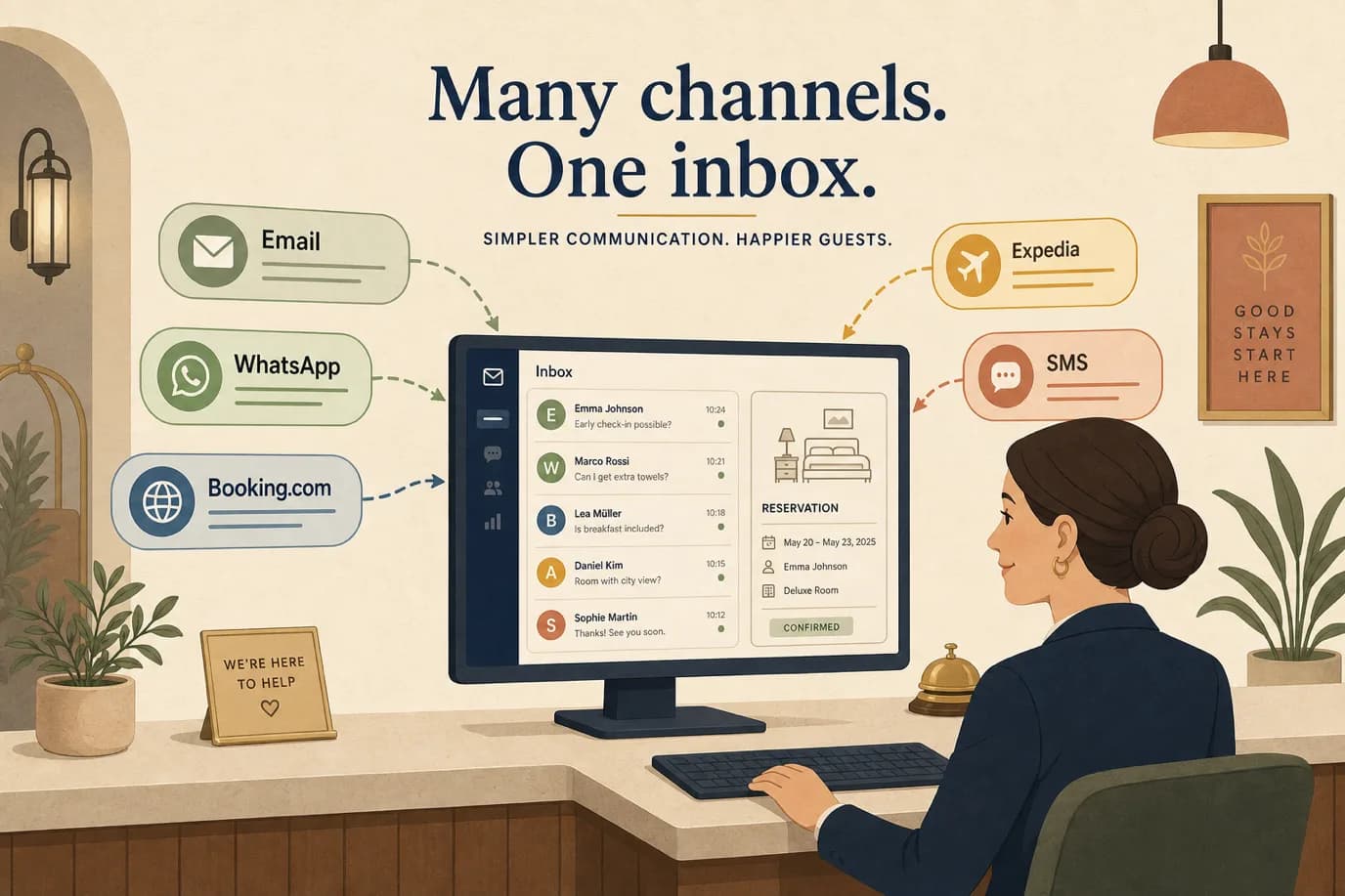
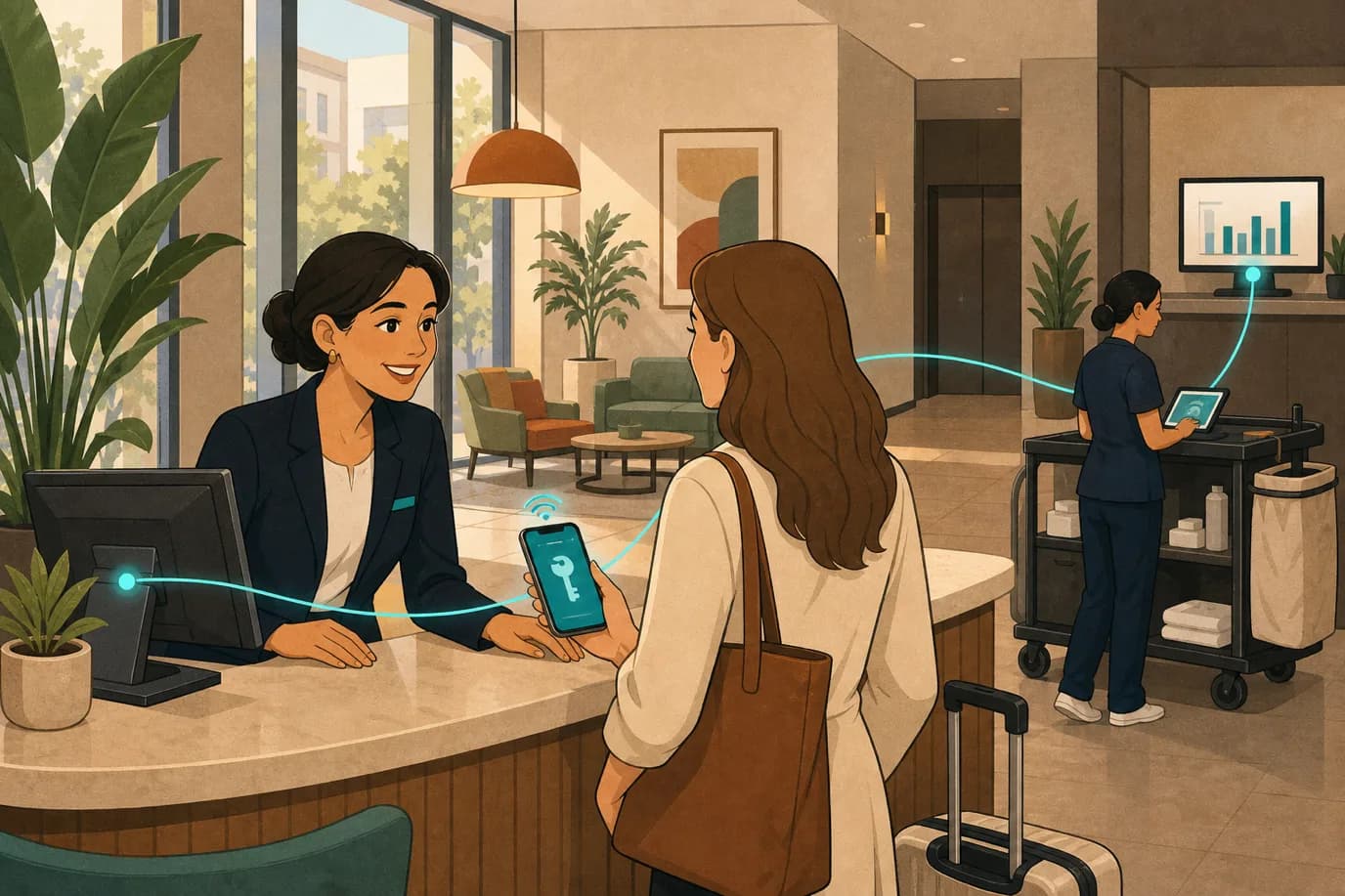
The arrival itself is now a choice, not a queue: online check-in that collects registration data and payment before the guest lands, a kiosk or mobile key for those who want to walk straight up, and a staffed desk for those who want a person, covered end to end in our guide to contactless check-in. And the newest layer answers before anyone books: AI guest messaging that quotes, books and answers questions in WhatsApp, SMS and email around the clock, in the guest's own language, converting the enquiries that used to die in an inbox overnight. The same conversational layer increasingly powers the phone and the front desk, as covered in our guide to the AI reservation agent.
Front Office and Housekeeping Operations
Inside the operation, automation is scheduling and status. The housekeeping board rebuilds itself each morning from departures, stayovers and arrivals, assigns rooms by section, and updates in real time as attendants mark rooms done from a phone, so reception stops asking the radio whether 204 is ready and the system simply knows; the wider toolset is covered in our guide to housekeeping software. Maintenance tickets open themselves from inspection checklists and recur on schedule for the boiler that needs quarterly attention. Task lists for the front desk generate from the day's events, early arrivals flagged, VIP amenities queued, and the shift handover stops depending on a paper notebook and one person's memory.
Revenue and Pricing
Manual pricing means someone looks at next month's calendar when they have time, which is never, and adjusts rates by feel. Automated pricing watches occupancy pace, pickup, day-of-week patterns and demand signals continuously, and moves rates within the guardrails you set, small adjustments, hundreds of times a season, in both directions. A revenue management system does the watching; you keep the strategy: floors, ceilings, how aggressively to chase demand. Alongside price, the same layer automates the paperwork of revenue, rate-plan restrictions applying themselves, minimum stays lifting when pace slows, and the daily flash report arriving without anyone assembling it, the practices our guide to revenue management strategies turns into a playbook.
Finance and the Back Office
The least visible automation is the one accountants love most. Payments run on policy instead of memory: cards validated at booking, deposits captured on schedule, balances settled at checkout, no-shows charged per the cancellation terms, every transaction landing on the right folio. The night audit, historically a human staying up to roll the business date and reconcile the day, becomes a process the system runs itself, as covered in our guide to the hotel night audit. Past the audit, invoices issue themselves with correct taxes, city-tax reports assemble from the guest ledger, and journal entries post to the accounts without a monthly export-and-import ritual, the full argument of our piece on automated hotel accounting. Finance automation has no glamour and enormous returns: it is where errors are most expensive and where nobody ever wanted the manual work in the first place.
What Should Stay Human
The strongest case for automation is what it buys back for people, so the honest guide also draws the other line. Complaints and service recovery stay human: an automated apology is worse than none, and the guest with a real problem needs a person with real authority, as our guide to handling guest complaints argues. The welcome stays human where it counts, automation should remove the queue, not the greeting, and the properties that get this right use self-check-in to free the desk for eye contact rather than to eliminate it. Local judgment stays human: the restaurant recommendation matched to this couple tonight is hospitality's actual product. And exceptions stay human: the honeymoon arriving to a plumbing failure, the corporate block that needs creative rooming, the guest whose card declines at 2 a.m. The working rule: automate transactions, never relationships, and let the machine hand off to a person the moment a conversation stops being routine.
The ROI: What Automation Is Actually Worth
Automation earns its keep through four channels, and it is worth pricing each for your own property rather than trusting anyone's brochure, including ours.
Hours. Tally the weekly time spent on extranet updates, booking retyping, confirmation emails, registration cards, housekeeping coordination and the night audit. For a typical independent property the honest count lands between 15 and 30 staff-hours a week, half a salary, every week, spent on work software does silently. In a market where our guide to reducing hotel labor costs is perennially among our most-read, this is the cost line automation attacks first.
Revenue. Automated selling monetises moments no one had time to work: the add-on offered at booking, the upgrade in the pre-arrival email, the enquiry answered and closed at midnight by the AI agent, the rate that rose on a compressing Saturday while the manager slept. Each is small; together they routinely add points of RevPAR, which is why upselling works best precisely when it is systematic rather than heroic.
Errors. Overbookings walked to a competitor, rate disparities that trigger OTA penalties or undercut your own website, charges that never reached a folio, tax lines mistyped at midnight: error costs are invisible until you total a year of them. Synced systems do not make transcription mistakes, and policies enforced by software do not forget.
People. The least measured return: teams stripped of drudgery turn over less, train faster, and face guests more. New staff become productive in days on modern systems, and the receptionist who spent an hour a day on extranets spends it in the lobby. In a hiring market that has not loosened, retention is a financial line, not a soft one.
How to Introduce Automation Without Breaking the Operation
Automation projects fail socially before they fail technically, so the rollout matters as much as the tooling. Phase it: distribution first, because it removes the most hated work and produces the fastest visible win; the guest message cycle second; payments on policy third; self-check-in fourth; dynamic pricing fifth, once the team trusts the data underneath. One layer a month is a comfortable cadence for an independent property, each phase measured for a month, hours saved, revenue added, errors caught, before the next begins.
Three practices keep the team on side. Involve the people whose work changes: the head housekeeper should help configure the housekeeping automation, both because she knows the edge cases and because ownership beats compliance. Keep manual overrides everywhere, the desk must always be able to hold a room, comp a charge or stop a message, because staff who feel trapped by a system will work around it. And retrain the time you saved into service: if the desk gains ninety daily minutes, decide out loud what those minutes are now for, welcome calls, review replies, the lobby at peak checkout, or the hours quietly disappear. The craft of this change is the same one covered in our guide to hotel staff training: people support what they helped build.

Integrated Platform or a Stack of Tools?
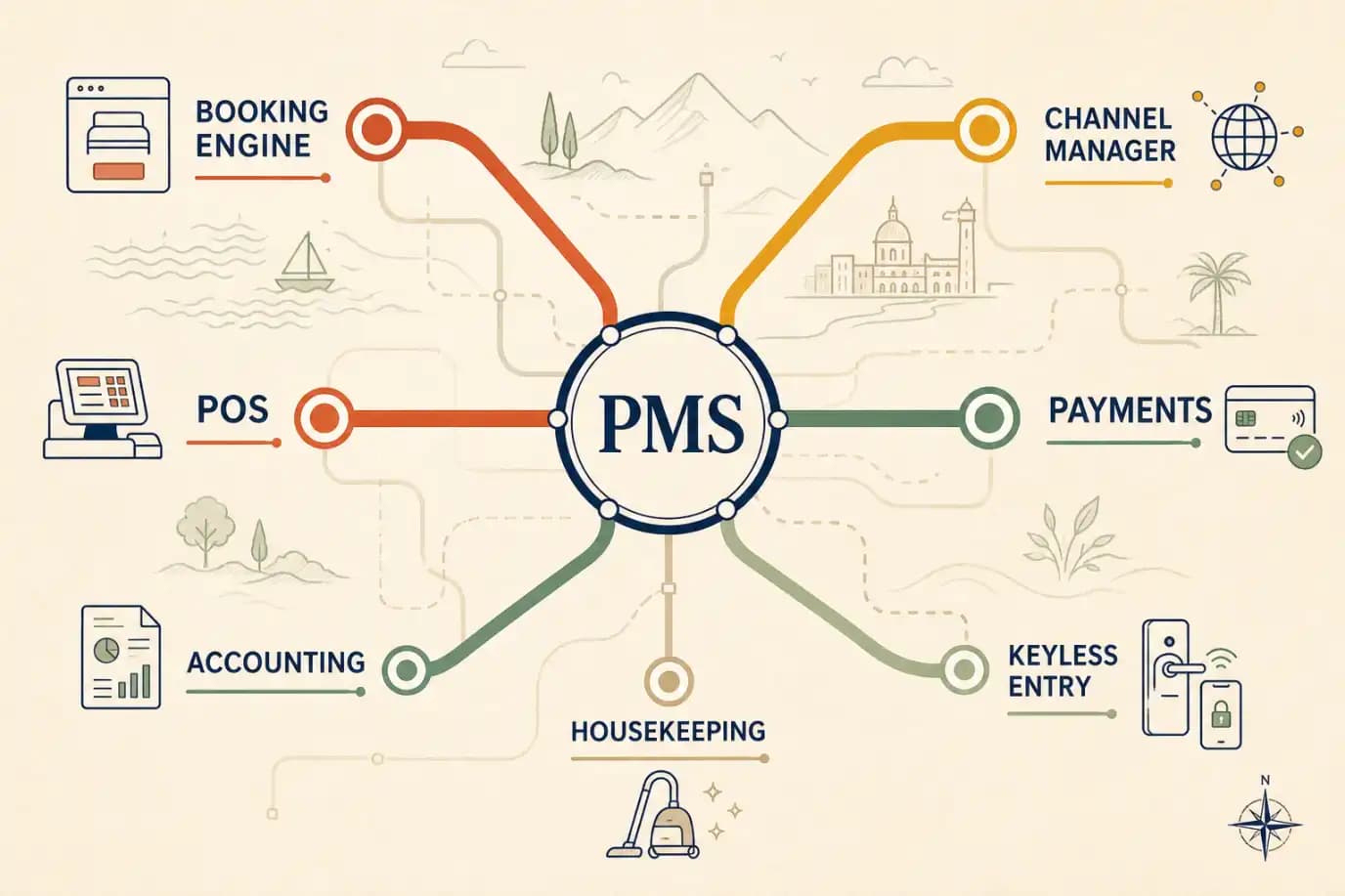
Every capability above can be bought as a separate product: a standalone channel manager, a messaging tool, a check-in app, a pricing engine, an accounting bridge, each bolted to the PMS through an interface. The bolt-on route lets you pick a favourite in each category, and it carries three permanent taxes: every interface is a subscription plus a point of failure, every pair of systems disagrees eventually and someone reconciles them, and every automation that crosses systems, which is most of the useful ones, is only as reliable as its weakest connector. Automation is precisely the thing that breaks at the seams, because it is chains of events crossing system boundaries.
The integrated route runs the chain inside one platform: booking to folio to housekeeping to invoice to ledger with no interface in between, one login, one bill, one support team, and automations that cannot desynchronise because there is nothing to desynchronise from. That is the architecture Prostay is built on, and the practical difference shows up exactly where this guide lives, in whether the automation you configured in January still runs unattended in August. For the wider evaluation, integrations, data flows, what to ask vendors, our guide to the connected hotel tech stack goes deeper.
Key Takeaways
Hotel automation is events triggering actions without a person in between, across five layers: distribution, the guest journey, operations, pricing, and finance. Distribution automation pays first; finance automation pays quietest and longest. The AI layer now handles conversations, quoting, booking and answering in the guest's language, on top of the rule-based plumbing.
Automate transactions, never relationships: complaints, welcomes, local judgment and exceptions stay human, and the hours automation saves should be visibly reinvested in them. The ROI adds up from four lines, 15 to 30 staff-hours a week, systematic upsell and after-hours conversion, error costs that stop occurring, and a team that stays, and most properties recover the software cost within the first year.
Roll out one layer a month, involve the people whose work changes, and keep manual overrides everywhere. And decide the architecture deliberately: bolted-on tools tax every automation at the seams, while an integrated platform runs the whole chain natively. If you want to see what a fully automated day looks like on your own numbers, booking to folio to ledger without a hand touching it, a Prostay demo is the fastest way to watch it run.