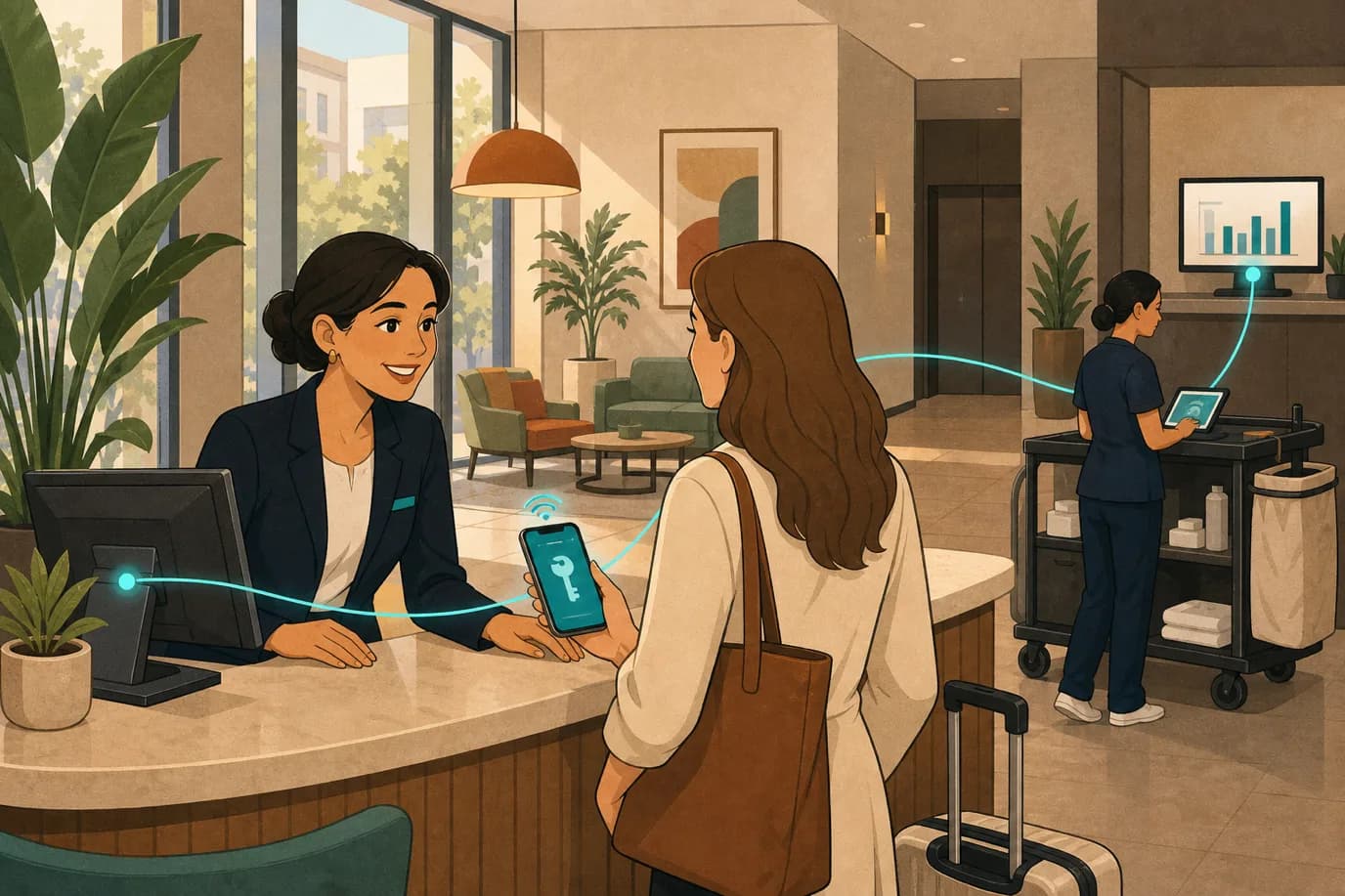

In March 2026, OpenAI quietly killed one of the most-watched experiments in travel: the plan to let people book a hotel natively inside ChatGPT, without ever leaving the conversation. Instant Checkout for travel was walked back, transactions were pushed out to partner apps, and Expedia's share price jumped 12% on the news. For hoteliers, the retreat is not a reprieve, it is a map. It tells you exactly where the AI booking game is actually played in 2026: discovery happens in the chat, and the booking happens wherever the chat sends the guest, on an OTA app inside ChatGPT, or on your own website.
That split, AI owns the shortlist, platforms own the transaction, is the single most useful thing to understand about ChatGPT and hotels right now. This guide covers how travelers actually use ChatGPT to choose properties, what OpenAI's pivot means in practice, and the four moves that make your hotel both visible in the conversation and bookable the moment it ends. It extends our deeper technical guide to AI search optimization, which covers the citation mechanics; here the focus is the full path from recommendation to reservation.
How Travelers Actually Use ChatGPT to Choose Hotels in 2026
The behavioral shift is real and measurable: a meaningful share of travelers now start trip planning in an AI assistant rather than a search engine, and the ones who do arrive at your website or OTA listing in a very different state. A traditional Google searcher arrives with ten open tabs and a vague intent. A ChatGPT user arrives having already had the comparison done for them, they asked for a quiet four-star near the old town with parking and good breakfast reviews, got a shortlist of three, interrogated the trade-offs in follow-up questions, and clicked out with a decision substantially made.
Two mechanics matter here. First, ChatGPT answers hotel questions from a blend of its training data and live retrieval, and its live search leans on Bing's index, which is why properties invisible to Bing are invisible to the fastest-growing discovery channel in travel. Second, since late 2025 the raw text answers have increasingly been augmented by in-chat apps: Expedia and Booking.com launched at the apps platform's debut, with Tripadvisor, Skyscanner and Accor following, surfacing real-time prices, photos and interactive maps directly inside the conversation. The guest is no longer just reading about hotels in ChatGPT; they are browsing live inventory there.
The queries themselves have changed shape, too. Nobody types hotel-plus-city-plus-four-star into a chat window; they write the way they would talk to a well-traveled friend: we are two adults with a toddler, arriving late Thursday, want to walk to the old town but sleep quietly, breakfast matters, parking would be nice. Assistants answer those questions by matching them against whatever specific, concrete information exists about your property, which room types sleep three, how far the old town actually is, whether parking is on-site or a block away. Hotels whose websites answer real questions in plain sentences get matched; hotels whose websites say nestled-in-the-heart-of get skipped.
What has not changed is what the AI rewards. Assistants recommend properties they can read consistent facts about and verify social proof for, which is why the fundamentals, complete business profiles, a strong recent-review record, structured data on a crawlable site, behave like ranking factors in this channel too. The broader context of how AI is reshaping every layer of the industry is covered in our guide to artificial intelligence in hospitality.
The March 2026 Pivot: Why ChatGPT Stopped Trying to Be a Booking Engine
OpenAI's ambition was genuinely end-to-end: Instant Checkout, built with Stripe on the Agentic Commerce Protocol, launched in September 2025 with retail partners like Etsy and Shopify, and testing extended toward hotel bookings completed entirely in-chat. By early March 2026 the company pulled the plug on native travel checkout, moving transactions into third-party apps and telling the press it was prioritizing search and product discovery instead.
The reasons it cited are a free education in why hotel distribution is hard. Live pricing changes by the minute; cancellation policies are a thicket; payments carry regulatory weight; and when a booking goes wrong, someone has to answer the phone, and a chat interface cannot re-accommodate a family standing in a lobby at midnight. A hotel stay cannot be returned like a sweater, so the trust threshold for completing the purchase is far higher than for retail. The market read the retreat instantly: Expedia jumped 12%, Booking Holdings 8%, Tripadvisor 5%. The intermediaries are not being disintermediated; they are being fed.
The strategic lesson for a hotelier is sharper than the headlines suggest. The AI layer has settled, for now, into the role of a phenomenally persuasive concierge who hands the guest to whoever can actually take the booking. Your job is to be the property the concierge recommends, and then to make sure that wherever the hand-off lands, an OTA listing or your own website, the booking completes instantly and, ideally, commission-free.
Where the Bookings Actually Happen Now
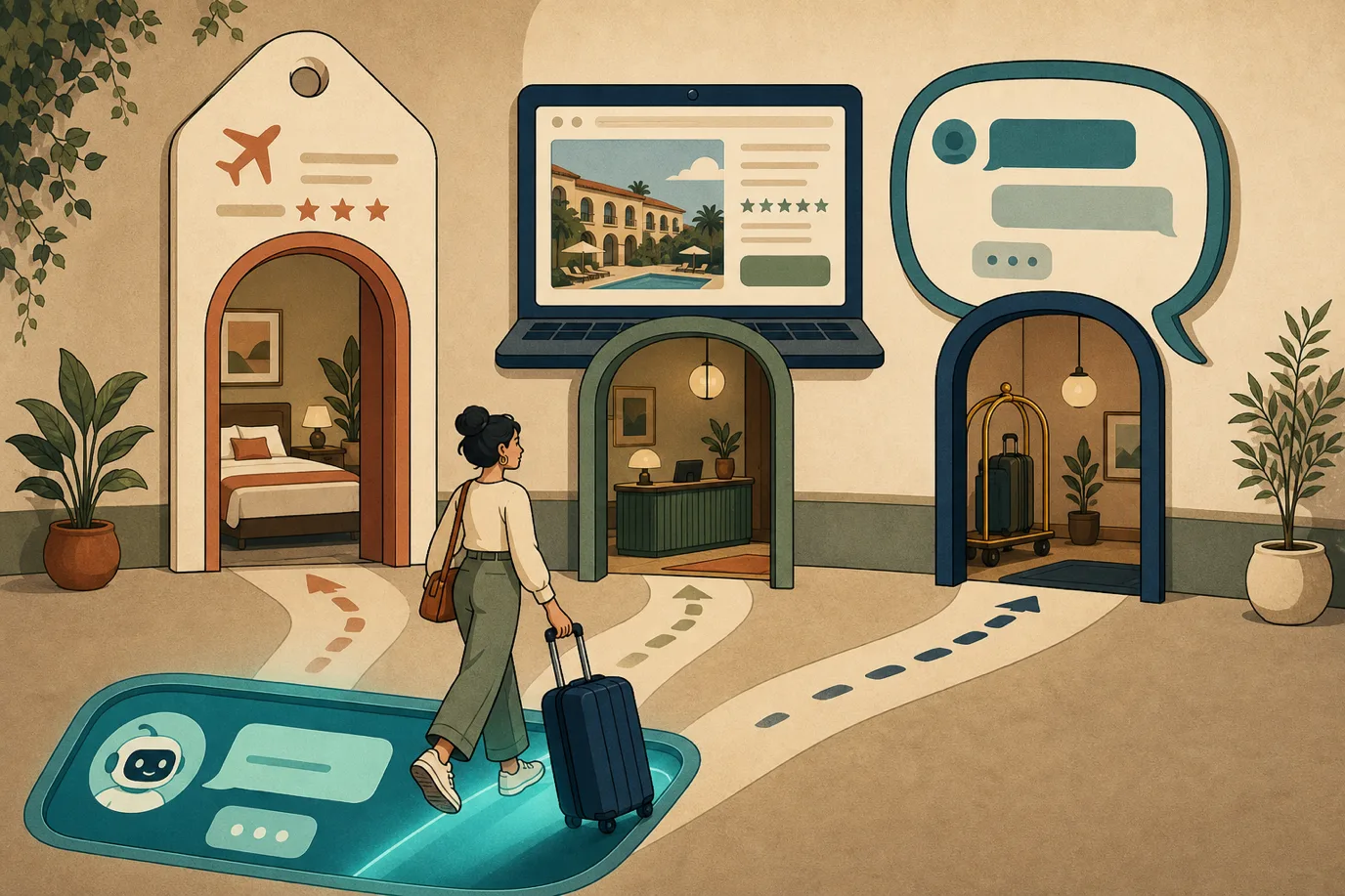
Post-pivot, the ChatGPT-to-reservation path runs through three doors. The first is the in-chat OTA apps: a guest comparing options in the Expedia or Booking.com app inside ChatGPT completes the transaction on that platform, commission included, exactly as if they had started there. The second is the click-out to your own website: guests who were recommended a specific property by name very often go verify it directly, and that traffic converts at remarkable rates because the decision is already made. The third, still small but growing, is the AI-assisted enquiry: guests who message the hotel directly, on WhatsApp or via the website, having done all their research in the chat.
Notice what all three doors have in common: they punish anything that is not instantly bookable. An AI agent comparing live inventory will simply skip a property whose price requires an email exchange; a pre-decided guest landing on a website with no functioning booking engine will bounce to the OTA and cost you the commission; a WhatsApp enquiry that sits unanswered overnight goes to the competitor whose AI guest messaging replied in ninety seconds with a bookable quote. "Contact us for rates" was already a liability in the Google era; in the AI era it is invisibility.
Move 1: Win the Research Phase
Everything downstream depends on being in the shortlist, and the shortlist is assembled from sources you largely already control. The complete playbook, robots.txt access for AI crawlers, schema that matters versus schema theatre, Wikidata, llms.txt and the measurement problem, lives in our dedicated guide to getting cited by ChatGPT and Perplexity; the compressed version is four disciplines.
Keep your facts consistent everywhere. AI assistants cross-check, and a property whose room count, star rating or distance to the beach differs between its website, Google Business Profile and Tripadvisor listing reads as unreliable. Treat your Google Business Profile as a primary AI surface, complete, current, photographed, and give the same care to Bing Places, because ChatGPT's live retrieval runs on Bing's index and registering with Bing Webmaster Tools is the single cheapest visibility win in this channel. Earn reviews relentlessly and recently, volume and recency both feed the models' confidence, and our guide to improving hotel reviews covers the systematic way to do it. And publish citable facts in crawlable text: opening year, renovation dates, room count, check-in times, pet policy, parking, distances, the concrete details assistants quote verbatim when they recommend you. The same discipline that powers local SEO for hotels powers AI visibility; the audience is now a language model as well as a map pack.
Move 2: Be Live-Bookable Everywhere the Apps Look
The in-chat apps sell from live inventory on their platforms, which means your OTA presence is your ChatGPT bookability. You do not need, and cannot get, your own app in ChatGPT as an independent property; you get into those experiences by being listed, rate-loaded and available on Expedia, Booking.com and the platforms that follow them into the apps layer.
That puts unglamorous distribution hygiene back at the center of AI strategy. Listings need current photos, complete amenity data and accurate policies, because the app surfaces what the platform knows. Rates and availability need to be genuinely live, which is the job of a channel manager synced to the PMS in real time: an agent comparing three properties at 11 p.m. sees the inventory your systems published, and a stale closeout or a lagging rate update is a lost booking no report will ever show you. If the mechanics of multi-channel sync are new territory, our explainer on what a channel manager does covers the foundations. Metasearch belongs in this move too: Google's hotel surfaces remain a massive research-and-compare layer alongside the AI ones, and our Google Hotel Ads guide shows how to be bookable there without burning the marketing budget.
Move 3: Make Your Direct Channel the Best Click-Out
The most valuable ChatGPT guest is the one who was recommended your property by name and clicks out to book direct, no commission, full guest data, upsell opportunities intact. Whether you capture that booking or donate it to an OTA depends entirely on what they find when they land.
The bar is specific: a fast site that loads instantly on a phone, real-time rates and availability visible within one tap, and a booking flow that completes in a couple of minutes with modern payment options. Anything less and the pre-decided guest books the same room on the OTA app they still have open, because it was easier. The craft of a converting hotel site, speed, photography, friction removal, rate presentation, is covered in our guide to high-converting hotel website design, and the case for why the direct channel deserves this investment is made in our piece on the direct booking website. If your current site cannot clear that bar, that is exactly the gap the Prostay Instant Site exists to close: a fast, structured, SEO-clean hotel website with the booking engine built in, live from the same inventory as every other channel.
Structured data completes the loop: schema for your property, rooms and offers is machine-readable confirmation of what the AI recommended, and pages that answer natural-language questions, is there parking, can I check in at midnight, is the pool heated, in crawlable FAQ form serve the follow-up queries guests actually ask assistants.
One more discipline the AI era quietly enforces: rate parity, in your favor. A guest comparing your property in an in-chat OTA app and on your own site sees both prices within seconds of each other, and an AI agent asked to find the best rate will do that comparison explicitly. If the direct price is worse than the OTA price, you have paid for a website that advertises the commission channel. Direct should always carry the best available rate or a value edge the OTAs cannot show, a drink, late checkout, a room-upgrade priority, stated plainly enough that both a human and a language model can quote it.
Move 4: Get Agent-Ready Anyway
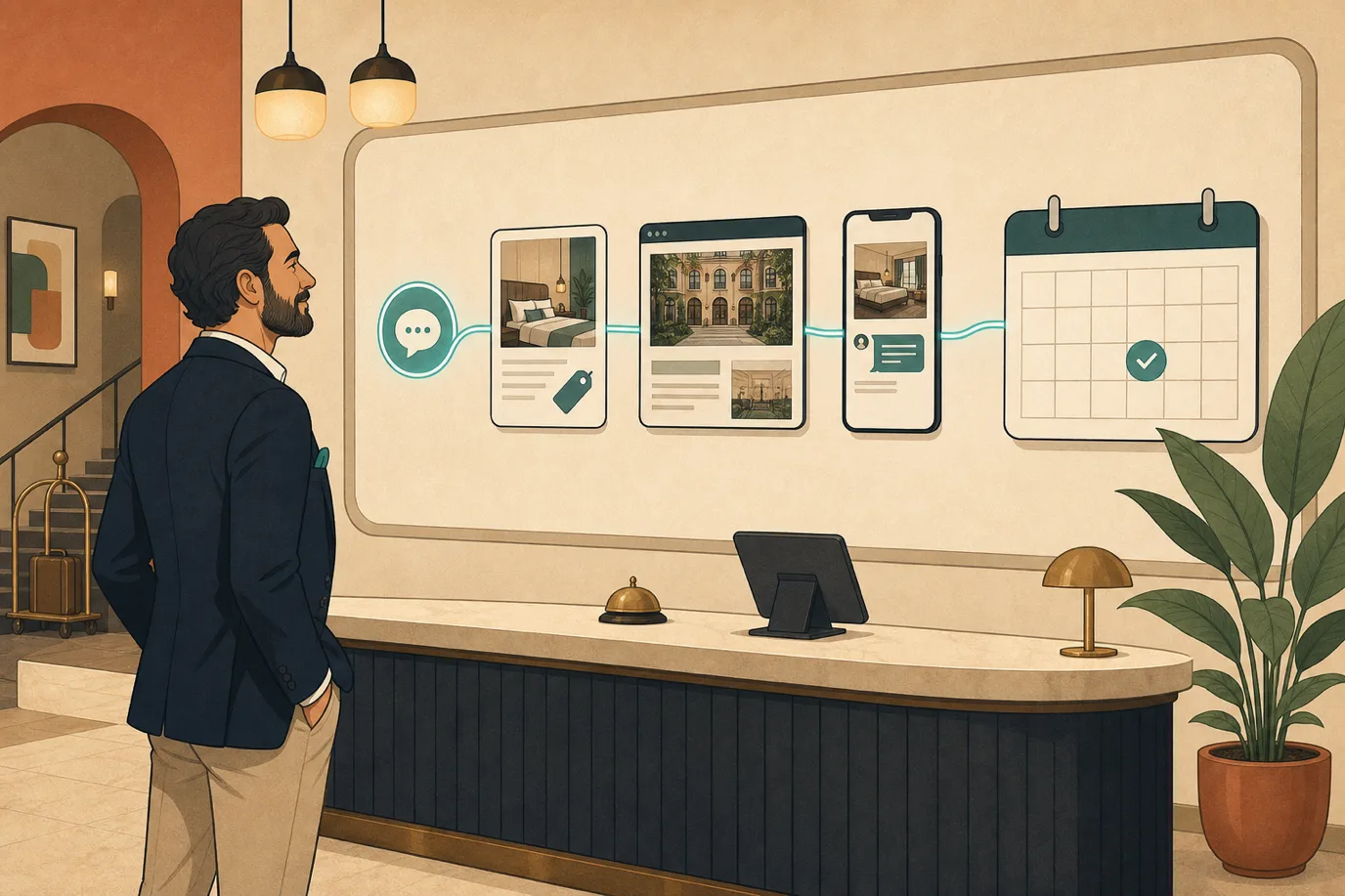
The March pivot was a retreat, not a surrender. The Agentic Commerce Protocol continues to mature in retail, Google is building its own agentic commerce rails, and the direction is unmistakable: within a few years, AI agents will complete more of the transaction with less human clicking, and travel will be re-attempted once the trust and support problems are cracked. The hotels that will benefit are the ones whose commercial data already lives where software can read it.
Being agent-ready turns out to be the same work as running a clean modern operation. Rates, availability and restrictions maintained in one system and published everywhere in real time. Policies, cancellation, deposits, pets, children, written as structured data rather than buried in a PDF. Payments that can be captured programmatically under clear rules. Enquiries answered by systems as well as people, the job an AI reservation agent already does today over WhatsApp and web chat. None of this is speculative infrastructure; it is the same integrated-platform argument made in our hotel automation guide, with one more buyer of your machine-readable data on the horizon.
The Other Side of the Conversation: Your Hotel's Own AI
Everything so far concerns the guest's AI. The hotels winning this channel are also putting AI on their own side of the conversation, because a guest who researched you through a chat interface expects to be answered like one: instantly, precisely, in their language, at midnight. A front desk that takes nine hours to answer an email is now competing with an assistant that answered every other question in the guest's evening within two seconds.
This is exactly the layer Prostay AI was built for, and the design principle matters more than the branding: it is grounded in your property's live data. Where a generic chatbot improvises, Prostay's AI answers from the same system that runs the hotel, real rates, real availability, real policies, so it can quote accurately instead of plausibly. The AI booking assistant takes the third door from earlier in this guide, the direct enquiry on WhatsApp, web chat or email, and closes it: it understands the request, quotes a live price for the exact dates, holds the conversation through objections and follow-ups, and completes the reservation, around the clock and without adding a shift. The AI front desk agent covers the rest of the guest conversation, the is-there-parking, can-we-check-in-early, what-time-is-breakfast traffic that fills a reception inbox, answering instantly from property data and handing off to a human the moment a conversation stops being routine.
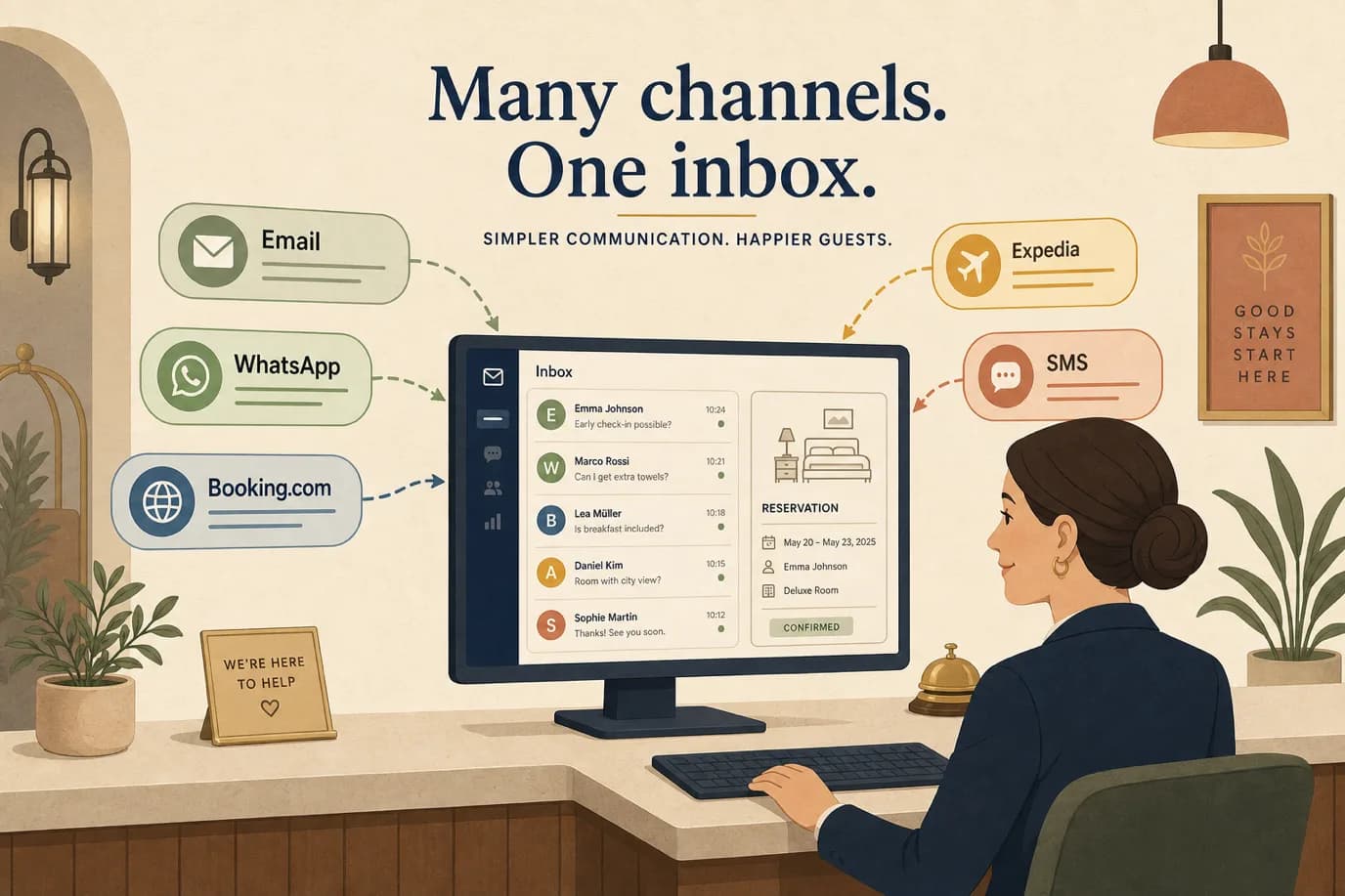
Both run inside Prostay Nexus, the messaging hub linked earlier, so staff see every AI conversation in one inbox and can step in mid-thread with full context. The strategic point for this guide: the same qualities that make your hotel legible to ChatGPT, structured data, live inventory, machine-readable policies, are what let your own AI answer guests truthfully. Hotels that do the four moves above get both benefits from the same work: the guest's assistant recommends them, and their own assistant converts them.
What to Measure
AI referral tracking is imperfect but far from hopeless. Watch four signals. Direct and organic traffic from AI sources: ChatGPT click-outs arrive with identifiable referrers in most analytics setups, and a rising line there is the clearest evidence the research phase is being won. Branded search volume: guests recommended by name go and Google you, so an unexplained lift in branded queries often means AI is talking about you. Ask-the-guest data: one field on the booking engine or one question at check-in, how did you hear about us, with an AI assistant option, produces the attribution your analytics cannot. And spot-check the assistants themselves monthly: ask ChatGPT the questions your guests would ask, best boutique hotel near X, quiet hotel with parking in Y, and record whether you appear, what facts it cites, and whether they are right. Wrong facts in the answers point you straight to the profile or page that needs fixing.
Key Takeaways
ChatGPT settled in 2026 into the role of travel's most persuasive concierge: it owns discovery, and after OpenAI's March retreat from native checkout, it hands the transaction to platforms with live inventory, the OTA apps inside the chat, or your own website. Visibility is earned with consistent facts, strong recent reviews, Bing-indexed crawlable pages and structured data; bookability is earned with real-time distribution through a channel manager and a direct site fast enough to convert a pre-decided guest.
You do not need your own ChatGPT app, and you should not wait for agentic booking to arrive before getting your data agent-readable, because that work pays today through every existing channel. The four moves compound: win the shortlist, be live everywhere the apps sell, make direct the best click-out, and keep your commercial data machine-readable. If you want to see how one platform runs that whole chain, live inventory, booking engine, AI messaging and a structured website, from a single system, a Prostay demo is the quickest look.