

A seasonal closure is a planned stop in trading, usually because off-season demand will not cover the cost of opening the doors. The building gets secured, the water and heating go into a controlled state, stock is run down, most of the team leaves, and the property stays insured, maintained and bookable for the season ahead. Done properly it is a schedule that starts months out. Done badly it is a week of switching things off, and your property management system quietly stops reflecting anything real.
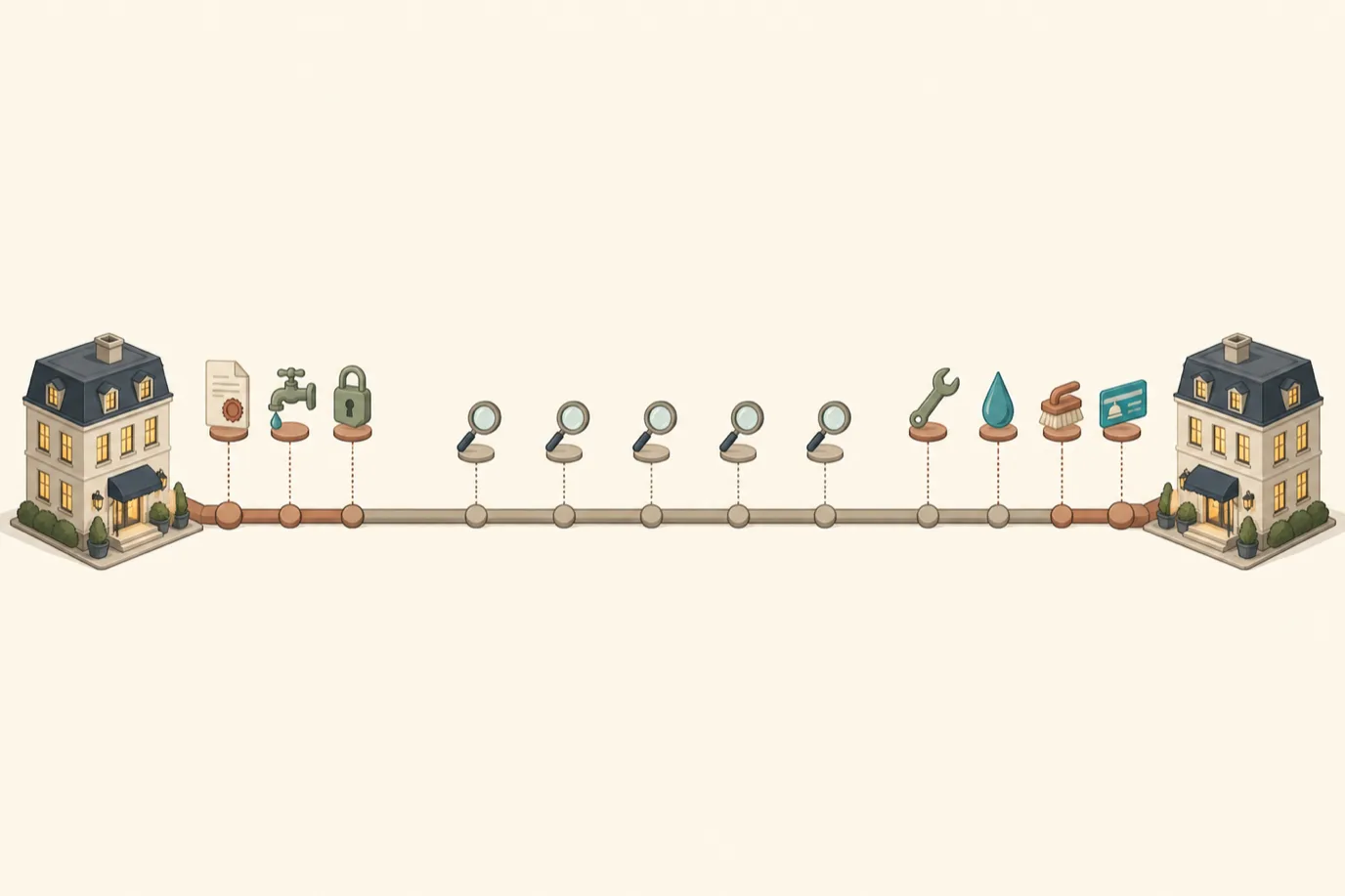
The failures are rarely dramatic. Nobody burns the place down. What actually happens is a burst pipe in February that the insurer declines because the building met the policy definition of vacant, or a reopening week spent chasing a boiler engineer who is booked until June, or an OTA listing that was switched off in October and comes back in April ranking below properties half as good. Almost all of it is preventable with decisions made before you close, most of them boring, several of them involving your channel manager rather than the building at all. This article covers whether to close, what the insurer needs, the water system, what stays powered, distribution, the systems work, stock, people, the maintenance window, and the countdown back.
What Closing a Hotel Actually Means
There is a spectrum here and being clear about where you sit on it changes almost every decision that follows.
Full closure is the version most people picture. No guests, no staff on site except a caretaker, the building winterised, water drained or on a strict flushing regime, heating on a frost setting. Common in Alpine summer, Mediterranean winter, and northern coastal properties.
Partial closure keeps a wing, a floor or a handful of rooms live, often with the restaurant closed and a skeleton front office. This is the most common version in practice and the most likely to catch you out, because the building feels open while the insurance paperwork may well classify it as vacant.
Reduced operation is not a closure at all. You trade at low occupancy with a small team, which is a demand problem rather than a shutdown problem, and it belongs with the tactics in the shoulder season guide rather than here.
The distinction that matters most is not how it feels to you. It is how it reads to three parties: your insurer, your local authority, and the platforms you distribute on. All three have their own definition of closed, none of them will ask you which one you meant, and you find out whose definition applied at the worst possible moment.
Whether to Close at All Is a Money Question
Plenty of properties close because they always have. The grandfather closed in November, so the hotel closes in November. That is not analysis, and in a market where shoulder demand has been growing for a decade it is worth redoing the arithmetic every few years.
The comparison is straightforward once you separate two kinds of cost. Some costs stop when you close and some do not, and the ones that do not are larger than most operators assume.
| Cost | Behaviour when closed | Notes |
|---|---|---|
| Payroll | Mostly stops | Retained core, notice periods and any off-season retainers remain |
| Utilities | Falls, does not stop | Frost protection, alarms, network and standing charges continue |
| Insurance | Continues, may cost more | A vacancy endorsement is not usually free |
| Debt service and rent | Unchanged | The single biggest reason closure hurts cash |
| Software and subscriptions | Usually unchanged | Worth auditing, rarely worth cancelling |
| Maintenance | Rises | You are buying the annual programme into this window |
| Marketing | Should not stop | You are selling next season during the closure |
Against that sits the contribution you give up. The right test is not whether the off-season is profitable, it is whether marginal revenue covers marginal cost. A November weekend that runs at 30 percent occupancy and a rate 40 percent below summer may still be worth trading if the alternative is paying the fixed costs anyway and earning nothing against them. The number to look at is contribution per room night after variable cost, not the headline profit line, and the modelling belongs alongside the rest of your hotel budgeting work rather than in a separate spreadsheet nobody opens again.
Three things weigh against staying open that do not appear in that calculation. Staff will not stay for a season of two-day weeks, and losing them costs you more than the revenue is worth. Guest experience in a half-empty hotel with the pool covered and the restaurant closed generates reviews that follow you into the summer. And you lose the maintenance window, which is the hidden subsidy that a closed period gives you and which is very expensive to buy back in August.
There is also a middle path more properties should consider: close the building and keep selling. Nothing about a closed hotel stops you taking bookings for April, running your email list, or answering enquiries. Some of the best seasonal operators do their strongest direct-booking work in the dark months, when their competitors have gone quiet and their own team finally has time to write something.
Insurance Is the First Phone Call, Not the Last
If you take one thing from this article, take this one, because it is the item most likely to turn a bad winter into an existential one.
Standard commercial property wordings contain a vacancy provision. The widely used ISO building and personal property form treats a building as vacant unless at least 31 percent of its floor area is used by the owner for customary operations. A seasonal hotel that stops renting rooms is, by that definition, not conducting customary operations, so the building is vacant no matter how much furniture is still in it. Once vacancy runs past 60 consecutive days, the usual effect is that cover for vandalism, theft, water damage and sprinkler leakage falls away entirely, and any remaining covered loss is settled at a reduced amount, commonly 15 percent less.
Read that again with a January burst pipe in mind. Water damage is the single most likely loss in an empty building in a cold climate, and it is precisely the peril the vacancy clause removes first.
The fix is not exotic. Insurers know seasonal properties exist and will normally issue a vacancy permit endorsement covering the closed period. What they will not do is issue it retrospectively after a claim. So the sequence is: tell the broker in writing before the closure begins, agree the endorsement, and read the conditions attached to it, because those conditions are the part that catches people.
Typical conditions look like this, and the exact numbers are policy-specific rather than universal:
- Documented internal and external inspections at a stated interval, often every 7, 14 or 30 days, with a written log. Missing inspections is one of the most common grounds for rejecting an unoccupied-period claim, and an undated note on a phone is not a log.
- Either a maintained minimum temperature through a frost thermostat, or a fully drained water system. Insurers usually accept one or the other and will specify which.
- Intruder and fire alarm systems maintained, monitored and actually set.
- Keys controlled, and no combustible waste left against the building.
Two more items are worth raising in the same conversation. Business interruption cover behaves oddly around a planned closure, since you have chosen not to trade, so ask specifically how a loss during the closed period that delays your reopening would be treated. And if contractors are on site doing the annual works, confirm they are covered and that their own liability certificates are current and filed. This sits inside the broader picture in the hotel risk management guide.
The Water System Is the Thing That Bites
Water gets its own section because it is the only part of a seasonal closure with a body count attached to getting it wrong.
Legionella bacteria multiply in water sitting between roughly 20C and 45C. A hotel that has been closed for four months is an almost perfect culture: warm pipework, no flow, dead legs behind every unused bathroom, and a shower head in each of them ready to turn the result into an aerosol on the first morning back. UK duty holders work to the Approved Code of Practice L8 and the technical guidance in HSG274 Part 2, which require a written scheme, and equivalent obligations exist across most of Europe. The regulator's position after any extended shutdown is unambiguous: a water system should not simply be put back into use.
You have two coherent strategies and one dangerous habit.
Keep it moving. Flush every outlet, hot and cold, for several minutes on a weekly cycle, with valves fully open, and log it. The guidance is explicit that once started this has to be sustained, because a lapse can produce a sharp rise in bacteria at the outlet. Practical for a small property with a caretaker on site. Genuinely burdensome for 90 rooms, and it is where good intentions in November become a skipped fortnight in February.
Take the water out. Drain the system down, isolate the supply, drain calorifiers and tanks, protect traps against evaporation, and treat the whole thing as decommissioned. Then recommission properly before reopening. This is more work at both ends and far less work in the middle, and for a full multi-month closure it is usually the honest choice.
The dangerous habit is the third option nobody admits to: leaving the system full, flushing when somebody remembers, and hoping. Stagnant water at room temperature with an occasional partial flush is worse than either discipline, because it moves contaminated water into parts of the system that were previously undisturbed without ever achieving the flow needed to clear them.
Recommissioning has a shape worth knowing before you plan the reopening date. A small, simple system may need no more than a thorough flush with fresh mains water. Anything with storage tanks, calorifiers, extensive pipework and a lot of showers is likely to need extended flushing followed by cleaning and disinfection, and possibly microbiological sampling, which takes days to come back from a laboratory. Before you accept guests you want to be able to demonstrate hot water reaching 50C within one minute at the outlet and cold below 20C within two. Water is stored at 60C to control bacteria, which is a scald risk, so thermostatic mixing valves need to be checked at the same time rather than assumed.
Put the sampling date on the reopening plan working backwards, not forwards. A laboratory result you were not expecting to wait for is a classic reason a reopening slips by a week.
What Stays Switched On
The instinct on the last day is to walk the building turning everything off. Resist it, because several systems cost very little to run and cost a great deal to have been off.
Fire detection and suppression stay live. Always. An empty building has a worse fire outcome than an occupied one because nobody is there to notice, and your insurer's conditions will require it anyway. If sprinklers run through unheated areas, the antifreeze or dry-pipe arrangement needs checking before the first frost rather than after it.
Intruder alarms and cameras stay live, and someone must actually respond to them. An alarm that dials a number nobody answers is decoration.
Frost protection stays on unless you have drained the system, in which case confirm what your policy requires rather than guessing. Heating a large building to a bare minimum is not cheap, and it is still cheaper than a first-floor pipe letting go above a refurbished restaurant.
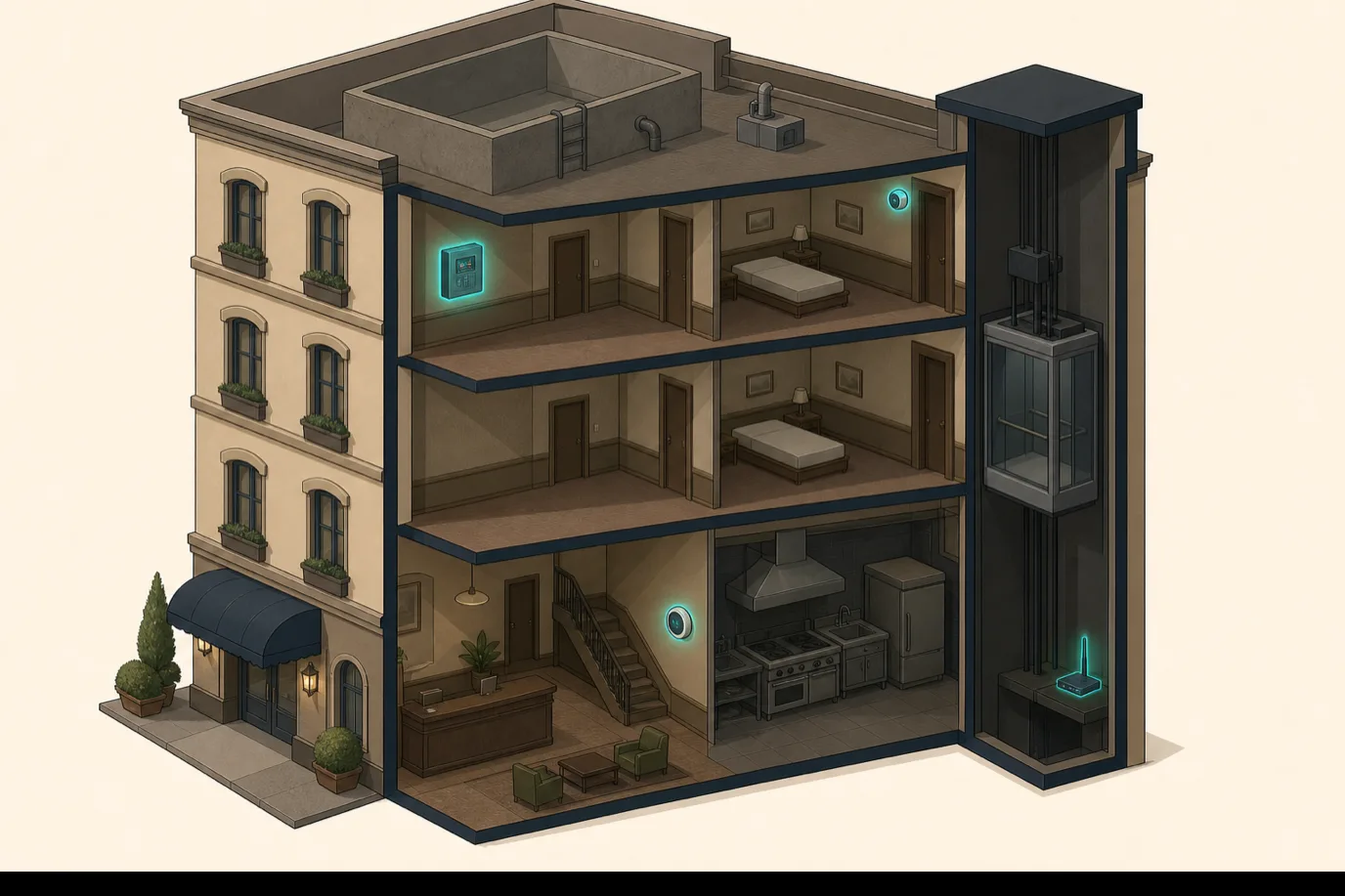
The network stays up. This one gets missed constantly. Your building management system, alarm panels, card readers, CCTV, remote thermostats and any cloud software all depend on connectivity, and the router is often the first thing unplugged by somebody being thorough. Leave it powered, leave one circuit live for it, and label the socket.
Dehumidification in specific places. Indoor pools, spas, cellars and anywhere below ground. Damp does its damage slowly and invisibly across four months, and the bill arrives as mould remediation in the week you wanted to be training staff.
Everything else is fair game, and switching it off properly is worth doing well rather than quickly. Isolate rather than merely turning off at the wall. Empty and prop open fridges so they do not grow anything. Take the pressure out of coffee machines and beer lines. Lift the arms on lifts, or rather, get the lift company to advise, because leaving a lift powered but unused for four months and leaving it isolated have different consequences and only one of them is right for your installation. This is exactly the kind of judgement your regular contractors will give you free if you ask in September and charge you for in April. The routine version of all this belongs in your preventive maintenance programme, and the running costs are worth revisiting against the hotel energy management picture, since a closed building is the cleanest baseline you will ever get for spotting what your property draws when nothing is happening.
Do Not Let Your Listings Go Dark
Here is the part that costs real money and gets delegated to whoever is least busy on the last day.
There is a difference between closing dates and closing a property, and the platforms treat them very differently. Blocking availability for the closed period leaves your listing live, searchable and bookable for every date after it. Snoozing or unlisting removes the property from search, and Booking.com's own partner documentation is direct about the consequence: because your property is not bookable, snoozing can affect your ranking. Airbnb behaves similarly, where a snoozed listing has to re-earn its position.
So the default is straightforward. Close the dates you are closed. Keep the property open and bookable for the season ahead, and make sure rates and restrictions are actually loaded for those dates, because a listing that is technically open with no rates loaded is invisible in exactly the same way. Travellers can book up to 16 months out on Booking.com, which means a property closing in October should already be selling next June.
Reserve the snooze for the case it was designed for, which is a closure with no confirmed reopening date, or a property genuinely leaving the market for a year.
Two consequences of a dark period are worth planning around even when you do everything right.
Review recency. If your last guest leaves in October and your first arrives in April, the newest review on your page throughout the booking season is five months old. Every platform weights recency, and more importantly every human reading your page in February notices. This is a decent argument for a short mid-closure opening, a New Year weekend or a single event, purely to keep the page alive. It is also an argument for making sure every October departure is asked for a review, because those are the ones carrying you through the winter.
Rate plan drift. Reopening in spring with last season's rate plan still attached is so common it is almost a tradition. Restrictions, closed-to-arrival rules, minimum stays and seasonal plans all sit dormant through the closure and come back exactly as you left them. Whatever you had running on the last night you traded is what you will be selling on the first night back unless somebody checks. Put it on the reopening list rather than trusting memory across five months.
While the building is closed, distribution is the one part of the operation that should get busier rather than quieter. This is when you rewrite the property description that has not been touched in three years, replace the photographs taken on a phone in 2019, fix the amenity list, and answer the reviews you never got round to. None of it requires a guest in the building.
What to Do in the PMS Before You Lock the Door
The systems work is small and mostly gets skipped, which is why so many reopenings start with two days of accounting archaeology.
Close the books cleanly. Run the final night audit, settle every open folio, and chase outstanding city ledger balances while the people who remember the bookings are still employed. An unpaid corporate account in November is a manageable phone call. In April it is a stranger explaining that the person who stayed has left the company. Cash discipline through a closed period is unforgiving because nothing is coming in, which the hotel cashflow guide covers in more depth.
Deal with deposits and future bookings. Any reservation that falls inside the closed period needs finding and moving now, not discovering in January. This includes anything sitting in a group block or an allotment, which will not show up in a simple arrivals report.
Take a stock and asset count. An empty hotel is the only time you can count linen, crockery, minibar stock and furniture accurately. Do it once, properly, and you have a baseline for next season's par levels rather than an argument. The method sits in the linen par guide.
Load next season before you leave. Rates, rate plans, restrictions, packages and any seasonal room configuration. The team that closed the hotel knows what was working. The team that opens it may be partly new, and the difference between loading rates in October with institutional memory and loading them in March from a spreadsheet is visible in the first month's ADR.
Turn off what should not fire. Automated pre-arrival emails, review requests, birthday campaigns and payment retries. There is nothing quite like a closed hotel sending a cheerful message about your upcoming stay.
Keep the enquiry channel open and watched. People will email a closed hotel, and those emails are next season's bookings. A shared inbox with one named person checking it weekly is enough. If you keep a waitlist for the dates you could not sell, the closure is a good moment to work it for the season ahead rather than letting it expire quietly.
One organisational note. Decide who has access to what during the closure and write it down. Four months is long enough for a departing seasonal employee to still hold a login they should not, and access reviews are much easier to do when there are twelve accounts than when there are sixty.
Stock, Kitchens and the Run-Down Plan
The kitchen is where closure planning either shows or fails, and the failure is measured in bin bags.
A run-down plan starts about six weeks out and works backwards from the last service. The principle is that ordering patterns change well before the closing date: you stop buying anything with a shelf life longer than the days remaining, you switch to smaller and more frequent deliveries even though the unit price is worse, and you accept a slightly narrower menu in the final fortnight rather than a full one you cannot sell through. The maths is not close. Paying a few percent more on a small delivery beats writing off a case.
The last two weeks are where the menu should visibly shrink. Take off the dishes that need a dedicated ingredient nobody else uses. Run specials built around whatever is genuinely still in the walk-in. Any competent chef does this instinctively; the failure is usually a general manager insisting the full menu runs to the last night for appearances.
Then the disposal decisions, in a sensible order. Staff meals absorb a surprising amount and are the easiest goodwill you will ever generate. Freeze what freezes well, labelled with a date, and be honest that some of it will still be thrown away in April. Local food banks or shelters will often take sealed dry goods and unopened stock, which needs arranging in advance rather than on the day. Only then the bin.
Beyond the kitchen, three categories need decisions:
- Beverage. Wine and spirits keep and should be counted and locked. Draught beer does not, so plan the last keg rather than discovering it. Beer lines need cleaning and leaving in the correct state or the reopening starts with a line replacement.
- Amenities and consumables. Toiletries, stationery and packaging survive storage but degrade in damp, so they need somewhere dry rather than the coldest storeroom.
- Linen. Everything goes into storage clean and dry. Linen stored damp comes out mildewed and you will not know until you open the cupboard in March.
If you run any F&B stock control worth the name, the closure count is the one that resets it. The habits that make this painless rather than painful are in the restaurant inventory management guide.
Offboarding Is Really Next Season's Hiring
The most expensive thing you can do at the end of a season is let people leave badly.
The numbers are unsentimental. Cornell's Center for Hospitality Research puts the average cost of replacing a frontline hospitality employee at 5,864 US dollars once recruiting, onboarding, training, the productivity ramp and the overtime paid to cover the gap are counted. A returning employee skips most of that. They know the building, the systems, the regulars and the shortcuts, and they need a fraction of the training a new hire does. A property that gets 60 percent of its team back is starting the season in a completely different position from one that gets 20 percent.
What actually drives the return rate is less about money than most managers assume.
Tell people the reopening date before they leave. Not approximately. A date, even a provisional one, with a note that you will confirm in January. People arrange their lives around certainty, and the competitor who names a date gets the answer first.
Make the offer at the end of the season, not the start of the next. The right moment to ask someone to come back is the week they are still proud of what they did. Six months later they have a different job.
Keep in touch through the gap, lightly. Two or three messages across a closed season. What the refurbishment looks like, when the recruitment opens, a note at the holidays. Not a newsletter.
Give returners something concrete. First choice of shifts, an express rehire that skips the parts you already have on file, a small return bonus, or the training they asked for last year. Any of these beats a pay rise of the same value, because they signal that the relationship continued.
Then run the formal process 90 to 120 days out. Leaving it to 30 days is how you end up paying agency rates, which run meaningfully above direct hire during the peak hiring window, for people who need training you do not have time to give. The scheduling side of getting a rebuilt team through a first month is covered in the staff scheduling guide.
One more thing that pays for itself. Before people leave, have each department write down what broke this season, what they fixed with a workaround, and what they would change. Half an hour each. That document is worth more in March than any consultant's report, and it disappears completely if you do not capture it in the final week.
The Closed Months Are Your Only Real Maintenance Window
Everything you cannot do with guests in the building has to happen now, and the calendar is shorter than it looks because contractors are dealing with every other seasonal property in the region at the same time.
Book the specialists first, before you have finalised anything else. Lift inspections, boiler and HVAC servicing, fire system testing and certification, kitchen extract deep clean, pool plant work, and any electrical testing that is due. These have lead times measured in weeks, and the good ones are booked out by the properties that called in August.
Then the work that is genuinely easier in an empty building:
- Deep cleaning that needs rooms out of service: carpets, curtains, upholstery, grout, extract systems.
- Mattress rotation and replacement, which is nearly impossible to schedule around occupancy.
- Redecoration and the touching up of corridors that always looks bad in photographs.
- Anything requiring scaffolding, a crane, or the closure of an access route.
- Cabling, access point replacement and any network work that would take rooms offline.
Sequence matters more than most closure plans acknowledge. Dust-generating work goes before deep cleaning, not after, and the number of properties that carpet-clean in February and then sand a floor in March is higher than it should be. Water system work has to finish before recommissioning and sampling. Anything that opens up walls or ceilings needs to complete before the final fire system test, not alongside it.
If the closure includes a real refurbishment rather than maintenance, the planning is a different discipline with its own failure modes, and the hotel renovation guide is the better starting point. The rule of thumb worth carrying across is that a refurbishment finishing the week you reopen has not finished.
The Reopening Countdown
Reopening is a pre-opening in miniature, and it fails in the same way pre-openings fail: everything is scheduled to land in the final week, so any single slippage is absorbed by the guests. Work backwards from the first arrival, not forwards from when the contractors finish.
| Weeks out | What has to be happening |
|---|---|
| 8 | Confirm the reopening date publicly. Rehire offers out and accepted. Service visits booked and confirmed in writing. |
| 6 | Water system recommissioning starts. Suppliers reactivated and first delivery dates agreed. Rates and restrictions for the new season reviewed against what is actually loaded. |
| 4 | Contractor works complete, not nearly complete. Water sampling submitted if required. Payment terminals, card gateway and integrations tested end to end. |
| 3 | Deep clean of guest areas begins. Linen and consumables out of storage and checked. Staff contracts, right-to-work checks and payroll set up. |
| 2 | Full team on site for training. Kitchen and bar stocked. Fire drill, alarm test and evacuation walkthrough with the new team. |
| 1 | Every room inspected and signed off individually. Test booking pushed through from the booking engine to a paid folio. Soft opening or a friends-and-family night if you can manage it. |
The test booking deserves emphasis because it is the single highest-value hour in the whole countdown and it is skipped more often than any other step. Make a real reservation on your own website, in the same way a guest would, with a real card. Watch it arrive in the PMS. Check the confirmation email is correct and does not still reference last season's breakfast times. Check in, post a charge, take a payment, check out, and look at what hits your accounting. Then do the same through one OTA. An hour of this finds the broken integration that would otherwise be found by your first guest, at your busiest moment, with a queue behind them.
Some of the useful structure from opening a property for the first time applies directly here, particularly the sequencing and sign-off discipline in the hotel pre-opening guide.
The room-by-room sign-off
Do not accept a general assurance that the floors are ready. Every room gets opened individually with a short list: run every tap hot and cold for the required time and record it, flush the toilet twice, check the shower for pressure and temperature, test every light and socket, check the television and the network, open and close the safe, test the door lock with a freshly encoded card, look behind the headboard and under the bed, and sit on the bed for a moment because that is what the guest does first.
In a hundred-room property this is two people for a day and a half. It is the cheapest guest-satisfaction spend available to you and it front-loads the snag list rather than discovering it one complaint at a time. Write the standard down once and it becomes part of your standard operating procedures rather than an annual improvisation.
The First Week Back
Expect it to be worse than you planned for, and staff it accordingly.
The first week has a specific character. Systems that worked in October have had updates. The team is partly new and partly rusty, and even the returners have forgotten small things. Suppliers deliver at the wrong times because their own routes have changed. And the building itself behaves oddly for a few days as everything comes back up to temperature and humidity.
Three practical decisions make it survivable. Sell fewer rooms than you can on the first two nights, deliberately, and treat the gap as training cost rather than lost revenue. Put your most experienced person on the front desk rather than in the office, because the first week is when guest-facing judgement matters most. And keep a shared snag list that anyone can add to, reviewed daily for the first fortnight, so that the small things get fixed while they are still small.
Watch the complaint pattern rather than the complaint count. A scatter of unrelated issues is normal for a reopening. The same issue reported by four different guests is a system that did not come back properly, and it will keep producing complaints until somebody treats it as one problem instead of four.
How to Tell Whether You Closed Well
Most properties never evaluate a closure, which is why the same mistakes repeat annually. Four numbers, none of which need a reporting project, tell you almost everything.
Cost of the closed period. Everything spent between the last departure and the first arrival, maintenance included. This is the number nobody calculates, and without it you cannot have an honest conversation about whether closing was the right call.
Staff return rate. The share of last season's team back this season. Track it by department, because a strong overall number can hide a housekeeping team that turns over completely every year, which is a different problem with a different fix and one the housekeeping manager will already know about.
Days from reopening to steady state. How long until the operation ran normally, judged by complaint volume and the snag list rather than by feel. Two weeks is good. Six weeks means the reopening plan was really a two-week plan.
First-month performance against the same period last year. Occupancy, rate and review score together. A weak first month after a closure is usually a distribution problem from October rather than a demand problem in April, and comparing across years is what makes that visible. Where these sit alongside the rest of your reporting is covered in hotel performance metrics, and the forward view belongs with your hotel forecasting.
Add one habit that costs nothing. In the second week back, while it is still raw, write down everything that went wrong with the reopening. Not a formal review, just a list. Open it in September when you plan the next closure. The single biggest improvement available to most seasonal properties is simply not repeating last year's mistakes, and the only reason they repeat is that nobody wrote them down.
If You Are a Twelve-Room Property, Not a Resort
Most of this article assumes a certain scale. Plenty of seasonal properties are a family with twelve rooms and a part-time cleaner, and the honest version for them is shorter.
Four things are not optional at any size. Tell the insurer in writing and get the endorsement. Sort the water out, which for a small simple system usually means draining it and flushing thoroughly before reopening rather than a weekly regime nobody will keep. Keep the listing bookable for next season with rates loaded. And book the boiler and fire service now rather than in spring.
Everything else scales down to a single sheet of paper and an afternoon. The mistake small properties make is not insufficient process, it is assuming that because the building is small, the insurer and the water regulations treat it differently. They do not. A twelve-room hotel with a legionella case or a declined water damage claim faces the same consequence as a two-hundred-room resort, with far less balance sheet behind it.
The underlying idea holds at every size. A closure is not an absence of operation. It is a different operation, with its own checklist, its own risks and its own deadline, and the properties that treat it that way spend April selling rooms while everybody else spends April fixing things.