

Talk to a hotelier the week after something has gone badly wrong, a guest injured on a loose stair rail, a double-booked suite on a sold-out night, a five-figure chargeback wave, and you will almost always hear the same quiet admission: we knew about that. The rail had a maintenance ticket from March. The two systems that disagreed about availability had disagreed before. The card details were being taken over the phone and typed into a terminal for years. Hotel disasters are rarely bolts from the blue; they are small, known risks that nobody owned until they grew teeth. Risk management is the unglamorous discipline of owning them early, and much of it lives in the systems you already run: a property management system with proper user roles and audit trails closes a whole category of exposure on its own, and a channel manager quietly retires the most famous hotel risk of all, the overbooking.
This article is the prevention-side companion to our crisis management guide. That one is about the night things go wrong; this one is about the months before, when the same problems are visible, small and cheap to fix. The method is deliberately modest, one page, one score, one hour a quarter, because the risk management that works in an independent hotel is the kind that fits between a checkout rush and a supplier delivery. Frameworks with committees and heat-map software are for companies that have someone whose job title contains the word risk. Yours probably does not, and the discipline still works.
What Risk Management Is, and How It Differs From Crisis Management
The two get blurred, so draw the line once: crisis management is response, risk management is prevention. Crisis management asks, the storm is here, who calls whom and what do we tell the guests. Risk management asks, months earlier, what are the ten most likely ways this property gets hurt, and which three of them will we make smaller this quarter. One is a fire drill; the other is checking the wiring.
The two disciplines feed each other in both directions. Every risk you reduce is a crisis that never books a room, and every crisis or near miss you experience is data for the register: a risk you had scored too low, or had not listed at all. Properties that only do crisis management live in a permanent state of heroics, lurching from save to save. Properties that only write risk documents and never rehearse a response discover, on the bad night, that a spreadsheet does not answer the phone. You need a little of both, and the good news is that neither needs to be large.
One more framing that keeps the work honest: risk is not the same as worry. Worry is unfocused and infinite; risk is specific and finite. The moment you write a risk down as a sentence, a guest slips on the pool deck tiles that get slick after rain, it stops being ambient anxiety and becomes a maintenance decision with a price tag. The entire craft is that conversion, repeated.
The Risk Register: One Page That Runs the Whole Discipline
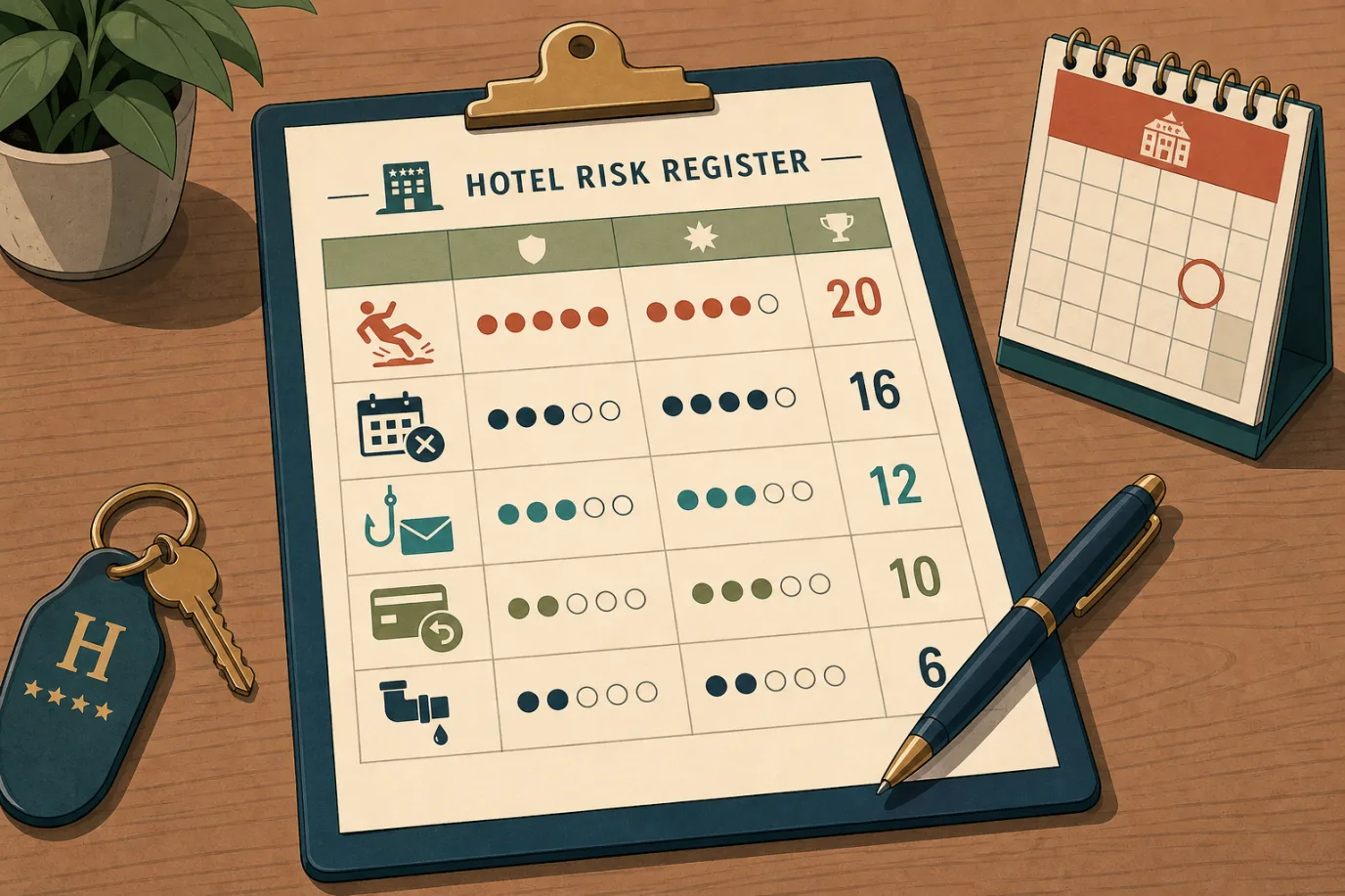
Everything in this article funnels into one artefact: the risk register. It is a table, and a spreadsheet is the right tool. One row per risk. Columns: what could happen, written as a plain sentence; likelihood from 1 to 5; impact from 1 to 5; the product of the two as a score; who owns the risk, a name, not a department; what mitigation already exists; and what action is planned next, with a date. Sort by score, descending. That is the whole system, and it beats what most independent hotels currently run, which is memory and hope.
Building the first version takes one honest afternoon with the right people in the room: whoever runs the desk, whoever fixes things, whoever does the books. Walk the property physically, walk the guest journey mentally from booking to checkout, and walk the money from card terminal to bank statement. Write down everything anyone has ever quietly worried about. The first draft will be messy and slightly alarming, and both of those are fine; a register that does not make you a little uncomfortable is a register with rows missing.
Then prune. Ten to twenty rows is the working size for an independent property. A fifty-row register feels thorough and is actually a burial ground, because nobody re-reads fifty rows in a quarterly hour. Merge the trivia, park the exotic, and keep the register at the size where every row still gets eye contact four times a year.
Scoring: Likelihood Times Impact, Nothing Fancier
The scoring exists to force ranking, not to simulate precision. Likelihood 1 means might happen once a decade; 5 means expect it this season. Impact 1 means an annoyance absorbed within a day; 5 means someone is seriously hurt, the property closes for a period, or the year's profit is gone. Multiply, sort, and resist the temptation to argue any single number for more than a minute, because the register's power is comparative: whether phishing scores 12 or 15 matters far less than the fact that it outranks the wobbly pool fence, or does not.
Two scoring habits keep the tool honest. First, score the risk as it stands today, with current mitigations in place, not the theoretical raw hazard; the question is what is exposed now. Second, let the quiet, compounding risks compete fairly with the dramatic ones. A fire scores high on impact and low on likelihood; a chargeback process gap scores modest on impact and high on likelihood, and over five years the process gap may cost more. The register exists precisely to make that comparison visible, because human instinct alone always over-weights the dramatic.
Family One: Safety and Legal Risk
Safety risk is the family with the highest stakes and, fortunately, the most established playbook, because much of it is regulated: fire systems, food hygiene, pool safety, gas and electrical certification. The risk management work here is less about invention and more about closing the gap between what is certified on paper and what is true on a Tuesday. The extinguisher was inspected, but is the fire exit currently blocked by the laundry trolley? The kitchen passed its audit, but does the new weekend cook actually follow the allergen procedure? Paper compliance with operational drift is the standard failure mode, and walking the property with fresh eyes quarterly is the cheap correction.
The legal half of the family is documentation. When a guest is injured, the difference between a defensible incident and an expensive one is usually the record: the maintenance log showing the rail was checked, the incident report written the same night, the photos taken before anything was moved. Build the habit of writing things down when they are small, because you cannot reconstruct a paper trail after the claim arrives, and courts and insurers both read silence as negligence. This is also the family where near misses deserve the most respect: the guest who almost fell is a free rehearsal of the claim you have not received yet.
Family Two: Operational Risk, From Overbookings to Key People
Operational risk is everything that stops the machine running smoothly: the overbooking, the boiler that dies in the cold week, the supplier who fails on a festival weekend, the one person who knows how everything works being on a plane. It is the least dramatic family and the one that erodes the most profit year over year, because operational failures cost money and reputation in small, frequent bites.
The overbooking deserves its named place because it is the classic, and because it is structurally solvable. Almost every overbooking is a synchronisation failure: two or more systems holding different pictures of availability, a booking landing in the gap. A channel manager that pushes one inventory to every platform in real time reduces the gap to seconds, which converts the risk from weekly danger to rare accident. What remains is handled by procedure, not prevention: a written walk plan naming the partner hotel, who pays, and what the apology includes, so a bad moment does not improvise itself into a bad review.
Key-person dependency is the other row that belongs on nearly every independent's register, and it hides because nothing is currently wrong. Ask the test question: who can run the desk, close the month and reset the router if the most knowledgeable person is unreachable for two weeks? If the answer is nobody, the mitigation is documentation and cross-training, an afternoon a month of deliberately boring knowledge transfer. It is the least exciting risk work there is, and in a small property it is routinely the highest-scoring row once someone is honest about the likelihood column.
Family Three: Financial Risk, Cash Flow, Fraud and Chargebacks
Financial risk in hotels wears three main faces. The first is seasonality itself: revenue that arrives in four months and costs that arrive in twelve. The mitigation is boring and effective, a cash buffer built in the strong months sized against the weak ones, plus a rolling thirteen-week cash forecast so a squeeze is visible in June rather than discovered in November. Properties fail from cash flow far more often than from lack of bookings, and the register should say so plainly.
The second face is payment fraud and chargebacks. Card-not-present bookings, stolen card numbers used for reservations, and guests disputing legitimate charges months later are a fixed feature of the landscape now. The mitigations are procedural: take payments through proper tokenised links or terminals rather than reading numbers over the phone, keep evidence bundles for disputes, signed registration cards, correspondence, usage records, and watch for the classic fraud patterns such as long stays booked with third-party cards and refund requests to a different card. Each chargeback you win back is process, not luck.
The third face is pricing error: the rate typo that sells the suite for a tenth of its price, the discount stack that quietly halves a month's average rate, the currency mistake on a channel. These are control risks, and the controls are simple: rate floors in the systems that support them, a second pair of eyes on bulk rate changes, and a weekly glance at the bookings report sorted by rate, ascending. Thirty seconds of looking at the cheapest bookings of the week catches almost every pricing accident while it is still one booking instead of forty.
A note on honouring the accidents you do catch: when the mispriced suite has already been booked, the cheapest resolution is usually to honour it gracefully for the bookings already made and fix the rate for the future. The occasional loss on one night is a rounding error next to the dispute, the review and the platform escalation that come from cancelling a confirmed reservation over your own typo. Price errors are a prevention problem; once one lands, it becomes a hospitality problem, and hospitality problems are solved with generosity.
Family Four: Cyber and Data Risk
Small hotels believe they are too small to attack, and the attackers know they believe it. In reality the independent property is a soft, rich target: full names, addresses, passports, card data and travel dates, defended by a shared inbox password that has not changed since the website launched. The threats that actually land are unglamorous: phishing emails that harvest the OTA extranet login, and with it the ability to message your arriving guests with fake payment links; ransomware that locks the booking data; and simple credential reuse, the same password on the extranet, the email and the bank.
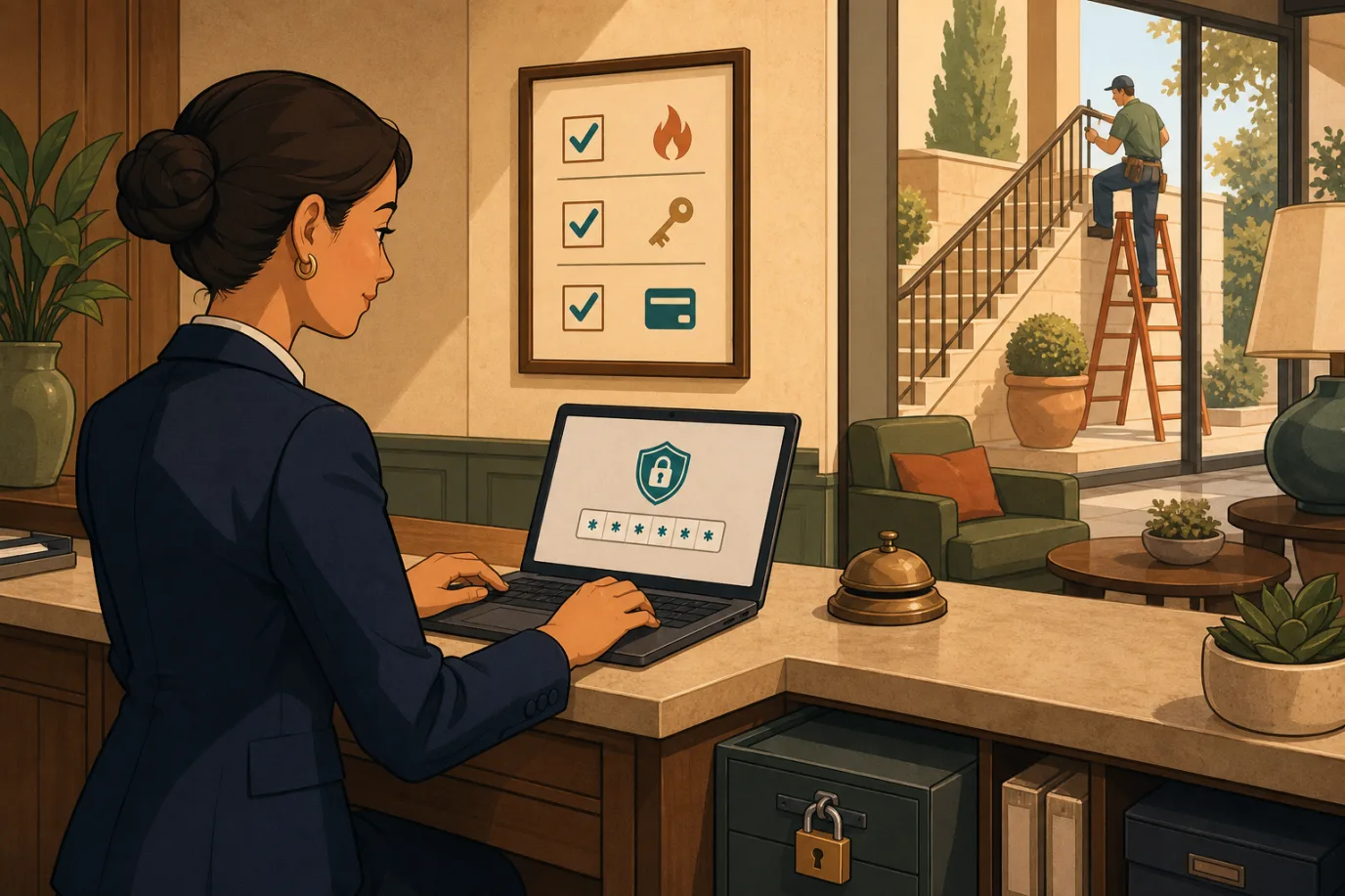
The defence layer that matters is equally unglamorous and mostly free: two-factor authentication on the OTA extranets, the email, the PMS and the bank, unique passwords in a manager, software updates applied, and staff who have been shown one real phishing email in a five-minute briefing, because recognition beats policy documents. Beyond that, data minimisation quietly shrinks the blast radius: keep guest data in the PMS where access is logged and role-limited, not in exported spreadsheets on three laptops, and do not retain what you have no reason to keep. A breach you cannot suffer is data you never stored.
Family Five: Reputational and Compliance Risk
Reputational risk is mostly the downstream shadow of the other four families: the injury becomes the news story, the breach becomes the apology email, the overbooking becomes the one-star review that outranks your website. Manage the upstream families and this one largely manages itself. The register still deserves a few dedicated rows, though: dependence on a single review platform for most of your demand, a rating that sits within a point of the OTA visibility cliff, and any marketing claim, star rating, beachfront, spa, that drifts from what the property actually delivers, because the gap between promise and experience is the raw material of viral complaints.
Compliance is the quieter sibling: licences, tourist taxes, data protection registration, fire certificates, insurance renewals, all the paperwork with dates attached. The risk is rarely malice and usually calendar failure, the licence that lapsed because the reminder lived in a departed manager's inbox. The mitigation is a single shared compliance calendar with renewal dates and a named owner per item, reviewed in the same quarterly hour as the register. It is the least intellectually interesting row in the whole discipline and the one whose failure modes come with fines attached.
The Four Responses: Reduce, Transfer, Accept, Avoid
Once the register is sorted, every top row gets one of four responses, and naming which one you are choosing is half the value, because it converts drift into decision. Reduce is the default: make the risk less likely or less damaging, fix the rail, add the two-factor, write the walk procedure. Transfer means paying someone else to carry the financial impact, which is what insurance is. Accept is a legitimate choice for low-score risks: written down, eyes open, we know the terrace umbrellas blow over twice a year and replacing them is cheaper than engineering the problem away. Avoid means stopping the activity entirely, declining the visiting circus's group booking, discontinuing the flaming dessert, and it is used more rarely than it should be, because saying no to revenue feels unnatural even when the arithmetic supports it.
The trap in this step is the unwritten accept. Every risk on the register that has no action and no explicit acceptance is being accepted silently, by default, without anyone having done the arithmetic. The quarterly review's most important sentence is often: are we actually choosing to accept this, or have we just not looked at it?
Insurance: What Transfer Actually Buys
Insurance deserves its own honest paragraph because it is the most misunderstood response. The core stack for a small hotel is public liability, property, business interruption, employer's liability where staff exist, and increasingly cyber cover. The two classic gaps: business interruption that is underinsured or missing, covering the rebuilding but not the eighteen months of lost revenue while it happens, and cyber incidents assumed to be covered by the general policy when they are usually excluded. Review the limits annually against this year's revenue, not the revenue you had when the policy was first written, and read the exclusions before the incident rather than after; the insurer certainly will. And remember what transfer does not buy: no policy restores a reputation, refills a cancelled season or attends the injured guest. Insurance pays for damage; it does not prevent it, which is why transfer complements reduction and never replaces it.
Making It a Habit: The Quarterly Hour
The register only works if it is alive, and the cadence that keeps it alive without burning anyone out is one hour per quarter. Same small group that built it, register on the screen, three questions per top row: has the likelihood changed, has the impact changed, did the action we agreed actually happen. Add anything new that the quarter taught you, especially near misses, because a near miss is a free lesson about a row you scored wrong. Re-sort, reassign, book the next hour. That is the entire operating system.
Two additions make the habit stick in a real hotel. First, attach the review to something that already happens, the quarterly accounts, the seasonal deep clean, so it borrows an existing rhythm instead of competing for a new one. Second, keep score visibly: rows retired, actions completed, incidents that did not happen because a fix was in place. Risk management has a marketing problem, its successes are invisible non-events, and a short written record of closed rows is what convinces an owner, an insurer or a buyer that the property is run by adults. Over a few years, that record quietly becomes one of the property's assets.
Where Prostay Fits
A meaningful share of a hotel's risk register turns out to be software-shaped, and the fixes arrive as configuration rather than heroics. Overbooking risk is retired by the channel manager holding one real-time inventory across every platform. A whole band of internal risk, the wrong person editing a reservation, a rate changed without a trace, a departed employee whose access never ended, is closed by the PMS's user roles, permissions and audit trail, so every change has a name and a timestamp attached. Payment risk shrinks when cards are handled through tokenised links instead of dictation over the phone. Data risk shrinks when guest information lives in one access-controlled system instead of exported spreadsheets. And the financial early warnings, the cheapest-bookings glance, the pace check, the channel cost report, are standing reports rather than monthly archaeology.
The register itself, the scoring and the quarterly hour remain stubbornly human work, and no vendor should pretend otherwise. The fair test for any system, ours included, is which rows of your register it lets you delete: if the software cannot demonstrably retire risks, it is a cost line, and if it can, it is one of the cheapest mitigations you will ever buy.
Frequently Asked Questions
The questions owners ask most about hotel risk management, what it covers, how to build a register, what insurance actually protects and how often to review, answered with the same practical bias as the rest of this guide.