Early check-in and late checkout are not spare inventory. They are hours that already belong to somebody else. The room a guest wants at ten in the morning is still occupied, or still dirty, and the afternoon a departing guest wants to keep is the afternoon somebody else is arriving into. That is what makes pricing these awkward, and it is why most properties never really price them at all. The request arrives at the desk, a receptionist makes a judgement call, and a decision worth real money gets made by whoever happened to be on shift. Your property management system knows the room status and the arrival list that would answer the question properly, but nobody consults it in the four seconds the conversation takes.
The second problem is where the money gets left. These are among the few things a hotel can sell after the booking is made, to a guest who has already chosen you and is no longer comparing prices. Selling them through your booking engine before arrival turns a favour into a priced option, and it moves the decision from a busy lobby to a quiet moment when the guest is planning their journey. A guest who is asked at nine in the morning by email will often pay. The same guest standing at the desk at ten expects a smile and a yes.
This article is about treating those hours as a product with a cost. What you are actually selling, why early check-in and late checkout are not the same thing, how to price each of them, when giving them away is correct, and what to say when you have taken the money and cannot deliver. It sits next to selling day-use rooms, which is a different trade: there you are selling a room nobody has booked, here you are selling hours attached to a room somebody has.
What You Are Actually Selling
A hotel room is usually described as a nightly product, which is a convenient fiction. What you actually control is a continuous line of hours, cut into nights by convention and by the practicalities of cleaning. Check-in at three and checkout at eleven exist because that four-hour gap is the window housekeeping needs to turn the room, not because guests naturally want to arrive mid-afternoon.
When someone asks for a ten o'clock arrival, they are asking you to move that boundary. The hours between eleven and three on any given room are not idle. They are committed to the process that makes the room sellable again. Selling them means either compressing that process or taking the room out of the previous night's inventory.
This is the difference that matters, and it explains most of the confusion. A day-use booking is sold on a room you did not sell last night. An early check-in is sold on a room you did. The first is genuinely spare capacity. The second is borrowed, and the lender is either your housekeeping schedule or last night's rate.
Once you see it that way, the pricing question becomes simpler. You are not asking what a guest will pay for convenience. You are asking what those specific hours cost you to release, on that specific day, and pricing above it.
Why the Two Are Not the Same Product
They get bundled together on every policy page ever written, and they behave completely differently.
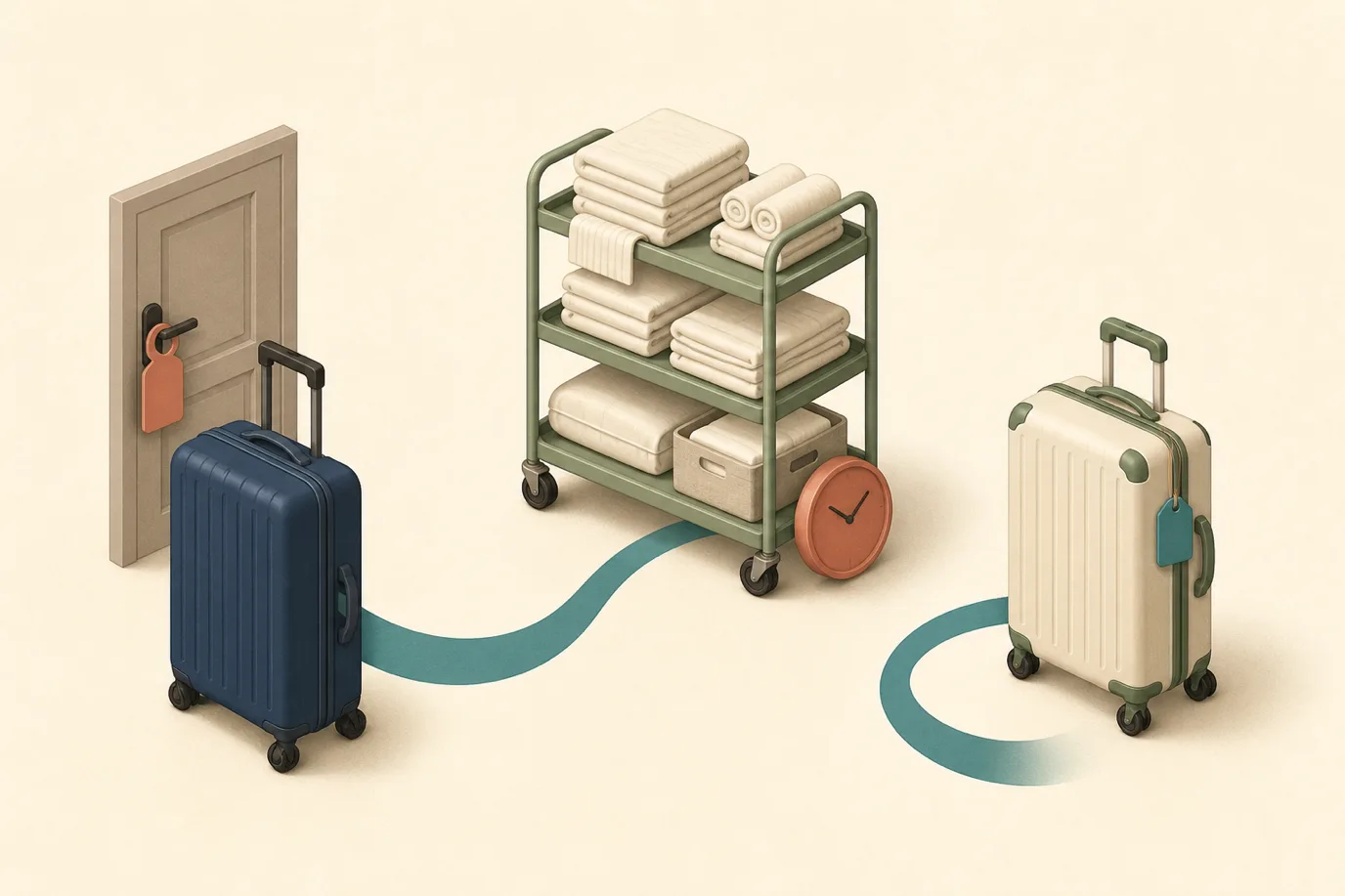
Early check-in is a supply problem you find out about late. At nine in the morning you do not yet know which rooms are leaving. Departures firm up between ten and noon, and a room is only genuinely available when the guest has gone and housekeeping has finished. So an early arrival request is a bet on a sequence that has not happened yet. You can improve the odds by knowing which rooms were flagged as early departures, but you cannot remove the uncertainty without holding the room from the night before.
Late checkout is a demand problem you can see coming. You know tonight's arrivals. You know your occupancy. If you are at sixty percent, an extra four hours on a room costs you almost nothing beyond a scheduling headache. If you are sold out and the same room needs to be ready for a guaranteed arrival, those four hours are the difference between a clean room at three and an apology.
The practical consequence is that they should be priced on different logic. Late checkout can be sold quite freely on low-occupancy days and should be capped hard on high-occupancy ones. Early check-in is risky on exactly the days it is most requested, because a busy morning is one where every room is turning. Charging the same flat fee for both, on every day of the year, is how properties end up giving away the valuable one and charging for the worthless one.
What Housekeeping Throughput Lets You Promise
Everything in this article is downstream of one number: how many rooms your team can turn per hour, and when they start.
If eight housekeepers each clean roughly two rooms an hour from nine, you have sixteen rooms an hour of throughput. If forty rooms are departing, the last one is not ready until well into the afternoon even with everything going right. That is your real constraint. It is not a policy question and no amount of pricing changes it.
What pricing can do is decide the order. A room with a paid early arrival attached should be cleaned first, ahead of a room with no arrival until evening. Most properties sequence by floor or by section because it saves walking, which is efficient for housekeeping and wrong for the business. The moment you start selling early check-in, the cleaning order has to be driven by who is arriving and who has paid, not by geography.
This is the operational commitment people underestimate. Selling early check-in properly means giving housekeeping a live list of which rooms matter this morning and expecting the sequence to change during the shift as departures come in. If you cannot do that, sell late checkout and leave early arrival as a free favour when it happens to be possible.
What a Real Guarantee Costs You
Worth being blunt about, because the word guarantee gets used loosely and it is where complaints come from.
A room is guaranteed available at nine in the morning only if nobody slept in it and it was cleaned the previous day, or if the same guest paid for that night. There is no third option. Everything else is a probability dressed as a promise.
So a genuine guaranteed early arrival costs you the previous night. Price it that way, at or near a full night's rate, and it becomes an honest product that some business travellers will happily buy after a long flight. Price it at a token amount and you have sold a lottery ticket with your reputation as the prize.
Guaranteed, or Subject to Availability
The cleanest structure most properties land on has three tiers, and the value of it is that everybody at the desk can explain it in one breath.
Subject to availability, free. The guest arrives, the room happens to be ready, they go up. No charge, no promise made in advance, no expectation created. This is what most early check-ins already are, and there is nothing wrong with it as long as nobody has paid for it.
Priority, paid, still not guaranteed. The guest pays a moderate fee and their room goes to the front of the cleaning queue. You are selling sequence, not certainty, and the wording has to say so. Charge on delivery rather than at booking, so a guest who does not get in has nothing to reclaim and nothing to complain about.
Guaranteed, paid properly. The room is blocked from the night before. The guest can walk in at any hour and the key works. This costs a night and should be priced like one.
The middle tier is the one that needs the most care and generates the most revenue. Guests understand paying to jump a queue. They do not understand paying for a queue jump and then still waiting, unless you told them clearly and refunded promptly.
Four Ways to Price the Hours
All four are in common use. They fail in different ways.
| Model | How it works | Where it breaks |
|---|---|---|
| Flat fee | One amount, every day, every room type | Too expensive in low season, far too cheap when you are full. Simple to train, which is why it survives |
| Share of the nightly rate | A quarter of the rate for a few hours, up to a full night for a guarantee | Scales correctly with season and room type. Needs the desk to be able to see the rate, which is not always true |
| Hourly or two-hour bands | Priced per block, rising as the request moves further from the standard time | Matches what you actually give up. Can get fiddly to explain and to post |
| Free above a tier, paid below | Loyalty members and direct bookers free, everyone else pays | Turns the fee into a loyalty benefit. Only works if the tier genuinely means something |
The share-of-rate model is the one that survives contact with a full year. It is automatically cheaper in February and automatically expensive in August, without anyone updating a policy document. It also scales across room types without a separate table, which matters if your suites cost three times your standards.
Whatever you choose, decide in advance what happens at the far end. Late checkout that drifts past mid-afternoon should convert to a full night rather than continuing to accrue in blocks, because past a certain hour you have lost the room for the day regardless.
The Free-If-Available Trap
Free-if-available sounds generous and costs almost nothing on a quiet day. The trap is what it teaches.
Once guests learn that asking works, they ask. The asking concentrates on exactly the days you are busiest, because those are the days with the most arrivals. So your free policy gives away the most inventory on the days that inventory is worth most, which is the opposite of what any other part of your pricing does.
It also creates a fairness problem at the desk that has no good answer. Two guests ask the same question ten minutes apart. The first gets a room because one was ready, the second does not. From behind the desk that is simply how it went. From the guest's side it looks like a decision about them, and it is the sort of thing that appears in reviews as inconsistency.
The fix is not to abolish the favour. It is to stop letting the favour be the only product. Keep giving rooms away when they are genuinely ready and the day is soft, because that costs nothing and generates goodwill. Add a priced option for guests who want to remove the uncertainty, and make sure the desk offers it rather than waiting to be asked.
Who Should Still Get It Free
Charging everybody is as unconsidered as charging nobody.
Top-tier loyalty members should get late checkout free and reliably, because it is one of the few benefits in most programmes that guests genuinely value and can actually use. A benefit that is subject to availability on every busy day is not a benefit, and frequent guests notice quickly.
Guests recovering from something that went wrong should get it without being asked. A late checkout is a cheap and unusually effective gesture when a room was noisy or a booking was mishandled, because it gives back time rather than money.
Long-stay guests are worth treating differently too. Somebody on their ninth night has already paid you a great deal, and the marginal value of charging them for four hours is small next to the risk of souring the last impression of the stay.
Everyone else is a commercial decision, and the honest version of that decision depends on the day rather than the person.
Sell It Before Arrival, Not at the Desk
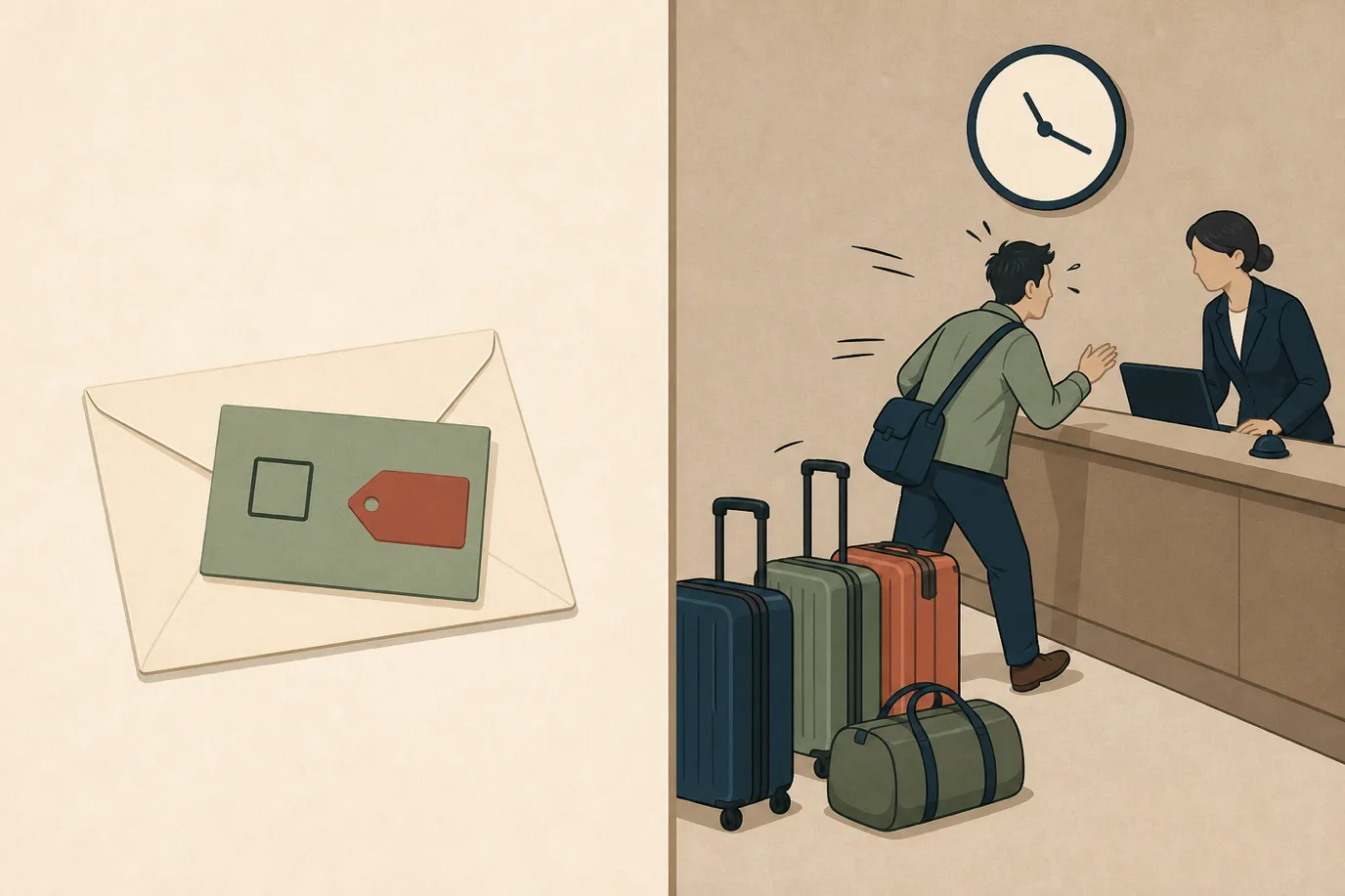
The desk is the worst place to sell these, for four reasons that all compound.
There is a queue. Whatever the receptionist says will be short, and short answers to money questions come out as either a flat no or a free yes.
The guest is tired and standing up. Nobody negotiates well with luggage in their hands, and a price quoted in that moment reads as opportunism rather than as an option.
The receptionist has no time to check anything. Doing this properly means looking at room status, tonight's arrivals and the cleaning sequence. That is a minute of work, and it is not available while six people wait.
And the answer is binary. At the desk the room is either ready or it is not, so there is nothing to sell. The commercial opportunity existed the day before, when you could still arrange it.
A message the afternoon before arrival, offering a priced early arrival with a clear statement of what is guaranteed, does all the work the desk cannot. It gives the guest time to decide, it gives you notice to sequence housekeeping, and it converts because the guest has already committed to staying with you. Our pre-arrival email playbook covers the timing of that message in more detail, and the same logic applies to late checkout sold on the morning of departure rather than at the moment somebody is packing.
What the Fee Does to Your Numbers
Small amounts, but they land in places that matter.
Attach a fee to enough arrivals and it moves your rooms revenue meaningfully, because the cost of delivering it is close to zero on the days you sell it correctly. A property selling early arrival to one arrival in ten at a quarter of rate is adding roughly two and a half percent to rooms revenue, without a single extra room sold. That is a better return than most upsell programmes produce, which is why it is worth the operational effort. The wider case for selling after the booking is made is covered in the hotel upselling guide.
It also distorts your statistics if you are careless, which is the part people miss.
Room Revenue or Service Charge
Decide this once and hold it, because the two treatments are both defensible and mixing them is not.
Treated as an extension of the stay, the fee is rooms revenue. It flows into ADR and RevPAR, it usually attracts whatever lodging or tourist tax a room night attracts, and it makes your rooms numbers slightly better and slightly harder to compare year on year.
Treated as a service charge, it sits outside rooms revenue in other operated departments. ADR stays clean, the fee is visible as ancillary income, and the tax treatment may be different.
Neither is wrong. What is wrong is having half your desk post it one way and half the other, which is common and produces a rooms revenue line nobody trusts. If you report against the uniform system of accounts, pick the treatment that keeps you consistent with how you handle other stay extensions. And confirm the tax position locally rather than copying a policy from a property in another country, because lodging taxes are unusually varied and an error here repeats on every transaction.
Where It Meets the OTAs
Two questions come up, and the answers are more favourable than people expect.
Is the fee commissionable? Generally not, if you sell it directly to the guest after the booking is made and collect it yourself. It is an ancillary sold by you, not part of the rate the agent booked. If you bundle early check-in into a rate plan that the agent distributes, it becomes part of that rate and is commissionable like everything else. That difference is worth real money and is entirely within your control.
Does rate parity stop you offering it? Parity clauses concern the room rate, not what you sell alongside it. Free late checkout for direct bookers is a legitimate direct-booking advantage that does not touch the rate at all, which makes it one of the more useful tools available for shifting demand to your own channel. The rate parity position in Europe has moved considerably in the hotel's favour in any case, but this particular tactic was never the problem.
The Conversation When You Cannot Deliver
You will sell an early arrival and fail to have the room. Plan for it rather than improvising.
The first rule is not to hold money you might have to give back. Authorise rather than charge, and capture when the guest actually gets into the room. A refund that arrives three days later does not undo the morning, and a guest who paid for something they did not receive writes a different review from one who was simply unlucky.
The second is to have something to offer instead. Luggage storage is the minimum and does not count for much. Access to a shower or a gym changing room, a coffee and something to eat, and a genuine estimate of when the room will be ready are worth more than the fee itself. The estimate matters most: guests wait far better against a real time than against repeated assurances that it will not be long.
The third is to tell them before they arrive if you already know. If at eight in the morning it is clear the room will not be ready by eleven, a message saying so lets the guest plan their morning. Nobody enjoys that message, and everybody prefers it to discovering the problem after a taxi ride.
Writing the Policy Down
Most properties have a policy that lives in the heads of three long-serving receptionists, which means it varies by shift and disappears when they leave.
A written version needs to answer six things: what times the free grace periods run to, what the priced bands are and what each costs, what is guaranteed and what is not, who gets it free regardless, how many can be sold on a given day, and what happens when you cannot honour one. Six answers, one page.
The daily cap is the one that gets left out and the one that protects you. Selling five late checkouts on a sold-out night is a very different act from selling five on a half-empty one, and without a cap the decision falls to whoever takes the fifth request. Set the number against occupancy, review it at the morning meeting, and let the desk sell freely up to it.
Publish the paid options where guests can see them, including on your own booking flow. A policy that only exists as an answer to a question is a policy that gets asked about at the desk, which is the outcome this whole exercise is meant to avoid.
The Five Numbers Worth Watching
Enough to know whether this is working, few enough that somebody will actually look at them.
Attach rate. The share of eligible arrivals or departures who buy. This is the number that tells you whether your offer is reaching people at a moment when they can act on it. A low attach rate is usually a timing problem rather than a price problem.
Realisation. The share of sold early arrivals you actually honoured. Anything below the high nineties means you are overselling a promise, and the review damage will exceed the revenue.
Denial rate. How often you turn down a request you could have sold. Track it for a month and it usually reveals that the constraint is cleaning sequence rather than genuine unavailability.
Incremental revenue per occupied room. The fee income divided by rooms sold, which lets you compare this against every other ancillary you run and against the effort it costs.
Mentions in reviews. Search your reviews for the words check-in and checkout each month. This is the only one of the five that catches the failure mode where the revenue looks fine and the guest experience is quietly deteriorating.
None of this is complicated, and that is rather the point. The hours between eleven and three exist whether you sell them or not, they carry a real cost that changes day by day, and at the moment most hotels hand them out based on who asks nicely and who happens to be on shift. Putting a price and a policy on them is not about squeezing guests for a few more currency units at the end of a stay. It is about making the same decision the same way twice.