The Numbers That Matter
If you run a hotel in the European Union, the European Economic Area, or Switzerland and you have not changed your rate parity setup since 2023, the regulatory floor has moved out from under you. Here is the situation as of the day this article was published, with the citations you need to verify each claim independently.
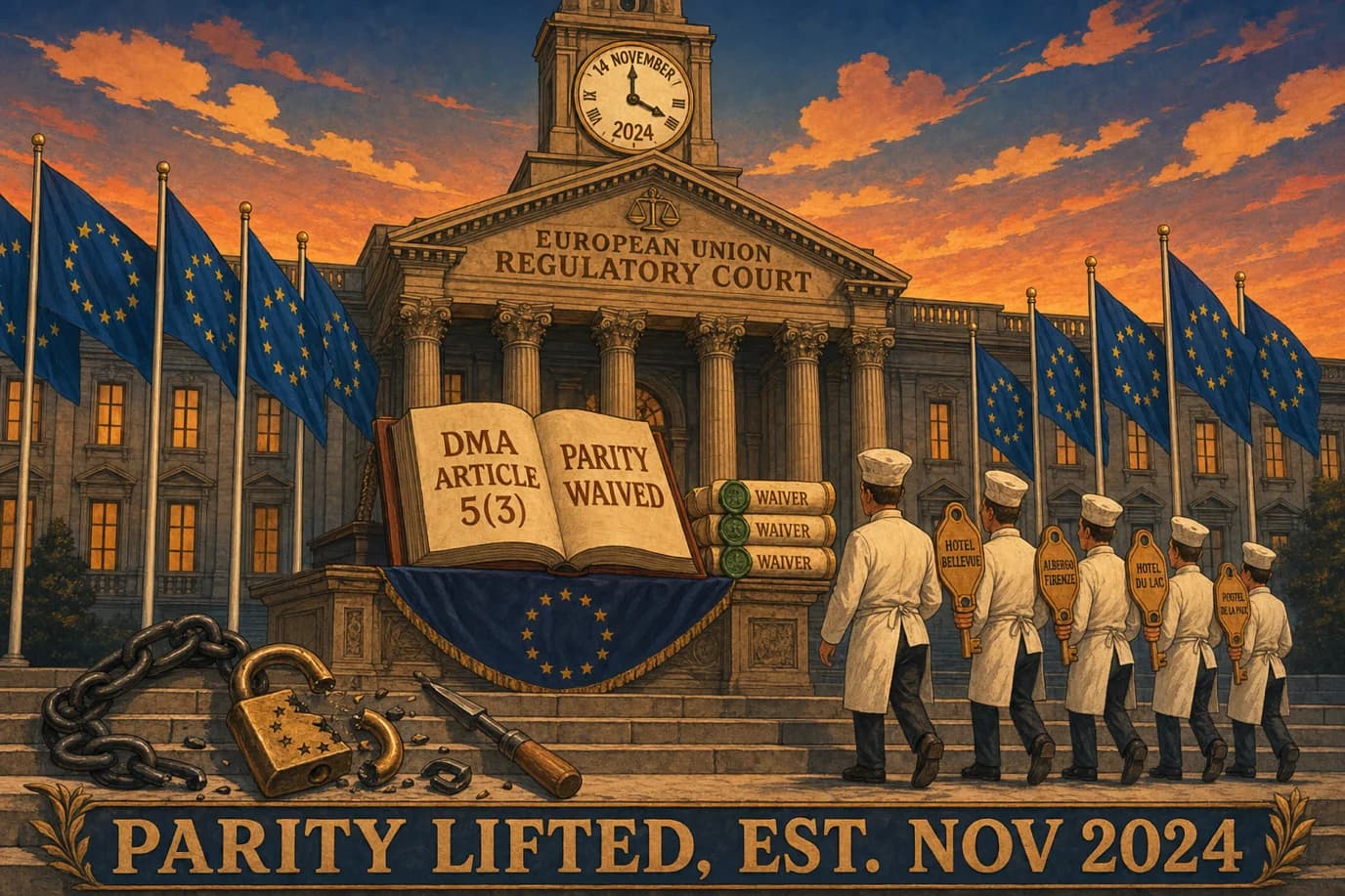
On 13 May 2024, the European Commission designated Booking Holdings as a gatekeeper under the Digital Markets Act for its online intermediation service, Booking.com. The compliance deadline was 14 November 2024. From 2 December 2024, Booking.com confirmed in its DMA compliance report that all wide and narrow parity clauses were either removed or waived for European Economic Area inventory, applying to both new partners and existing contracts.
On 19 September 2024, the Court of Justice of the European Union issued its ruling in Case C-264/23 (Booking.com and Booking.com Deutschland), holding that both wide and narrow parity clauses do not qualify as ancillary restraints to the platform-hotel agreement and therefore must be assessed independently under Article 101 of the Treaty on the Functioning of the European Union. In practical terms, the ruling cleared the legal path for hotel damages actions across the EU.
On 16 December 2025, the Landgericht Berlin II issued a ruling in case 61 O 60/24 Kart that found Booking.com BV and Booking.com (Deutschland) GmbH jointly liable to compensate 1,099 hotel operators for damages caused by the use of unlawful best-price clauses from 1 January 2013 onward. The judgment is not yet final and can be appealed to the Kammergericht within one month. It is the largest collective-damages ruling against an OTA in European hotel history.
If you have spent the last decade believing that rate parity was a permanent fixture of how the hotel distribution market works, you have missed the largest contractual shift since the introduction of dynamic pricing. Hotels in 30 European countries are now contractually free to offer lower prices on their direct channels than on Booking.com, and the same freedom extends to most other major OTAs operating in the European Economic Area.
For a 30 to 150 room independent in 2026, the practical implications are significant. A hotel running a typical channel mix (60 percent OTA, 30 percent direct, 10 percent corporate) at 200,000 euros monthly room revenue is paying 20,400 euros per month in OTA commission at a 17 percent blended rate. Recovering 10 percentage points of OTA share to direct, which the new contractual freedom makes possible, recovers roughly 16,800 euros per year net of payment processor fees. Recovering 20 points recovers 33,600 euros. Neither number is hypothetical. They are the directly addressable margin that parity clauses prevented hotels from contesting until November 2024.
The Phocuswright 2025 forecast on European hotel distribution puts the addressable shift at 6 to 14 percentage points of direct booking share over 24 months for hotels that act on the new freedom within the first 12 months. Hotels that wait until 2027 to redesign their pricing strategy will find that OTAs have largely closed the price gap themselves through targeted promotion programs (Booking Sponsored Benefit, Genius price discounts, Preferred Plus visibility incentives) that exploit the same regulatory space hotels are slow to claim.
This is the honest 2026 read on hotel rate parity in Europe. The actual legal status across the eight countries that matter most, the four common mistakes hotels make when they first try to break parity, the empirical evidence on what happens to prices when parity ends, the three direct-pricing strategies that actually work in 2026, and the 60-day plan that one operationally-minded person can run to convert the regulatory shift into measurable direct-channel growth.
The EU Crackdown Timeline 2013 to 2026
If you want to argue intelligently with your Booking.com market manager about what you can and cannot do in 2026, you need the legal timeline at your fingertips. Most market managers do not have it. Most published hotel guides do not have it either.
The story begins in December 2013, when the German Bundeskartellamt ruled that the wide parity clause used by Hotel Reservation Service Robert Ragge GmbH, then one of the major German OTAs, violated EU competition law. The decision established the basic legal principle that wide parity (the hotel must offer Booking.com the lowest rate across all sales channels including its own direct site) restricted competition between intermediation services and forced higher commissions on hotels.
In July 2015, the French National Assembly passed Article 133 of the Macron Law (Loi pour la croissance, l'activite et l'egalite des chances economiques), effective from 8 August 2015. The law prohibited any form of price parity between OTAs and hotels in France. France became the first European country to fully ban both wide and narrow parity clauses, and the Macron data set has since become the most-cited empirical evidence of what happens when parity disappears.
In December 2015, the Bundeskartellamt extended its HRS ruling to Booking.com itself, finding that narrow parity clauses (the hotel must offer Booking.com a rate at least as low as its direct site, but can offer lower rates on other OTAs) also violated competition law. Booking.com removed the clauses from German contracts effective 1 February 2016.
The German ruling was confirmed by the Bundesgerichtshof, Germany's federal court of justice, in case KVR 54/20 on 18 May 2021. The BGH found that Booking.com's narrow parity clauses were not group-exempt under Article 2(1) of the Vertical Block Exemption Regulation because Booking.com's market share in Germany exceeded 30 percent, and that the clauses produced no offsetting efficiency gains under Article 101(3) TFEU.
The Italian Parliament passed a similar prohibition in August 2017 via Article 166 of the Annual Competition Law, banning all parity clauses in Italy. Austria followed in September 2016, Belgium in July 2018. By the end of 2018, parity clauses were unlawful in five of the six largest hotel markets in continental Europe.
The European Court of Justice consolidated the patchwork into a unified European standard with its ruling in Case C-264/23 on 19 September 2024. The court held, in response to a preliminary reference from a Dutch court hearing an action by hotels against Booking.com, that both wide and narrow parity clauses are not ancillary restraints to the platform-hotel agreement and therefore must be assessed independently under Article 101 TFEU. The ECJ also clarified that the relevant market for assessing platform market share requires a concrete examination of supply-side and demand-side substitutability between online intermediation services and other sales channels, raising the bar for any future ancillary-restraint defense.
Parallel to the ECJ proceedings, the European Commission designated Booking Holdings as a DMA gatekeeper on 13 May 2024 with a compliance deadline of 14 November 2024. Article 5(3) of the DMA prohibits gatekeepers from imposing parity clauses or measures with equivalent effect on their business users. Booking.com's compliance approach, documented in its 2025 DMA Compliance Report, was to remove or waive parity requirements for all EEA-based travel offerings, amending five of its standard agreements and issuing more than 70 waivers on negotiated agreements. The waivers came into effect for new and existing partners on 2 December 2024.
Italy's Autorita Garante della Concorrenza e del Mercato (AGCM) closed its Booking.com competition case on 19 December 2024, accepting commitments under which Booking.com agreed that prices set by hotels on other online sales channels would not be taken into account at any stage in the operation or promotion of the Preferred Partner Programme, Preferred Plus tier, or Booking Sponsored Benefit programs. The AGCM also extracted commitments on transparency, requiring Booking to communicate program access and operation through nominative emails and periodic statistical data.
The AGCM reopened a separate investigation on 22 April 2026 into the Preferred Partner Programme and Preferred Plus tier, this time under consumer protection law rather than competition law. The new investigation alleges that Booking misleads consumers by presenting Preferred Partner properties as selected for superior service when the eligibility criteria are in fact driven primarily by commission levels paid by the hotel. The investigation is ongoing as of this writing.
The Swiss Preisueberwacher issued a formal Verfuegung on 20 May 2025 following an investigation into Booking.com's commission levels in Switzerland, building on the existing Swiss Federal Council prohibition of parity clauses from 1 December 2022. Switzerland is not in the EU and the DMA does not apply directly, but the Swiss legal and regulatory environment is independently hostile to parity restrictions.
And on 16 December 2025, the Landgericht Berlin II issued the ruling that converted a decade of regulatory action into a damages claim, finding Booking.com jointly liable to compensate 1,099 German hotel operators for losses caused by parity clauses used from 1 January 2013 onward. The court did not quantify the damages; that question is left to subsequent proceedings. But the establishment of liability for the entire 12-year window of unlawful clause use is the largest single judicial result against an OTA in European history.
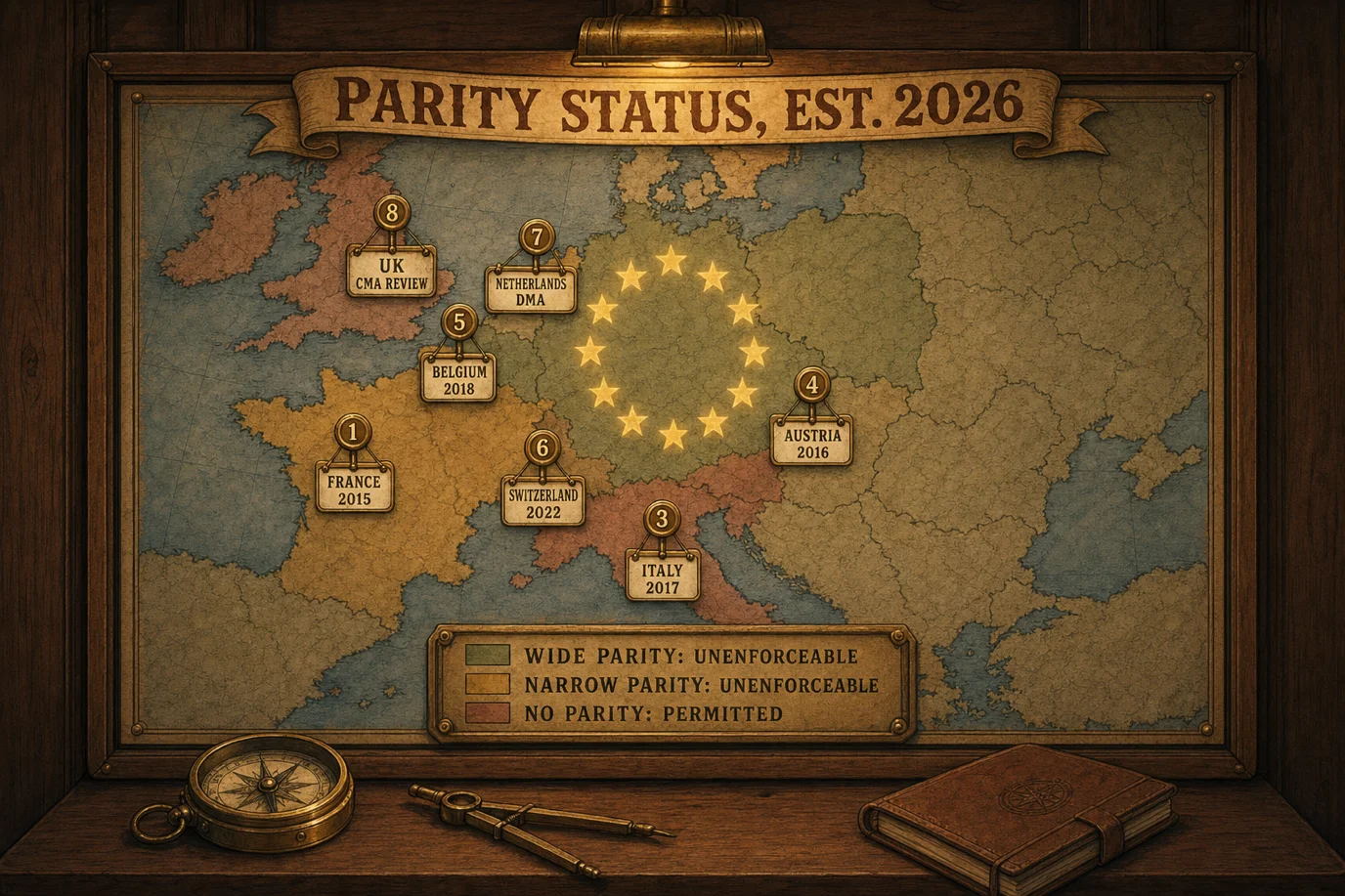
The cumulative effect of these decisions is that wide and narrow parity clauses are now unenforceable in the EU, the EEA, the UK (where the post-Brexit Competition and Markets Authority has not reversed the position), Switzerland, and most of the rest of Europe. The conventional advice that hotels must comply with parity to avoid sanctions is, as a matter of European law in 2026, simply wrong.
Wide Parity, Narrow Parity, No Parity: The Real Distinctions
Most published guides treat rate parity as a binary, the hotel either complies or does not. The reality across European jurisdictions in 2026 is three distinct legal categories, each with its own enforceability profile, and a fourth category that the OTAs are quietly building to recover what the regulators took away.
Wide parity
Wide parity (also called the most-favored-nation clause or MFN) is the contractual requirement that the hotel offer Booking.com the lowest rate it offers on any sales channel, including its own direct website, its own phone reservations, its corporate accounts, and every other OTA. Wide parity was the standard Booking.com contract from the mid-2000s until 30 June 2015, when Booking.com voluntarily narrowed the clause in response to German regulatory pressure.
Wide parity is now unenforceable across the EU, the EEA, the UK, and Switzerland. The Bundeskartellamt's December 2013 HRS decision, France's August 2015 Macron Law, Italy's August 2017 Annual Competition Law, the ECJ's September 2024 C-264/23 ruling, the November 2024 DMA Article 5(3) prohibition, and the December 2025 Landgericht Berlin II damages ruling have all converged on the same answer: wide parity is anticompetitive, restricts both downstream price competition between hotels and upstream competition between intermediation platforms, and produces no offsetting efficiency that would justify the restriction under Article 101(3) TFEU.
If your contract with any OTA still contains a wide parity clause and you are operating in the EEA or the UK, you should treat the clause as legally void. You may want a competition lawyer to confirm this for your specific contract before you act on it, but the legal floor is now clear and well-established.
Narrow parity
Narrow parity (also called the narrow MFN) was the half-step retreat. Under narrow parity, the hotel could offer lower rates on other OTAs and through corporate or wholesale channels, but the hotel could not publicly offer a lower rate on its own direct website. Booking.com adopted narrow parity globally on 1 July 2015 in response to wide-parity pressure from German, French, and other European regulators. The argument from Booking was that narrow parity protected against free-riding (hotels would let Booking.com pay for the marketing and then offer the lower direct rate) without restricting hotel-to-hotel price competition.
The German Bundeskartellamt rejected this argument in December 2015, and the Bundesgerichtshof confirmed the rejection in May 2021. The ECJ confirmed the same position at EU level in September 2024 with C-264/23. The reasoning is consistent: narrow parity still restricts competition between platforms (other OTAs cannot win share by negotiating lower rates with hotels), still inflates intermediation commissions, and still produces no offsetting efficiency.
Narrow parity is now unenforceable across the EEA from 14 November 2024 under DMA Article 5(3), and was already unenforceable in Germany, France, Italy, Austria, Belgium, and Switzerland under national law before then. In the UK, post-Brexit, the Competition and Markets Authority has not formally banned narrow parity, but the CMA has signaled it views narrow parity skeptically, and any UK hotel could realistically expect a CMA-favorable outcome if it broke narrow parity and Booking.com sought enforcement. In practice, Booking.com is not enforcing narrow parity in the UK either.
No parity
No parity is the contractual state that hotels are now legally entitled to insist on across Europe. The hotel can offer any rate it chooses on any channel, including a lower direct rate than the Booking.com rate, without breaching its contract with Booking.com. Booking.com remains free to demote the listing in its own search results based on its own ranking criteria (which is not the same thing as a parity violation), but the contractual prohibition has been removed.
The practical effect of no parity is more subtle than most published guides suggest. Hotels are not forced to offer lower direct rates. Hotels are not forced to break visible online price symmetry. Hotels simply have the contractual freedom to do so, and the operational freedom to design pricing strategies that do not assume parity is a constraint.
Measures with equivalent effect (the catch-all)
Article 5(3) of the DMA prohibits gatekeepers not only from imposing parity clauses but also from imposing "measures with equivalent effect" that would prevent business users from offering better prices or conditions on other channels. This catch-all language is the regulatory acknowledgment that OTAs would otherwise replace parity clauses with operational mechanisms that achieve the same result without using the word "parity."
The mechanisms that the Commission is watching for, per stakeholder submissions to the November 2024 DMA Compliance Workshop, include:
- Algorithmic demotion of hotels that offer lower direct rates, where the demotion is presented as a "quality" or "competitiveness" signal but is in fact a parity proxy
- Eligibility for Preferred Partner Programme, Preferred Plus tier, or Genius participation conditioned on direct-channel pricing behavior
- Booking Sponsored Benefit, the platform-funded discount that Booking.com applies without hotel approval to match the lowest competing online price, as a mechanism that resets the visible price differential the hotel was trying to create
- Variable commission rates that adjust based on how the hotel prices on other channels
The Italian AGCM commitments from 19 December 2024 specifically addressed several of these mechanisms in the Italian market, requiring Booking to ensure that prices on other channels are not taken into account at any stage in the operation or promotion of the Preferred Partner Programme, Preferred Plus tier, or Booking Sponsored Benefit. The AGCM's separate April 2026 consumer protection investigation suggests that the Italian regulator is now watching whether the operational commitments are being honored or whether new mechanisms have emerged.
The honest 2026 read is that "no parity" is the legal state but the operational state is "no parity, watched closely for replacement mechanisms." Hotels that want to act on the new freedom should expect Booking.com to push back through ranking signals, program eligibility, and Booking Sponsored Benefit deployments, and should escalate any specific incidents to their national competition authority. Both the European Commission and most national competition authorities have indicated openness to receiving complaints.
The Five Things Hotels Get Wrong About Parity in 2026
Across every independent hotel I have spoken to about rate parity in 2025 and 2026, the same five misconceptions show up. None of them are stupid. All of them reflect what was true in 2019 and is no longer true. Correcting them is a precondition for actually changing your pricing strategy.
1. Believing parity is still mandatory in the EU
The single most common misconception is that rate parity remains a contractual requirement and that breaking it would expose the hotel to sanctions from Booking.com. This was true in 2019. It has been progressively untrue in country after country since 2015 and has been comprehensively untrue across the EEA since 2 December 2024.
The Booking.com 2025 DMA Compliance Report is the authoritative source on this. The report, published in November 2025 and accessible on the European Commission's DMA case page, states explicitly that Booking.com complies with Article 5(3) DMA by ensuring that its partners are not subject to parity requirements for inventory in the EEA. The waivers issued to existing partners remain in force until the next available renegotiation point, at which point partners move onto revised standard terms aligned with the DMA.
If you have not received a parity waiver from Booking.com and you operate in the EEA, you should request one in writing from your market manager. If you operate in France, Germany, Italy, Austria, Belgium, or Switzerland, the parity clause was already void under national law before the DMA waivers were issued. The waiver is a confirmation, not a precondition, of your contractual freedom.
2. Confusing contractual parity with rate-publicly-visible parity
The second misconception, which compounds the first, is that the only way to use the new contractual freedom is to publicly post a lower direct rate on the front page of the hotel website. This conflates two separate things: the contractual freedom to set lower rates on direct channels (which now exists) and the marketing decision about where to make those rates visible (which is and always was a strategic choice).
The Macron empirical research (discussed in detail below) shows that hotels that simply lower their visible online direct rates after a parity ban capture almost no incremental booking volume because Booking.com's algorithmic price match and the consumer's own price comparison behavior closes the visible gap quickly. The hotels that do capture volume are the ones that use the new freedom to design closed-channel offers (member rates, email-club rates, repeat-guest rates) that are not visible to the price comparison surface but are visible to qualified direct-channel users.
The right mental model is "contractual freedom enables strategy" not "contractual freedom requires strategy." You do not have to lower direct rates simply because you can.
3. Not knowing about the Booking.com waiver process
Most hotels, when asked, do not know whether they have received a DMA waiver from Booking.com. Many have, and the waiver is buried in a partner email from June 2024 or in a contract amendment dated November 2024. Some have not, and the waiver process is still available on request.
The waiver is important because it documents the contractual position. If a future dispute arises about whether the hotel breached the parity clause (and Booking.com seeks to demote the hotel's ranking on grounds related to pricing), the waiver is the evidence that the hotel was contractually free to set the rate. The waiver also typically clarifies that the change applies to both new and existing inventory in the EEA, removing ambiguity about start dates.
The first task for any European hotel that has not yet acted on the new pricing freedom is to confirm in writing with the Booking.com market manager whether the waiver is in place, when it took effect, and whether it covers all the EEA inventory the hotel sells. The same conversation should happen with Expedia, Hotels.com, Agoda, and any other major OTA that the hotel sells through. Expedia operates under different commercial terms, but its EEA contracts are now subject to the same DMA Article 5(3) analysis even though Expedia is not yet a designated gatekeeper.
4. Lowering online direct rates and expecting bookings to shift
The Macron empirical study, published in The Economic Journal in 2026 and based on data from 166 European hotels comparing France (which banned parity in 2015) with countries where parity remained in force, found that visible online prices in France dropped only 1 to 2 percent and the change was not statistically distinguishable from zero after the parity ban. Hotels were contractually free to lower direct rates and largely chose not to publicly do so.
The same study found that offline prices, the rates negotiated by direct phone calls, corporate sales contacts, and walk-in inquiries, dropped by around 5 percent, or 8.50 euros per booking. Bookings shifted away from online platforms toward direct offline channels. The mechanism is that hotels and guests were both able to use closed channels to capture and pass on the value that the parity-clause-imposed visible online floor had previously prevented.
The implication for 2026 is that the visible-online-price-war strategy is not the strategy that paid off in France. The closed-channel-direct-pricing strategy is what paid off. Hotels that respond to the DMA by simply lowering their publicly visible direct rates should expect almost no shift in booking mix and a small but measurable reduction in revenue per visible booking. Hotels that respond by building member-rate infrastructure, repeat-guest pricing, and direct-channel inclusions should expect a 5 to 10 percent shift in booking share to direct over 12 months, replicating the French pattern.
5. Treating Genius and Preferred Partner discounts as parity violations to chase
The fifth misconception is the inverse of the first. Some hotels, alerted to the parity ban, immediately try to enforce parity from the opposite direction by demanding that Booking.com not offer Genius price discounts (typically 10 to 15 percent off the standard rate, granted to Booking.com loyalty members) or Preferred Partner visibility discounts on the hotel's inventory.
This argument is legally weak. The parity ban runs against the OTA imposing parity on the hotel, not against the OTA offering loyalty discounts to its own members on its own platform. Booking.com is contractually entitled to discount your standard rate to its Genius members at Booking.com's expense (or, in some implementations, at the hotel's expense if the hotel opted in to Booking Sponsored Benefit, which is a separate question). The Genius discount is not a parity violation.
The right hotel response to Genius is to treat it as a marketing channel that competes with the hotel's own loyalty program rather than as a contractual breach. If Booking.com's Genius rate is lower than the hotel's direct member rate, the hotel can use the now-legal freedom to set a lower direct member rate that beats Genius. The contractual route is closed; the pricing route is open.
Booking Sponsored Benefit, the program through which Booking.com applies discounts to hotel inventory to match the lowest competing online price, is a separate question. The Italian AGCM December 2024 commitments addressed exactly this program, requiring Booking to ensure the program's operation does not take other-channel pricing into account. Hotels that operate in Italy can specifically cite the AGCM commitments when negotiating Booking Sponsored Benefit participation. Hotels elsewhere should treat Sponsored Benefit participation as a separate negotiation and read the program terms carefully.
The Macron Research: What Actually Happens When Parity Ends
France banned all parity clauses in August 2015. The country has been the natural experiment that the rest of Europe is now running ten years later. The 2026 study published in The Economic Journal by Carlo Reggiani and colleagues is the most rigorous quantitative analysis of what actually happens to hotel prices and bookings when parity disappears. It deserves close reading because the headline findings contradict what most hotels (and most OTAs) expected.
The study analyzed price data from 166 hotels across multiple European countries from 2014 to 2018, using a difference-in-differences design that compared French hotels to hotels in countries where parity remained in force. The methodology controls for seasonal patterns, market conditions, and hotel-specific characteristics, isolating the policy effect.
The three headline findings:
First, online visible prices barely moved. The estimated effect of the Macron Law on visible online prices was a 1 to 2 percent reduction, but the confidence interval included zero. Hotels did not respond to the parity ban by publicly discounting their direct rates relative to the OTA rates. The visible online price differential between direct and OTA channels was essentially unchanged.
Second, offline prices dropped significantly. The estimated effect on offline prices (direct bookings made by phone, walk-ins, corporate negotiations, and other non-publicly-listed channels) was a roughly 5 percent reduction, or 8.50 euros per booking on a typical 170 euro French independent. The effect was statistically significant and persistent across the post-policy window.
Third, channel mix shifted toward direct. The proportion of bookings made through direct offline channels increased measurably after the Macron Law, while the proportion made through OTAs declined. The shift was concentrated in repeat guests, corporate accounts, and locally-sourced demand, the segments most able to use closed channels to capture the price differential.
The mechanism that the authors propose for this pattern is the difference in price visibility and monitoring. Visible online prices are aggressively monitored by all parties: OTAs run automated price comparison, consumers comparison-shop across multiple platforms, and hotels themselves dare not deviate from a publicly visible parity because the OTA can detect it within hours. Offline prices, by contrast, are not monitored. A hotel can offer a 10 percent discount to a repeat corporate client by phone without Booking.com ever knowing, without the OTA's algorithm responding, and without the next consumer seeing the lower price and demanding the same.
The practical implication is that the parity ban created legal space for direct-pricing strategies that depended on closed monitoring, not for open price wars. The hotels that captured value used the new freedom to design member-rate programs, repeat-guest discounts, corporate-account pricing, and email-club exclusive rates. The hotels that did not see meaningful change either took no action or attempted the open-price-war strategy that the data shows does not work.
A second observation from the French data: the OTAs' response to the parity ban was not to passively accept the loss of share. Booking.com and Expedia both deployed their own consumer-facing loyalty discount programs (Genius and Expedia Rewards) more aggressively in France after 2015 than in the countries where parity remained in force. The OTA-funded discounts closed roughly half of the visible price gap that hotels could otherwise have opened. The hotels that won were the ones whose closed-channel programs were not subject to OTA price-match.
The 2026 European environment is in some ways more favorable than the 2015 French environment. The DMA Article 5(3) prohibition extends not only to parity clauses but to "measures with equivalent effect," which the Italian AGCM December 2024 commitments interpret as including the operation of programs like Booking Sponsored Benefit. The legal space for closed-channel hotel pricing is now broader than France's 2015 ban created. The hotels that act on this space within 12 months should expect to capture the same 5 to 8 percent direct-channel uplift the French independents captured in 2016 to 2018, perhaps more.
The hotels that wait for OTAs to redesign their programs around the new legal floor (which they will, and are already doing) will find the addressable space narrower by 2027 than it is in 2026. The window of competitive advantage for early movers is the next 12 to 18 months.
The Three Strategies That Actually Work in 2026
The empirical data from France and the structural reality of the 2026 European market converge on three direct-pricing strategies that work. None of them is the open-price-war strategy that most published guides recommend. All of them require operational infrastructure that the hotel must put in place, but the infrastructure is within reach of any 30 to 150 room independent with a competent booking engine.
Strategy A: Closed user groups (member rates and email clubs)
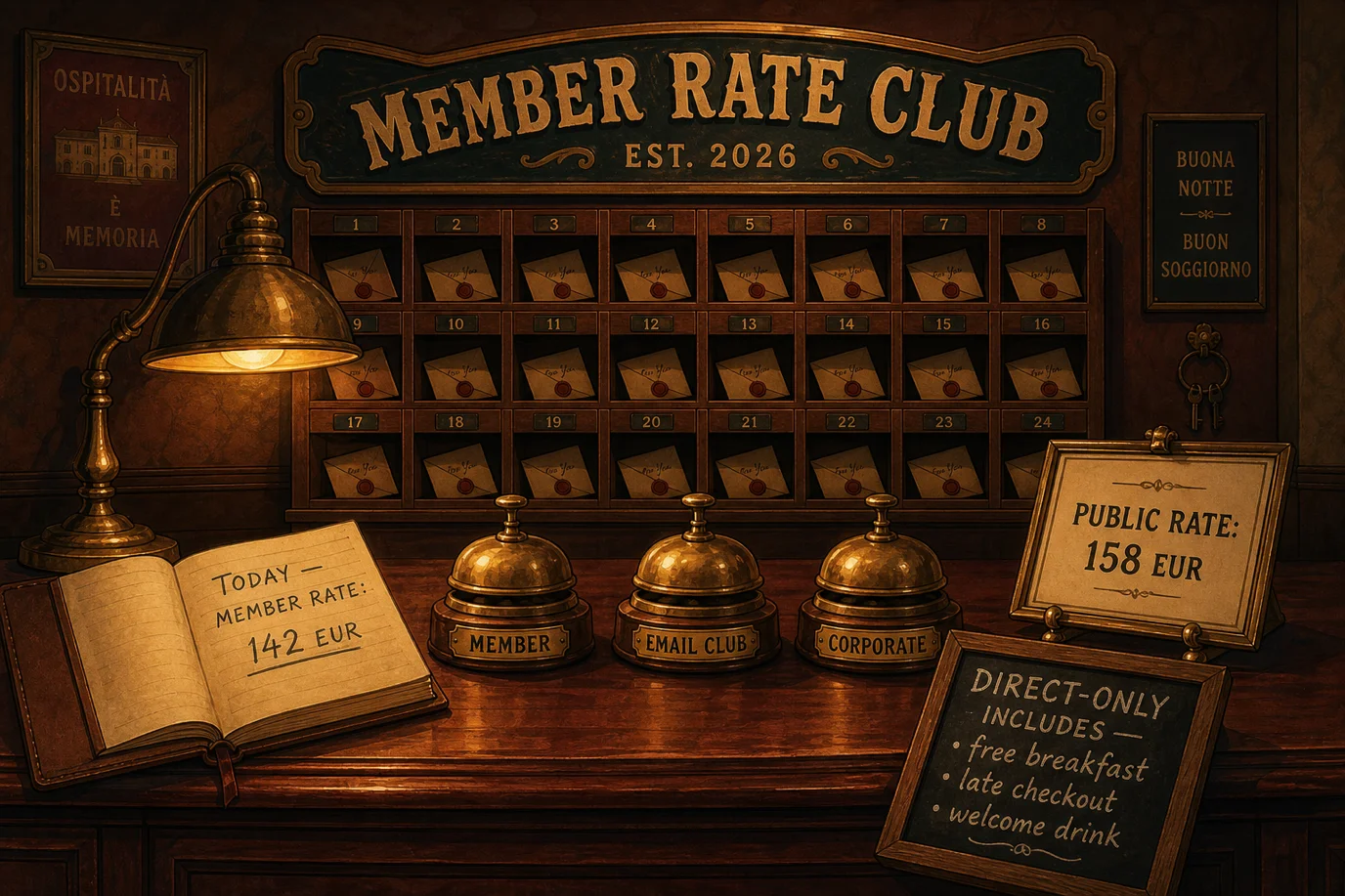
The most effective direct-pricing strategy in 2026 is to create one or more closed user groups whose members can see a lower direct rate that is not publicly visible. The closed group can be defined by email signup (the simplest implementation), loyalty program enrollment, corporate account membership, or repeat-guest status. The member rate is typically 5 to 12 percent below the publicly visible direct rate and 7 to 15 percent below the equivalent Booking.com rate after Genius discount.
The technical implementation has three components: a sign-up surface (a "join our member club" form on the website, ideally with a single email field and an immediate confirmation), a member-identification mechanism on the booking engine (a member-rate code, an automatic recognition by logged-in email, or a unique URL given to the member), and a separation in the rate plan from the publicly visible direct rate.
Booking engines that support closed user groups natively include Prostay, Bookassist, Profitroom, D-EDGE, Mews, Cloudbeds, and most other modern independent-focused systems. Older systems often require workarounds (a hidden rate plan that is exposed only via direct URL, for example). The reason the closed-user-group approach is legal in 2026 is that the member rate is not publicly visible to the price comparison surface and therefore does not trigger any OTA price-match algorithm or any consumer perception of cross-channel disparity.
The economics: a 60-room European independent at 200,000 euros monthly room revenue with a 5 percent member discount on 20 percent of bookings shifted from OTA to direct captures roughly 1,400 euros per month in net commission savings (after the discount), or 16,800 euros per year. The implementation cost is one to two weeks of staff time plus an email marketing tool (often free under 500 subscribers). The payback is measured in weeks, not quarters.
Strategy B: Direct-only value inclusions (same headline rate, better package)
The second strategy is to keep the headline rate identical across all channels but add value inclusions to the direct booking that the OTA cannot replicate. The most common inclusions are free breakfast (typical perceived value 12 to 20 euros), free room upgrade subject to availability (perceived value 25 to 40 euros), free late checkout (perceived value 0 to 15 euros depending on the guest), early check-in, free Wi-Fi premium tier, free parking, free welcome drink, free gym access for non-fitness-tier guests, or a small property-specific perk such as a wine tasting voucher.
The legal status of direct-only inclusions is unambiguous. Inclusions are not part of the room rate and therefore not subject to even the strictest historical interpretation of parity. Booking.com cannot demand inclusion parity because inclusions are an extension of the hotel's service, not a pricing parameter. The strategy was viable even under wide parity and remains the lowest-risk way to differentiate the direct channel without any contractual exposure.
The challenge with inclusions is communication. The guest who books on Booking.com does not see the direct-only inclusions and does not know they exist. Hotels that rely on inclusions to drive direct must invest in pre-stay communication (a confirmation email that explicitly highlights the inclusions the guest would have received if they had booked direct), in lobby signage, and in repeat-guest education. The first-booking effect is typically modest (1 to 3 percentage points of channel shift in the first year), but the second-booking effect is strong: guests who experienced the inclusions on a previous stay are 30 to 50 percent more likely to book direct on the next stay per the Bookassist 2024 Direct Booking Behaviour study.
Strategy C: Selective time and channel discounting
The third strategy is the most operationally demanding and the most strategically powerful. The hotel uses the new contractual freedom to offer lower direct rates on specific dates, specific source markets, or specific traveller segments where the hotel has high confidence that the rate will not be exploited by OTA price-match algorithms.
The typical implementations:
- Last-minute direct discounting on rooms unsold 48 hours before arrival, offered through a remarketing email to recent direct visitors. The rate is visible only to the recipients and is taken down before the OTA daily refresh.
- Source-market direct rates for guests booking from a domestic source IP, where the typical OTA share is lower and the direct channel competes more with phone bookings than with Booking.com. The rate is invisible to international visitors and to the OTA's price-comparison crawlers.
- Loyalty tier direct rates visible only to logged-in members of the hotel's email club, with two or three tiers depending on past booking frequency.
- Corporate-account direct rates negotiated with specific business clients and accessed through a unique URL or account code, completely separate from the public-facing rate plan.
The operational risk with selective discounting is rate leakage. If a member-rate URL is forwarded by one guest to ten others, or if a corporate code ends up posted on a deal-hunting forum, the closed-channel rate becomes a publicly visible one and the strategy collapses. Hotels that pursue selective discounting need a unique-per-user rate code mechanism rather than a single shared code, and need monitoring for rate-leak surface appearances on aggregator sites like deal forums and rate-leak detection services like 123compare.me or OTA Insight.
The combined effect of these three strategies, deployed together, is a sustained shift of 8 to 14 percentage points of direct-channel booking share within 18 months for a typical independent. The shift comes mostly from substitution out of OTA channels (where the hotel was paying 15 to 25 percent commission) and partly from new bookings that the more compelling direct-channel offer attracted. The net margin recovery on a 200,000 euros monthly room revenue hotel is typically 22,000 to 38,000 euros per year, dependent on the existing channel mix and the OTA commission rates the hotel was paying.
Country-by-Country Status Snapshot
European parity law in 2026 is technically uniform across the EEA under DMA Article 5(3), but the underlying national law varies, the enforcement intensity varies, and the strategic implications vary. Here is the country-by-country read for the eight jurisdictions that account for almost all European hotel revenue.
France
The strictest jurisdiction in Europe. The Macron Law (Article 133, effective 8 August 2015) banned both wide and narrow parity. The Direction Generale de la Concurrence, de la Consommation et de la Repression des Fraudes (DGCCRF) has actively enforced the ban. The DMA Article 5(3) protections are additive. French hotels operate with the maximum legal freedom to set differential rates across channels and have the longest empirical track record of doing so.
The strategic implication for a French independent in 2026 is that the legal floor was already low; the DMA changes are confirmatory rather than transformative. The hotels that have already built closed-user-group and direct-inclusion strategies should continue refining them. The hotels that have not yet built them are several years late and should start immediately.
Germany
The jurisdiction with the most aggressive judicial enforcement. The Bundeskartellamt's December 2015 narrow-parity ban, confirmed by the Bundesgerichtshof in May 2021 (KVR 54/20), is layered on top of the December 2025 Landgericht Berlin II damages ruling (case 61 O 60/24 Kart) that established Booking.com liability to 1,099 German hotels for the entire 2013-2016 window of unlawful clause use. The damages quantification is pending in separate proceedings but the liability is established.
The strategic implication for a German independent is that aggressive direct-pricing strategy is well within established legal protection, and the hotel may have a residual damages claim against Booking.com for the 2013-2016 window that it should explore with a competition lawyer. The German Hotel and Restaurant Association (DEHOGA) has resources on the damages claim process.
Italy
The jurisdiction with the most active regulator. Italy's Article 166 of the 2017 Annual Competition Law banned all parity. The Italian AGCM closed its competition case against Booking.com on 19 December 2024 with commitments specifically addressing the Preferred Partner Programme, Preferred Plus tier, and Booking Sponsored Benefit. The AGCM opened a new investigation on 22 April 2026 into the same programs under consumer protection law, signaling continued scrutiny.
The strategic implication for an Italian independent is twofold: the legal freedom to set differential direct rates is well-established, and any specific incident of perceived discrimination based on direct-channel pricing should be reported directly to the AGCM, which has demonstrated willingness to act.
Spain
No national parity ban specifically, but the Spanish Comision Nacional de los Mercados y la Competencia (CNMC) has signaled alignment with the EU Commission position. The DMA Article 5(3) protections apply directly. Spanish hotels operate with the same legal freedom as French hotels, just with less empirical history of using it.
The strategic implication for a Spanish independent is that the playbook is identical to France but the competitive landscape is less developed. Early movers will have a longer window of advantage.
United Kingdom
Post-Brexit, the DMA does not apply. The UK Competition and Markets Authority has not formally banned narrow parity but has signaled skepticism. Booking.com is not currently enforcing narrow parity in the UK in any meaningful way, and any UK hotel that breaks narrow parity should expect minimal enforcement action and a CMA-favorable outcome if escalation occurs.
The UK Digital Markets, Competition and Consumers Act 2024, in force from 1 January 2025, gives the CMA the explicit ability to impose strategic-market-status obligations on dominant digital platforms that are similar in substance to DMA obligations. The CMA has not yet designated Booking.com under the Act but has indicated travel platforms are a priority sector. UK hotels should expect the legal floor to formally lower in 2026 or 2027.
Austria and Belgium
Austria banned all parity from 1 September 2016 under Section 1 paragraph 1 of the Bundesgesetz gegen den unlauteren Wettbewerb amendment. Belgium banned all parity from 22 July 2018 under Article XVII.91 of the Code de droit economique. Both jurisdictions are now additionally protected by DMA Article 5(3). Hotels in both countries have full legal freedom; the strategic implication mirrors Germany without the damages-claim window.
Switzerland
Switzerland is not in the EU and DMA does not apply directly. The Swiss Federal Council prohibited parity clauses effective 1 December 2022 via amendment to Article 8a of the Federal Act on Unfair Competition (UWG). The Swiss Preisueberwacher issued a formal Verfuegung on 20 May 2025 in proceedings MB 4/16 and MA 23/18 examining Booking.com's commission levels. Swiss hotels operate under full legal freedom from differential rate-setting and additionally have a regulator that is examining whether Booking.com's commission levels themselves are abusive.
Other EEA (Netherlands, Nordics, Portugal, Ireland)
All covered by DMA Article 5(3) from 14 November 2024. Specific national-law positions vary but the DMA establishes a common floor. Dutch hotels are particularly active because the Dutch District Court was the referring court in the C-264/23 ECJ proceeding and the Dutch hotel association (KHN) has been an organized voice on parity issues.
Rest of Europe and beyond
EU member states outside the EEA (none, since all EU states are in the EEA) are covered by DMA Article 5(3). Non-EEA European countries (Turkey, the Balkans excluding Slovenia and Croatia, Russia) are not directly covered. Booking.com's global policy in those markets typically still includes some form of parity, though enforcement is uneven. Turkish hotels in particular have benefited indirectly from Booking.com's softening global stance per the OtelCiro 2026 analysis.
United States hotels operate under no federal parity ban, though state-level inquiries by the California Attorney General (2019), New York Attorney General (2020), and the Federal Trade Commission (preliminary 2024) have examined the issue without imposing prohibitions. US hotels have historically had narrow-parity contractual obligations to Booking.com and Expedia and should treat their parity status as live unless they have negotiated specific waivers.
The 60-Day Action Plan: From Parity Lock to Direct-First Pricing
If you operate a hotel in the EEA and you have not yet acted on the November 2024 DMA changes, here is the 60-day plan that converts the regulatory shift into measurable direct-channel growth. One operationally-minded person with access to the general manager, the revenue manager, the booking engine, and the OTA market managers can run it without external consulting. Block roughly 4 to 6 hours per week across the 60 days.
Days 1 to 15: Audit and clarify
Document your current contractual position with each OTA. Email your Booking.com market manager and ask specifically: "Has the DMA Article 5(3) parity waiver been applied to our property, and if so, when did it take effect and what is its scope?" Save the response. Do the same with Expedia, Hotels.com, Agoda, and any other OTA representing more than 5 percent of your bookings. The waiver confirmation is the documentation that protects you in any future dispute.
Inventory your existing rate plans. Document every rate code, every closed user group, every loyalty tier, and every channel-specific override your booking engine supports. Many independents discover during this exercise that the booking engine already supports closed-user-group rates but they have never been activated. The native capability is usually present; the operational habit of using it is not.
Pull your current channel mix. For the past 12 months, document the share of bookings, room nights, and revenue from each major channel: direct website, OTAs ranked by volume, corporate, walk-in, phone, and any wholesalers. The baseline is the reference against which you will measure direct-channel uplift in subsequent quarters.
Pull your current parity status across the major OTAs. Run a rate-shopping query for the next 30 days across Booking.com, Expedia, Hotels.com, your direct site, and any wholesaler-distributed channels. Document the lose rate (your direct rate is higher), the meet rate (within 0.5 percent), and the beat rate (your direct rate is the lowest). Per the 123compare.me H1 2025 report, the typical European independent runs a 37 percent lose rate; the goal by day 60 is to lower this materially through the channel-share shift the plan produces, not through public direct-price discounting.
Days 16 to 30: Build the infrastructure
Activate the closed-user-group rate plan in your booking engine. The configuration is typically a new rate plan with a small discount (5 to 10 percent off the standard direct rate) and access restricted to either a unique URL, a member code, or a logged-in email match. The exact mechanism depends on the booking engine. If your engine does not support closed user groups, document the workaround (typically a hidden URL with a tracking parameter) and proceed.
Set up the member sign-up surface on the website. The form should be one or two fields (email plus optional first name), should fire immediately on submission, and should send a single welcome email with the member rate URL or code. Do not require a password. Do not require a phone number. Friction here destroys the conversion. Email service providers like Mailchimp, Brevo, and ConvertKit all handle this for under 30 euros per month for the first 1,000 to 5,000 subscribers.
Add direct-only value inclusions to the standard direct rate plan. The inclusions should be visible on the booking confirmation page and on the pre-stay email. Typical starter inclusions are free breakfast (if not already included), free Wi-Fi premium tier, free welcome drink, and free late checkout subject to availability. The cost of these inclusions is typically 5 to 15 euros per booking; the conversion uplift from including them visibly in the direct flow is typically 3 to 8 percent of direct-channel conversion.
Set up the rate-leak monitoring. The cheapest implementation is a weekly manual rate-shopping query across the major OTAs and a deal-forum search for the member rate code. The more reliable implementation is a paid tool such as 123compare.me, OTA Insight (now Lighthouse), or RateGain RateShop. Budget 100 to 400 euros per month for the tool. The payback is preventing a single major leak that would otherwise force the closed-channel program to shut down.
Days 31 to 45: Launch and measure
Send the first member-rate email to your existing email list. The subject line should focus on the rate advantage (typical performing line: "Member rate: 8% off your next stay, only on our site"). The email should explain the rate is exclusive to members and not available on Booking.com or any other site. Track the click-through rate, the booking-engine arrival rate, and the conversion rate. The typical performing benchmarks are 12 to 25 percent open rate, 3 to 8 percent click-through rate, and 5 to 12 percent booking-engine conversion rate, for an end-to-end conversion of 0.2 to 0.6 percent of the list per send.
Layer the member rate into the website. The home page, the rooms page, and the booking engine landing page should each have a clear "join our member club for member rates" call-to-action. The conversion is typically 2 to 6 percent of unique visitors per month sign up. For a 60-room independent doing 25,000 monthly unique visitors, that is 500 to 1,500 new members per month, the compounding base of the program.
Monitor for OTA response. The OTAs do not have visibility into your closed-channel rates, but they do monitor your publicly visible direct rates and any rate-leak. If Booking.com's algorithm detects a sustained direct-channel discount visible at the rate-comparison surface, the platform may deploy Booking Sponsored Benefit to match the lower rate, which neutralizes the strategy. If this happens, the response is to make the rate more closed (more aggressive gating) rather than less, and to document the incident for the appropriate national competition authority.
Days 46 to 60: Iterate and document
Run the first 45-day performance review. The relevant metrics are: net change in direct-channel booking share (target: +1 to +2 percentage points by day 60), net change in OTA-channel booking share (target: -1 to -2 points), member sign-up volume (target: 2 to 6 percent of monthly unique visitors), member-rate redemption rate (target: 5 to 15 percent of members per quarter), and net commission savings (target: 1.5 to 4 percent of monthly revenue, depending on the channel-shift magnitude).
Tune the member discount and the rate-leak monitoring based on the first 45 days. A 5 percent member discount is the typical starting point; if redemption is high and direct conversion is rising, the discount can stay; if redemption is low, consider raising to 8 to 10 percent. If rate-leak is detected, tighten the gating mechanism (move from a shared URL to a unique-per-user URL, or add an email confirmation step) and re-launch.
Document the program for handover. Write a one-page operating manual covering the rate plan configuration, the member sign-up flow, the email cadence, the rate-leak monitoring routine, and the monthly reporting metrics. This is the document that another person can pick up if you go on vacation or move roles. Direct-pricing programs that depend on a single individual to keep running fail when that individual leaves.
By day 60, you should have: clear contractual documentation of your DMA waivers, an activated closed-user-group rate plan, a member sign-up surface generating 2 to 6 percent of monthly unique visitors as members, a 5 to 10 percent member discount being redeemed by 5 to 15 percent of members per quarter, direct-only inclusions on the standard rate plan, rate-leak monitoring in place, and the first 45-day performance review showing 1 to 2 percentage points of direct-channel share gained.
The 12-month outcome a well-executed plan typically produces, replicating the French Macron pattern, is 6 to 14 percentage points of direct-channel share gained, 20,000 to 40,000 euros annual net commission savings on a 200,000 euros monthly room revenue hotel, and a member program that compounds at 30 to 60 percent year-over-year as the base grows.
Where Prostay Fits, Briefly and Honestly
I write for Prostay so this section is unavoidable, but I will keep it honest. Prostay is a property management system, channel manager, and booking engine for independent hotels, and it supports the operational primitives that the 60-day plan above requires: closed-user-group rate plans with native gating, member sign-up surfaces that fire on the website without third-party integration, automated rate-leak detection across the major OTAs, direct-only inclusion configuration on rate plans, and channel-specific overrides for source-market and time-window discounting.
None of these capabilities are unique to Prostay. Bookassist, Profitroom, D-EDGE, Cloudbeds, Mews, and SiteMinder all support some or all of the same primitives. The 60-day plan above can be run on any of them with similar end-state results. The question is not whether the booking engine supports the primitives but whether the hotel uses them.
The Prostay choices that matter specifically for direct-pricing strategy in 2026: native closed-user-group rate plans that do not require a separate membership platform, an integrated email marketing module that handles member sign-up and rate-redemption tracking without a third-party email service provider, daily rate-shopping queries across the major OTAs that surface parity drift and Booking Sponsored Benefit incidents within 24 hours, and a unified rate-and-inventory store that means changes propagate to every channel within seconds rather than minutes.
The honest structural argument for any single-vendor stack, Prostay or otherwise, is that the operational latency of detecting and responding to OTA changes drops materially when the booking engine, channel manager, PMS, and rate-shopping tool share a data layer. The hotel that detects a Booking Sponsored Benefit incident on Tuesday morning, responds with a counter-adjustment to the closed-user-group rate by Tuesday afternoon, and is back at intended margin by Wednesday outperforms the hotel running three separate vendors that need to be reconciled manually each week.
If you want a tour of how Prostay handles closed-user-group pricing, member club setup, or rate-leak monitoring specifically, the Prostay booking engine and Prostay channel manager product pages walk through the configuration step by step. If you are running the 60-day plan above and want help configuring it with the Prostay revenue team, book a demo and we will go through it without trying to sell you a separate parity-strategy consulting engagement.
Frequently Asked Questions
The five questions I get most often from independent hoteliers about rate parity in 2026, answered with the actual current European legal position rather than the 2019 conventional wisdom.