A guest books a 4-night stay at your hotel on a Tuesday. They give you their email address. Between booking and arrival, depending on how you operate, you might send them 1 email, 3 emails, 7 emails, or none at all. Each of those choices costs or makes you money, shapes the arrival experience, and is invisible to almost everyone on the team except whoever set up the automation 18 months ago and stopped looking at it.
Pre-arrival is the most under-managed surface in independent hotels. Marketing worries about the booking funnel. Operations worries about the check-in moment. The two-week window between those two is a quiet revenue line that almost nobody actively runs.
This guide is the playbook we wish someone had written for us five years ago. The five emails to send, in order. The timing windows that work. The segmentation rules that make a real difference. Subject lines and body copy you can paste into your messaging tool tomorrow. And the metrics that tell you whether any of it is moving the needle.
Why Pre-Arrival Emails Matter More Than You Think
Three numbers worth carrying in your head.
Open rates run 50 to 70 percent. Compare that with a marketing newsletter (16 to 22 percent across hospitality benchmarks) and you see the asymmetry. The guest has already given you money. They are actively interested in the email they get from you between booking and arrival. They are also nervous, especially on a first stay, and your email is the cue they are looking for.
Upsell conversion runs 4 to 12 percent. A leisure guest on a 3-night stay who buys early check-in (20 EUR), a parking add-on (15 EUR per night) and a breakfast upgrade (12 EUR per person per day for two guests) adds 113 EUR to your folio without taking a phone call. At a 50-room property with 60 percent occupancy, that line item is 80,000 to 200,000 EUR a year. Most independent hotels we audit are leaving 60 to 80 percent of it on the table.
Check-in friction drops 60 to 120 seconds per guest. When the day-of email already covers arrival window, address, parking, key pickup and the late-arrival contact, the front desk fields fewer phone calls in the afternoon and the conversation at the counter is shorter. That matters less on a quiet Tuesday and a great deal at 18:00 on a Saturday with 22 arrivals.
There is also a quieter effect that does not show up in any dashboard. Guests who get clear, useful pre-arrival information rate their arrival experience higher in TripAdvisor and Booking.com reviews. The lift is small (typically 0.1 to 0.2 stars on the arrival sub-score) but it compounds across hundreds of reviews and quietly pushes your overall ranking up.
The Five-Email Sequence
The right number of pre-arrival emails for almost any independent hotel is five. Fewer leaves money and reputation on the table. More starts to feel like spam, and the guest learns to ignore the next email you send.
The five, in order:
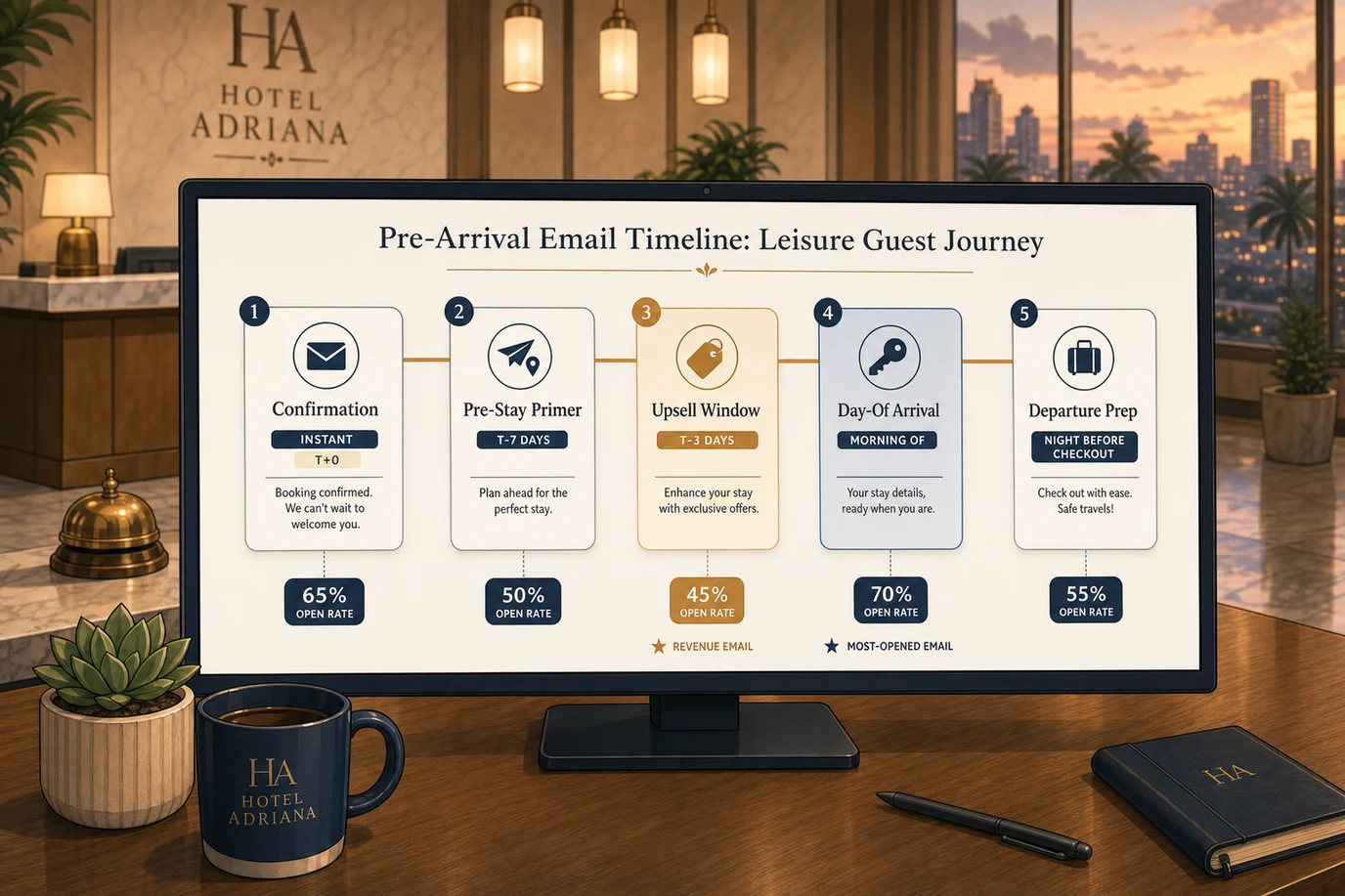
- The confirmation. Instant. The legal record.
- The pre-stay primer. T-7 days. Sets expectations.
- The upsell window. T-3 days. Where the revenue lives.
- The day-of arrival logistics. Morning of arrival. The most-opened email in the sequence.
- The departure prep. Night before checkout. Small, but it matters.
Each is described below with purpose, timing, who gets it, the subject line that tends to win, and a real body example you can adapt.
Email 1: The Confirmation (T+0, Instant)
Purpose. The legal record of the booking, the email the guest searches for in their inbox the day before arrival when they are looking for the address. It is also the only email some OTAs do not block, so you want this one to be useful.
Who gets it. Every guest, no segmentation. Direct booking, OTA booking, group block, walk-in (if you captured the email).
Subject line that wins. Boring and direct. Your reservation at [Hotel Name] is confirmed, [arrival date]. Avoid emoji, avoid clever copy. This email is searched for, not browsed.
What goes in the body. Booking reference, guest name, room type, check-in and check-out dates, total amount, payment status, cancellation policy in plain language (not the legal full text), and one paragraph that says what to do next ("you do not need to do anything until 7 days before arrival, when we will send you the property information"). End with the hotel's direct phone, direct email and address. No marketing. No upsells.
Real example body:
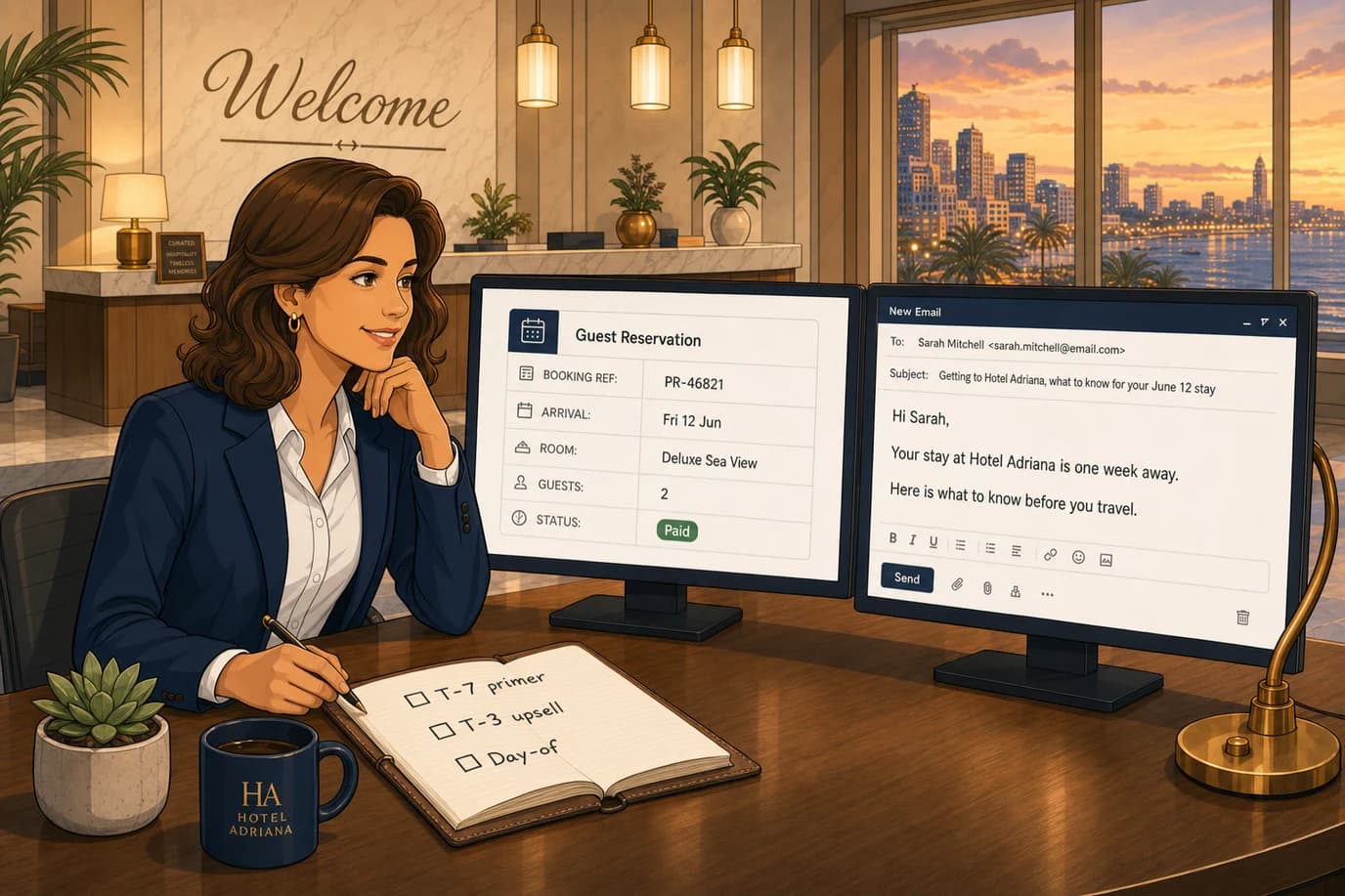
Hi [First Name],
Your reservation at Hotel Adriana is confirmed.
Booking reference: PR-46821
Arrival: Friday 12 June 2026 (check-in from 15:00)
Departure: Monday 15 June 2026 (check-out by 11:00)
Room: Deluxe Sea View, 2 guests
Total: 642 EUR (paid in full)You do not need to do anything until next week. Seven days before arrival you will get our pre-stay note with the address, directions, parking information and how to reach us on the day.
If you need to change anything before then, just reply to this email or call us on +39 081 4567 890. Same goes if you need an early check-in or a late check-out.
Looking forward to having you on the coast,
Maria
Hotel Adriana
One thing to call out specifically. The confirmation email is the one most often forwarded to a colleague, an assistant or a spouse, because it has the booking reference. Make it forwardable. Strip the "log in to your account" friction. Put everything the recipient needs in the email body itself.
Email 2: The Pre-Stay Primer (T-7 Days)
Purpose. Set the practical expectations for the stay. Address, transportation, neighborhood, what is included and what is not. The trust-building email.
Who gets it. Every confirmed guest. Skip if the booking was made less than 7 days out (in that case the day-of email picks up the work).
Subject line that wins. Something useful in the preview. Getting to Hotel Adriana, what to know for your June 12 stay. The destination plus the date creates a search anchor and signals utility.
What goes in the body. Full address with a one-line direction ("on Via Roma, 50 meters from the harbor"). Transport options ranked by what most guests actually use (airport transfer, taxi from station, by car). Parking information including cost and whether reservation is needed. Neighborhood orientation in 3 to 5 lines (the nearest pharmacy, supermarket, ATM). One paragraph on what is included in the rate (breakfast, wifi, beach towels). One paragraph on what is not included that guests often assume is (parking, mini-bar, late check-out).
Resist the urge to upsell in this email. The pre-stay primer establishes trust by being useful first. Save the upsells for email 3.
Real example body:
Hi [First Name],
Your stay at Hotel Adriana is one week away. Here is what to know before you travel.
Address. Via Roma 18, 80067 Sorrento, Italy. We are 50 meters from the harbor, on the right after the small piazza with the lemon trees.
Getting here. From Naples airport, the most common route is the Curreri shuttle (16 EUR per person, 75 minutes, runs every hour). Taxi from the airport runs 110 to 130 EUR. From Sorrento train station, we are an 8-minute walk or a 5-EUR taxi.
Parking. We have 12 spots in the garage at 18 EUR per night, first-come first-served. Public parking on Via Marina is 2 EUR per hour, 9:00 to 20:00. If you are driving, let us know and we will hold a spot if one is free.
The neighborhood. Closest pharmacy is on Corso Italia (open until 20:00). Supermarket Conad is 3 minutes away on Via San Cesareo. The ATM you want is the Intesa one on the harbor, not the standalone one near the train station (the latter charges 4 EUR per withdrawal).
What is included. Breakfast on the terrace from 7:30 to 10:30, wifi everywhere on the property, beach towels at reception. Bottled water and an espresso machine in every room.
What is not. The garage is paid separately, the mini-bar is paid separately, and late check-out past 11:00 is 25 EUR per hour.
I will write again three days before you arrive with the day-of details.
Maria
Hotel Adriana
Email 3: The Upsell Window (T-3 Days)
Purpose. This is the revenue email. The guest is mentally in the stay now, the cancellation window has typically closed, and they are in the right frame of mind to add to the booking. Three days out is the sweet spot. Earlier, the stay is abstract and the guest is not ready. Later, they are packing and they tune out.
Who gets it. Direct bookings convert 2 to 3 times better than OTA bookings on this email, because the guest already has a relationship with you and not with Booking.com. Send it to OTA guests too, but track the segments separately and do not be surprised when OTA conversion runs in the 1 to 3 percent range while direct sits at 6 to 12 percent.
Subject line that wins. The named-personal-touch lines work best here. A few things we can arrange for Friday, [First Name]. Avoid "Upgrade your stay!" energy. The guest sees that as marketing and opens at 28 percent. The personal-touch version opens at 52 percent.
What goes in the body. 3 to 5 specific add-ons, priced, with a one-click confirmation. Not a catalog. Not 12 options. Pick the upsells that fit the segment.
For a leisure couple, the high-converting set is usually: early check-in, a room upgrade if you have inventory open, a dinner reservation at the in-house restaurant, a spa add-on, an airport transfer back.
For a business guest, the set is different: late check-out, room upgrade, parking, breakfast (if not already included), and laundry.
For a family with kids, prioritize: a crib or extra bed, a kids breakfast, a babysitter contact for one evening, beach equipment rental.
Real example body (leisure couple):
Hi [First Name],
Three days until your arrival on Friday. A few things we can arrange ahead of time so you do not have to think about them at the desk.
Early check-in at 12:00. Subject to availability, 25 EUR. We confirm by Thursday evening.
Upgrade to a junior suite. Extra space, separate sitting area, sea-view terrace. 45 EUR per night, 3 nights, so 135 EUR for your stay. We have one available on your dates.
Dinner reservation at our terrace restaurant. We can hold a table for two for one of your evenings. The Friday tasting menu is 65 EUR per person, with a wine pairing for 35 EUR more.
Spa treatment for two. 60-minute couples massage, 180 EUR. We have Saturday at 16:00 open if you want it.
Airport transfer back. Sunday morning, private car to Naples airport, 110 EUR. Tell us your flight time and we will time it.
Reply to this email with what you want, or call us on +39 081 4567 890. Anything you add we will put on the room and you will see it on the folio at checkout.
Maria
Hotel Adriana
One thing about the upsell email that almost everyone gets wrong. The five add-ons listed are not the only five you can offer. They are the five that fit this specific guest, on this specific stay, this specific weekend. A solo business guest arriving on a Tuesday gets a completely different set. If you are sending the same upsell list to every guest, you are leaving 60 percent of the revenue on the table.
Email 4: The Day-Of Arrival Logistics (Morning of Arrival)
Purpose. This is the most-opened email in the sequence. 70 to 85 percent open rate. The guest is packing, in a taxi, at the airport. They want the practical detail and they want it now.
Who gets it. Every guest. Send between 7:00 and 9:00 in the guest's local time, not yours. If you do not have the guest's home timezone, send between 7:00 and 9:00 at the destination (which is at least correct for the guest's arrival day).
Subject line that wins. Practical and immediate. Today's check-in at Hotel Adriana, directions and the late-arrival number. The word "today" in the subject lifts open rate 8 to 12 points.
What goes in the body. The address again (so the guest does not have to scroll back). A 2-line direction from the most common arrival point. The check-in window. The late-arrival phone number (in case the guest is delayed). Any confirmed upsells from email 3 ("we have you booked at the restaurant at 20:30, your spa appointment at 16:00 tomorrow"). Anything time-sensitive on the day (the elevator is being serviced from 14:00 to 16:00, the restaurant is fully booked tonight so we recommend reserving elsewhere). End with the WhatsApp number if you offer it, because most guests would rather message than call from a foreign country.
Real example body:
Hi [First Name],
See you today.
Address: Via Roma 18, 80067 Sorrento. From the harbor, walk along Via San Francesco for 50 meters and we are on the right, after the piazza with the lemon trees.
Check-in: From 15:00. If you arrive before then, you can leave your luggage with us from 10:00 and head out to lunch.
Late arrival: If you are arriving after 22:00, call or WhatsApp Luca on +39 333 245 6789. He has the night shift and will let you in.
Your bookings. Restaurant at 20:30 on Friday. Spa for two at 16:00 on Saturday. Airport transfer Sunday morning at 09:00 (Naples airport).
One thing for today: the elevator is being serviced 14:00 to 16:00. We have a porter standing by if you arrive in that window.
WhatsApp us anything: +39 081 4567 890.
Safe travels,
Maria
Hotel Adriana
Email 5: The Departure Prep (Night Before Checkout)
Purpose. Reduce friction at checkout, surface one last small upsell window, set up the post-stay survey ask. The smallest email in the sequence and the easiest to forget.
Who gets it. Every guest. Send between 18:00 and 20:00 local time the night before checkout.
Subject line that wins. Practical and warm. One last thing before you check out tomorrow. The "one last thing" framing is conversational and avoids the cold-reminder energy of "checkout reminder".
What goes in the body. Confirmation of checkout time. Two practical upsells: late check-out (if available) and luggage storage (free, but mentioning it stops the desk conversation). The transfer-out arrangement if booked. A line on how the bill will be settled (auto-charged to the card on file, or pay at the desk). And one final useful suggestion: where to go for breakfast or coffee on the way out if your dining room is closed by their departure time.
Real example body:
Hi [First Name],
Hard to believe the stay is already at the last night. A few things for tomorrow.
Check-out is by 11:00. If you want more time, we have a late check-out until 14:00 for 35 EUR, subject to availability. Let us know and we will hold it.
Luggage storage is free and unlimited. Drop bags with us at any time and come back for them.
Your transfer to Naples airport is confirmed for 09:00. The driver will be in the small piazza out front.
The bill will be auto-charged to the card on file. We will email a copy after you check out. If you would rather settle at the desk, just let us know in the morning.
If you want coffee before the transfer, the bar across the street opens at 06:30. The pasticceria two doors down does a good cornetto.
Safe trip home, and thank you for staying with us.
Maria
Hotel Adriana
Send-Timing Rules That Actually Work
Four rules of thumb we have learned the hard way.
Send by the guest's local time, not yours. The day-of email at 8:00 a.m. local time hits the inbox when the guest is packing. The same email at 8:00 a.m. your time, when your guest is in a different timezone, hits at 2:00 a.m. or 5:00 p.m. and gets buried. Almost every modern messaging platform supports per-guest timezone scheduling. If yours does not, you have a tooling gap to fix.
Never send between 22:00 and 06:00 guest local time. Guests check their phone at night, get a notification from your hotel, and the first thing they associate with your name is "interrupted my sleep". The lift in open rate from a 6:30 a.m. send compared with a 23:00 send is roughly 14 percent. The damage to the next email's open rate is bigger than that.
The Tuesday-Thursday window outperforms the weekend. Pre-arrival emails sent on Monday tend to get lost in catch-up. Friday and Saturday sends compete with weekend personal email and underperform. The Tuesday to Thursday window has the highest open rates in our data, regardless of the guest's arrival day.
Spacing matters more than count. Five emails over 14 days is fine. Five emails over 3 days is spam. The pre-stay primer at T-7 and the upsell email at T-3 work together because there is meaningful daylight between them. If your booking is made 5 days out, collapse the sequence to 3 emails (confirmation, combined primer plus upsell at T-2, day-of) rather than firing all five into a compressed window.
Segmentation Rules That Make a Real Difference
The default state for most independent hotels is no segmentation at all. Same email, every guest. Adding even basic segmentation lifts upsell conversion noticeably.
Transient vs Group
Group bookings (weddings, conferences, corporate blocks) need different copy. The pre-stay primer goes to the group organizer, not to every guest. The day-of email can go to each guest, but should not contain pricing for add-ons that have been pre-negotiated as part of the group rate. If you send the same upsell email to a conference attendee that you send to a leisure couple, you confuse the attendee and you erode the trust of the meeting planner who negotiated the package.
Leisure vs Business
Different upsells, different tone. Leisure guests respond to experience-based add-ons (spa, dinner, in-room amenities). Business guests respond to friction-removers (early check-in, late check-out, laundry, parking, reliable wifi). Tone-wise, leisure tolerates and even welcomes a slightly more personal voice. Business prefers tight, direct, no-padding copy.
First-Time vs Returning
A returning guest does not need to be told the address, the parking situation or the neighborhood. They know. The pre-stay primer for a returning guest collapses to a short note ("nothing has changed since your last stay, here is what is new"). Sending a returning guest the full primer is fine, but they will skim it the first time and stop opening your emails entirely by the third stay.
Domestic vs International Guests
International guests need more context: visa or entry requirements, the local currency, what a typical tip looks like, whether the tap water is drinkable, what voltage the outlets are. Domestic guests do not. Adding a short "for international guests" section in the pre-stay primer to non-domestic guests adds value without padding the email for the locals.
What NOT to Send
Four anti-patterns that erode trust and reduce future open rates.
The corporate loyalty pitch the guest never asked for. If the guest has not joined your loyalty program, asking them to join in the pre-arrival window does not work and slightly insults them. They are here to stay at your hotel, not to sign up for an account. Save the loyalty ask for the post-stay sequence.
The pre-arrival survey. Some hotels send a "what are you most looking forward to?" survey email. Conversion is under 4 percent and the data is rarely actionable. The guest is busy. They are not here to fill out your CRM. Save the survey for post-stay, when they have a real opinion to give.
The third-party app upsell. "Download our app to manage your stay" before the guest has even arrived is friction the guest will not absorb. If you want them on an app, hand them the QR code at check-in with a reason to use it (digital key, room service ordering). Pre-arrival is the wrong window.
The hard cancellation reminder. A formal email two days before arrival reminding the guest of the cancellation policy and the no-show penalty is a strong negative signal. If you genuinely need to reduce no-show risk, ask for a credit card pre-auth at booking and skip the threatening email.
Subject Line Craft (with Real Examples)
Subject lines on pre-arrival emails are not the same as marketing newsletters. The guest already has a booking. The subject is a utility cue, not a hook.
Three patterns that consistently outperform.
The named-personal pattern. A few things we can arrange for Friday, [First Name]. Personalization on the upsell email lifts open rate 8 to 14 points over the unnamed version.
The today anchor. Today's check-in at Hotel Adriana, directions and the late-arrival number. The word "today" in the subject of the arrival-day email lifts open rate 10 to 12 points.
The destination plus date anchor. Getting to Hotel Adriana, what to know for your June 12 stay. Searchable, indexable, useful when the guest goes looking for it 6 months later.
What dies in spam, regardless of body content: emoji-heavy subjects, all-caps anywhere, the word "FREE" anywhere, and exclamation marks in the subject line. Modern spam filters score on subject heuristics first, body second. A great body with a spammy subject never reaches the inbox.
How to Measure Pre-Arrival Email Success
Four metrics, in priority order.
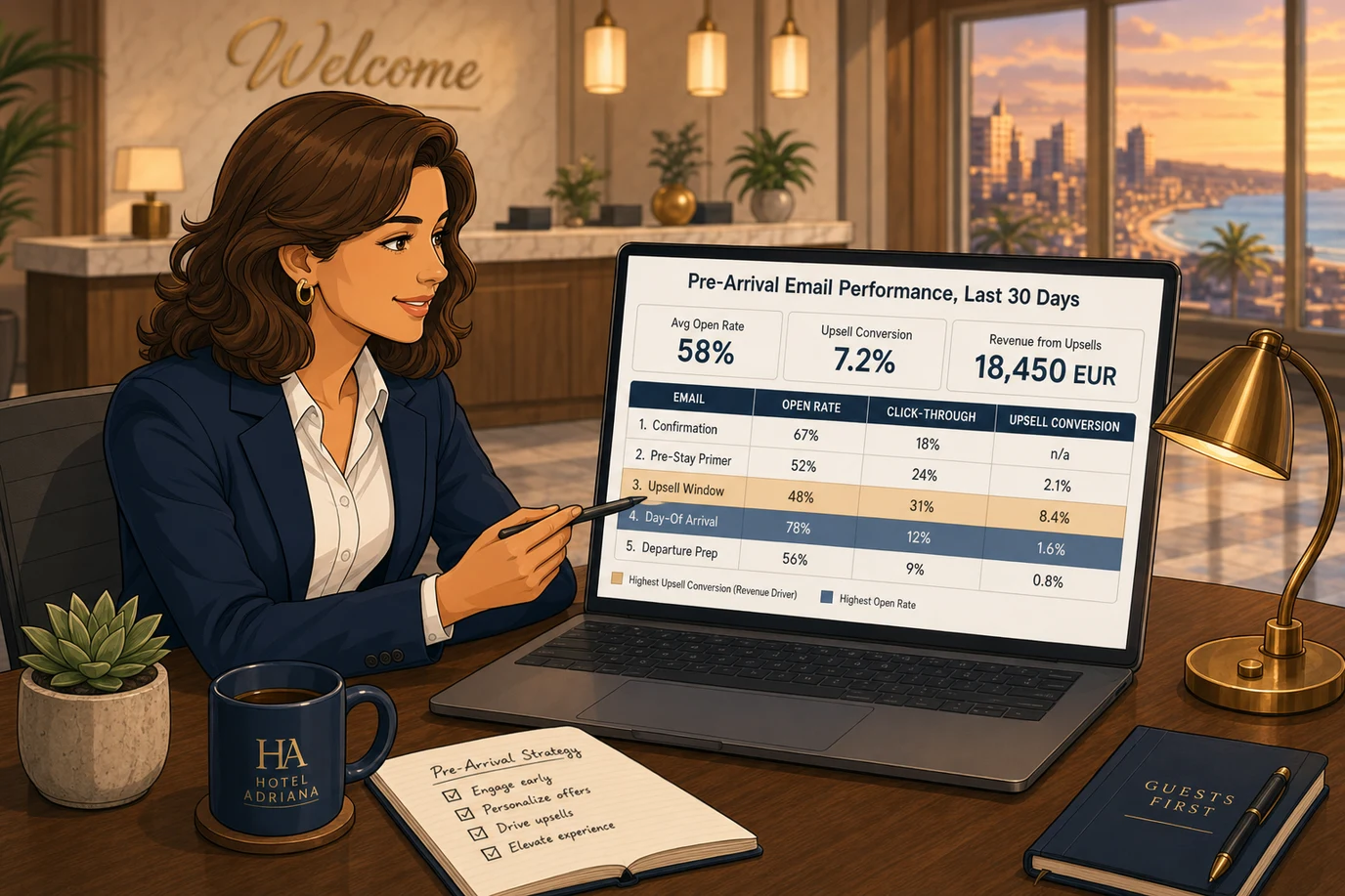
1. Open rate, per email type. Track the five emails as separate cohorts. Confirmation: target 65 percent. Pre-stay primer: target 50 percent. Upsell window: target 45 percent. Day-of: target 70 percent. Departure prep: target 55 percent. If you are below these, the diagnosis is usually subject line or send time, in that order.
2. Upsell conversion, per email and per segment. The upsell email is the one where this number lives. Track it by guest segment (leisure vs business vs group) and by booking source (direct vs OTA). Target 6 to 10 percent on direct and 2 to 4 percent on OTA for the upsell window. The day-of email also has a small upsell conversion (1 to 3 percent for late check-out and similar), which is worth tracking separately.
3. Front-desk call volume, before and after. Hard to measure precisely but useful directionally. If your front desk fields 15 pre-arrival phone calls per 100 arrivals before you tighten the email sequence and 8 per 100 after, you have shipped real value. The released time goes into in-house guest experience, which is the better use of a front-desk shift.
4. Arrival sub-score on TripAdvisor and Booking.com. A lagging indicator. Track the 90-day rolling average of the arrival-experience sub-score. A 0.1 to 0.2 lift in 6 months is realistic and quietly compounds your overall ranking.
What not to over-measure: click-through rates on the email itself. Most useful pre-arrival emails do not require a click. The guest reads the content and acts on it. A low CTR is not a problem if the open rate and the operational effect are right.
How Prostay Handles Pre-Arrival Communication
Pre-arrival sequences live in Prostay's messaging layer, alongside in-stay and post-stay flows. The same engine that handles your day-of email also handles the WhatsApp message the guest gets when the room is ready. Templates are per-segment (leisure, business, group, returning) and per-language (the multi-language layer translates to 30+ languages without a third-party app). Send timing is per-guest-timezone by default. Upsell conversion attribution is wired directly to the folio, so the line item that gets posted is what actually generated the revenue, not a self-reported click.
The point is not that Prostay is the only way to do this. Plenty of hotels run a good pre-arrival sequence on a standalone tool. The point is that the messaging surface and the PMS being the same product collapses the integration tax to zero, which matters when you are iterating on the copy weekly and want to see the folio impact next morning.
A 10-Step Implementation Checklist
If you are starting from a single confirmation email and want to be at the full five-email sequence in 30 days, here is the order.
- Audit the existing confirmation email. Make sure it has the booking reference, the cancellation policy in plain language, and a forwardable copy of the address.
- Write the pre-stay primer for your two highest-volume guest segments (usually leisure couples and business individuals).
- Identify your top 5 upsells by margin, not by revenue. Late check-out and parking are usually high margin. F&B add-ons are usually mid margin. Pick the ones that move money cleanly.
- Write the upsell email with those 5 add-ons. One version per segment.
- Write the day-of arrival email. Include the late-arrival phone number and any time-sensitive operational notes.
- Write the departure prep email.
- Schedule all five in your messaging tool with the correct triggers and timezone logic.
- Add tracking to each email so you can see open rate and click-through per email type.
- Run the sequence on all bookings for 30 days. Do not iterate during this period.
- At day 30, look at the data. Iterate on the worst-performing email first. Then the second worst. Then leave it alone for another 30 days.
The temptation in week 2 will be to start tweaking the upsell offers based on early data. Resist. 30 days of clean baseline data is worth more than a month of micro-optimization that conflates a hundred small changes.
Key Takeaways
Pre-arrival is the most under-managed surface in independent hotels. Marketing focuses on the booking funnel. Operations focuses on the check-in moment. The two-week window between them is a quiet revenue line that almost nobody runs deliberately.
The right number of pre-arrival emails is five. The confirmation, the pre-stay primer at T-7, the upsell window at T-3, the day-of arrival logistics, and the departure prep the night before checkout. Fewer leaves money and reputation on the table. More starts to feel like spam.
The upsell window is where the revenue lives. 6 to 10 percent conversion on direct bookings, 2 to 4 percent on OTA bookings, with a per-segment offer set. The single biggest mistake is sending the same upsell list to every guest.
The day-of arrival email is the most-opened email in the sequence. 70 to 85 percent open rate. Send it at 7:00 to 9:00 in the guest's local time, never yours. Include the address, the late-arrival contact and any time-sensitive operational notes.
Send by guest local time. Never between 22:00 and 06:00 local. Tuesday to Thursday outperforms the weekend on any non-arrival-day email.
Segment by transient vs group, leisure vs business, first-time vs returning, and domestic vs international. The default state of one-size-fits-all leaves real revenue and trust on the table.
Do not send the loyalty pitch, the pre-arrival survey, the third-party app push, or the hard cancellation reminder. All four erode trust and reduce future open rates.
Track open rate per email type, upsell conversion per email and per segment, front-desk call volume, and the TripAdvisor / Booking.com arrival sub-score over 90 days. Do not over-measure click-through, because the best pre-arrival emails do not require a click.
If you are starting from a single confirmation email, give yourself 30 days to get to the full five-email sequence. Then run it cleanly for 30 more days before you start iterating. Baseline data is worth more than premature optimization.
If your messaging tool, your PMS and your folio do not speak to each other natively, the attribution problem will hide most of the revenue your pre-arrival emails are actually generating. Prostay Nexus wires the messaging layer to the folio so the upsell line item that posts is the one you can credit back to the email that sent it. A live demo is the fastest way to see whether the integrated path is the one that fits the way you actually want to run.