

A corporate rate is a negotiated price you give a company in exchange for volume, usually 10 to 30 percent below your best available rate. Most of them are agreed during an annual bidding season that opens in June and closes with rates loading for 1 January. It is the most structured negotiation in the hotel calendar, and for an independent property it is also the one with the worst return on the hours it consumes. If you run a revenue management system and a sales manager, the question is not whether corporate business is worth having. It is where the winnable corporate business actually sits.
The honest answer is that it mostly sits outside the bid. Hospitality RFP win rates run 5 to 7 percent, against roughly 44 percent across all industries, and about nine in ten awarded properties are the incumbent from last year. Meanwhile 61 percent of business travellers book outside their own company's managed programme anyway. This article covers how the season actually works, when a bid is worth answering, how fixed and dynamic rates differ in practice, which contract terms cost more than the rate itself, and what your property management system has to track by source before any of these conversations are worth having.
What a Corporate Rate Actually Is
Strip away the process and a corporate rate is a simple trade. A company promises to send you room nights. You promise a price below what a walk-in would pay. Both numbers are estimates and only one of them is enforceable.
The rate is loaded against an account code, so it appears only to travellers booking under that company through their agency, their booking tool, or a direct link you provide. That code is what makes it a commercial relationship rather than a discount. It is also what makes production reporting possible, because every night booked under it can be traced back to the account that earned it.
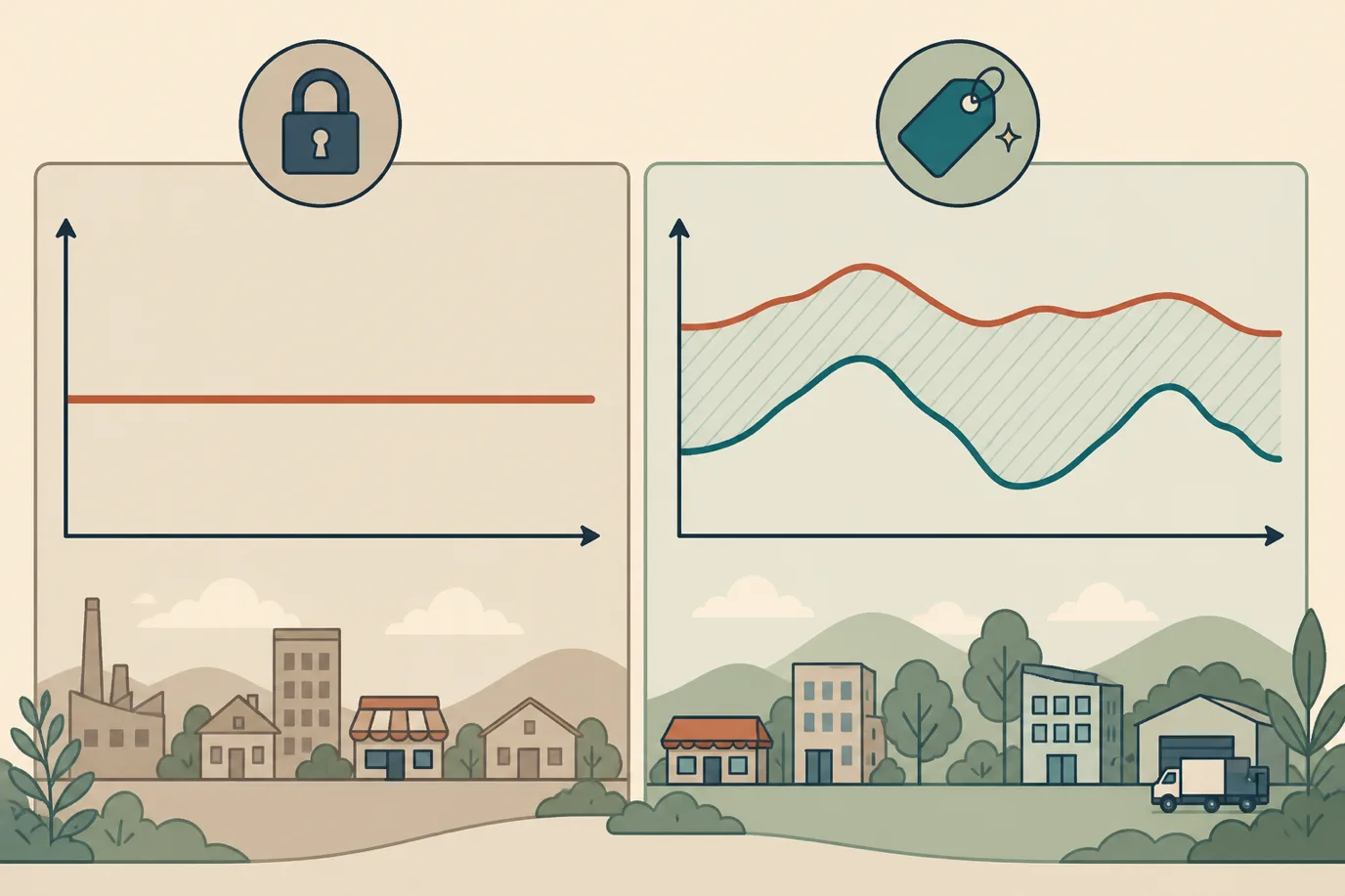
Three structures cover almost everything you will be asked for. A fixed nightly rate holds one number for the contract year. A dynamic rate applies an agreed percentage off your best available rate, so it moves as your pricing moves. A hybrid uses fixed rates in a handful of critical markets and dynamic everywhere else, which is where most programmes have quietly ended up.
Two other terms travel alongside the rate and matter more than most hoteliers treat them. Last room availability commits you to honouring the rate whenever you have inventory, including on your best nights. Amenity inclusions, typically breakfast and wifi, are counted by buyers as part of the total cost of a stay. Both are covered properly further down, because both are routinely conceded during a negotiation by people focused on the headline number.
If any of the vocabulary here is unfamiliar, the hotel terminology glossary defines the distribution and front office terms this article leans on.
The RFP Calendar, and Where August Sits in It
The season runs on a calendar that has barely moved in twenty years, and it is worth knowing precisely because the penalty for missing a window is invisible until it is too late.
| Period | What happens | What you should be doing |
|---|---|---|
| Second quarter | Buyers pull twelve months of travel data from their agency and rank spend by city | Clean your own production data by source, so you can argue with theirs |
| June to August | Requests are issued, mostly through Cvent Transient for larger programmes | Decide which bids you will answer, and which you will decline on purpose |
| September to October | Hotels respond, then negotiation rounds begin | Answer fast, with a defensible opening number and clear limits |
| Fourth quarter | Multiple rounds, then awards | Hold your guardrails, concede terms in a planned order |
| 1 January | Rates take effect, loaded into the GDS | Verify the rate is loaded, bookable and correct in every channel |
Cvent Transient handles the majority of large enterprise bidding and processed 16.5 billion dollars of sourcing volume in 2024, which gives a sense of the gravity involved. The GBTA Hotel RFP Workgroup publishes the standardised template that most requests are built from, so the questions rarely surprise anyone who has answered a few.
Two features of this calendar deserve more attention than they get. The first is that responding late is genuinely expensive. Properties that answer in September or later typically face fewer competing responses but also weaker outcomes, because sales teams have already allocated attention and inventory to programmes that respected the cycle. The second is duration. The average acceptance cycle takes 76.6 days. That is two and a half months of a sales manager's attention spread across a period when you are also trying to sell the fourth quarter.
Negotiation is not a formality either. Across the most recent season, around 92 percent of bids went to at least one round, roughly half went to two or more, and about 12 percent ran to three rounds or beyond. There is a trend toward faster conclusions, which rewards properties that open with a considered number rather than an anchor they intend to abandon.
The Win Rate Nobody Puts in the Pitch
Here is the part that rarely makes it into the seminar about winning corporate business.
Hospitality RFP win rates sit at 5 to 7 percent. The average across all industries is around 44 percent. And roughly 90 percent of awarded properties are the incumbent, meaning the hotel that held the account last year holds it again. Michael Laumanns, Accor's VP of Global Corporate Clients, has put the paradox plainly: the average hotel programme is nine tenths incumbent, yet the industry insists on re-tendering those relationships every twelve months when every other category in business travel manages multiyear contracts.
Now price the effort. Sales teams invest two to four hours per individual response, and some properties spend two full weeks managing a single cycle. Hotels spend an average of 40,100 dollars a year simply managing their business-to-business distribution networks. More than half of group requests sent to hotels receive no response at all, which tells you how many properties have already done this arithmetic. And 64 percent of hoteliers admit they have no idea how much revenue slips away through poorly managed bidding.
The conclusion is not that you should ignore corporate business. It is that answering every request that lands in the inbox is a strategy for being busy in September rather than full in February. A property answering thirty bids at three hours each has spent ninety hours to win one or two accounts, most likely ones it already held.
When the RFP Is Actually Worth Bidding
Selective bidding beats broad bidding, and the selection criteria are not complicated.
You are the incumbent. This is the strongest signal on the list. Nine in ten awards stay put, so defending an account you already hold is a far better use of three hours than pursuing one you do not. Treat renewals as the priority and everything else as speculative.
You have a genuine location advantage. If the company's office, plant or client site is within walking distance and the competing properties are a taxi ride away, you are not competing on rate at all. Travellers will choose you regardless of policy, which is worth saying out loud in the response.
You are buying entry to a new market or segment. A first corporate account in a city or an industry has value beyond its own room nights, because it gives you a reference and a production history to point at next season. Accept that the first year's rate will be uncomfortable.
The volume is real and verifiable. Ask for the number of room nights the account produced in your city last year, not the number it hopes to produce. A programme that cannot answer that question is offering you a discount in exchange for a forecast.
The inverse is equally useful. Decline where you would be the fourth property on a panel in a market you do not dominate, where the requested rate sits below your cost of doing business, or where the volume is a round number with no history behind it. Declining is not a lost opportunity. It is ninety minutes returned to a sales manager who could spend it on the local accounts covered further down.
Requests still have a use even when you do not intend to win them. They are a free market benchmark. The rates competing properties are being asked to hit tell you where your market is priced for managed travel, which is information you would otherwise pay a consultant for.
Fixed, Dynamic and the Hybrid Most Programmes Land On
The single most consequential decision in a corporate negotiation is the structure, not the number, and most hotels get talked into the structure that suits the buyer.
A fixed rate holds one figure for twelve months. Buyers love it because it makes budgeting trivial. It is also the structure that hands your compression nights away, because when a conference fills your city and your best available rate triples, the corporate rate does not move. Contract a fixed rate with a large account and you have effectively sold your best nights at February pricing.
A dynamic rate is a percentage off your best available rate. It moves with the market, protects your peaks, and reflects what you actually do with pricing the rest of the year. High-volume programmes with real leverage typically negotiate 10 to 15 percent off the dynamic rate, and lower-volume programmes land between 5 and 10 percent, with the discount rarely uniform across every property in a group.
So the market should have moved to dynamic years ago. It has not. Around 85 percent of accepted corporate rates are still fixed, a figure that has barely shifted, and only about 7 percent of buyers primarily negotiate dynamic, though 64 percent now use a mix of the two. The resistance is genuine rather than stubborn. Buyers cite budget unpredictability, difficulty verifying that the best available rate used for the discount calculation is legitimate, and a straightforward institutional preference for certainty.
The chains signalled this direction a very long time ago. Marriott moved to dynamic consortia rates in 2003 and 2004. Hilton and IHG both eliminated fixed consortia rates effective January 2005. That 85 percent of rates remain fixed two decades later tells you something useful about how slowly buyer behaviour changes, and it tells you not to expect a single conversation to change it.
The practical position for an independent is the hybrid. Use fixed rates for your first-tier accounts, where cost certainty is what buys you the relationship and the volume justifies the risk. Use a percentage off best available rate everywhere in the long tail, where the volume does not justify surrendering your peak pricing. If a buyer insists on fixed in a market where you know you will compress, the honest counter is a fixed rate with named blackout dates rather than a fixed rate you intend to quietly close out.
One caution on dynamic contracts. Buyers will ask for a ceiling, a rate the discount can never exceed. A cap converts a dynamic rate into a fixed rate that only works in one direction, which is worse for you than either structure on its own. If you concede a ceiling, price it deliberately rather than treating it as a technicality.
The Terms That Cost More Than the Rate
Negotiations focus on the nightly number because it is the easiest thing to compare. The terms attached to it routinely cost more.
Last room availability. LRA obliges you to sell the corporate rate whenever any room remains, which means on the Tuesday of your biggest conference week. This is the most expensive concession on the list and the one most casually granted. Concede it only for accounts with verified volume, and pair it with blackout dates around your known compression periods. Buyers have become good at auditing this, and rate monitoring tools have made a habit of catching properties that agree to LRA and then fail to honour it, so agreeing to something you intend to ignore is now a reputational problem as well as a contractual one.
Amenity inclusions. Breakfast and wifi are counted by procurement as part of the total cost of a stay, and they frequently deliver more traveller satisfaction than a further one percent off the rate. This makes them a good trade rather than a giveaway. Offering included breakfast to protect two points of rate is usually the better arithmetic, particularly if your breakfast cost per cover is well understood.
Blackout dates. Perfectly standard and worth naming specifically rather than generally. Your city's three biggest event weeks, named by date in the contract, will rarely be refused by a buyer whose travellers are unlikely to visit during them anyway.
Cancellation and no-show terms. Corporate travel changes late by nature, so expect to concede more flexibility than you would on a leisure rate. Know what it costs you before you agree, because a flexible rate with a heavy late cancellation profile behaves very differently from the same number on paper. The mechanics of recovery are covered in the no-show guide.
Rate parity implications. A negotiated rate loaded incorrectly can end up visible where it should not be, and that is not a theoretical problem. Around 98 percent of hoteliers report losing revenue to rate leakage, with an average annual loss of about 6 percent, and 49 percent of rate loading errors are caused by human mistakes. If a corporate rate leaks into public channels, you have discounted your whole market rather than one account. The rate parity guide covers the distribution side, and the channel manager sync article covers how these errors actually propagate.
What Leaks After You Win
Suppose the bid goes your way. The rate is signed, loaded and live. Now comes the part that decides whether the account was worth having.
Travellers do not comply. 61 percent of business travellers book outside their organisation's managed programme, and fewer than 40 percent use their company's recommended hotel providers. One professional services firm tracked by CWT found 73 percent of its travellers booking outside the negotiated programme before anyone intervened.
The reason is not rebellion. GBTA found the most common cause is simple inconvenience, at 36 percent, followed by the trip being a last-minute decision, at 30 percent. A traveller with a flight to catch opens the app they use for holidays. If your negotiated rate is harder to find and book than a consumer app, the discount you conceded buys nothing.
This has a direct consequence for how you treat the account after signing. A negotiated rate that is not bookable in the traveller's actual booking tool is a rate that will not be used. Verify in January that the rate is loaded, that it is visible under the correct account code, that it appears in the agency's tool and not merely in the GDS, and that it is bookable for the room types you intended rather than only the one nobody wants.
The second consequence is that volume promises should be treated as forecasts rather than commitments. Very few corporate contracts carry enforceable minimums. When a programme promises 400 room nights and delivers 180, the recourse is renegotiation next season, which is precisely why production data by source matters more than the contract language.
GDS Quietly Overtook Direct for Corporate
Here is the finding that should reshape how independents think about corporate distribution. A HEDNA and NYU study published in January 2026 found that the GDS has overtaken direct channels as the leading source of corporate hotel room nights. Between 2023 and 2025, corporate and consortia travellers steadily shifted bookings away from direct toward the GDS, and those bookings consistently achieve higher average rates. D-EDGE data puts GDS hotel booking growth at 14.3 percent between 2023 and 2025, with average booking values reaching 412.80 euros.
This runs directly against a decade of book-direct orthodoxy, and the reconciliation is straightforward. For leisure travellers, direct remains critical. Corporate travel is managed travel. It flows through agencies, booking tools and policy-compliant platforms that sit on GDS infrastructure. A traveller obeying company policy is not visiting your website.
The economics are also better than most hoteliers assume. GDS bookings typically carry a transaction fee of roughly 3 to 8 dollars plus an 8 to 12 percent agency commission. Compare that with OTA commissions that commonly run 15 to 30 percent of room revenue. Managed corporate business remains one of the more cost-efficient channels available, though you are usually funding the commission and the negotiated discount on top of the transaction fee. The net ADR calculation is the honest way to compare them, and the wider commission argument sits in reducing OTA commissions.
Content quality is the lever most independents never pull. Properties with fully optimised GDS content see conversion improve by 25 to 30 percent, according to Sabre. That means complete descriptions, correct amenity codes, current images and accurate room type mapping. It is unglamorous work that takes a day and pays for years, and it is covered in more depth in the GDS guide.
The landscape is shifting again, and in a direction that rewards breadth. Newer travel management platforms such as Spotnana treat the GDS as one content source among several, pulling inventory from Amadeus, Sabre, Travelport, Booking.com and Expedia at the same time. Platforms like Navan and Ramp Travel let employees book almost anywhere while checking policy automatically. A hotel present only on the GDS will miss bookings from these platforms. A hotel present only on OTAs will miss traditional managed travel entirely.

The Local Account Nobody Bids Against You For
The most reliable corporate revenue available to an independent hotel is the business that never runs a sourcing process at all.
Roughly 65 percent of business travel spending remains unmanaged. The small and mid-sized segment represents 57.6 percent of the travel management market and is growing at about 7.1 percent a year. These are the engineering firm with nine travelling staff, the regional office that hosts auditors twice a quarter, the equipment supplier whose technicians visit a client site every six weeks. None of them are on Cvent. None of them will send you a 40-question template.
They are negotiated with a phone call, a site visit and a one-page agreement. There is no bid platform fee, no negotiation round, and no incumbent defending the account with a global sales team. The rate is whatever the two of you agree, the volume is small but genuinely predictable, and the relationship survives on service rather than procurement policy.
Finding them is a mapping exercise rather than a marketing one. Look at your own arrivals over the past year and identify every company name that appears more than twice. Those are accounts you already have without a contract. Then look at what is physically near you: business parks, hospitals, universities, construction projects, manufacturing sites, government offices. A construction project with an eighteen-month timeline is a corporate account with a defined end date and very predictable midweek demand.
Three things make these relationships work in practice. Give them a booking method that takes less effort than a consumer app, because inconvenience is what pushes travellers away from negotiated rates in the first place. Give them one named contact at the hotel who answers the phone. And review the arrangement twice a year with actual production numbers rather than waiting for an annual cycle nobody imposed on you.
The volume from any single account will look unimpressive next to a national programme. The difference is that it costs you almost nothing to win, it does not expire on 31 December, and no procurement team is auditing your rate against the market every week.
One Corporate Night Is Often Three
The line between business and leisure travel has effectively dissolved, and the rate architecture at most independent hotels has not caught up.
62 percent of business travellers now add at least one leisure element to a trip. Marriott has reported business trip length of stay up 20 percent against 2019. The number that matters operationally is this: 82 percent of travellers extending a business trip stay at the same property for both parts of it. Every corporate booking is a potential extended stay, and the decision about whether it becomes one is usually made by your pricing.
Here is where it goes wrong. A traveller finishes work on Friday and considers staying until Sunday. The corporate rate covers the working nights. Saturday reverts to your public leisure rate, which on a good weekend might be double. That cliff is what sends them home, or to a different hotel for the weekend portion.
The fix is a rate rule rather than a campaign. Offer an incremental extension discount, in the region of 10 percent off for one additional night and 20 percent for two. Set weekend extension rates that stay within sight of the corporate rate rather than snapping back to public pricing. Build a small package that pairs the work amenities the traveller already values with something worth staying for.
Corporate buyers are increasingly supportive of this rather than resistant. 43 percent of programmes now have defined policies on leisure extension, 88 percent of companies permit it, and 73 percent of employees regard it as a perk that influences where they want to work. The economics often favour the buyer too, since a Saturday night stay can cost less than the Friday evening flight home. Larger groups have already moved: Marriott's BreakAway programme offers up to 30 percent off leisure rates to employees of its most important corporate accounts, Hilton launched Signia for exactly this traveller, and Crowne Plaza has added pay-per-use coworking.
For an independent, the whole opportunity fits in two rate rules and a paragraph in the corporate agreement. The relevant metric to watch is length of stay, and the mechanics of moving it sit in the average length of stay guide.
You Cannot Negotiate What You Cannot Measure
Every part of this article depends on one operational capability: knowing what each source actually produced. Without it, you are negotiating against the buyer's data using anecdotes.
The buyer arrives at the table with twelve months of spend pulled from their travel agency, ranked by city and by property. If you cannot produce your own version of that history, you will accept their version of it. When a programme claims it sent you 300 room nights and your system says 140, the difference is worth several points of rate, and the only way to have that conversation is with a report you can export.
What your PMS needs to hold is not exotic. Every booking should carry the source that produced it, whether that is an OTA, a direct booking, a corporate account, a travel agent, a wholesaler or a walk-in. Each source needs a profile of its own with a code, a contact, a country and a flag marking whether it is a key account. Contracted rate ladders, allotments and minimum stay rules belong against the source rather than living in a folder. The commercial model matters too, since a net contract and a gross contract with commission produce very different revenue from the same headline rate, and that difference has to be captured at the time of booking rather than reconstructed later.
Then it has to come back out as production reporting. Revenue by source, by rate plan, by room type, compared year on year. The ability to filter the booking grid by source, export it, and put it in front of a buyer who has just quoted you a volume figure.
Prostay models this as a first-class object rather than a text field, which is the distinction that matters. Each source carries its own profile, code, contact and key-account flag, its own contracted ladders and allotments, and its own commercial model, and every booking is tied back to it so the production reports build themselves. The commercial team opens revenue by source on Monday rather than assembling it from three exports.
Two habits turn that data into leverage. Review production against every corporate contract quarterly rather than annually, because a programme delivering 40 percent of its forecast in March is a conversation you want to have in April, not the following January. And track what the account is worth net of the commission and the discount, not gross, since a national programme booking through an agency at a 20 percent discount plus a 10 percent commission is a different proposition from a local account booking direct at 15 percent off. Where these numbers sit in the wider reporting picture is covered in hotel performance metrics.
Running the Season Without Losing the Quarter
The season is open now. Practical instructions, in the order they matter.
Triage the inbox before you answer anything. Sort incoming requests into three piles: accounts you already hold, accounts where you have a real location or rate advantage, and everything else. Answer the first two properly. Decline the third, in writing and politely, because a clean decline preserves the relationship better than a rushed response that loses.
Set your floor before the first round, not during the third. Know the rate below which the business costs you money once commission, discount and any amenity inclusions are counted. Write it down. Negotiations run to two rounds or more in about half of cases, and a floor decided under pressure is not a floor.
Decide the order in which you will concede. Amenity inclusions first, since they buy goodwill cheaply. Then a modest rate move. LRA last and only for verified volume. A concession sequence agreed in advance is the difference between negotiating and reacting.
Answer inside the window. Requests circulate from June, responses run through September and October. Being early is not merely tidy, it is a competitive position.
Verify the loading in January. The rate must be live under the right account code, visible in the agency tool rather than only the GDS, and bookable for the room types you intended. This step gets skipped constantly and it is where signed accounts quietly produce nothing.
Spend the time you saved on local accounts. The hours you did not spend answering unwinnable bids are the hours that pay for themselves. Pull the list of company names that appear more than twice in last year's arrivals. Start there.
The wider point is worth stating plainly, because the industry rarely does. The annual bid is not dying, and treating it as dead would cost you the accounts you already hold. But it is a defensive exercise for most independent hotels, with a 5 to 7 percent win rate and nine in ten awards going to whoever held the account last year. The growth is in the places the annual cycle does not reach: the unmanaged 65 percent of business travel spend, the GDS content nobody has updated since 2019, the second night that a traveller would have stayed if your weekend rate had not doubled. Defend the bid. Grow everywhere else.