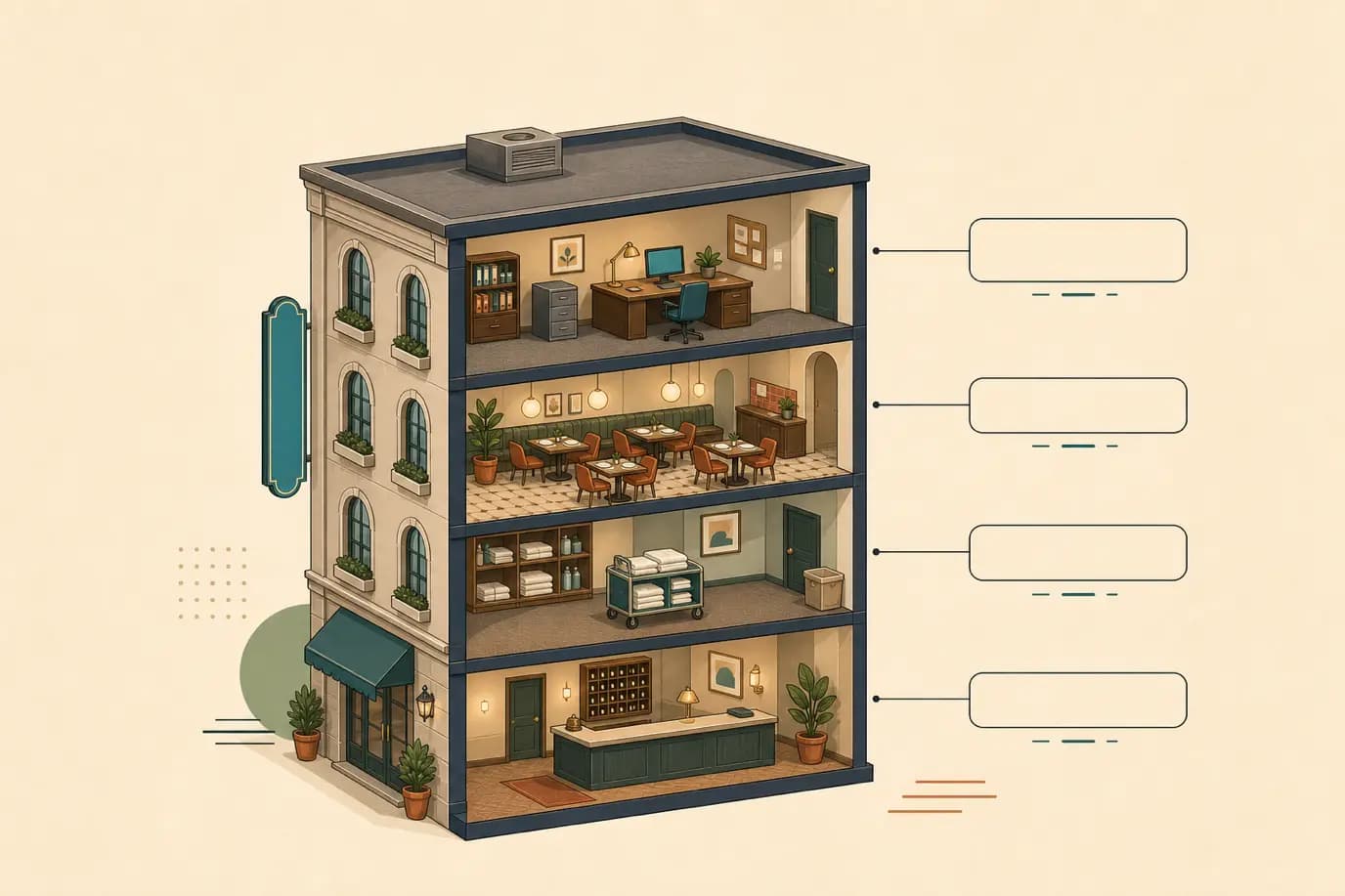

A city ledger is a hotel's accounts receivable for people who are not currently staying there. Companies billed directly, travel agents, group organisers, card companies awaiting settlement, and guests who have departed still owing money. It is also called the non-guest ledger, and it is where revenue sits between being earned and being collected. Any hotel accounting system that handles receivables is, at heart, managing this.
The distinction that matters is not accounting theory, it is who is responsible. While a guest is in the building, their balance belongs to the front office and can be collected at the desk. The moment they leave without settling, that balance becomes somebody else's problem in a different department, invoiced on terms and chased by email. The transfer between those two states is the single point where hotels lose track of money they have already earned, and where a property management system either records the handoff or leaves a balance stranded on a departed guest's folio.
This article defines the city ledger, sets it against the other front office ledgers, walks through how balances arrive on it, and covers credit approval, invoicing, ageing, collection, write-offs and the failure patterns that show up in almost every property that has not looked at this in a while.
What Is a City Ledger?
The city ledger is the collection of non-guest accounts receivable. In traditional front office accounting, receivables are split into two subsidiary ledgers: the guest ledger for registered guests, and the city ledger for everybody else. Together they make up the hotel's total accounts receivable.
The name is a historical accident. It comes from an era when the accounts in question belonged to businesses in the surrounding city, as opposed to travellers passing through, and it has survived long after the distinction stopped being geographic. You will also see it called the non-guest ledger, and older properties sometimes still say city account. Whatever it is called, it is a subsidiary ledger: the balances on it roll up into the single accounts receivable figure that appears on the balance sheet, alongside the guest ledger. If you have ever wondered why the receivables line in the accounts is larger than anything the front office recognises, this is why, and the vocabulary around it is collected in the hotel terminology glossary.
Two things define it.
The service has already been delivered. Unlike a deposit, which is money received in advance, a city ledger balance is money owed after the fact. The room has been slept in, the meeting has happened, the dinner has been eaten. The hotel has spent everything it was going to spend and is now waiting.
That single fact is why the city ledger carries real credit risk while the rest of the operation mostly does not. A guest who cannot pay at checkout is a problem you can address while they are standing in front of you. A company that does not pay an invoice sixty days later is a legal and commercial problem, and the leverage is gone.
Collection is somebody's job, not a by-product. Guest ledger balances get settled because guests check out. City ledger balances get settled because a named person invoices, monitors and chases them. Nothing about a city ledger balance resolves itself, which is why properties that treat receivables as an afterthought find the balance grows quietly for a year before anybody notices.
City Ledger vs Guest Ledger vs Deposit Ledger
Most confusion about the city ledger disappears once these three are set side by side. They are all front office ledgers and they behave completely differently.
| Guest ledger | City ledger | Deposit ledger | |
|---|---|---|---|
| Also called | Front office, transient or rooms ledger | Non-guest ledger, city accounts | Advance deposit ledger |
| Who owes whom | Guest owes the hotel | A third party owes the hotel | The hotel owes the guest a stay |
| On the balance sheet | Receivable | Receivable | Liability, or deferred revenue |
| Who is responsible | Front office | Accounting | Front office, until arrival |
| How it clears | Guest settles at checkout | Invoice is issued and paid on terms | Applied to the folio at check-in |
| Typical age | Days | Weeks to months | Days to months before arrival |
| Credit risk | Low, the guest is present | Real, the service is already delivered | None, the hotel holds the money |
The deposit ledger is included because it is the one people mix up in the opposite direction. A deposit is not a receivable at all. The hotel is holding money for a service it has not yet provided, which makes it a liability until the guest arrives and it is applied to their folio. Properties that book deposits straight to revenue on receipt end up restating things later, and the reasons are covered in the night audit and general ledger playbook.
One nuance worth knowing, since it appears in older texts and can be confusing. Some traditional treatments place the advance deposit account inside the city ledger, on the basis that it is a non-guest account, even though it is a payable rather than a receivable. Most modern properties keep it separate precisely because mixing a liability into a receivables ledger makes the ageing meaningless. If your system offers a distinct deposit ledger, use it.
What Sits on the City Ledger
A well-run city ledger is not one pile of debt. It is a set of named debtor accounts, categorised, each with its own balance, terms and history. Hotel accounts receivable procedures typically break it down along these lines.
| Account type | What it holds | Typical terms |
|---|---|---|
| Corporate, local | Direct-billed company stays under a negotiated agreement | 30 days |
| Corporate, foreign | The same, with currency and remittance complications | 30 to 60 days |
| Travel agents | Agency bookings billed to the agency, and commissions | 30 to 60 days |
| Tour operators | Series and allocation business, often high volume | Up to 90 days |
| Airlines | Crew accommodation and disruption bookings | 30 days |
| Group and event masters | The master bill for a conference, wedding or block | Per contract |
| Government and public sector | Per diem and official travel | Often slow, by design |
| Card companies | Card sales awaiting settlement from the acquirer | Days |
| Affiliated companies | Owner, sister hotels, management company | Frequently ignored, frequently large |
| Loyalty and reward schemes | Redemption reimbursements from the programme | Per scheme |
| Employee accounts | Staff charges, advances, recoverables | Payroll cycle |
| Departed guests | Late charges and unsettled balances after checkout | Immediate, in theory |
Three of these deserve comment because they behave differently from the rest.
Card receivables surprise people. When a guest pays by card, the hotel has not been paid, it has acquired a claim against the card company. In classic treatment that claim lives in a city ledger account for each acquirer until the money arrives. Plenty of modern properties never see this because settlement is fast and automatic, which is fine right up until a settlement is short, delayed or clawed back and there is no account showing what was expected. The disputes side of that is dealt with separately in the chargeback guide.
Affiliated company accounts are the quiet ones. Charges to the owner, to a sister property or to the management company rarely get chased with the same energy as an external debtor, because chasing feels awkward. They then sit for a year and distort the ageing. They are receivables like any other and belong on the report.
Departed guest balances are the category most likely to be invisible. A late charge that arrives after checkout, a minibar item posted the following morning, a disputed line left open. Individually trivial, collectively a recurring leak, and unlike the others there is no company to invoice, just a person who has gone home.
One modern addition deserves its own note, because it does not appear in the textbooks and now accounts for a meaningful share of many city ledgers. Online travel agencies increasingly settle through virtual card numbers: a single-use card, funded by the agency, activated on or around the stay dates, which the hotel charges like any other card. When it works, it never touches the city ledger at all.
When it does not, it produces exactly the kind of balance this ledger exists for. The card is charged before its activation window and declines. The available amount is the net rate while the folio shows the gross, leaving the commission stranded. The stay is extended and the card was funded for the original dates. A no-show is charged against a card that was cancelled the same morning. In each case the hotel has provided the room and holds a claim against the agency rather than a completed payment, and unless somebody transfers that balance to a debtor account for that agency it will sit on a departed guest's folio indefinitely.
The practical response is to treat each agency as a named debtor account like any other, and to reconcile virtual card charges against expected amounts rather than assuming a payment attempt succeeded. The broader relationship with those channels, including how commission is calculated on what, is covered in the piece on online travel agencies.
How a Balance Gets onto the City Ledger
The transfer itself is simple and the discipline around it is where properties differ.
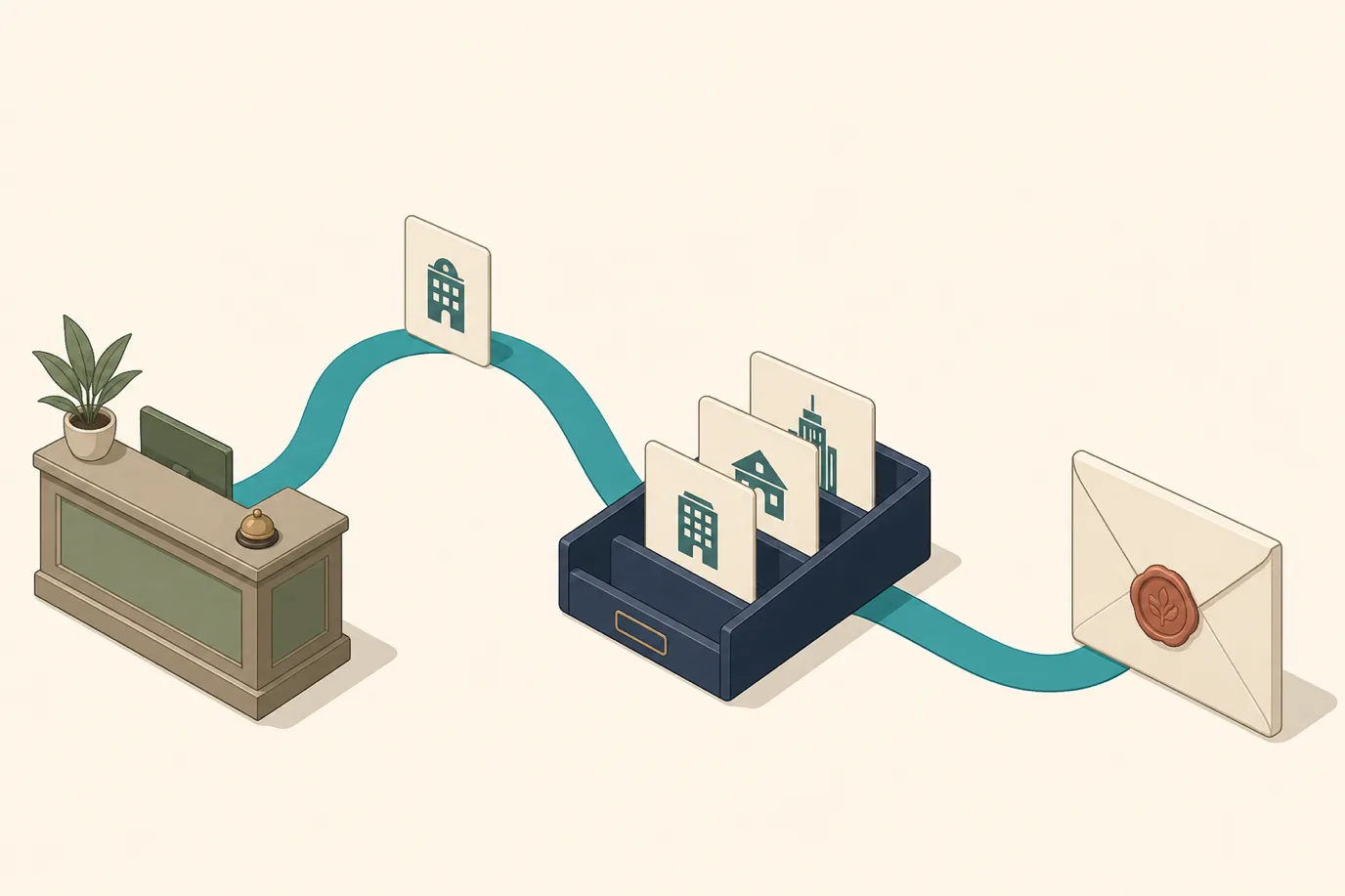
Mechanically, the folio balance moves from one receivable to another. In double entry terms the city ledger is debited and the guest ledger is credited, for the same amount, on the day of departure. Nothing about the hotel's total receivables changes. What changes is which account the money is sitting in and who is now responsible for it.
The folio should end at zero. This is the part that goes wrong most often. A folio left showing a balance after departure means the transfer never happened, which means no invoice will be raised, which means nobody is chasing anything. A report of checked-out reservations still carrying a balance is one of the highest-value reports in a hotel precisely because everything on it represents money that has fallen between two ledgers.
Timing conventions from standard hotel accounts receivable practice are worth adopting as they are.
Individual and voucher accounts transfer on the day of checkout. There is no reason to wait, and waiting is how the account acquires age before anybody has looked at it.
Group and event masters transfer within about three days. Masters need checking first: the banquet charges have to be agreed, the attrition or cancellation terms applied, the disputed lines resolved. Three days is enough to do that and short enough that the invoice still goes out inside the same week.
Nothing should sit unposted beyond 48 hours after departure. This is the outer limit in most hotel receivables procedures, and the reason is arithmetic. If your terms are 30 days and you take a week to transfer and another week to invoice, you have converted a 30 day account into a 44 day one without anybody making a decision.
There is one rule from formal receivables procedure that is worth stating on its own, because breaking it is so common. Do not maintain a hold-all account. If a balance transfers from the guest ledger and no matching debtor account exists, create the debtor account, even if there is no approved credit application on file. Sweeping unmatched balances into a miscellaneous or suspense account is how a city ledger becomes uncollectable: within a few months nobody can say which company each amount belongs to, and an amount you cannot attribute is an amount you cannot invoice.
Who Qualifies for Direct Billing
Direct billing is the arrangement that populates most of the city ledger, and it is a credit decision dressed up as a sales courtesy.
The sequence that works is straightforward. A company applies for credit. Somebody assesses it. A limit and payment terms are set. Only then can the front office transfer that company's folios at checkout. Formal hotel procedure is explicit that credit approval happens before arrival, and that a cashier should not be able to transfer a balance to an account that has not been approved.
In practice, the pressure runs the other way. A sales manager wins an account and wants the billing set up by Monday. A regular guest asks whether their company can just be invoiced. Somebody says yes on the spot, because saying no feels like bad service, and the credit assessment either happens afterwards or not at all.
A workable credit application asks for the legal entity name and registration number, the billing address, a named accounts payable contact with a direct email, the tax registration details, the requested limit, and agreement to the payment terms in writing. Trade references are common for larger limits. None of this is onerous and all of it is what you will wish you had if the account goes bad.
Two decisions should be made deliberately rather than by default.
The credit limit. A limit is not a prediction of how much they will spend, it is the maximum you are willing to be owed at any moment. It should appear on the ageing report next to the balance, so that anyone reading the report can see which accounts are approaching or past their ceiling.
What the limit does when it is hit. A hard block that refuses a check-in at the desk is usually the wrong answer, because the person standing in front of you is a traveller who knows nothing about their employer's payment habits. The realistic control is a visible warning plus an escalation to the credit manager, with the decision made away from the counter.
Terms themselves are a commercial variable and belong in the same negotiation as the rate. A company that wants 60 days when your standard is 30 is asking for a month of free financing, and that is a legitimate thing to price for, which is part of the wider argument in the piece on corporate rates and the RFP season.
What a City Ledger Account Should Contain
An account is not just a balance. The reason properties struggle to collect old debt is almost always that the account record is thin, so reconstructing what was agreed takes longer than the amount is worth.
A complete account carries the legal entity and trading name, because the invoice must be addressed to the entity that signed. It carries the billing address and tax registration, without which the invoice may be legally deficient in the buyer's country. It carries a named accounts payable contact rather than a generic mailbox, since generic mailboxes are where reminders go to die. It carries the agreed terms and credit limit, the account type so the ageing can be analysed by segment, any purchase order or cost centre reference the client requires on invoices, and a history of what has been invoiced and paid.
That purchase order point deserves emphasis. A large share of late payment in corporate travel has nothing to do with unwillingness to pay. The invoice arrives without the reference the client's own system requires, gets rejected on receipt, and sits in an exception queue for weeks while the hotel assumes it is simply overdue. Capturing the reference when the account is opened, and putting it on every invoice, removes an entire category of delay that looks exactly like bad faith and is not.
Invoicing Off the City Ledger
The invoice is what converts a ledger balance into something a company's finance department can act on, and most collection problems are really invoicing problems.
Speed matters more than anything else. Terms usually run from the invoice date, so every day between departure and invoice is a day of your own financing. If the transfer happens on the day of checkout and the invoice goes out the same week, a 30 day account behaves like a 30 day account.
Consolidate to match how the client pays. A company with twelve stays in a month generally wants one invoice with twelve lines, not twelve invoices. Sending twelve creates twelve opportunities for one to go missing and twelve separate approvals. Ask the client which they want, because a minority genuinely need them separated by cost centre or by traveller.
Include enough detail to prevent a query, and no more. Guest name, dates, room nights, rate, extras and tax per stay is normally the right level. Sending a full folio for each stay invites line-by-line scrutiny; sending a single total invites a request for the breakdown.
Send it where it will be processed. To accounts payable, not to the traveller or the booker. This sounds obvious and is one of the most common causes of a 60 day balance that nobody was chasing because the invoice was in a sales manager's inbox.
Two structural points are increasingly relevant. Larger clients often require invoices in a structured electronic format rather than a PDF attachment, and in a growing number of European countries this is becoming a legal requirement rather than a preference, which is covered in the piece on e-invoicing mandates. Separately, if the invoice is issued in a currency other than the one you keep your books in, the rate and date used need to be on the record, for the reasons set out in the piece on multi-currency pricing and FX.
How to Read a City Ledger Ageing Report
The ageing report is the primary management tool for receivables. It groups every open balance by how long it has been outstanding, and it is read by looking at the shape rather than the total.
Standard buckets in hotel receivables practice are current, 1 to 30 days, 31 to 60, 61 to 90, and over 90, with larger operations splitting the tail further into 91 to 120 and beyond. Whatever the split, the buckets should be consistent between months, because the report is only useful as a trend.
| Bucket | What it means | What should happen |
|---|---|---|
| Current | Invoiced, not yet due | Nothing. This is where the book should mostly live |
| 1 to 30 | Just past due | Routine reminder, usually administrative rather than a problem |
| 31 to 60 | Late enough to be deliberate or stuck | Named contact by phone, confirm the invoice was received and approved |
| 61 to 90 | Something is wrong | Formal written demand, credit hold considered |
| Over 90 | Recovery is now genuinely at risk | Escalate, suspend credit, assess individually for collectability |
Two reading habits separate people who use this report from people who file it.
Read the shape, not the total. A ledger that has grown because business has grown is fine. A ledger that is flat in total but where the over-60 share has doubled is deteriorating even though the headline has not moved.
Read by account, not just by bucket. A single large debtor can hide behind a healthy-looking distribution. It is normal for a small number of accounts to represent most of the exposure, so the concentration matters as much as the age.
As for what good looks like, published hospitality figures give a rough shape rather than a rule. Industry data has put the share of hotel receivables that are current at around 80 percent, and a widely used working target is to keep balances over 60 days below roughly 5 percent of the book. Treat both as directional. A resort trading heavily with tour operators on 90 day terms will look structurally worse than a city hotel billing corporates on 30, and neither is necessarily mismanaged.

The Four Numbers Worth Tracking
Beyond the ageing shape, four figures tell you almost everything about how the receivables function is performing. They belong on the monthly pack alongside the operating numbers in the performance metrics you already report.
Days sales outstanding. Total receivables divided by credit sales for the period, multiplied by the number of days in the period. It answers how long, on average, money takes to arrive after it has been earned. Published hospitality benchmarks tend to sit in the mid to high twenties of days, with tighter operations quoted below that. The absolute number matters less than the direction over six months.
The share over 60 days. The single most predictive figure in the report. Recovery rates fall sharply with age, and an account past 90 days is materially less likely to be collected in full than one at 45. Watching this share is watching your future bad debt.
Collection effectiveness. What proportion of what became collectable in a period was actually collected. It separates a collections problem from a sales problem, because a book can grow for entirely healthy reasons while collection quietly deteriorates underneath.
Bad debt as a share of revenue. The eventual cost of everything above. Published figures for hospitality have put bad debt at around 3 percent of receivables, which is high enough to be worth managing and low enough that most properties never quantify it.
All four connect to cash rather than profit, which is the point. A hotel can report an excellent month and be unable to pay its suppliers because the month is sitting in the city ledger, and the relationship between the two is the subject of the piece on hotel cash flow management.
Collecting Without Losing the Account
Collections in hospitality are unusual because the debtor is usually also a customer you want to keep. The corporate account that is 70 days late is also booking forty room nights a month. That tension is why hotel collections are so often too soft for too long, and then abruptly too hard.
An escalation ladder resolves this by making the response a function of age rather than of mood.
Under 30 days, a polite automated reminder with the invoice attached. Most of what this catches is administrative: an invoice that never reached accounts payable, or one waiting on a reference.
At 31 to 60 days, a phone call to the named accounts payable contact. Not an email. The purpose is to confirm the invoice was received, is approved, and has a payment date. A specific promised date is worth far more than an assurance that it is in the system.
At 61 to 90 days, a formal written demand referencing the agreed terms, copied to the commercial contact who owns the relationship. This is the point where the sales side needs to know, because they are still selling to an account that is not paying.
Beyond 90 days, credit is suspended and the account is assessed individually. Suspension means new bookings require prepayment, not that they are refused. This is also the point at which external recovery becomes a realistic option, and the calculation is simply whether the amount justifies the cost and the relationship damage.
Two practices make the whole ladder work better.
Log every contact against the account. Who was called, when, what they said, what they promised. Six weeks later this is the difference between a specific conversation and starting again.
Separate a dispute from a delay immediately. If a client is questioning a line, that is not a late payment, it is an open query, and it needs resolving by whoever can actually decide. Disputed items left in the general chase queue are the most reliable way to turn a small disagreement into a very old balance.
Write-Offs, Provisions and Bad Debt
Some receivables will not be collected. Handling that honestly is part of running the ledger, and the alternative is a balance sheet asset that is partly fictional.
A provision is an estimate of what will not be collected, recognised while the debt is still on the books. Under current accounting standards, entities are expected to recognise expected credit losses rather than waiting for a debt to actually fail, which in practice means applying a loss expectation to the ageing profile at each period end. Older balances carry higher expected loss. Auditors typically look closely at anything beyond 60 days and assess larger items individually.
A write-off is the later step of removing a specific balance once recovery has genuinely been abandoned. Three points of discipline matter.
Write-offs need authorisation at a level above the person collecting. The individual chasing a debt should not be the person who can make it disappear, for straightforward control reasons.
Write-off does not mean forgiveness. Removing the balance from receivables is an accounting decision. Whether you continue to pursue it, and whether the client is allowed to book again, are separate commercial decisions that should be recorded on the account.
Write-offs should be reviewed as a pattern. One agency failing is bad luck. Three agencies from the same segment failing in a year is a credit policy problem, and the useful response is upstream, in who gets terms in the first place.
Where City Ledgers Go Wrong
The same handful of failures appear across properties of every size, and each has a specific cause rather than being general sloppiness.
The transfer never happens. The guest departs, the balance stays on the folio, and because it is not on the city ledger it never reaches an ageing report. The fix is to run the checked-out-with-balance report daily and clear it to zero, treating anything on it as an exception rather than a list.
Credit is granted at the desk. Somebody agrees to bill a company that has never applied for credit, and the first anybody in accounting hears of it is an unmatched balance after departure. The fix is procedural: no approved account, no direct billing, and an escalation path for the genuine exceptions.
The hold-all account. Unmatched balances swept into a miscellaneous debtor because attributing them is fiddly. Within months the account contains amounts nobody can trace to a client, and an amount you cannot attribute is an amount you cannot invoice.
Invoices go to the wrong place. Sent to the traveller or the booker rather than accounts payable, or without the purchase order reference the client's system requires. Both look identical to non-payment from the hotel's side and are trivially fixable.
Disputes are parked. A queried line stops the whole invoice being paid, and the query sits with somebody who cannot resolve it. Disputed items need their own queue and an owner.
Nobody owns the ledger. In smaller properties receivables belong to whoever has time, which means they belong to nobody. This is the root cause of most of the others. It does not require a full-time credit controller; it requires one named person and a recurring hour in the calendar.
The Credit Meeting
Larger hotels run a formal credit meeting, and it is one of the few pieces of big-hotel practice that scales down to a small property almost unchanged.
The attendees are the general manager, whoever owns the finances, and the heads of department whose clients are on the ledger, which usually means sales and events. The agenda is short and the same every month: new credit applications and any proposed change to an existing account's limit or terms, the ageing report with specific attention to everything past 90 days, accounts heading toward bad debt and what will be done, and any large pending balances that have not yet been invoiced.
The reason it works is that it puts the commercial and financial sides in the same room in front of the same list. Sales sees which of their accounts are not paying, which is information they otherwise actively avoid. Finance hears the context behind a slow account, which is sometimes a genuine reason and sometimes a warning. And the decision to suspend an account gets made jointly rather than becoming a fight after the fact.
At a thirty room property this is twenty minutes with two people. The value is not the ceremony, it is that somebody looks at the ageing report every month with the authority to act on it.
What This Needs From Your Systems
The capabilities required here are unglamorous and specific, and they are worth checking rather than assuming, because receivables handling varies enormously between systems that otherwise look similar.
You need to be able to transfer a folio balance to a named debtor account at checkout, leaving the folio at zero. You need debtor accounts that hold terms, a limit, a billing entity and a payable contact rather than just a name. You need to raise one invoice covering several stays for the same client, in the client's required format and with their reference on it. You need an ageing report with consistent buckets, readable by account and by category, that shows the credit limit alongside the balance. You need to apply a payment across multiple invoices, including partial payments, and to record a credit note when something is genuinely wrong. And you need a record of what has been chased and when, attached to the account.
Where those capabilities live varies. In some properties everything happens inside the property management system. In others the folio balance is exported to a finance package that handles invoicing, chasing and cash application, with the hotel system tracking only the operational side. Both work. What does not work is a gap in the middle, where balances leave the folio and arrive nowhere in particular, or where invoicing happens in a spreadsheet that only one person understands.
The diagnostic question is simple, and worth asking of whatever you use today. If a company owes you money for four separate stays across two months, how long does it take you to produce one accurate invoice for all of it, and to say without checking anything else how much that company owes you in total? In a system that handles receivables properly the answer is a couple of minutes. If the honest answer is an afternoon and a spreadsheet, the city ledger is being managed by memory, and memory is the reason old balances get old.
None of this is complicated work. It is simply work that nothing forces you to do, in a part of the operation where the consequences of neglect arrive slowly and out of sight. A hotel notices an empty room the same day. It notices an uncollected invoice a year later, in a write-off, long after anything could have been done about it.