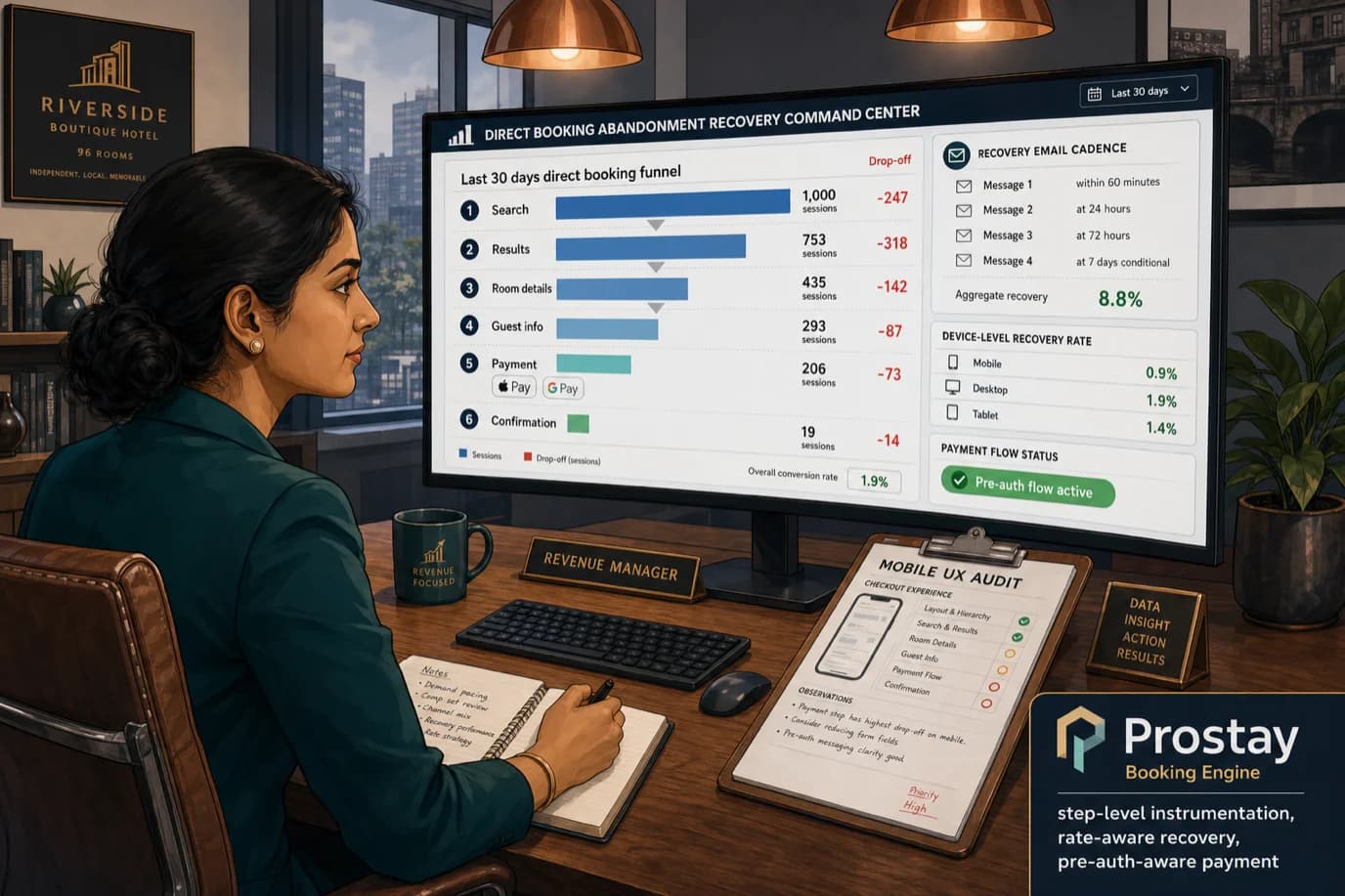
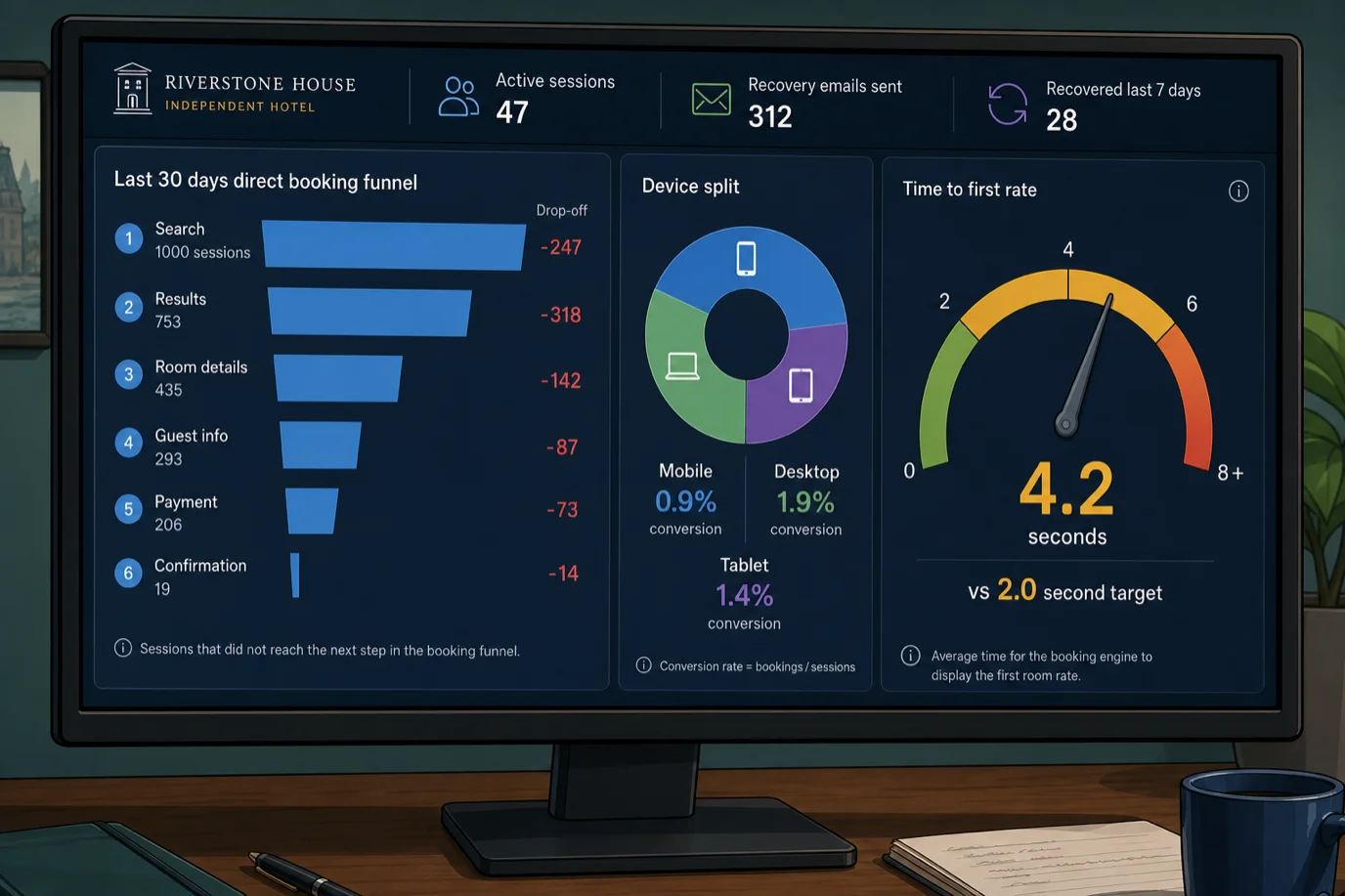
The revenue manager at a 96-room independent hotel in Dublin showed me her analytics dashboard over a video call in March 2026. The property had spent eight months and roughly 22,000 euros on a website redesign with a vendor that promised a 30 percent lift in direct bookings. Six months in, the conversion rate on the booking engine had moved from 1.7 percent to 1.9 percent. The vendor reported this as a success. The revenue manager was not so sure. She pulled up the funnel report from her booking engine, the one most independent hotels never look at, and walked me through what was actually happening on the site. Out of every 1,000 sessions that opened the booking widget, 247 left on the date-search step before any rates were shown, 318 left on the results step after seeing rates but before clicking a room, 142 left on the room-details step after clicking but before reaching guest information, 87 left on the guest-information step after starting the form, 73 left on the payment step after entering card details, and 14 left between authorization and the confirmation page. 19 actually completed a booking. The vendor reported only the 19. Nobody had ever shown her the 247, 318, 142, 87, 73, or 14.
The follow-up question was the one most operators stop short of asking. Of those six drop-off points, which ones were structural intent leak and which ones were fixable? The vendor's position was that most of the abandonment was simply comparison-shopping behaviour and there was nothing to be done about it. We spent the next 90 minutes walking through her session recordings, and the answer turned out to be more specific. The 318 who saw rates and left were not all comparison-shopping. About 110 of them had bounced because the lowest rate displayed was the non-refundable rate while the property's selling proposition was free cancellation. The 142 who reached room details and left included 64 who had clicked the wrong room because the room-type photos were misordered after a CMS migration. The 87 who started the guest information form and left included 41 who had hit a required-field error on a phone-format check that did not accept Irish numbers in their native format. None of those three things were comparison-shopping. They were configuration errors that the booking engine vendor had no incentive to surface, because surfacing them would have meant telling the customer that the website redesign had not actually fixed the underlying conversion problem.
This article is the operational guide to how booking-abandonment recovery should actually work for independent hotels in 2026. It walks the seven concrete drop-off points on a hotel direct-booking funnel, the five numbers that most booking engines structurally miscount, the seven operational failure modes that silently leak revenue at every independent we have data on, the recovery toolkit (exit-intent, cart persistence, email sequences, retargeting, SMS, pre-authorization), the four-message email cadence that recovers 8 to 12 percent of abandoners against 1.5 to 3 percent for a single email, the mobile-specific fixes that claw back 4 to 7 percentage points of mobile conversion, and a 30-day playbook for repairing the funnel without rebuilding the booking engine. The numbers cited below are pulled from a sample of 22 independent hotels (60 to 240 rooms) across Europe, the UK, and North America for which we have step-level funnel data over the last 12 months, complemented by published industry data (Cloudbeds State of Independent Hotels, SiteMinder Direct Booking Index, Skift Research direct-channel reports) and the GA4 e-commerce funnel benchmarks. Prostay ships a booking engine with step-level instrumentation, abandoned-booking recovery sequences, and pre-authorization-aware payment flows as first-class features, so the diagnostic and the fix are the same workflow rather than two separate vendors who have to be wired together at midnight.
Why booking abandonment is the largest unmeasured leak on most hotel websites
Direct-booking funnels at independent hotels are structurally different from e-commerce funnels in ways that most analytics vendors do not handle correctly out of the box. The differences add up. Three of them matter most.
The first is that hotel booking sessions are multi-step in a way that retail checkouts are not. A typical retail checkout has three steps (cart, shipping, payment). A hotel booking funnel has six to eight (date search, results, room details, extras, guest information, payment, 3DS challenge if triggered, confirmation). Each step has its own drop-off rate, and each step has its own fixable failure modes. The blended conversion rate that most booking engines report is the geometric product of the step-level conversion rates, which means a 90 percent retention at each of seven steps produces a 48 percent end-to-end conversion, while 95 percent retention at each step produces 70 percent. Small step-level improvements compound. The reverse is also true. A single step that retains only 70 percent (because of a configuration error) caps end-to-end conversion at 70 percent of whatever the rest of the funnel can produce, no matter how good the other steps are.
The second is that booking decisions involve a date-and-rate evaluation that retail purchases do not. A guest arriving at the booking widget has a flexible date range, a flexible budget, and an open question about whether the property fits the trip. The first 30 to 90 seconds of the session is evaluation, not transaction. Funnels that treat this segment as transactional drop-off are misreading the behaviour. The right model is a two-stage funnel: a discovery stage (search to room details) where the question is "does this property work for my trip", and a transaction stage (guest information to confirmation) where the question is "can I complete this booking in under three minutes". The drop-off causes are different, the recovery levers are different, and the analytics treatment should be different. Most booking engines do not separate the two, which means the discovery-stage drop-off (large but expected) and the transaction-stage drop-off (smaller but recoverable) get blended into a single number that obscures both.
The third is that hotel sessions are multi-device and multi-visit in a way that retail checkouts rarely are. The same guest might search on mobile in the morning, look again on desktop at lunch, abandon on mobile at the payment step in the evening, receive a recovery email the next morning, and complete the booking on desktop two days later. Booking engines that report conversion as session-based undercount this guest by treating each visit as a separate session. The correct unit is the user across visits, attributed across devices, with a 14-day recovery window. Properties that switch to user-level cross-device attribution discover that 18 to 28 percent of their direct bookings are recovered abandoners that the session-level reports had recorded as new conversions, which is the difference between funding the recovery channel adequately and starving it.
None of this means hotel funnels are unfixable. The honest 2026 read is that the typical independent hotel booking funnel has 4 to 7 percentage points of conversion sitting in fixable drop-off points that nobody has measured, and the right tools turn most of that diagnostic and recovery work into automation that the front office and the night audit do not have to think about. That is the gap this article walks through.
The seven concrete drop-off points on a hotel booking funnel
Hotel direct-booking funnels are not abstract. The drop-off happens at specific steps with specific causes that are visible if you instrument the funnel correctly. Across the 22 properties in our sample, seven drop-off points account for the bulk of abandonment, and the diagnostics for each are different. The version below is the canonical pattern. Your specific property will weight these differently.
Drop-off 1: Search to results, the rate-display mismatch
The guest enters dates and party size, hits search, and sees the rate grid. 18 to 28 percent of sessions exit on this step. The most common diagnosis is that the lowest rate displayed in the grid is not the rate the guest was expecting based on the metasearch, the OTA, or the marketing creative that brought them to the site. A guest arriving from a Google Hotel Ads listing showing a rate of 142 euros and landing on a results page where the lowest visible rate is 168 euros (because the 142 was the non-refundable rate and the booking engine defaults to refundable) will exit at a higher rate than the OTA listing. The fix is not to default to non-refundable. The fix is to make the rate-plan toggle visible above the fold with both rates side by side, so the guest sees the rate they expected and the trade-off is explicit.
The second diagnosis is currency. A property that shows GBP rates to a guest whose IP geolocates to France and whose browser language is French will lose 4 to 7 percentage points of conversion on that segment, because the guest is doing the conversion math in their head and the cognitive load is higher than on the OTA which shows EUR. The fix is automatic currency display based on browser locale with a manual override, and the rate display has to recalculate, not just relabel. The third diagnosis is availability. Properties with overly aggressive minimum-length-of-stay or closed-to-arrival rules show a no-availability or higher-rate result on date combinations that the guest had reason to believe should work, and the exit on this step spikes. Hotel rate parity in the EU in 2026 covers the parity context that makes the rate-display question more nuanced post-DMA, but the operational point is that the booking engine has to show the rate the guest expected, not the rate the property would prefer to lead with.
Drop-off 2: Results to room details, the room-type friction
The guest sees the rate grid, picks a rate, and is supposed to land on a room-details page that confirms what they are buying. 12 to 19 percent of sessions exit between results and room details. The diagnoses are typically photo quality (the room photos load slowly or are clearly older than the property's current decor), room-type confusion (the labels do not map to what the guest searched for), and amenity ambiguity (the room shows "free wifi" and "air conditioning" but does not address whether the bathroom is private or shared, whether the bed is queen or twin, whether breakfast is included). Each of these is a fixable content problem, not a booking-engine problem.
The forensic pattern is to pull the session recordings for the exits on this step and watch what the guest looked at before leaving. In our sample, 60 to 75 percent of the exits had paused on a single field of the room-details page (most often "bed type", followed by "breakfast included") before exiting, which is the signal that the answer on the page did not match what they expected. The other 25 to 40 percent had clicked back to the rate grid and left from the previous step. The first group is fixable with content updates. The second group is harder to recover and usually represents a different failure higher up. The mistake is to treat the entire 12 to 19 percent as a single bucket and apply a single fix to all of it.
Drop-off 3: Room details to extras, the forced upsell friction
Some booking engines route the guest from room details to an extras page (parking, breakfast upgrade, late checkout, spa credit) before guest information. 8 to 14 percent of sessions exit on this step when it exists. The diagnosis is almost always that the extras page is forced rather than optional, the layout shows checked-by-default upsells, and the guest reads it as a friction step rather than a value step.
The fix is to make the extras page genuinely optional with a clear "skip and continue" path that is visually equal to the "add and continue" path, default all upsells to unchecked, and limit the page to four extras maximum. Properties that follow this pattern see 4 to 7 percentage points of recovery on this step, with no measurable loss in upsell attach rate. The mistake is to leave defaults checked because it lifts attach rate, which it does, but the conversion loss is roughly 3 times larger than the attach lift in revenue terms across the funnel as a whole.
Drop-off 4: Extras to guest information, the account-required wall
Some booking engines require account creation before guest information can be entered. 6 to 11 percent of sessions exit on this step when it exists. The diagnosis is straightforward: the guest does not want to create an account to make a single hotel booking, and the value proposition for the account is not visible at the moment of the ask. Brand chains can sometimes get away with this because the loyalty program is a known value. Independents almost never can.
The fix is to default to guest checkout with an optional "save my details for next time" checkbox that creates the account in the background after confirmation. Properties that switch from forced account creation to guest checkout typically see 5 to 8 percentage points of recovery on this step. The fallback fix, if the booking engine does not support guest checkout natively, is to push the account creation to a post-confirmation thank-you page where the value (faster next booking, member discount on future stays) is visible alongside the just-completed transaction.
Drop-off 5: Guest information to payment, the form friction
The guest fills in name, email, phone, address, and any property-required fields, then clicks continue to payment. 7 to 12 percent of sessions exit on this step, which is the highest-yielding step for fixes because the guest has invested time and intent in completing the form. The diagnoses cluster around four issues. Required-field validation that rejects valid inputs (the Irish phone format problem from the Dublin example, the hyphenated last-name problem, the postal-code problem for international guests). Errors that surface only on submit rather than on field blur, which forces a full-form re-read. Required fields that are not actually required for the booking (passport number, date of birth in formats the guest has to look up). And submit buttons that disable on any unfilled field rather than highlighting which field needs attention.
The fix is field-level validation on blur, internationally permissive format checks (use libphonenumber rather than a regex written by someone who has not seen a Greek mobile format), required fields trimmed to the legal and operational minimum, and a submit button that always works and explicitly tells the guest which fields are missing on click. Properties that audit and rewrite the guest-information form along these lines typically see 3 to 6 percentage points of recovery on this step. Direct-booking conversion at hotels in 2026 covers the broader conversion-rate optimization workflow, of which the form audit is the highest-yield single step.
Drop-off 6: Payment to confirmation, the tokenization and 3DS failure
The guest enters card details and clicks pay. 5 to 9 percent of sessions exit between payment submission and the confirmation page. This step is the most technical to diagnose because the failure surfaces are split across the booking engine, the payment processor, the issuing bank, and the 3DS authentication flow. The four common failure modes are: hard declines from the issuing bank that surface as a generic error message ("there was a problem, please try again") with no actionable signal, soft declines that the booking engine retries on a different rail without telling the guest, 3DS challenges that drop the guest back at the start of the funnel rather than the payment step on completion, and pre-authorization holds that look to the guest like a charge they did not expect.
The fix on the booking engine side is to surface specific decline reasons where the processor returns them ("your bank declined this transaction, please try a different card or contact your bank"), to handle 3DS challenges with a return URL that lands the guest on a "we are completing your booking" page rather than the start of the funnel, and to display pre-authorization terms in plain language above the pay button so the hold is expected rather than surprising. Properties that get this step right see 2 to 4 percentage points of recovery, with the larger gains coming from the 3DS return-URL fix specifically. Hotel pre-authorization versus deposits in 2026 covers the pre-auth versus deposit decision, which is the upstream variable that determines what surface the guest sees on the pay button.
Drop-off 7: Mobile only, the orientation, keyboard, and autofill problems
Mobile-only drop-off compounds across the previous six steps and adds a few of its own. The aggregate mobile conversion rate at independent hotels is 0.5 to 1.5 percent against 1.5 to 2.5 percent on desktop, with the gap concentrated on the form-filling and payment steps. The fixable mobile-specific issues are sticky rate display (the rate disappears on scroll, so the guest forgets what they are paying), keyboard mismatch (the date picker triggers a default text keyboard rather than a numeric one, the phone field triggers an alpha keyboard rather than a numeric one), autofill blocking (form fields are styled in a way that the browser does not recognize as standard, so iOS Keychain and 1Password do not offer to fill), and orientation rotation (the form layout breaks on rotation between portrait and landscape, which interrupts the session for guests who rotate to type more comfortably).
Each of these is a 0.5 to 2 percentage point recovery on its own, and they are additive. The aggregate fix moves mobile conversion by 4 to 7 percentage points in our sample. The mistake most properties make is treating mobile abandonment as a single problem to be solved with "responsive design", when the underlying issues are specific UX patterns that have to be addressed individually. The starting point for the mobile audit is to do the booking yourself on your own phone, in airplane mode for the first 30 seconds (to see what loads from cache), and to write down every friction point as it happens. The list will be longer than you expect.
The five numbers most booking engines miscount
Funnel performance is a measurement problem before it is an operational one, and most independent-hotel booking engines track five numbers that are computed in subtly but meaningfully wrong ways. Each one biases the dashboard in a direction that flatters the booking engine and hides the recovery opportunity. Here is what each number should be, what most tools actually compute, and how to fix it.
Number 1: Step-level drop-off, not blended conversion rate
Most booking engines report a single conversion-rate number (sessions to bookings) and call it done. The number is real, but it is the geometric product of six or seven step-level retention rates, and reporting only the product hides every diagnostic question worth asking. A funnel running 95 percent retention on five steps and 70 percent on the sixth produces the same blended conversion as a funnel running 85 percent on every step. The two are not the same problem and they do not have the same fix. The first one wants a single-step audit. The second one wants a UX overhaul. A booking engine that hides the per-step numbers makes both look like a generic conversion problem.
The correct number to track is the per-step retention rate over a 30-day rolling window, by device, with the step-to-step transition probability and the absolute exit count on each step. The aggregation is straightforward once the events are firing. The hard part is making the events fire reliably, especially on mobile where third-party tag managers and consent-mode banners interfere with event delivery in ways that vary by browser. Properties that get this right treat the funnel events as core booking-engine instrumentation, not analytics, which means the events post directly to the booking-engine database and not just to GA4. The reports then become a join against the database rather than a query against an analytics tool that may have dropped 15 to 25 percent of the events on consent rejection.
Number 2: Time to first rate, not page load time
Page-load time is a generic web-performance metric (the canonical Core Web Vitals number is Largest Contentful Paint, target under 2.5 seconds). Time to first rate is the booking-engine-specific version: the elapsed time from when the guest clicks "search" to when the first rate is visible on the screen. They are not the same number, and the gap between them is a major silent abandonment driver. A property with an LCP of 1.8 seconds and a time-to-first-rate of 6.4 seconds (because the rate fetch is async after the page paints) loses 4 to 8 percentage points of conversion on the search-to-results step purely to the wait. The page is technically loaded. The thing the guest came for is not.
The correct number is time-to-first-rate measured from search-click to first-rate-visible, broken out by device and by rate-plan complexity (a property with five rate plans and three room types will have higher time-to-first-rate than one with two rate plans and a single room type, and the comparison should be like-for-like). The target in 2026 is under 2.0 seconds on desktop and under 2.5 seconds on mobile. Properties whose booking engines run higher than this typically have a back-end that calls a channel manager or PMS for live availability on every search, which is the right architecture for accuracy but the wrong architecture for speed. The fix is a cached availability layer with a 30-second staleness budget, which is short enough that overbooking risk is negligible and long enough that the rate fetch returns in 200 milliseconds rather than 4 seconds.
Number 3: Mobile versus desktop drop-off, not blended by device
Mobile and desktop funnels behave differently enough that blending them produces a useless aggregate number. Mobile sessions exit the search-to-results step at 26 to 34 percent against 18 to 24 percent on desktop, exit the guest-information step at 12 to 18 percent against 7 to 10 percent on desktop, and complete the payment step at 0.6 to 1.4 percent of all sessions against 1.6 to 2.6 percent on desktop. The shape of the funnel is the same. The slope is different. Booking engines that report a single funnel number average the two and produce a curve that does not match either one, which means the diagnostic and the recovery work is targeted at the wrong device.
The correct treatment is to report the funnel separately for mobile and desktop, with a third bucket for tablet (which usually behaves more like desktop than mobile but warrants its own line). The mobile-specific drop-offs (orientation, keyboard, autofill) need their own diagnostic dashboard, not a footnote on the main funnel report. Properties that split the funnel by device discover that 60 to 70 percent of the recoverable abandonment is on mobile, even when mobile is only 35 to 50 percent of sessions, which means the budget allocation between mobile and desktop UX work is structurally backward at most independent hotels.
Number 4: Recovery email open, click, and book, not just open rate
The standard email-platform report shows open rate, click rate, and unsubscribe rate for the recovery sequence. None of those numbers tell you what the recovery channel actually delivered, which is bookings. A 56 percent open rate that produces 0.4 percent recovered bookings is worse than a 38 percent open rate that produces 6 percent recovered bookings, but the open rate is the headline number on every email-platform dashboard and the booked rate usually requires manual stitching across the email platform and the booking engine.
The correct numbers to track are recovered bookings as a percentage of recovery-email recipients, with the breakdown by message in the sequence (Message 1 typically delivers 60 to 70 percent of the recovered bookings, Message 2 delivers 20 to 25 percent, Messages 3 and 4 deliver the remaining 10 to 15 percent), and the recovered-booking ADR against the abandoned-booking ADR (in our sample, recovered ADRs run 4 to 9 percent below the original abandoned-booking rate, which is the cost of the recovery and has to be netted into the channel ROI). Open rate is a leading indicator. Booked rate is the number that determines whether the recovery email infrastructure pays for itself.
Number 5: Repeat-visit attribution window, not session-only conversion
Booking engines that treat each session as independent undercount cross-session recoveries, which means the recovery channel (email, retargeting, SMS) gets less credit than it earned and the budget allocation drifts away from recovery toward acquisition over time. The undercount is large. In our 22-property sample, session-level reporting attributes 73 to 81 percent of bookings to the original session that produced them, while user-level reporting with a 14-day window attributes 55 to 67 percent of bookings to the original session and the rest to a recovery touchpoint that happened later.
The correct attribution model is a 14-day cross-device user window with a position-based credit assignment (40 percent to the first touch, 40 percent to the converting touch, 20 percent split across any intermediate touches). The 14-day window is necessary because the median time from abandonment to recovered booking in our sample is 38 hours but the 90th percentile is 11.4 days. A 7-day window misses 18 to 22 percent of recoveries. A 24-hour window misses 60 to 70 percent. The position-based model matters because most recovered bookings touch two or three channels and a last-touch model under-attributes the early channels. GA4 ships a position-based model out of the box for e-commerce, and most booking engines can be configured to push their conversion events into that model rather than running a separate session-based conversion report.
The seven operational failure modes
The numbers above are the measurement layer. Below the measurement layer is the operational layer, which is where most direct-booking funnels actually leak conversion at independent hotels. In the 22-property sample, seven failure modes appeared often enough to be considered the typical pattern. Two of them are configuration problems. Two are content problems. Three are workflow and process problems. They compound. It is unusual for a property to be clean on five of the seven. It is rare for a property to be clean on all seven.
Failure 1: Treating discovery and transaction as the same funnel
The booking engine reports a single funnel from search to confirmation, the conversion-rate optimization plan tries to lift conversion at every step uniformly, and the team ends up applying transaction-stage tactics (urgency banners, scarcity messaging, exit-intent popups) to the discovery stage where the guest has not yet decided whether the property fits the trip. Urgency on the search-results step before the guest has even looked at a room actively reduces conversion, because the cognitive frame is "this property is pressuring me" rather than "this property is what I want".
The fix is to model the funnel as two stages: discovery (search to room details, where the question is "does this property work for my trip") and transaction (extras to confirmation, where the question is "can I complete this booking quickly"). Discovery-stage tactics are about clarity (clear photos, clear amenity descriptions, clear rate-plan distinctions). Transaction-stage tactics are about speed (one-page checkout, autofill, Apple Pay). The two have to be designed separately. Properties that segment the funnel along these lines see 3 to 5 percentage points of recovery on discovery-stage drop-off without affecting transaction-stage conversion at all.
Failure 2: Forced account creation or overzealous required fields
The booking engine asks for an account before the guest can enter their information, or the guest-information form requires fields that are not legally or operationally necessary (passport number, date of birth in a non-standard format, marketing consent that is bundled with terms acceptance). 6 to 14 percent of sessions exit on this step solely because of the friction. The booking engine vendor often defaults to the more aggressive collection because it improves the property's first-party data set, and the property accepts the default because nobody runs the cost-benefit on the lost bookings.
The fix is to run the form audit. List every field. For each one, write down why it is required, who needs it, and what happens if the guest leaves it blank. Most properties find that 30 to 50 percent of the fields on their guest-information form are not needed for the booking and can be moved to a post-confirmation form (loyalty signup, marketing preferences, special requests) where the cognitive load is no longer between the guest and the conversion. The fields that remain are the legal minimum (name, email, phone for booking confirmation) plus whatever is operationally required for arrival (estimated time of arrival, special requests if it changes housekeeping). The form gets shorter, the conversion rises, and the post-confirmation enrichment fills in the rest at lower friction.
Failure 3: Payment errors that swallow signal
The payment step returns a generic error message ("there was a problem processing your payment, please try again") regardless of whether the issue was a hard decline from the issuing bank, a 3DS challenge that the guest closed, a CVV mismatch, an expiry-date typo, or a network timeout between the booking engine and the processor. The guest does not know what to do next. The most common response is to assume the card has been blocked and to leave the site without trying again. A different card might have worked. A different rail might have worked. The retry never happens.
The fix is to surface the specific decline reason where the processor returns one ("your bank declined this transaction, please try a different card or contact your bank to authorize the payment"), to handle 3DS challenges with a return URL that lands the guest on a "completing your booking" interstitial rather than the start of the funnel, and to log every payment failure with the processor response code so the night audit can review the pattern weekly. Properties that improve the payment-error UX along these lines recover 2 to 4 percentage points of payment-step abandonment, with the larger gains on the 3DS interaction specifically.
Failure 4: Single recovery email instead of a multi-message cadence
The property fires a single abandonment email 24 hours after the session, and the open rate is reported as the channel performance number. 1.5 to 3 percent of abandoners book through that single email. The math suggests the channel is marginal. The math is wrong. The correct comparison is the four-message cadence (1 hour, 24 hours, 72 hours, 7 days) which recovers 8 to 12 percent of abandoners in the same sample. The 5-to-9-percentage-point gap is the difference between a channel that almost pays for itself and a channel that funds half the recovery program.
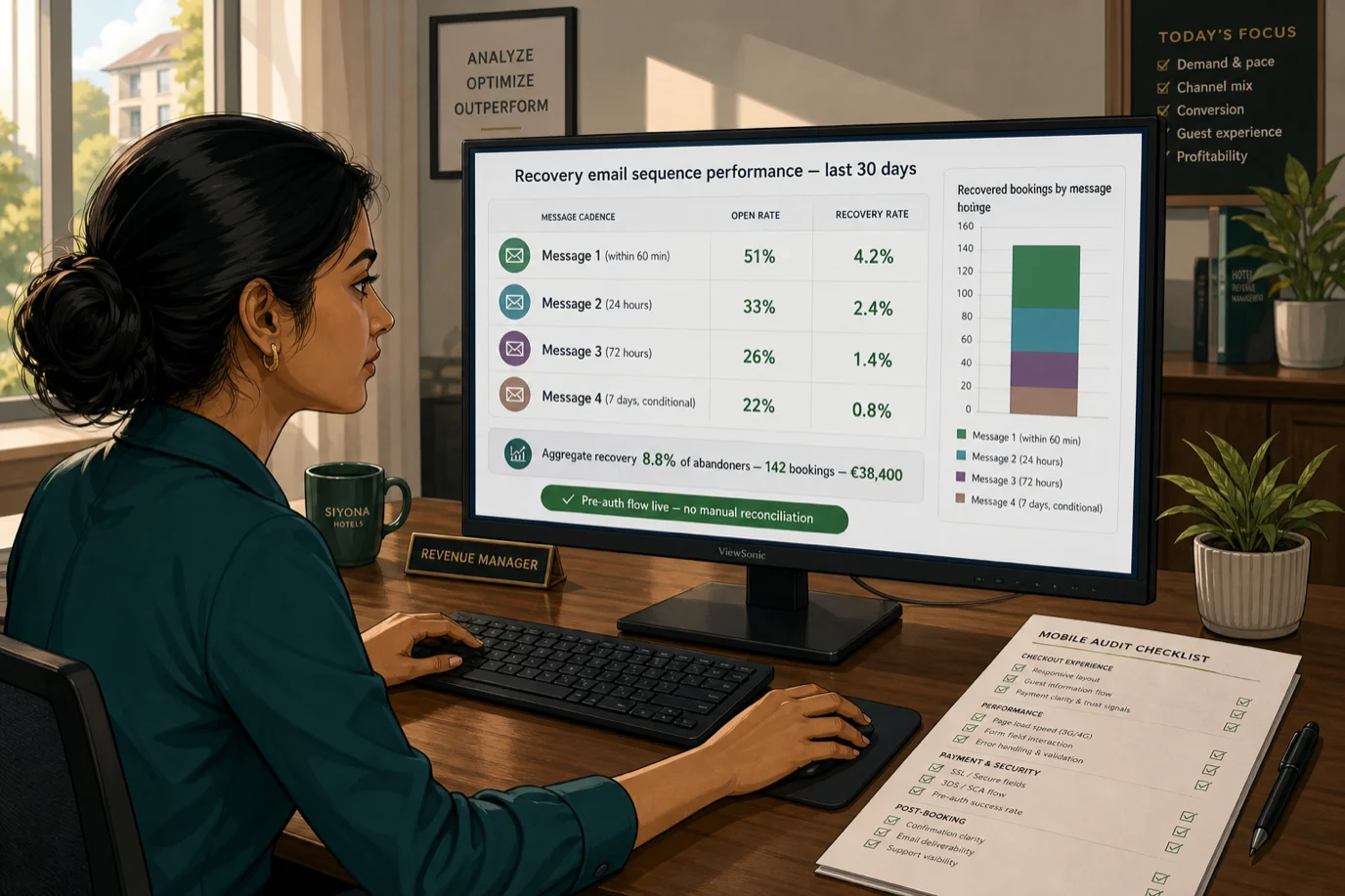
The fix is to design the cadence around the reasons the guest left rather than around an arbitrary time window. Message 1 (within 60 minutes) catches the guest who is still on the trip-planning task and got distracted, with a one-click resume link to the exact funnel step. Message 2 (24 hours) catches the guest who slept on it and is now comparing options, with one piece of social proof and a same-rate confirmation. Message 3 (72 hours) catches the guest who has not booked yet because of payment friction, with explicit options (Apple Pay, deposit terms, free cancellation if applicable). Message 4 (7 days) catches the guest who is still considering by alerting them to a rate change. The four messages address four different reasons. Sending all four to everyone produces lower aggregate cost per booking than sending one message to everyone.
Failure 5: Retargeting creative that undercuts the on-site rate
The retargeting creative shows a price below the public rate the guest saw on the booking widget. The guest clicks back, lands on the booking engine, and sees the higher rate again. The credibility of the entire site drops, and the conversion rate on the retargeted session is lower than on a control group that saw no ad at all. The mistake usually comes from a marketing team that sets the retargeting budget on a discounted creative and a revenue team that maintains the public rate, with no shared review of the two.
The fix is to align retargeting creative with the on-site rate as a hard rule, with discounts only on member or logged-in rates which are not visible to public traffic and therefore not subject to parity. The rate-parity context post-DMA gives independents more flexibility on this than they had in 2023, but the on-site consistency rule still holds. Hotel rate parity in the EU in 2026 covers the parity context that makes member-rate discounts the cleanest retargeting tactic. The other recipe that works is rate-equal creative with a value-add (free upgrade, early checkin, free breakfast) which lifts perceived value without breaching parity.
Failure 6: No mobile-first audit
The property's web team does the booking flow on desktop in a Chrome browser with a US English keyboard and high-bandwidth connection, declares it works, and ships it. The mobile experience is tested on the developer's iPhone in the office on the office wifi. Real guests are doing the booking on a mid-range Android in low-coverage areas with a non-English keyboard and a thumb-only typing pattern. The desktop test gives no signal about whether the mobile experience works. The internal-iPhone test gives partial signal at best.
The fix is a mobile-first audit on the second of every month, where the revenue manager or the GM does the booking flow on their own personal phone, in airplane mode for the first 30 seconds, in landscape orientation for the form-filling step, with the phone language set to a non-English locale at least once a quarter. The audit takes 12 minutes. The list of friction points is always longer than the team expects, and the act of running the audit at all is a stronger signal than the specific findings, because it forces the team to experience the booking funnel the way actual guests do.
Failure 7: No multi-touch attribution for the recovery channels
The booking confirmation screen records "direct" as the channel, the marketing dashboard reports the booking as direct, and the email platform shows the recovery message as having been sent without crediting it for the eventual booking. The recovery channel always under-reports. Over time, the budget moves to channels that report cleanly (paid search, metasearch) and away from channels that produce real bookings but cannot prove it (recovery email, retargeting), which compounds the misallocation.
The fix is to push the recovery-message touchpoint into the GA4 conversion path with a custom event, configure the position-based attribution model with a 14-day window, and report the recovery channels with the model-attributed credit rather than the last-touch number. Properties that switch to this model see the recovery email channel grow from 1 to 2 percent of attributed bookings to 8 to 14 percent, which usually reverses the budget allocation conversation in the next quarter and funds the email infrastructure properly. The same logic applies to retargeting, where the model-attributed share is typically 4 to 8 percent against a last-touch number near zero.
The recovery toolkit: what actually works in 2026
The drop-off points and the failure modes set up the diagnosis. The recovery toolkit is the set of tactics that produce measurable bookings against that diagnosis. Six tactics carry the weight in 2026, ordered roughly by ROI in our 22-property sample. Each one targets a different kind of abandoner.
Trigger 1: Exit-intent for active searchers
Exit-intent is a desktop-only tactic (mobile has no equivalent because there is no mouse-out signal) that fires a contextual message when the cursor leaves the browser window. The message is not a discount. It is a one-line confirmation of the rate the guest had been viewing, with a single resume button that returns to the exact funnel step. The conversion contribution from a well-implemented exit-intent overlay is 0.5 to 1.2 percentage points of desktop-session bookings, with the larger gains on the room-details and guest-information steps where the guest has invested time.
The mistake most properties make with exit-intent is to use it for a discount offer (which trains guests to abandon the funnel deliberately to trigger the discount) or to use it on the search-results step where the guest has not yet committed (which feels like pressure). The correct configuration is to fire only on the room-details step or later, no discount, the message confirms the rate is held for a fixed time window (15 minutes is the shortest that feels credible), and the dismiss button is equal in visual weight to the resume button. Anything more aggressive than this trains the wrong behaviour and reduces total conversion over time.
Trigger 2: Cart persistence for returning sessions
Cart persistence is the booking-engine feature that remembers the guest's search (dates, party size, room selection, any extras) and restores it when the guest returns to the site within a defined window. The window in 2026 should be 30 days, not 7 days and not 24 hours. The guest who left on Monday and returned on Wednesday should land on the rate grid for their dates with the room they had been viewing already selected, not on a blank widget that requires re-entry. The conversion contribution from cart persistence is 0.6 to 1.4 percentage points of returning-session bookings.
The implementation is a first-party cookie or local-storage record of the search, written on every funnel-step transition, with a TTL of 30 days and a graceful expiry that falls back to the rate the guest last saw. Properties whose booking engines do not support this natively can implement a thin client-side layer over the booking widget that captures the URL parameters and re-injects them on return. The point is that the friction of re-entering the same search is pure conversion loss, and the recovery is one of the cheapest tactics to deploy.
Trigger 3: Abandoned-booking email sequence
The four-message email cadence is the highest-yielding recovery channel by a wide margin. The full cadence design is in the next section. The summary number is 8 to 12 percent recovery on abandoners who supplied an email address before exit, against 1.5 to 3 percent for a single-message version. The cadence requires the booking engine to capture email at the guest-information step or earlier, which means the email field has to come before the payment field rather than after. Booking engines that ask for email only at payment lose most of the recovery opportunity because most abandonment happens before the email is captured.
The technical implementation requires an event-triggered email platform (most modern transactional email platforms support this), a session record that includes the funnel step at exit, and a one-click resume link that authenticates the user and returns them to the abandoned step with rate, room, and party size already populated. The cadence design is in the next section.
Trigger 4: Retargeting ads with rate-parity caveats
Retargeting through Meta and Google works for hotels in 2026, with two configurations that produce positive ROAS in our sample. The first is a 7-day window targeting only sessions that reached the room-details step or further, with creative that confirms the rate the guest had been viewing rather than a discount. The second is a 14-day window targeting only payment-step abandoners, with creative that addresses payment friction (Apple Pay, deposit terms, free cancellation if applicable). Configurations that lose money are short windows targeting all sessions including search-step exits, generic property-shot creative, and any creative that drops below the on-site public rate.
The rate-parity question is less constraining post-DMA than most independents assume. Booking.com waived narrow rate parity in December 2024, which means that a member-rate retargeting creative with a 5 to 8 percent loyalty discount is permissible under almost every parity clause that survives in 2026. The mistake is to discount the public rate, which is still rate-parity-restricted in some EU jurisdictions, where the member-rate workaround is the cleanest tactic. Hotel metasearch bidding in 2026 covers the overlapping ad-spend question on metasearch, which has different parity rules than retargeting and should be budgeted separately.
Trigger 5: SMS for high-intent ADR ranges
SMS recovery is a more aggressive channel than email and works best on a narrow segment: high-ADR bookings (above the property's 75th percentile rate) that abandoned at the payment step with a phone number captured. The open rate on SMS is 92 to 98 percent in 2026 against 38 to 52 percent on the recovery email, and the conversion rate on the SMS-driven recovery is 12 to 18 percent of the SMS audience against 5 to 7 percent on the equivalent email audience. The catch is that SMS works only on a narrow segment because broader sends produce unsubscribe rates and brand damage.
The right configuration is SMS only on the highest 25 percent of ADRs by booking value, only with explicit consent at the guest-information step (a separate checkbox, not bundled with terms acceptance), and only one message in the sequence (not a cadence) sent within 90 minutes of abandonment. The message confirms the rate is held and offers a one-tap resume link. Properties that try to use SMS more broadly than this find that the unsubscribe rate climbs quickly, the deliverability drops with carriers flagging the sender ID, and the channel ROI inverts within two months. The narrow-segment configuration sustains over time.
Trigger 6: Pre-authorization as a friction reducer, not a barrier
Pre-authorization is usually framed as a fraud-protection tactic, which it is, but it is also a recovery lever for the payment step that most independents do not use that way. A guest who is hesitating between two properties and reaches the payment step on yours will sometimes abandon because they want to keep their options open. A "we will hold the rate but only charge on arrival" pre-auth flow lowers the commitment threshold and converts that hesitation into a booking, where a "we will charge your card now" deposit flow loses the booking to the property that offers the lower-commitment option.
The configuration that works is to offer pre-auth as the default for refundable rates, with the deposit flow reserved for non-refundable rates and last-minute bookings inside the cancellation window. The pre-auth amount is the first night, not the full stay, and the language on the pay button reads "hold rate (no charge today)" rather than "pay now". Hotel pre-authorization versus deposits in 2026 covers the broader pre-auth versus deposit decision and the chargeback implications, which are the upstream variables that determine which flow is appropriate per rate plan. Properties that switch their refundable-rate default from deposit to pre-auth typically see 1.5 to 3 percentage points of payment-step recovery.
Email sequence design: the four-message cadence that recovers 8 to 12 percent of abandoners
The recovery email cadence is the single highest-yielding tactic in the toolkit and the one that most independents either skip entirely or run as a single 24-hour email. The four-message version below is the configuration that produced 8 to 12 percent recovery in our sample. The cadence is designed around the four reasons abandoners actually leave, not around an arbitrary time schedule.
Message 1 (within 60 minutes): the rate-hold reminder
The first message goes within 60 minutes of abandonment, ideally within 15 to 30 minutes if the email infrastructure supports near-real-time triggers. The message is plain text, no marketing layout, no images, no urgency. It confirms the rate the guest had been viewing, the dates, and the room type, and offers a one-click resume link that returns the guest to the abandoned funnel step. The body of the email is six lines of text. The subject line is "Your room at [property] is held for 24 hours" and the from-address is a real human at the property (the revenue manager, the front-office manager, the GM), not a no-reply address.
The performance numbers in our sample for Message 1 are open rates 42 to 56 percent, click rates 14 to 22 percent, recovery rates 3 to 5 percent of all abandoners. The recovery from this single message is already higher than the recovery from a 24-hour delayed message, because the guest is still on the trip-planning task and got distracted rather than having actively decided not to book. The plain-text format is intentional. Marketing-layout emails get filed as marketing in inbox filters. Plain-text emails from a real person look like correspondence and land in the primary inbox.
Message 2 (24 hours): the social-proof and same-rate confirmation
The second message goes 24 hours after the abandonment, regardless of whether Message 1 was opened. The body adds one piece of social proof (a recent guest review, a stay number, a notable mention if the property has one) and confirms the rate is still held. The format can be slightly more visual than Message 1 (one image is acceptable, more than one starts to look like marketing) but the from-address remains the same human and the resume link is identical to Message 1. Subject line is "Still holding your room at [property]" or similar.
The performance numbers for Message 2 are open rates 28 to 38 percent, recovery rates 2 to 3 percent. The aggregate recovery from Messages 1 and 2 is 5 to 8 percent of abandoners, which is already higher than most single-email programs achieve. The social proof in Message 2 is critical and most templates get it wrong. Generic copy ("travelers love us") performs poorly. Specific copy ("Marie from Dijon stayed last week and wrote: [review snippet]") performs much better, because the specificity reads as real rather than templated. The reviews used should rotate weekly to avoid repetition for guests who get the message on multiple properties.
Message 3 (72 hours): the payment-friction options
The third message goes 72 hours after abandonment and addresses payment friction explicitly. The body lists the payment options the property accepts (credit card, Apple Pay, Google Pay, bank transfer for some markets), explains the deposit and pre-authorization terms in plain language, and reiterates the cancellation policy. The message is for the segment that is interested but is hesitating because they are not sure about the financial commitment. The format is more structured than Messages 1 and 2 (a short list is acceptable here) and the resume link drops the guest at the payment step rather than the start.
The performance numbers for Message 3 are open rates 22 to 30 percent, recovery rates 1 to 2 percent. The aggregate recovery from Messages 1 through 3 is 6 to 10 percent. The payment-options framing in Message 3 catches a specific kind of abandoner, the one who got to payment and was uncertain about being charged twice (deposit and final), about the timing of the charge, or about the refund flow if they had to cancel. Addressing those questions head-on with the same human from-address as the previous two messages converts a meaningful slice of that segment.
Message 4 (7 days): the rate-change alert
The fourth message goes 7 days after abandonment and only if the rate for the original dates has actually changed (in either direction). If the rate has gone up, the message reads "rates for your dates have moved to [X], the original rate of [Y] is no longer available, here is the current best option". If the rate has gone down, the message reads "rates for your dates have dropped to [X] from the [Y] you were viewing, here is the current rate". If the rate has not changed, the message is not sent. Triggering this message indiscriminately at 7 days regardless of rate movement reduces credibility and trains the recipient to ignore the next series.
The performance numbers for Message 4 are open rates 18 to 26 percent on rate-up alerts and 26 to 34 percent on rate-down alerts, with recovery rates 0.5 to 1 percent on rate-up and 1 to 2 percent on rate-down. The aggregate recovery from Messages 1 through 4 is the headline 8 to 12 percent. The conditional logic on Message 4 is what separates a credible recovery sequence from a generic drip, which is the difference between a channel that builds the property's email reputation and one that erodes it.
Mobile-first abandonment: where to claw back 4 to 7 percentage points
Mobile abandonment is structurally different from desktop abandonment in ways that warrant a separate diagnostic and a separate fix. The aggregate gain in our sample is 4 to 7 percentage points of mobile conversion across the four fixes below, which translates to 1.5 to 2.5 percentage points of total site conversion since mobile is typically 35 to 50 percent of sessions and 25 to 35 percent of bookings. Each fix is independent of the others, so they can be sequenced rather than batched.
The keyboard problem: input mode and format checks
The default mobile keyboard for a form field is the alpha keyboard. Phone fields, postal-code fields, date fields, and numeric fields require the guest to manually switch to the numeric keyboard, which is friction that compounds across the form. The fix is to set the inputmode attribute correctly on every field (inputmode="numeric" for phone and postal code, inputmode="email" for email, type="date" for dates with a native date picker). Each correct inputmode is a 0.1 to 0.3 percentage point lift on its own, and the aggregate across a typical 8-field form is 1 to 2 percentage points of mobile recovery.
The format-check fix is to use libphonenumber for phone validation rather than a custom regex, because the regex usually rejects valid international formats (the Irish leading 0, the German leading 4, the French E.164 with leading +33). Properties whose forms reject valid international phone numbers lose 1.5 to 3 percentage points of conversion on the international segment, which is a third or more of total mobile traffic for European hotels.
The autofill problem: form styling that the browser recognizes
iOS Keychain, 1Password, and Google's autofill recognize standard form-field naming and styling. Booking-engine forms that use custom field names ("guestFirstName" instead of "given-name") or that style the fields in a way that does not match the autofill heuristics (custom div wrappers, JavaScript-rendered inputs that are not in the DOM at page load) do not get autofill offers. The guest types the full address by hand, which is 30 to 50 seconds of additional friction on the form, and the abandonment rate climbs accordingly.
The fix is to use the autocomplete attribute on every field with the correct value (autocomplete="given-name", autocomplete="family-name", autocomplete="email", autocomplete="tel", autocomplete="street-address", autocomplete="postal-code", autocomplete="cc-number", autocomplete="cc-exp", autocomplete="cc-csc"). Properties that audit and fix the autocomplete attributes on their booking form see 1.5 to 3 percentage points of mobile recovery, with the larger gains on the credit-card section where typing 16 digits manually is the highest-friction step in the entire funnel.
The 3DS problem: return-URL handling after the challenge
3DS challenges are now the default for European card payments under PSD2 SCA and increasingly common elsewhere. The challenge takes the guest to the issuing bank's authentication page, the guest completes the challenge, and the bank redirects back to a return URL on the booking engine. If the return URL is configured as the start of the booking funnel (which is the default in many booking-engine configurations), the guest lands on the search widget, has to redo the entire funnel, and most abandon at that point.
The fix is a return URL that lands the guest on a "completing your booking" interstitial page that polls the payment processor for the challenge result and then either confirms the booking or returns the guest to the payment step with a clear error message. This requires booking-engine support for the interstitial flow, which most modern booking engines have but most properties have not configured. Properties that get this right recover 0.5 to 1.5 percentage points of mobile conversion on the segment of payments that triggered a 3DS challenge, which is typically 35 to 60 percent of European payments and 15 to 30 percent elsewhere.
The orientation problem: layout that survives rotation
The form-filling step is one of the few moments in the booking flow where guests routinely rotate their phone to landscape, because typing a long address is more comfortable on a wider keyboard. Many booking-engine layouts break on rotation, with form fields that disappear off-screen, a sticky rate bar that overlaps the form, or a virtual-keyboard interaction that loses focus on rotation. The interruption is enough to push some abandoners to give up.
The fix is straightforward responsive-design hygiene with explicit testing on rotation. Build the form so that every field is visible in both portrait and landscape, the sticky elements re-anchor on rotation, and the field focus is preserved across the orientation change. Properties that audit for this find that the rotation-break case is the cause of 0.3 to 0.8 percentage points of mobile abandonment, which is a small but easily-fixed leak that compounds with the other three mobile fixes.
A 30-day recovery playbook
The above is a lot of theory. Most properties reading this article are running booking funnels in 2026 that already have some of these problems baked in, and the question is what to do about it without rebuilding the booking engine. The 30-day playbook below is the sequence we use with properties that want to clean up their abandonment recovery without disrupting the active calendar.
Days 1 to 7: Audit and instrument
The first week is data work. Pull the last 90 days of booking-engine sessions and categorize each one by the funnel step at which it ended. If your booking engine does not report this, the GA4 e-commerce funnel report does, with the begin_checkout, add_payment_info, and purchase events as the canonical step markers. Add custom events for the intermediate steps (search-results-viewed, room-details-viewed, guest-info-started). At the end of day 3 you should have a step-level drop-off report by device and a list of the top three drop-off points by absolute exit count.
Days 4 through 7 are content audit. For each of the top three drop-off points, pull 20 session recordings (Hotjar, FullStory, Microsoft Clarity all work, the latter is free) and watch every one. Note which fields the guest paused on, what they hovered over, what error messages surfaced, and at what point they exited. The session recordings are the qualitative complement to the quantitative drop-off report, and the diagnoses they produce are usually different from what the team had assumed. By day 7 the property should have a list of 8 to 15 specific configuration or content fixes prioritized by drop-off impact.
Days 8 to 14: Fix the top three drop-off points
The second week is implementation on the highest-impact fixes from the audit. The pattern that works is to ship one fix per day rather than batching them, because batched ships make it impossible to attribute the conversion change to any individual fix, and the team needs the per-fix attribution to know which patterns generalize. Each fix gets a 24-hour observation window before the next one ships.
The most common quick wins in this week are: rate-plan toggle visible above the fold on the results page (recovers 1 to 2 percentage points), guest-information form trimmed to legal minimum fields (recovers 2 to 4 percentage points), payment-step error messaging that surfaces specific decline reasons (recovers 1 to 2 percentage points), and the inputmode and autocomplete attribute fixes on the form fields (recovers 2 to 4 percentage points on mobile). By day 14 the property should have shipped 5 to 8 specific fixes with measured per-fix conversion lift, and the aggregate mobile and desktop conversion should already be 2 to 4 percentage points higher than the day-1 baseline.
Days 15 to 21: Launch the email recovery sequence
The third week stands up the four-message email cadence. The technical work is to capture email at the guest-information step (or earlier if the booking engine supports it), to wire the abandonment event into the email platform, to author the four message templates with the specific guest data fields populated, and to test the resume link end-to-end so the abandoned-step return works correctly. Most modern email platforms (Klaviyo, Customer.io, Braze, even Mailchimp's higher tier) support this with a few hours of configuration.
Days 17 through 21 are template authoring and testing. Each message gets written, reviewed for brand voice, and tested by sending the sequence to internal test addresses with seeded abandonment events. The plain-text Message 1 is the highest-stakes write because it produces 60 to 70 percent of the recovery, and the from-address has to be a real human at the property. By day 21 the cadence is live for new abandoners, and the property should be seeing the first recovered bookings attributed to the email channel within 24 to 48 hours of launch.
Days 22 to 30: Mobile pass and retargeting
The fourth week handles the mobile-specific fixes that did not get covered in week 2 (the 3DS return-URL flow, the orientation handling, the pre-authorization-versus-deposit defaults), and stands up the retargeting program with the rate-parity-aware creative. The mobile fixes typically take 3 to 4 days because they involve booking-engine configuration that the property does not own directly and has to coordinate with the vendor. The retargeting work is faster (the creative is briefed in a day, the audience is configured in another) but the first two weeks of measured ROAS are unreliable because the audience is still building.
By day 30 the property should have step-level instrumentation in place, the top three drop-off points fixed, the four-message email cadence live, the mobile-specific fixes shipped, and the retargeting program running. The cumulative effect over the following 60 to 90 days is typically a 25 to 40 percent lift in total direct bookings against the day-1 baseline, with most of the gain coming from the funnel fixes (which lift conversion at the front end) and the email cadence (which converts abandoners who would otherwise have been lost). The retargeting and SMS contributions are smaller in absolute terms but compound over time as the audience builds.
The decision matrix by property segment
Different property segments have different abandonment patterns and different optimal recovery configurations. The matrix below summarizes the practical recommendations for each segment based on the 22-property sample and the operational pattern observed.
For an urban transient-driven property of 80 to 180 rooms with strong corporate calendar (typical ADR 200 to 320 dollars or euros, annual occupancy 65 to 75 percent, weekday peaks), the right operational stance is full step-level instrumentation, all four mobile fixes, the four-message email cadence, exit-intent on desktop only, retargeting at the 14-day window for payment-step abandoners, and SMS only for the top quartile of ADRs. The DOSM target should be a 22 to 28 percent share of total bookings from direct channel, with abandonment recovery contributing 8 to 14 percent of those direct bookings. The corporate calendar segment is the highest-yield audience for the email cadence because the bookings tend to be made during work hours and the recovery message lands during the same trip-planning task.
For a leisure resort of 100 to 240 rooms with seasonal demand (typical ADR 300 to 600 dollars, annual occupancy 55 to 70 percent, summer or winter peaks), the right stance is the same instrumentation and mobile work plus more aggressive email-cadence personalization (the messages reference the season, the activity calendar, and the specific weather window the guest had been searching). Retargeting works better at a 7-day window for resorts because the trip-planning task is shorter and the comparison set is narrower. SMS works on a wider segment than urban properties because the ADR floor is higher. The recovery contribution is typically 10 to 16 percent of direct bookings, with the larger gains on the shoulder-season dates where transient demand has time to be recovered.
For a luxury boutique of 30 to 80 rooms (typical ADR above 600, occupancy 60 to 70 percent, brand-conscious clientele), the stance is light instrumentation but heavy personalization. The email cadence has to read as correspondence rather than templated, the from-address has to be the GM by name, and the language has to match the brand register. Exit-intent is usually counterproductive at this segment because it reads as pressure to a guest who is paying premium rates. SMS is appropriate at this segment because the ADR floor is high enough. The recovery contribution is usually smaller in percentage terms (5 to 10 percent of direct) but larger in absolute revenue per recovered booking.
For an extended-stay property of 80 to 200 rooms (typical ADR 140 to 220 dollars, occupancy 75 to 85 percent, longer average stay), the abandonment pattern is different because the booking decision is project-driven rather than leisure or corporate. The four-message cadence still works but the timings shift (Message 1 within 60 minutes is still right, but Messages 2 and 3 can compress to 18 hours and 48 hours because the booking-decision window is shorter). Retargeting works less well because the audience is harder to target (the project-based booker is not browsing leisure travel sites). SMS works on a narrow segment of corporate-relocation bookings. The recovery contribution is typically 6 to 11 percent of direct.
For a select-service economy property of 80 to 180 rooms (typical ADR 90 to 150 dollars, occupancy 65 to 75 percent), the recovery work is different because the per-booking margin does not support expensive channels. The four-message cadence still pays for itself (transactional email is cheap and the recovery rate is the same percentage on a smaller absolute number). Retargeting at this segment is borderline (the per-booking ROAS is thin). SMS is usually not appropriate (the segment is price-sensitive and SMS feels intrusive at lower ADRs). The recovery contribution is 5 to 9 percent of direct, with the email cadence carrying almost all of it.
Where Prostay closes the abandonment loop
The operational pattern described above breaks at two specific points in most independent hotels. The first is in the data layer, where the booking engine does not report step-level drop-off natively, the funnel events do not survive consent-mode rejection in GA4, and the recovery email channel cannot be attributed against the booking engine because the two systems do not share session identifiers. The second is in the workflow layer, where the abandonment trigger fires inconsistently because the email platform and the booking engine are wired through a third-party integration that times out, the rate-hold cannot be enforced because the booking engine does not track per-session rate locks, and the resume link expires because the cart-persistence window is too short. Both breakages compound. A property that has fixed the data layer but not the workflow layer ends up with great reports on a recovery program that does not actually fire reliably. A property that has fixed the workflow layer but not the data layer ends up running a recovery program it cannot measure.
Prostay is built to close both gaps at the booking-engine and PMS level, rather than as a recovery module bolted on after the fact. The booking engine ships with step-level instrumentation as a first-class feature, with the funnel events posting directly to the Prostay database (which means consent-mode rejection in GA4 does not eat the event, the events are always available for diagnostics). The abandonment trigger fires within 60 seconds of session exit at any funnel step, the rate-hold is enforced at the PMS inventory layer for 24 hours by default, and the resume link returns the guest to the exact step with the rate, room, and party-size populated from the original session. The cart-persistence window is 30 days. The four-message email cadence ships as a configurable default with the property's brand voice and from-address. The pre-auth-versus-deposit logic is per-rate-plan and the payment-step error handling surfaces the specific processor decline reason rather than a generic message.
The instrumentation extends through the recovery channels with a unified attribution view that reports the email cadence, the retargeting, and the SMS recoveries against the same booking-engine session, with the 14-day position-based attribution model running natively rather than requiring a GA4 export. Direct-booking conversion at hotels in 2026 covers the broader CRO program that the abandonment recovery feeds into. The chargeback workflow is connected to the same payment-step instrumentation, which means a dispute on a recovered booking surfaces the original abandonment session, the recovery touchpoints, and the payment authorization sequence as a single record, and chargebacks reduced by 60 percent walks the chargeback workflow that the recovered bookings need to connect into.
Where this matters most operationally is the place where the Dublin revenue manager was at midnight on the call I described in the opening. The funnel diagnostic should not be a separate analytics project. The recovery email should not be a separate vendor with separate billing. The mobile-specific fixes should not require coordination across three systems. The numbers should be right from the start. None of this is a software feature. It is the operational stance that good independents are starting to adopt and that the right tools support rather than obstruct.
What to do on Monday morning
The honest summary of this article is short. Direct-booking abandonment recovery at independent hotels in 2026 is a place where most properties are leaving 4 to 7 percentage points of conversion on the table because the standard tools, the standard email programs, and the standard operational habits have drifted. The fix is the seven drop-off points in the funnel section, the five numbers in the measurement section, the seven failure modes you can audit your own property against, the recovery toolkit that determines which abandoners can actually be recovered, the four-message email cadence that carries most of the recovery weight, the four mobile-specific fixes that claw back another 4 to 7 percentage points, and the 30-day playbook that closes the operational gaps without rebuilding the booking engine.
If your property runs a direct-booking funnel and you have read this far, there are three things to do on Monday morning. First, instrument the step-level drop-off if it is not already instrumented. The GA4 e-commerce funnel events are the minimum viable version, the booking-engine database events are the full version, and the gap between them is usually a half-day of work for a developer. Second, run the audit on the top three drop-off points using session recordings (Microsoft Clarity is free and good enough). The list of fixes that emerges is almost always shorter and more concrete than the team expects. Third, scope the four-message email cadence with whoever owns the email platform, even if you cannot launch it this week. Knowing the cadence is two weeks of work rather than a quarter changes the prioritization conversation immediately.
That gets the property 60 percent of the available operational improvement. The remaining 40 percent is the data and workflow integration that a well-built booking engine handles automatically, and that the Prostay team will be glad to walk you through if the post-Monday-morning audit suggests there is a structural gap to close. Request a demo when you want to see the abandonment-recovery workflow live with your own funnel data.