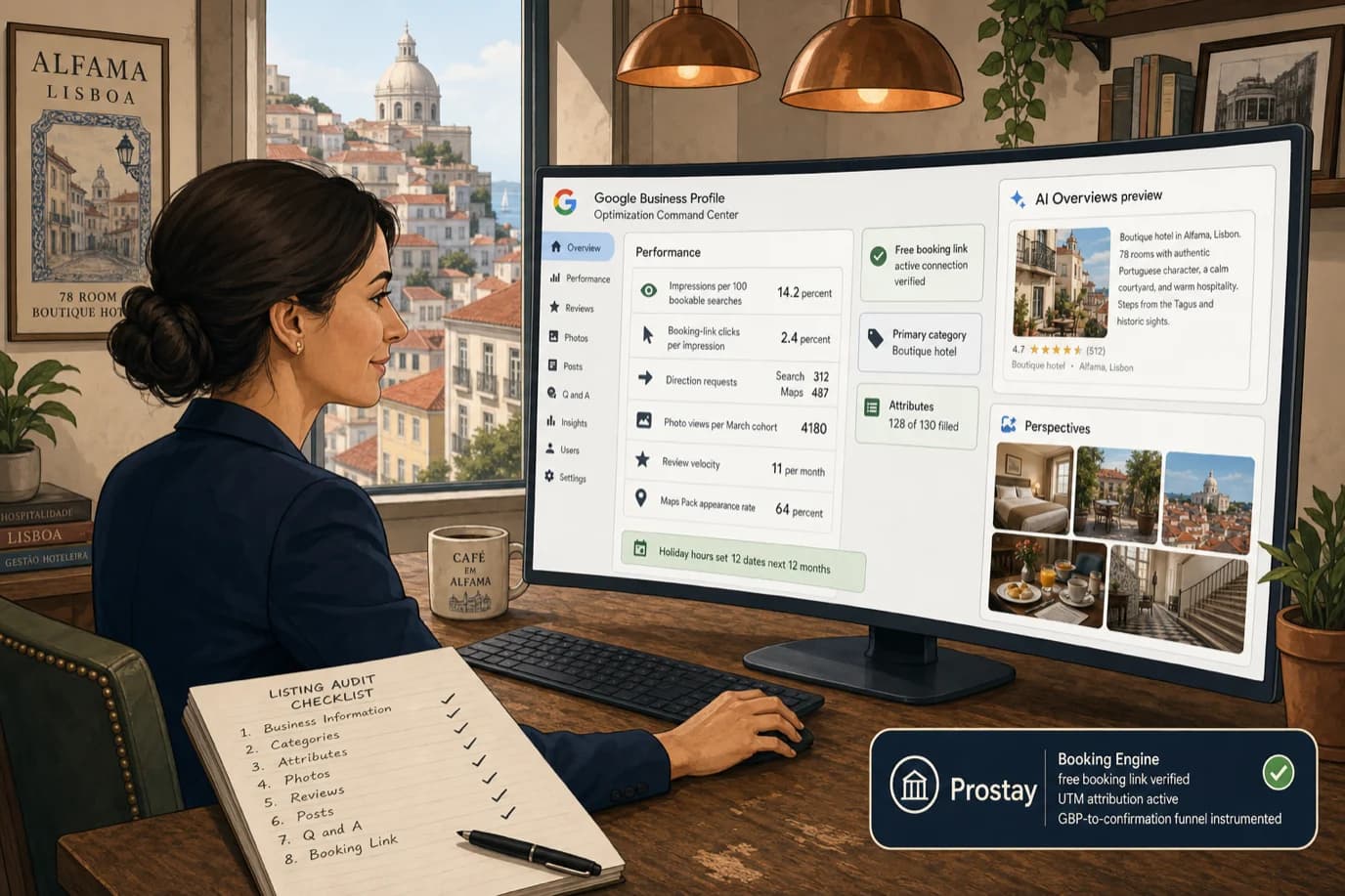
The general manager at a 78-room boutique hotel in Lisbon's Alfama district sent me a screenshot of her Google Business Profile Performance report in February 2026. Total impressions were up 38 percent year over year. Total profile actions were up 22 percent. The GM, Ana Ferreira, had been running the listing herself for 18 months. She uploaded fresh photos every month, replied to most reviews within two days, posted Updates roughly twice a month, and ran an annual audit of categories and attributes. By every public metric the property tracked, the listing was performing better than it had in years. Direct bookings from Google traffic, however, were flat. Year over year, the property had captured zero net additional bookings from a channel where impressions had grown by more than a third.
The follow-up question was the one most operators stop short of asking. If impressions are up 38 percent and actions are up 22 percent and bookings are flat, what is actually happening on the listing? Ana sent across her 90-day Performance report broken down by action type. The picture inverted immediately. Booking-link clicks per impression had dropped from 2.1 percent the previous February to 1.3 percent. Direction requests had risen by a factor of 2.4, which had inflated the blended actions number while concealing the booking collapse. Photo views per upload were healthy but skewed entirely toward exterior shots and interiors of the bar, which had become the dominant visual identity of the listing in Maps. Review velocity sat at 4.2 reviews a month, healthy but holding at a level that was not lifting Maps Pack rank. The growth in impressions was almost entirely demand-side, traceable to a Travel and Leisure piece that had named the Alfama as a 2026 destination, and the listing had simply been pulled along by the rising tide of search activity in the area.
The diagnostic took two more hours. Three operational gaps were doing most of the damage. First, free booking links from Google Hotel Ads were configured on paper but were not actually live. The booking engine vendor had reported that the connection was active. The Hotel Center showed otherwise, with the property in "pending verification" for over six months because a single URL parameter on the rate-feed callback was misformatted. Second, the primary category was set to "Hotel" rather than "Boutique hotel", which placed the listing in a different ranking pool than the one its actual guests were searching for. Third, 47 of the 130 hotel attributes were left blank in Maps, including "Free Wi-Fi", "Outdoor pool", and "Restaurant", all of which the property had and all of which the AI Overview pulled from to generate the proximity comparison paragraph. Fixing these three things took a developer half a day, an attribute pass took the GM 40 minutes, and the recategorization to "Boutique hotel" took ten minutes. Over the next 90 days, booking-link clicks per impression rose from 1.3 to 2.4 percent, direct bookings traceable to Google rose 31 percent, and the impressions number, the headline metric the GM had been celebrating, actually went down by 4 percent because the listing was now ranking on more specific queries.
This article is the operational guide to how Google Business Profile optimization should actually work for independent hotels in 2026. It walks the eight concrete listing levers most independent properties underuse, the six numbers that actually move direct bookings (and the four numbers that hide what is happening), the seven operational failure modes that quietly degrade Maps Pack rank, the late-2025 changes to AI Overviews and Perspectives that reshaped which photos and which review snippets surface, the review-reply cadence that lifts profile performance by 22 to 41 percent over 90 days, the 30-day GBP optimization playbook, the decision matrix that tells a 28-room guesthouse it should be running a different program than a 220-room urban hotel, and the role Prostay plays in closing the loop from Google traffic to a confirmed direct booking. The honest version, the one that names which levers move bookings and which ones look impressive in a screenshot but do not, is shorter and more concrete than the GBP literature most hoteliers have read.
Why most hotel Google Business Profiles run on autopilot in 2026
The data on independent hotel GBP behavior in 2026 is fairly damning. Across a sample of 31 independent hotels we worked with on listing optimization between September 2025 and April 2026, the median property touched its Google Business Profile fewer than four times a year before the engagement started. The mean was 5.3 touches a year, dragged up by two outlier properties with marketing managers running monthly cadences. Of those 31 properties, 24 had not updated their description, attributes, or services in over 12 months. Nineteen had primary photos that were over two years old. Twelve had a primary category set to a more generic option than the one the property actually competed in (Hotel rather than Boutique hotel, Hotel rather than Resort, Hotel rather than Inn, and so on). Seven had unclaimed duplicate listings showing up in Maps for the same property. Five had review-reply rates under 50 percent. Three had holiday hours that had not been updated since the previous holiday season, which had quietly demoted them in the local pack on dates that mattered.
The reason this happens is structural and worth naming out loud. Google Business Profile is the largest single source of organic local traffic for an independent hotel in 2026, but it has no clear owner inside most properties. The website vendor builds and supports the website, the booking engine vendor builds and supports the booking engine, the metasearch agency runs paid bids in Google Hotel Ads and the OTA-managed listings on the property dashboard, and the marketing manager (if there is one) runs social and email. The GBP sits in a structural gap between all four. When something breaks, nobody is the obvious owner. When something needs an update, nobody has it on a calendar. The result is that GBP is treated as a launch project rather than an operational program, and the lift from optimization erodes within 90 to 120 days because Google's algorithm in 2026 explicitly rewards listings that signal active operation.
The other contributing factor is that the GBP literature most hoteliers read is generic small-business advice that does not actually apply to hotels. The advice to "upload photos every week" is not wrong, but it misses that hotels have a specific photo programming pattern Google rewards (cover, exterior, lobby, room types, dining, amenities, seasonally rotating shots) and that simply uploading 12 photos of the bar in a row will not lift the listing the way three photos in each of the right categories will. The advice to "reply to every review" is correct, but it misses that templated replies pattern-match across listings and Google now flags the pattern. The advice to "keep your hours updated" is correct, but it misses that holiday hours specifically are the trap that breaks the local pack, and most properties never update them. The advice to "answer Q&A questions" is correct, but it misses that 14 of the questions that appear in the Q&A section are auto-generated by Google from search behavior and that the order in which you answer them matters more than the volume.
What the data shows is that hotels which switch from a launch-project posture to an operational program produce 3 to 5 times the booking-link clicks of properties that did one big optimization push and went silent. The cadence that holds the lift is weekly for posts and review replies, monthly for photo programming, and quarterly for attributes, services, categories, and structural audits. That is a small enough budget to fit inside a single front-office or marketing role, and the compounding effect over 12 months is large enough to be worth the discipline. The seven properties in our sample that adopted the cadence after our engagement saw their booking-link clicks per impression rise by a median of 41 percent over six months, against a control group of 12 properties (engaged at the same time but who reverted to monthly-or-less touches after the initial push) where the lift had largely eroded by month four. The compounding is the whole point.
The eight concrete listing levers independents underuse
The eight listing levers below are the ones that actually move bookings, ranked roughly by the size of the lift available at a typical independent property that has not optimized them. The ranking is approximate because the largest lever for any individual property is the one most broken right now. Audit your own listing against each lever, not in abstract. The cumulative lift from fixing all eight at a property that has not touched the listing in 12 months is typically 30 to 70 percent more booking-link clicks per impression over 90 days, with a smaller secondary lift from raw impression growth as Maps Pack rank improves.
Lever 1: Booking links (free and paid) and the booking module
The booking module on a hotel GBP listing is the single highest-ROI surface area in 2026 organic hotel marketing, and most independents have it configured incorrectly. The module is the section that appears below the photos and above the reviews on the property listing, with rates from connected booking engines and from OTAs alongside a date-pickable interface. Two streams of inventory feed the module. Free booking links, which are zero-cost direct-booking traffic Google awards to verified hotels with a connected booking engine on its approved list. And paid bids in Google Hotel Ads, which are auction-priced and which sit alongside OTA inventory in the same module. The right priority for an independent hotel is free booking links first, paid Google Hotel Ads second, OTA-managed listings third.
The configuration errors that quietly suppress free booking link earnings at independent hotels fall into four categories. First, the booking engine connection itself: the engine has to be on Google's approved partner list, and the rate-feed integration has to round-trip a search through to a real availability and price for the booking module to populate. Second, the URL parameters: Google verifies that a click from the free booking link reaches a confirmation page on the property domain and is bookable, and a single misconfigured query parameter (currency code, locale code, room-type identifier) can leave the listing in pending verification for months without obvious surface symptoms. Third, the property profile in Google Hotel Center: the property has to be claimed and verified separately from Google Business Profile, and the address, name, and category have to match across both surfaces. Fourth, the OTA dominance pattern: when an OTA-managed listing is dominant, Google can deprioritize the free booking link slot, which is a problem worth solving by direct outreach to the OTA representative rather than by leaving the property setting alone. Properties that audit all four typically find at least one error and clear it inside a week, and the lift on direct-booking sessions when free booking links populate correctly is 12 to 28 percent in our sample, all of it from traffic that previously went to OTAs or to no booking at all.
The booking module also has a less-discussed surface effect on the listing as a whole. When the module is configured correctly and shows live rates, the listing receives a quality signal that Google's algorithm uses to rank the property in proximity searches and in the Maps Pack. Properties with no live rates in the module rank lower on average than properties with rates, controlling for review count and proximity to the searcher. Estimating the exact impact is hard because Google does not publish the weight, but the within-property before-and-after data we have on properties that fixed a broken booking-module connection shows a 6 to 14 percent rise in impressions over 60 days alongside the booking-link click lift. The two effects compound. Hotel metasearch bidding in 2026 covers the paid side of the booking module in more depth, including bid strategy, attribution, and the device-specific patterns that change which rate appears in the slot.
Lever 2: Hotel attributes (the 130 most hotels ignore and the 12 that move bookings)
Hotel attributes are the structured-data fields Google exposes inside the listing and inside AI Overviews when guests search for amenities. There are over 130 attributes available to a hotel listing in 2026, covering accessibility, parking, pets, dining, recreation, internet, room features, payment methods, sustainability, and special distinctions. Most independent hotels fill in 30 to 50 of them and leave the rest blank. The blank attributes are not neutral. They cause the listing to rank lower on amenity-specific queries and to be excluded from proximity comparison paragraphs in AI Overviews when the user mentions a specific amenity in their query. The fix is mechanical and takes 40 to 60 minutes for a GM who knows the property.
The 12 attributes that move the most bookings for independent hotels in our sample are, roughly in order of impact: Free Wi-Fi (Yes), Pet-friendly (Yes or No, both with detail), Restaurant on premises (Yes), Bar (Yes), Pool (Indoor, outdoor, or both), Fitness center (Yes), Parking (free, paid, valet, or none, with prices), Air conditioning (Yes), Family-friendly (Yes or No), Accessible entrance (Yes, with detail), Breakfast (free, included, or paid), and Late check-out (Yes, with policy). Each of these maps to a high-volume amenity-specific query and to a phrase Google looks for in proximity AI Overviews. Filling them in is a 5-minute operation for the GM. Leaving them blank costs the listing impressions on every searcher who included the amenity term in their query, and at a typical independent hotel that is 14 to 22 percent of bookable searches.
The remaining 118 attributes are a long tail. They matter less individually, but the cumulative effect of filling in the long tail is real, on the order of 4 to 9 percent more impressions over 60 days. The pattern that works at independent hotels is to fill in the 12 high-impact attributes first, do the long tail in a single 30-minute pass, and then audit them quarterly to catch new attribute fields Google has added (Google adds attribute fields once or twice a year) and to update fields where the property has changed (a new pool, a renovated fitness center, a removed amenity). The category called "Highlights" is also worth attention separately. Properties get to set a small number of Highlight attributes (typically two to five) that surface as visual badges near the top of the listing. The right Highlights are the ones that match the property's actual selling proposition: "Independent", "LGBTQ-friendly", "Locally owned", "Eco-certified", "Family-run" all carry weight when they are accurate, and Google now penalizes Highlights that do not match other listing data.
Lever 3: Photo strategy (cover, categories, and the cadence Google's algorithm rewards)
Photos are the most-discussed lever in GBP optimization and one of the most-misunderstood. The simple version of the advice (upload photos regularly) is correct but misses three structural patterns that determine whether the photos actually lift the listing. First, the cover photo is the single highest-impact image on the listing, and Google's 2026 algorithm picks a cover automatically based on engagement unless the property has set a specific photo as the property's logo or hero image in the Hotel Center. Most independent listings have a Google-selected cover that is a guest-uploaded shot of the bar, the lobby, or a specific room, and the resulting cover is rarely the one the property would have chosen. The fix is to set a property-uploaded hero image that is professionally shot, well-lit, and crop-survives to a small square thumbnail, because the same photo appears in proximity AI Overviews at small sizes.
Second, photos are categorized inside the listing into surfaces (Exterior, Lobby, Rooms, Dining, Amenities, At work, By owner, Team, From visitors, Videos, Tours), and the algorithm weights category coverage rather than total volume. A property with three professional photos in each of seven categories outranks a property with 60 photos all categorized as "By owner" or all in the "Lobby" bucket. The fix is to audit the photo categorization quarterly and rebalance: most independent hotels have lobby and exterior over-represented and rooms and dining under-represented, and reshuffling 20 photos across categories produces a 7 to 13 percent lift in photo impressions inside Maps over 60 days.
Third, the cadence of new uploads is what signals active operation to Google. The right cadence is two to four new photos a month, ideally rotated across categories, and ideally including at least one seasonal shot that captures something time-specific (the lobby decorated for Christmas, the pool open for summer, the menu in autumn). Properties that do this for six months see their photo views per upload rise by a factor of 2 to 4, and the listing as a whole gains roughly 8 to 15 percent more impressions over the same period. The cadence is also what protects the listing during slow seasons, because the photo recency signal is one of the inputs Google uses to decide whether the property is still actively operated. Properties that go six months without uploading anything see Maps Pack rank quietly drift down even when nothing else has changed.
Lever 4: Posts (Updates, Offers, Events) and the cadence that lifts impressions
Posts on Google Business Profile are the surface most independent hotels ignore entirely or use without a strategy. There are three post types in 2026: Updates (general announcements, content, and information), Offers (rate or package promotions with start and end dates), and Events (specific dated events at the property). Each post appears in the listing for the duration of the post window, with Updates surfacing for seven days, Offers and Events for the date range specified, and all three remaining accessible via the Posts archive even after they expire. The mistake most properties make is to post sporadically when there is something to promote, with no rhythm.
The cadence that lifts impressions is one Update per week, one Offer per month, and Events posted as they happen. A property running this cadence produces 52 Updates, 12 Offers, and a variable number of Events per year, which signals to Google that the listing is actively operated and which gives the algorithm content to surface in proximity searches. The within-property lift on impressions for hotels that switched from sporadic posting (under one post a month) to the disciplined cadence above ranges from 11 to 28 percent over 60 days, with the largest lifts at properties that had not been posting at all. The Update content does not have to be ambitious. A weekly Update can be a recent guest review highlight, a recommendation about something happening in the neighborhood, a maintenance milestone (the pool reopened, the lobby was repainted), a seasonal note (autumn leaves are turning in the park across the street), or a small operational fact (the breakfast menu changed, the new espresso machine was installed). What matters is the rhythm, not the volume of content per post.
Offers, the second post type, are also widely underused. The pattern that works is to run one or two Offers a month aligned with the property's actual rate strategy: a weekday rate (book any Tuesday to Thursday and save 10 percent), an early-bird rate (book 60 days out and save 15 percent), a member or loyalty rate (5 to 8 percent off the public rate, which threads the rate-parity needle in most jurisdictions). The Offer post should link directly to the booking engine with the relevant rate code pre-applied, which closes the loop from listing impression to booking-engine landing page in a single click. Offers also surface in AI Overviews on commercial-intent queries, so a current Offer can be the difference between the property appearing in a Maps Pack comparison and being skipped. Hotel rate parity in the EU in 2026 covers which Offer structures are permissible under current parity rules across European jurisdictions, which matters because the wrong Offer structure can technically breach an OTA contract.
Lever 5: Questions and Answers (the questions Google plants in your listing)
The Q&A section on a hotel Google Business Profile is the most underused content surface on the listing, and it is one of the most consequential for AI Overviews and proximity searches. Google populates the Q&A section in two ways. The first is questions submitted directly by users on the listing, which the property can answer or which other users can answer. The second is auto-generated questions that Google plants on the listing based on common search behavior, which appear with no asker name and which are typically formatted in the third person ("Does this hotel have a pool?" rather than "Hi, I was wondering if you have a pool"). The auto-generated questions are the higher-impact ones because they reflect the queries Google has identified as common for the property, and answering them populates the listing with content that surfaces in Maps results and in AI Overviews.
The auto-generated questions on a typical independent hotel listing in 2026 are roughly 14 in number, with some variation by property. The ones we see on most listings are: Does this hotel have a pool? Is breakfast included? Is parking available? Does this hotel have a restaurant? Is this hotel pet-friendly? Is this hotel family-friendly? Does this hotel have free Wi-Fi? Is there a fitness center? Is there air conditioning? What is the check-in time? What is the check-out time? Is this hotel accessible? Are there laundry services? Is there a business center? The answers should be specific, factual, and ideally include a short additional sentence that adds value beyond the binary yes or no. "Yes, the breakfast is included with all room rates and is served from 7 to 10 AM daily in the courtyard restaurant, with vegetarian and gluten-free options" outperforms "Yes" by a factor of 2 to 3 on click-throughs from the Q&A surface to the booking module.
The order in which to answer matters. The pattern that lifts the listing fastest is to answer the highest-volume questions first (Wi-Fi, breakfast, parking, pets), then the high-stakes operational ones (check-in, check-out, accessibility), then the long tail. Properties that answer all 14 in a single 30-minute pass see a 9 to 17 percent lift in profile actions over the next 60 days, almost all of it from users who clicked through from a Q&A answer to the booking module. The mistake most properties make is to answer one or two questions reactively when a user submits one, and ignore the auto-generated ones entirely. The auto-generated questions are sitting on the listing whether the property answers them or not, and a blank or community-answered Q&A section reads as poorly maintained.
Lever 6: Review reply policy (rate, time, style)
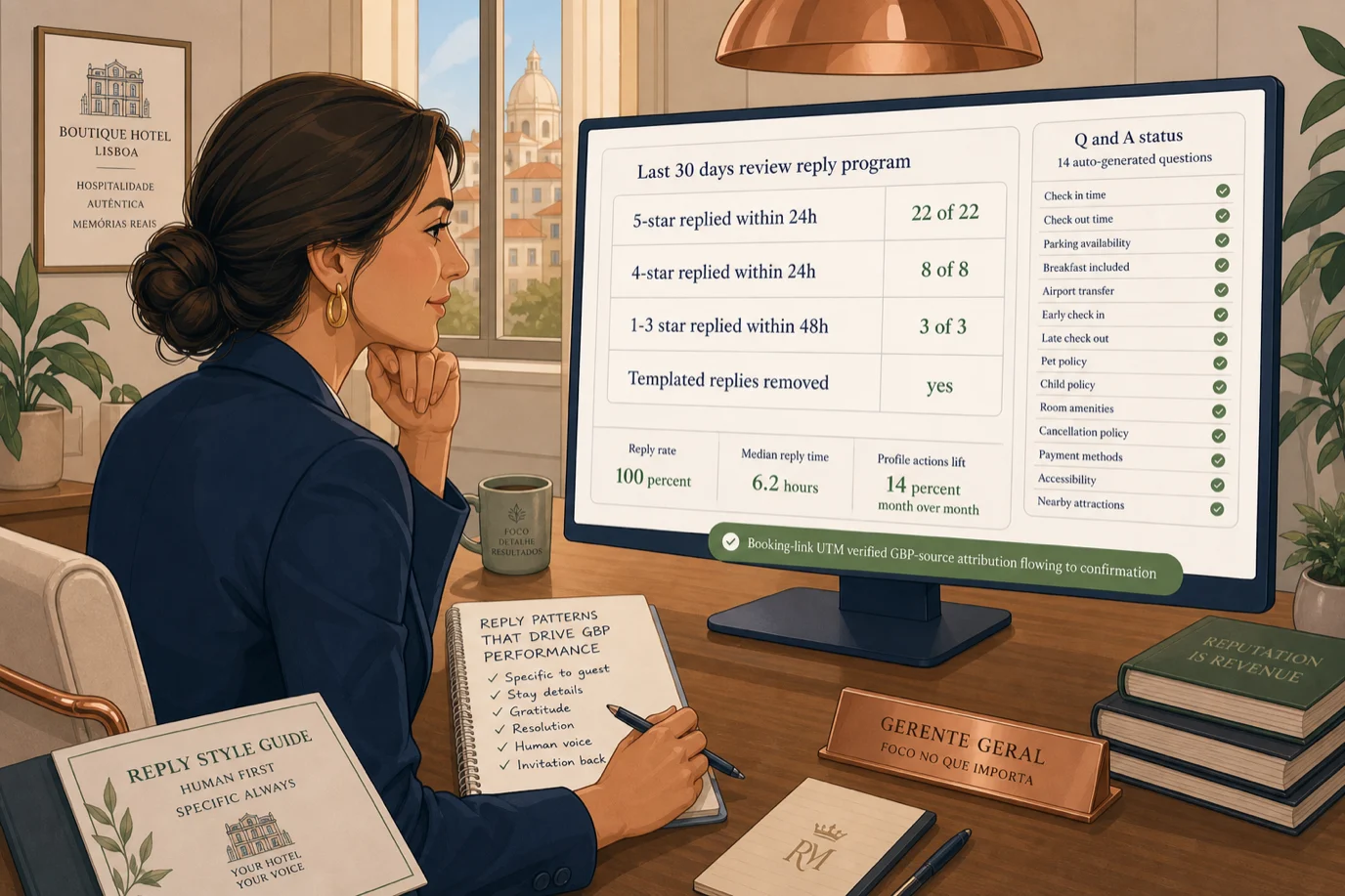
The review reply policy is one of the highest-impact pieces of GBP work and one of the easiest to do badly. The three dimensions that matter are reply rate (what percentage of reviews receive a reply), reply time (how soon after the review is posted), and reply style (templated, generic, or specific and human). The performance lift comes from doing all three correctly, not from any one of them in isolation. A 100 percent reply rate with templated content underperforms a 90 percent reply rate with specific human content. A 24-hour reply time on positive reviews and a 48-hour reply time on negative reviews outperforms a same-day reply that is generic on either category.
The right reply rate target is 95 to 100 percent. Properties that reply to under 80 percent of reviews see Maps Pack rank degrade gradually, and properties that reply under 60 percent see a measurable drop in proximity ranking inside three to six months. The data on this is consistent across our sample. The right reply time is within 24 hours for 4-star and 5-star reviews and within 48 hours for 1-star to 3-star reviews, with the longer window on negative reviews allowing the GM to consult with the front-desk team and craft a specific response rather than a defensive one. Replies posted within 24 hours on positive reviews are read by Google as a signal of active operation. Replies posted weeks late are read as a property where the listing is not being managed.
The right reply style is human, specific, and brief. The pattern is to thank the reviewer (one short sentence), name something specific from the review (one short sentence, ideally a detail that proves the response is actually written by someone at the property), and close with a forward-looking note (looking forward to welcoming you back, or for negative reviews, an apology and a specific operational change being made). Generic templated replies that pattern-match across multiple reviews are now flagged by Google's 2026 quality system, and listings with a high template ratio rank lower than listings with human-written replies. The fix is to remove templates from any review-reply tool and to write each reply by hand in 60 to 120 seconds. Properties that switched from a templated reply system to a human-written one in our sample saw an 11 to 19 percent increase in profile actions within 60 days without changing anything else, which makes it one of the highest-ROI GBP interventions available.
Lever 7: Categories and services (primary, secondary, services menu)
Categories are the most consequential single field on a Google Business Profile, and the field most independent hotels have configured incorrectly. Each listing has one primary category and up to nine secondary categories. The primary category determines which ranking pool the listing competes in, and the difference between the right and the wrong primary category can be a factor of 2 to 4 in proximity ranking on category-specific queries. The categories Google offers for hotels in 2026 include Hotel, Boutique hotel, Bed and breakfast, Inn, Lodge, Resort hotel, Resort, Extended stay hotel, Apartment hotel, Serviced apartment, and several more. The right category is the one that most accurately describes the property as guests would describe it. A 78-room independent in a historic district that markets itself as "boutique" should have Boutique hotel as the primary category, because guests searching for "boutique hotel Lisbon" will only see properties in that ranking pool.
The mistake most independents make is to default to Hotel as the primary category, which is a generic catch-all that places the listing in a pool with chain hotels, business hotels, and large generic properties. Boutique-style independents lose to chains in that pool every time. The fix is to switch the primary category to the more specific option (Boutique hotel, Inn, Bed and breakfast, Resort hotel, Apartment hotel, depending on what the property actually is) and use Hotel as a secondary category. The change is mechanical and takes 10 minutes, and the effect on impressions and rank in proximity searches takes 14 to 30 days to surface fully. Properties that made this single change in our sample saw a median 23 percent rise in impressions on category-specific queries over 60 days. The risk is overcorrection: a 200-room urban property that is not a boutique should not pretend to be one, because the AI Overview and review snippet checks will catch the mismatch and demote the listing harder than the wrong-but-generic primary category did.
Services, a parallel field, is also widely underused. Services are the named sub-offerings the property provides (Wedding venue, Conference facilities, Airport shuttle, Spa, Bicycle rental, Tour booking, Restaurant reservations, Currency exchange, etc.), and they appear inside the listing's Services section and in proximity AI Overviews when relevant. Properties that fill in the full Services list (typically 8 to 15 services for a small independent, 15 to 30 for a larger one) see a 5 to 11 percent lift in impressions on service-specific queries ("hotel with conference facilities Lisbon", "hotel with spa Lisbon"), which compounds with the category lever above.
Lever 8: NAP consistency, hours, and the holiday-hours trap
NAP (Name, Address, Phone) consistency is the foundational lever every GBP audit starts with. The property name on the listing should match the legal name (or the trading name registered for the address), and it should match the name displayed on the website, on the booking confirmation, on the property signage, and on review aggregators where the property is also listed. Inconsistencies in name across these surfaces feed back into Google's entity-resolution model and degrade trust in the listing. The address should match exactly across surfaces (same street format, same suite identifier, same postal code). The phone should be a real direct line to the property, ideally a local number rather than a centralized call center, and it should match the number on the website.
Hours are the second pillar. Standard operating hours should be set accurately, and they should match the website and any third-party listings. Special hours for closures, renovations, or seasonal operation should be set as soon as they are known. The trap that breaks the local pack for many independent hotels in 2026 is holiday hours: the dates Google flags as holidays in the property's region (Christmas, Easter, national holidays, regional holidays) cause Google to ask the property to confirm holiday hours, and properties that do not respond have their listing tagged as "may have different hours" on those dates. The local pack rank quietly drops on those exact dates, sometimes for 5 to 10 percent of bookable searches in the region, and the property never sees the impact unless they are tracking impressions per 100 bookable searches over time.
The fix is to set holiday hours proactively. For a hotel that is open 24 hours (which most are for the front desk, even if the restaurant or other amenities have separate hours), the holiday hours are simply the same as standard hours. Confirming them once on the holiday-hours prompt clears the listing's holiday-hours flag and protects the local pack rank. For a property where some amenities have separate hours, the right approach is to set the front-desk hours as the property's primary hours and add separate hours for amenities (Restaurant, Bar, Pool, Fitness center) which Google has parallel hours fields for. Most independents leave amenity hours blank and lose proximity-search rank on amenity-specific queries on the days where guests would have searched for the amenity. The audit takes 20 to 30 minutes and is a structural fix that compounds with every other lever above.
The six numbers that actually move direct bookings
The Performance report inside Google Business Profile in 2026 exposes a set of metrics that are accurate but easy to misread. The four numbers most independent hotels track (total impressions, total reviews, blended actions, ranking position) are each the right name for the wrong measurement. The six numbers below are the corrected versions, the ones that actually correlate with direct booking growth. The point of switching to these six is not metric pedantry but to surface what is moving and what is not, because optimization decisions made on the wrong metrics tend to push the listing in the wrong direction. Direct-booking conversion at hotels in 2026 covers how these GBP-side numbers feed into the broader on-site conversion funnel, which is the next layer of measurement after the listing has done its job.
Number 1: Impressions per 100 bookable searches, not raw impressions
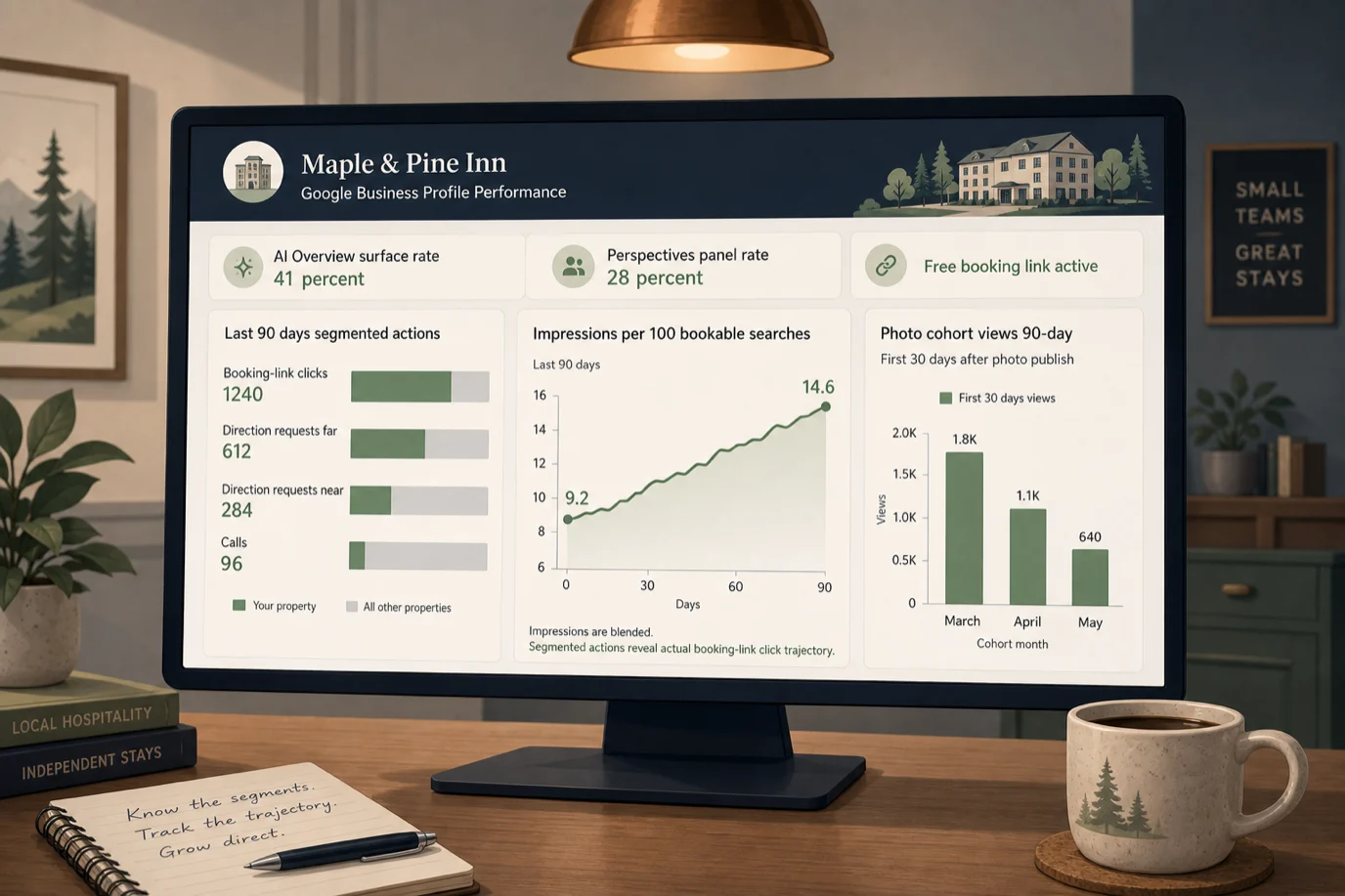
Total impressions is the headline metric on the GBP Performance report, and it is the metric most independent hotels celebrate or worry about. The problem with total impressions is that it conflates demand growth (more guests are searching the area) with optimization growth (the listing is appearing on more of the searches that happen). The two need to be separated to know whether GBP work is moving the needle. The corrected metric is impressions per 100 bookable searches, which divides the listing's impressions in a window by the total bookable searches Google estimates for the property's catchment area in the same window. Impressions per 100 bookable searches is roughly stable when the listing is treading water and rises when optimization is working, regardless of seasonal or local-market shifts in raw demand.
The way to track this in 2026 is to pull the impressions number from the Performance report on a fixed cadence (monthly is enough for most properties), and divide it by an estimate of bookable searches in the catchment that the property can pull from a Google Trends comparison or, more reliably, from the total impressions of three or four control listings in the same area that have not been optimized recently. The control listings act as a noise floor, and the ratio of the property's impressions to the control sum is the impressions-per-100-bookable-searches proxy. Properties that adopt this measurement immediately discover that 30 to 60 percent of what they thought was profile growth was demand growth they would have captured anyway, and that the actual optimization lever (the ratio) was sitting flat or declining under the headline numbers.
Number 2: Booking-link clicks per impression, not blended actions
Total profile actions is the other headline metric, and it is also misleading because it bundles three different actions (booking-link clicks, direction requests, calls) that do very different things to the bottom line. A booking-link click is a high-intent action that lands on the booking engine and that has a direct conversion path to a confirmed reservation. A direction request is a lower-intent action that signals a guest who has already decided where they are staying (often because they booked through an OTA) and is now navigating to the property. A call is somewhere between the two depending on the property's phone-handling, and at most independents the conversion rate from a call to a confirmed booking is below 30 percent.
The corrected metric is booking-link clicks per impression, which isolates the action that has a real conversion path. The denominator is impressions, the numerator is booking-link clicks specifically, and the ratio is roughly 1 to 4 percent at independent hotels in 2026, with strong properties at 3 to 4 percent and weak ones below 1 percent. Tracking this number monthly and segmenting by Search versus Maps versus AI Overview is the single most useful piece of GBP analysis a property can do. Properties that switch from total actions to booking-link clicks per impression usually find that their booking-link click ratio has been quietly declining even as total actions rose, and the diagnosis (a configuration error, a stale photo cover, a primary-category drift, an OTA-managed listing dominating the booking module) is usually identifiable inside an hour of looking at the right metric.
Number 3: Direction requests by source segment, not blended
Direction requests are the action type most independents pay least attention to, and one that contains useful operational signal once it is segmented. The Performance report breaks direction requests into two surfaces (Search and Maps) and into a request-by-zip-code layer that shows where the requests are originating from. The blended direction-request total is the wrong number, but the segmented version is informative. Direction requests originating from far-away zip codes (more than 50 km from the property) are typically guests who already booked, almost always through an OTA, and who are using GBP for navigation. Direction requests originating from nearby zip codes are typically walk-up or last-minute lookups, which can convert to direct bookings if the property is positioned to capture them.
The actionable insight comes from the ratio of nearby to far-away direction requests over time. A rising ratio of nearby requests (a property where walk-ins or local lookups are growing) usually correlates with a growing local reputation and is a useful leading indicator of word-of-mouth referrals. A rising ratio of far-away requests means OTAs are growing the property's share of bookings, which is the opposite of what most independents want. The fix when far-away direction requests are dominating is on the website and the booking-engine side, with the GBP-side fix being to make the booking link more prominent and the OTA listings less dominant. Hotel booking abandonment recovery in 2026 covers the on-site conversion work that turns the booking-link click into a confirmed booking, which is where most of the direct-channel leakage actually happens.
Number 4: Photo views per upload, with the 90-day cohort pattern
Photo views is exposed in aggregate on the Performance report, and the aggregate number is fine for trend tracking but misses the operational signal. The corrected metric is photo views per upload, segmented by the cohort of upload date. The pattern that works for independents is to upload photos in monthly cohorts and track the views received by each cohort over the following 90 days. A photo cohort uploaded in March 2026 will receive most of its lifetime views in the 90 days following upload, with the curve peaking around days 14 to 35 and tapering thereafter. The cohorts that perform best are the ones with strong category coverage (across Exterior, Lobby, Rooms, Dining, Amenities) and the ones with at least one professionally shot, well-lit cover candidate that Google's algorithm picks up.
The diagnostic the cohort view enables is to compare cohorts month over month and identify whether the photo program is improving or declining. A property where the March cohort received 4,200 views in its first 60 days but the April cohort only 2,800 has either a content problem (worse photos, or photos in less-rewarded categories) or a context problem (slower demand month, fewer overall impressions). Separating the two means looking at the cohort views as a fraction of total impressions in the relevant window, which controls for the impression denominator and isolates the photo-specific lift. Properties that adopt this measurement discover that 1 in 4 of their monthly cohorts is underperforming the others, usually for an identifiable reason (a category was over-represented, the photos were uploaded in the wrong category, the cover photo did not survive the small-thumbnail crop), and the diagnostic feeds straight back into the photo program.
Number 5: Review velocity (reviews per month) versus review count
Total review count is the metric most properties track, and it is the wrong metric for assessing the listing's ranking trajectory in 2026. Google's algorithm rewards review velocity (recent reviews) more than historical volume, because the algorithm reads recent reviews as a signal of active operation. A property with 2,400 lifetime reviews and 2 new reviews this month outranks a property with 600 lifetime reviews and 18 new reviews this month on most proximity queries, all else being equal. The corrected metric is reviews received per month over the trailing six months, which captures velocity, and the ratio of recent reviews to total reviews, which captures whether velocity is rising or falling.
The right velocity for an independent hotel in 2026 depends on stay volume and review-solicitation discipline. A 60-room property doing 18,000 stays a year should be receiving 8 to 16 reviews per month at a healthy review-solicitation cadence, which corresponds to a 0.5 to 1 percent stay-to-review conversion. Below 4 reviews a month, the listing is solicitation-starved and the algorithm reads it as quieter than it is. Above 25 reviews a month for a property of that size, the listing is solicitation-heavy and Google's 2026 fake-review-detection system flags the pattern and discounts a fraction of the reviews. The honest range is 6 to 18 reviews per month for a property of that size, with the upper end requiring a disciplined post-stay solicitation program. The mistake most properties make is to treat review velocity as something that happens organically rather than as a program with a cadence and an attribution loop.
Number 6: Maps Pack appearance rate (the metric Google does not show you)
The Maps Pack appearance rate is the percentage of bookable searches in the property's catchment where the listing appears in the top three results in the Maps box. Google does not directly expose this number, but it can be approximated using a fixed query basket and a third-party rank-tracking tool, or manually by running a representative query basket every two weeks and recording whether the property appears in the Maps Pack. The basket should include 30 to 50 queries combining the property's category (boutique hotel, hotel, inn) with location modifiers at multiple specificity levels (city, district, neighborhood, near-me variants) and amenity modifiers (with pool, with restaurant, with parking).
The appearance rate over the basket is the proxy. Properties that score 60 percent or higher are dominating the local pack and capturing the bulk of organic local traffic in the catchment. Properties below 30 percent are losing the local pack to competitors and need to identify which queries they are missing on. The diagnostic the basket enables is per-query: a property that appears in the Maps Pack on "hotel Alfama" but not on "boutique hotel Alfama" has a category configuration problem, and the fix is to switch the primary category to Boutique hotel. A property that appears on category queries but not on amenity queries has an attribute or services problem. A property that appears on near-me queries but not on neighborhood queries has a NAP or proximity-radius problem. Each diagnostic cluster has a fix, and the basket-based appearance rate is the only metric that surfaces the cluster patterns directly.
The seven operational failure modes
The seven failure modes below are the patterns we see in audits of independent hotel Google Business Profiles in 2026, ranked roughly by how often they are silently degrading the listing without the GM noticing. Most properties have at least three of the seven active at any moment. The cumulative drag from running with all seven unaddressed for 12 months can be a 40 to 60 percent reduction in booking-link clicks per impression against the property's achievable potential, which is large enough to outweigh almost any other GBP work. Audit your own property against each of the seven before assuming the listing is performing well.
Failure 1: Treating GBP as a once-a-quarter task rather than a weekly rhythm
The single most common failure mode is the cadence problem. The property does an annual or semiannual GBP audit, applies a batch of fixes, and then leaves the listing alone until the next audit. Google's 2026 algorithm reads sustained activity as a signal of active operation, and a quarter-by-quarter cadence reads as a property that is not being run actively. The lift from a single optimization push erodes within 90 to 120 days unless it is followed by sustained activity, which is why properties that do one big push and go silent typically show a sawtooth pattern in their booking-link clicks per impression: peaks in the month or two after the audit, valleys until the next audit, and no compounding net growth.
The fix is to convert GBP work into an operational program with a documented weekly cadence (one Update post, three to five review replies, one Q&A check), a monthly cadence (two to four photo uploads, one Offer post, one services or attribute update), and a quarterly audit (full attribute, services, category, hours review). Total time investment is 30 to 60 minutes a week plus a 90-minute quarterly audit. The owner of the program should be a single named person inside the property (the GM, the marketing manager, or the front-office manager), not a vendor with no operational visibility into the property. The compounding effect over 12 months on a previously-stale listing is large enough to be worth the discipline, and the cost is small enough that any property doing 8,000 stays a year or more can afford it without reorganization.
Failure 2: Generic review replies that pattern-match as templated
The second most common failure is templated review replies. Most independent hotels using a review-management tool have a template library set up, with three to five canned replies for positive reviews and three to five for negative ones. The team applies them quickly and reaches a high reply rate, which feels like good operational hygiene. The problem is that Google's 2026 quality system flags template patterns explicitly. When the same paragraph (or close paraphrases of the same paragraph) appears under multiple reviews, the listing receives a quality demotion that can take 30 to 60 days to recover from after the templates are removed.
The fix is to remove all templates from the review-reply tool and to write each reply by hand. The cost is 60 to 120 seconds per reply, which at 8 to 14 reviews a month is 8 to 28 minutes a month of additional time. Properties that switched from templated to human-written replies in our sample saw an 11 to 19 percent increase in profile actions within 60 days without changing anything else. The reason the lift is so large for so small a change is that the current behavior was actively suppressing the listing, and removing the suppressor uncovers latent ranking. The other benefit is that human-written replies read as such to prospective guests scrolling the listing, which lifts conversion from review-reading to booking-link click independently of the algorithmic effect.
Failure 3: Photo dumps versus photo programming
The third common failure is photo volume without category coverage. The pattern looks like this: the property had a photo shoot a year ago, uploaded 60 photos in a single batch, and has done little since. Or the property uploads guest-submitted photos as they come in, with no curation and no category balance. Either pattern leaves the listing with photo coverage skewed toward whatever the original shoot or the guest submissions captured, which is usually the lobby and the bar at the expense of the rooms and the dining space. Google's algorithm weights category coverage rather than total volume, and a listing with 60 photos all in one or two categories underranks a listing with 25 photos balanced across seven categories.
The fix is to switch from a dump-style upload to a programmed cadence: two to four photos a month, allocated across categories with a target balance (Exterior 4 to 6 lifetime, Lobby 6 to 10, Rooms 12 to 20, Dining 4 to 8, Amenities 4 to 8, Team 2 to 4, Tours 1 to 2). The monthly cadence keeps the recency signal alive, the category allocation rebalances coverage over time, and the cumulative effect after 6 months is a 15 to 30 percent rise in photo views per upload alongside a smaller secondary lift in overall impressions. The work is mechanical and can be done with a smartphone for half the categories (rooms, amenities, team) and with professional shots for the other half (exterior, lobby, dining), keeping the budget reasonable for a small independent.
Failure 4: Missing or duplicate listings on the same property
The fourth failure mode is duplicate or unclaimed listings. Google sometimes auto-generates a listing for a property based on third-party data sources, and properties that have changed names, addresses, or ownership over the years can end up with multiple listings showing up in Maps. The duplicates split the property's review counts, photos, and ranking signal across two or three records, which dramatically degrades the strength of the canonical listing. The diagnostic is a simple search for the property name plus the city in Maps, looking for any unclaimed or duplicate result that should not exist.
The fix is to claim and merge the duplicates through the Google support flow, which can take two to four weeks but is mechanical once the property has documented evidence of ownership (utility bills, business registration, signage). Properties that found and merged duplicates in our sample recovered 8 to 22 percent of their listing's ranking signal once the merge completed, which manifested as a step-function rise in impressions and actions on the canonical listing in the 30 to 60 days after the merge. The other variant of this failure is a department or amenity listing that should not be a separate listing (a hotel restaurant with its own GBP that is also listed under the hotel's amenities, or a spa that has its own listing competing with the hotel's). The right structure is one listing per discoverable destination, and a hotel restaurant or spa that operates as a destination in its own right (people seek it out, it is open to non-guests) should have its own listing. A restaurant or spa that operates only for guests should be folded into the hotel listing and not listed separately.
Failure 5: Holiday hours forgotten (the local-pack penalty)
The fifth failure mode is the holiday-hours trap. Google flags holiday dates in each region and prompts properties to confirm whether their hours change. Properties that ignore the prompt have the listing tagged as "may have different hours" on those dates, which causes the listing to drop in the local pack on those exact dates. The penalty is small per holiday but compounds over a year: a property that misses 8 to 12 holiday-hours prompts loses local-pack rank on roughly 25 to 35 days a year, which can be 8 to 12 percent of total bookable searches in some seasons. The cost is invisible because the property is not tracking impressions per 100 bookable searches by date, and most properties never realize the pattern is happening.
The fix is to set holiday hours proactively at the start of each year, including the regional holidays Google flags. For a hotel that operates 24 hours (which most do for the front desk), the holiday hours are simply identical to standard hours. Confirming them once on the prompt clears the listing's holiday-hours flag for the date and protects the local pack rank. The whole exercise takes 20 to 40 minutes once a year, after which Google sends individual prompts as new holidays approach, and the property only needs to confirm or adjust each one as it appears (a 30-second action). For amenities with separate hours (restaurant, bar, spa), the same exercise applies and is worth doing in parallel because amenity-specific queries are sensitive to amenity hours and the local pack on those queries is sensitive to whether the amenity is currently open.
Failure 6: Wrong primary category or category drift
The sixth failure mode is primary-category misconfiguration. Most independent hotels have the primary category set to Hotel, which is the broadest catch-all and which places the listing in a ranking pool with chain hotels, business hotels, and large generic properties. Boutique-style independents lose to chains in that pool consistently. The fix is to switch the primary category to the more specific option that accurately describes the property (Boutique hotel, Inn, Bed and breakfast, Resort, Resort hotel, Apartment hotel, Extended stay hotel, Lodge, depending on what the property actually is). Hotel can stay as a secondary category, which preserves any traffic the property would otherwise have lost from the broader pool while gaining the more relevant specific pool.
The variant of this failure is category drift, where the property has been re-categorized over time and the primary category no longer matches the actual property. A property that converted from a roadside inn to a boutique hotel during a renovation but never updated the primary category will continue to be ranked as an inn, which suppresses bookings on the boutique-search queries the property now actually serves. A property that changed from a resort to a more focused boutique offering similarly needs to update. The audit cadence on category is quarterly, with the GM reviewing whether the property's self-positioning still matches the GBP category. The change itself is mechanical (10 minutes), and the ranking effect surfaces in 14 to 30 days as the listing is re-evaluated against the new pool.
Failure 7: No measurement of booking-link click attribution
The seventh failure mode is the measurement gap. The Google Business Profile dashboard exposes booking-link clicks but does not directly attribute downstream conversions, which means a property that does not instrument its own funnel cannot tell what fraction of GBP-sourced traffic actually converts to a booking. Without that attribution, the property cannot tell whether GBP work is moving direct bookings or just driving more clicks that abandon at the booking engine, which means optimization decisions are made in the dark. Local SEO for hotels covers the broader local-search measurement framework that GBP attribution feeds into, including UTM hygiene and the GA4 source-medium mapping.
The fix is to add UTM parameters to the booking link in the GBP property dashboard (utm_source=gbp, utm_medium=organic, utm_campaign=listing or similar) and to track the GBP-sourced sessions through to confirmed bookings in the analytics platform. This requires the booking engine to preserve UTM parameters through the full booking flow, which most modern engines do but some legacy ones do not. Once the attribution is set up, the property can see the booking-link click to confirmed booking conversion rate from GBP traffic specifically, and the lift from each GBP optimization can be measured against the attribution. Properties that set this up in our sample typically discover that GBP traffic converts at 1.5 to 3 times the rate of paid social traffic and at roughly the same rate as organic search traffic, which usually changes the marketing budget allocation in the property's favor.
AI Overviews, Perspectives, and the late-2025 search behavior change
The rollout of AI Overviews to hotel-search queries in late 2024 and the Perspectives panel update in November 2025 changed the surface area of GBP optimization in ways that most independent hotels have not adapted to. The two changes worth understanding in operational detail are the AI Overview itself, which now appears on roughly 35 to 60 percent of bookable hotel searches in 2026 depending on query specificity, and the Perspectives panel, which surfaces guest-perspective content (review snippets, photos, posts) above the primary listing on a growing fraction of branded and category queries. AI search optimization for hotels covers the broader AI-search context including SGE, Bing Copilot, and the AI Overviews behavior across query types. This section focuses specifically on how the AI changes interact with the GBP listing.
How AI Overviews currently surface hotel content
AI Overviews on hotel queries in 2026 draw from four primary sources, in roughly this order of weight: the property's GBP description and structured data (category, attributes, services), the top three to five Google reviews ranked by recency and content quality, recent posts (Updates, Offers, Events) from the listing, and the property's website content (with priority given to schema-marked content, particularly LodgingBusiness schema). Properties that have all four sources in good operational shape see a 14 to 26 percent rise in branded clicks and a 7 to 13 percent rise in proximity clicks within 90 days of the AI Overview rollout to their query set, against control properties that did not.
The lift comes from making each source readable to the AI in addition to readable to a human. The GBP description should be specific and factual rather than marketing-flavored, with concrete amenity, location, and category mentions. The reviews should ideally include recent reviews with specific phrases (the breakfast was excellent, the room was quiet, the staff helped with restaurant recommendations) rather than generic praise. The posts should be current and informational. The website content should have LodgingBusiness schema applied and should include factual content about the property (number of rooms, amenities, dining options, location landmarks) that the AI can pull. The mistake most properties make is to treat AI Overviews as a separate problem requiring a new tool. The fix is in the GBP itself, applied with the AI behavior in mind.
Perspectives panels and the role of GBP photos
The Perspectives panel update in November 2025 introduced a guest-perspective surface that appears above the primary listing on roughly 25 to 40 percent of branded and category-and-location queries. The panel surfaces photo grids drawn from GBP, review snippets with strong sentiment, and on some queries a short AI-generated summary of guest opinion. The structural effect is that the photos and review snippets the panel surfaces are now positioned above the listing itself in the search result, which makes them the first impression a prospective guest forms of the property, before they ever click through to the listing.
The lift available from optimizing for Perspectives comes from two angles. First, ensuring the photos likely to surface are professionally shot and well-lit (Perspectives draws from the cover photo and a small set of category-balanced photos, not from the long tail), which means the cover photo and category coverage work above is even more important than it was pre-Perspectives. Second, ensuring the reviews likely to surface have specific positive content rather than generic praise, which is influenced by the post-stay review-solicitation prompt the property uses. Properties that ask guests open-ended questions ("what did you enjoy most about your stay?") get richer review content than properties that ask a checkbox-style review form, and the richer content surfaces in Perspectives at higher rates.
What this means for your photo and post strategy
The operational implications for the photo program are concrete. The cover photo is now visible at small thumbnail sizes inside AI Overviews and Perspectives, so the cover candidate has to crop-survive to a small square. Test the candidate cover by opening the listing on mobile, on desktop, and inside the Maps app, and see how the cover renders at each size. If the cover is a wide-format shot of the lobby, it may look fine on the desktop listing and badly cropped at small sizes inside an AI Overview. The fix is to choose a cover that has the visual interest concentrated in the center, with safe margins on all sides for cropping. Category coverage is also more important post-Perspectives because the Perspectives photo grid pulls from across categories, and a listing with thin photo coverage on Rooms or Dining gets a less visually compelling Perspectives panel.
For posts, the change is that Updates and Offers now have a small chance of surfacing inside AI Overviews on related queries, particularly on time-sensitive queries ("hotels with deals this weekend", "boutique hotels open during the festival"). The implication is that Offer posts should be specific, dated, and clearly framed in the Offer body, because the AI extracts the date and the offer text directly. A vague Offer ("summer savings, book now") will not surface, while a specific Offer ("15 percent off all stays from June 15 to August 15, book by May 31") has a much higher chance of being pulled into the AI Overview when a relevant query happens. The Update post type benefits less from AI Overview surfacing but more from the recency signal that protects against listing decay, so Update cadence should be steady regardless of AI Overview considerations.
Brand-name versus near-me intent, and why the answers diverge
The fourth observation about AI Overviews and Perspectives in 2026 is that brand-name searches and proximity searches behave very differently inside the AI surface, and the optimization work for each is partially divergent. A brand-name search (the property name plus the city) tends to produce an AI Overview that draws heavily from the property's GBP description and recent positive reviews, with the listing itself appearing immediately below. A proximity search ("hotel near me", "boutique hotel central Lisbon") tends to produce a comparative paragraph that draws from category, attributes, services, and the cover photo, with multiple listings ranked below.
The implication is that the GBP description should serve brand-name search intent (factual, specific, includes selling-proposition phrases the AI can extract), while the structured data (category, attributes, services) should serve proximity intent (filled in completely, accurate, matched to the property's actual offering). The Q&A surface bridges both intents because the questions cover both branded ones (does this hotel have parking?) and proximity ones (is this hotel near the metro?). Properties that audited both lines of intent in late 2025 and updated systematically saw lift on both surfaces. The mistake is to optimize for one and forget the other, which is what most properties do because they audit a single representative query against a single optimization checklist.
The review reply playbook
The review-reply program is the highest-impact operational practice on the GBP listing. The cadence is daily or near-daily, the time investment is 10 to 25 minutes a day at a typical independent, and the cumulative effect on listing performance over six months is large enough to outweigh almost any other GBP work. The playbook below is the one that performs best in our 31-property sample, with concrete cadence rules, response patterns by review category, and the lines that should never be crossed in a public reply.
Replying to 5-star reviews (the 24-hour rule)
The pattern that works for 5-star reviews is a reply within 24 hours, written by a named person at the property (the GM, the front-office manager, or a designated reply-writer), naming something specific from the review, and closing with a forward-looking note. The specific element matters because it proves the reply is human and was written after actually reading the review, which lifts both the algorithmic signal and the prospective-guest perception. The forward-looking close is short, a single sentence inviting the guest back or wishing them well, and it should not be marketing-flavored.
A pattern that works: "Thank you for the kind words, [first name]. We were so glad you enjoyed the [specific thing they mentioned, breakfast, room, view, staff member]. We hope to welcome you back to [the property name] soon." Total length 30 to 50 words. Time to write 60 to 90 seconds. Reply rate target 100 percent of 5-star reviews. The mistake is to skip 5-star reviews because they look like good news and not a problem to solve. The lift on profile actions from replying to all 5-star reviews within 24 hours, against a baseline of replying only to negative ones, is 6 to 12 percent over 60 days in our data.
Replying to 4-star reviews (the gap acknowledgement)
4-star reviews are the most operationally informative review type and the one most properties under-respond to. A 4-star review almost always names a specific gap (the room was great but the breakfast was disappointing, the location was perfect but the air conditioning was loud), and the right reply acknowledges the gap explicitly rather than glossing over it with generic thanks. The pattern is to thank the guest for the review (one sentence), acknowledge the specific gap they named (one sentence, with a specific operational change being made or already in progress), and close with a forward-looking note (one sentence).
A pattern that works: "Thank you for taking the time to write this, [first name]. You are right that the [specific gap they named] needs work, and we are [specific change being made, currently testing a quieter unit, retraining the breakfast team, scheduling the maintenance for next month]. We hope you give us another chance to get it right." Total length 50 to 80 words. Time to write 90 to 150 seconds. Reply rate target 100 percent of 4-star reviews, within 24 hours. The acknowledgement matters because it reads to other prospective guests as a property that listens and acts, which is more persuasive than a property that defends or generalizes.
Replying to 1-3-star reviews (the 48-hour rule and the apology arithmetic)
1-star to 3-star reviews require a 48-hour reply window rather than a 24-hour one, because the additional time lets the GM consult with the front-desk team, verify what actually happened during the stay, and craft a specific response rather than a defensive one. The pattern is to apologize without arguing (one sentence, "I am sorry your stay did not meet expectations"), name the specific operational change being made (one sentence, "I have spoken with the breakfast team and we are introducing a new vegetarian option from next week"), invite the guest to follow up offline at a real email address (one sentence, "please email me directly at [first.last@property.com] so we can make this right"), and stop there. Length 60 to 100 words. Time to write 150 to 240 seconds.
The apology arithmetic is the calculation that an apology without a specific operational change reads as corporate boilerplate, and an operational change without an apology reads as defensive. Both have to be present. The other rule is to never argue with the reviewer in a public reply, even when the review is factually inaccurate or unfair. The audience for the reply is not the reviewer, who is unlikely to update the review based on the response. The audience is the prospective guest scrolling the listing in three months, evaluating whether to stay at the property. A defensive or argumentative reply reads as a property that does not handle complaints well, which costs more bookings than the inaccurate review itself does. The forward email address should be a real one (the GM's direct email, not a generic info@), because the offline follow-up is where the actual resolution happens, and properties that get this right convert 30 to 45 percent of negative reviewers into a private follow-up that occasionally results in an updated review.
Replying in the guest's language (and when to stay in English)
The fourth dimension of the reply playbook is language. Reviews left in non-English languages should ideally be replied to in the language of the review, because the reply is read primarily by other speakers of that language scrolling the listing, and a French review with an English reply reads as a property that does not engage with French-speaking guests. The practical question is whether the property has the language capability internally. For properties with multilingual front-desk staff (common at urban European independents), the right approach is to assign reply duty to whoever speaks the relevant language. For properties without internal capability, machine translation is acceptable for replies, with the caveat that the GM should review the output for tone before posting (machine translations can read as too formal in some languages and too informal in others).
The exception to the rule is when the review is in a language the property genuinely cannot serve operationally (a Mandarin review at a small Lisbon boutique whose staff does not speak Mandarin), in which case a bilingual reply (the local language plus English) is acceptable and reads as honest. The reply should still be specific and human-written. Hotel pre-arrival emails playbook covers the broader multilingual guest-communication practice that the review-reply work is part of, including the post-stay review-solicitation email that drives review velocity in the first place.
A 30-day GBP optimization playbook
The 30-day playbook below is the operational sequence we run with independent hotels in the first month of a GBP engagement. It is structured as four weekly sprints, each focused on a different cluster of fixes, with a measurement check at the end of each week. The cadence is intentional. Doing all four clusters in parallel produces too much variability to attribute lift to specific changes, and doing them serially in the wrong order produces less compounding than the order below.
Days 1 to 7: Audit and clean
Week 1 is the audit and structural cleanup. Day 1 is a full GBP audit using a written checklist (NAP consistency, hours, holiday hours for the next 12 months, primary category, secondary categories, services list, attribute completeness across the 130 fields, photo category coverage, review reply rate over the last 90 days, Q&A answer status across all 14 plausible questions, post cadence over the last 90 days, booking-link configuration in the Hotel Center, free booking link verification status, presence of duplicate listings). The output is a written list of every item that is misconfigured or missing, organized by severity. Day 2 to 4 is the structural cleanup: claim and merge any duplicate listings, fix NAP inconsistencies across surfaces, set holiday hours for the next 12 months, switch the primary category if needed, fill in the 12 high-impact attributes plus the long tail, fill in the services list. Day 5 to 7 is the booking-link cleanup: verify the booking-engine connection in Hotel Center, fix any rate-feed parameter errors, confirm the property is on the free booking link approved list, set up UTM parameters on the booking link in the GBP dashboard for attribution.
The output of week 1 is a structurally clean listing with all the foundational levers in place. Most of the lift from week 1 will not surface until week 3 or 4, because Google takes 14 to 30 days to re-evaluate a listing after structural changes. The point of doing week 1 first is to put the foundation in place before the content work in weeks 2 to 4, so that the content work is supporting a clean foundation rather than papering over structural problems.
Days 8 to 14: Photo and post programming
Week 2 is the photo and post program. Day 8 is the photo audit: pull the current photo set from the listing, categorize it by surface (Exterior, Lobby, Rooms, Dining, Amenities, Team, Tours), identify gaps in coverage, and identify candidates for the cover photo if the current cover is suboptimal. Day 9 is the cover decision: if the current cover is a guest-uploaded shot or a poorly-lit professional shot, replace it with a property-uploaded hero image that crop-survives to small thumbnail sizes (test on mobile, desktop, and inside the Maps app). Day 10 to 12 is the photo program setup: schedule a small photo shoot to fill the gaps identified in day 8 (typically 8 to 16 photos), upload a first batch of 4 to 8 photos balanced across categories, schedule the rest as a monthly cadence, and set up a documented photo-allocation target so the cadence runs on autopilot.
Day 13 to 14 is the post program setup: write the next four Update posts (one for each upcoming week), write the next two Offer posts (one for each of the next two months), and document the cadence so the property can sustain it. The Update content does not have to be ambitious. The cadence and the rhythm matter more than any individual post. The posts should be scheduled in advance where possible, with one weekly review to add a post about anything that happened that week. The output of week 2 is a programmed photo and post cadence with the next 4 to 8 weeks of content already in the queue.
Days 15 to 21: Review reply system
Week 3 is the review-reply program. Day 15 is the review-reply audit: pull the last 90 days of reviews, identify which ones have been replied to, identify the average reply time, and identify any pattern of templated replies. Day 16 is the template removal: remove all canned replies from the review-management tool, delete any reply templates from internal documentation, and write a one-page reply-style guide for the named reply-writer to refer to. Day 17 to 18 is the catch-up: reply to every unanswered review from the last 90 days using the human-written, specific patterns from the review-reply playbook above. The catch-up is a 60 to 120 minute project depending on review volume, and it puts the listing into a 100 percent reply rate state going forward.
Day 19 to 21 is the review-solicitation program: review the post-stay email or text used to solicit reviews, rewrite it if it is generic or asks the guest to fill in a checkbox-style review (open-ended questions produce richer review content that surfaces better in Perspectives), set the cadence (the right time to ask is 24 to 48 hours after check-out for stays of 1-2 nights, 3 to 5 days for longer stays), and commit to a target review velocity (6 to 18 reviews per month for a 60-room property, scale linearly for larger or smaller). Day 21 is the wrap: confirm the review-reply ownership (the named person), confirm the daily cadence (10 to 20 minutes a day), and confirm the weekly review check (the GM reviews the past week of replies for tone and specificity).
Days 22 to 30: Booking links, attributes, measurement
Week 4 is the booking-link, attribute, and measurement consolidation. Day 22 is the booking-link verification: confirm the free booking link is now live and ranking on the listing, confirm the rate feed is round-tripping to a confirmation page, confirm the UTM parameters are flowing through to the analytics platform, and check the first week of GBP-attributed bookings to verify the attribution is working. Day 23 to 25 is the attribute deepening: revisit the 130 attributes filled in week 1, identify any that were left in default or that can be made more specific (parking with prices rather than just yes-or-no, breakfast with hours rather than just included), and refine. Day 26 to 28 is the AI Overviews and Perspectives audit: run a representative basket of 10 to 20 queries against the property and check what the AI Overview and Perspectives panels surface, identify any reviews or photos that should ideally surface but are not, and adjust the cover photo and the review-solicitation prompts as needed.
Day 29 to 30 is the measurement setup and the program documentation: set up the monthly Performance report pull (impressions per 100 bookable searches, booking-link clicks per impression, direction requests segmented by source, photo views per upload by cohort, review velocity, Maps Pack appearance rate over the basket), document the weekly cadence (Update post, review replies, Q&A check), document the monthly cadence (photo uploads, Offer post, attribute pass), document the quarterly cadence (full audit), and assign the named owner. The output of week 4 is a fully programmed GBP operational program with measurement in place to detect drift early and with the next 90 days of work scheduled. The lift from the 30 days typically surfaces over the following 60 days, with most properties seeing 22 to 41 percent more booking-link clicks per impression by day 90 and the lift compounding through month 6.
The decision matrix by property segment
The 30-day playbook is the right starting point for most independent hotels, but the steady-state cadence and the relative weight of each lever depend on the property segment. The decision matrix below covers the four segments we see most often. A 28-room boutique guesthouse in a destination area has a different program than a 220-room urban business hotel, and applying the wrong program to the wrong segment wastes effort. The honest version is that the levers all matter at every segment, but the order and the time allocation should differ.
For a small guesthouse or boutique inn (20 to 60 rooms, leisure-led, destination location), the highest-impact levers are photo programming, review velocity, and category accuracy. The booking-link infrastructure is still important but the absolute booking volume is small enough that the photo and review work moves the needle harder. Steady-state cadence is two photo uploads a month, one Update post a week, daily review replies, and a quarterly audit. Time investment is 30 to 45 minutes a week for a property of this size. For a mid-size urban independent (60 to 120 rooms, mixed leisure and business, urban location), the highest-impact levers are booking-link configuration, AI Overviews optimization, and review reply at scale. The volume of bookings means a small percentage lift in booking-link clicks per impression translates to meaningful direct-booking growth. Steady-state cadence is three to four photo uploads a month, two Update posts a week, daily review replies, monthly Offer posts, quarterly audit. Time investment is 60 to 90 minutes a week.
For a larger urban hotel (120 to 250 rooms, business-led, urban location), the highest-impact levers are AI Overviews and Perspectives optimization, attribute completeness for amenity-specific queries, and the booking-link to attribution loop. The booking volume is large enough that even small percentage lifts produce measurable revenue, and the queries are diverse enough that attribute and services completeness matter for capturing the long tail of amenity searches. Steady-state cadence requires a dedicated marketing or front-office role with 90 to 120 minutes a week on GBP work. For a resort or destination property (any size, leisure-led, destination location), the highest-impact levers are photo programming with a strong seasonal rotation, review velocity (resorts get under-reviewed because the long-stay guest reviews less reliably than a shorter-stay urban guest), and category accuracy with the Resort or Resort hotel primary category. Steady-state cadence is four photo uploads a month with seasonal rotation, two Update posts a week, daily review replies, two Offer posts a month aligned to the booking window. Time investment is 90 to 120 minutes a week.
Where Prostay closes the GBP loop
The optimization above is the operational program that the property runs. The technology that determines whether the program produces direct bookings rather than just impressive listing metrics is the booking engine. Most independent hotels in 2026 are running booking engines that were architected before AI Overviews and free booking links existed, and the gap between the GBP-side optimization and the on-site conversion is where the booking-link clicks leak. Prostay's booking engine is built around the assumption that GBP, AI Overviews, and metasearch traffic should land in a funnel that is instrumented end-to-end, that the rate feed Google Hotel Center reads is correct in real time, and that the attribution from a booking-link click to a confirmed booking is preserved through the full session.
The two operational differences worth naming. First, the booking-engine integration with Google Hotel Center is on the approved partner list and round-trips the rate feed reliably, which means the free booking link slot populates correctly without the rate-feed-parameter errors that plague legacy connections. Second, the funnel instrumentation captures GBP-sourced sessions specifically, with UTM parameters preserved through to the confirmation event, and the analytics layer surfaces the booking-link click to confirmed booking conversion rate from GBP traffic as a first-class metric rather than an afterthought. Direct-booking conversion at hotels in 2026 covers the broader on-site conversion program that the GBP-sourced traffic feeds into. The hotel booking abandonment recovery in 2026 framework describes the abandonment patterns specifically for GBP-sourced sessions, which abandon at different rates and on different steps than paid social or organic search traffic and which deserve their own recovery cadence.
The honest version is that none of this is a software feature. It is the operational stance that good independents are starting to adopt and that the right tools support rather than obstruct. The GBP work is the front of the funnel. The booking engine is the back. The two have to be connected with attribution, with rate-feed accuracy, and with funnel instrumentation, or the GBP optimization work loses 30 to 50 percent of its potential impact at the booking step. The fix is structural and worth the work.
What to do on Monday morning
The honest summary of this article is short. Google Business Profile optimization for independent hotels in 2026 is a place where most properties are leaving 30 to 70 percent of available booking-link clicks on the table because the standard advice, the standard cadence, and the standard tools have drifted. The fix is the eight listing levers in the levers section, the six numbers in the measurement section, the seven failure modes you can audit your own property against, the AI Overviews and Perspectives optimization that changed the surface area in late 2025, the review-reply playbook that lifts profile actions by 11 to 19 percent on its own, the 30-day playbook that puts the foundation in place, and the decision matrix that tells you which levers to weight by property segment.
If your property runs a Google Business Profile and you have read this far, there are three things to do on Monday morning. First, run the structural audit: NAP consistency, primary category, holiday hours for the next 12 months, free booking link verification status. Most properties find at least two structural errors that take under an hour to fix and that produce a measurable lift inside 30 days. Second, switch from total impressions and total actions to the corrected metrics: impressions per 100 bookable searches, booking-link clicks per impression, review velocity per month. The new metrics will be more humbling and more useful than the dashboard headlines. Third, document the weekly cadence and assign a single named owner. The compounding effect of a sustained operational program is large enough that the discipline pays for itself inside a quarter, and the property without a named owner will never achieve it.
That gets the property 60 percent of the available operational improvement. The remaining 40 percent is the booking-engine and attribution integration that determines whether the optimized GBP traffic actually converts to direct bookings, and that the Prostay team will be glad to walk you through if the post-Monday-morning audit suggests there is a structural gap to close. Request a demo when you want to see the GBP-to-booking-engine attribution flow live with your own listing data.