Open Booking.com, type in your own city, and scroll until you find your hotel. For most independent properties, that scroll is depressingly long. You are on the platform, your rooms are bookable, your rates are loaded, and yet a traveller searching your own town has to wade past forty other properties before they reach you. Being listed felt like the hard part. It turns out being listed is the easy part, and being found is where the actual work begins. The order those results appear in is decided by a ranking system, and that system can be influenced far more than most hoteliers realise. Getting your OTA content and rates onto the platforms cleanly through a channel manager is step one; getting the resulting listing to climb the sort is the part this guide is about.
None of this is only about the OTA. A hotel that ranks well on Booking.com and Expedia is also more visible to people who will then go and book direct, the effect distribution people call the billboard. So the visibility you earn on the OTA quietly feeds your own booking engine too, which is why it is worth getting right even for a property that resents paying commission. The goal is not to love the OTAs. It is to use the position they can give you, pay as little as possible for it, and convert the attention into bookings on the channels you control.
One disclosure before the detail. I write for Prostay, so the short section near the end about how our own product helps with this is interest, not neutral advice, and it is labelled as such. Everything before it is true whatever software you run.
Being Listed Is Not the Same as Being Found
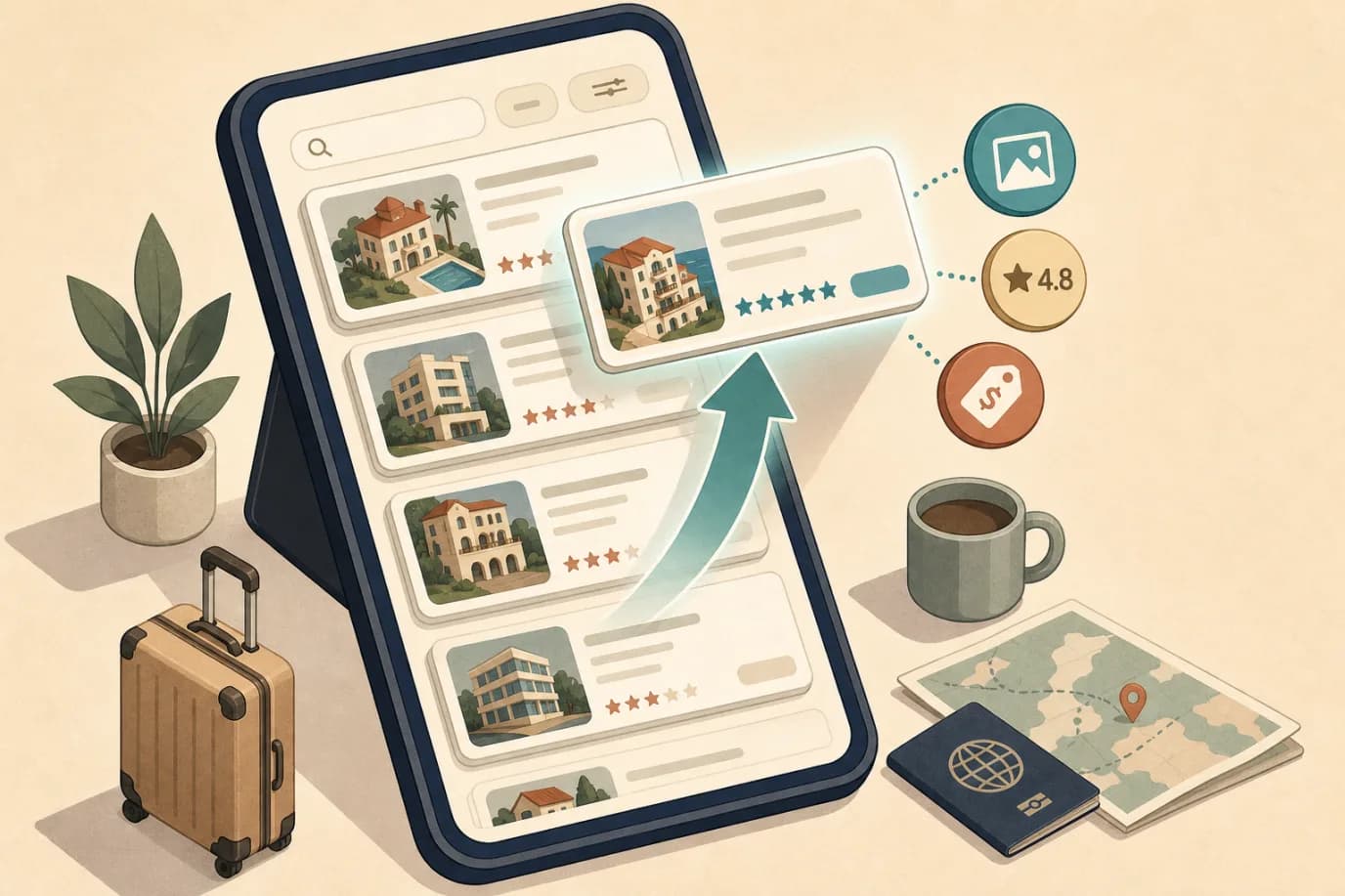
Here is the uncomfortable arithmetic. A traveller searching a mid-sized city sees a list that can run to hundreds of properties, and almost all of the bookings go to the first page or two. Position one on a popular search is worth a multiple of position thirty, and position thirty is worth a multiple of position one hundred, where for practical purposes you no longer exist. The drop-off is not gentle. It is a cliff, and most properties are standing at the bottom of it wondering why the OTA is not sending them business.
The instinct when this happens is to blame the algorithm, or to assume the only fix is to pay. Both are wrong often enough to be expensive. The sort is not a black box that only responds to money, and it is not random. It is a conversion engine. The platform makes money when a search turns into a booking, so it is relentlessly trying to show each individual searcher the properties most likely to make them book right now. That is the whole game. Once you understand that the OTA is not ranking hotels by quality in the abstract, but by likelihood of converting this specific search into a paid stay, every lever in this article starts to make sense.
Which means the question is not how good is my hotel. It is how convincing is my listing to the person looking at it, at this price, on these dates, compared to the properties beside it. A modest three-star with a complete page, sharp photos, recent reviews and a competitive rate will out-rank a lovely boutique with a half-built listing and a year-old review, because the platform can see which one travellers actually book. The good news buried in that is simple: most of what decides your rank is in your hands, and a lot of it is free.
How the Booking.com and Expedia Sort Actually Works
Neither platform publishes its ranking formula, and both adjust it constantly, so anyone promising you the exact weighting is selling something. What both companies do say openly, in their partner help centres and partner programmes, is which factors feed the sort. Read enough of that material, and a clear picture forms. The ranking is built from three broad families of signal, and they pull in the same direction more often than not.
Relevance, Conversion and the Revenue Signals
The first family is relevance: how well your property matches the specific search. A family of four searching for a two-bedroom apartment with parking should not see your single-room city hostel near the top, however good it is, because it is not relevant to them. Filling out every facility, room configuration and policy is what lets the platform match you to the searches you can actually win.
The second family, and the heaviest, is conversion. How often does a person who sees your listing click it, and how often does a click become a booking. This is the platform watching real behaviour and rewarding what works. Strong photos, a clear description, a good review score and a fair price all push conversion up, and rising conversion pushes you up the sort, which gets you more impressions, which, if you keep converting, compounds. It can also run in reverse: a listing that gets clicks but no bookings tells the platform something is wrong, often the price or the reviews, and it quietly slides.
The third family is the platform's own economics. Commission level matters at the margins through the paid programmes covered later, and so does your cancellation rate, because a booking that cancels earned the platform nothing and tied up inventory. Properties with punishing cancellation terms and high cancellation rates can find themselves disadvantaged versus a property whose bookings stick. The lesson is that the platform is optimising for realised revenue, not just for the click.
Why the Order Changes With Every Search
One thing trips up every hotelier who tries to track their own rank: the result is personalised, so there is no single position to monitor. The same hotel can be eighth for one searcher and fortieth for another at the same moment. The sort weighs who is searching, including their location, device, history and loyalty tier, alongside the search itself, the dates, the length of stay, the party size and how far ahead they are booking. A property that ranks well for a Friday-night couples search might rank poorly for a week-long family stay, simply because it converts differently for each.
This matters practically in two ways. First, stop obsessing over a single rank number; check your position the way a real guest would, in an incognito window, for a few representative searches, and watch the trend rather than the absolute. Second, accept that you cannot win every search, and you should not try. Win the searches your property is genuinely well suited to by making your listing unmistakably relevant to them, and let the mismatched searches go to someone else.
Content Completeness: The Part You Fully Control
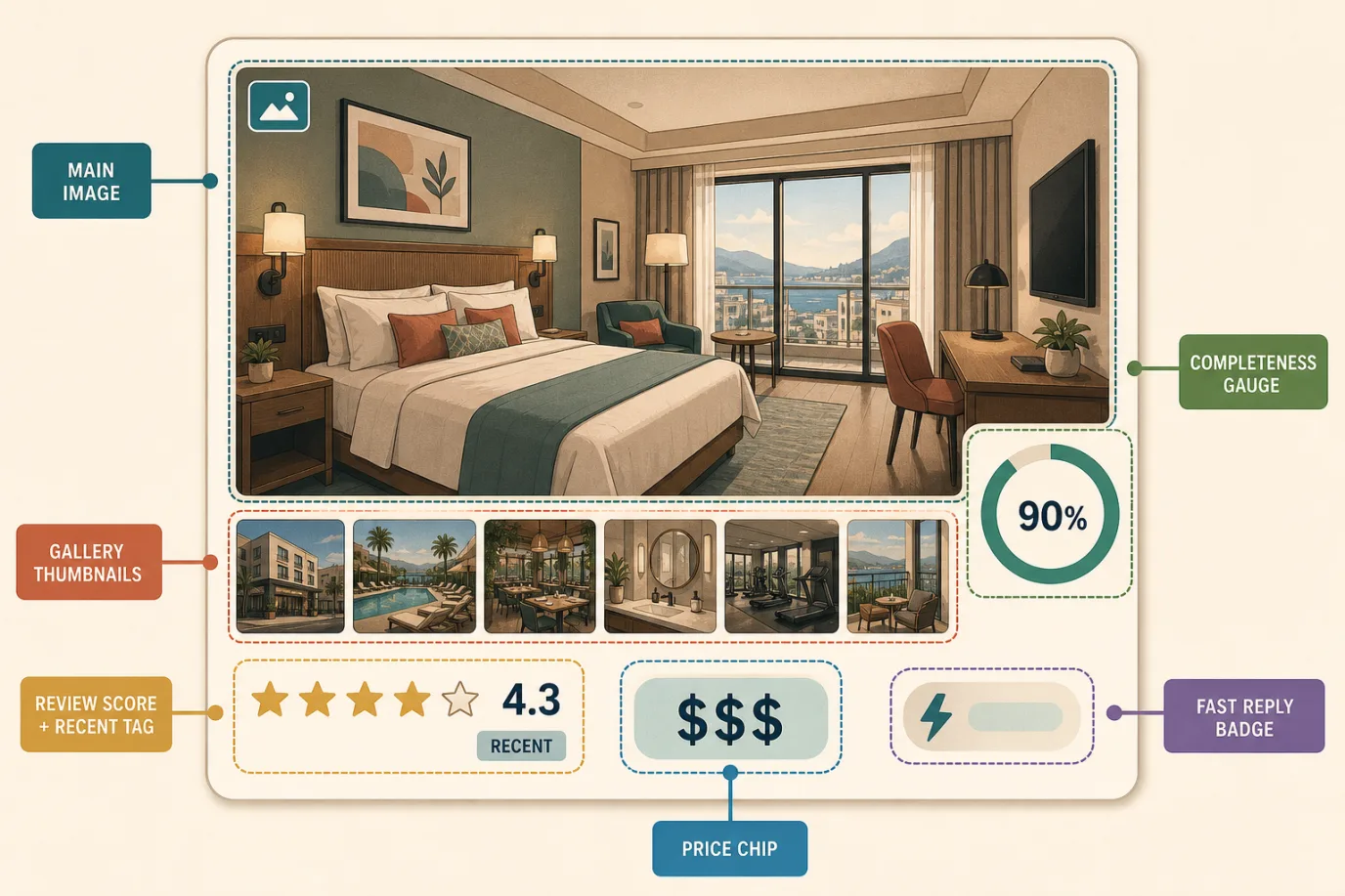
Both platforms give you a content score, sometimes called a content health or listing quality indicator, and it is the most honest free feedback you will ever get from an OTA. It is a checklist of everything your listing could tell a traveller, scored on how much of it you have actually filled in. A listing at sixty percent completeness is leaving ranking on the table for no reason other than blank fields.
Work the checklist to the end. Every room type described with its size, bed configuration and view. Every facility ticked, from the obvious wifi and parking to the ones travellers filter on, air conditioning, a kettle, a lift, family rooms, pet policy, EV charging. Check-in and check-out times, the cancellation policy, the languages your staff speak, the exact location pin. Each of these does two jobs: it lets the platform match you to more searches, and it removes a reason for a traveller to hesitate or message you before booking. A complete listing converts better and ranks better, and it costs nothing but an afternoon.
The detail people skip most is the one that filters hardest. Accessibility information, family suitability, and the small facility flags are exactly what a certain searcher screens on before they even look at photos. If you have a ground-floor accessible room and never said so, you are invisible to everyone who needs one, no matter how high you might otherwise rank. Filling the gap does not just help that guest; it opens a whole segment of searches you were silently excluded from.
Photos Do More Ranking Work Than Anything Else
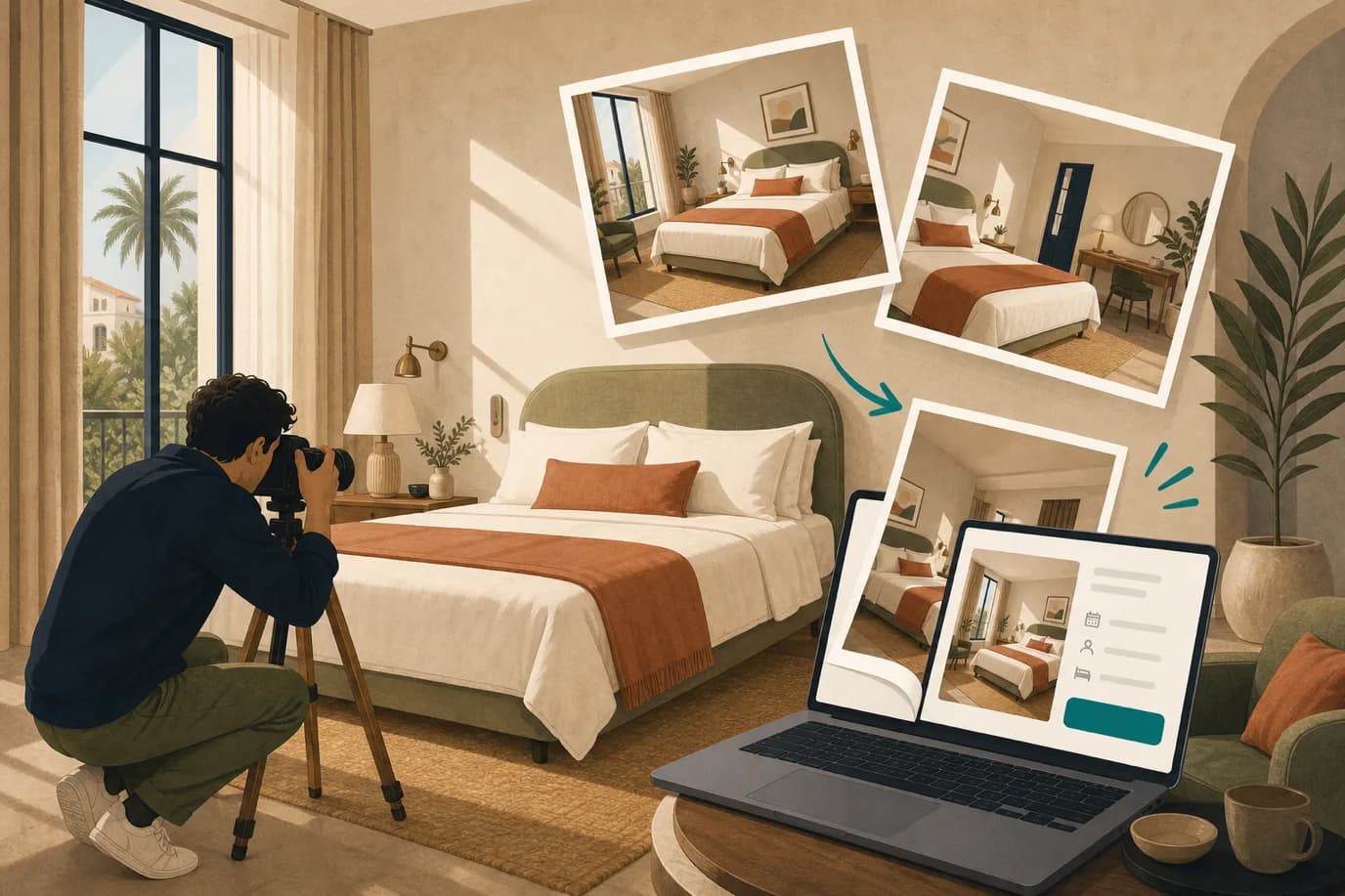
If you do one thing after reading this, fix your photos. Across both platforms, imagery is the single biggest driver of whether a traveller stops on your listing, and stopping is the first step to booking. The hero image, the first one in the gallery, does an outsized share of the work, because it is what appears in the search list itself. A dim, cluttered or generic hero image loses the click before your price or your reviews ever get a vote.
The standard to aim for is higher than most independents think. At least twenty to thirty high-resolution images, shot in good light, covering every room type, the bathrooms, the breakfast, the common areas, the exterior and the immediate neighbourhood. Order them deliberately, with your strongest, most representative shot first, because the gallery order is itself a lever. Real, recent photography of your actual property beats stock or staged imagery, and it beats the tired set you uploaded when you joined the platform and never refreshed. Travellers can smell a hotel hiding its rooms behind one flattering lobby shot.
There is a compounding effect worth naming. Better photos lift your click-through and your conversion, both of which feed the sort, so you climb, get more impressions, and the better photos now work on a larger audience. Of all the free levers, this is the one with the steepest payoff, and it is the one most often neglected because it feels like a chore rather than a ranking tactic. It is a ranking tactic.
Reviews, Replies and the Score That Feeds the Sort
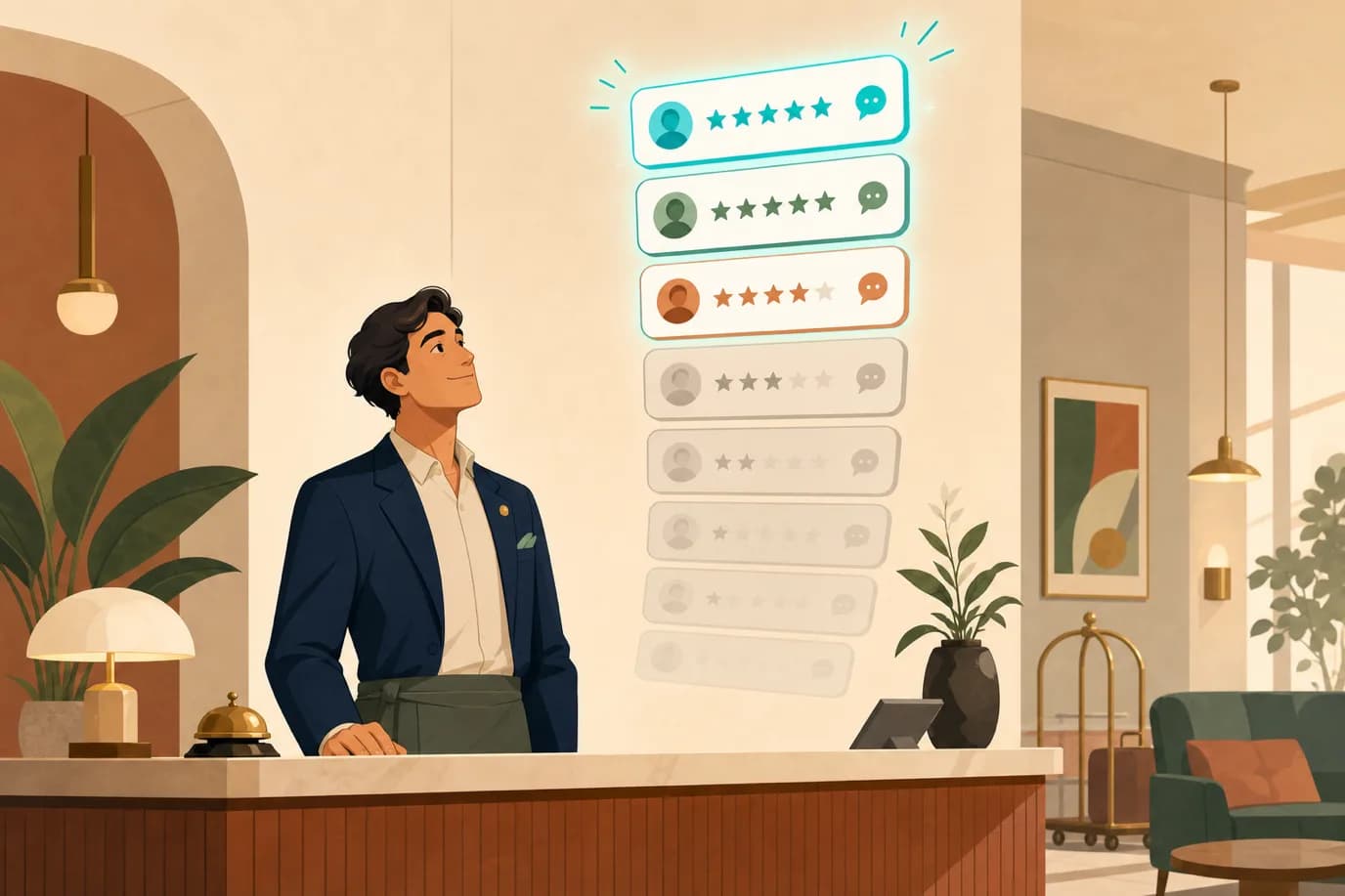
Your review score is a direct input to the ranking, not just a badge of pride. A higher score lifts you, and the platforms weight recent reviews more heavily than ancient ones, which is the part hoteliers miss. A property with a 9.1 built from reviews two years ago is weaker, in ranking terms, than a property holding 8.7 with a steady flow of fresh feedback. Momentum counts. A listing that keeps gathering recent, positive reviews looks alive to the algorithm and to the next traveller reading it.
That reframes how you should think about reviews. The job is not to chase a perfect average; it is to keep the stream flowing. Ask every guest, at the moment they are happiest, through whatever channel they actually use, and make it effortless. A property that collects ten honest reviews a month at 8.6 will usually out-rank and out-convert one that collected forty glowing reviews two summers ago and went quiet.
Then reply, especially to the bad ones. A calm, specific public reply to a critical review is not really aimed at the reviewer; it is aimed at the next reader deciding whether to book, and that reader is watching how you handle a complaint. Engaged properties that respond convert better, and several platforms treat responsiveness to reviews as a positive signal in its own right. Replying to praise is nice; replying well to criticism is what moves the needle.
Price and Availability Competitiveness
Price is woven through the sort because it is woven through conversion. You do not have to be the cheapest, but you have to be credible against the properties shown beside you for that search. A rate that is wildly out of line for your set will get clicks that never convert, and the platform reads that failure to convert and pushes you down. Competitive does not mean cheap; it means defensible to a traveller comparing you with three similar options.
Availability is the quieter half of this, and the one properties sabotage without realising. Closing out dates, holding tight minimum-stay restrictions, or simply not loading inventory far enough ahead all shrink the number of searches you can appear in. A property bookable for more date combinations, more lengths of stay and further into the future is eligible for more searches, and eligibility is the precondition for ranking at all. If you are invisible on a date, your perfect listing scores zero for everyone searching it.
There is a parity trap worth flagging here, because it bites direct-booking strategy directly. The OTAs watch whether a cheaper public rate exists elsewhere, and a lower price on your own website can cost you the Preferred badge or a visibility penalty. The clean way through is to keep your public rates aligned and put your genuinely better direct price behind a members login or a closed user group, which most agreements explicitly allow. Your direct channel still wins on price; the listing you rely on for visibility stays clean.
Why Reply Speed Is Quietly a Ranking Signal
Both platforms track how fast you answer guest messages, show that responsiveness to travellers, and factor it into how they treat your property. The logic is the same conversion logic as everything else: a traveller with a pre-booking question who gets a fast, helpful answer books; one who waits a day books somewhere else. Slow replies leak bookings, and leaked bookings are exactly the conversion failure the sort punishes.
The practical problem is that OTA messages live inside each platform's own extranet, so keeping reply times low means living in two or three message centres at once, on top of email and WhatsApp. Almost nobody does this well by logging in and out of separate tabs all day. The properties that hit fast response times consistently are the ones that pull every channel's messages into a single inbox, answer from one screen, and never have a Booking.com question sitting unread because that particular tab was closed. Reply speed is a ranking signal you can only really win by fixing the plumbing behind it.
The Paid Levers: Genius, Preferred Partner and Sponsored Placement
Once the free foundations are solid, the paid levers are worth understanding, because used well they are surgical and used badly they are a slow leak of margin. The mistake is reaching for them first, to compensate for a weak listing. A paid boost on a page that does not convert just buys you expensive impressions that still do not book. Fix the listing, then consider paying for reach.
On Booking.com there are three you will meet. The Genius programme enrols you in their loyalty tiers in exchange for a discount to Genius travellers, which lifts visibility to a large, high-converting segment of frequent bookers. The Preferred Partner and Preferred Plus programmes give a ranking lift and a thumbs-up badge in return for a higher commission, on the logic that you convert well enough to be worth featuring. And the Visibility Booster lets you bid additional commission for more exposure in specific markets or on specific dates. Each is a trade of margin for position, and each only pays off if your conversion is already healthy.
Expedia's structure rhymes with this. Its accelerator and sponsored-listing tools let you bid for higher placement, and its loyalty and member-deal mechanics work much like Genius. The names differ, the principle is identical: you are paying to move up a sort that still fundamentally rewards conversion. The smart use is targeted, not blanket. Turn a booster on for your genuinely soft dates, your shoulder weeks and midweek gaps, where filling a room at a slightly higher cost of sale beats leaving it empty, and leave it off for the high-demand dates you would have sold anyway. Paying for visibility on a night that sells itself is just donating margin to the platform.
The Billboard Effect: Turning OTA Visibility Into Direct Bookings
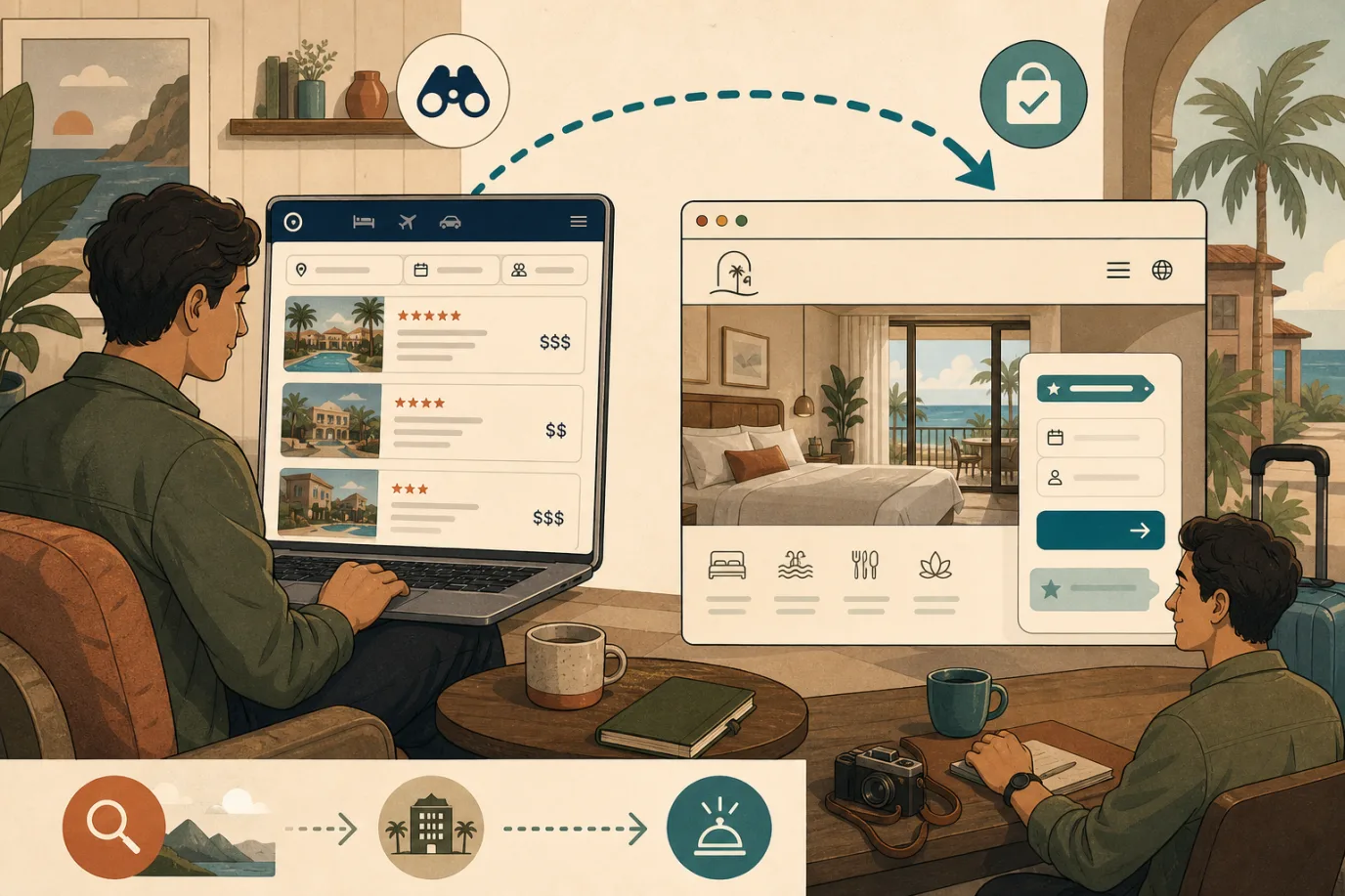
Here is the part that makes all the OTA effort pay for itself twice. A meaningful share of travellers who find a hotel on Booking.com or Expedia do not book there. They discover you on the OTA, then open a new tab, search your name, and look for your own website to book direct, often hoping for a better deal or just preferring to deal with you directly. Researchers and hoteliers have called this the billboard effect for years: the OTA listing acts as advertising that drives demand to your own channel. So the visibility you fought for on the OTA is also feeding your direct bookings, if, and only if, you are ready to catch that traveller when they arrive on your site.
Being ready means three unglamorous things. Your own website has to be easy to find and obviously yours when someone searches your name. The booking path has to be at least as smooth as the OTA's, because a clunky direct checkout sends the guest straight back to the platform they trust. And you need a reason to book direct that is allowed under parity, the members rate, a free perk, the closed-user-group discount, so the traveller who took the trouble to find you is rewarded for it. Get those right and every place you climb on the OTA sort lifts your direct revenue alongside your OTA revenue.
This is why ranking well on the OTA is not a betrayal of a direct-booking strategy; it is the top of the funnel for one. The properties that win treat the OTA as paid-for awareness they then try to convert into a direct relationship, capturing the guest's details, getting them into the messaging and loyalty flows, and making the second stay a direct one. You cannot run that play from page four. You have to be seen first.
A 30-Day Plan to Climb the Ranking
None of this has to be done at once, and trying to do everything in a weekend tends to produce a burst of effort that fades. A month of focused, sequenced work moves the needle more reliably, because the free foundations compound while you watch. Here is a sequence that works.
- Week one, fix the photos. Reshoot or re-source a deep, well-lit gallery of every room type and the key spaces, set the strongest image as the hero, and order the rest deliberately. This is the steepest free lever, so it goes first.
- Week two, max out the content score. Take both platforms' completeness checklists to one hundred percent: every facility, every room detail, policies, languages, accessibility, the exact map pin. Open up the searches you were silently excluded from.
- Week three, fix the conversion blockers. Sanity-check your rates against your real competitive set for the next ninety days, open availability and loosen needless minimum-stay rules, and review your cancellation terms. Make sure the clicks you are about to earn can actually convert.
- Week four, build the engine that keeps it up. Put OTA messages into one inbox so reply times stay low, set up a habit of asking every happy guest for a review, start replying to reviews, and align your parity so your direct site can win on a members rate. Only now, if soft dates remain, switch on a paid booster surgically.
Then keep going. Ranking is not a project you finish; it is a position you hold. Refresh photos seasonally, keep the review stream alive, answer fast, and watch your trend in an incognito window rather than chasing a single number. The properties that stay near the top are not the ones that did a heroic week once. They are the ones that made these few habits routine.
Where Prostay Fits, Honestly
The disclosure first, again: I write for Prostay, so read this as interest rather than neutral analysis. The honest, narrow point is that most of what lifts your OTA rank lives in systems Prostay runs together. The channel manager keeps your content, rates and availability clean and consistent across Booking.com, Expedia and the rest, which is the precondition for ranking and the thing most parity penalties come from getting wrong. Prostay Nexus pulls the OTA message centres into one inbox with email and WhatsApp, which is how you actually keep reply times low instead of just intending to. And the booking engine, with members rates and closed user groups, is how you catch the billboard-effect traveller and turn hard-won OTA visibility into a direct booking.
That does not make Prostay the only way to do any of this. You can run a separate channel manager, a standalone inbox tool and a third-party booking engine and stitch them together, and plenty of properties do. The case for one platform is that these levers reinforce each other, clean distribution, fast replies, competitive rates, direct capture, and running them in one place removes the gaps where a rate goes stale or a message goes unanswered. The test to apply, to us as much as anyone, is concrete: does your setup keep parity clean automatically, does it let you answer every OTA message from one screen inside minutes, and does it give the guest who found you on Booking.com a reason and an easy path to book direct next time. If it does, you will climb. If it does not, no booster will save you.
Frequently Asked Questions
The questions hoteliers ask most about ranking on Booking.com and Expedia, on commission and visibility, photos, reviews, parity and reply speed, answered from how the platforms actually behave rather than from a brochure.