The Numbers That Matter
If you run an independent hotel and you have been ignoring metasearch since 2023, you have probably missed the two changes that matter most. Here is the situation as of the day this article was published, with sources you can verify yourself.
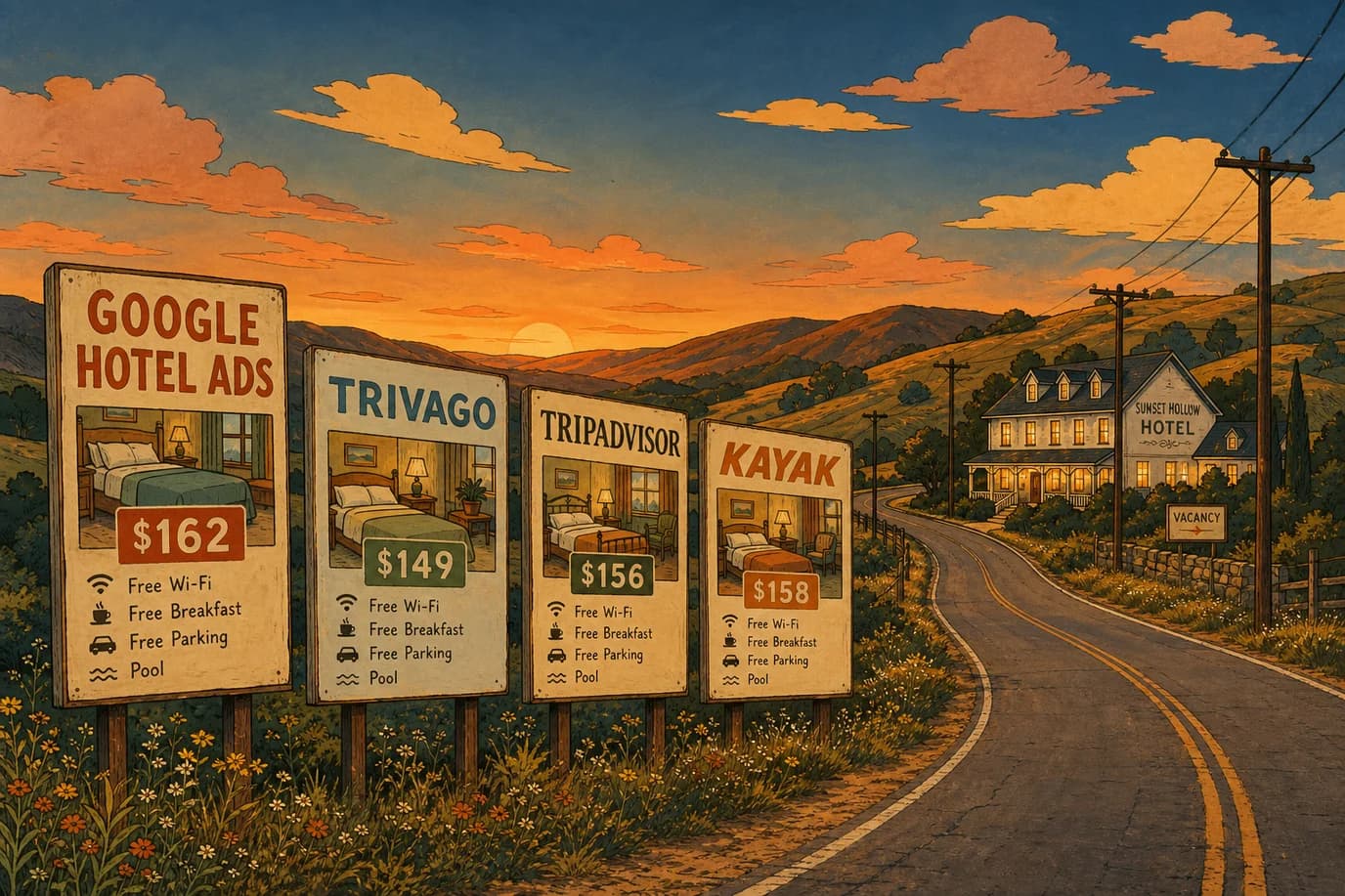
Google Hotel Ads holds 55 to 60 percent of the global hotel metasearch market by spend, somewhere around $8.2 billion a year per the 2026 Foundry CRO travel benchmarks. Trivago holds another 10 to 20 percent depending on the source, Kayak around 5 to 8 percent, Tripadvisor another 5 to 8 percent, and Skyscanner 3 to 5 percent. The long tail of HotelsCombined, Wego, Hotwire, and the smaller regional engines splits the rest. 47 percent of hotel searches begin on a metasearch engine in 2026, and the percentage that pass through one at some point in the journey is higher than that.
The two things that changed and that most hotel guides have not been updated to reflect:
First, Google retired its commission-based bid strategies for Hotel Ads in 2024 and 2025. Commissions (per stay) and Commissions (per conversion) stopped accepting new campaigns on 30 April 2024, existing campaigns stopped serving on 20 February 2025, and the final reconciliation window closed on 30 November 2025. The official reason is the deprecation of third-party cookies, which the commission models relied on for guest-stay tracking. The practical reason is that Google wants you on Performance Max for Travel and Target ROAS, both of which give Google more control over how your bids are set. If you ran a hotel ads campaign on commissions before 2025 and have not migrated, your campaign has been dark for over a year and you do not know it.
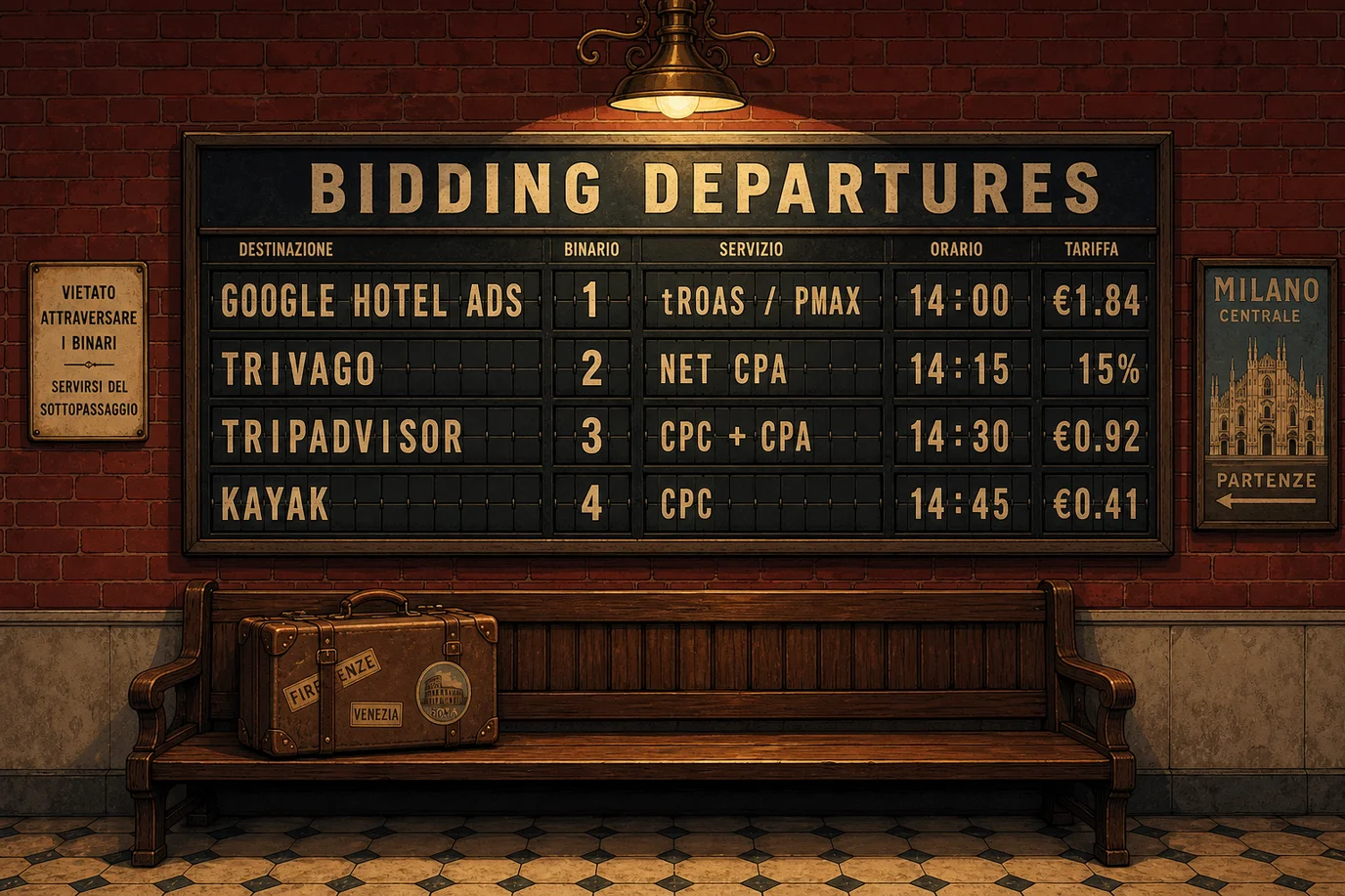
Second, Trivago retired CPC bidding on Rate Connect on 1 September 2025 and moved every Rate Connect hotel to a CPA-only model with a minimum 10 percent commission. Rate Connect now offers five commission tiers (12 percent, 15 percent, 18 percent, 20 percent, 25 percent) and that is your only choice. CPC bidding still exists on Trivago's separate Sponsored Listings product but Sponsored Listings is a tiny fraction of Trivago's hotel inventory. For 95 percent of independents using Trivago, the bidding decision is now "which commission tier do you accept" and nothing else.
For an independent 60-room hotel doing 2.5 million euros in card revenue per year, a properly run metasearch program delivers an effective acquisition cost of 7 to 12 percent of revenue versus the 15 to 25 percent the same hotel will pay an OTA for the same booking, and the typical direct-channel uplift is 12 to 18 percent of total bookings within the first 12 months. The D-EDGE 2024 Hotel Distribution Report, drawing on 1,221 European and Asian hotels, recorded average ad-driven direct distribution costs of 7.1 percent in 2023, down from 8.1 percent in 2019. Those numbers are real, repeatable, and within reach of any independent that can spend 300 to 1,500 euros per month on metasearch and treat it seriously for two quarters.
This is the honest read on hotel metasearch bidding for an independent in 2026. The four bidding models that actually exist today, the four platforms ranked by ROI for a 30 to 150 room property, the look-to-book math that determines whether your campaign breaks even, the four mistakes that quietly destroy metasearch ROI for almost everyone, and the 90-day plan that one person can run without hiring a metasearch agency.
What Changed in 2024 and 2025
The Google Hotel Ads commission sunset is the bigger of the two changes because Google is the larger platform. Here is the actual sequence so you can stop being confused.
Commissions (per stay) was introduced by Google in 2017. It let hotels bid a commission percentage (say, 10 percent) and pay only when a guest actually stayed. Reconciliation happened 45 days after checkout, cancellations cost nothing, and the resulting effective cost was usually 8 to 14 percent of booking value, below OTA commissions. It was the most hotel-friendly bidding model in the industry for almost a decade.
Commissions (per conversion) was the looser sibling. You bid a commission percentage and Google charged you on the booking conversion (not the stay), which meant cancellations did cost you. It existed primarily for hotels that did not want to handle the reconciliation file every month.
On 23 February 2024, Google announced that both bid strategies would be deprecated. The dates that matter:
- 30 April 2024: no new Hotel Ads campaigns could be created with either commission strategy.
- 20 February 2025: existing campaigns running on either strategy stopped serving in the auction. They did not downgrade automatically; they stopped, and the hotel's traffic from Google Hotel Ads went to zero.
- 30 November 2025: the final 9-month reconciliation window for Commissions (per stay) closed. After this date, all unreconciled conversions were billed to the merchant in a single final invoice, often surprising hotels who had forgotten the program existed.
Google's recommended replacements are Target ROAS (you set a return-on-ad-spend target and Google sets the bids), Enhanced CPC (you set max CPC and Google adjusts within it based on conversion probability), and Performance Max for Travel (Google chooses everything including placement, creative, and bid). All three of these are CPC-billed under the hood. Cancellations cost you because clicks cost you, not stays.
The Trivago change is simpler but probably more disruptive for a small European independent. On 1 July 2025, Trivago announced that Rate Connect (its flagship hotel ads product) would move to a CPA-only bidding model on 1 September 2025. The new structure offers five commission tiers, 12 percent, 15 percent, 18 percent, 20 percent, and 25 percent, and the hotel chooses one. Whether you sit higher in Trivago's metasearch rankings is a function of the commission you offer plus your hotel's trivago Rating Index plus your price competitiveness against OTAs on the same listing. Hotels on the 10 percent minimum will see substantially less impression share than those on 18 percent or higher.
The Net CPA structure (vs Gross CPA) means cancellations are not charged. Bookassist and a handful of other certified connectivity providers offer Net CPA campaigns directly. RoomCloud added Net CPA support to its interface in late 2025. If your booking engine vendor is not on that certified-partner list, you may be defaulted to Gross CPA, which charges you on every transaction regardless of cancellation. Confirm this with your connectivity provider before September 2025 if you have not already.
The third change, smaller but worth flagging, is the Tripadvisor platform shift. Tripadvisor moved from a pure metasearch-and-reviews company to a subscription-plus-AI-Trip-Planner model between 2024 and 2026. The platform now demands an additional 10 to 15 percent guest discount from hotels participating in TripAdvisor Plus, the subscription program. The CPC Sponsored Placements and CPC TripConnect metasearch ad formats still exist, the CPA Instant Booking still exists at 12 to 15 percent commission, but the broader strategic emphasis is shifting toward the AI Trip Planner recommendation surface and Tripadvisor's effective metasearch share is in slow decline. If you have not noticed declining Tripadvisor performance in 2024 and 2025, look again.
The Four Bidding Models You Actually Use Today
Almost every metasearch guide written before 2025 talks about five bidding models. There are now four, and one of them (Net CPA) is offered by some platforms and not others. Here is the full set with what each actually costs and what they actually do.
1. CPC (cost per click)
You pay a fixed or auction-driven amount every time a guest clicks your listing, whether the click converts or not. Average hotel metasearch CPCs in 2026:
- Google Hotel Ads: $0.50 to $3.00 (average $1.34 to $2.12 in the US). Luxury hotels often $2.00 to $5.00. Budget hotels $1.00 to $1.50. Seasonal swings of 100 to 400 percent between peak and off-season are normal.
- Trivago Sponsored Listings (CPC still available here, separate from Rate Connect): $0.10 to $1.30.
- Kayak: $0.20 to $0.80 in 2026 per the OtelCiro 2026 hotel benchmark. Often half of Google's CPC for equivalent placement, with the trade-off that Kayak traffic skews to the US and Canada and is roughly a third of Google's volume.
- Tripadvisor Sponsored Placements: $0.50 to $2.00 depending on market, billed for every click that navigates away from the search results page.
- Tripadvisor TripConnect CPC: $0.20 to $1.50 typically, though Tripadvisor restricts CPC visibility for small properties more aggressively than the other platforms.
CPC works when your booking-engine conversion rate is high enough to recover the click cost. The math: if your booking engine converts at 4 percent and your ADR is 180 euros, every click is worth (0.04 x 180) = 7.20 euros in expected revenue. A 1.50 euro CPC delivers 20 percent effective acquisition cost. A 0.50 euro CPC delivers 7 percent. A 3.00 euro CPC delivers 42 percent and is bleeding you.
2. Enhanced CPC and tCPA
Enhanced CPC is Google's automated bid adjustment layer on top of manual CPC. You set a max CPC, Google adjusts within it based on conversion probability per query. The official guidance after the commission sunset is that Enhanced CPC is the easy migration path for hotels that were on commissions and do not want to commit to full Target ROAS yet.
tCPA, where available (it was retired in Google Hotel Ads with the commission sunset but still exists in regular Google Ads campaigns), lets you set a target cost-per-acquisition in dollars and Google bids to hit it. tCPA is not directly applicable to Hotel Ads campaigns in 2026.
3. Target ROAS and Performance Max for Travel
Target ROAS is Google's current default recommendation for Hotel Ads. You set a return-on-ad-spend target (say, 800 percent, meaning you want 8 euros of revenue per 1 euro of ad spend) and Google sets the bids to hit it. It needs at least 30 days of conversion data to train, ideally 90 days. New hotels should not start on Target ROAS; start on Enhanced CPC, collect three months of conversion data, then migrate.
Performance Max for Travel is Google's newer unified product that takes Target ROAS and adds automated placement, creative, and channel selection across Google Hotel Ads, Search, Display, YouTube, and Discover. It is the most set-and-forget product Google offers for travel. The trade-off is that Google chooses where to spend your money, which is a problem if you wanted to spend it only on Hotel Ads. Independents should approach Performance Max with caution and only after they have a working Target ROAS campaign that proves their conversion data is clean.
4. Net CPA (cost per acquisition)
Net CPA is the only metasearch bidding model where you pay only when a guest actually books and pay nothing when they cancel. Trivago Rate Connect from 1 September 2025 is CPA-only with five tier choices: 12 percent, 15 percent, 18 percent, 20 percent, and 25 percent. Tripadvisor Instant Booking offers two effective tiers: 12 percent (gets you 25 percent of Book on TripAdvisor traveller views) and 15 percent (gets you 50 percent of traveller views). Gross CPA charges on every transaction regardless of later cancellation; Net CPA adjusts for cancellations and is the version your booking engine vendor needs to support to make Trivago Rate Connect viable.
CPA works when your operational reality is closer to every transaction in our PMS becomes a stay (low cancellation rates, well-managed deposit policies, refundable rates that are actually mostly stayed). Hotels with cancellation rates above 25 percent should expect Net CPA reconciliation to surface uncomfortable surprises in the first three months. The trade-off is risk shifted from the hotel (no payment unless guest books) to the platform.
The Four Platforms Ranked for Independents
The order matters because every dollar you spend on a lower-ROI platform is a dollar you cannot spend on a higher-ROI one. Here is the order I would deploy budget into for a typical 30 to 150 room independent in 2026, with the actual reasoning for each.
Google Hotel Ads: the must-have
Google Hotel Ads should account for 60 to 75 percent of your metasearch spend as a starting allocation. Three reasons:
First, Google holds 55 to 60 percent of the global metasearch market and the share is still growing year over year. The D-EDGE 2024 report found that Google accounts for 61 percent of ad-driven direct booking revenue for hotels and that this proportion has been stable since 2020. Translation: if you are in metasearch at all, Google is where the volume is.
Second, the Free Booking Links program. If your hotel runs paid Hotel Ads, you also get free organic placement on the same Hotel Ads surface for guests who arrive via Google Search, Google Maps, or Google Hotels. Free Booking Links delivered roughly 25 to 35 percent incremental direct bookings for hotels in the D-EDGE data, on top of the paid spend. No other metasearch platform offers a comparable free tier at this volume.
Third, the Performance Max for Travel product, when run correctly, ties metasearch into your broader Google Ads activity (brand search, generic search, display, YouTube remarketing) and lets one optimization signal (the booking conversion event) train all of them. For an independent that is also running a small brand-search campaign and possibly some remarketing, this is structurally efficient.
The trade-offs of Google Hotel Ads:
- The bidding strategy choice is now constrained to Enhanced CPC, Target ROAS, or Performance Max. Commission bidding is dead and is not coming back.
- CPC inflation is real: Foundry CRO benchmarks show YoY CPC growth of 18 to 25 percent in high-demand markets in 2025 and 2026.
- The Hotel Ads CVR average (3.55 percent) is below standard paid search (4.72 percent) per Foundry's 2026 benchmark, meaning you need a higher-converting booking engine to break even on Hotel Ads than on, say, brand search.
Minimum monthly spend to be worth setting up: 500 euros per month. Below that you are paying setup overhead with no scale benefit. Start at 750 to 1,500 euros monthly if you can justify it.
Trivago Rate Connect: the Europe play
Trivago should account for 15 to 25 percent of your metasearch spend if you are in Europe (especially Germany, Austria, Switzerland, the Netherlands, Italy, or Spain), 5 to 10 percent elsewhere, zero in North America unless you have a very specific German or Nordic source-market dependency.
The strategic case for Trivago is that it remains the dominant hotel metasearch platform in DACH and in much of southern Europe. Its 10 to 20 percent global market share is heavily concentrated in markets where German is spoken. For a small German lake hotel or an Italian agriturismo serving primarily European leisure traffic, Trivago is the second-largest source of direct ad-driven bookings after Google.
The Trivago tactical decision in 2026 is simpler than it used to be. You no longer choose between CPC and CPA on Rate Connect; you choose your commission tier. The empirical guidance:
- 10 percent commission (the minimum): you will get bottom-of-page placement. Suitable only if you are testing Trivago without commitment.
- 12 to 15 percent commission: typical sweet spot for independents. Gets you reliable mid-page placement in non-competitive markets. CPA in practice will land at 12 to 18 percent of booking value once cancellations are reconciled.
- 18 to 20 percent commission: aggressive placement. Justified when your direct-booking conversion is strong and your competing OTAs are at 17 to 20 percent themselves.
- 25 percent commission: only in head-to-head bidding wars with Booking.com Genius prices. Rarely worth it for an independent.
The OtelCiro 2026 Trivago Rate Connect analysis found that hotels running Rate Connect produce, on average, 18 percent more direct-channel bookings within the first 12 months, and that bookings via Rate Connect cancel 30 percent less often than OTA bookings to the same hotel. Both numbers depend on a good rate parity setup, a fast tokenized booking engine, and accurate availability feeds. Without those, the same campaign loses money.
Tripadvisor: the credibility play
Tripadvisor should account for 5 to 15 percent of your metasearch spend depending on how heavily your guest mix relies on review-led discovery, zero to 5 percent if your guests mostly find you through search and direct channels.
Tripadvisor is the most complex platform because it sells four overlapping products to the same hotel:
- TripConnect CPC: classic CPC metasearch, similar to Google's. Average CPCs $0.20 to $1.50.
- Sponsored Placements: CPC ad above the organic ranking. Requires a Business Advantage subscription. Every click that navigates from the ad (to your property page, to the review section, to the photos) is billed.
- Instant Booking (CPA): pay 12 percent or 15 percent per completed transaction. The higher tier gets you 50 percent of Book on TripAdvisor traveller views; the lower tier gets you 25 percent.
- Business Advantage: an annual subscription, base price around $99 per year, required to participate in Sponsored Placements.
The compounded effect is that Tripadvisor can absorb spend in four places at once and an inattentive hotelier ends up paying $99 for Business Advantage, plus CPC on Sponsored Placements, plus CPC on TripConnect, plus CPA on Instant Booking, with significant overlap in the user journey. The hotelnewsresource.com analysis of Sponsored Placements highlighted exactly this risk: the compounded costs have the potential to leave little opportunity to achieve a positive blended ROAS amongst the Tripadvisor initiatives.
The honest 2026 recommendation: start with TripConnect CPC at a modest daily budget (10 to 20 euros), measure direct booking attribution honestly, add Sponsored Placements only if TripConnect ROI is clearly positive, and only consider Instant Booking if your direct booking conversion rate is below industry average and you genuinely cannot fix it. TripAdvisor Plus participation is a separate question and should be evaluated entirely on incremental revenue, not on visibility.
Kayak: the cheap incremental
Kayak should account for 5 to 15 percent of your metasearch spend if you serve US, Canadian, or Western European leisure guests, zero if your demand is primarily Asian, Middle Eastern, or Latin American.
The case for Kayak is purely economic. Average CPCs in 2026 are 0.30 to 0.80 euros for budget and mid-range hotels, half of Google's equivalent. Bid competition is roughly 35 percent lower than on Google for the same impression share per the OtelCiro Kayak benchmark. Kayak has 150 million monthly visitors and around 5 to 8 percent of global hotel metasearch share, with strong US, Canadian, and UK demand. Its package-search feature (flight plus hotel) tends to produce higher ADR per booking than its standalone hotel search, which is a small bonus for hotels in flight-served destinations.
The trade-offs:
- Kayak is CPC-only. There is no CPA option for hotels.
- Kayak's audience is more price-sensitive than Google's, which means the marginal click is less likely to convert at your standard rates.
- Kayak attribution is murky because guests often start on Kayak, switch to Google, and book direct from there. Last-click attribution will underweight Kayak's contribution.
Minimum useful monthly spend: 200 euros. Kayak rewards consistent, modest spend better than burst spending.
Honorable mentions and what to skip
Skyscanner Hotels (Trip.com Group): only worth setting up if you have meaningful demand from Asian, Australian, or Nordic source markets. Otherwise skip.
HotelsCombined: 5 to 8 percent Asia-Pacific share. Skip unless that is your market.
Hotwire, Wego, Hipmunk, and the long tail: skip for almost all independents. The setup overhead exceeds the incremental booking value.
TripAdvisor Plus and the loyalty subscription tier: evaluate independently on incremental ADR-net-of-discount, not bundled with metasearch.
The Look-to-Book Math Nobody Publishes
Most metasearch agency pitches lead with ROAS. ROAS is the wrong metric to evaluate metasearch with. Here is the right metric and how to calculate it.
The mechanic of every metasearch campaign is identical, regardless of platform:
Click cost (CPC) -> Booking engine arrival (1.0x)
                 -> Booking engine conversion (CVR%)
                 -> Booking value (ADR x Length of stay)
                 -> Effective cost per acquisition = CPC / CVR
                 -> Effective % of revenue = (CPC / CVR) / (ADR x LOS)
The two numbers that vary the most in 2026 and that almost no published guide tells you the truth about are CVR and ADR.
Independent hotel website conversion rates, per the h2c 2020 Global IBE and Metasearch Study and the Hotel Benchmark dataset:
- Independent hotel website CVR (all visits): 0.73 percent average, range 0.66 to 0.81 percent
- Independent hotel booking engine CVR (visits that reach the IBE): 3.28 percent average, range 2.99 to 3.72 percent
- Optimized independent: up to 4.72 percent booking engine CVR
- Hotel group website CVR: 1.9 percent average
- Hotel group booking engine CVR: 6.8 percent average
Metasearch traffic enters the booking engine flow directly (typically straight to a room-and-rate selection page with the user's dates pre-filled), so the relevant number for metasearch is the booking engine CVR, not the site-wide CVR. That means a typical independent should expect 3 to 4 percent CVR on metasearch arrivals, with a realistic ceiling of 5 to 6 percent if the booking engine is well-tuned, mobile-first, and price-competitive.
Average ADR and length of stay, for context, vary wildly by market. The Foundry 2026 benchmark cites $150 to $500 per night for chain hotels and $200 to $600 for boutique. European independents typically run 120 to 280 euros ADR and 1.8 to 2.3 nights average LOS.
Plug those into the formula. A typical independent on Google Hotel Ads with 1.50 euro CPC, 3.5 percent booking engine CVR, 180 euro ADR, and 2.0 nights LOS:
Effective CPA      = 1.50 / 3.5%   = 42.86 euros
Effective % of rev = 42.86 / (180 x 2.0) = 11.9%
ROAS               = 1 / 11.9%     = 8.4x
11.9 percent acquisition cost beats Booking.com's 15 percent and absolutely crushes Expedia's 20 to 30 percent. That is why metasearch works for independents.
Now run it for a worse hotel: same 1.50 euro CPC, 1.8 percent CVR (a typical chain-like CVR for a poorly tuned independent), 140 euro ADR, 1.6 nights LOS:
Effective CPA      = 1.50 / 1.8%   = 83.33 euros
Effective % of rev = 83.33 / (140 x 1.6) = 37.2%
ROAS               = 1 / 37.2%     = 2.7x
37 percent effective cost is worse than every OTA on the planet. This is the campaign you absolutely should not run, and yet many independents run it for years.
The honest 2026 break-even rule of thumb is: if your booking engine CVR is below 2.5 percent and your average booking value is below 250 euros, do not start on metasearch CPC bidding. Fix the conversion problem first (in that order: rate parity, payment-page speed, mobile UX, deposit policy) and then come back. CPA bidding can mask the conversion problem temporarily by shifting risk to the platform, but the platforms will eventually deprioritize your listing if your conversion does not meet their thresholds.
The Four Mistakes That Destroy Metasearch ROI
In every independent-hotel metasearch engagement I have been near in 2025 and 2026, the same four mistakes show up. None of them are technical. All of them are commercial discipline issues, and they collectively cost the typical hotel more revenue than the metasearch program produces.
1. Rate parity violations that auto-disqualify you
Metasearch engines are pricing aggregators. Their entire user value proposition is we show you the best price across all booking sources. When your direct rate is higher than the OTA rate for the same room-night, you appear in the search but you appear at the bottom, sometimes with a yellow higher-than-other-sites warning, and you convert almost nothing.
The 123compare.me H1 2025 hotel pricing report found that independent hotels recorded a lose rate of 37 percent (their direct price was higher than at least one OTA), versus 31 percent for major hotel groups. 54 percent beat rate (direct was the lowest) and 9 percent meet rate (within 0.5 percent). The independents that win at metasearch are in the 60 to 70 percent beat rate, not 54 percent.
The fix is operational, not technical. Audit your channel manager weekly for parity drift. Send the audit to your front office and revenue manager. Enforce parity contractually with your OTAs (Booking.com and Expedia both contractually require it, despite many hotels not knowing this; smaller OTAs frequently break parity and you have to chase them). The single most expensive thing in metasearch is starting a campaign before you have parity under control.
Specifically watch for: wholesaler leakage (a wholesaler reselling your inventory below your direct rate on a tertiary OTA), Genius price disparity (Booking.com Genius members see prices 10 to 15 percent lower, and this counts as a parity violation in Google's eyes), early-booking promo windows that automatically discount OTA rates but not direct, and package rate disparities where an OTA's package looks cheaper than your direct rate even though the package has different inclusions.
2. Stale feed and availability that waste clicks
Metasearch platforms charge you for clicks whether the click leads to a successful booking or an available room that, when the guest reaches your booking engine, is suddenly sold out. Stale availability is one of the highest-cost defects in metasearch and one of the easiest to fix.
The two failure modes are rate-not-loaded (your channel manager has not pushed today's rates to Google in the past four hours and Google shows yesterday's price) and room-not-available (your inventory shows availability but the room was just sold through Booking.com 30 seconds ago and the sync to Google is on a slow batch). The first costs you the click and a price-discrepancy demerit. The second costs you the click and a no-availability demerit, which is the worst class of demerit and can drop your impression share for days.
The technical fix is to choose a connectivity provider that supports real-time rate updates (every change, no batch delay) and real-time inventory updates for every booking source. Most modern booking engines and channel managers support this; many older ones do not. If your provider only supports 15-minute batch updates, you are losing 4 to 7 percent of metasearch impressions to availability mismatches and there is nothing you can do at the bidding layer to fix it.
3. The wrong attribution model
The standard last-click attribution model gives 100 percent of the booking credit to the last channel touched before checkout. In metasearch, that channel is almost always your direct site, because the guest comes from metasearch to your booking engine and books there. Last-click attribution makes metasearch look great.
The truth is more complicated. About 30 percent of metasearch-attributed bookings would have happened anyway through brand search or direct navigation. Another 20 percent would have happened through an OTA where you would have paid 15 to 25 percent commission. The remaining 50 percent are genuinely incremental direct bookings that metasearch created.
If you evaluate metasearch on incremental revenue instead of last-click revenue, the ROI is roughly half of what your dashboard says. Still positive in almost all cases, but the optimization decisions you make are different. You should be willing to spend more on top-funnel metasearch keywords (where the user is genuinely exploring) and less on brand-keyword metasearch placements (which are largely cannibalizing your free organic and direct traffic).
The pragmatic 2026 fix: run a monthly brand-keyword exclusion test. Pause Google Hotel Ads bids on guests who searched for your hotel name in the past 14 days. Measure the difference in total direct bookings for those guests over the next 30 days. If pausing brand-keyword bids decreases your bookings by less than 70 percent of the lost spend, brand-keyword metasearch was cannibalizing.
4. Optimizing for blended ROAS instead of true incremental direct
The fourth mistake compounds the third. Hotels measure metasearch ROI by total booking revenue divided by total ad spend, which sounds correct but is wrong because most of the booking revenue would have happened anyway. The metric that actually matters for an independent's strategic decision (should I increase metasearch spend?) is incremental direct booking lift per dollar of incremental ad spend, and that is much harder to measure.
The substitute that works in practice is to track direct booking share of total bookings, month over month, against a baseline measured before the metasearch program started. If direct booking share is rising 1 to 2 percentage points per quarter, metasearch is working. If it is flat or rising less than 0.5 points, metasearch is mostly substituting for organic and OTA bookings and is not paying its way.
The OtelCiro benchmark of 18 percent direct channel uplift in 12 months from Trivago Rate Connect is achievable for an independent that gets all four of these mistakes right. Hotels that get any of them wrong typically see a 3 to 8 percent lift in 12 months and conclude metasearch does not work. It works, but it requires the operational discipline of catching rate parity violations within hours, real-time inventory feeds, and honest attribution analysis.

Connectivity Provider Choice (the Underrated Decision)
Whether you can run a serious metasearch program depends almost entirely on the connectivity provider that pushes your rates and availability to the metasearch platforms. This decision is more consequential than the bidding strategy choice and most hotels make it once, by accident, when their booking engine is selected.
The connectivity provider sits between your booking engine and the metasearch platforms. It signs the certification agreements that let your hotel be listed at all, it handles the technical work of pushing rate and availability changes, and it determines whether you have access to Net CPA on Trivago, real-time inventory on Google, Instant Booking on Tripadvisor, or any other premium capability.
The certified Google Hotel Ads connectivity providers in 2026 include all the major hotel booking engines: SiteMinder, Cloudbeds, Mews, Profitroom, D-EDGE, Bookassist, RoomCloud, Vertical Booking, Hotelogix, and a few dozen others. The certified Trivago connectivity providers are a tighter list, and the certified Net CPA partners are tighter still (Bookassist and RoomCloud among the major European ones; check Trivago's published partner list before assuming yours qualifies).
Three things to evaluate when choosing or switching connectivity provider for metasearch in 2026:
First, real-time rate updates. Push every rate change to Google within 5 minutes, no batch delay. Confirm in writing. Anything slower will silently cost you 4 to 7 percent of impressions.
Second, Net CPA support on Trivago Rate Connect. As of 1 September 2025 this is the only Trivago Rate Connect bidding model and Gross CPA (the default for non-Net-CPA-certified providers) charges you on cancellations, which is materially worse for an independent.
Third, the campaign-management interface. Can you change your Target ROAS target or your CPA tier from the connectivity provider's dashboard, or do you have to file a ticket and wait three business days? The ones that let you self-serve are dramatically easier to optimize.
If your current connectivity provider fails any of these three tests, the metasearch program will underperform regardless of your bidding sophistication.
The 90-Day Plan One Person Can Run
If you are starting from zero metasearch in 2026, here is the plan that gets you to a working program in 90 days. One person who is operationally competent and has reasonable access to the GM, revenue manager, and booking-engine vendor can run it without external consulting. Block roughly 6 to 8 hours per week across the 90 days.
Days 1 to 30: Foundation
Audit rate parity across Booking.com, Expedia, Hotels.com, Agoda, your direct booking engine, and any wholesalers. Document the lose rate and the cause for each violation. Spend two full days on this; it will save you ten days of metasearch underperformance later. Negotiate or enforce parity with the worst offenders before turning on any campaign.
Audit your booking engine for the metasearch entry flow. Click a metasearch link from Google's hotel search, land on your booking engine with pre-filled dates, and count the page-load time, the number of clicks to checkout, the mobile checkout experience, and whether tokenized payment is supported. Fix everything that is broken before turning on the spend.
Confirm your connectivity provider supports real-time rate updates, real-time inventory updates, Net CPA on Trivago, and self-serve campaign management. If it does not, decide whether to switch (which is a 60 to 120 day project of its own) or proceed knowing the ceiling is lower.
Set up Google Hotel Ads with the booking engine integration. Start on Enhanced CPC with a daily budget of 25 to 50 euros per day (750 to 1,500 euros per month). Enable Free Booking Links from day one regardless of paid spend. Do not start on Target ROAS in the first 30 days; you do not have enough conversion data yet.
By day 30 you should have: parity audit complete, booking engine speed and mobile UX clean, connectivity provider verified, and Google Hotel Ads running with 30 days of clean conversion data.
Days 31 to 60: Scale and Diversify
Migrate Google Hotel Ads from Enhanced CPC to Target ROAS with a conservative target (700 to 900 percent depending on your effective margin). Monitor the first 14 days carefully; if Target ROAS underspends or stops serving, return to Enhanced CPC and rebuild the conversion data.
Add Trivago Rate Connect at a 15 percent commission tier (the sweet-spot starting point). Confirm Net CPA is active. Monitor performance for 14 days and adjust to 12 percent or 18 percent only if the data justifies it; do not jump straight to 25 percent.
Add Tripadvisor TripConnect CPC at a small daily budget (10 to 15 euros per day). Do not add Sponsored Placements yet. Do not add Instant Booking yet.
Add Kayak CPC at 100 to 200 euros per month if you serve US, Canadian, or Western European source markets. Skip if you do not.
By day 60 you should have: three to four metasearch platforms running, monthly spend 1,200 to 2,500 euros, and 60 days of cross-platform conversion data.
Days 61 to 90: Optimize and Defend
Run the brand-keyword exclusion test (described in Mistake 3 above) for 14 days. Resize your brand-keyword metasearch spend based on the result.
Run a parity re-audit. Catch and fix anything that has drifted since day 30. This re-audit will become a weekly cadence after the 90-day plan ends.
Layer Tripadvisor Sponsored Placements onto your highest-performing TripConnect campaign at the lowest budget tier. Measure for 14 days. Keep or kill.
Run a Performance Max for Travel test, if your conversion data is clean and you have at least 60 days of stable Target ROAS performance behind it. If your Target ROAS is volatile, do not enable Performance Max. It needs stable input.
Document the campaign settings, daily routines (parity audit, performance review, bid adjustments), and quarterly tasks (creative refresh, deeper attribution analysis, channel mix review) in a single playbook that someone else can pick up if you go on vacation.
By day 90 you should have: a multi-platform metasearch program at 1,500 to 3,000 euros monthly spend, direct booking share rising 0.5 to 1 percentage point per month, and a documented playbook that does not require your continuous attention.
Where Prostay Fits, Briefly and Honestly
I write for Prostay so this section is unavoidable, but I will keep it honest. Prostay is a property management system and booking engine for independent hotels, and it is one of the certified connectivity providers for Google Hotel Ads, Trivago Rate Connect (including Net CPA), Tripadvisor TripConnect, and Kayak. From a metasearch perspective that is the same checkbox you can tick with SiteMinder, Cloudbeds, Mews, Bookassist, Profitroom, D-EDGE, or any of the other major booking engines. Any of these will let you run the 90-day plan above.
The specific Prostay choices that matter for metasearch: real-time rate and inventory push to Google (no batch delay), Net CPA support on Trivago Rate Connect from the September 2025 launch, an iframe-hosted booking engine that satisfies the PCI SAQ A criteria so guests trust the checkout, and a self-serve campaign-management surface that lets your operationally-minded person change Target ROAS or commission tiers without filing a ticket. None of these are unique to Prostay; they are simply the table-stakes metasearch capabilities that I think a 2026 booking engine should have.
The structural argument for Prostay is the same one I make about any single-vendor stack: when your PMS, channel manager, booking engine, and payment processor share an audit boundary and a single rate-and-inventory store, the latency between a booking on Booking.com and that inventory disappearing from your Google Hotel Ads listing drops from minutes to seconds. That latency difference is the difference between losing 7 percent of metasearch impressions to availability mismatches and losing 1 percent.
If you want a tour of how Prostay handles metasearch connectivity specifically, the Prostay channel manager and Prostay booking engine product pages walk through it. If you are running the 90-day plan above and want help configuring it with the Prostay revenue team, book a demo and we will go through it without trying to sell you a separate metasearch consulting engagement.
Frequently Asked Questions
The five questions I get most often from independent hoteliers about metasearch bidding in 2026, answered with the actual current platform rules rather than the 2023 conventional wisdom.