
A guest sits down on a Tuesday night, opens ChatGPT and types: What is a good small hotel in Sorrento for a weekend with my partner. The model thinks for two seconds and returns three names with a sentence each. None of them are yours. None of them are ranked number one on Google for the same query either, and none of them appear in the Google AI Overview if the guest types the same words into the search bar. The guest books one of the three.
That is the new search reality. It is producing more variance in hotel discovery than any change since Google promoted Tripadvisor up the SERP in 2014. The question is not whether to optimize for AI search. The question is what actually works, who is selling snake oil, and what a hotel marketer should do this quarter.
The vendor noise around all of this is deafening. Inboxes are filling up with pitches for AI SEO packages, Answer Engine Optimization services, Generative Engine Optimization audits, and AI URL submission products. The honest read of what is published as of May 2026 is that a small share of that pitch list is genuinely useful, the majority is speculative at premium prices, and a not-small slice is outright fraud. This article is the practical, sourced, opinionated guide we wish someone had written six months earlier.
The New Search Reality, in Numbers That Are Actually Verified
Five numbers. They are the only numbers anchoring this entire piece. Anyone quoting clean, hotel-vertical, share-of-search percentages between ChatGPT and Google in 2026 is extrapolating. The audited data does not exist yet.
Thirty percent of United States travelers used ChatGPT or similar tools extensively for trip planning in 2025, up from thirteen percent in 2024. A one-hundred-and-twenty-four percent year-over-year jump. The data comes from a Skift Research and McKinsey survey of 1,002 United States respondents conducted June 3 to July 5, 2025. The chart line is steep enough that it should be taken seriously, even allowing for a self-report bias in any survey methodology.
Thirty-nine percent of United States travelers used generative AI for travel research in 2024, up from twenty-six percent in 2023. Phocuswright research, separately published. The two surveys ask different questions but trend in the same direction.
AI Mode queries are roughly three times longer than standard Google queries. Google said this in its Q4 2025 earnings commentary. The implication for hotels is that a guest typing into AI Mode is not searching hotel sorrento but rather quiet boutique hotel in Sorrento for a couple with a balcony and breakfast included under three-hundred euros a night. The question on the table is whether your content can answer the longer, more specific version.
Travel is the lowest-overlap industry between AI Overviews citations and organic top-ten rankings, at twenty-three-point-six percent. BrightEdge tracked this across nine industries through mid-2025. The translation for a hotelier: ranking number one organically in Google for boutique hotel sorrento does not reliably get you cited in the AI Overview for the same query. The signals AIO uses in travel are demonstrably different from the signals that drive organic position.
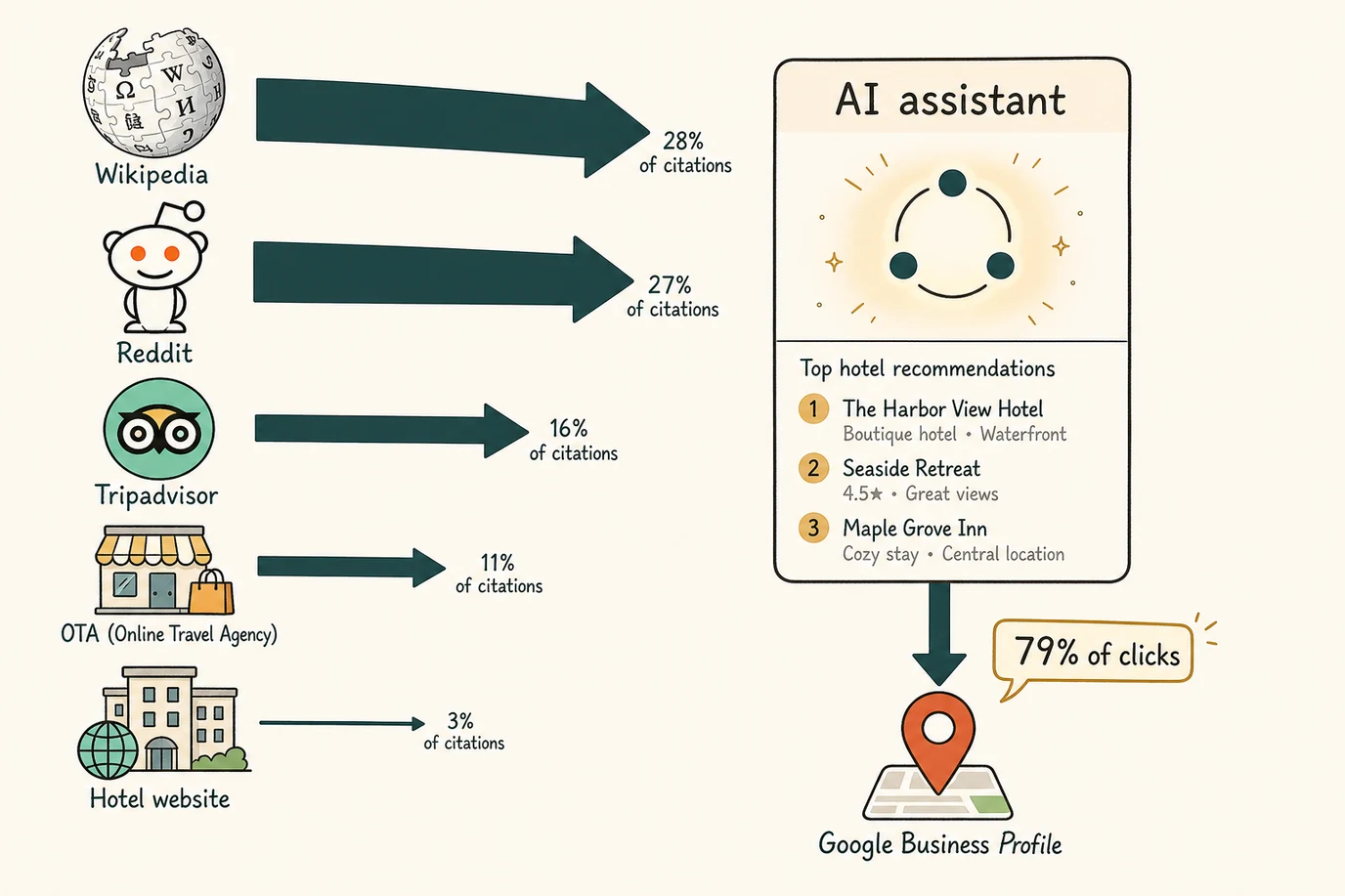
Seventy-nine percent of hotel links in Google AI Mode responses route to a Google Business Profile, not to the hotel website and not to an OTA. Hotelrank's 2026 study of four-thousand queries across eight cities, with eighty-four-thousand source citations parsed. Only sixteen-point-three percent of hotel links route to hotel websites directly. Three-point-six percent route to OTAs, even though OTA content makes up forty-six-point-six percent of the source citations the model uses to compose its answer. The model reads the OTA, mentions the hotel, and then sends the click to the Google Business Profile. This is the single most actionable number in the entire dataset.
Those five numbers tell a coherent story. AI travel search is real, growing fast, structurally different from organic SEO, and disproportionately routed through Google's own surfaces even when the model is not Google's. Everything else in this article follows from that.
How AI Assistants Actually Pick Which Hotels to Mention
Three mechanics matter. Understanding which one is operating in a given product is most of the work.
Training Versus Real-Time Retrieval
When ChatGPT or Claude or Gemini answers a hotel question, the answer is the output of two different processes blended together. Some of the answer comes from the model's training data, meaning text the company scraped or licensed up to a cutoff date. Some of the answer comes from real-time retrieval, meaning a search request the model issued mid-conversation, parsed, and folded into its response. The blend ratio is invisible to the user and increasingly invisible even to the people building the products. What matters for a hotelier is that you have two doors and you should care about both.
Training crawlers (GPTBot for OpenAI, ClaudeBot for Anthropic, CCBot for Common Crawl, Bytespider for ByteDance) read your site to feed future model versions. If they are blocked or your content is thin, you will be invisible in answers that lean on model knowledge.
Real-time retrieval crawlers (OAI-SearchBot for ChatGPT search, PerplexityBot for Perplexity, Bingbot for everything Microsoft including Copilot) read your site at query time. If they are blocked or your content is unreadable, you will be invisible in answers that use grounding.
User-initiated fetchers (ChatGPT-User, Perplexity-User, Claude-User) read your site when a specific user clicks a link in their conversation. These largely ignore robots.txt because the request is initiated by a human, not the crawler.
The Bing Dependency Nobody Talks About
ChatGPT Search uses Bing as its primary search partner. For Enterprise and Edu accounts, Bing is the only partner. OpenAI's own help documentation is explicit about this. The implication a lot of hotels miss is that everything you do to be discoverable in Bing has a direct upstream effect on whether ChatGPT can cite you. Bing Webmaster Tools, the Bing IndexNow protocol, your Bing Places for Business listing, all of it. The hotel industry treats Bing like a forgettable third-place search engine. In 2026 that is a mistake, because Bing is the substrate that ChatGPT runs on for the hundreds of millions of weekly active users OpenAI reports.
The OTA Paradox
Forty-six-point-six percent of the source citations in Hotelrank's Google AI Mode study came from OTA content. Booking.com, Expedia, Hotels.com, Agoda. Only three-point-six percent of clicks went to those same OTAs. The model is reading the OTA, learning the property exists, learning its room types and amenities and average review tone, and then routing the user to the Google Business Profile instead. The OTA is paying to host the content that trains the model that recommends the hotel that gets booked direct.
Two consequences for a hotelier. First, your OTA listings are doing structural work for your AI visibility whether you want them to or not. Keeping them current matters even if your primary commercial strategy is direct bookings. Second, the gap between what AI surfaces read and where they click is the strongest argument for making your own Google Business Profile pristine. If the click is going there anyway, you want the surface it lands on to be your strongest possible storefront.
One additional structural point. Ahrefs measured the correlation between a brand's backlink strength and its citation rate on three platforms: 0.70 for Google AI Overviews (strong), 0.40 for Perplexity (moderate), 0.12 for ChatGPT (weak). The platforms weight different signals. Google AI Overviews still cares about classical link authority. ChatGPT mostly does not. A strategy that treats all three as the same surface will misallocate effort.
Ten Things to Do This Quarter (Ranked by Real Impact)
Ten items, ranked. The first three are doing eighty percent of the work for the median independent hotel. Items four through seven are real but lower-leverage. Items eight through ten are inexpensive bets with speculative or specialist value.
1. Audit Your Robots.txt for the AI Crawlers You Actually Want
Open your robots.txt file. If you do not have one, the first action is to create one. If you do, audit who is allowed and who is blocked. The crawler list as of May 2026, with the official vendor documentation URL, is below. The user-agent strings change occasionally and the vendor doc is the source of truth.
OpenAI publishes GPTBot (training), OAI-SearchBot (ChatGPT search surface), and ChatGPT-User (user-initiated fetches). Anthropic publishes ClaudeBot (training), Claude-SearchBot (Claude responses), and Claude-User. Perplexity publishes PerplexityBot and Perplexity-User. Google uses Google-Extended as an opt-out token applied to Googlebot for Gemini and Vertex training. The Googlebot itself crawls for both Search and AI Overviews, so blocking Googlebot blocks AI Overviews. Microsoft uses Bingbot for both Bing and Copilot. Meta uses Meta-ExternalAgent and Meta-ExternalFetcher. Common Crawl uses CCBot. Amazon uses Amazonbot. ByteDance uses Bytespider and has a documented habit of ignoring robots.txt.
The pragmatic default for a hotel that wants to be discoverable: allow all of them. The principled position if you object to model training: block the training family (GPTBot, ClaudeBot, CCBot, Bytespider) and explicitly allow the real-time retrieval family (OAI-SearchBot, PerplexityBot, Bingbot). Either is defensible. Blocking the real-time retrieval crawlers is straightforward self-harm in 2026.
While you have the file open, check that you are not accidentally blocking Bingbot. A surprising number of hotel sites we audit have Bingbot disallowed from the booking engine subdirectory because someone copied a robots.txt template from 2018 when Bing was a rounding error. Today it is the substrate ChatGPT runs on.
2. Treat Google Business Profile as Your Most Important AI Surface
Seventy-nine percent of hotel link clicks from Google AI Mode go to a Google Business Profile. If you read nothing else in this article, internalise that and treat your profile like a top-of-funnel landing page rather than a directory listing.
The complete-profile checklist for hotels in 2026: full address with the exact same wording as on your website and Tripadvisor (NAP consistency matters more than ever for entity resolution), accurate hours including any seasonal variation, all room types with primary categories selected (Hotel, plus the most specific sub-category that applies), at least twenty current photos shot in the last twelve months, the website URL pointing to your direct booking site and not an OTA, the phone number that actually reaches the front desk, three or more answers in the question-and-answer section addressing common pre-booking queries, response to every review of the last six months (yes, every single one), a complete set of attributes for amenities (free wifi, breakfast included, pet-friendly, accessibility features, EV charging), and at least one Google Business post per month showing the property is actively managed.
The attributes section in particular is where a lot of value sits because the AI surfaces query against attribute data directly. A guest asking AI Mode for family-friendly small hotel in Sorrento with parking is generating a structured query that looks at family-friendly, hotel sub-category, location, and parking attributes. If your profile does not have those attributes selected, you are not in the candidate set.
3. Earn (Not Buy) Your Tripadvisor Standing
Perplexity announced a Tripadvisor partnership on January 9, 2025 that gave it access to Tripadvisor's one-billion-plus reviews and eleven-million business listings across forty-three markets. Travel queries in Perplexity now show hotel result cards with Tripadvisor ratings and amenity highlights pulled directly through the integration. There are dedicated Perplexity hotel result pages at URLs of the form perplexity.ai/hotels/[slug]-[tripadvisor-encoded-id]. The pages are live as of May 2026.
For an independent hotel, the practical consequence is that your Tripadvisor listing is now the upstream supply for your Perplexity visibility. The actions are the same actions that have always mattered on Tripadvisor: respond to every review, keep your property photos current, make sure your amenity list matches reality, do not solicit positive reviews from staff or family (Tripadvisor's review-fraud detection has become genuinely good and a fraud flag will pull you down on Perplexity too), and treat low-rating reviews as a product signal not a marketing problem.
The single fastest improvement for most properties is review-response coverage. A property responding to one-hundred percent of reviews in the last ninety days has, in our experience auditing hotels, a visibly stronger Perplexity presence than an otherwise-identical property responding to forty percent. Tripadvisor weights response coverage in their own internal ranking, Perplexity now reads Tripadvisor's data, the chain is two hops.
4. Ship the Right Schema, Without the Marketing Theatre
The four schema types that earn their place on a hotel website: Hotel (or its parent LodgingBusiness) for the property itself, LocalBusiness for the operational entity, Place with GeoCoordinates for the location, and Review plus AggregateRating for social proof if you are aggregating reviews on your own site.
What Google says officially: To appear in AI Overviews or AI Mode, no additional technical specifications are required beyond standard Google Search eligibility. The exact words are in Google's Search Central documentation. There is no AI-specific schema. Anyone selling a six-month engagement for AI-optimized schema markup is selling a regular SEO engagement with a 2026 buzzword on the cover sheet.
One specific tactic to avoid being pitched on: FAQPage schema as the secret to AI Overviews. Google deprecated FAQPage rich-result eligibility for general sites in August 2023, keeping it only for government and authoritative health sources. FAQ schema may still help by making your content structurally clearer for crawlers, and the FAQ content itself is genuinely useful (we cover this in item seven below), but the rich-result eligibility argument is dead and any vendor selling that specific angle should be asked why they are still selling something Google itself stopped supporting two and a half years ago.
The honest framing: ship the four schema types listed above for the same reason you ship any technical SEO baseline. They help your standard Search eligibility, AI Overviews is downstream of that, the cost is one developer day, the upside is real even if it is not the silver bullet some vendors will frame it as.
5. Put Citable Facts on Your Press Kit and About Pages
The 2023 Princeton paper that introduced Generative Engine Optimization tested nine specific content tactics against a ten-thousand-query benchmark. The top three techniques that boosted visibility in generative engine responses were: citing sources, adding quotations, and adding statistics. Up to a forty percent boost in visibility for sites using those tactics in combination.
The critical caveat that most agencies selling GEO services do not mention: the effect is rank-conditional. Cite-sources lifted lower-ranked sites by 115.1 percent. It decreased top-ranked sites' visibility by 30.3 percent. The optimal tactic depends on where you start. A hotel with low organic authority should add citations aggressively. A hotel with strong organic authority should be more careful, because the same technique can demote you.
The actionable interpretation for an independent hotel (which is, for almost all of you, in the low-to-mid authority bucket): your About page, your press kit, and your blog should contain dense, specific, citable claims. Named numbers, named years, named third-party comparisons. Built in 1923, fifty-two rooms across three floors, twenty-three with sea view, family-run by the same household since 1987, ranked top ten in Sorrento on Tripadvisor for nineteen consecutive months as of May 2026. AI models prefer to cite content that gives them something specific to quote. Marketing copy that says nestled in the heart of Sorrento, our charming property offers an unforgettable experience is uncitable because it has no facts in it.
Keyword stuffing was also tested in the GEO paper and did not appear in the top-performing techniques. Anyone selling AI keyword stuffing is, by the GEO paper's own data, selling something the paper does not support.
6. Earn Third-Party Mentions Where AI Actually Looks
The studies on what AI assistants cite vary in their exact percentages, but they converge on a clear order: Wikipedia and Reddit dominate, followed by topical authority sites, followed by news media, with brand websites further down the list. The Hashmeta study of one-hundred-thousand AI responses across major models reported Reddit citation share at 46.7 percent for Perplexity, 29.4 percent for ChatGPT, 21 percent for Google AI Overviews, with Wikipedia hovering in the same range across platforms. Different studies report different numbers, methodologies matter, and anyone quoting one clean percentage as ground truth is overclaiming. The directional point is unambiguous: AI cites third-party content more than brand content.
For a hotel, the practical implications: be present where guests discuss travel honestly. r/travel, r/solotravel, r/Italy, r/Sorrento_Italy, and the city-specific subreddits where locals and visitors talk about where to stay. Being present does not mean astroturfing. It means staff (or owner) participation under a clearly-identified account, helpful answers to genuine questions, and a complete enough profile that an AI model querying the subreddit for hotel recommendations finds context for your property. A property that comes up organically in a r/travel thread once a month over a year will accumulate citation value that no amount of paid promotion replicates.
The same logic applies to listicles. Best small hotels in Sorrento 2026 by a travel publication, a credible blog, or a city guide is the kind of source AI models lean on. The earned-media playbook of pitching to travel writers, hosting press trips, and being the property a guidebook editor mentions when asked has not gone away. AI has made it slightly more valuable than five years ago, not less.
7. Build FAQ Pages That Match Natural-Language Guest Queries
The pre-FAQPage-schema-debacle case for FAQ pages was that they produced rich results in Google SERPs. Google killed that for general sites in August 2023. The post-debacle case is different and, in our reading, stronger: FAQ pages are the highest-density format for matching the long, conversational queries that AI Mode and ChatGPT generate.
The patterns to write to: How do I get from the airport to your hotel?, Is your restaurant open to non-guests?, Can I check in early on a Friday in August?, What is the closest beach to your property?, Do you have parking?. These are the literal sentences guests type when they have ChatGPT plan their stay. A hotel website with thirty to fifty such question-and-answer pairs, each with a concrete sourced answer, gives the model citation handles it would not have if the same information were buried in a wall of brochure prose.
The FAQ pages do not need FAQPage schema to be useful for this. The content is the lever. Schema is a structural nicety.
8. File a Wikidata Entry (Not Wikipedia, Probably)
Wikipedia is the single most-cited domain in AI assistant responses by every study that has measured it. The seductive next thought is to create a Wikipedia page for the hotel. The honest answer is that almost no independent hotel will clear Wikipedia's notability bar for organizations and companies, which requires significant coverage in multiple independent secondary reliable sources, explicitly excluding routine listings, press releases, and trade publications. Trying anyway, or worse paying an agency to do it on your behalf, runs straight into Wikipedia's paid-editing disclosure policy and conflict-of-interest guidelines and the page will be deleted via Articles for Deletion within weeks. Vendors who pitch buy a Wikipedia page for your hotel are selling something that violates Wikipedia's own policy and will not survive editorial review.
Wikidata is different. Wikidata is the structured-data sibling of Wikipedia. Any verifiable real-world entity can have a Wikidata Q-item, the notability bar is lower because the format is structured statements rather than encyclopaedia prose, and Wikidata data feeds the Google Knowledge Graph. A hotel with a clean Wikidata entry showing location coordinates, founded date, parent organization, number of rooms, official website, and a few notable awards or rankings is making itself queryable as a structured entity in a way that downstream knowledge surfaces (including some AI systems) consume.
Total cost: a couple of hours of careful editing if you do it yourself, or a small piece of work for a qualified Wikidata contributor. Total upside: modest but real, and it stays in place. Total downside: zero if you cite sources properly and follow the structured-data rules.
9. Set Up Bing Webmaster Tools, Because ChatGPT Runs on Bing
The argument was made earlier in the article: ChatGPT Search uses Bing as its primary search partner. The practical action follows: Bing Webmaster Tools is free, takes thirty minutes to configure, and produces data nobody else gives you about your visibility on the substrate ChatGPT runs on.
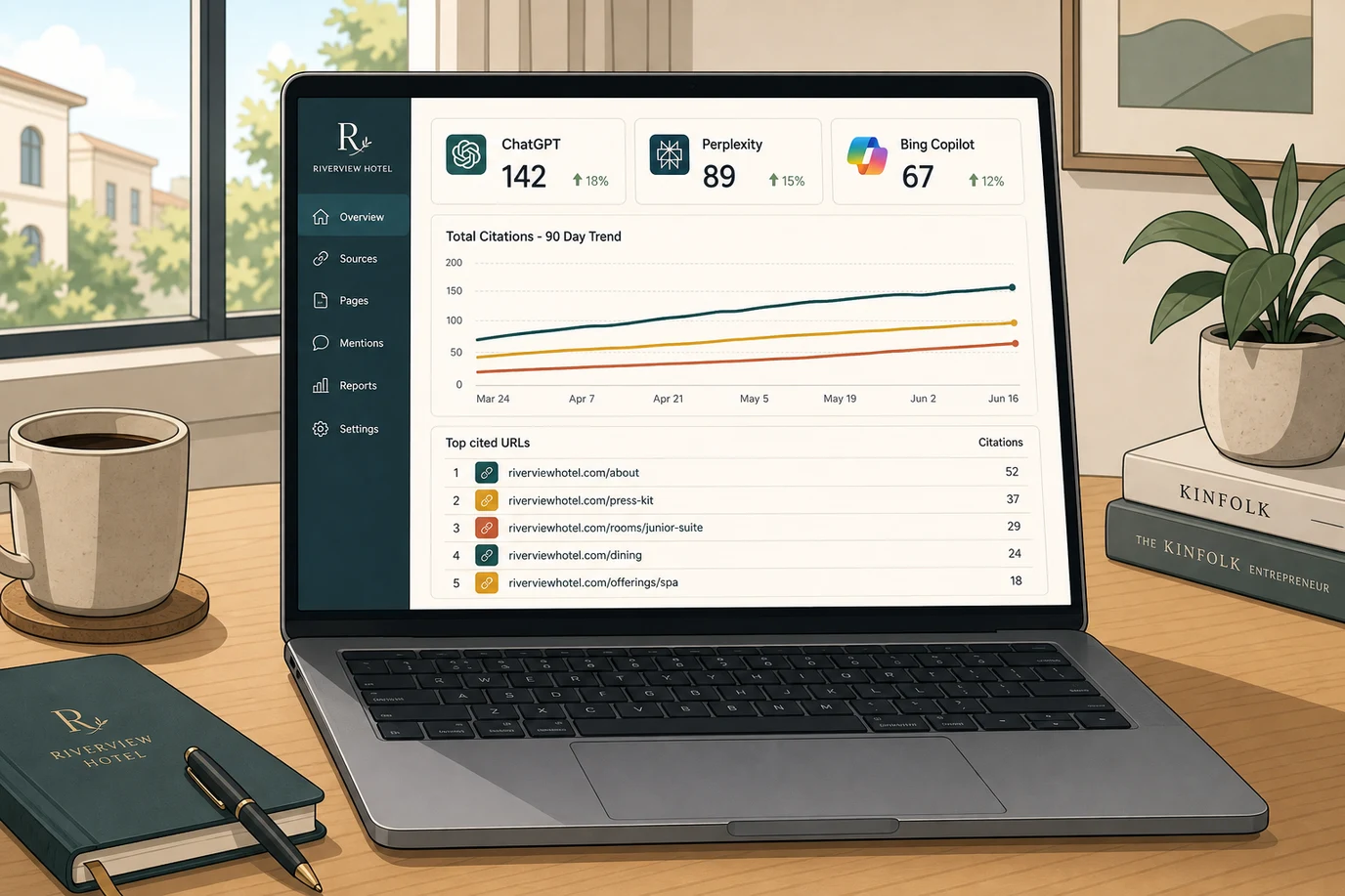
Microsoft launched the AI Performance dashboard inside Bing Webmaster Tools in February 2026, currently in public preview. It reports Total Citations, Average Cited Pages, Page-level Citation Activity, sample grounding queries the system used to construct an answer that mentioned your site, and visibility trends across Microsoft Copilot and Bing AI summaries. It is the most credible AI-citation reporting available from a primary source today. Free.
While you are inside Bing, claim and complete your Bing Places for Business listing the same way you completed Google Business Profile. The fields are similar. The work is similar. The return on attention is much smaller in absolute volume than Google, much higher in 2026 marginal value per hour spent because nobody else in the hotel category is paying attention.
10. Ship an llms.txt, Honestly, for Speculative Value
llms.txt is a proposed text file that lives at the root of your domain (example.com/llms.txt) and gives AI systems a curated, machine-readable index of your most important pages, summary content, and contextual information. The proposal came from Jeremy Howard at Answer.AI in September 2024 and has community traction. As of May 2026, no major AI vendor has officially confirmed that they read third-party llms.txt files for ranking or citation purposes. OpenAI and Anthropic both publish their own llms.txt files for their developer documentation, which is sometimes cited as evidence that they read yours. It is evidence of nothing of the kind. Server-log analyses report request rates against /llms.txt from the major LLM crawlers in the fraction-of-a-percent range.
Two honest framings, take your pick. The first is: shipping an llms.txt costs an hour of work, the file is well-defined, the worst case is no benefit, the best case is that adoption shifts and you are already there. Reasonable speculative bet. The second is: every hour you spend on llms.txt is an hour you are not spending on your Google Business Profile, which the data above says is doing seventy-nine percent of the work. Opportunity-cost reasonable to deprioritize. Either is defensible. The unreasonable position is paying an agency a thousand dollars to do this for you, since the work is two hours and the value is speculative.
The Snake Oil Checklist (What to Refuse to Pay For)
Google's John Mueller, the Search Advocate at Google, said this in August 2025 in a Search Engine Land piece: The higher the urgency, and the stronger the push of new acronyms, the more likely they're just making spam and scamming. It is the cleanest summary of the situation available from a primary source.
Specific patterns to refuse:
Submit your business to ChatGPT for X dollars. There is no submission API. OpenAI does not accept business submissions. Multiple services charge for this. All of them are charging for nothing. The hour you might spend submitting to twenty of them is better spent updating your Google Business Profile.
Guaranteed five-hundred-percent AI citation increase in ninety days. No citation system has guaranteed inclusion mechanics. No vendor has privileged access to LLM training data or retrieval behavior. Anyone guaranteeing a specific lift is guaranteeing something they cannot control. A mid-sized Toronto e-commerce company is documented paying fifty-thousand dollars to an AI optimization expert and seeing zero AI traffic after six months. That story is going to get more common before it gets rarer.
AI-Friendly Site Certification badges. No such certification body exists. There is no W3C-equivalent for AI friendliness. Anyone showing you a badge is showing you an image they made in Canva.
Pay to get your hotel a Wikipedia page. Violates Wikipedia's paid-editing disclosure policy and conflict-of-interest guidelines. The page will be deleted within weeks. Wikidata is the legitimate adjacent move (covered above).
FAQ schema as the secret to AI Overviews. Google deprecated FAQ rich results for general sites in August 2023. The vendor selling this either does not know, or knows and is selling it anyway. Both are reasons to walk away.
AI keyword stuffing. The original GEO research paper tested this directly and it was not in the top-performing tactics. Sold anyway because stuffing is easy to deliver as a service even when the data does not support it.
The general AI optimization expert engagement with no specified deliverables. If a proposed contract for an AI SEO engagement does not enumerate specific pages, specific schema additions, specific crawler rules, specific Wikidata or Google Business Profile actions, and specific measurement methodology, the engagement has no shape and the work will not happen. Walk.
The pattern across all of the above: the legitimate work in AI search visibility is concrete, sourced, and inexpensive. The fraud pattern is abstract, urgent, and premium-priced. A working test for almost any AI optimization pitch is to ask the vendor to point you to the primary source that supports the specific claim they are making. If they cannot, the pitch is theatre.
How to Actually Measure AI Search Visibility in 2026
Four tools, ranked by usefulness. The first is free. The fourth costs four-figures a month and is overkill for almost any independent hotel.
Bing Webmaster Tools AI Performance dashboard. Free, public preview as of February 2026, primary source data from Microsoft for ChatGPT-via-Bing and Copilot visibility. Sign up, verify the domain, wait two weeks for data, then check Total Citations, the sample grounding queries Microsoft shows you, and the page-level citation activity report. Use it as your primary ground-truth source.
Manual prompt audits. Free, fifteen minutes a week, surprisingly accurate as a directional signal. The method: write down ten queries a real guest in your market might type into ChatGPT or Perplexity (boutique hotel sorrento for a couple, quiet small hotel near positano for a weekend, where to stay in sorrento with parking, etc.). Run each query in ChatGPT, Perplexity, and Google AI Mode. Log whether your property appears in the response and what sources the model cites. Repeat weekly. Track week-over-week. Adjust your content based on which sources the models keep citing for queries where you do not appear.
One paid AI-citation tracker. Otterly.AI at twenty-nine dollars a month for the Lite plan (fifteen prompts tracked daily across ChatGPT, Google AI Overviews, Perplexity, and Copilot) is the price-of-entry tool. AthenaHQ at two-hundred-ninety-five a month and Profound from ninety-nine into the thousands sit further up the spend curve. All of them use prompt-and-scrape methodology, all of them produce sample data not ground-truth data, and the value is in the consistency of the prompt set over time more than the absolute numbers. One tool is enough. Two tools comparing different prompt sets will produce different answers and confuse the decision more than help it.
Google Search Console. Does not, as of May 2026, report AI Overview impressions or clicks separately from regular Search. Google has hinted but not shipped. If they ship a dedicated report, treat it as the highest-priority addition to your stack the day it lands. Until then, AI Overview traffic shows up as undifferentiated organic clicks.
One metric that nobody talks about and that we think is meaningful: front-desk and reservation enquiries that mention ChatGPT or Perplexity by name. When a guest calls saying ChatGPT recommended you for our anniversary, that is a measurable, attributable AI-source booking. It is anecdotal data, it does not scale to a dashboard, and it is closer to ground truth than any of the four paid tools above. Train the front-desk team to log it. Six months of logged anecdotes is a real dataset.
A 90-Day Implementation Plan for an Independent Hotel
The full ten-item list above is sequenced and effort-estimated as a quarter of work for one person with no agency support.
Days 1 to 7. Audit robots.txt against the AI crawler list. Fix anything blocking the real-time retrieval crawlers. Set up Bing Webmaster Tools, verify the domain, claim Bing Places for Business if not already done. Complete the Google Business Profile checklist from item two, every field, every photo, every attribute. This is the highest-leverage week.
Days 8 to 21. Tripadvisor cleanup. Respond to every unresponded review of the last six months. Update amenities to match reality. Refresh property photos if they are older than twelve months. Establish a weekly cadence for review response going forward.
Days 22 to 35. Schema deployment. Ship Hotel, LocalBusiness, Place, and Review schema on the relevant pages of your website. Validate with Google's Rich Results Test and Schema.org validator. Fix the warnings.
Days 36 to 49. Content audit and citable-facts pass. Rewrite About, Press Kit, and Property History pages to embed dense, specific, sourceable facts (named numbers, named years, named comparisons). Build out an FAQ section of thirty to fifty natural-language questions with concrete answers, structured one question per page or in clear sections.
Days 50 to 63. Wikidata. Create the Q-item for the property if it does not exist, fill in core structured statements with sources, link to the official website.
Days 64 to 75. Third-party presence. Pitch one travel publication on a story angle related to the property. Engage in three to five relevant city subreddits with helpful (not promotional) answers, identified as the owner or manager. Refresh any tired listicles you appear in via a quick outreach to the original author with updated info.
Days 76 to 83. llms.txt. Ship the file. Speculative bet, low cost, do it because the work is one afternoon.
Days 84 to 90. Measurement loop. Pull the first thirty days of Bing Webmaster Tools AI Performance data. Run a full ten-query manual prompt audit. Decide whether to add one paid tracker. Set the cadence for what becomes the ongoing operating rhythm.
At day 90, the property has a measurably stronger AI search posture than it did at day 0, the work was done in-house, no agency was paid, and the operating rhythm is in place to compound for the next year. Total cash spent if you stay with the Bing-Webmaster-and-manual-audit measurement approach: zero. Total cash spent if you add Otterly.AI Lite: about ninety dollars across the three months. Compare to the fifty-thousand dollars the Toronto company paid for nothing.
How Prostay Handles AI Search Visibility
The Prostay platform ships several pieces of the AI-readiness baseline by default, on the basis that an independent hotel should not have to engineer this manually.
Property content created in Prostay (rooms, amenities, policies, photos, descriptions) is rendered into the public website with Hotel, LodgingBusiness, Place, and GeoCoordinates structured data automatically. Add or change a room type in the back office and the schema updates without a separate developer task. Review and AggregateRating are emitted if you choose to surface guest reviews on the public site.
Robots.txt is generated with the AI-crawler family auto-allowed (with a per-property opt-out toggle for hoteliers who object to training crawlers on principle). The default is permissive because the data above says permissive is correct for almost every property.
The Bing IndexNow protocol is supported on content updates, which means a new blog post or property page change is pushed to Bing within minutes rather than waiting for a routine crawl, which matters disproportionately given the ChatGPT-on-Bing dependency.
FAQ pages, About pages, and Press Kit pages are templated in the platform with prompts that encourage citable-facts content (named numbers, named years, named third-party rankings) rather than generic marketing prose. The templates were designed against the Princeton GEO paper's specific findings on what AI models cite.
The Google Business Profile integration pushes attribute and operational data (hours, amenities, current room types, photos) from Prostay to the Business Profile, which means a hotelier updating once in Prostay does not have to remember to update separately on Google. This is the same integration logic that has always made sense for booking-engine to OTA sync. We apply it here because Google Business Profile is now, per the Hotelrank data, the highest-leverage AI surface for hotel discovery.
None of which is to say Prostay is the only way to do this. A hotel running on any modern PMS or website platform can ship every item on the ten-point list above with manual effort. The practical observation is that the manual effort adds up to two to three weeks of focused work per property per year, which is real, and a platform that builds the baseline into the operating rhythm is usually the difference between getting it done and intending to get it done.
Key Takeaways
AI search in travel is real and growing, but the audited data does not yet support clean share-of-search numbers between ChatGPT and Google. The verifiable anchors are: thirty percent of United States travelers used ChatGPT extensively for trip planning in 2025 (Skift/McKinsey), travel is the lowest-overlap industry between AI Overviews citations and organic top-ten rankings at twenty-three-point-six percent (BrightEdge), and seventy-nine percent of Google AI Mode hotel link clicks route to a Google Business Profile (Hotelrank). Use those numbers, not vendor estimates.
The single highest-impact action is completing and continuously maintaining a Google Business Profile. The second is earning a clean Tripadvisor listing because Perplexity now sources hotel recommendations from a Tripadvisor partnership. The third is auditing robots.txt to ensure you are not blocking the AI crawlers you actually want to allow. Those three actions are eighty percent of the value.
Schema markup helps standard Search eligibility and AI Overviews is downstream of that. Ship Hotel, LocalBusiness, Place, GeoCoordinates, Review, and AggregateRating schema. Do not pay anyone for AI-specific schema, because there isn't any. Do not pay anyone for FAQPage schema as a route to AI Overviews, because Google deprecated FAQ rich results for general sites in August 2023.
Citable facts on About, Press Kit, and Property History pages do real work, per the Princeton GEO paper. The effect is rank-conditional, so low-authority properties should add citations aggressively. Avoid keyword stuffing, which the same paper tested and did not find effective.
Be present where AI models actually look for third-party signals: Reddit (relevant subreddits, helpful and identified, not astroturf), Wikipedia (only if you genuinely clear notability, otherwise file a Wikidata entry which is the legitimate adjacent move), and Tripadvisor (response coverage matters more than star count).
Bing Webmaster Tools is free, the AI Performance dashboard launched February 2026, and it is the closest thing to ground truth on AI citation that exists from a primary source. Use it. Supplement with manual prompt audits weekly. One paid tracker is plenty if you want one. Four tools comparing different prompt sets is wasteful.
The snake oil is loud, urgent, and expensive. Submit your business to ChatGPT, Guaranteed 500% AI citation increase, AI-Friendly Site Certification badges, buy a Wikipedia page, FAQ schema as the secret to AIO, AI keyword stuffing, and the general expert engagement with no enumerated deliverables. Refuse all of them. The legitimate work is concrete, sourced, and runnable in-house in ninety days for under one-hundred dollars total cash.
The five-figure AI optimization invoice the agency is sending you is the most expensive part of your AI strategy this year. The Google Business Profile your night manager could update for free this week is the most valuable. The job of the marketing lead at an independent hotel in 2026 is to know which is which. Prostay Nexus ships the technical AI-readiness baseline (schema, robots.txt defaults, Bing IndexNow, Google Business Profile sync) by default, which removes the engineering layer from the discussion so the energy can go into the genuine high-leverage actions. A live demo is the fastest way to see whether that baseline matches how you actually want to operate.