
Ask an independent hotelier what they spend on marketing and they will mention the website, maybe some ads, perhaps a photographer. The real answer is usually none of those. For most properties, the single largest marketing expense is OTA commission: 15 to 25 percent of every Booking.com, Expedia and Agoda reservation, taken quietly at source, every night of the year. A hotel doing €400,000 a year through the channels at 18 percent hands over €72,000, more than a full-time salary, without ever writing a cheque. The good news is that this bill responds to management like any other cost, and the two tools that move it most are a booking engine that converts the guests who find you and a channel manager that lets you steer the mix deliberately.
One thing this article will not tell you is to leave the OTAs. That advice sounds brave and costs a fortune: the platforms bring demand most independents cannot replace, and commission on a room you would never have sold is a fair price for a guest you would never have met. The waste sits elsewhere, in commission paid on guests who already knew you, on repeat visitors booking their third stay through an intermediary, on programs that raise your rate without raising your occupancy. The goal is not zero OTA bookings. It is zero unnecessary commission, and there is usually a lot of it.
First, Know Your Real Number
Before touching any lever, establish what you actually pay, because almost nobody knows. The contractual rate is only the start. Add the preferred partner points if you are enrolled, the visibility boosters someone switched on two years ago, the stacked discount campaigns that quietly widen the gap between the rate you set and the money that arrives. Then divide the total of all fees by your total OTA revenue for the last twelve months. That is your effective commission rate, and it is routinely three to six points above the number the owner would quote from memory.
While you are at it, compute the same figure per channel and per month. The spread is where the decisions hide: one platform may be delivering bookings at an effective 17 percent while another, after boosters and campaigns, is costing 28 for the same kind of guest. And the seasonal view matters even more, because commission that is acceptable in a need period is pure leakage in the weeks you would have sold out anyway. Nothing in the rest of this article works without this baseline; every lever below is judged by whether it moves this number without moving occupancy the wrong way.
Why Leaving the OTAs Is the Wrong Goal
It is worth spelling out why the dramatic option fails, because the fantasy of delisting recurs in every owners' forum. The OTAs spend more on advertising in a week than most independent hotels will in a lifetime; they own the first page of search results for every destination-plus-hotel phrase; and for international and first-time travellers they are not a channel but the market itself. Properties that delist typically watch occupancy drop far faster than the commission savings accumulate, then return within a year on worse terms and with a lower ranking than they left with, since the algorithms reward continuous conversion history.
There is also an honest accounting point. A 20 percent commission on a €150 room is €30. If your own acquisition path for that same anonymous first-time guest is paid search, metasearch fees and agency management, you may not beat €30 by much, and sometimes you will not beat it at all. The OTA is often a reasonable deal for the guest who has never heard of you. It is a terrible deal for the guest who has, and the entire strategy that follows rests on separating those two.
The Billboard Effect, and the Guests You Are Overpaying For
The billboard effect is the industry's name for a pattern you can watch in your own analytics: a traveller finds your property on an OTA, then opens a new tab and searches your name. They want to see your real photos, read your site, check whether booking direct is better. At that moment the OTA has done its job, the introduction, and what happens next is entirely up to you. If your website loads fast, answers their questions and offers a booking path as smooth as the platform's, you win the booking and the commission stays home. If the site is slow, the engine asks for twelve fields before showing a price, or the rate is worse than the OTA's, they go back, and you pay full commission on a guest who was standing in your lobby, digitally speaking, minutes earlier.
This is why the commission conversation starts with your own funnel rather than with the OTAs. Every guest who searched your name and still booked through a platform is the purest form of commission waste: the demand was already yours, the acquisition already paid for by the OTA's billboard, and the 15 to 25 percent bought nothing. Industry studies have long put the share of OTA-influenced guests who visit the hotel's own site before booking at well over half. Your job is not to out-market Booking.com. It is to stop fumbling the handover it gives you for free.
Lever One: Shift the Shiftable Bookings to Direct
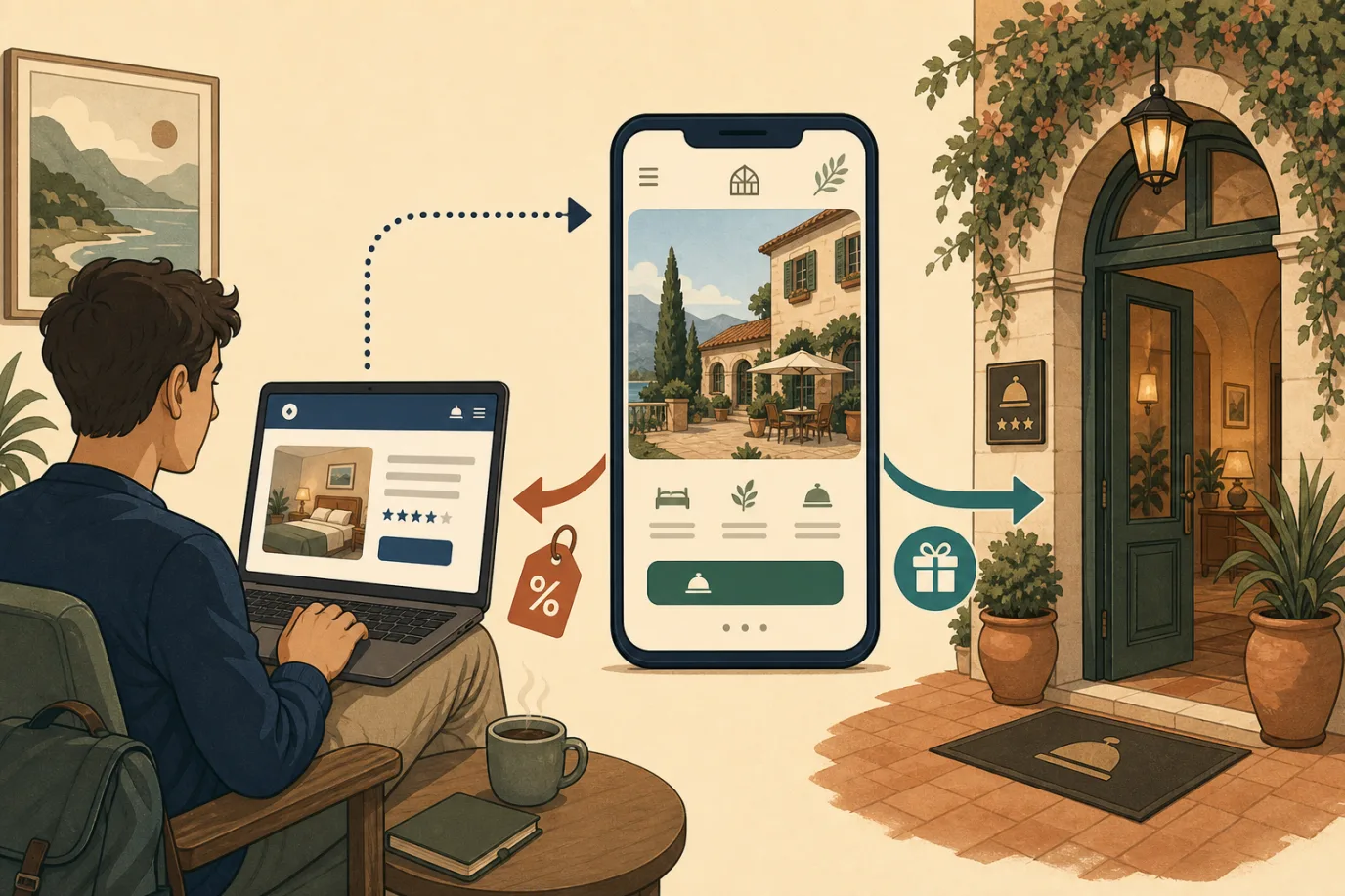
Not all OTA bookings can move. The anonymous first-timer comparing twenty hotels in a city they have never visited is the platform's guest, and that is fine. The shiftable segment is everyone else: name-searchers, past guests, referrals, locals booking for visiting family, the wedding block that heard about you from the couple. For most independents this shiftable share is somewhere between a fifth and a half of current OTA volume, which is exactly why the direct-shift lever pays better than any negotiation with the platforms ever will.
A Website and Booking Engine That Can Actually Convert
The baseline is unglamorous: a website that loads in under three seconds on a phone, real photography, prices visible without a login, and a booking engine that gets from dates to confirmation in a couple of minutes without demanding an account. Every extra form field and every surprise fee at the last step sends a percentage of your name-searchers back to the tab they came from. The test is brutal and worth running honestly: sit someone unfamiliar with your site in front of it with a phone and time them from arrival to a completed test booking. If it takes visibly longer than the same booking on Booking.com, the commission you pay on name-searchers is a design decision, not a market condition.
Give Guests a Reason: Perks Beat Price Cuts
Then give the guest a visible reason to finish the booking with you. Undercutting the OTA on public price is often contractually fenced and always margin-eroding; value beats discounting. Free early check-in or late checkout when available, a welcome drink, a room-upgrade priority, better cancellation terms, breakfast included in the direct rate: each costs far less than the €25 to €40 of commission it replaces, and each is something the platform structurally cannot offer. Say it on the website, plainly: book direct and get X. The properties that do this well treat the direct-booking pitch as a permanent fixture of the site, not a banner that appears when occupancy dips.
One channel sits between the platforms and pure direct and deserves a mention: metasearch. Google's hotel results, Trivago and Kayak show your direct rate alongside the OTAs' and link straight to your booking engine, usually on a per-click or per-booking fee well below OTA commission. For a property whose website and engine already convert, listing the direct rate there catches comparison shoppers at exactly the moment they decide where to book, and the economics beat the platform fee on every booking it wins.
Lever Two: Never Pay Commission Twice for the Same Guest
The first commission on a new guest is an acquisition cost. The second is a process failure. A guest who has slept in your beds, eaten your breakfast and talked to your team should never again be worth 18 percent to an intermediary, and yet repeat guests routinely rebook through the OTA simply because that is where the app and the saved card details live. Breaking that habit is the highest-margin marketing work a small hotel can do, and it happens at the desk, not online.
The mechanics are simple and mostly ignored. Capture a real email address and consent at check-in, every guest, every time, including OTA guests, which is entirely legitimate: the platform owns the booking, not the human. At checkout, make the next stay concrete rather than theoretical: guests who book direct next time get the better cancellation terms and the perk, here is the card, here is the code. Then actually use the list: a short message a few weeks before their season, a genuine offer for returning guests, a birthday or anniversary note if you collected the date. None of this is sophisticated. It is the difference between a guest database and a pile of registration forms, and it compounds: every converted repeat guest is commission saved on every future stay, not just one.
Do the arithmetic once to motivate the habit: a hotel with 30 percent repeat business and €400,000 of OTA revenue is paying roughly €20,000 a year in commission on people who already chose it before opening the app. That is the budget for the perks, the emails and the desk training many times over.
Lever Three: Audit the Programs That Raise Your Rate
The headline commission is only part of the bill. The platforms earn the rest through optional programs that are easy to switch on, hard to evaluate and rarely reviewed, and this is where an hour of audit often finds immediate money.
Preferred Partner and Visibility Boosters
Preferred and boosted placements add three to five points of commission, or a bid-style fee, in exchange for better ranking. The trap is structural: the extra points apply to all your bookings through the channel, including the majority you would have received anyway, while the benefit is only the increment. The honest test is seasonal A/B: run the program in your genuinely soft periods, switch it off for the weeks you fill regardless, and compare effective commission against occupancy both ways. Most properties that run this test keep the program for the shoulder season and drop it for peak, saving several points on their busiest, most profitable weeks. Leaving it on all year because someone enabled it in a bad month three years ago is the most common single piece of commission waste we see.
Discount Programs That Stack
The same discipline applies to the discount machinery: mobile rates, geo rates, early-access deals, campaign participation. Each looks small alone; stacked, they can take a further 10 to 20 percent off the rate before commission is even calculated, which arithmetically behaves exactly like more commission. Check how the discounts combine, cap what can stack, and point the aggressive discounts at the dates that need them rather than blanket-enrolling the calendar. The platforms design these programs to be opt-out rather than opt-in for a reason; your job is to make every one of them a deliberate choice with a date range attached.
Lever Four: Manage the Mix, Not Just the Rate
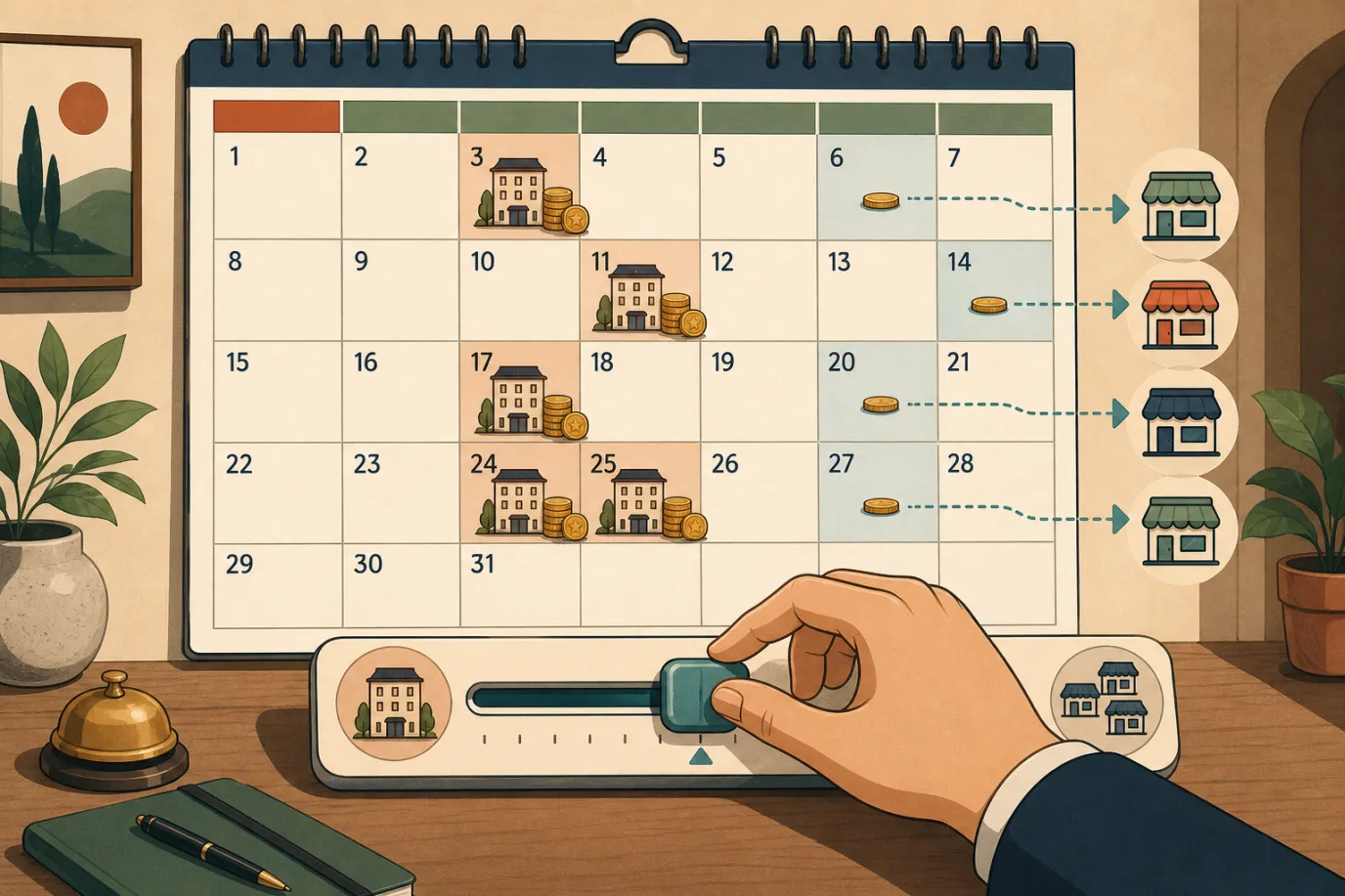
Commission is not an annual constant; it is a per-date decision. The nights your market fills you regardless, festival weekends, peak season, the conference week, are the nights every OTA booking displaces a cheaper one, and the nights a platform books in your need periods are worth every point of the fee. Managing this means treating channel availability like inventory: keep the OTAs wide open where pace is behind, and tighten allocations, lengthen minimum stays or close the discounted rate plans on dates that historically sell out. A booking curve by channel makes this almost mechanical; if you know a date reaches full occupancy from direct and corporate demand alone by thirty days out, OTA availability there in the final month is a donation.
This is also where the previous levers compound. The stronger your direct channel becomes, the more dates can be protected, and the more the OTA spend concentrates on the periods where it genuinely earns its fee. A property that moves from 70 percent OTA share to 55 has not just saved commission on fifteen points of revenue; it has bought itself the freedom to use the platforms tactically instead of structurally.
Lever Five: Earn Commission-Free Revenue on OTA Guests
The commission applies to the room rate. It does not apply to anything the guest buys after booking, and this is the lever properties forget entirely: an OTA guest, once captured, is a direct customer for everything else. Pre-arrival upsells, the upgrade offer, early check-in, the airport transfer, the dinner reservation, land in the days between booking and arrival, when anticipation is high and the message arrives from you, not the platform. On-property spend, breakfast added at the desk, the spa slot, the dive trip, the late checkout, is entirely yours. A €150 OTA booking at 18 percent yields €123; add €40 of ancillaries and the effective commission on the total falls under 12 percent without the platform's terms changing at all.
The prerequisite is being able to reach the guest between booking and arrival, which means capturing contact details early and having a channel to message them on. Done systematically, ancillary revenue does not just dilute commission; it converts your most expensive bookings into your best data, because every pre-arrival exchange is a relationship the OTA never sees.
The Math: What a Ten-Point Shift Is Worth
Put the levers together with real numbers, because the total is easy to underestimate. Take a 30-room property averaging €120 a night at 70 percent occupancy: roughly €920,000 of room revenue. At 70 percent OTA share and an effective 20 percent commission, the annual bill is about €128,000. Now run the levers: shift ten points of share to direct (worth about €18,000), cut the effective rate by two points through the program audit and seasonal boosts (about €11,000 on the remaining volume), and add €15 of average commission-free ancillary spend per OTA booking. The combined effect approaches €40,000 a year, without a single room sold cheaper and without leaving any platform. That is the scale of the opportunity sitting inside a bill most owners have never itemised.
Notice also what was not on the list: no heroic ad budget, no price war, no delisting. Every lever was either process, capture the email, audit the programs, protect the sold-out dates, or product, a booking engine that converts, a perk that beats the platform. Commission reduction is operations, not marketing bravado.
Negotiating With the OTAs, and What Rate Parity Really Allows
Can you simply negotiate the rate down? Sometimes, and it costs nothing to try, but go in with realistic expectations. The headline commission is close to fixed for an independent property; the platforms negotiate real reductions with chains and large groups, not with thirty rooms. What is genuinely negotiable sits around the edges: which optional programs you join and when, campaign participation, and occasionally a temporary reduction tied to a ranking push in a need period. Your market manager is the route for all of it, and the relationship is worth maintaining for a different reason too: they see your market's demand data and will tell you things about your own pace that your competitors already know. Treat the call as intelligence gathering first and negotiation second.
Rate parity deserves the same clear-eyed reading, because owners routinely believe they are more constrained than they are. Wide parity clauses, promising never to publish a lower rate anywhere, persist in many contracts, but they bind the public price only. Almost everywhere, you remain free to offer lower rates through unpublished channels: email offers to your own list, phone and walk-in rates, member rates behind a login, corporate agreements and packages whose components cannot be compared line by line. Several European jurisdictions have restricted or voided parity clauses outright, so what your contract can enforce depends on where you operate; it is worth twenty minutes with the actual text rather than the folklore version of it. In practice, the fenced space, perks, terms, unpublished rates and packaging, is large enough that very few properties ever exhaust what parity actually permits before assuming they are not allowed to compete.
Where Prostay Fits
Every lever above has a tooling requirement underneath it, and this is where the property management system either helps or quietly sabotages. The direct shift needs a booking engine on your own site that converts name-searchers instead of leaking them; Prostay's sits on the same inventory as everything else, so the direct rate, the perks and the availability are always current. Mix management needs a channel manager that opens, closes and re-prices channels per date from one screen rather than five extranets. The repeat-guest lever needs guest profiles that survive the stay, capturing emails and history so the second booking never costs 18 percent again. And the ancillary lever needs pre-arrival messaging and upsells that reach OTA guests directly. The commission bill itself should be visible too: channel production and effective cost per channel belong on a report you check monthly, not in an annual accounting surprise.
None of that is unique to us, and the test you should apply to any system is the same: can you see this month's effective commission per channel in under a minute, change a date's channel availability in one action, and message an OTA guest before arrival without touching the extranet? If the answer is yes, your software is on your side of this fight. If it is no, part of your commission bill is really a software bill wearing a disguise.
Frequently Asked Questions
The questions owners ask most about OTA commissions, what the platforms actually charge, whether to leave, what rate parity allows and which programs are worth it, answered with the arithmetic that should drive each decision.