
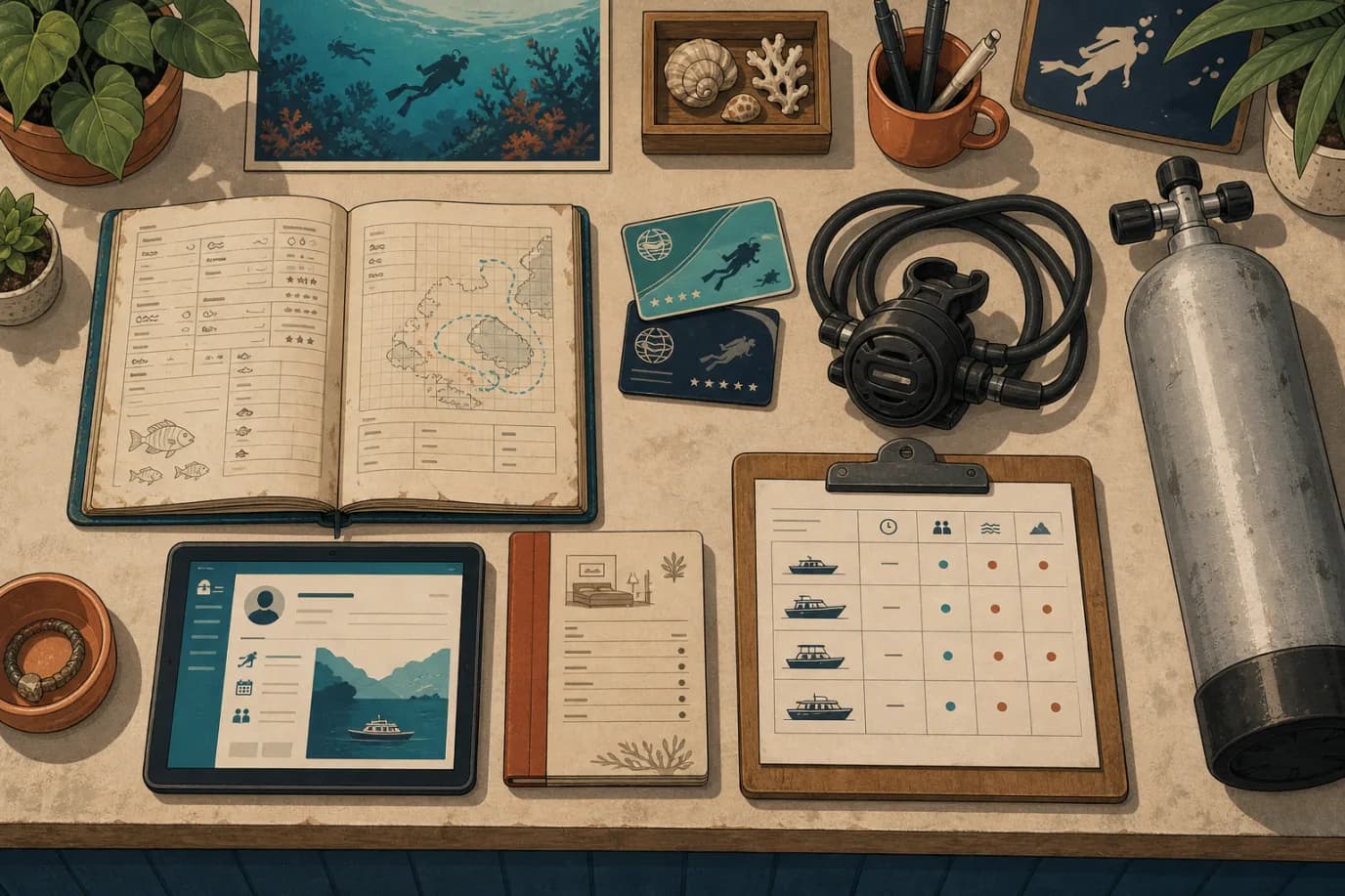
Walk the dock of a busy dive resort at seven in the morning and you will see the operation that quietly funds a large slice of the property. Two boats loading tanks, an instructor counting heads against a clipboard, a guest who swears they booked the wreck dive and is not on the list, and a dive master trying to remember whether the couple from room 214 ever signed their medical forms. The dive centre is often the single most profitable square metre on the property, and on most resorts it is run on a whiteboard, a paper logbook and a piece of software that has never once spoken to the front desk. Dive centre management that lives inside the same platform as the rooms is the fix, and it is less exotic than it sounds: it is just refusing to run the busiest part of the hotel as an island.
The cost of that island is easy to underestimate because it never shows up as a line on an invoice. It is the boat that went out with two empty seats while a walk-in was turned away, the rental BCD that never came back because nobody logged who took it, the open-water course that clashed with the instructor's day off, and the checkout where the front desk rebuilds three days of dives from a stack of paper chits. When the dive centre runs separately from the property management system, every one of those is somebody's job to patch by hand, every day, and the patching is where the money leaks.
One disclosure before we go on. I write for Prostay, so the section near the end about how our own product handles this is interest, not neutral advice, and it is labelled as such. Everything before it holds true whatever software you run, including no software at all.
The Dive Centre Is the Resort's Best Upsell and Its Worst-Run System
Think about what the dive centre actually sells. A guest arrives for a week. On day one they try a discover-scuba session in the pool. By day three they have signed up for an open-water course. By day five they are buying a two-tank boat dive every morning, renting a full kit, filling nitrox, and picking up a mask and a dive computer from the retail shelf on the way out. A single guest can turn a room booking into several hundred dollars of extra spend, and unlike the room, most of that spend is high-margin and booked on the spot.
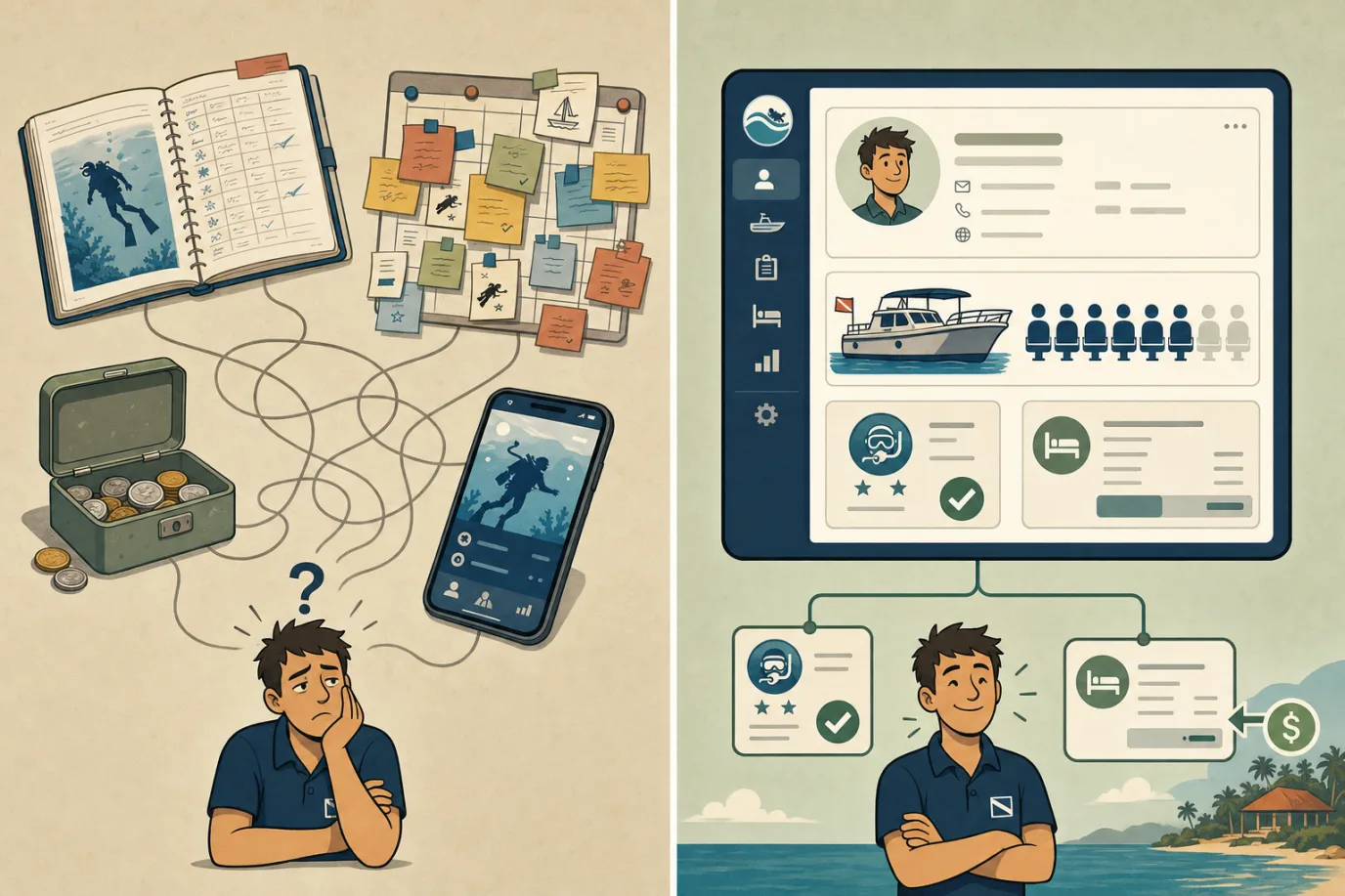
That is the opportunity. The problem is that the system meant to capture it is usually the least organised one on the property. The bookings live on a wall planner. The certifications live in a drawer. The gear lives in a shed with a sign-out sheet nobody fills in after lunch. The money lives in a cash tin and a separate card terminal whose total never quite matches the chits at the end of the night. None of this is incompetence. It is what happens when a high-volume operation grows on tools that were never designed to talk to each other.
The mismatch matters because diving is unforgiving of sloppy admin in a way that a spa booking is not. Put the wrong certification level on a dive and you have a safety problem, not a service hiccup. Lose track of which tank was last tested and you have a cylinder you should not be filling. Double-book the boat and someone's holiday morning is ruined before breakfast. The dive centre needs the tightest operational system on the property, and it usually has the loosest.
Why Dedicated Dive Shop Software Stops at the Water's Edge
Plenty of dive centres do buy software. There is a healthy market of dive shop and dive booking tools, and the good ones handle the diving side well: trip calendars, certification fields, gear hire, course progress, even air-fill logs. If the dive centre were a standalone shop on the high street, one of these would be the whole answer.
A resort dive centre is not a standalone shop. It is one revenue centre inside a hotel, and that changes the maths. The guest who dives at nine has a room they checked into yesterday, a folio that already has a dinner and a spa treatment on it, a card on file from check-in, and a profile the front desk built when they arrived. Standalone dive software knows none of that. So every booking starts by retyping the guest's name and contact details, every payment is taken separately on the dive centre's own terminal, and at the end of the stay you have two systems with two versions of what the guest spent and no easy way to merge them.
The friction shows up in small, daily ways. A guest wants to add a night dive to the room rather than pay cash on the dock, and the answer is no, because the dive system cannot post to the folio. The front desk wants to comp a course as part of a package deal, and they cannot, because the course lives in a different tool. A manager wants one number for how the property performed yesterday, rooms plus food and beverage plus diving, and instead gets three exports that have to be stitched together in a spreadsheet. Dedicated dive software is not bad at diving. It is just blind to everything the rest of the hotel knows, and that blindness is expensive.
There is also the quieter cost of two sources of truth. When a guest's certification is recorded in the dive app but their identity is recorded in the PMS, the two drift. A name is spelled differently. A repeat guest is a new record in one system and a returning VIP in the other. Reconciling them is nobody's favourite afternoon, so mostly it does not happen, and the resort loses the thread on its best customers exactly where it matters most.
What Running It Inside the Hotel System Actually Changes
Strip away the feature list and integrating the dive centre into the hotel system does two things. It gives every diver a single profile that the whole property shares, and it puts every dive charge on the room folio. Almost every other benefit flows from those two.
One Guest Profile, From Check-In to the Boat
When the dive centre reads from the same guest record as the front desk, the booking stops starting from zero. The dive manager pulls up the guest, sees their room, their departure date, the card on file, and the certification level already stored against their profile from a previous stay or from the forms they signed on arrival. Booking a dive becomes a matter of choosing the trip and confirming, not re-entering a person who is already a guest of the hotel. A returning diver who was here last season is recognised, with their kit sizes and their last certification still on record.
That shared profile is also what makes the safety checks real instead of theatrical. Because the system knows the diver's certification and the requirements of the dive, it can refuse a booking that does not match, an open-water diver onto a deep technical dive, for example, before anyone is standing on the boat in a wetsuit. The check happens at the point of booking, where it is cheap to fix, not on the dock, where it is a confrontation.
Every Dive Charge on the Room Folio
The second change is the one guests feel most. A two-tank dive, a nitrox surcharge, a week of equipment rental, a replacement mask strap from the shop: each posts to the room folio the instant it is booked or sold, itemised, with the date and the diver's name. The guest does not queue at the dive centre to settle up. They do not carry cash to the dock. They check out once, at the front desk, and the dives are simply there on the bill with everything else, clearly labelled.
For the property, this is the difference between a clean close and a nightly reconciliation. There is no separate dive till to balance, no stack of chits to key in, no cash drifting between the dock and the safe. Revenue lands in the same ledger as rooms and restaurant, so the daily report is one number and the accounting is one set of books. The folio becomes the single record of what the guest owes, which is exactly what a folio is supposed to be.
Scheduling Trips, Courses and Instructors Without Double-Booking
The daily schedule is where a dive centre lives or dies. Get it right and the boats run full, the instructors are matched to the right divers, and the morning leaves on time. Get it wrong and you are turning guests away from a half-empty boat, or worse, putting eight divers in the water with one guide who should have had four.
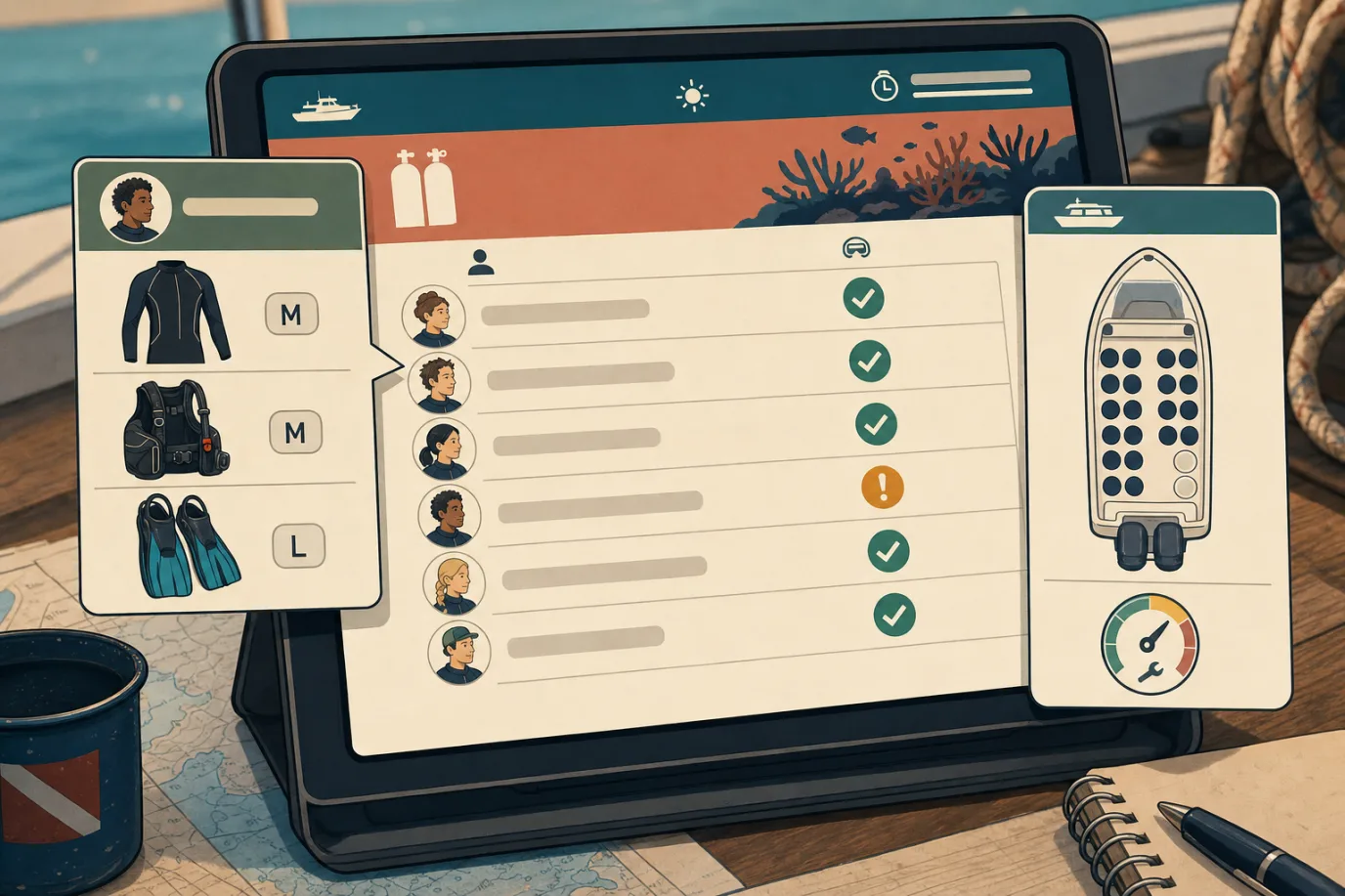
A proper dive schedule is not a single calendar. It is several things stacked on top of each other that all have to agree. There is the trip itself, the nine o'clock two-tank dive to the reef, with a departure time and a site. There is the boat that trip runs on, which has a fixed number of seats. There are the instructors and dive masters assigned to it, each of whom can only be in one place at once and can only safely supervise so many divers. And there are the divers booked onto it, each of whom needs the right certification for the site. Scheduling software for a dive centre has to hold all four together, so that booking a tenth diver onto a nine-seat boat is simply not possible, and assigning an instructor who is already teaching a course at the same time throws an error instead of a crisis.
Courses add another layer because they run across days, not hours. An open-water course might be three days of pool sessions, theory and open-water dives, with a specific instructor and a minimum and maximum number of students. The schedule has to reserve that instructor across the whole course, not just one slot, and it has to know that a student halfway through a course is committed and cannot be casually rebooked onto a fun dive that clashes with their training. When all of this sits in one view, the dive manager builds the next day in minutes and can see at a glance where the gaps and the clashes are. When it sits on a whiteboard, the same job is guesswork, and the guesswork fails on the busiest mornings, which are precisely the ones you cannot afford to get wrong.
The payoff of getting scheduling into software is not only avoiding disasters. It is filling capacity. When you can see that tomorrow's afternoon boat has four empty seats, you can have the front desk offer them to guests at check-in, push a message to in-house divers, or open them to walk-ins, instead of letting the boat leave half full because nobody knew the space was there.
Fleet Management: Boats, Maintenance and the Asset Register
Boats are the most expensive thing a dive centre owns and the easiest to manage badly. A resort might run two or three vessels, each with its own capacity, its own engine hours, and its own maintenance schedule that, if ignored, turns a planned service into a breakdown on a Saturday with twelve guests aboard. Fleet management is the part of dive centre software that treats each boat as an asset with a life of its own, not just a name on the trip schedule.
In practice that means three things working together. First, each boat has its own daily schedule and passenger capacity, so the system knows that the larger boat seats sixteen and the rib seats eight, and it will not let you overbook either. Second, each boat has a maintenance log tied to running hours, so when an engine approaches its service interval the system flags it before the trip is booked, and you can take the boat out of rotation on a quiet Tuesday rather than cancelling a full Saturday. Third, the boat sits in a wider asset register alongside the compressors, the cylinders, the regulators and the rest of the capital kit, each with its own inspection and test dates.
That asset register is quietly one of the most useful things a dive centre can have, because so much dive equipment has a legal or manufacturer-set lifespan. Scuba cylinders need a visual inspection roughly every year and a hydrostatic test every few years, depending on the jurisdiction and the cylinder. Compressors need their filters and air quality tested on a schedule. Regulators get serviced annually. When all of that is tracked as asset data with dates attached, the system can warn you that three cylinders are due for a visual inspection next month, instead of a staff member noticing a long-expired sticker on the morning a guest has already paid for the dive. The boat that breaks down and the tank that should not have been filled are the same failure: an asset whose maintenance fell off a list that lived in someone's head. Fleet management is how you stop keeping that list in your head.
Certifications, Medicals and the Liability Paper Trail
Diving is one of the few hotel activities where the paperwork is not bureaucracy for its own sake. A certification card proves a guest is trained to do the dive they are booking. A medical questionnaire flags a heart condition that genuinely matters at depth. A liability release is the document that protects the business if something goes wrong. Run these on paper and they are a drawer of forms nobody can find under pressure. Run them in the system and they become checks that actually prevent the problem.
Each diver profile holds the essentials: certification level and agency, whether that is PADI, SSI, RAID, SDI or another, the certification number, and the date of their last dive, which matters because a diver who has not been wet in two years may need a refresher before a challenging site. When a diver is booked onto a trip, the system compares their certification against the requirements of the dive and stops the booking if they do not match. No instructor has to be the bad guy on the dock explaining why an open-water diver cannot join the deep wreck.
The medical and liability side moves to digital forms signed before the diver is ever added to a manifest. The guest completes the medical questionnaire and the liability release on a tablet or their own phone, the answers are stored against their profile, and a missing or incomplete form blocks them from the boat until it is done. The signed documents stay attached to the guest, dated, so if a question is ever raised months later, the record exists and is findable in seconds rather than being a frantic search through a filing cabinet. This is not about adding admin. It is about making the admin you are already legally required to do impossible to skip and trivial to retrieve.
Rental Gear and Retail as Real Inventory
A dive centre is also a small shop and a hire business, and both leak money when the stock is not tracked. Rental gear is the obvious one. A resort owns a finite number of BCDs, regulators, wetsuits and computers in a range of sizes, and on a busy week demand can outstrip supply. Without a system, the only way to know whether there is a medium BCD free for tomorrow is to walk to the shed and look. With one, rental gear is inventory: each item is assigned to a diver for the dates they need it, you can see what is available before you promise it, and an item that has not come back is flagged against the guest who took it rather than quietly disappearing.
Tracking gear as inventory also feeds maintenance, the same way the boats do. A regulator that has done a certain number of rentals, or a wetsuit reaching the end of its life, can be retired on schedule rather than failing on a guest. And because rental charges post to the folio like everything else, a week of equipment hire is simply a line on the bill, not a cash transaction someone has to remember to record.
Retail is the other half. Dive centres sell masks, fins, snorkels, computers, spare straps, sun cream and branded shirts, and these move through the same point of sale and the same folio as a dive. When a guest grabs a mask on the way out, it is rung up against their room in seconds, stock ticks down by one, and the item appears on their checkout bill alongside their dives. Treating rental and retail as proper inventory, connected to billing, turns the dive shop from a leaky cash business into a measured revenue centre you can actually manage.
Three Days at a Dive Resort, With and Without One System
The case for joining the dive centre to the hotel is clearest in the moments where a guest's holiday and the property's revenue both hang on whether the systems agree. Here are three, told twice.
Arrival: The Discover-Scuba Upsell
A family checks in. Without one system, the receptionist hands them a printed dive centre flyer and hopes they wander down later; most do not. With one system, the receptionist can see there is space on tomorrow's discover-scuba session, mention it at check-in, book the kids in on the spot and post the charge to the room, all without leaving the front desk screen. The upsell happens at the one moment the guest is standing right there and excited, and it is captured in the same breath as the room key. That is revenue that simply evaporates when the dive centre is a separate building with a separate system.
Mid-Stay: The Certification Course
One of the kids loves it and wants to do their open-water certification. Without one system, signing them up means a new record in the dive software, a fresh set of paper forms, a parent hunting for a card to pay a deposit, and an instructor's schedule that may or may not actually be free. With one system, the guest is already known, the medical and consent forms are sent to the parent's phone to sign, the course checks the instructor's availability across all three days before it confirms, and the fee goes on the room. The course that might have been lost to friction becomes a booking that takes two minutes.
Checkout: One Bill, No Reconciliation
The family leaves on Saturday. Without one system, checkout is the awkward part: the front desk has the room and the restaurant, the dive centre has its own tally on a separate terminal, and the two have to be married up while the family waits with their bags and a taxi outside. Something is always missed, in the guest's favour or the hotel's, and neither is good. With one system, the dives, the course, the gear rental and the mask from the shop are all already on the folio, itemised by day. Checkout is one bill, settled once, with nothing to reconstruct. The family remembers a smooth departure, and the property captured every dollar of what was, for them, a very profitable week.
What It Costs and How to Phase It In
Pricing for a dive module is usually structured the way the rest of a modern hotel platform is: an add-on to the core system, charged per property per month, switched on for the resorts that actually have a dive centre and left off for everyone else. The point worth holding any vendor to is that the dive centre should not be a separate product with its own contract, its own login and its own bill. It should be a module of the platform you already run the rooms on, so the guest profile, the folio and the reporting are shared rather than bridged.
The phased rollout matters more than the price, because a dive centre cannot stop operating while you change systems. The sequence that works is to start with the part that touches money. Connect billing first, so that dives, courses, rentals and retail post to the folio, and the nightly reconciliation problem disappears on day one. Next, move the schedule into the system, the boats, the trips, the courses and the instructor roster, so the daily plan stops living on a wall. Then bring certifications and the digital medical and liability forms across, so the safety checks become part of booking. Finally, load the asset register, the boats, compressors and cylinders with their service and test dates, so maintenance stops being a memory test. Treated as four steps over a few weeks, the change is calm. Attempted as one big switch in peak season, it is reckless. Pick a quiet month and move one piece at a time.
A fair warning on data. Bring your diver records across cleanly, certification levels, numbers and gear sizes for your regulars, because that history is part of what makes a returning guest feel known. Budget an afternoon to tidy it before it goes in, rather than importing years of half-kept spreadsheets and inheriting the mess.
Where Prostay Fits, Honestly
The disclosure first, again: I write for Prostay, so read this as interest rather than neutral analysis. The narrow, honest point is that the dive centre described above is what the Prostay Dive Centre Management module is, built into the same platform as the property management system, the point of sale and the booking engine. The guest profile beside every dive booking is native rather than a fragile sync, the dive charges land on the same folio as the room, and the boats, courses, certifications and gear all sit in one place with the rest of the hotel.
That does not make Prostay the only sensible choice for every dive operation. A large, standalone dive centre that is not attached to a hotel may be better served by dedicated dive shop software built only for diving. The case for running it inside the hotel platform is specifically for resorts and hotels where the dive centre is one revenue centre among several and the guest is shared. The test to apply, to us as much as anyone, is concrete: does the dive booking read from the same guest profile as the front desk; do dive charges post straight to the room folio; does the schedule hold boats, courses and instructors together so it can refuse an impossible booking; does it manage boat maintenance and the cylinder test dates as real asset data; and are certifications and signed medical forms enforced before a diver reaches the boat. If you want to judge it properly, do not watch a tidy demo. Hand a vendor a real week from your own dive centre, the bookings, the clashes, the no-shows and the gear, and see whether the system would have run it.
Frequently Asked Questions
The questions resort operators ask most about running a dive centre inside the hotel system, on billing, certifications, boats and how it differs from standalone dive software, answered from how these operations actually behave rather than from a brochure.