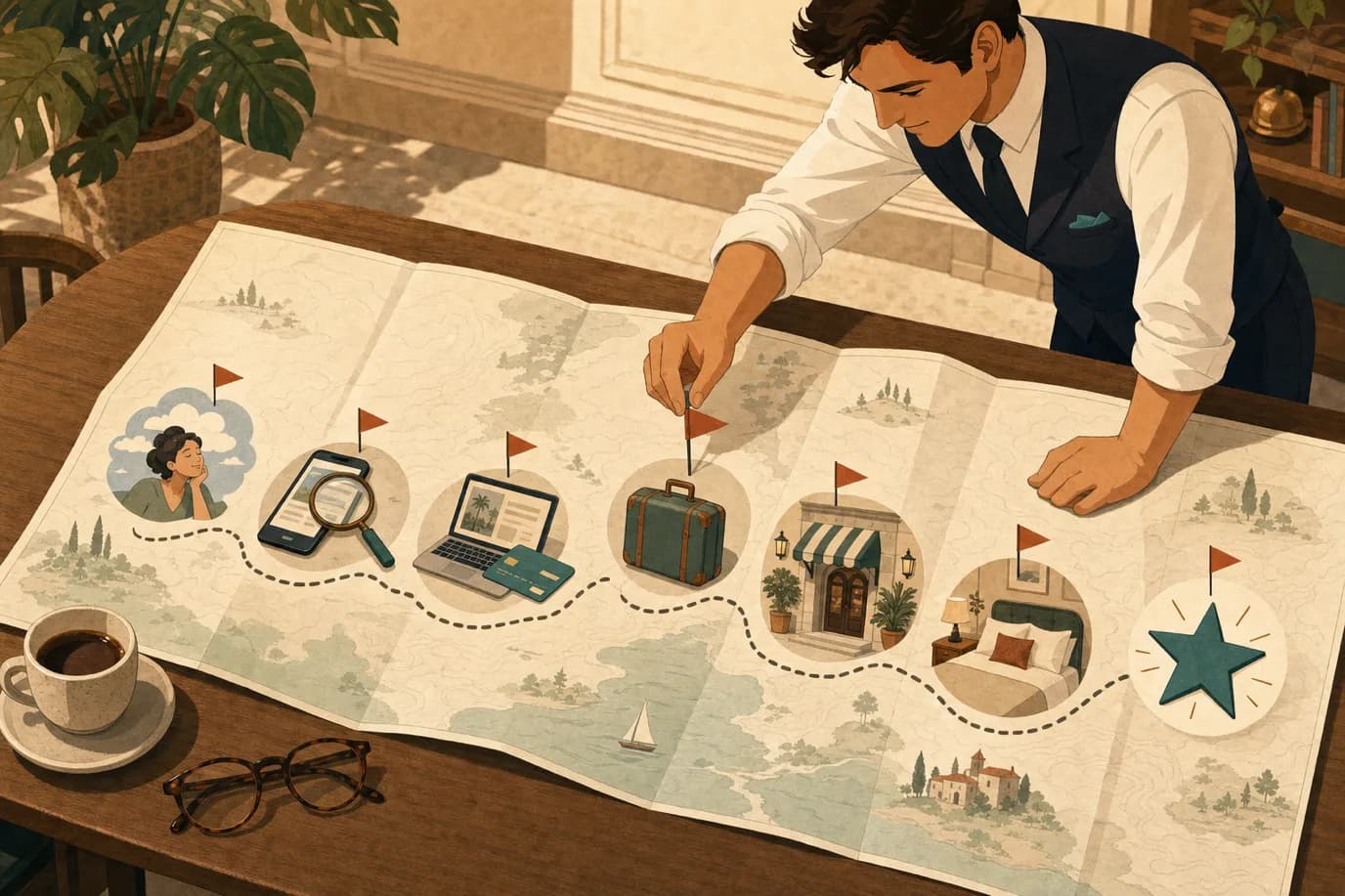
Ask a guest about their stay and they tell you one story: found you on a map, booked on a phone at midnight, drove four hours, arrived to a warm welcome or a queue, slept well or badly, argued about the bill or did not, and wrote the review. One narrative, no chapter breaks. Now ask your property about that same guest and you get six unrelated files: a reservation in the booking system, a channel record in distribution, an arrival on the front desk list, a room on the housekeeping board, a folio in accounting, a review in the reputation dashboard. Six owners, six systems, and nobody responsible for the story the guest actually experienced. That gap between the guest's one journey and the hotel's six departments is where most bad stays are manufactured, and guest journey mapping is the tool for closing it.
This is a practical guide to doing the mapping properly at an independent property: the seven stages, what to look for in each, how to run the mapping workshop in an afternoon, and how to turn the map into a ranked fix list instead of a poster. The journey crosses your technology at every stage, guests meet your booking engine before they ever meet your staff, and the record of everything they asked for and complained about lives in your property management system, so the map doubles as an audit of whether your systems are serving the journey or merely recording it. But mapping needs no new software to start. It needs a wall, the right people, and the willingness to see the property the way a stranger does.
Why Hotels Keep Losing Guests Between Departments
Here is the pattern worth staring at: read a hundred negative reviews of well-run hotels and very few describe a department failing at its own job. The rooms were clean, the breakfast was fine, the staff were friendly. What guests describe is the seams. The airport transfer they requested by email that never reached the desk. The early check-in they were promised by one channel and denied by another. The allergy noted at booking that surprised the kitchen at breakfast. Each department did its job; the journey still broke, because the failure lived in a handoff that nobody owned.
This is why departmental quality programs plateau. You can drill housekeeping to perfection and coach the desk to warmth, and the review score stalls anyway, because the remaining defects are structural: information that does not travel between stages, promises made in one stage and honoured in none, moments where the guest needs the hotel to behave as one organism and it behaves as six. Journey mapping attacks exactly this layer. By drawing the whole sequence in one place, with every touchpoint and handoff visible, it converts invisible seams into named problems that can be assigned, fixed and measured. Properties that do the exercise honestly tend to report the same surprise: the fixes are mostly cheap. The expensive thing was not knowing.
The Seven Stages Every Guest Journey Passes Through
The standard model runs seven stages: dreaming, searching, booking, pre-arrival, stay, departure, post-stay. The labels matter less than the discipline of walking all of them, because hotel attention is distributed almost inversely to opportunity. Properties pour everything into the stay, staff it, measure it, renovate for it, and treat the other six stages as someone else's problem: marketing owns dreaming, the OTA owns booking, nobody owns pre-arrival, accounting owns departure, and post-stay is a dashboard nobody opens on busy weeks. Yet the stay is the stage where you are already at your best, which means the cheapest improvements are almost always hiding in the neglected stages around it. A quick sketch of each, and what mapping looks for.
One caution before the tour: map one guest type at a time. The midnight-booking business traveller, the family planning eight months ahead and the group block have genuinely different journeys, and a map that averages them describes nobody. Start with your highest-value segment, map it end to end, then repeat for the next. If you are unsure which segment to start with, let the PMS decide: pull a year of reservations, find the guest type that contributes the most revenue, and map that journey first, because a ten percent improvement in the journey your best guests take is worth more than perfection in a journey almost nobody travels.
Stage One and Two: Dreaming and Searching
Dreaming is the stage hotels can least control and most misunderstand. The guest is not choosing a hotel; they are choosing a feeling, a region, a week off. Your presence here is your photography travelling on Instagram, your area's content ranking for the experiences it offers, your past guests telling the story for you. The mapping question is simple: when someone dreams about what your area offers, does anything of yours appear? For most independents the honest answer is no, and the fix is content built around the reasons people visit, not around the hotel itself.
Searching is where intent forms and comparison happens: OTA lists, metasearch price grids, the Google panel with your reviews, your own website's first three seconds on a phone. The journey lens adds something the marketing lens misses: consistency across surfaces. The guest does not see channels, they see one hotel telling different stories, one price here, another there, gorgeous photos on the OTA and dim ones on the website, a pool mentioned on Booking.com that closed two winters ago. Every inconsistency reads as untrustworthiness at the exact moment trust is being decided. Walk your own listings quarterly as a stranger would, all of them, side by side, and reconcile what they claim.
Stage Three: Booking, Where Journeys Quietly Die
Booking is the narrowest gate in the whole journey: everything before it is interest, everything after it is revenue, and the gate itself leaks. Industry abandonment figures for hotel booking flows run brutally high, roughly four of five started bookings never finish, and while some abandonment is guests comparison-shopping, the preventable share dies on friction you control: a flow that drags past three steps, surprise fees appearing late, forced account creation, a mobile layout that fights the thumb, a form that greets a returning regular like a stranger. Map the stage by doing: book your own cheapest room on your own site on a phone with a timer running, then do the same on your top OTA and feel the difference in seconds and taps.
The stage ends with a moment hotels barely register and guests weight heavily: the confirmation. It should arrive instantly, restate everything that was promised, price, dates, room, policies, and answer the three questions every guest immediately has, how do I get there, when can I check in, how do I reach a human. A confirmation that reads like a receipt is a missed first act of hospitality; the journey has started, and the hotel has not noticed yet.
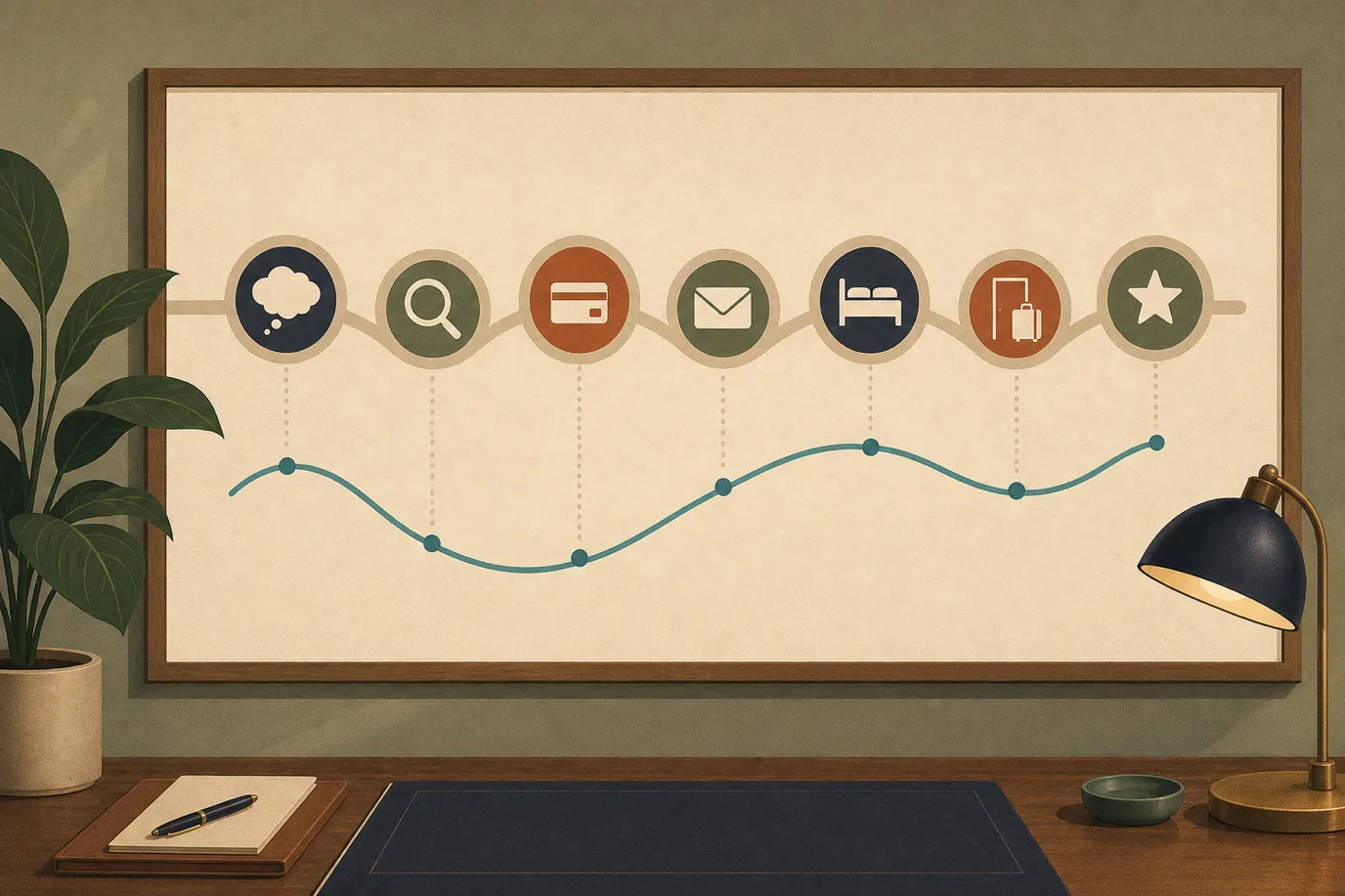
Stage Four: Pre-Arrival, the Neglected Goldmine
Between booking and arrival stretches a window, days or months, in which the guest is committed, attentive and increasingly excited, and most hotels send them nothing but silence or a single automated reminder. Mapped honestly, pre-arrival is usually the emptiest stretch of the journey and the easiest to improve. The guest has questions that will otherwise all land at the desk on arrival day: parking, transfers, check-in time, what to pack for the season. Answering them proactively, a few days out, in one useful message, converts future front-desk load into arrival-day smoothness.
Pre-arrival is also where the stay's revenue and its personalisation are cheapest to build. The guest who booked a standard room in January is a different buyer in the week before a June arrival: closer to the experience, more willing to add the airport pickup, the better view, the dinner reservation, and upsell offers sent in this window convert at rates the front desk cannot match. Personalisation is the same story: asking one question ahead, arrival time, occasion, anything we should know, costs nothing and hands the desk the material for a welcome that feels seen rather than processed. The mapping question for this stage: what does the guest hear from us between booking and arrival, and does any of it help them?
Stage Five: The Stay, Mapped Hour by Hour
The stay is the stage hotels know best, so the mapping value here comes from resolution: not is the stay good but what is the guest trying to do at each hour, and what does the property make easy or hard. Arrival: find the entrance, park, get inside with luggage, be acknowledged within moments. Settling in: locate the Wi-Fi, work the shower and the air conditioning without an engineering degree, find plugs beside the bed. The middle of the stay: eat, ask, borrow, fix, extend. Each micro-task the property makes clumsy generates either a front-desk interruption or a silent deduction from the review score, and the deductions compound.
The single most useful artefact from mapping the stay is the desk's question log. Have the front desk write down, for two weeks, every question guests actually ask. The list is never surprising and always damning: the same ten questions, hundreds of times, each one marking a place where the building, the signage, the room folder or the pre-arrival message failed to communicate. Fixing the top five questions out of existence, a sign, a card by the kettle, a line in the confirmation email, is the highest-leverage service improvement most properties can make, and it costs almost nothing.
The stay is also the only stage where feedback can still change the outcome, and mapped properties treat that as an asset. A guest who is quietly unhappy on night one and asked about it on night one can be recovered; the same guest asked by a survey email a week later can only be apologised to, after the review is already public. Build one low-friction mid-stay check into the journey, a short message on the first evening asking whether everything is as expected, a desk that asks the question at breakfast and means it, and route the answers somewhere with authority to act within the hour. Properties that do this consistently report the same asymmetry: the check costs seconds per guest, and every problem it catches in-house is a negative review that never gets written.
Moments of Truth: Check-In, the First Ten Minutes, Recovery
Guests do not average a stay; they remember its peaks, its troughs and its ending. That psychology gives mapping its priorities: a handful of moments carry the verdict, and they deserve disproportionate protection. Check-in is the first: after a journey, the guest's tolerance is at its daily minimum and their attention at its maximum, which is why a three-minute wait at five p.m. costs more goodwill than a broken hairdryer all week. The first ten minutes in the room are the second: this is when the rate is silently judged against the reality, the light switched on, the bathroom inspected, the view checked, and no later excellence fully recovers a bad first impression. And recovery is the third: something will go wrong for some guests, and the research on service recovery keeps finding the same paradox, a problem handled fast and generously often leaves more loyalty than no problem at all. Map what happens at your property in the first five minutes after a guest reports a problem, who hears it, who owns it, what they are empowered to give, because that script, or its absence, is written all over your worst reviews.
Stage Six and Seven: Departure and the Afterlife of a Stay
Endings are weighted in memory, and hotel endings are weirdly hostile by default: a queue, a bill inspection, a printer, small charges the guest is seeing for the first time. Mapping the departure means asking what the last interaction actually is, and for many properties the honest answer is a folio dispute. The fixes are mechanical: no surprise charges, everything itemised as it was incurred, express and digital checkout for guests who want them, and a farewell that acknowledges the person rather than the transaction. The final bill is also the final impression of your pricing: a guest who feels nickel-and-dimed at the end retroactively re-prices the whole stay.
Post-stay is where the journey loops or dies. Within days the guest writes the review or does not, shares photos or does not, files you under return someday or never thinks of you again. Mapping this stage means knowing your own numbers: what share of guests are asked for a review and when, who answers the reviews and how fast, what a past guest hears from you in the following year. The economics are familiar, repeat guests book direct, cost nothing to acquire and cancel less, but the journey lens sharpens the point: the post-stay stage is the pre-arrival stage of the next visit, and silence here is the sound of the next booking going to whoever emails first.
How to Actually Map It: The Afternoon Workshop
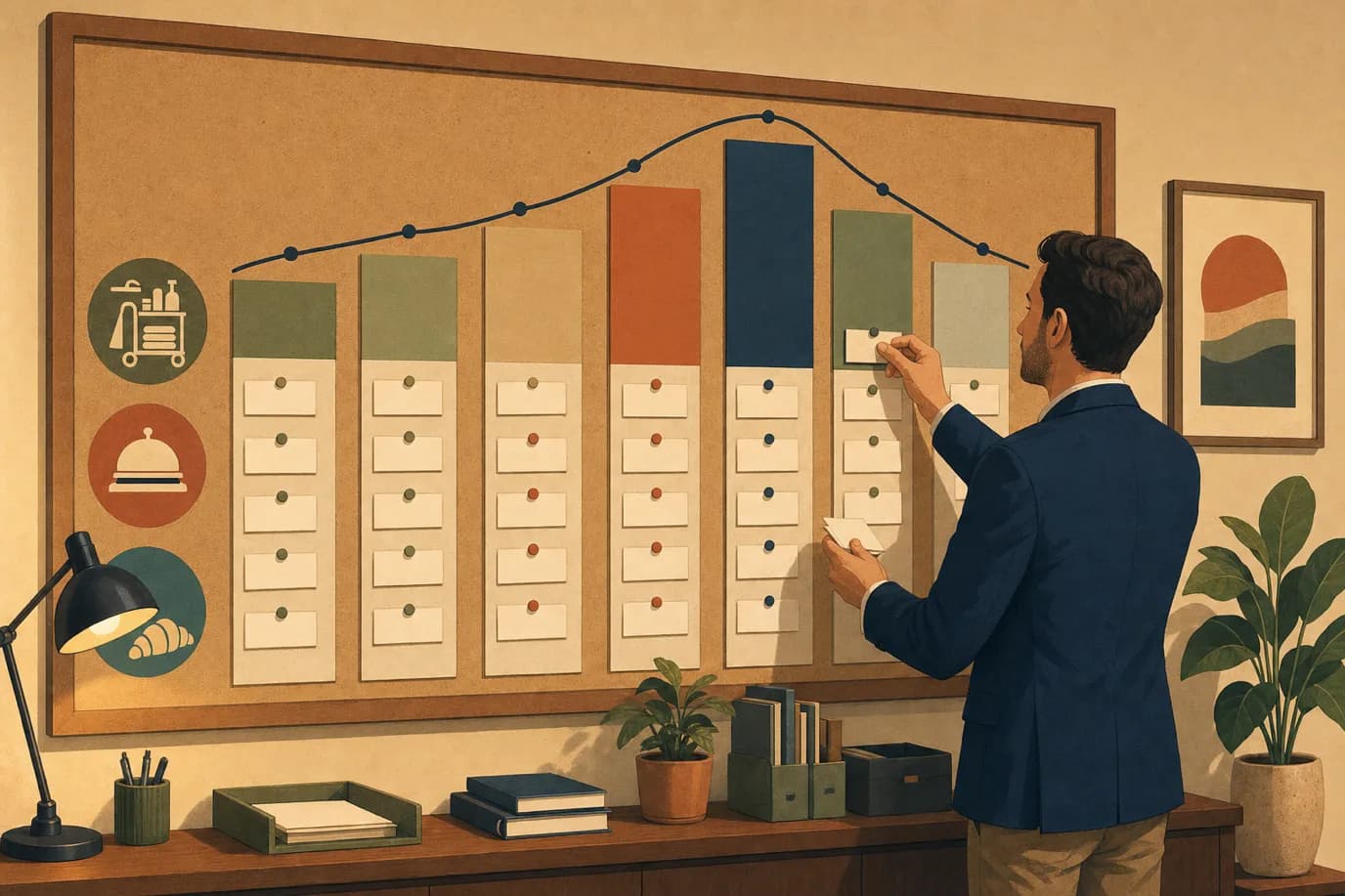
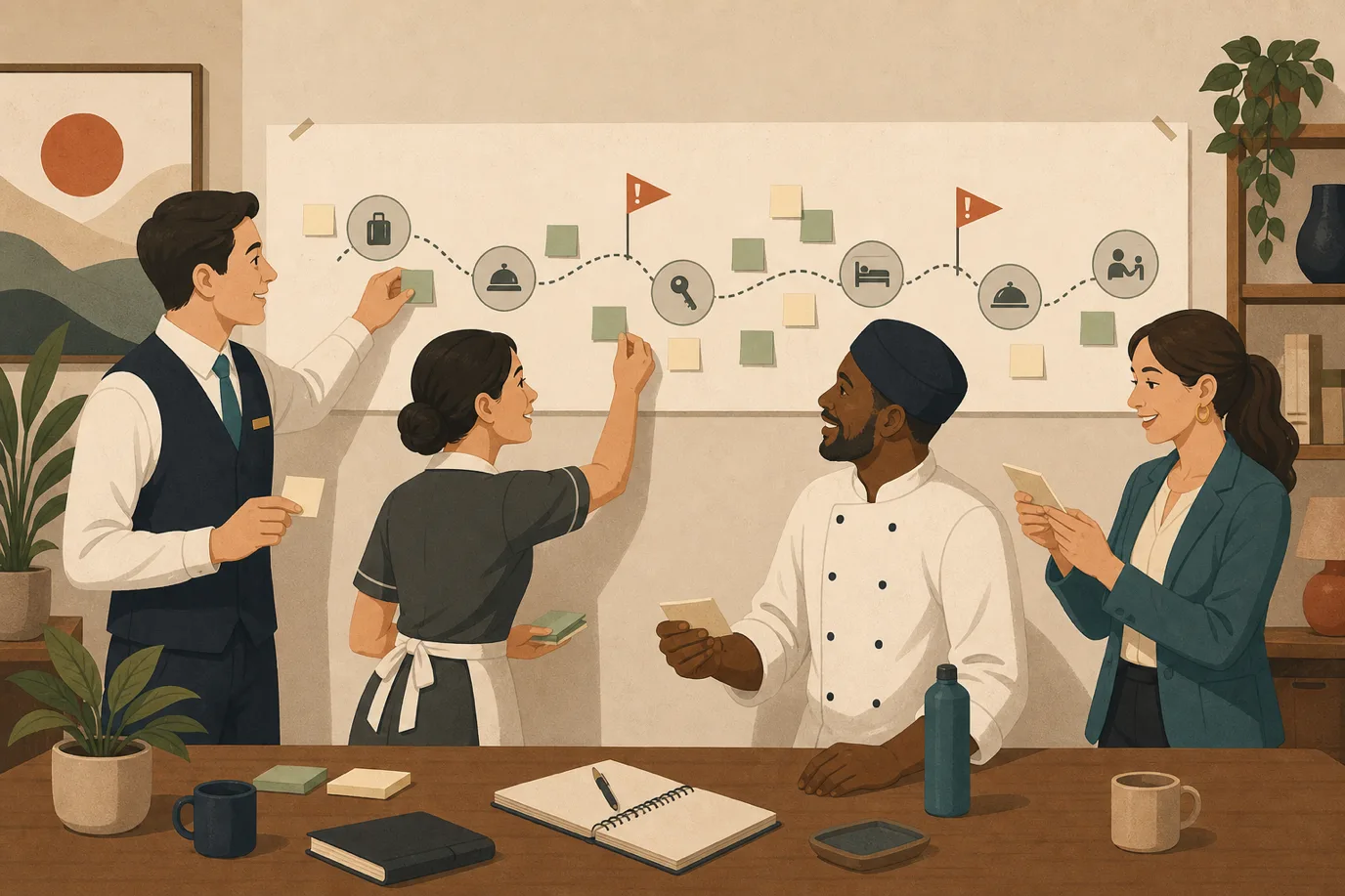
The mapping itself is an afternoon, not a consultancy engagement. Put the seven stages across a wall. Bring one person who actually works each part of the journey, someone from the desk, from housekeeping, from breakfast, whoever answers the emails, and the manager, and give them each a stack of notes. Under every stage, collect four layers: the touchpoints (every contact between guest and property, human or digital), the guest's goal at that moment, the guest's likely emotional state, and the evidence, what reviews, complaints and staff observation say actually happens there. Then mark the map in two colours: moments that delight, and moments that break. The room will disagree, and the disagreements are the point; the desk knows things the manager does not, and breakfast has watched failures nobody upstairs has heard about.
Two rules keep the exercise honest. First, every claim needs evidence or a test: guests love our check-in is an opinion until the arrival-hour queue has been watched or timed. Second, the map records what is, not what should be; the aspirational version comes later and is a different document. The output you want is not beauty, it is a photograph of the seams: a wall where every handoff between systems, shifts and departments is visible, with the broken ones flagged.
Walking the Journey Yourself, and Reading the Evidence
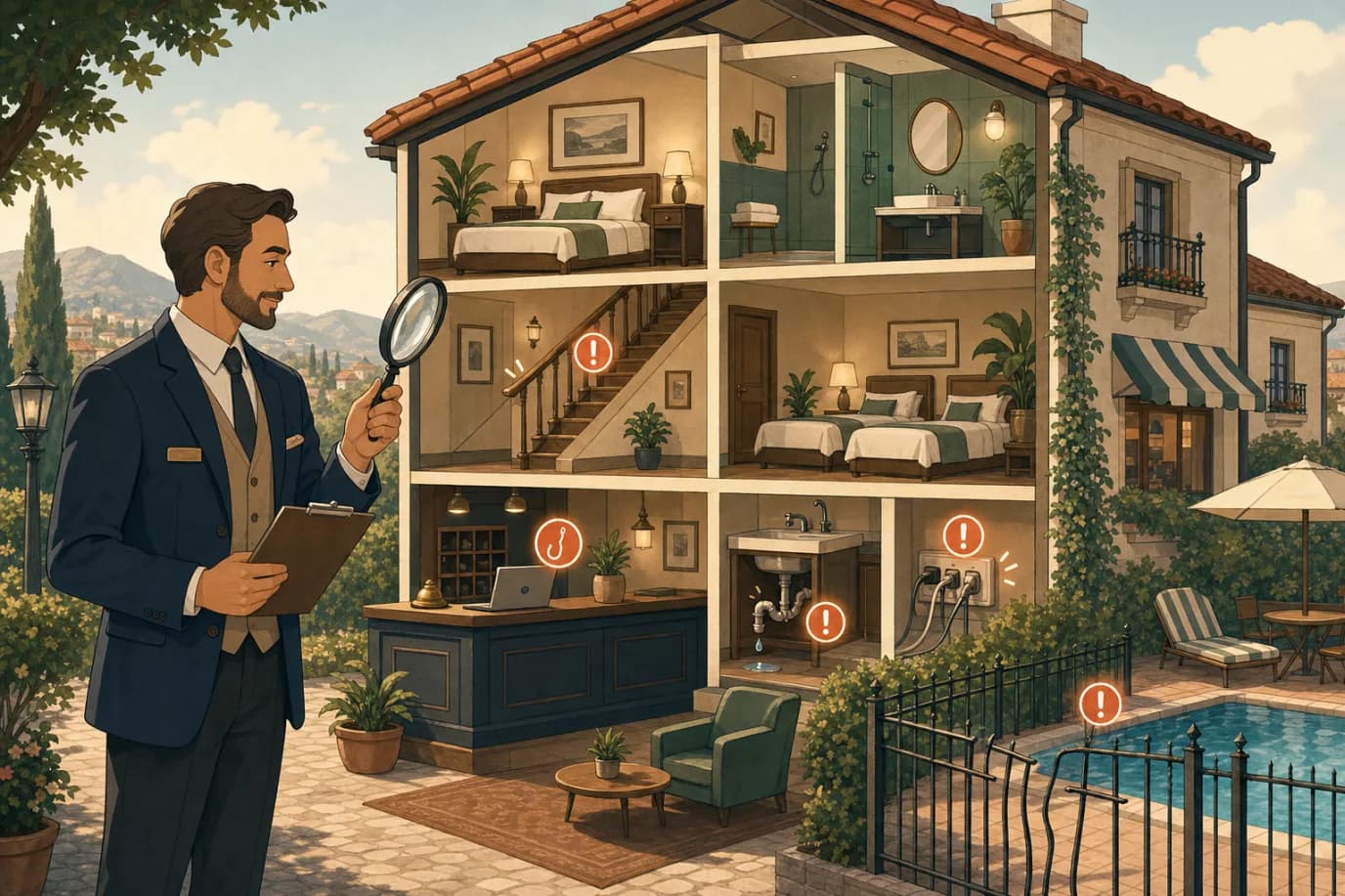
The workshop wall is hypothesis; the walk is verification. Book your own hotel on a phone, at full price, without warning the desk. Arrive by the route guests arrive. Carry a bag up. Try the shower, the Wi-Fi, the thing your last three reviews complained about. Call the desk with a request from the room and see where it goes. Almost every property that does this discovers something the map missed, usually in the first fifteen minutes, because staff walk the building with owner's eyes and the walk forces guest's eyes. Pair it with the written evidence: the last hundred reviews sorted into journey stages make a heat map of where your story breaks, and the booking funnel numbers say what the reviews cannot, since the guests who abandoned at booking never wrote one.
From Map to Fixes: Prioritising by Cost, Not by Embarrassment
A finished map produces a long list of defects, and the failure mode of the whole exercise is fixing them in order of embarrassment rather than economics. Rank each break by what it plausibly costs: a booking-flow failure bleeds revenue on every single journey and outranks almost anything inside the stay; a broken moment of truth outranks a broken ordinary moment; a defect that generates recurring front-desk load costs labor every day it lives. Assign every fix an owner and a date, pick a number the fix should move, review score, direct conversion, questions per arrival, and reconvene quarterly with the map on the wall and the numbers beside it. Three fixes actually shipped beat thirty identified, and the map's real function is to make sure the three are the right ones.
For a sense of scale, the fixes that surface most often from first-time mapping exercises at independent properties are humbling in their smallness: a confirmation email rewritten to answer the arrival questions, which cuts a third of pre-arrival phone calls; a luggage rack and a second plug socket beside the bed, which retire two recurring review complaints; a one-line script giving the desk authority to resolve complaints under a set amount without a manager, which transforms recovery speed; visible walking directions from the parking area to the entrance, which fix the first sixty seconds of hundreds of journeys a year. None of these require budget approval or a project plan. They required only that someone, once, looked at the whole journey from the outside and wrote down where it snagged.
Where Prostay Fits
Journey mapping keeps exposing the same root cause: information that fails to travel between stages, and the seams between systems are where it falls. This is the argument for running the journey on one platform. In Prostay, the booking a guest makes through the booking engine, the preference they mention pre-arrival, the request they make on night two and the folio they settle at checkout are one record, not four exports, so the handoffs that mapping flags, booking to desk, desk to housekeeping, stay to billing, happen inside the system instead of between systems. Prostay Nexus carries the communication side of the same journey: the pre-arrival questions, the WhatsApp message from the room, the OTA inquiry and the post-stay follow-up land in one inbox with the guest's history attached, which is precisely the one organism behaviour the mapped journey demands. The map tells you where the seams are; the platform is how you stop having so many.
Every hotel already has a guest journey; the only question is whether anyone has looked at it whole. The look costs an afternoon and a little humility. What it returns is the shortest honest list of what to fix next, ranked by what each break is costing, and the quiet structural advantage of being the property where the story never snaps between chapters. Guests cannot name it, but they feel it, and they write the reviews that say so.