

Training in the hospitality sector is the most important part of providing excellent service in hotels, restaurants, and tourist businesses all over the world. These specialized training programs give personnel the knowledge and skills they need to provide great service while also meeting the high operational standards that make hospitality firms profitable.
This article covers all kinds of hospitality training, from getting certified in customer service and food safety to learning how to be a leader and use digital marketing tools. It only talks on training methods that are specialized to the hospitality industry, leaving out basic business education that doesn't apply to that field. The target audience includes HR managers, hospitality professionals in charge of training, business owners who run hotels, restaurants, event venues, and tourism operations, and anybody else who needs practical ways to help their people grow.
Hospitality industry training includes specialized programs that teach hotel, restaurant, and tourism business employees how to provide exceptional hospitality, excellent customer service, run their businesses well, and be good leaders. Good hospitality education combines technical training with hands-on experience to get people ready for the particular challenges of working in service contexts where they deal with guests.
By the end of this guide, you will know:
- How to choose and use training programs that raise visitor satisfaction levels
- Which ways of delivering information work best for different hospitality jobs and learning goals
- Ways to keep people from leaving by offering interesting professional development
- Ways to show that training works and that it was worth the money
- Ways to get professional certification that help you move along in your job
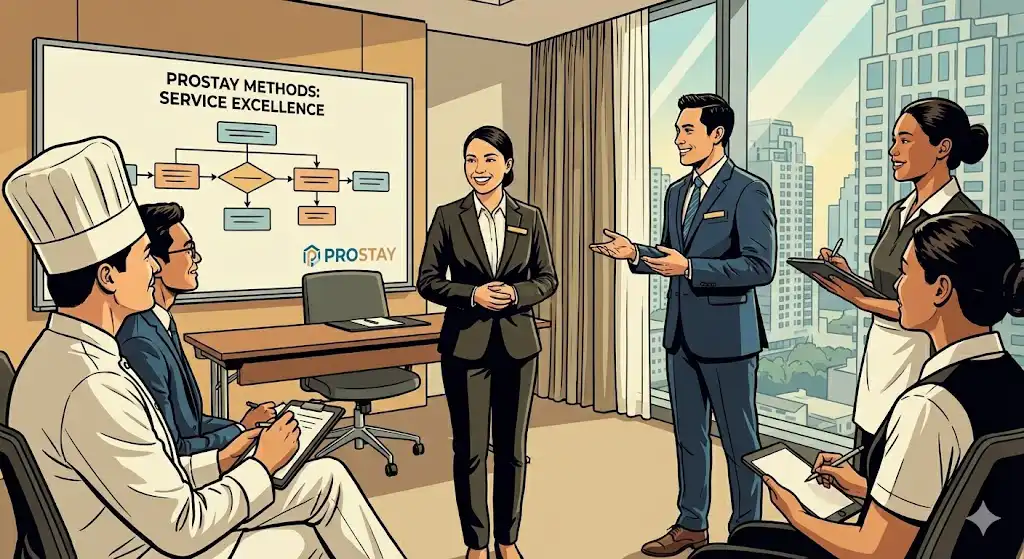
Understanding Hospitality Industry Training
Hospitality industry training is the planned growth of the skills, knowledge, and attitudes needed to provide guest-centered service in the accommodation, food and drink, travel, and entertainment industries to achieve a better hospitality management. Unlike general customer service training, hospitality training focuses on the unique problems that come up when managing guest expectations in high-stress, time-sensitive situations when every interaction affects the hotel reputation.
About one in ten jobs in the world are in the hotel industry. Training is a key way to boost productivity, set your business apart from others, and keep your best employees. Employers who invest in developing a whole curriculum see demonstrable benefits in guest happiness, operational efficiency, and employee engagement because of high turnover rates and ongoing skills gaps.
Core Training Categories
Training for customer service includes basic skills for dealing with guests, ways to resolve conflicts, and ways to improve the customer experience. Structured service recovery frameworks teach participants how to anticipate requirements, tailor assistance, and deal with complaints. This category helps you develop the social skills and emotional intelligence that set great hospitality apart from good service.
Operations training is the technical layer. F&B staff learn ServSafe, knife handling, plate preparation, and the property's specific recipe specs. Housekeeping learns the room-attendant inspection checklist, the chemical-handling SDS, and the linen-par counts by floor. Front office learns the PMS, the property's reservation flow, and the check-in script. None of this is glamorous. All of this is the difference between a property that runs and one that limps.
Training in leadership and management gets managers and supervisors ready for the special demands of running a hotel or restaurant. The material includes motivating teams, coaching performance, scheduling workers, managing income, and making financial decisions. This category helps people advance in their careers and builds the leadership pipeline that organizations need to be strong.
These three groups work together to help people become fully competent in hospitality. Operations that are efficient but frigid happen when people have technical competence but no service orientation. If you focus on the customer but don't know how to run your business, you'll have trouble delivering. Leadership development makes ensuring that skills can be used on all properties and in all seasons.
Industry-Specific Skill Requirements
People who work in hospitality need a unique mix of technical and people skills that are different from those needed in other service industries.
Being good at property management systems, point-of-sale systems, and reservation tools are all examples of technical talents. Food and drink jobs need to know how to serve wine, develop menus, and organize events. All jobs require knowledge of safety rules, from how to get out of a building in case of fire to how to be aware of security issues. Structured hospitality training courses can teach these abilities, and you can test them by doing them in real life.
Soft skills include being able to talk to people in person, on the phone, via email, and by text message; being aware of other cultures while serving international guests; being able to manage your time when things get tough; and being able to find solutions when normal methods don't work. Role-playing, mentorship, and real-world practice with hotel guest feedback help people build these skills.
Knowing what skills are needed for hospitality jobs is the first step in figuring out how to best teach people.
Training Delivery Methods and Formats
Modern hospitality industry training uses a variety of delivery methods to fit shift patterns, different types of curriculum, and different ways of learning. The best hospitality program designs don't just use one way; they match approaches to learning goals.
Online and Digital Training Platforms
Self-paced e-learning modules help employees finish courses when things are slow or between shifts. SC Training and other platforms like it offer interactive content with quizzes, progress monitoring, and certificates of completion. Online learning is especially good for learning things like food safety rules, brand standards, and compliance needs. Many platforms allow more than one language, which is important for the hospitality industry, as workers come from many different backgrounds.
Virtual reality and simulation tools let you rehearse real-life situations without bothering real guests. Trainees can practice dealing with difficult guests, emergency circumstances, or complicated operations over and over again until they feel more sure of themselves. VR training lowers the number of mistakes made in the actual world while learning, even though the expenses of implementation are still high.
Microlearning works because nobody on a hotel floor has 90 minutes to sit in a classroom. The format is a 3 to 7 minute lesson on the phone, done between a check-out and the next arrival. Useful for the things that change often: a new menu item, a property update, a refresher on the tip-pooling rule. Not useful for the heavy material that needs reps and a real instructor.
In-Person and Hands-On Training
Classroom instruction with a real trainer in the room is what you use for the hard material: the leadership track, the complex SOPs, the topics that need debate. The other reason it works in hospitality is the cross-pollination. A front desk agent and a banquets manager in the same room learn things about each other's job that they would never pick up from a video.
On-the-job training is still the bedrock of how hospitality work actually gets learned. New hires shadow a senior staffer for a full week, then take the desk with a manager standing behind them as backup. The PMS is learned by booking real arrivals on a busy Friday. Wine service is learned by pouring at a real table for a real guest. The mentor catches the mistakes in the moment, before they reach a review. That is the piece the LMS cannot replicate.
Role-playing games connect theory and practice by putting people in controlled situations that are like those of guests. People practice how to handle challenging requests, upselling strategies, and service recovery conversations. Getting feedback right away from trainers and peers speeds up the learning process and keeps mistakes low-stakes.
Hybrid and Blended Learning Approaches
The best training programs use a mix of several formats in a smart way. Participants might finish online modules that cover theory and standards, then go to in-person sessions to practice and talk about what they've learned, and then use what they've learned on the job with help from a coach.
Microlearning integration fits small digital lessons into work schedules instead of necessitating long breaks from work. A five-minute training on being sensitive to other cultures before a shift meets immediate demands without affecting service coverage.
Different formats work better for different types of learners and different types of work. Video demonstrations are helpful for people who learn best by seeing things. Kinesthetic learners need to practice with their hands. People who learn by hearing things like to talk and listen to instructions. Successful hospitality programs give students more than one means to reach the same competency goals.
The next step is to make sure that training is done in a consistent way across the whole organization.
Implementing Effective Hospitality Training Programs
Strategic implementation turns training from a cost into an investment that leads to clear business returns. The difference between hospitality businesses that provide great service and those that don't is frequently how organized they are for planning and delivering training.
Training Program Development Process
A organized procedure that connects learning activities with corporate goals is what makes training development work:
- To do a requirements assessment, look at visitor comments, internet reputation data, operational bottlenecks, and performance gaps with the help of supervisors. If guests are complaining about long check-in times, it means that the front desk staff needs more training. Kitchen training priorities can be seen in the drop in food safety audit scores.
- Design a curriculum that meets brand standards, legal requirements, and the skills needed for each role. Link learning goals to actions that can be seen and results that can be measured. The full curriculum should build on what students already know and lead them to more advanced uses of that information.
- Choose the best way to present the content based on what it is, who is available to help, and what the learning goals are. Online compliance training might be a good idea. In-person engagement helps people grow as leaders. You need to practice using equipment to learn technical abilities.
- Before rolling out the software to the whole organization, try it out in a few departments first. Get input from both participants and trainers to improve the content, timing, and logistics. Pilots show real-world difficulties, like schedule conflicts, tech challenges, and missing content, before they affect the whole workforce.
- Use performance indicators, guest satisfaction scores, and behavioral observation to judge how well something works. No matter how happy the participants are, training that doesn't improve results isn't useful. Set baseline measurements before training so that you can make relevant comparisons.
Training Method Comparison
There are a lot of things to think about while choosing the correct training method:
| Training Method | Cost Effectiveness | Engagement Level | Time Investment | Best Applications |
|---|---|---|---|---|
| Online Learning | High | Medium | Low | Compliance, product knowledge, standards |
| In-Person Training | Medium | High | High | Leadership, complex procedures, team building |
| Hybrid Approach | Medium | High | Medium | Technical skills, service behaviors, onboarding |
| On-the-Job Training | High | High | Medium | Role-specific tasks, system operation, mentorship |
Online learning is the most efficient way to transfer knowledge, yet it might not help you learn how to do things. Training in person gets people really involved, but it takes a lot of planning to fit it into their schedules. Hybrid methods find a middle ground between what works and what is possible. Training on the job is cheap, but the quality depends a lot on how good the trainer is.
Most hospitality firms do better when they use a mix of methods, like online modules for learning, classroom sessions for talking about what they've learned, and supervised practice for putting what they've learned into action.
Knowing how to adopt a strategy can help you deal with the problems that often get in the way of training programs.
Training Examples by Department
Department-specific training is the standard. Front desk learns one thing, F&B learns another, maintenance another. The catalog isn't glossy, the curriculum is tactical. Skills that map directly to the next shift, not the next quarterly review. The training that doesn't move a real metric is training nobody bothers to attend.
Front Desk
Front desk training is mostly about putting the right person at the friendliest part of the property and arming them to handle whatever walks in. The core blocks:
- Guest Service Excellence: Greeting guests warmly, managing check-in/check-out processes smoothly, and delivering personalized service.
- Property Management System (PMS) Proficiency: Navigating reservation software, processing payments securely, and optimizing room assignments.
- Conflict Resolution: Techniques for handling guest complaints calmly and effectively, including service recovery strategies.
- Upselling and Revenue Generation: Promoting room upgrades, amenities, and additional services to enhance revenue.
- Communication Skills: Verbal and written communication, cultural sensitivity, phone etiquette, and active listening.
- Role-Playing Exercises: Simulated guest interactions to practice problem-solving and build confidence.
- Time Management: Balancing multitasking during peak periods without compromising service quality.
Sales & Reservations
Sales and reservations training is about lifting two numbers: occupancy and ADR. The path runs through the booking system, the lead pipeline, and the calls that close groups. The core blocks:
- Customer Relationship Management (CRM): Using CRM tools to track leads, maintain guest profiles, and manage follow-ups.
- Digital Marketing Tools: Using social media, email campaigns, and online travel agencies (OTAs) to reach target markets.
- Sales Techniques: Consultative selling, negotiation skills, and crafting personalized offers.
- Revenue Management Basics: Understanding pricing strategies, seasonal demand, and package creation.
- Booking System Operations: Managing reservations, group bookings, and coordinating special requests.
- Client Relationship Building: Engaging corporate clients, travel agents, and event planners for repeat business.
- Professional Communication: Enhancing persuasive communication, active listening, and formal correspondence.
- Performance Assessments: Sales simulations and regular evaluations to reinforce skills and identify improvement areas.
Housekeeping
Housekeeping training teaches practical skills and operational knowledge that help keep things clean, safe, and comfortable for guests. Some of the best parts of training are:
- Cleaning Techniques: Proper use of cleaning agents and equipment for guest rooms, public areas, and back-of-house spaces.
- Time Management: Efficient room turnover without compromising quality.
- Health and Safety Protocols: Handling hazardous materials, infection control, and ergonomic practices to prevent injuries.
- Inspection and Quality Control: Conducting thorough room inspections to meet brand standards.
- Laundry and Inventory Management: Managing linens, supplies, and reporting maintenance issues.
- Guest Interaction: Respecting guest privacy and responding to special requests discreetly.
- Supervisory Skills: Scheduling, quality control, team motivation, and conflict resolution for housekeeping leads.
- Hands-On Practice and Checklists: Supporting consistent performance and regulatory compliance.
Food & Beverage
Food and drink training teaches you how to handle food safely, provide great service, and plan events. Some of the most important parts are:
- Food Preparation and Safety: Instruction on preparation methods, portion control, hygiene, and food safety certifications such as ServSafe.
- Menu Planning and Allergen Awareness: Designing menus and accommodating dietary restrictions.
- Wine Service and Table Etiquette: Proper serving techniques and enhancing guest dining experiences.
- Customer Service: Managing special requests, upselling, and complaint handling with professionalism.
- Event Planning Logistics: Coordinating banquet and catering events, focusing on timing and teamwork.
- Cross-Training: Encouraging collaboration between kitchen and service staff to improve efficiency.
- Leadership Development: Supervisory training on staff scheduling, inventory control, cost management, and health regulation compliance.
- Role-Playing and Feedback: Practical exercises to refine skills in dynamic service environments.
Engineering
Training in engineering gives maintenance workers the skills they need to keep hotel operations safe, efficient, and long-lasting. Some parts of training are:
- Preventive Maintenance: Procedures for HVAC, electrical systems, plumbing, and building infrastructure.
- Troubleshooting and Repairs: Diagnosing and resolving equipment failures promptly.
- Safety Protocols: Lockout/tagout procedures, personal protective equipment (PPE) use, and emergency response training.
- Energy Management: Lower utility line, smaller carbon footprint, same comfort.
- Interdepartmental Collaboration: Coordinating with housekeeping and the front desk to triage tickets fast.
- Documentation and Compliance: Logging every PM and inspection so the audit goes clean.
- Supervisory Training: the schedule, the budget, the contractor calls at midnight.
- Hands-On Workshops and Simulations: Fire drill, kitchen burn, walk-out at check-in. Practice the real one.
Common Challenges and Solutions
Even the best-planned hospitality training programs have problems that are easy to see. If you know these problems are coming, you may come up with solutions before they happen instead of fixing them after they happen.
Limited Staff Availability During Peak Seasons
Hospitality firms require the most training when they can least afford to take personnel away from their jobs. During peak seasons, comprehensive coverage is needed, and skill gaps are most obvious.
The answer is to use microlearning to give training in 5 to 10 minute chunks during natural breaks, as when people change shifts, at calm times, or before service meetings. With mobile training platforms, you may learn without having to go to a specific training room. When occupancy allows, schedule intense training during the shoulder seasons. Cross-train staff at slack times so they can do more than one job during busy times.
High Staff Turnover Affecting Training ROI
The hospitality industry has a lot more turnover than most other industries. Managers are frustrated and budgets are tight when they spend a lot of money training staff who depart after a few months.
Solution: Make uniform onboarding programs that quickly help new employees learn what they need to know. Focus early training on skills that can be used right away to assist new employees achieve rapidly. This will make them happier at work, which will keep them longer. Make growth a purpose to stay at a work instead of merely an obligation by designing training paths that lead to professional advancement. The residential educational institute model of stackable certifications helps keep students by showing them how far they've come.
Measuring Training Effectiveness and ROI
Tying training spend to a P&L outcome is the part most properties skip. They count completions, file the certificates, and stop there. The number you actually need is the delta between trained and untrained cohorts on the metrics the property runs on.
Pick the KPIs before the curriculum is even built, not after. The usual ones for hospitality: guest satisfaction score, online review average, upsell attach rate at the front desk, safety incidents per quarter, and the share of new hires still on staff past 90 days. Take a clean baseline reading on each metric. Run the training. Read the same numbers again 60 and 120 days out. The delta on those numbers is the ROI conversation you have with the GM at the next review.
Inconsistent Training Quality Across Properties
For training, multi-property businesses typically see big differences in how it is given and taken in. What works at the main property might not function as well at smaller ones.
Standardize the core curriculum by using centralized resources, but let local schools make changes to meet their own requirements. Use digital platforms to make sure that content is always delivered the same way, no matter where you are. To make sure that the level of facilitation stays the same, certify trainers through programs like those offered by the American Hotel & Lodging Educational Institute (AHLEI). Regular audits look at the training results from different properties to find the best ways to do things and the ones that need work.
By dealing with these problems, training programs can be set up for long-term success and ongoing progress.
Outsourcing Hotel Staff to Simplify Hospitality Industry Training
Some properties skip the training cycle entirely on certain roles by hiring through a specialist agency. The agency's pre-vetted housekeepers, banquet servers, and front desk agents arrive with the certifications already in place. The hotel pays the markup and trades the in-house training timeline for a worker who can be on the floor by Friday.
The trade-off makes sense for the role layer that a property does not want to own forever: night audit, banquet on-call, peak housekeeping. The internal training budget then gets aimed at supervisors, managers, and the brand-specific service piece. Outsourcing also flexes capacity for a 200-cover wedding without forcing the GM to hire and train two extra servers.
The agency selection is the part that decides whether this works. Ask for the curriculum, the trainer credentials, and the supervision ratio on a typical shift. Ask how they handle a guest complaint about an outsourced staffer. If the answers are vague, the brand standard is going to slip the first weekend they cover for you.
Used well, outsourcing thins the training calendar, frees the L&D team for the work that compounds, and gives the property a faster way to staff up when a new segment shows up.
Conclusion and Next Steps
Training in the hospitality sector is a smart investment that has a direct effect on guest pleasure, operational efficiency, and employee retention. Businesses that continuously provide great service are the ones who invest in their employees through carefully planned and executed training programs.
Multiple ways of teaching are used in effective hospitality education: online learning for information, in-person workshops for difficult skills, and hands-on training for real-world use. To be successful, you need to clearly define your demands, make sure your curriculum is in line with your business goals, use the right method, and measure your results carefully.
To keep going with making your hospitality training better:
- Look at guest feedback, operational metrics, and supervisor input on skill gaps to find out what training needs to be done.
- Choose delivery methods that work with your content kinds, personnel schedules, and budget.
- Before rolling out throughout the whole company, start with pilot initiatives in one or two departments.
- Set up ways to monitor how training sessions affect business results.
- Make growth paths that help people move higher in their careers and stay with the company.
Professional certification programs, leadership development initiatives, and partnerships with hospitality education institutions are all structured ways for organizations to improve their training capabilities even more. These programs prepare both students and current employees for the changing needs of this fast-paced industry.
Additional Resources
Industry Certification Bodies:
- AHLEI (American Hotel & Lodging Educational Institute) offers nearly 30 professional certification designations and provides study materials for hospitality training courses at all career levels
- ServSafe provides food safety certification recognized across the food service industry
- Various national tourism boards offer destination-specific credentials
Training Platform Features to Evaluate:
- Mobile accessibility for on-the-go learning
- Multi-language support for diverse workforces
- Integration with operational checklists and quality assurance
- Analytics dashboards connecting training completion to performance metrics
- Customization capabilities for brand-specific content
Professional Development Associations:
- Industry groups hold networking events, seminars, and continuing education classes that help hospitality workers stay up to date on new trends and best practices in the field.
- Colleges that offer local hospitality education often work with businesses to set up internships that help people get ready for careers in hospitality and give firms trained prospects.