
Every hotel has its bad night eventually. The storm that closes the coast road with forty arrivals due. The power cut that takes the lifts, the key cards and the booking system down together. The guest who is hurt in the pool area, or the review that catches fire online while you are still working out what actually happened. None of this is exotic; ask any operator with ten years behind a desk and they will tell you two or three of these stories. What separates the properties that come through with their reputation and their bookings intact is not luck. It is a short plan that people have actually read, and a property management system whose data they can still reach when everything else is failing.
This article is that plan, in practical form: what counts as a crisis, the four families of trouble a hotel realistically faces, what to prepare before, what to do in the first hour, and how to communicate with guests and booking channels while it is happening rather than after. Communication is half the battle in almost every scenario, because a guest who knows what is going on forgives almost anything, and a guest left guessing forgives nothing. That is why a unified message hub like Prostay Nexus shows up more than once in what follows: reaching every affected guest quickly, on whatever channel they booked through, is the difference between a disruption and a disaster in the reviews.
Everything that follows applies whatever software you run, and most of it applies even if the plan lives in a laminated folder behind the desk. The tools matter less than the habits.
What Counts as a Crisis, and What Does Not
The word gets overused, so it is worth drawing the line. A crisis is an event that threatens guest safety, the property's ability to operate, or its reputation at a scale the normal complaint process cannot absorb. A blocked toilet is not a crisis. Twelve rooms without water on a sold-out night is getting close. A kitchen fire, a flooded ground floor, a guest taken to hospital, or a video of your front desk going viral for the wrong reasons: those are crises, because they demand decisions and communication beyond anyone's daily routine.
The distinction matters for a practical reason. If everything is a crisis, nothing is, and staff learn to ignore the alarm. The plan you are about to build should be triggered rarely, deliberately, and by a named person, not fired off every time something breaks. A useful internal test: does this event require us to change what we tell guests, or change how we operate, for more than a few hours? If yes, trigger the plan. If no, it is a bad day, and bad days are handled by the normal playbook.
The second thing worth saying early: small and independent hotels are hit harder by the same event than big ones. A chain property has a regional office, a PR team and a sister hotel to absorb relocated guests. An independent has whoever is on shift. That is not a reason for despair, it is the argument for preparation, because the plan is precisely the thing that substitutes for the infrastructure you do not have. A rehearsed two-person night team with a one-page runbook routinely outperforms an unrehearsed corporate machine.
The Four Families of Hotel Crises
Crisis planning collapses when it tries to enumerate every possible event. You cannot write a plan for everything, and you do not need to, because hotel crises cluster into four families that share their response patterns. Plan for the family, and the specific event mostly takes care of itself.
Natural and weather events: storms, floods, wildfires, earthquakes, heavy snow. Their signature is that they affect your whole market at once, arrivals cannot reach you, and the recovery is measured in days. Technical failures: power cuts, internet loss, PMS or key-card outages, water supply problems. Their signature is that the property is physically fine but its nervous system is down, and the crisis is mostly about operating blind. People incidents: guest injuries and medical emergencies, security problems, theft, food safety, staff incidents. Their signature is legal exposure, which means documentation and careful language matter from the first minute. And reputational events: the viral review, the social media pile-on, bad press, a booking-platform dispute gone public. Their signature is that nothing physical has happened at all, and the entire crisis lives in communication.
Rank the four for your own property honestly. A beach resort in a typhoon belt has a different top of the list than a city hotel above a train station. But two entries belong near the top everywhere: a technical outage, because every hotel now runs on systems and the grid does not care about your location, and a reputation event, because every hotel is one bad night and one articulate guest away from a public incident. Those two are also the cheapest to prepare for, which makes them the right place to start.
Before: The One-Page Plan That People Actually Use
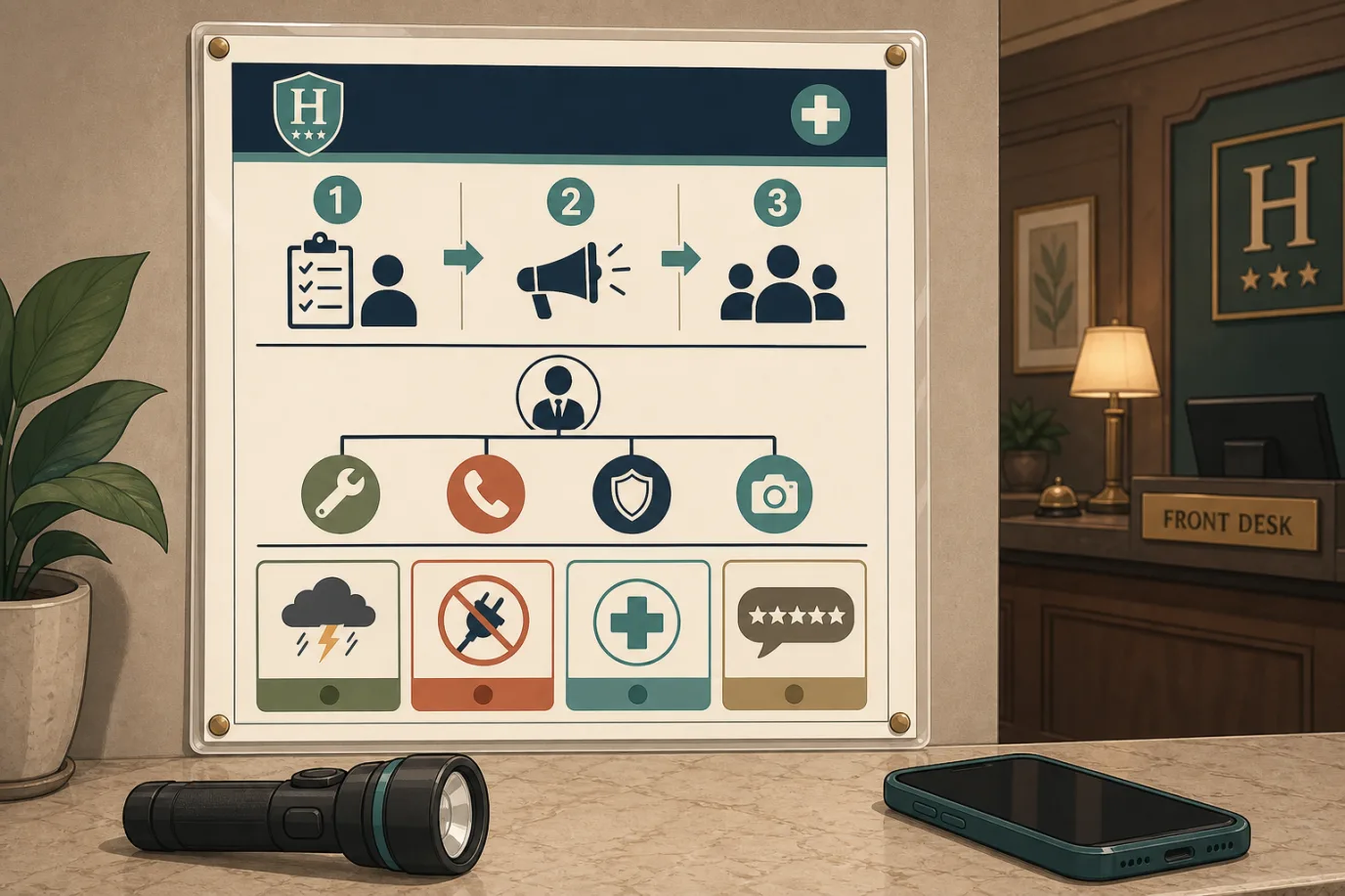
The binder-style crisis manual, seventy pages, last updated four years ago, signed off and never opened, is the most common form of hotel crisis planning and the least useful. At 2 a.m. with the lights out, nobody reads chapter six. The plan that works is short enough to print, specific enough to follow, and lives where the night team can physically reach it without electricity: a laminated sheet at the desk and a copy on phones.
Roles, the Contact Tree and Decision Rights
The first thing the sheet settles is who is in charge, by role rather than by name, because names change and shifts rotate. Whoever holds the duty manager role owns the first hour. The sheet then gives the contact tree: owner or GM, maintenance, the electrician and plumber you actually trust, the utility's fault line, local emergency services, the insurance contact, and whoever can post to your website and social accounts. Every number checked quarterly, because a contact tree with two dead numbers is worse than none; it burns the exact minutes it was built to save.
Just as important is writing down decision rights in advance. Can the night auditor comp a room without approval? Up to what amount can the duty manager spend on taxis, bottled water or an emergency generator without waking the owner? Who is authorised to speak to a journalist, and who is explicitly not? Crises stall on permission-seeking more than on ignorance. The plan should pre-authorise the obvious moves so the person on shift acts instead of phoning up a chain of people who are asleep.
Runbooks for Your Likely Scenarios
Behind the one-pager sit runbooks, one page each, for your top scenarios: at minimum the power or system outage, the severe-weather night, the guest medical incident and the reputation event. A runbook is not prose, it is a numbered sequence: first do this, then this, then call this person, then say this to guests. Write them with the newest member of the night team in mind, because that is who will be holding the sheet when it happens. If a step needs judgement, name whose judgement. If a step needs a phrase, write the phrase.
During: The First Hour, in Order
Whatever the scenario, the first hour has the same skeleton, and the order is the whole point: make people safe, establish facts, then communicate. Reversing the order is the classic failure, a statement goes out before anyone knows what is true, and the correction does more damage than the event.
Safety first is obvious but worth making mechanical: follow the emergency procedure for the event, count heads where relevant, and get anyone who needs medical help attended to before a single thought is spent on messaging. Facts second: the duty manager, personally or through one delegated person, confirms what is actually known. Not what is assumed, not what a panicked guest reported, what is known. Write it down with times; that log becomes the backbone of the insurance claim, any legal matter and the debrief. Early information in every crisis is partly wrong, and the discipline of separating known from assumed is what keeps your later communication credible.
Then communicate, in a fixed order: staff first, so every person a guest might ask gives the same answer; guests second, in-house and arriving; external channels third. Staff first is the step everyone skips and the one that most changes how the night feels, because nothing erodes guest confidence faster than three employees giving three versions of events.
Communicating With Guests While It Is Happening
Guests do not primarily judge you on the event, which they mostly understand is not your fault. They judge you on whether you told them what was happening, and whether someone seemed to be in charge. The working rules: communicate early, even when the honest message is that you do not know yet; give a next update time and keep it, an update promised for 9 p.m. and delivered at 9 p.m. buys enormous calm; and be concrete about what it means for them, dinner, hot water, check-out, refunds, rather than reciting what happened to the building.
Reach matters as much as tone. In-house guests you can catch at the desk and by a note under the door, but tonight's arrivals are on the road, and they booked through four different channels. This is where scattered communication kills you: someone messages the OTA guests through one extranet, forgets the second extranet, emails the direct guests late, and the guest who heard nothing is the one who writes the review. Whatever tooling you have, the requirement is one list of every affected guest and one place to message all of them, email, WhatsApp or OTA thread, in minutes rather than hours.
Working With OTAs During a Disruption
If the property genuinely cannot honour bookings, act in this order: stop the bleeding by closing availability for the affected dates on all channels, which is one action in a channel manager and five logins without one; message affected arrivals with the situation and their options before the OTA does it for you; and where you must cancel, do it through the platform's proper process, flagged as force majeure where the option exists, so you are not penalised as a routine canceller and relocation obligations stay manageable. OTAs are far more forgiving of a property that communicated early and closed its availability than one that went silent and let guests arrive at a dark building.
The Outage Playbook: Operating When the Systems Are Down
The technical outage deserves its own section because it is the crisis every hotel will face, and the one where preparation pays off most directly. Power cut, internet down, PMS unreachable, key-card server dead: different causes, same operational problem. The building is fine, the guests are fine, and you suddenly cannot answer the three questions the desk answers a hundred times a day: who is arriving, which rooms are they in, and what do they owe.
The whole playbook hangs on one decision made before the outage: tonight's information must exist outside the system before the system goes down. That means an automatic end-of-day export or printed report, arrivals and departures with contact details, room assignments and balances, produced every evening as part of closing routine. It costs a minute a day, and it is the difference between an outage being an inconvenience and being chaos. A cloud PMS helps here in a way worth stating plainly: if the building loses power but the world does not, your data is reachable from a phone on mobile data, and check-ins can continue from the terrace. But a phone with no local information because everything lived in an unreachable system is the modern version of the locked filing cabinet.
The rest of the kit is mundane and decisive: torches and lanterns where the night team can find them in the dark, charged power banks, a paper registration form and a documented offline check-in procedure, a manual way to take payments or a clear policy to record charges and settle later, and physical override keys for electronic locks, with the knowledge of where they are. Add the utility company's fault number to the contact tree, and a phrase for the desk: what we know, what still works, when we expect the next update. Hotels ran for a century without electricity in the walls; a night of it is entirely survivable if the information survived.
Reputational Crises: Reviews, Social Media and the Press
The reputation event feels different from the others because nothing physical has happened; the crisis exists entirely in what is being said. That makes it the family where instinct is most dangerous, because the natural human responses, defending yourself in public, correcting the record point by point, matching the guest's tone, all pour fuel on it.
The sequence that works: verify internally first, because responding to a version of events that turns out to be false is unrecoverable; decide on one voice, a single person who responds everywhere, so the property speaks once rather than five staff members improvising; then post one calm, factual reply that acknowledges the experience without grovelling, states any corrective action briefly, and moves the exchange to a private channel. Then stop. Do not reply to every comment. Do not post again unless there is new substance. Most firestorms burn out in days, and the defensive follow-up is what keeps them trending.
Two harder cases: when the guest is simply wrong, respond to the audience rather than the author, one polite, factual reply exists for the thousand future guests who will read the thread, not to win the argument; you will not win the argument. And if the press calls, the plan should already say who speaks, and everyone else's line is a warm referral to that person, never a comment. A named, prepared spokesperson is the difference between a paragraph of your words and a paragraph of a reporter's guesswork.
The quiet preparation for this family is the strength of your baseline. A property with a steady flow of recent, detailed positive reviews has ballast; one bad story sits in context. A property whose last review is four months old is defined by whatever lands next. Systematic post-stay review requests are not vanity, they are reputational insurance you build before the day you need it.
After: Recovery, Refunds, Documentation and the Debrief
The crisis is not over when the lights come back. The forty-eight hours after are where reputations are actually settled, because that is when guests decide whether the story they tell is about the storm or about how you handled it.
First, close the loop with every affected guest, individually where you can. A short message that says thank you for your patience, here is what happened, here is what we are doing about your bill, converts a bad night into a loyalty story surprisingly often. Decide refunds and gestures by policy rather than by whoever shouts loudest: the plan should say in advance what a night without hot water is worth, what a cancelled arrival receives, and who signs off exceptions. Consistency here protects you twice, once against overspending in guilt and once against the accusation of treating guests differently.
Second, finish the paperwork while memory is fresh: the incident log with times, photographs of any damage, receipts for emergency spending, copies of guest communications. Insurance claims and any legal questions are won or lost on this file, and it takes an evening to build now versus weeks to reconstruct later. Third, hold the debrief within a week, blameless by explicit rule: what did the plan get right, where did it stall, which number was dead, which step was missing. Then actually amend the sheet. A plan that does not change after contact with a real crisis is not being used, it is being displayed.
Drills: Keeping the Plan Alive Between Crises
An untested plan is a theory. The properties whose crisis response looks effortless are the ones that spent two unglamorous hours a year rehearsing, and the rehearsal does not need theatre. Twice a year, walk one scenario end to end: pull out the sheet, follow the runbook, place no real calls but point at each number and say who answers. One walk-through of the outage runbook, one of a guest-incident or reputation scenario, under an hour each.
Add a quarterly five-minute check of the contact tree, because numbers rot faster than any other part of the plan, and a nightly habit that costs nothing: the closing-shift export or printed arrivals report that makes the outage playbook possible. The standard to hold yourself to is concrete: the newest person on the night team, alone, can find the plan, run the first three steps of the most likely scenario, and reach a human who can make decisions. When that is true, you have a capability. Until then, you have a document.
Where Prostay Fits, Honestly
Two parts of crisis response depend directly on the tools you run, and both came up in every scenario above. The first is reaching guests fast. When arrivals from four channels need the same message in the next thirty minutes, a unified inbox that holds email, WhatsApp and OTA conversations in one place, with templates ready, is the difference between one person handling communication and the whole team drowning in it. That is what Prostay Nexus is for on a normal day, and a crisis is the day it earns its keep. The second is data that survives the building. A cloud PMS with a daily arrivals report means the outage playbook works from any phone; availability can be closed across channels in one action rather than five extranet logins.
None of that replaces the laminated sheet, the contact tree or the rehearsal, and no software will make decisions at 2 a.m. for you. The test to apply to us or any vendor is the practical one: in a simulated outage, can you produce tonight's arrivals with contact details from a phone, message every affected guest across every booking channel from one screen, and close availability everywhere in under ten minutes? If yes, your tools will hold up on the bad night. If no, fix that before the weather does it for you.
Frequently Asked Questions
The questions owners and managers ask most about crisis management, what a plan should contain, what to do first, how to run an outage and how to handle a public reputation event, answered from how these nights actually unfold in a real property.