
A hotel room is the most perishable product in commerce. A shop can sell yesterday's stock tomorrow; you cannot sell last night's empty room ever again. That is why occupancy is the number that follows hoteliers home, and why the reflex response to a soft calendar, cut the rate, is so common and so often wrong. In fifteen years around this industry I have watched the same scene play out in properties from twelve rooms to two hundred: occupancy dips, someone panics, rates drop 20 percent across the board, occupancy barely moves, and now the same rooms are selling for less. The problem was never the price. The problem was that nobody diagnosed the problem.
This guide is about doing occupancy properly: figuring out which of the four distinct causes of empty rooms you actually have, and then pulling the levers that work on that cause instead of the one lever everyone pulls. Some of the fixes live in your distribution setup, where a channel manager determines whether your rooms are even visible where guests shop. Some live on your own website, where a booking engine decides whether the guests who find you actually finish the booking. Some live in your pricing, and some live outside your property entirely, in demand that has to be created rather than captured. None of them start with a blanket discount.
First, Know What Your Occupancy Actually Is, and Should Be
Occupancy rate is rooms sold divided by rooms available, multiplied by one hundred. A 40-room property that sells 28 rooms tonight runs 70 percent. Simple enough that everyone computes it, loose enough that half the industry computes it wrong. Two details corrupt the number if you are careless. Rooms out of order, genuinely unsellable because of renovation or damage, should come out of the denominator; counting them makes your occupancy look worse than your performance. And complimentary rooms, house use, and owner stays need a consistent policy, because flip-flopping on whether they count makes month-to-month comparison meaningless.
The more interesting question is what your occupancy should be, and the honest answer is that there is no universal target. Global full-service averages sit somewhere in the 60 to 75 percent band depending on the year and region, but averages hide everything useful. A city business hotel might run 85 percent midweek and 40 percent on weekends. A beach resort might run 95 percent for four months and 30 percent for five. A highway property lives night to night. Your meaningful benchmark is not the industry, it is your own market: your competitive set's performance on the same nights, which you can approximate from rate shopping, market reports and the simple discipline of watching when your competitors sell out.
One more foundation before the diagnosis: occupancy is one leg of a three-legged stool with average daily rate and RevPAR, revenue per available room. Occupancy alone is a vanity metric. One hundred percent occupancy at desperate rates is a busy way to lose money, since every occupied room carries real costs in cleaning, linen, amenities and utilities. Everything in this article assumes the goal is profitable occupancy, which is why the title says without giving the rooms away.
Diagnose Before You Discount: The Four Causes of Empty Rooms
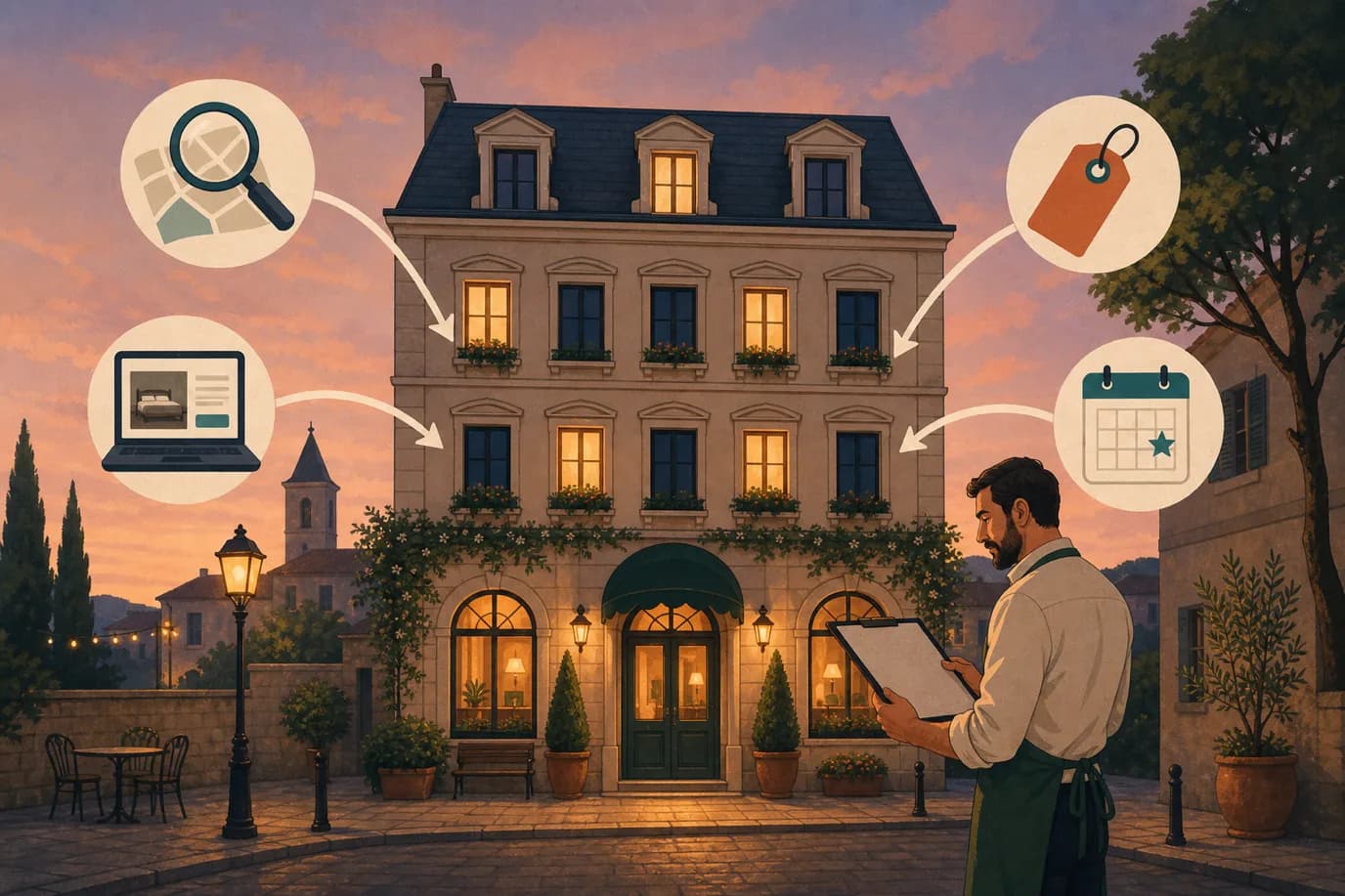
Empty rooms are a symptom with exactly four causes, and the treatment for each one is different. First: nobody finds you. Your property does not appear where your potential guests are searching, whether that is OTA results, Google, or metasearch. Second: they find you and leave. You get looked at, on OTAs or on your own website, and the looker books elsewhere or nowhere. Third: the price is wrong. You are visible, considered, and rejected on rate, or blocked by a restriction like a minimum stay that makes the booking impossible. Fourth: the demand is not there. Nobody is coming to your market on those dates at any price, and no amount of visibility or discounting summons travellers who were never considering the trip.
The reason diagnosis matters is that the levers do not transfer. Discounting, the universal reflex, only treats cause three, and only when price-sensitive demand actually exists to capture. Applied to cause one it sells nothing, because invisible rooms are invisible at any price. Applied to cause four it sells nothing either, and damages your rate integrity for the season. So before spending a euro or cutting a rate, spend an hour with your data. Your PMS and channel reports will tell you most of it: how many eyeballs are you getting on each OTA (Booking.com and Expedia both expose page-view and conversion stats in their partner portals), what is your website traffic and booking conversion, how does your rate sit against your compset on the soft dates, and is your compset also empty? That last question is the fastest single diagnostic in the business. If every hotel in town is empty on the same nights, you have a demand problem and should skip straight to the demand section. If your competitors are full and you are not, the problem is yours, and it is one of the first three.

Cause One: Nobody Finds You. The Visibility Levers
Visibility problems are the most common cause of soft occupancy at small independent properties, and the least glamorous to fix, which is why they persist. The work is administrative: channels, content, profiles, mappings. Nobody puts it on a vision board. It also happens to be the highest-return work available, because it captures demand that already exists and is already searching for a room like yours.
OTA Ranking, Content Score and the Channels You Skipped
Start with the channels you are on. Both Booking.com and Expedia rank properties within search results using algorithms that reward conversion, content completeness, review scores, availability depth and commercial participation, and a listing that has drifted, old photos, thin descriptions, half the room types unmapped, sinks in those rankings regardless of how good the hotel is. The extranet content score both platforms show you is not decoration; properties in the top content tier get measurably more visibility. Fresh professional photography, complete amenity lists, accurate room descriptions and answered reviews are the price of admission, not the extra mile. I wrote a full breakdown of how those ranking algorithms work and which levers move them, so I will not repeat it here, but the one-line summary is: the algorithm sells what converts, so everything that improves your conversion also improves your rank, and the compounding is real.
Then the channels you are not on. Plenty of properties list on the big two and stop, leaving regional and niche demand on the table: Agoda and Trip.com for Asian source markets, Hostelworld for the budget segment, HRS for German corporate travel, regional players in whatever market feeds yours. Each additional channel is incremental eyeballs on the same physical inventory, and with a channel manager keeping availability and rates synchronised automatically, the marginal administrative cost of an extra channel is close to zero. Without one, every added channel multiplies the manual work and the overbooking risk, which is exactly why under-distributed properties are almost always properties managing channels by hand.
Check your mappings while you are there. A surprisingly common visibility failure is structural: room types that exist in the PMS but were never mapped to a channel, rate plans that stop selling 30 days out because someone set a booking window years ago, inventory allocations that starve one channel while another sits on unsold allotment. Rooms that are not loaded cannot be found. An hour auditing your channel manager's mappings finds these embarrassingly often.
Google Business Profile, Metasearch and Your Name
The second visibility front is search. When someone googles your hotel by name, the panel on the right side of the results, your Google Business Profile, is your real homepage: photos, reviews, rates, booking links. An unclaimed or neglected profile hands that moment to the OTAs, whose ads and links will happily wrap themselves around your name. Claim it, load real photography, keep hours and amenities current, respond to reviews, and connect your direct rate through free booking links so that your own price appears alongside the OTA prices in the hotel panel. Google's free booking links remain one of the few genuinely free distribution channels in the industry, and the number of independent properties that still have not enabled them is remarkable.
Metasearch, Google Hotels, Tripadvisor, Trivago, Kayak, is where rate comparison actually happens, and being absent from it means the comparison happens without your direct rate in the running. Paid metasearch bidding is its own discipline with its own budget question, but the free and cheap tiers, Google's free links above all, belong in every property's setup. The same goes for local SEO basics: consistent name, address and phone across directories, a website that mentions the neighbourhoods and landmarks guests actually search for, and pages that answer the questions your guests ask before booking. None of this fills ten rooms by Thursday, but visibility work compounds, and six months of it changes the baseline demand your property receives every single week.
Cause Two: They Find You and Leave. The Conversion Levers
If your OTA pages get traffic and your website gets visits but the bookings do not follow, you do not have a visibility problem, you have a conversion problem, and pouring more visibility into a leaking funnel is expensive. The diagnostics are direct: OTA extranets show your page views against your bookings, and your website analytics show how many people enter the booking flow and where they abandon it.
On OTAs, conversion is mostly photography, reviews and rate presentation. The first photo decides whether anyone opens your listing; the review score decides whether they shortlist it; the rate plans decide whether they commit. A property scoring below the high sevens on Booking.com is fighting uphill, and the fix is operational, not digital: find the recurring complaint in your reviews and kill it at the source. Review response matters too, less for the guest you are answering than for the hundred guests reading the exchange.
On your own website, the conversion killers are so consistent they are almost boring: a booking engine that loads slowly, breaks on mobile, forces account creation, hides the total price until the last step, or dumps the guest to a third-party page that looks nothing like the site they were just on. Mobile is the majority of traffic for most properties now, and a booking flow that was never really designed for a phone quietly bleeds bookings every night. The direct channel also has to give the guest a reason to book direct: rate parity rules constrain public undercutting in some markets, but perks do not, so free early check-in, a welcome drink, a room-preference guarantee or a small member rate fenced behind an email signup all tip the decision without touching public price. I have covered direct booking conversion at length elsewhere on this blog; the point for this article is that conversion is a distinct disease with distinct medicine, and no rate cut fixes a checkout that fails on an iPhone.
Cause Three: The Price Is Wrong. The Rate and Inventory Levers
Sometimes the price genuinely is the problem, in either direction. Priced meaningfully above your compset without a differentiator the market recognises, you will watch lookers become bookers somewhere else. Priced far below, you fill early with your cheapest demand and have nothing left to sell when the high-rate, late-booking guest shows up. Both failures come from the same root: static pricing in a dynamic market. The property that sets one rate for high season and one for low season is not making one pricing decision a year, it is making the wrong pricing decision 365 times a year.
The fix is dynamic pricing calibrated to your booking pace: rates that move with demand, day by day, informed by how far ahead your market books, what your compset is charging, and what is happening in town. This does not require a revenue management department. A small property can get most of the benefit from a weekly rhythm: check pace against the same weeks last year, shop the compset, adjust the outliers. The deeper treatment of booking windows and lead-time pricing is its own article on this blog. The core principle for occupancy is that price should be doing targeted work on the specific soft dates, not blanket work on the whole calendar. A public 25 percent off everything teaches your market to wait for sales. A quiet mobile rate on the two dead midweek nights three weeks out captures the price-sensitive traveller without repricing your product.
Fenced and non-refundable rates are the honest way to discount. A fence is a condition that limits who can access a lower price: book 30 days ahead, stay three nights, pay now without refund, be a member, book on mobile. Fences let you reach the price-sensitive segment while everyone who was going to pay full rate still does. Non-refundable rates in particular do double duty for occupancy, because the revenue is locked and the cancellation risk, which is itself a silent occupancy killer, disappears for that booking.
Minimum Stays, Room Types and the Inventory You Hide
The subtler pricing failure is the booking you made impossible. Minimum-stay restrictions set for peak season and never removed will quietly block every two-night attempt in your soft months; closed-to-arrival rules from a long-forgotten event weekend linger for years. Audit your restrictions quarterly, and any time a date looks inexplicably soft, try to book it yourself, on your own website and on an OTA. You will occasionally discover that the reason nobody booked Tuesday is that nobody could.
Room-type structure hides inventory the same way. If your entry room type sells out while premium rooms sit empty, the market is telling you the gap between the two prices is wider than the gap between the two products. Upgrade-at-a-discount offers to already-booked guests, or narrowing the price ladder on soft dates, sells the inventory the ladder was hiding. The same logic applies to unsellable-by-default inventory like accessible rooms or oddly shaped rooms that agents skip: photograph them properly, describe them honestly, and price the difference.
Cause Four: The Demand Is Not There. The Demand-Creation Levers
When your whole market is empty, the game changes completely. Visibility captures existing demand; conversion converts it; pricing allocates it. None of them create it. If nobody is coming to your town in November, a 40 percent discount does not manufacture a trip that was never being considered. What creates demand is a reason to travel, and the properties that thrive in soft markets are the ones that stopped selling rooms and started selling reasons.

Packages are the workhorse. Not the lazy kind, room plus breakfast and a bottle of wine, but packages that bundle the actual reason someone would visit your area in that season: the truffle harvest, the diving certification, the marathon, the wine route, the storm-watching, the silence. A package reframes the purchase from a commodity with a comparable price to an experience without one, which is precisely why packages resist price comparison in ways a bare room never can. Partner with the operators around you, the restaurants, guides, spas and instructors who also need November revenue, and split the value creation.
Events flip the model from waiting for demand to hosting it. Small properties fill soft periods with cooking weekends, yoga retreats, artist residencies, wine dinners and workshops, and larger ones chase the group and corporate calendar: conferences, sports teams, film crews, wedding blocks. Group business booked into precisely your weak months is worth more than the same business in months you would fill anyway, which should shape how aggressively you negotiate for it. The remote-work segment deserves specific attention because it is structurally counter-seasonal: people who can work from anywhere prefer your town when it is quiet and cheap, and a long-stay offer with weekly housekeeping, reliable Wi-Fi and a real desk turns a dead month into a base of week-long bookings.
Midweek, Shoulder Season and the Nights Nobody Wants
Most properties do not have an occupancy problem, they have a Tuesday problem, or a November problem: specific recurring holes in an otherwise healthy calendar. Treat those holes as their own market. Midweek soft nights in leisure destinations respond to a different buyer, retirees, remote workers, locals taking a break, than the weekend crowd, and reaching them takes different messaging on different channels, not a lower weekend product. Sunday-night softness responds to Sunday-specific length-of-stay offers, stay Sunday get it half price with the Saturday, which protect the strong night while filling the weak one. Shoulder season responds to the packaging and events work above, started early: the property that begins selling its November story in August eats the segment alone, while everyone else discovers in October that their calendar is empty. I have written a dedicated guide to shoulder-season strategy; the point here is that a hole in the calendar is a briefing for a campaign, not a signal to cut the annual rate.
The Compounding Lever: Repeat Guests and Length of Stay
The cheapest room-night you will ever fill belongs to a guest you already have. Repeat guests cost nothing to acquire, book more directly, cancel less and complain less, and every property has a pile of them sitting in the PMS as email addresses nobody messages. A modest email rhythm, a genuinely useful note before the season, a real offer for past guests when the calendar is soft, an anniversary nudge for the couple who came last spring, outperforms nearly any paid acquisition on cost per filled room. The offer to a past guest can even be generous without damaging your public rate integrity, because it is fenced by definition: nobody else sees it.
The second compounding lever is length of stay. Every extra night added to an existing booking is occupancy without acquisition cost: no commission, no marketing, no extra check-in, one less turnover clean. Length-of-stay pricing, third night 30 percent off, weekly rates that reward the seventh night, arrival-day nudges offering a late-checkout extension when tomorrow is empty, all convert bookings you already won into more room-nights. On soft dates, extending stays is nearly always more profitable than discounting to attract new short ones, and it is strange how much more industry energy goes to the second than the first.
When Higher Occupancy Is the Wrong Goal
A short, necessary heresy: sometimes the fix for your occupancy anxiety is to stop optimising occupancy. If you run at 95 percent for months, your prices are too low; you are selling out early to your cheapest demand and turning away the expensive kind, and the constant full house is burning out your housekeeping team and your building. If a market segment fills rooms at rates below your true variable cost per occupied room, cleaning, linen, amenities, utilities, commission, that occupancy is a loss dressed as a win. And RevPAR, not occupancy, is the number that should settle arguments: 70 percent at 150 beats 85 percent at 110, with less wear and fewer complaints. Occupancy is the goal only up to the point where it stops being profitable; past that point, rate is the goal. Break-even occupancy, your fixed costs divided by your net average rate, divided by available room-nights, tells you where you stand, and most properties are pleasantly surprised by how much room the number leaves. The purpose of everything in this article is more profitable room-nights, and it is worth re-reading your soft calendar with that lens before pulling any lever at all.
Where Prostay Fits
Almost every lever above runs through the distribution and booking layer, which is where Prostay does its work. The channel manager keeps your rates, availability and restrictions synchronised in real time across Booking.com, Expedia, Agoda, Trip.com and the rest, which makes wide distribution administratively free and makes the targeted moves in this article, opening a mobile rate on two soft dates, lifting a stale minimum stay, pushing a package to one channel, single-screen changes instead of five-extranet afternoons. The booking engine handles the conversion side of the direct channel: fast, mobile-first, total price up front, packages and fenced rates presented properly, so the visibility work you do actually ends in bookings rather than abandoned carts. And because both sit on the same platform as the PMS, your guest history, the raw material of the repeat-guest lever, is one query away rather than one export away. Occupancy strategy is diagnosis plus execution; the software's job is to make the execution cheap.
The empty room expiring at midnight will always be the industry's special anxiety. But it is a solvable one, night by night, once you stop treating every soft date as a pricing emergency and start treating it as a question: can they find me, do they book me, is the price right, does the demand exist? Four causes, four sets of levers, and not one of them is panic.