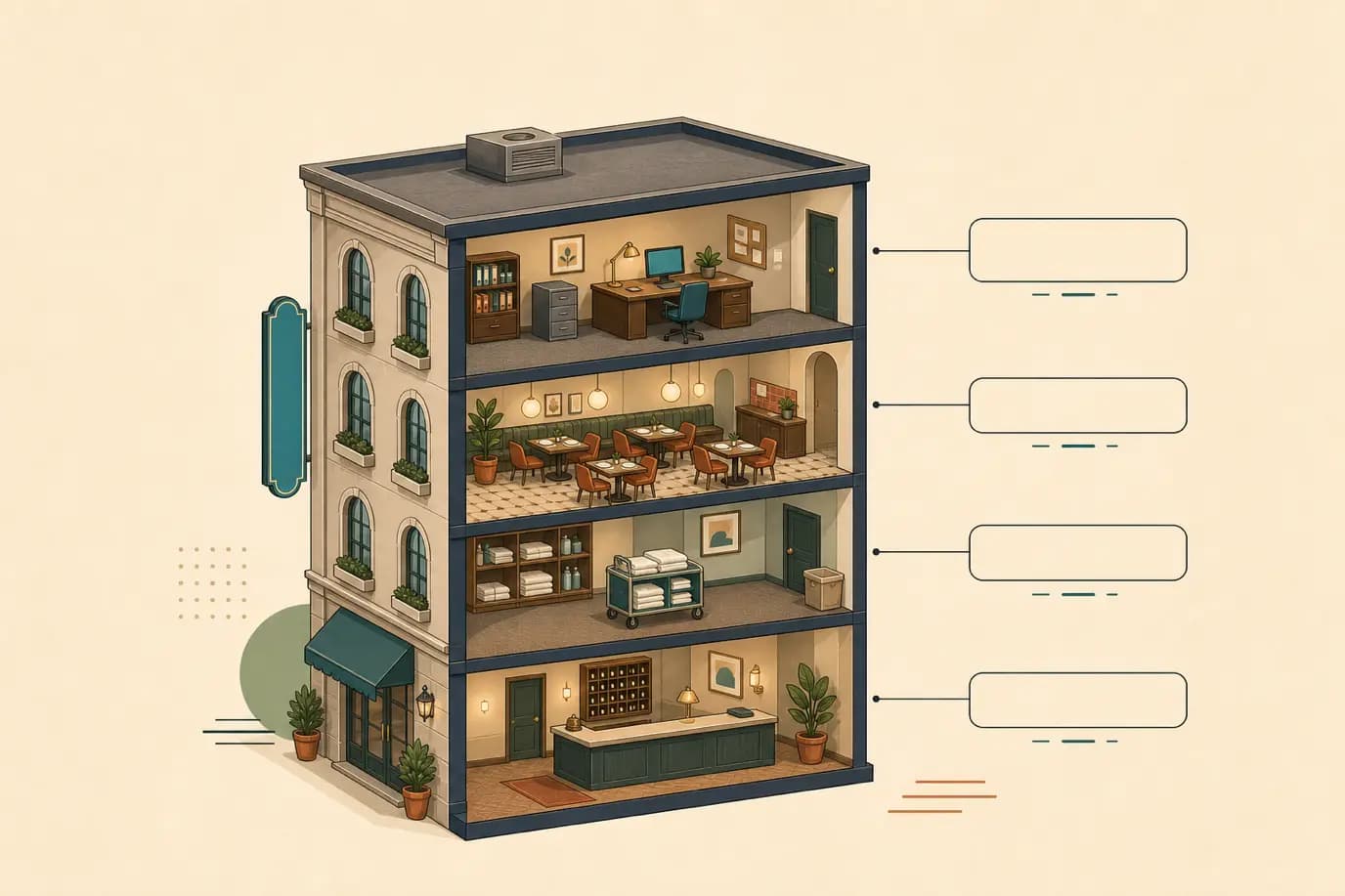

A house account is an open folio for someone who has no room. The city ledger is the debt that remains once that folio has been closed and invoiced. One is a container that is still filling up. The other is a consequence that somebody now has to go and collect. Most of the confusion in this area, and most of the friction between a front office manager and whoever runs the hotel accounting software, comes down to a disagreement about which of those two states a given balance is actually in.
The two are not competing options. They are consecutive. A charge does not go to either a house account or the city ledger the way a booking goes to either a room or a waitlist. It very often goes to one and then the other, in that order, and the moment it crosses between them is where money is most likely to go missing. Your property management system normally owns the first stage and hands the second to accounting, which is why the two halves of the story live on different screens, get run by different departments, and get described by different people using the same vocabulary to mean different things.
This article is about that crossing point rather than the definitions. If you want the definitions on their own, they are already written up: what a city ledger is covers the receivables side in detail, and house accounts and how they leak money covers the open-folio side. What follows assumes you have a rough grip on both and are trying to work out where one stops being the right answer and the other starts.
The Difference in One Sentence
If a new charge can still be added to it today, it is a house account. If the only thing left to do is collect, it is a city ledger balance.
That single test resolves the overwhelming majority of cases, and it is more useful than the usual framing about guests and non-guests, because both of these involve people who are not sleeping in your rooms. A wedding organiser running a bar tab at four in the afternoon and a wedding organiser who owes you four thousand for that bar tab six weeks later are the same person with the same debt. The thing that changed in between is that the account stopped accepting postings and started accruing age.
Think of it as a state, not a category. Open means operations still has work to do: charges are landing, the balance is moving, and a member of staff on shift can look at the running total and make a decision about it. Closed means finance has work to do: the number is fixed, a document exists with a number on it, and the only remaining question is when the money arrives. The vocabulary problem in hotels is that we have two nouns for what is really one thing in two states.
Why These Two Get Mixed Up
Several reasons, and none of them are anybody being stupid.
The first is that both are non-guest money. Everything a front office learns about billing is organised around the guest folio, and both of these sit outside it. When your mental model has exactly one category for money that does not belong to a person in a bed, two different things land in it and get treated as synonyms.
The second is that the terms are at different levels of abstraction and get used as if they were not. A ledger is a book. An account is one record inside a book. So a house account is a single thing you can open, close and print, whereas the city ledger is a collection of many accounts. Asking whether a balance is a house account or the city ledger is a bit like asking whether a page is a page or a chapter. People say it anyway, and everyone understands roughly what is meant, but the category error is what lets the two blur.
The third is that some systems genuinely implement one as the other. In classic Opera, a House Posting Account settles to accounts receivable, which is to say the city ledger, so the same object touches both worlds by design. Read three vendor manuals and you will find the same physical thing described as a posting master in one, a house account in another, and a non-guest folio in a third. None are wrong within their own documentation. They just cannot be read across.
The fourth is regional. In North American usage the guest ledger and city ledger split is taught as a fundamental of hotel accounting and turns up in every textbook. In much of Europe the same distinction exists but the terminology leans on accounts receivable directly, and city ledger sounds like an Americanism people half remember. A team assembled from four countries will not share a definition unless someone writes one down.
Following One Charge From the Bar to the Bank
Take a specific case, because the abstractions collapse the moment you follow one number.
A local company books your function room for a Saturday product launch. No bedrooms. Forty people arrive at midday, there is a buffet, there is a bar, and the account runs all afternoon. Here is what happens to a single glass of wine poured at 3pm.
Stage one, the posting. The bartender rings it up and needs somewhere to send it. There is no room number, because nobody is staying. The charge goes to an open house account in the name of the company, which behaves like a folio in every respect except that it has no reservation behind it.
Stage two, accumulation. The wine sits alongside the buffet, the corkage, the AV hire and the extra hour of room rental. Over the afternoon the balance climbs. It is visible to the duty manager, who can see the total moving and can say something if it goes past what was agreed. This is the part only an open account can do.
Stage three, the close. On Monday, once late dockets from the kitchen and the bar have all landed, somebody closes the account. A final total is agreed, an invoice is produced with a number on it, and that number goes to the company with payment terms attached.
Stage four, the transfer. The balance leaves the guest ledger and arrives in accounts receivable as a debt owed by that company. This is the moment it becomes a city ledger item. Nothing about the wine changed. What changed is that it can no longer be corrected at the desk and can no longer have anything added to it.
Stage five, ageing. The invoice is now dated. At thirty days it is current, at sixty it is a problem, at ninety it is a conversation with the finance director. It appears in the ageing report, it moves days sales outstanding, and it sits on the balance sheet as an asset you have not yet converted to cash.
Stage six, settlement. Payment arrives, is matched against the invoice, and the receivable clears. The wine is finally, actually, paid for, roughly five weeks after somebody drank it.
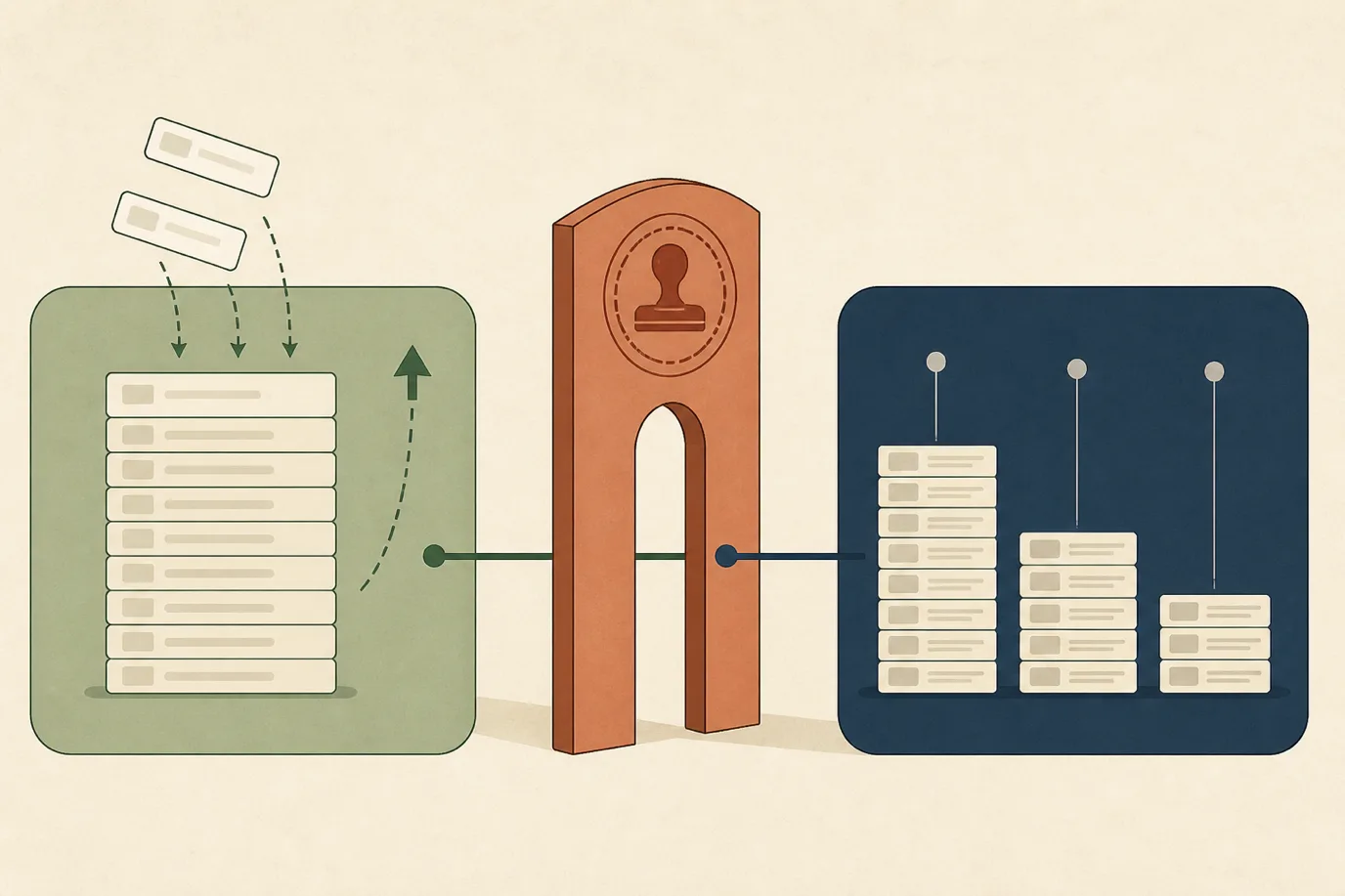
Six stages, two systems, and one handover in the middle. Almost everything that goes wrong in this area goes wrong at stage three or four.
The Handoff, and Why It Is the Risky Part
Closing an account sounds administrative. It is actually three separate things happening together, and they can come apart.
The first is capture. Every charge that belongs to the event has to have landed before the total is agreed. Kitchens and bars are the usual offenders here, not through carelessness but because a docket written at 11pm on Saturday reaches the office on Monday morning, by which point somebody eager has already invoiced.
The second is documentation. An invoice with a number has to exist, because the receivable needs something behind it. An amount owed with no document is not a receivable, it is a note.
The third is the transfer itself. The balance has to move out of the open account and into the debtor's account. This is the step people forget, and it is the one with the nastiest failure mode.
Consider what happens if the second and third come apart in either direction. Invoice issued, balance not transferred, and the amount now exists in two places: still showing as an open account balance in the front office and also as a receivable in accounting. Your ledgers do not agree and someone spends a morning in November working out why. Balance transferred with no invoice raised, and accounting is holding a debt with no document, which means nobody can chase it because there is nothing to send.
What Closed Should Actually Mean
Worth agreeing internally, because it is usually assumed rather than defined. A house account is properly closed when all four of these are true: no further postings are possible, the final total has been checked against what was actually agreed with the client, a numbered document exists, and the balance now appears in exactly one ledger. Not three of the four. Properties that write this down on a single card at the desk close accounts faster and argue about them less.
One more thing worth deciding in advance: who is allowed to press the button. Closing an account is the moment control passes from operations to finance, and it is a natural approval point. In most properties the person who can post a charge should not be the same person who can close an account and fix its total, for the same reason the person who counts the till is not the person who reconciles it.
What Only a House Account Can Do
The case for keeping accounts open longer than feels tidy.
It accepts live postings from anywhere in the building. The bar, the spa, the restaurant and the desk can all send charges to it during service without anybody stopping to ask finance a question. That is the entire point, and it is why an event should stay on an open account for as long as the event is still generating charges.
It carries a running balance that operations can see. A duty manager can look at a number at 9pm and decide whether the bar tab has passed the limit the client agreed to. Once that balance is a receivable, nobody on shift is looking at it.
It can take money before it takes charges. Deposits and prepayments sit naturally on an open account, which is useful for events where you want cash in hand before the day.
It can be corrected at the desk. A charge posted to the wrong account at 7pm can be voided and reposted at 7:05pm with a reason attached, which is a supervisor's job rather than a finance adjustment.
It can produce a proforma. Clients frequently want to see the position before the event ends. A proforma is explicitly not an invoice, carries no number, and creates no receivable, which is exactly what you want mid-event.
What Only the City Ledger Can Do
And the case for not leaving things open a day longer than necessary.
It ages. This is the single most important thing on the list. An open account has no age, or rather it has one that nobody is looking at, whereas a receivable is dated from its invoice and sorts itself into buckets automatically. Ageing is what converts a vague sense that someone owes you money into a specific fact about how long they have owed it.
It can be chased systematically. Reminder schedules, statements, escalation and eventually legal action all run off a receivable with a document behind it. There is no dunning process for an open folio.
It consolidates. One company that ran four events across a quarter can be looked at as one debtor with one total and one relationship, rather than four unrelated accounts nobody connects.
It carries terms and limits. Credit is a property of a debtor, not of an event. Payment terms, a credit limit and an approval history belong on the account in accounts receivable, and they are what let you decide whether to say yes to the fifth booking.
It can be provisioned and written off. Bad debt is an accounting act with tax consequences and needs to happen against a receivable. You cannot write off an open folio in any meaningful sense; you can only delete it, which is a different and much worse thing.
Who Owns Which, and Why the Boundary Matters
The front office owns the open account. The people posting to it are on shift, the balance is operationally relevant, and decisions about it are made in real time by whoever is running the floor.
Accounting owns the receivable. The decisions are about credit, collection and provisioning, they run on a monthly rhythm rather than a nightly one, and they need a view across the whole debtor rather than a single event.
That boundary is not bureaucratic tidiness. It is the main internal control in this whole area. The classic separation of duties principle says the person who initiates a transaction should not be the person who can make it disappear. Splitting at the invoice enforces that almost for free: operations can create and correct charges but cannot write them off, finance can write off but cannot quietly add a charge to an open account after the fact.
In a small property this is often the same human being wearing two hats, which is normal and not a scandal. What matters then is that the two activities are still separate acts with separate records, and that somebody other than that person reviews the write-offs periodically. Owner, general manager, external accountant, anyone. The control is the review, not the org chart.
What Each One Does to Your Reports
This is where the choice stops being philosophical.
A house account, implemented properly, should have no effect whatsoever on occupancy, ADR or RevPAR. Nobody is in a room, so nothing should touch room statistics. It will affect departmental revenue, because the food and beverage that got posted to it is real revenue in the period it was posted, and it will show up in the guest ledger balance until it closes.
A city ledger balance affects nothing on the revenue side, because the revenue was already recognised when the charge was posted. What it affects is the balance sheet, cash flow and days sales outstanding. This trips people up regularly: a hotel can have an outstanding month on paper and no money, because all of it went to receivables and none of it has been collected. Revenue and cash are different questions and the city ledger is precisely the gap between them.
The Pseudo-Room Trap
Worth its own warning, because it is common and it quietly corrupts a year of reporting.
Some systems cannot post a charge without a room number, because the posting engine is built around rooms. Their solution is a pseudo-room: a fake room on a dedicated room type that exists purely to hold house account charges. Opera does this, and it works, provided the pseudo-room type is excluded from every statistic that counts rooms.
The trap is that the exclusion has to be configured, and it is easy to skip. Get it wrong and your fake rooms count as occupied. Occupancy climbs above reality, ADR falls because those rooms carry no room revenue, availability is understated so you refuse bookings you could have taken, and the pseudo-rooms turn up on the arrivals list and in housekeeping tasks. The property most likely to hit this is the one that started using house accounts heavily after a busy events season, which is exactly the point at which the distortion is largest. If your occupancy looks slightly too good and nobody can explain it, count your room types.
Six Charges and Where They Belong
The decision, applied to cases that come up constantly.
| The situation | Where it goes | Why |
|---|---|---|
| Day meeting, buffet lunch, no bedrooms | House account, open through the event | Charges are still arriving, and somebody on shift needs the running total |
| Wedding bar tab on the night | House account, closed once the kitchen and bar dockets are all in | Closing on the night is the classic way to miss the last two hours of the bar |
| Corporate guest whose employer is billed | Guest folio during the stay, straight to the city ledger at checkout | There is a room and a guest, so it is never a house account. It becomes a receivable at departure |
| Minibar found after a guest has departed | Reopen the folio, or raise a document against the company account | Never post it straight to a debtor. A receivable with no document behind it cannot be defended |
| Deposit for next year's wedding | Deposit ledger, as a liability | You owe them an event, they do not owe you money. It is not a receivable in either direction |
| Duty manager entertaining a supplier | An internal or administrative account | It ends up as a cost, not a debt. Keeping it off both keeps your receivables honest |
The row people argue about most is the third one. A corporate guest on direct billing feels like it ought to involve a house account somewhere, because a company is paying. It does not. There is a guest in a room, so there is a folio, and the folio goes to receivables at checkout. The house account only enters the picture when there is no room at all.
What Breaks When You Pick Wrong
Four failures, in rough order of how often they turn up.
The account nobody closed. An event finishes in March, the account stays open, and in September somebody notices a four-figure balance sitting there. The revenue was recognised in March. No invoice was ever raised, so the client has never been asked to pay, and it has no age because it was never a receivable. It has been invisible for six months precisely because it was in the wrong place. This one is common enough that it is worth running a standing report of open accounts with balances and no activity, sorted oldest first.
The premature transfer. Somebody invoices on the Saturday night because they are keen. On Monday two kitchen dockets and a bar docket arrive. Now you either issue a second invoice for a small amount, which annoys the client and costs more to process than it collects, or you write the charges off. Most properties write them off, which means keenness costs money.
The double count. Invoice raised, balance never moved. Front office reports an open account balance, accounting reports a receivable, and the same money is in both. It will be found at month end, and finding it takes an afternoon.
The phantom room. The pseudo-room problem described above, but arrived at deliberately: a property with no house account feature at all creates a real dummy reservation to bill a non-resident. It works, and it poisons occupancy, ADR, availability, the arrivals list and housekeeping simultaneously. If a system forces this, the cost is not the workaround, it is a year of reporting nobody can trust.

How Each One Looks at Night Audit
The nightly audit is a useful lens here, because it treats the two very differently and that difference is diagnostic.
An open house account is part of the guest ledger, so it participates in the audit like any other folio. Its balance is counted, it has to balance, and it appears in the nightly position. That is genuinely useful: an account left open for weeks keeps showing up every single night rather than vanishing into a quiet corner. If your ledger balance has a stubborn component nobody can explain, open accounts are the first place to look.
A city ledger balance is not in the guest ledger at all. It has left the front office entirely and lives in accounts receivable, where it is reviewed monthly rather than nightly. The audit will show the transfer on the day it happens and then never mention it again.
So the audit gives you a free control if you use it. Any account carrying a balance with no postings for, say, three weeks deserves a look. It almost always means an event ended and nobody closed it. Our walkthrough of what the night audit actually does covers the wider routine, but this specific check costs nothing and catches the most expensive failure on the list above.
When a Small Hotel Needs Both
Not every property needs the full apparatus, and pretending otherwise is how small hotels end up buying software they never switch on.
If you take occasional function business, you need open accounts. There is no way around it, because the alternative is a dummy reservation and the reporting damage that comes with it. Even a twelve-room property doing six weddings a year needs somewhere to put a bar tab that is not a room.
Whether you need a city ledger inside the PMS is a different question. Plenty of small properties run receivables perfectly well as invoices in a general accounting package, with the ageing report coming from there rather than from the hotel system. That is a legitimate setup, not a compromise. The receivable does not care which system holds it, as long as somebody is looking at an ageing report monthly and the invoice numbers reconcile.
The point at which the separate approach starts to hurt is when you are running enough concurrent company balances that the reconciliation between the two systems becomes its own job, or when you need credit limits enforced at the point of booking rather than checked by memory. A rough marker: if you are chasing more than a handful of company debts at any time, or if anyone has ever taken a booking from a company that already owed you money without knowing it, the split has stopped being free.
What Different Systems Call These
Useful when reading vendor documentation, because the same object has four names and the manuals do not warn you.
| The thing | Common names | Watch out for |
|---|---|---|
| Open folio, no room | House account, posting master, PM account, house posting account, non-guest folio | Whether it consumes room inventory. This is the only difference that matters operationally |
| Receivable after invoicing | City ledger, non-guest ledger, accounts receivable, AR, direct bill | Direct bill sometimes means the arrangement and sometimes the balance itself |
| Live guest bill | Guest folio, guest ledger, transient ledger, front office ledger, rooms ledger | Ledger versus folio: one is the book, one is the record |
The practical advice is to stop asking vendors which of these they support and start asking what happens to a specific charge. Describe the wedding bar tab. Ask where it goes on Saturday, what happens on Monday, what document gets produced, which report it appears on at ninety days, and whether anything in that sequence touches occupancy. The answers tell you what the system actually does, regardless of what the feature list calls it.
Telling Which One You Are Looking At
Four questions, in order. The first one that gives you a clear answer is your answer.
Can a new charge be posted to it today? If yes, it is an open account, whatever the screen calls it.
Does a numbered invoice exist for it? If yes, it is a receivable. The document is what makes the difference, not the amount or the debtor.
Does it appear in an ageing report? If yes, it is in the city ledger. Only receivables age.
Who would you call to collect it? If the answer is the duty manager, it is an open account. If the answer is whoever does the invoicing, it has moved.
Underneath all of this is one idea worth keeping. These are not two ways of doing the same job. They are two stages of one job, separated by a document, and the document is the thing that changes who is responsible. Get the handoff right and the distinction stops mattering, because the money moves through both in a few days and nobody has to hold an opinion about terminology. Get it wrong and you will find out in September that a wedding in March was never invoiced, which is a conversation nobody enjoys having with an owner.