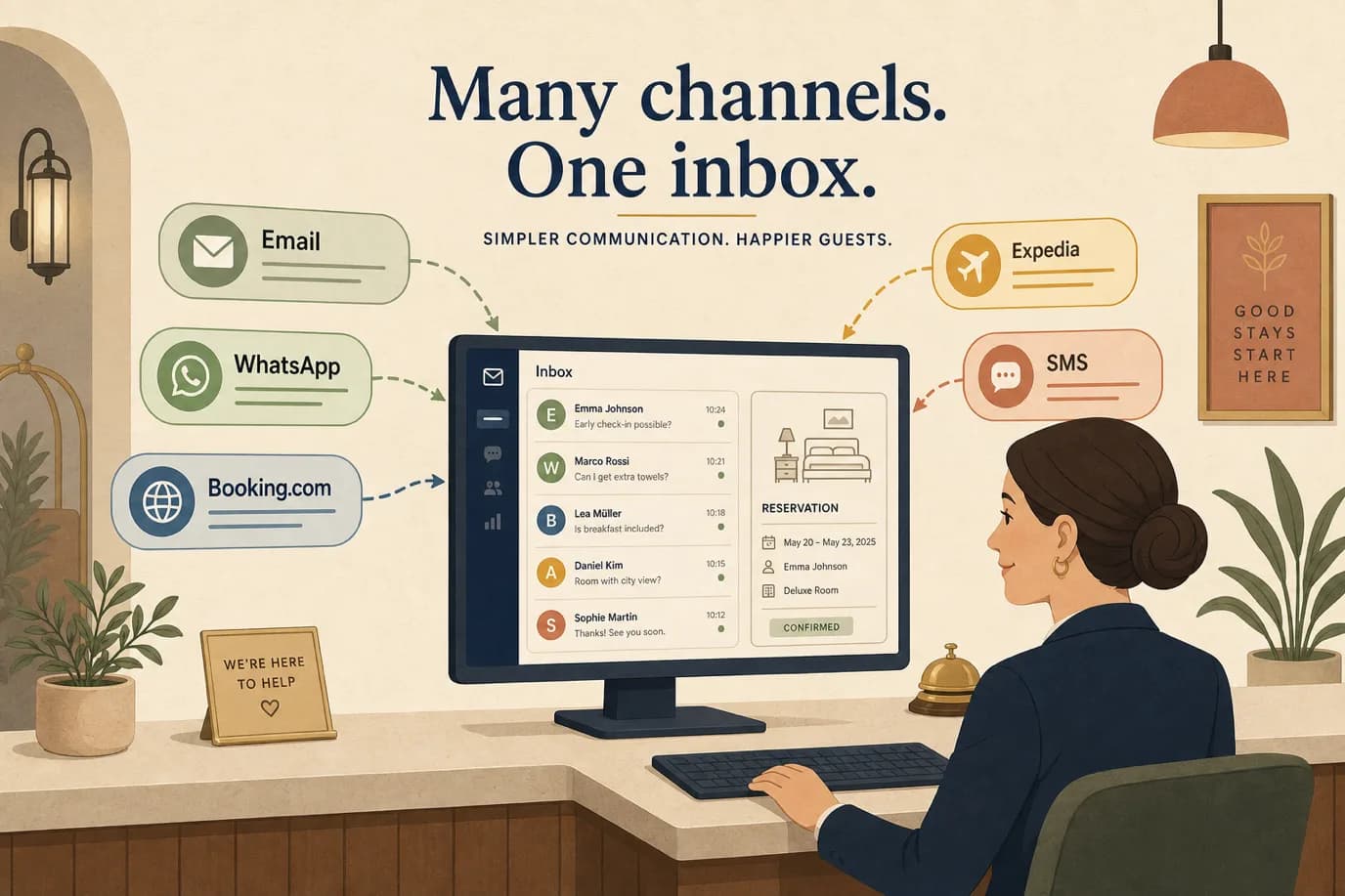
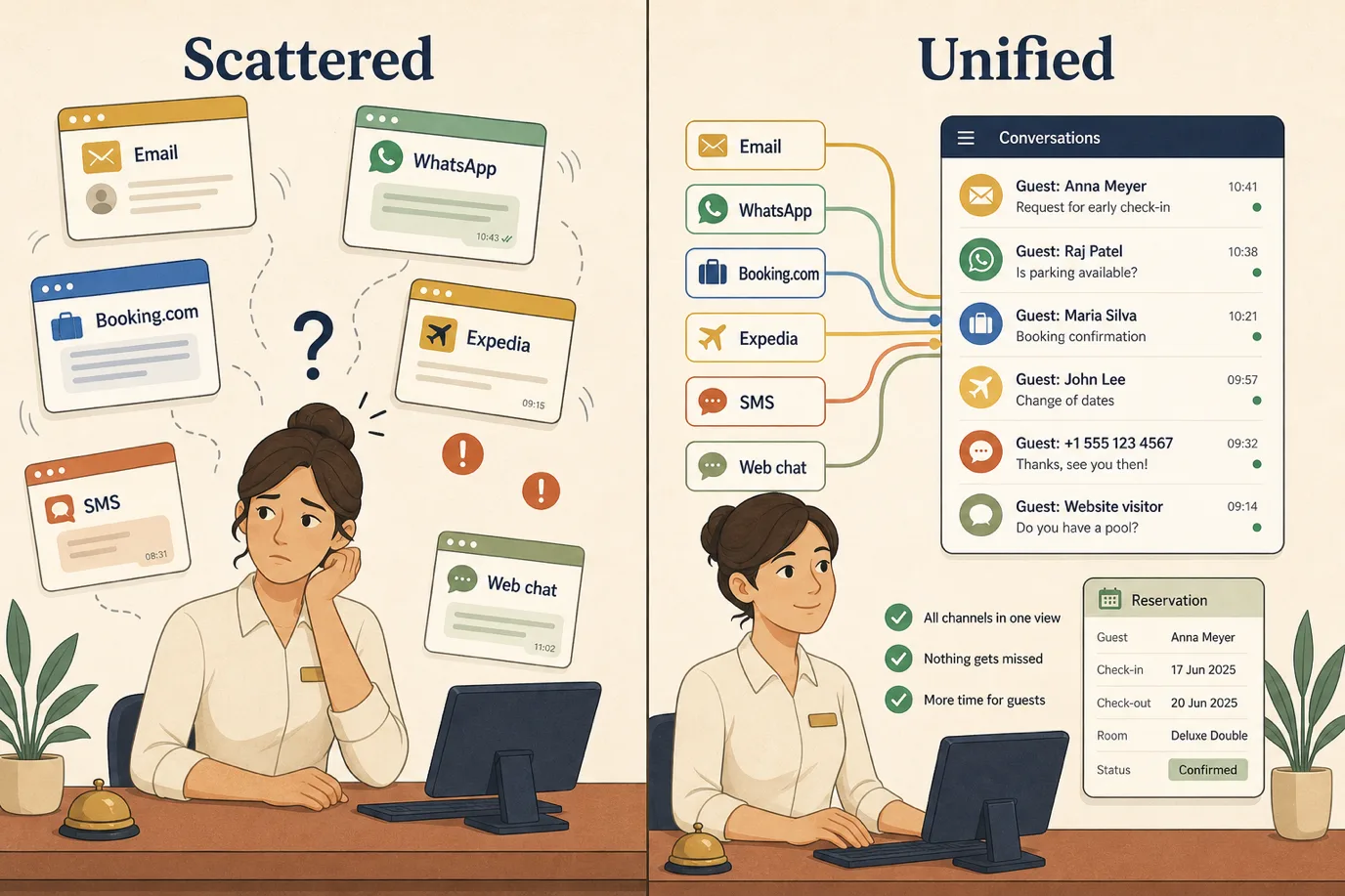
Picture the front desk on a normal Tuesday. One guest has emailed asking to arrive early. Another sent a WhatsApp about parking. A Booking.com message wants a quiet room away from the lift, and an Expedia traveller is asking whether breakfast is included. Each of those lives in a different tab, behind a different login, with a slightly different tone and no memory of the reservation it belongs to. Prostay Nexus exists to collapse that mess into one screen: every guest message, from every channel, in a single timeline that sits right next to the booking it relates to.
That sounds obvious until you have worked without it. The cost of scattered messaging is not only the minutes lost switching windows. It is the answer that contradicts what a colleague gave yesterday, the WhatsApp nobody saw until checkout, the upsell that never went out because the right person was in the wrong inbox. A unified inbox fixes the plumbing first. Once the plumbing is fixed, you can add the parts that actually move money: a shared knowledge base, template messages that fill themselves in, and an AI front desk agent that drafts the reply before a human even opens the thread.
One disclosure before we go further. I write for Prostay, so the section near the end about how our own product handles this is interest, not neutral advice, and it is labelled as such. Everything before it applies whatever software you run.
Why Guest Messages Ended Up Scattered Across Six Tools
No hotelier set out to run guest communication across half a dozen apps. It happened one decision at a time. Email came with the property. Then guests started messaging on WhatsApp, so someone put a phone on the desk. Booking.com and Expedia each built their own message centre, and you had to use theirs to answer a traveller who booked there. A web chat widget arrived with the new website. SMS got bolted on for arrival codes. Each addition solved a real problem on its own, and together they created a worse one.
The result is that the single most important conversation in the hotel, the one with the guest, is the least joined-up system you own. A receptionist might touch five interfaces in ten minutes and still miss the message that mattered, because it landed in the one tab nobody had open. There is no shared history, so the night team cannot see what the morning team promised. There is no shared voice, so two staff answer the same question two different ways. And there is no link to the booking, so every reply starts by asking who you are and when you are coming.
Put a rough number on it and the waste gets harder to ignore. A 50-room property handling a few hundred guest messages a week loses a real slice of every shift just to window-switching and re-reading threads to work out what was already said. Worse than the minutes are the misses: the parking question answered after the guest already paid for a garage down the road, the upgrade offer that arrived once the suite had been given away, the Booking.com message that sat unread long enough to dent the response-time score the platform quietly tracks. Those are not dramatic failures. They are small leaks, every day, that never show up as a line on any invoice but add up to lost revenue and thinner reviews.
This is the gap a unified inbox closes. Not by adding another channel, but by becoming the place all the existing ones land.
What a Unified Inbox Actually Does
Strip away the feature list and a unified inbox does one thing: it takes messages that arrive on many channels and presents them as one conversation per guest, in one place, with the booking attached. Everything else is built on that foundation.
Every Channel in One Timeline
Email, WhatsApp, web chat, SMS and the OTA message centres from Booking.com, Expedia and Airbnb all feed into a single timeline. A guest who emails before arrival and then switches to WhatsApp mid-stay appears as one continuous thread, not two strangers. Whoever picks up the conversation sees what was already said and on which channel, and replies on the channel the guest used, without copying anything across. One guest, one history, one assignment, regardless of how many ways they chose to reach you.
The Reservation Sitting Next to the Message
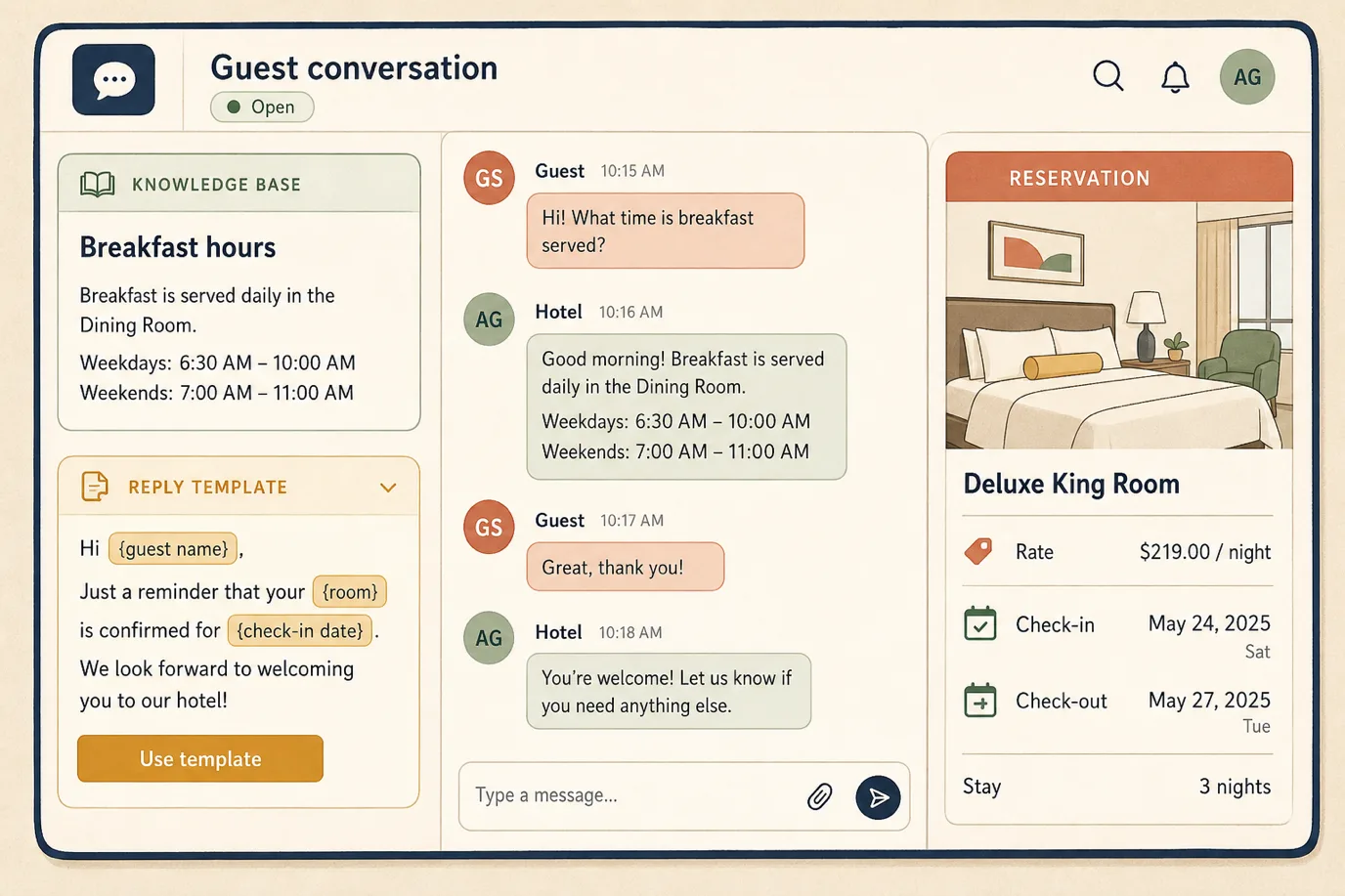
A message without context is a riddle. The unified inbox solves it by putting the reservation panel beside the conversation: who the guest is, which room, what rate, arrival and departure, folio balance, and prior stays. So when someone asks to extend by a night, the answer is two clicks away instead of a hunt through the property management system. You can apply a discount, charge an upsell, change a room or update the folio without leaving the thread. The conversation and the booking stop being separate jobs.
Replying to Booking.com and Expedia Without the Extranet Shuffle
OTA messaging is where the scattered model hurts most, because each platform locks its guest conversation inside its own extranet. To answer a Booking.com traveller, you log into Booking.com. To answer an Expedia guest, you log into Expedia. Switch properties or switch staff, and the logins multiply. Messages sit unread for hours because nobody had that particular tab open, and the OTAs notice slow replies in the ranking signals they care about.
A unified inbox connects to those message centres directly, so a Booking.com or Expedia message arrives in the same timeline as everything else and you answer it from one screen. The reply is delivered back through the OTA, the guest never knows you used anything other than their app, and the reservation is right there beside the thread. Response times drop because there is no shuffle, and because the message is impossible to miss.
It is worth being precise about a common confusion. This is not the same job as a channel manager, which syncs your rates and availability across the OTAs so you do not oversell. The channel manager handles the booking. The inbox handles the conversation about it. You need both, and they do different things.
WhatsApp as a First-Class Channel
For a large share of travellers, especially outside North America, WhatsApp is the channel they actually want to use. It gets opened, it gets read, and it gets answered in a way email rarely matches. The problem is that running WhatsApp off a phone at the desk does not scale: there is no history tied to the booking, no oversight, and no way to hand a conversation between shifts.
A unified inbox brings WhatsApp in through the official WhatsApp Business API, so it behaves like any other channel: one timeline, full reservation context, proper assignment and handover, and template messages for the things you send again and again. You can fire an arrival message with the door code 24 hours out, confirm a reservation, or send a payment link, all from the same place you answer email. The same conversation a guest starts on WhatsApp can be picked up by whoever is on shift, with everything that was said already in front of them.
There is a cost to be honest about, covered in full further down: WhatsApp template messages carry a small per-message fee set by Meta, and replies inside an open conversation window are free. It is not expensive, but it is not zero, which is exactly why it sits as an optional channel rather than something switched on by default.
The Built-In Knowledge Base That Keeps Answers Consistent
The quiet failure of hotel messaging is inconsistency. A guest asks whether the pool is heated and gets yes from one agent and not sure from another. Someone quotes last year's breakfast price. The late-checkout policy depends on who you ask. None of this is laziness; it is the predictable result of answers living in people's heads instead of in one place.
The built-in knowledge base is the fix. Management writes short articles, breakfast hours, Wi-Fi codes, parking, spa pricing, pet policy, the good local restaurants, and those articles become the single source of truth. When a reservations agent is replying, the right article is available inline, so they answer in seconds without leaving the thread or guessing. There is no copy-paste from a separate wiki nobody updates.
The knowledge base earns its place twice over because it also grounds the AI. Every suggested reply is built from the same library the humans use, so the machine and the staff give the same answer. Update the breakfast time once, and both the agent and the AI start saying the new time. That is how you stop a hotel from giving two versions of the truth in the same afternoon.
Template Messages That Fill Themselves In
Most hotel messages are not original. The arrival instructions, the booking confirmation, the review request, the payment reminder, the early-check-in apology, you send variations of the same handful every single day. Retyping them is wasted effort, and retyping them under pressure is where typos and wrong dates creep in.
Templates solve this without making your hotel sound like a robot. You compose a message once, drop in variables like guest name, room type, check-in date and a payment link, and the inbox fills those in from the reservation when you send. A 40-room property can push personalised pre-arrival instructions to every incoming guest in the time it used to take to write three by hand. Because the variables come from the live booking, the date is always right and the name is always spelled the way the guest wrote it.
Templates also keep your voice consistent across a team and across languages. Approve the wording once, and every shift sends the same well-judged message, in the guest's language, instead of fifteen slightly different improvisations.
Where AI Drafts and Where Humans Decide
The phrase AI reply sets off two opposite fears: that it will be a generic chatbot that annoys guests, or that it will go rogue and promise something you cannot honour. A well-built inbox avoids both by keeping the human in the loop by default.
Here is how it actually works. When a message arrives, the AI reads the reservation, the folio, the stay history and the earlier parts of the conversation, then drafts a reply grounded in your real data and your knowledge base, not a guess from a general model. The agent sees that draft already written and either sends it, tweaks it, or rewrites it, in one click. That is assist mode, and it is where most hotels live: the speed of automation with a person's judgement on every word.
From there you decide how much rope to give it. Simple, low-risk replies, confirming breakfast is included, sending the Wi-Fi code, can be set to send automatically. Anything the AI is unsure about, or anything that smells like a complaint, escalates to a human with the full thread already loaded. You set conversation caps and the escalation rules, so the AI handles the volume and your team handles the moments that need a person. If you want the deeper version of this, the AI front desk agent page walks through how the drafting and grounding work.
Routing, Sentiment and Response Times
Once every message is in one place, you can finally manage messaging like an operation instead of a scramble. Routing sends each conversation to the right person automatically: by language, so a German guest reaches a German speaker; by channel, so the WhatsApp team gets WhatsApp; by priority or guest segment, so a returning VIP does not wait in the same queue as a general enquiry.
Sentiment detection reads the tone of incoming messages and flags a guest who is getting frustrated before the frustration becomes a one-star review. That flag can escalate the thread straight to the duty manager. And because everything runs through one system, you can finally measure what matters: first-response time and resolution time, per property and per agent, with targets you actually track. You cannot improve a response time you never measured, and scattered tools make measurement impossible.
Three Messaging Moments Where This Pays Off
The case for a unified inbox is easiest to see in the three moments where messaging either makes money or loses goodwill.
Pre-Arrival: The Upsell Before They Land
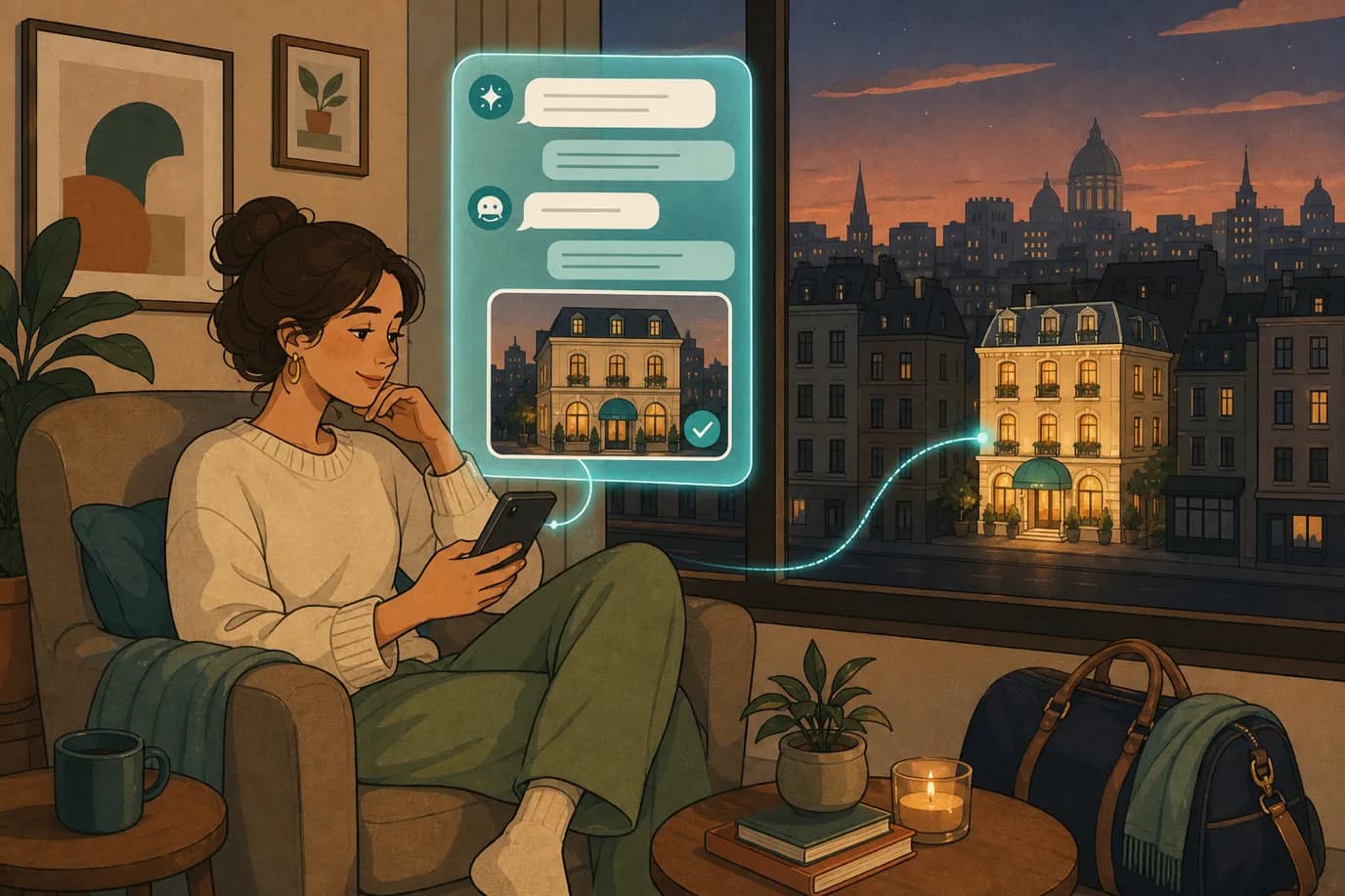
The 36 hours before arrival are the most valuable messaging window you have, and most hotels waste them. A targeted WhatsApp offering a sea-view upgrade, a late checkout or a breakfast add-on, paid for in the same thread, converts far better than a generic email sent to everyone. Because the inbox knows the reservation, the offer is relevant: you do not pitch a suite upgrade to someone already in your best room. Done well, pre-arrival upsells add real revenue per booking with no extra staff.
In-Stay: Catch the Problem Before the Review
A guest who is unhappy in room 214 will tell either you or the internet. The difference is whether you hear about it in time. A mid-stay check-in message gives them an easy channel to flag the noisy air conditioning, and sentiment detection escalates the annoyed reply to the duty manager with the thread already open. Fixing it that night is a recovered guest. Reading about it in a review next week is a number you cannot change.
Post-Stay: Ask at the Moment They Are Happy
Review requests sent to everyone, at a random time, drag your rating down by inviting the unhappy ones to vent. A smarter sequence triggers the review request only after positive signals during the stay, on the channel the guest actually uses, at a sensible local hour. You end up asking the happy guests and quietly handling the unhappy ones directly, which is how good properties keep their score up without gaming anything.
What It Costs, Honestly
Pricing is where vague marketing usually takes over, so here are the real numbers for how Prostay structures it, and you can hold any vendor to the same clarity. Email, plus Booking.com and Expedia messaging, is included with the All-in-One plan. There is no separate charge to bring your OTA conversations and your email into one inbox; that is the baseline.
WhatsApp is an optional channel at 29 dollars per property per month, because it carries real underlying costs. Meta charges a small per-message fee for template messages, set by the recipient country and typically a fraction of a cent to a few cents, while messages a guest sends you, and your replies inside the 24-hour window they open, are free. So the variable cost is genuinely small and falls mostly on proactive templates, not on normal back-and-forth.
The AI layer is a separate add-on, 39 dollars per property plus 2 dollars per room per month, with conversation caps you set so the bill never surprises you. Bundling it this way means a hotel can start with the unified inbox alone, prove the time saved, and add WhatsApp and AI when the volume justifies them. Nothing is switched on silently, and the per-message economics of WhatsApp are explained up front rather than buried.
How to Move Without Losing History
The biggest fear in changing how you handle messaging is losing the past: the email threads, the context, the running conversations with regulars. It is a fair worry and a solvable one. Email connects by pointing your existing inbox address at the new system, so new mail flows in from day one, and existing history can be migrated on request so old threads stay searchable next to the guest profile. WhatsApp moves onto the Business API with your number, with setup handled as part of onboarding rather than left to you. OTA message centres connect through their official integrations, so Booking.com and Expedia conversations simply start appearing.
The practical sequence that works: connect email and the OTA inboxes first, since that is most of your volume and carries no per-message cost, and let the team get used to one screen. Author the first dozen knowledge-base articles from the questions you already answer most. Then add WhatsApp once the habit has formed, and switch on AI assist last, so staff trust the drafts before you ever consider letting any of them auto-send. Treat it as a fortnight of small steps, not a single flip of a switch, and the move is calm rather than risky.
Where Prostay Fits, Briefly and Honestly
The disclosure first, again: I write for Prostay, so read this as interest rather than neutral analysis. The honest, narrow point is that the unified inbox described above is what Prostay Nexus is, built into the same platform as the property management system, so the reservation context beside every conversation is native rather than a fragile integration. Email, Booking.com and Expedia come included with All-in-One, WhatsApp is the optional paid channel, the knowledge base is authored by your managers, and the AI drafts against your real data with you holding the controls.
None of that makes Prostay the only sensible choice. Other modern platforms and standalone inbox tools follow the same unified principle, and a careful best-of-breed setup can get close. The test to apply, to us as much as anyone, is concrete: does it bring email, WhatsApp and the OTA message centres into one timeline; does the reservation sit beside the conversation; is there a knowledge base that both staff and AI draw from; and are the per-message costs of WhatsApp explained before you sign. If you want to see it on your own messages, the honest way to judge it is to have a vendor run anonymised samples of your real WhatsApp and email threads and show you what it would have replied, verbatim, rather than watch a clean demo.
Frequently Asked Questions
The questions hotel operators ask most about unified inboxes, OTA messaging, WhatsApp costs and AI replies, answered from how these systems behave in a real property rather than from a brochure.