
Somewhere in the back office of a few thousand hotels, the same meeting is happening this year. Oracle has set a date for the property's move from on-premise OPERA 5 to OPERA Cloud, the quote for the migration project has arrived, and the general manager is looking at a number, a timeline and a contract, and asking a question that would have been unthinkable ten years ago: do we actually want to stay on OPERA at all?
This guide is for that meeting. It is not a hit piece on Oracle OPERA. OPERA is the most widely deployed hotel PMS in the world, it runs the majority of large branded chains, and for a specific kind of property it remains the correct answer. The honest question is not "is OPERA good?" but "is OPERA the right shape for the hotel you actually run, at the price you are now being asked to pay for it?". For a growing share of independent and mid-market hotels, the answer in 2026 is no, and the forced migration is the moment that makes the question unavoidable.
What follows is the switching conversation in full: why hotels leave, when they should not, what a unified platform such as Prostay replaces and what it does not, what the migration actually involves, and the eight questions to settle before you commit in either direction.
Who This Guide Is For (and Who It Is Not)
This guide is written for the person who signs the software contract at an independent hotel, a small group, or a franchise property with PMS freedom: the owner-operator, the general manager, the group operations director. Someone who inherited OPERA or chose it years ago, and who now faces either a migration bill or a renewal with different terms.
It is not a guide for branded chain properties where the flag mandates the PMS. If Marriott, Hilton, IHG or Accor decides what runs at your front desk, the alternatives conversation happens at brand headquarters, not at the property. It is also not a guide for the 500-room convention property with three restaurants, a spa and forty group blocks a month. That property should read the section on when staying is the right call, because it probably is.
Why Hoteliers Look for an OPERA Alternative in 2026
Four specific pressures push hotels off OPERA, and it is worth naming each one precisely so you can check which of them actually applies to you.
The OPERA Cloud Migration You Did Not Ask For
Oracle has been moving its installed base from on-premise OPERA 5 to OPERA Cloud for several years, and the pressure has steadily increased. For hotels running a lightly configured OPERA 5, the move is manageable. For hotels with years of customizations, custom reports, tailored interfaces and local integrations, operators report migration projects measured in years, with the heaviest cases quoting 18 to 36 months of work.
Here is the strategic point that gets missed in the panic: if a heavy, disruptive, expensive migration is unavoidable either way, the switching cost argument that kept you on OPERA for a decade has just evaporated. You are going to re-map your rate codes, retrain your staff and re-validate your integrations no matter what you choose. The only question is which platform you land on when the dust settles, and what your monthly bill looks like for the ten years after that.
The Cost Structure After Migration
The second pressure is the bill. Operators moving to OPERA Cloud consistently report meaningful increases in ongoing license costs compared to their old on-premise agreements, with the sharpest complaints coming from mid-market properties that used a fraction of the system's capability. And the PMS license is only one line: a working OPERA operation typically also carries Simphony or another POS with its own contract, distribution interfaces billed per connection, a separate booking engine, third-party guest messaging, and the support tier that makes all of it answerable.
None of those line items is unreasonable on its own. Added together, they produce a per-room software cost that a mid-market independent hotel increasingly struggles to justify, especially when unified platforms deliver the same operational surface for one subscription. Our guide to hotel PMS pricing and total cost of ownership walks through how to model this honestly for your own property.
Staffing and Complexity
OPERA proficiency is a specialist skill. That was an asset when front-desk staff stayed five years and every city had a pool of experienced OPERA operators. In the 2026 labor market it is a liability: new hires take weeks to become confident on the system, agency staff need shadowing before they can safely run a shift, and the person who knows how the custom reports work is a single point of failure with a two-week notice period.
Modern cloud platforms made a different trade: less configurability at the edges, in exchange for an interface a new hire learns in a day or two. For a hotel where the front desk turns over every 18 months, that trade is worth real money, month after month. Our hotel front desk software guide covers what that difference looks like in a live shift.
The Guest-Facing Innovation Gap
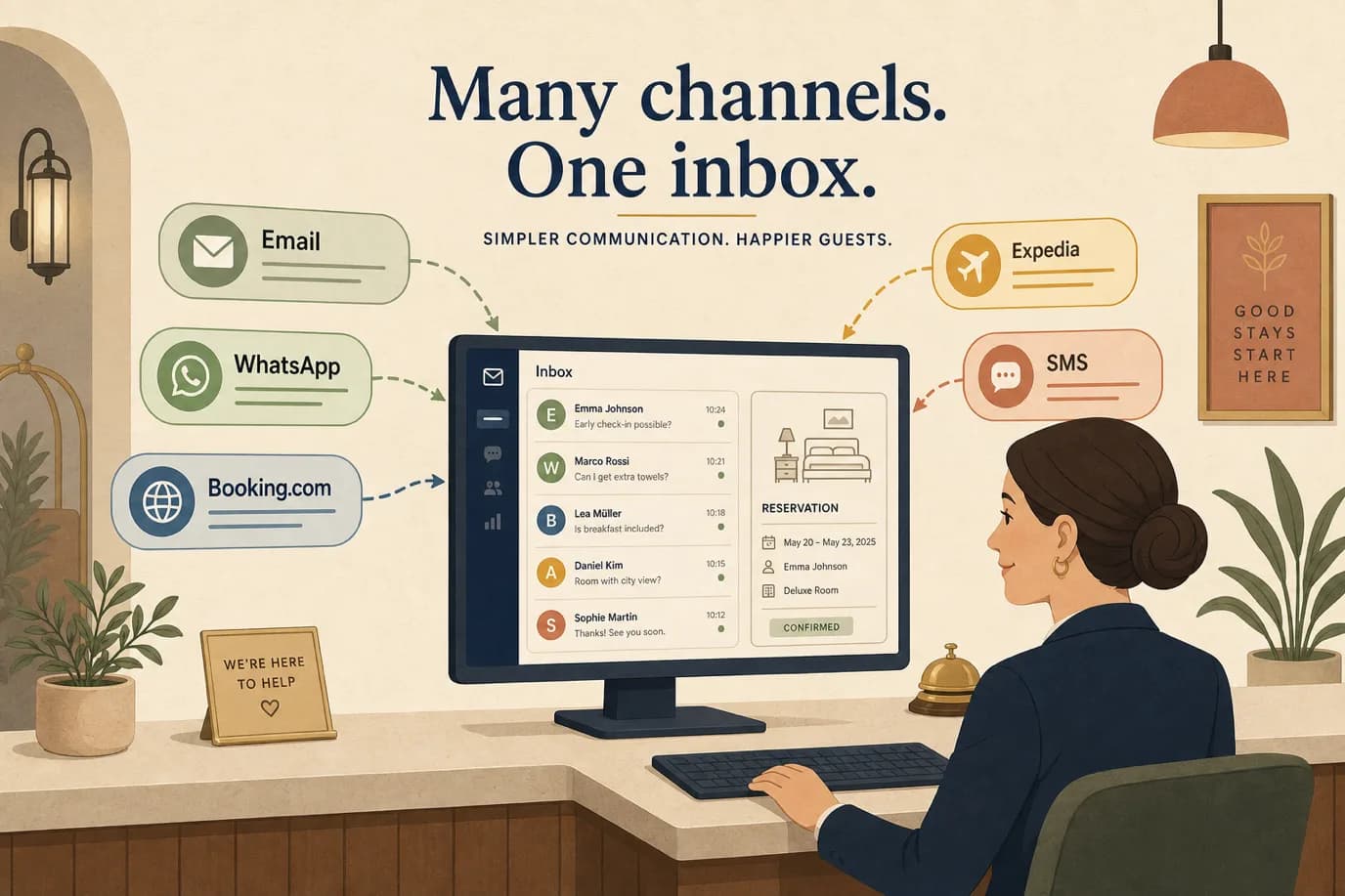
The fourth pressure is pace. Guest expectations moved fast in the last five years: WhatsApp and SMS conversations with the property, AI-drafted replies that keep response times under a minute, self-service check-in, one-tap payment links, direct-booking experiences that feel like consumer e-commerce. On OPERA, most of that arrives through third-party integrations, each one a contract, an interface and a monthly fee. On platforms built in the last decade, it increasingly arrives as part of the core product.
Oracle's engineering resources are real, but they are spread across an enterprise portfolio, and the guest-facing layer of hospitality is not the center of it. The hotels that feel this most sharply are the ones competing for leisure guests who compare every interaction to the last good app they used.
When Staying on OPERA Is the Right Call
An honest alternatives guide has to include this section, because for a meaningful set of properties the correct answer is to stay.
Stay if the brand decides. If your property carries a flag that mandates OPERA, the conversation is over. Run the migration the brand schedules, negotiate what you can, and focus your energy elsewhere.
Stay if you genuinely use the depth. A 400-room full-service property with three F&B outlets, a spa, a golf course and heavy group business uses OPERA's sales-and-catering, block management and configuration depth in ways no mid-market platform fully replaces. If your group block operation is the core of your business model and it is wired deeply into OPERA, the switching risk is real and the payoff is uncertain.
Stay if you are mid-crisis. A PMS migration is a project for a stable operation. If you are mid-renovation, mid-rebrand or mid-leadership-change, stabilize first. A rushed migration compounds whatever problem you already have.
Reconsider everything else. If you are an independent 40 to 250 room property running OPERA because it was the safe choice in 2015, using a fraction of its capability while paying for all of it, and now facing a forced migration anyway, you are the hotel this guide is for.

The Alternative: One Unified Platform Instead of a Module Stack
Most "OPERA alternatives" lists offer ten near-identical cloud PMSes and let you guess. We will make a different argument: the like-for-like swap from one standalone PMS to another standalone PMS rarely solves the problems that pushed you off OPERA, because you keep the stack. You still run a separate POS, a separate booking engine, separate distribution, separate messaging, and you still pay for and maintain the interfaces between them. You exchange the Oracle logo on the invoice for three or four smaller logos.
The structural alternative is a unified platform, where the modules OPERA sells separately (and the third parties around it) are one product. That is what Prostay is, and it is the direction we would argue for even if we did not build it, because it is the only direction that changes the cost structure and the operational complexity rather than just the vendor.
What You Get in One Subscription
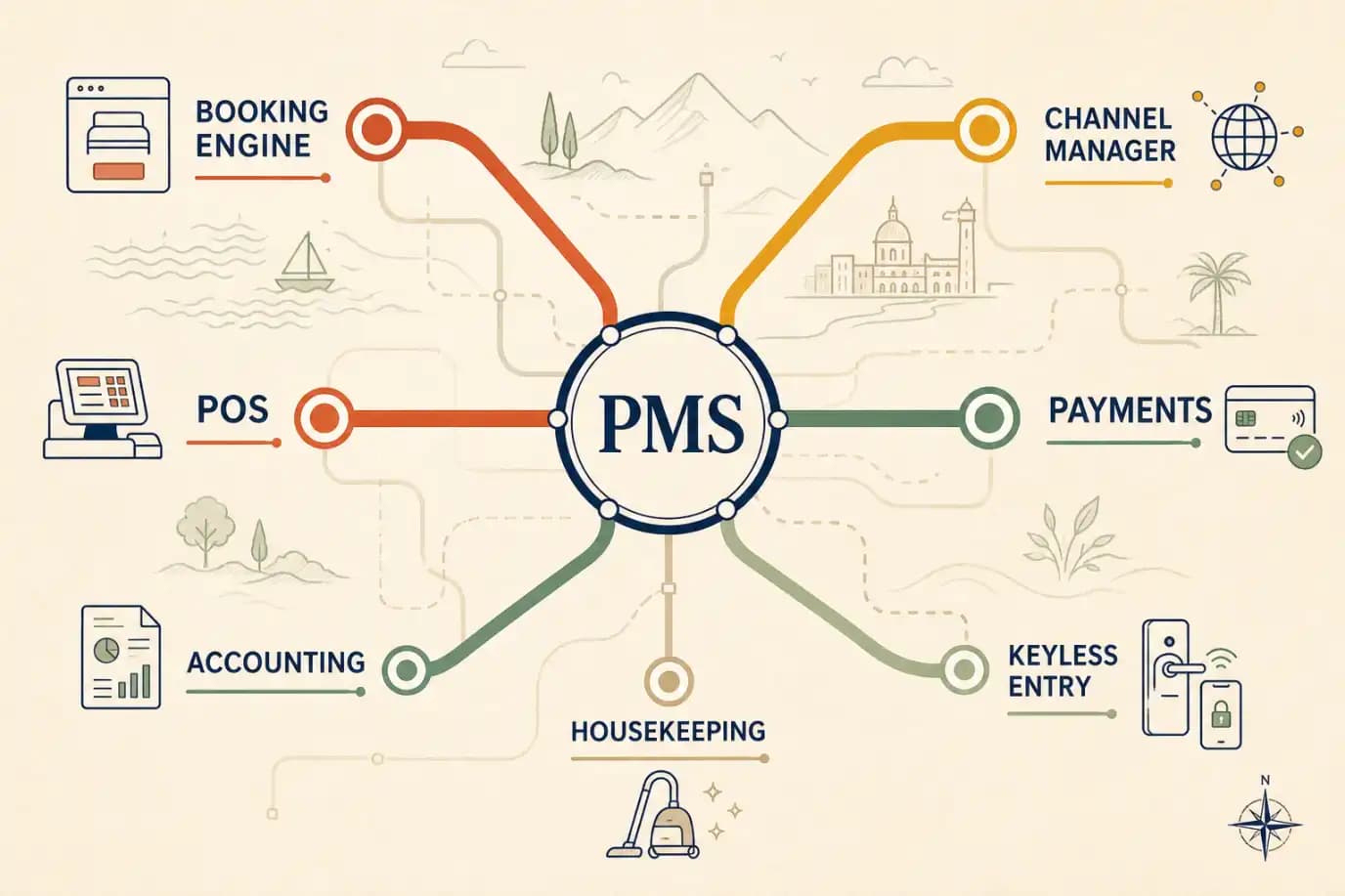
Prostay bundles the full operational surface of a hotel into one platform, one login and one bill: the property management system with front desk, housekeeping and a real-time reservations calendar, the channel manager for OTA distribution, a conversion-focused booking engine, an integrated point of sale that posts straight to the guest folio, payment processing wired into the guest bill, a revenue management system, hotel accounting that posts itself, AI-powered guest messaging across WhatsApp, SMS, email and OTA channels, and an instant hotel website builder.
The point is not the feature list. The point is what disappears: the Simphony contract, the interface maintenance, the per-connection distribution fees, the third-party messaging subscription, and the integration project every time you add a capability.
Mapping OPERA Modules to Prostay
For the evaluation spreadsheet, the mapping runs roughly like this. OPERA PMS maps to the Prostay PMS core: reservations, front desk, housekeeping, folios, night audit. Simphony POS maps to Prostay POS, with the difference that folio posting is native rather than an interface. OPERA's distribution stack (OXI interfaces, channel connections, ORS) maps to the built-in channel manager and booking engine. OPERA's reporting and the BI tools around it map to Prostay's reporting layer. Third-party guest messaging and upsell tools map to Prostay Nexus and the AI layer. Sales and catering is the one OPERA module without a full Prostay equivalent, which is exactly why heavy-groups properties should read the staying section again.
Where Prostay Wins Against OPERA
Total cost, structurally. One subscription replaces the license-plus-modules-plus-interfaces stack. For independent and mid-market properties the difference is not marginal, it is a different budget line.
Time to competence. Front-desk staff are functional on Prostay within a shift or two and confident within a week. No specialist administrator, no certification course, no single point of failure at the back office.
One source of truth. When the PMS, channel manager, booking engine and POS are the same system, the classic OPERA-era failure modes (rate disparity between systems, inventory drift, folio postings lost in an interface) structurally cannot happen. Our guide to PMS and channel manager sync issues covers what those failure modes cost.
Guest-facing pace. AI messaging, payment links, self-service flows and the direct-booking experience ship as part of the product, not as an integration project.
Where OPERA Wins (Honestly)
Sales and catering depth. For complex group, banquet and event business, OPERA's tooling remains the deepest in the industry. BEO-heavy operations should weigh this seriously.
Enterprise configurability. If your operation genuinely needs custom posting rules, exotic tax handling across jurisdictions, or brand-mandated interfaces, OPERA's configurability is the product. Most hotels never touch it, but the ones that need it, need it.
The ecosystem habit. If your ownership group runs twenty OPERA properties and your regional teams are trained on it, consistency has value that a per-property comparison misses.
Who the Switch Fits Best
The profile where the switch reliably pays: independent hotels and small groups from roughly 25 to 300 rooms, limited or moderate group business, an F&B operation that wants POS-to-folio posting without an interface, a commercial strategy leaning into direct bookings, and an owner or GM who wants the software bill to be one predictable number. If that is your profile and you are staring at an OPERA Cloud migration quote, the timing argument makes itself.
What an OPERA-to-Prostay Migration Actually Involves
The honest version: an OPERA migration is more preparation-heavy than a cloud-to-cloud move, because OPERA installations accumulate a decade of configuration. Plan 6 to 10 weeks for a 60 to 250 room property. For the full project plan, our complete PMS migration guide covers team structure, timeline and the post-go-live checklist in detail; what follows is the OPERA-specific view.
Data Migration
The extraction pass covers reservations, guest profiles, company and travel-agent profiles, rate plans, room types, taxes and the accounting structure. Two OPERA-specific frictions always appear. First, rate-code sprawl: a decade of OPERA operation typically leaves hundreds of rate codes, most of them dead, and the migration is the moment to map the twenty that matter and archive the rest. Second, profile duplicates: OPERA databases accumulate duplicate guest profiles over years, and the deduplication pass is worth doing properly because it is the foundation of your guest-recognition data going forward. The Prostay implementation team runs the mapping and the deduplication, you review and sign off before anything reaches the live environment.
Training and Parallel Running
Budget 8 to 16 hours of front-desk training split across shift-aligned sessions, plus focused sessions for the revenue manager, the accountant and the F&B lead. The consistent surprise for OPERA-trained staff is how little there is to learn: the workflows they spent weeks memorizing collapse into screens that surface the next action. Run a parallel period of one to two weeks with both systems live. It costs an overlapping subscription month and removes the single largest risk of any migration, the hard cutover that goes wrong on a Friday night.
Integrations and Distribution Handover
Distribution is a replacement, not a reconnection: the built-in channel manager takes over from the OXI-era interfaces, which means re-mapping room types to OTA rate codes and re-validating the Booking.com and Expedia connections. Plan 5 to 10 working days with the OTA market managers looped in from day one. Door locks, key encoders and in-room systems keep working through standard interfaces, and the integrations you no longer need (messaging, upsell, booking engine, POS bridge) get cancelled rather than rebuilt, which is where a chunk of the cost saving materializes. Our PMS integrations guide covers the handover in depth.
What the Switch Costs, Line by Line
Model four lines. One: the remaining value of your Oracle agreement, which depends entirely on where you are in the contract cycle, and which the forced Cloud migration often resets in your favor, because the natural break is now. Two: the migration itself, where data migration is included in the Prostay implementation package for properties up to 200 rooms and the real cost is your team's hours across training and parallel running. Three: the overlapping subscription during the parallel period, one to two months of double-running. Four, on the other side of the ledger: the cancelled contracts, the POS, the booking engine, the messaging tool, the interfaces, and the OPERA Cloud subscription quote you did not sign.
For most mid-market properties the payback lands inside the first year, driven less by the PMS line itself than by the stack of surrounding contracts that stop renewing. Run the math on your own numbers, not on anyone's marketing, ours included.
Eight Questions to Settle Before You Leave OPERA
- What is Oracle's actual deadline and quote for our OPERA Cloud migration, in writing, and what happens commercially if we decline it?
- Which OPERA modules and customizations do we genuinely use weekly, and which are paid-for shelf-ware? Pull the report usage logs, do not rely on memory.
- How much group, banquet and event business runs through sales and catering, and can the replacement platform or a lighter process carry it?
- What is the all-in monthly cost of the current stack: OPERA license, Simphony, interfaces, booking engine, messaging, support tiers? Most hotels have never added this number up.
- What is the all-in quote from the alternative, including migration, training and the parallel period, in writing?
- Which two reference customers of similar size and segment switched from OPERA specifically, and what do they say six months in?
- What is the data-export story in both directions: what do we get out of OPERA now, and what would we get out of the new platform if we left it in five years?
- Who owns the migration internally, and is the operation stable enough to absorb it this season?
If the answers to questions two and four surprise you, and they usually do, the rest of the decision tends to make itself.
Key Takeaways
OPERA is the enterprise standard, and for branded chains and heavy-groups full-service properties it remains the right answer. The alternatives conversation is not about whether OPERA is good, it is about whether its shape and its cost structure fit the hotel you actually run.
The OPERA Cloud migration is the forcing function. If a heavy migration is unavoidable either way, the switching cost that protected the status quo is gone, and the real comparison is between the two futures: an enterprise module stack with its contracts and interfaces, or a unified platform with one bill.
The like-for-like PMS swap solves little. The structural alternative is unifying the stack, which is what changes the cost line and the operational complexity. That is the argument for Prostay, made honestly: it wins on cost structure, staff onboarding, single-source-of-truth operations and guest-facing pace, and it concedes sales-and-catering depth and enterprise configurability to OPERA.
An OPERA-to-Prostay migration runs 6 to 10 weeks for a mid-market property, with rate-code cleanup and profile deduplication as the OPERA-specific work items. Payback for the typical switcher lands inside the first year, driven by the surrounding contracts that stop renewing.
Settle the eight questions before deciding. Then, if the unified direction fits, the fastest way to test it against a live OPERA operation is a demo built around your own workflows, folio splits, group blocks, night audit and all.