The Hidden Tax of Disconnected Systems
The most expensive thing about a hotel's technology is almost never the number on the invoice. It is the half hour the front desk spends every morning retyping last night's online bookings into the system because the booking engine and the property management system do not talk to each other. It is the rate that was correct in your revenue tool and wrong on Booking.com because the change never propagated. It is the restaurant charge that fell off a guest's bill, the housekeeping status that says a room is dirty when it has been clean for an hour, and the month-end report that never quite reconciles because three systems each hold a slightly different version of the truth. None of these show up as a line item, but together they are the single largest tax most independent hotels pay on their tech, and it is paid in staff hours, lost revenue, and quiet errors.
The fix everyone now sells is a connected property management system at the centre of an integrated stack, where your booking engine, channel manager, point of sale, payments, and accounting all share the same data instead of guarding their own copies. The idea is sound. The problem is that the phrase has been repeated by every vendor until it means almost nothing: connected, unified, open API, seamless integration are now table stakes in marketing and tell you very little about whether two systems will actually work together on a busy Saturday. This article is the operator's translation of that marketing back into something you can act on.
A short disclosure before we start. I write for Prostay, which builds a property management system and a connected stack of hotel products, so the section near the end is interest, not neutral advice, and I have flagged it as such. Everything else here is vendor-neutral and applies no matter whose systems you run. We will cover what a connected stack genuinely means, how systems actually connect (and the difference between a real integration and a nightly file dump), what open API should mean before you trust the phrase, which integrations actually matter, the unified-versus-best-of-breed decision, how to avoid lock-in, how to evaluate a connection before you depend on it, why all of this became an AI problem in 2026, and a 30-day connectivity audit you can run yourself.
What a Connected Tech Stack Actually Means
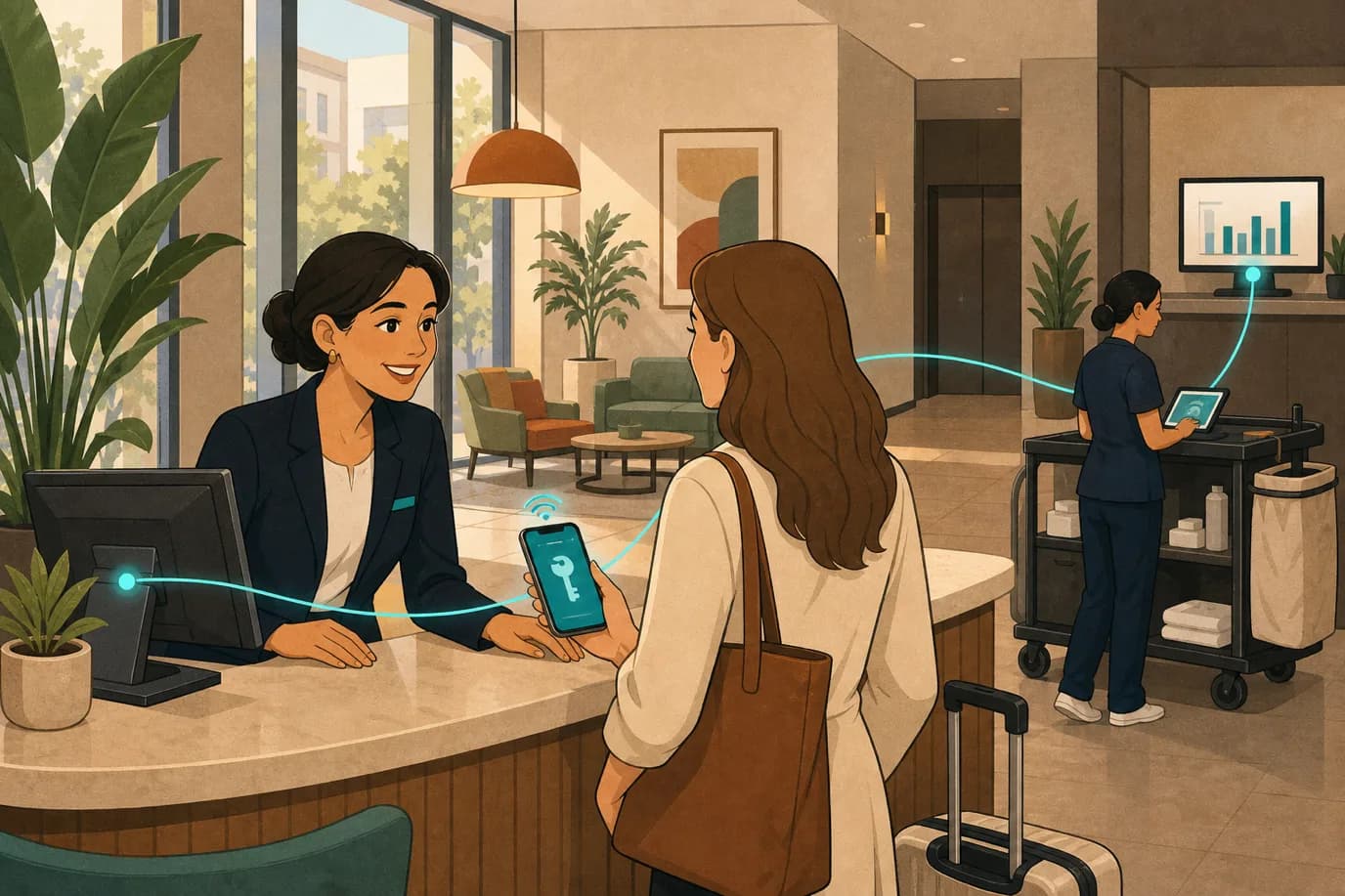
Strip away the marketing and a connected tech stack means one thing: data entered or changed in one system shows up, correctly and quickly, everywhere else it is needed, without a human carrying it across. That is the whole idea. When a guest books on your website, the reservation appears in the PMS without anyone retyping it. When that room sells, your availability drops on every OTA within seconds. When the guest orders dinner, the charge lands on their folio automatically. When they check out, the revenue flows into your accounting without a manual journal entry. Each of those is a connection, and a stack is connected to the degree that those connections are real, automatic, and timely.
The opposite is not a stack at all; it is a pile. A pile is a collection of good tools that each do their job well in isolation but force people to be the integration. The receptionist is the integration when they copy bookings between systems. The night auditor is the integration when they reconcile three reports by hand. The revenue manager is the integration when they update rates in four places. Every one of those human bridges is slow, error-prone, and expensive, and it is the default state of most properties that bought their tools one at a time over a decade. Recognising that you have a pile rather than a stack is the first useful step.
Why the PMS Is the Hub
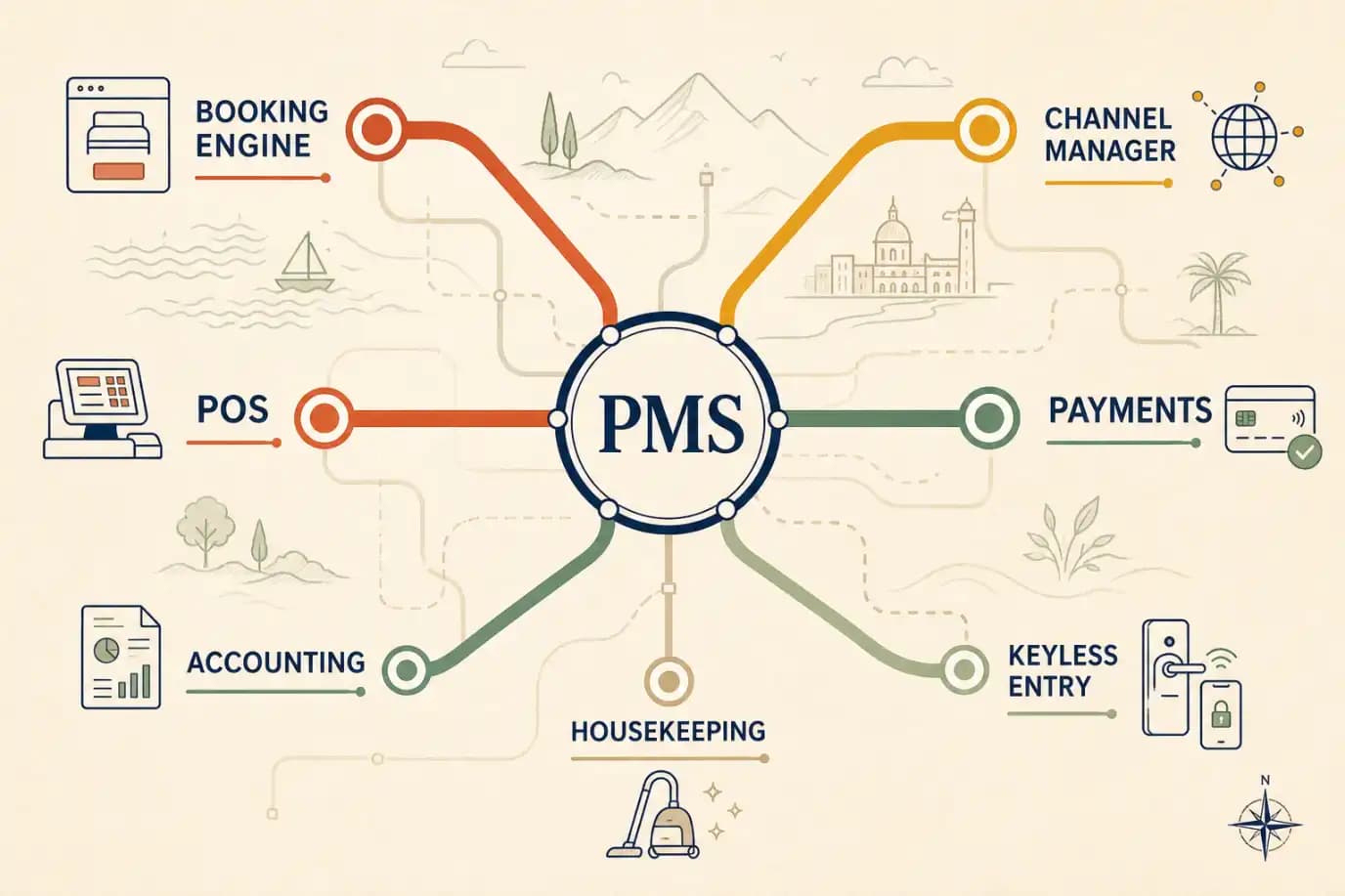
In a connected stack, one system has to be the centre, the single source of truth about who is staying, in which room, for how long, at what rate, and what they owe. That system is the property management system. Almost everything else is a spoke that reads from or writes to the PMS: the booking engine and channel manager feed reservations in, the point of sale and spa post charges to the folio, the payment system settles against it, housekeeping reads room status from it, and accounting pulls the finished financial picture out of it. The PMS is the hub not because it is the most glamorous tool but because it holds the reservation and the folio, which is the spine every other system attaches to.
This is why your choice of PMS quietly determines how good your whole stack can be. A PMS with strong, open, well-documented connections lets every spoke attach cleanly, so the stack can grow without friction. A closed or poorly connected PMS becomes a bottleneck no amount of excellent peripheral tools can overcome, because the hub they all depend on will not share its data properly. When people say the modern hotel system is really a platform rather than a single product, this is what they mean: the value is less in any one module and more in how well the hub connects everything to everything else.
How Systems Actually Connect: APIs, Sync, and Flat Files
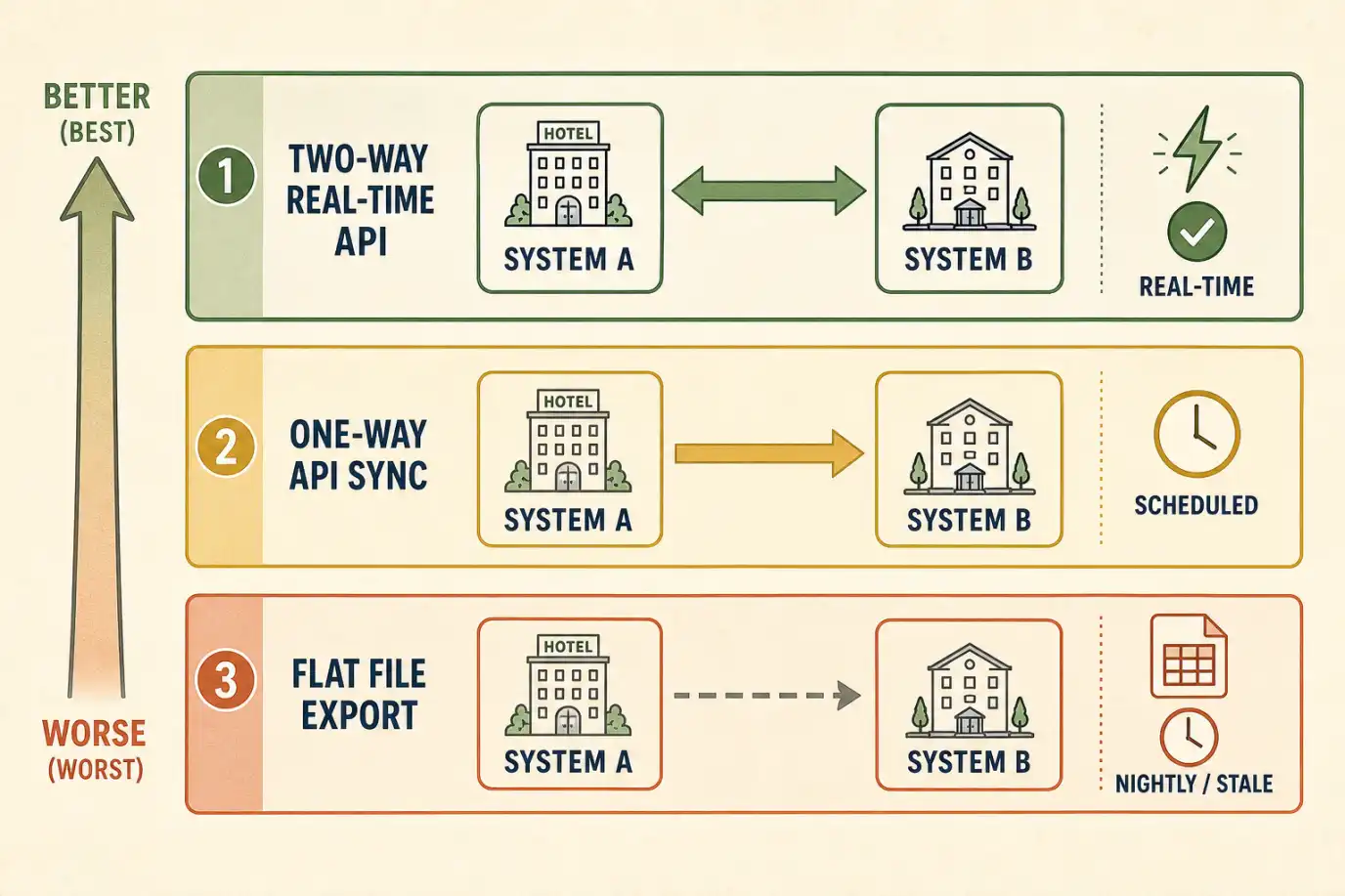
To judge whether two systems are genuinely connected, you need a rough mental model of how software talks to software. You do not need to be technical; you need to know enough to ask the right question and recognise a weak answer. There are broadly three ways hotel systems exchange data, and they sit on a ladder from worst to best.
At the bottom is the flat file: one system produces a spreadsheet or export, and someone (or a scheduled job) loads it into another. This is barely integration. It is one-directional, it is usually a batch that runs on a delay, and it breaks silently when a format changes. If your accounting gets a CSV from the PMS once a night, that is a flat-file connection, and it is better than nothing but a long way from connected. In the middle is a scheduled or one-way API sync: the systems talk through a proper interface, but only at intervals or only in one direction, so data is fresher than a file dump but still lags and still does not flow both ways. At the top is a real-time, two-way API: the systems are in continuous conversation, a change in one appears in the other within seconds, and updates flow in both directions. This is what connected actually means, and it is the only kind that prevents the day-to-day failures that cost you money.
Two-Way Sync vs One-Way Export
The distinction that matters most in practice is direction, and it is the one vendors are vaguest about. A one-way connection pushes data from A to B but not back. Sometimes that is fine: your accounting probably only needs to receive finished financials from the PMS, not send anything back. But for the connections at the heart of operations, one-way is a trap. Consider availability. If your PMS pushes availability to your channel manager but does not receive bookings back in real time, you will oversell, because a reservation made on an OTA will not reduce your PMS availability until the next sync, and in that gap two guests can book the last room. True availability management requires a two-way, real-time link so that a sale anywhere updates inventory everywhere immediately. We have written about exactly how these sync gaps cause overbookings and rate errors in a dedicated guide to channel-manager and PMS sync problems, and the root cause is almost always a connection that is weaker or more delayed than the vendor implied.
So when any vendor says their product integrates with another, the single most valuable question you can ask is: is it real-time and two-way, or scheduled and one-way? The marketing word integration covers all three rungs of the ladder, and the gap between the top and the bottom is the gap between a stack that runs itself and a pile that runs your staff ragged. Make them tell you which rung they are on, for each connection you care about.
What Open API Really Means, and Why Vendors Love the Phrase
An API, an application programming interface, is simply the defined doorway a piece of software offers so other software can read and write its data in a structured way. Every modern integration runs through APIs. When a vendor says they have an open API, they mean that doorway is published and available for other systems to use, including ones the vendor did not build, usually with documentation a developer can follow. In principle this is the most important word in the whole conversation, because an open API is what keeps your data from being trapped inside one product. With a genuine open API, you can connect a new tool, build a custom report, feed a data warehouse, or eventually migrate away, all without begging your vendor for a special favour.
In practice, the phrase is abused. Some vendors advertise an open API that turns out to be gated behind an approval process, a partner programme, or fees steep enough to discourage anyone outside a favoured circle, and sometimes competitors are quietly excluded altogether. An API that exists but that you cannot actually access on reasonable terms is a closed API with better marketing. So treat the claim as a question, not an answer. Is the documentation genuinely public, so a developer can read it without signing anything? Can you, or a third party you choose, get access without a bespoke deal? Do real integrations already run on it in real time, which proves it works rather than merely existing on a slide? If the answers are yes, the open API is real and it protects you. If they are evasive, the openness is decorative.
There is a related signal worth watching: a published integration marketplace or directory of certified partners. A vendor with a large, public marketplace of working integrations is implicitly proving their API is open and usable, because dozens of other companies have built on it. A vendor who promises openness but has almost no third-party integrations to show is asking you to take the doorway on faith. The marketplace is the evidence; the phrase is just the claim.
The Integrations That Actually Matter
You do not need every system on earth to connect to your PMS. You need a specific short list to connect well, and the rest to connect if convenient. Here are the integrations that genuinely move the needle for an independent hotel, roughly in order of how much pain a weak connection causes.
- Booking engine. Your direct-booking website must drop reservations straight into the PMS in real time, and the PMS must show those rooms as sold instantly. This is the connection that protects your most profitable channel, so it has to be flawless.
- Channel manager. The two-way link to OTAs that keeps availability and rates in sync everywhere. A weak connection here is the classic cause of overbookings and rate disparity, so this is non-negotiable for any property selling on more than one channel.
- Payments. Card capture, charges, refunds, and tokenization should run through a payment layer tied to the folio, so settlement reconciles automatically and card data is minimised. A disconnected payment process means manual reconciliation and reconciliation errors.
- Point of sale. Restaurant, bar, spa, and room-service charges should post to the guest folio as they happen. We go deep on exactly how this posting works, and the seven ways it silently breaks, in the POS-to-PMS integration guide.
- Accounting. The finished financial picture, room revenue, taxes, payments, should flow into your ledger without a nightly manual journal entry, so month-end reconciles instead of fighting you.
- Housekeeping. Room status shared between the front desk and housekeeping in real time, so the desk can sell a cleaned room the moment it is ready instead of waiting on a phone call.
- CRM and guest messaging. Guest profiles, stay history, and contact details flowing to whatever you use for email, messaging, and loyalty, so marketing and pre-arrival communication run on current data.
- Keyless entry and other peripherals. Useful and increasingly common, but a notch below the others: a weak link here is an inconvenience, not a revenue leak.
The lesson of the list is to spend your scrutiny where the thick spokes are. Get the booking engine, channel manager, payments, and POS connections genuinely real-time and two-way, and you have removed the connections that cost real money. Treat the rest as valuable but lower-stakes.
Disconnected vs Connected: A Day in the Life
The abstract case for connectivity becomes obvious the moment you trace a single day through both versions of the same hotel. The systems are identical; only the connections differ.
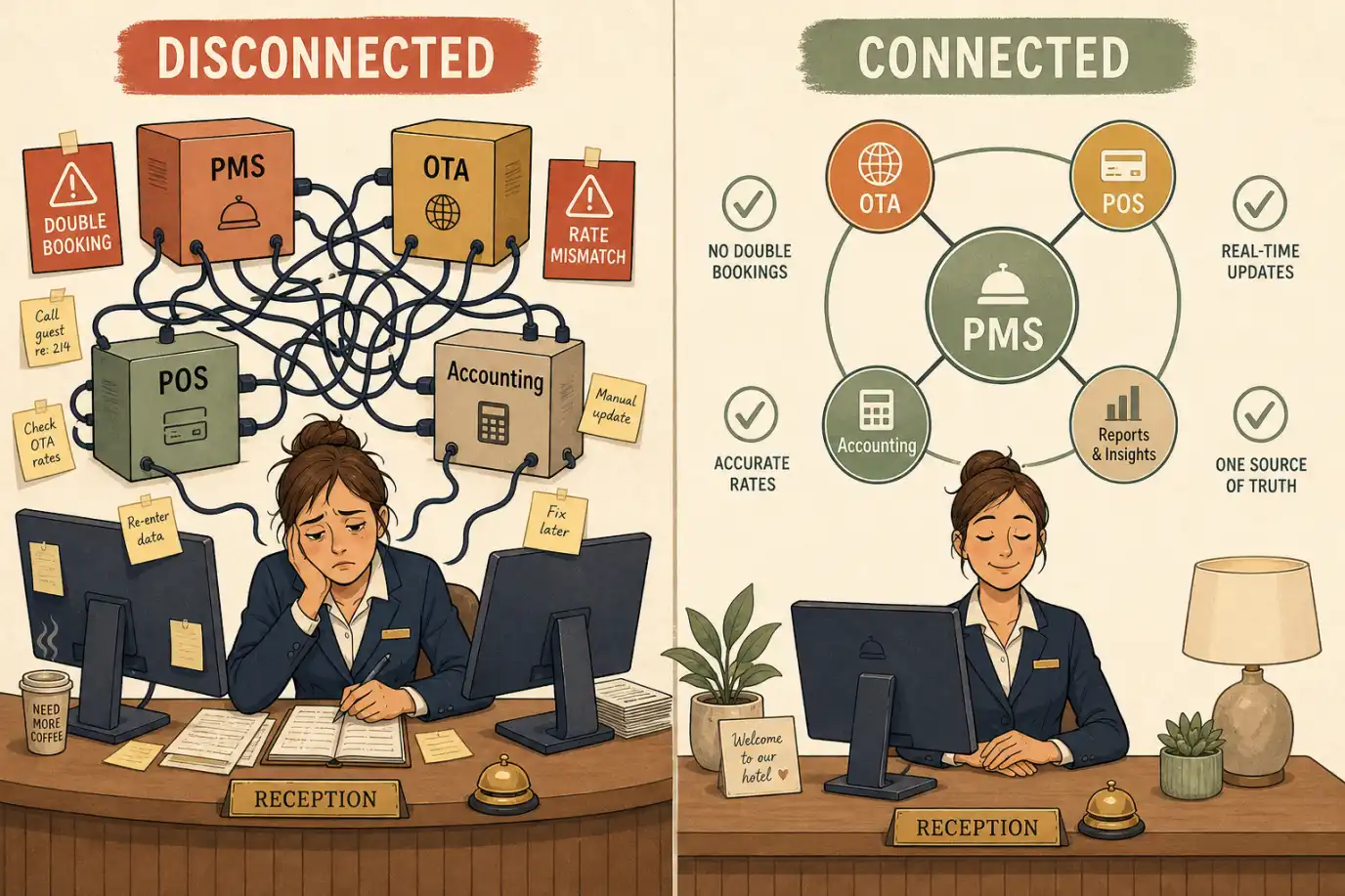
In the disconnected hotel, the morning starts with the receptionist exporting overnight OTA bookings and keying them into the PMS, hoping none arrived in the last few minutes. A guest who booked the last room online at 8 a.m. is double-booked because the channel manager only syncs every couple of hours. The revenue manager raises rates for a busy weekend in the pricing tool, then repeats the change in the PMS and on two OTA extranets, missing one. At dinner, a server writes a room charge on a slip that later cannot be matched to a folio. At night, the auditor reconciles the POS report, the payment terminal batch, and the PMS by hand, and the numbers are off by a little, as always. Every one of these is a person doing the job a connection should do.
In the connected hotel, the same morning has no export step, because online bookings are already in the PMS. The last-minute online booking reduced availability everywhere the instant it happened, so there is no double-booking. The rate change is made once and propagates to every channel within seconds. The dinner charge posts to the folio automatically as the server rings it in. The night audit is a review, not a reconstruction, because the POS, payments, and PMS already agree. The staff in the connected hotel are not working harder or smarter; they are simply no longer acting as the wiring between systems, which frees them to do the work that actually needs a human. That difference, multiplied across every day of the year, is the return on connectivity.
Unified Platform vs Best-of-Breed
This is the strategic fork every hotelier reaches, and it is usually framed as a religious war when it should be a practical choice. On one side is the unified platform: a single vendor builds the PMS, booking engine, channel manager, and often payments on one shared data model, so the core connections are native and guaranteed. On the other is best-of-breed: you choose the strongest individual product in each category and connect them through APIs. Both can produce a genuinely connected stack. Both can also produce a mess. The label tells you less than the execution.
The unified platform's advantage is that integration is solved for you. Because one company built the pieces together, they share data by design, you have one support number when something breaks, and setup is usually simpler. The cost is flexibility: you accept whatever that vendor's channel manager or booking engine does, even if a specialist tool would do it better, and you concentrate more of your operation with one supplier. For most small and mid-sized independents, this trade is worth it, because the time and risk saved on integration outweighs the marginal gain from a best-in-class point solution they may not have staff to exploit.
Best-of-breed's advantage is precisely that flexibility and ceiling: you can assemble exactly the tools your property needs and swap any one of them without replacing everything. The catch is that you, not a vendor, are now responsible for making sure every connection is real, two-way, and maintained, and that responsibility never ends, because any vendor can change an API and quietly break a link. This approach rewards larger or more specialised properties with the technical attention to manage it, and punishes those who assemble five excellent tools that turn out not to talk to each other, which is strictly worse than a competent unified system. The honest decision rule: choose unified if you want integration handled and will trade some flexibility for it; choose best-of-breed if you have a genuine need for specific specialist tools and the capacity to own the connections between them. Decide based on your staffing and your real requirements, not on which camp sounds more sophisticated.
Avoiding Lock-In Without Avoiding Integration
The fear that holds many hoteliers back from committing to a connected platform is lock-in: the worry that going all-in on one vendor leaves them trapped, hostage to price rises and unable to leave. The fear is legitimate, but the usual response, refusing to integrate deeply, is the wrong cure, because it just guarantees the daily pain of a disconnected pile. The right approach is to commit to integration while deliberately preserving your ability to leave. Those two things are compatible, and a good vendor supports both.
Lock-in comes from three sources, and you can defuse each before you sign. The first is data you cannot extract: if your guest, reservation, and financial history is held in a format you cannot export, you are stuck. Counter it by confirming, in writing and ideally by testing, that you can export your own data in a standard, usable form whenever you want, through the open API rather than as a one-off favour from support. The second is proprietary-only connections: if the only integrations that work are to the vendor's own other products, every addition deepens the trap. Counter it by preferring vendors whose API is genuinely open and who have a marketplace of third-party integrations, so you are choosing their products on merit, not because nothing else connects. The third is punitive contracts: long notice periods, data ransomed on exit, history lost when you leave. Counter it by reading the exit terms before you celebrate the demo.
The mindset that protects you is simple: choose integration you control rather than integration that controls you. A confident vendor makes leaving technically possible because their plan is to keep you by being good, not by being inescapable. If a vendor resists letting you export your data or hides their exit terms, that resistance is the most honest thing they will tell you, and you should believe it.
How to Evaluate an Integration Before You Trust It
When a vendor claims to integrate with a system you use, treat it as a claim to be verified, not a feature to be ticked. The demo will always look smooth; your job is to find out how the connection behaves on a bad day. A handful of pointed questions separates real integrations from optimistic ones.
Ask whether the connection is real-time and two-way or scheduled and one-way, and make them answer per data type rather than in general. Ask what happens when the connection drops: does it queue changes and catch up, or do updates silently vanish, and how would you even know it had failed? Ask how conflicts are resolved when two systems disagree, for example if a rate is changed in both places at once. Ask who supports the integration when it breaks at 9 p.m. on a Friday, the PMS vendor, the other vendor, or a finger-pointing gap between them. Ask to speak to a hotel of your size and type that already runs this exact connection in production, and then actually call them and ask what breaks. And ask to see it carry your real data, your menu, your rate plans, your channels, during the trial, not a clean demo dataset that hides the edge cases.
The pattern across all these questions is to probe failure, not success. Any integration works in the showroom. The ones worth trusting are the ones whose owners can calmly explain what happens when something goes wrong, because that means they have seen it go wrong and built for it. A vendor who only ever shows you the happy path has either not run their integration at scale or does not want you to know how it behaves when it does not.
Why Connectivity Is Now an AI Problem Too
For most of the last decade, connectivity was sold as an efficiency story: connect your systems and save staff time. That argument is still true, but in 2026 a second, sharper argument arrived, and it is the one every major vendor is now leading with. Artificial intelligence can only act on data it can actually see, and a disconnected stack hides your data from it. The much-discussed shift toward AI helping guests discover and book, and toward AI handling back-office work, sits entirely on top of whether your underlying systems are connected. If they are not, the AI has nothing reliable to work with.
Trace it through the use cases. An AI demand forecast is only as good as the data it sees; if your booking, rate, and pace data is scattered across three systems that do not reconcile, the forecast is built on a fractured picture and will be wrong in ways you cannot diagnose. An AI assistant that answers a guest's question about availability or price can only be trusted if your PMS, booking engine, and channel manager are genuinely in sync, otherwise it will confidently quote a room you already sold. And AI-driven discovery, the emerging world where travellers find hotels through conversational and answer engines rather than a list of links, depends on your property being represented by clean, consistent, structured data, which a disconnected stack simply cannot produce reliably. We cover the discovery side of this in our guide to AI search optimization for hotels; the point here is that it all rests on connectivity first.
This is why the industry reframed integration as the prerequisite for AI rather than a nice-to-have. The properties whose systems already talk to each other can layer AI on top and get real value. The ones running a disconnected pile have to fix the plumbing before any of the AI promises apply to them, because there is no intelligence to be had from data the AI cannot assemble into a coherent view. Connectivity stopped being only an operational convenience and became the entry ticket to the next wave of technology. Getting it right now is what determines whether the AI conversation includes you in two years or passes you by.
A 30-Day Connectivity Audit
You do not need a consultant or a rip-and-replace project to find out how connected your stack really is. A focused month, run by someone who knows your operation, will surface the worst gaps and give you an evidence-based plan. The goal of the audit is not to fix everything at once; it is to map reality and prioritise the connections that cost you money.
Days 1 to 7: map the stack. List every system that touches a guest, a rate, a room, or money: PMS, booking engine, channel manager, OTAs, payment system, POS and every outlet, accounting, housekeeping, CRM, messaging, door locks, anything. For each, write down what data it holds and which other systems it should be exchanging data with. The picture alone is usually sobering.
Days 8 to 14: trace the connections. For each pair that should connect, find out what actually links them today and which rung of the ladder it is on: real-time two-way API, scheduled one-way sync, flat-file export, or a human retyping. The fastest way to find the human bridges is to ask your staff which numbers they copy between systems and which reports they reconcile by hand. Every manual bridge is a missing or weak integration, and your team knows exactly where they are.
Days 15 to 21: rank by pain. Score each weak or missing connection by how much it costs in money and risk, not just hours. Overbooking and rate-disparity risks from a weak channel-manager link, revenue leaking from POS charges that do not post, and reconciliation errors from disconnected payments belong at the top. A keyless-entry link that needs a manual step belongs near the bottom. This ranking is your roadmap, and it almost always points at the booking engine, channel manager, payments, and POS first.
Days 22 to 28: fix or plan the top three. Take the three highest-pain gaps and either close them now, by enabling a real integration that already exists but was never switched on, which is surprisingly common, or get a concrete plan and quote to close them. Often the integration you need is available on your current PMS and simply not configured. Where the gap is the PMS itself being closed or poorly connected, you now have the documented case for a migration conversation.
Days 29 to 30: document and set a cadence. Record the map, the connection inventory, and the ranked gaps so the knowledge does not live in one person's head, and schedule a repeat in six months, because stacks drift as tools are added and APIs change. Connectivity is not a project you finish; it is a property you maintain. The audit, run twice a year, keeps the pile from quietly reassembling itself.
Where Prostay Fits, Briefly and Honestly
The disclosure first: I write for Prostay, which builds a connected stack of hotel software, so read this section as interest rather than neutral analysis. The useful, honest point is narrow and matches the argument of the whole article. Prostay is built as a connected platform rather than a single product: the property management system is the hub, and the Tableview point of sale, payments, and accounting are designed to share its data natively, so restaurant charges post to the folio in real time, settlement reconciles automatically, and revenue flows to the books without a manual journal. That native connection is exactly the unified-platform trade described above: tight integration handled for you, in exchange for running the core on one platform.
None of that makes Prostay the only sensible choice, and it would undercut the article to pretend so. Cloudbeds, Mews, and other modern platforms are built on the same connected principle, and a well-run best-of-breed stack can match it for a property with the staff to manage the connections. The genuinely useful test is the one this article gives you: whether the connections you depend on are real-time and two-way, whether the API is open enough that your data is never trapped, and whether you can leave if you ever want to. Apply that test to us as rigorously as to anyone else. If you want to see how Prostay's stack connects on your specific systems, the honest way to evaluate it is to make us run your real rates, channels, and outlets during a trial rather than watch a clean demo. Choose connectivity you can verify, from whichever vendor proves it.
Frequently Asked Questions
Five questions hotel operators ask most about integrations, open APIs, and building a connected stack, answered from how these systems behave in a real property rather than from a vendor's brochure.