
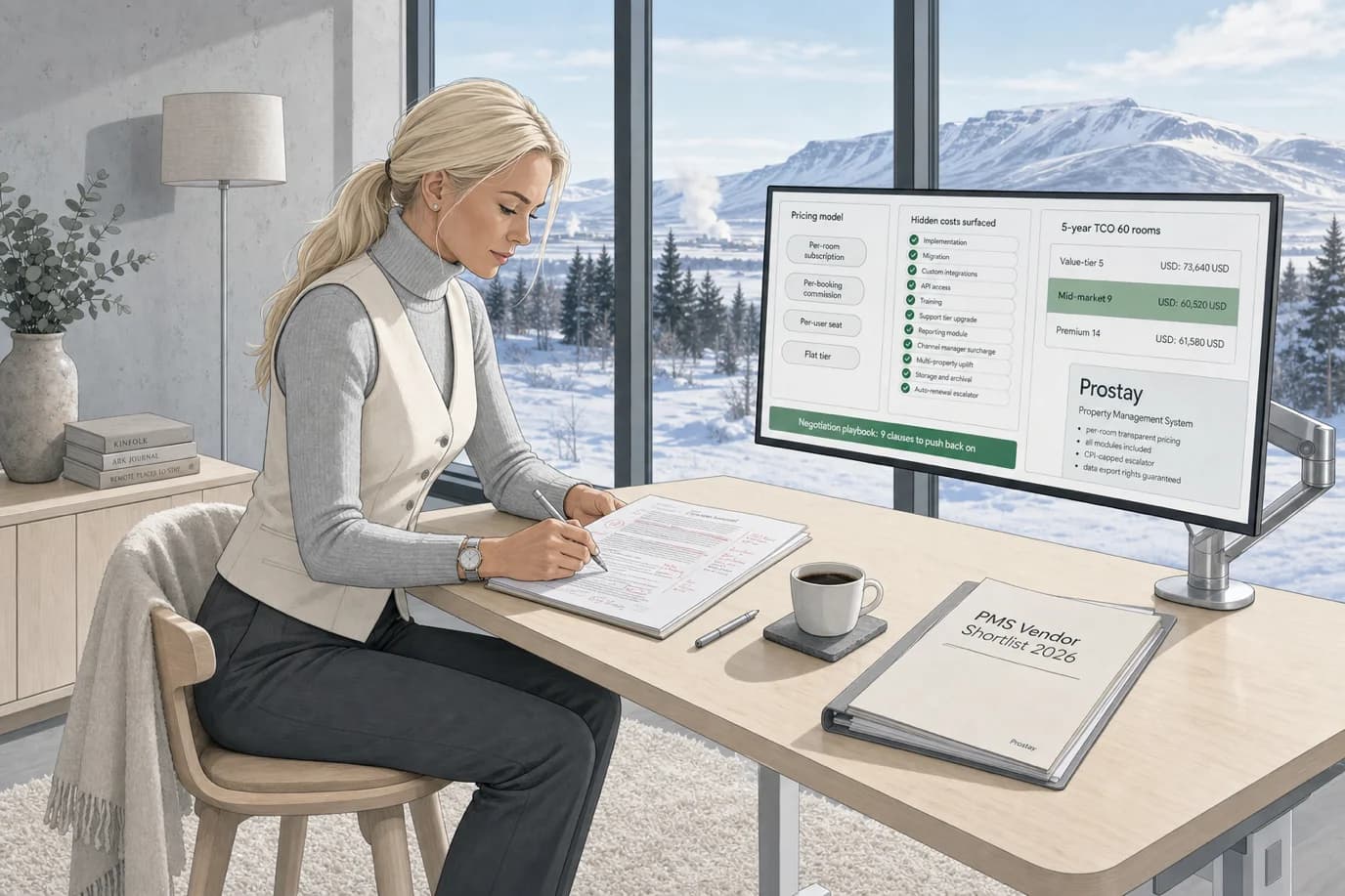
Why PMS pricing is confusing on purpose
Most independent hoteliers walk into a PMS evaluation with one number in mind and walk out 90 days later having signed a contract that costs 35 to 60 percent more than that number over five years. The gap is not a vendor scam. It is the structural way enterprise SaaS pricing has worked since 2018, and it has only gotten more layered as PMS vendors expanded into payments, revenue management, and AI. The headline subscription on the order form is real. It is also incomplete. Everything else lives in clauses, addenda, partner schedules, and the support tier you got automatically assigned to in onboarding.
This is the honest 2026 buyer's guide we wish had existed when we built our hotel property management system. Across 47 evaluations we sat in on with independent hotels in the 28 to 220-room range over the last 18 months, the same eleven cost lines kept showing up after signature, and the same nine contract clauses kept biting hotels in year two and year three. The good news is that this is all negotiable, all comparable, and all knowable before you sign. The work is forcing every vendor to quote on the same total-cost-of-ownership basis, then deciding which trade-offs you actually want to live with.
This first section is about the four pricing models you will see in 2026 and what each one tells you about the vendor's business. Section two is the eleven hidden costs that almost never appear on the first quote. Section three is worked TCO math for a 30, a 60, and a 120-room independent over five years, with realistic numbers. Section four is the negotiation playbook, the nine clauses to push back on, and the three terms that hotels accept by default and regret.
How PMS vendors decide how to charge you
A PMS vendor's pricing model is not a marketing decision. It is a financial decision, and reading it backwards tells you what the vendor optimizes for. Per-room subscription pricing optimizes for predictable monthly recurring revenue per logo, which is what venture-backed vendors need to look healthy on a board deck. Per-booking commission pricing optimizes for fast adoption among small properties that hate fixed costs, and it scales the vendor's revenue with your success. Per-user pricing optimizes for legacy enterprise sales motions where the buyer is an IT director who counts seats. Flat-tier pricing optimizes for vendors with cost-light architectures who want to avoid the operational complexity of per-unit billing.
None of these is wrong on principle. They are different bets about which kind of customer the vendor wants. The bet you should make is the one that aligns with your occupancy and ADR over the next five years, not the one that looks cheapest on month one. A 28-room boutique that runs at 78 percent occupancy and 240 USD ADR will pay materially more under a 2 percent commission model than under a 9 USD per-room subscription, and the gap widens as the property gets healthier. A 110-room independent that runs at 58 percent occupancy and 140 USD ADR will pay roughly the same on either model, and the choice comes down to which vendor has the integrations and the SLAs you actually need.
Model 1: Per-room per-month subscription
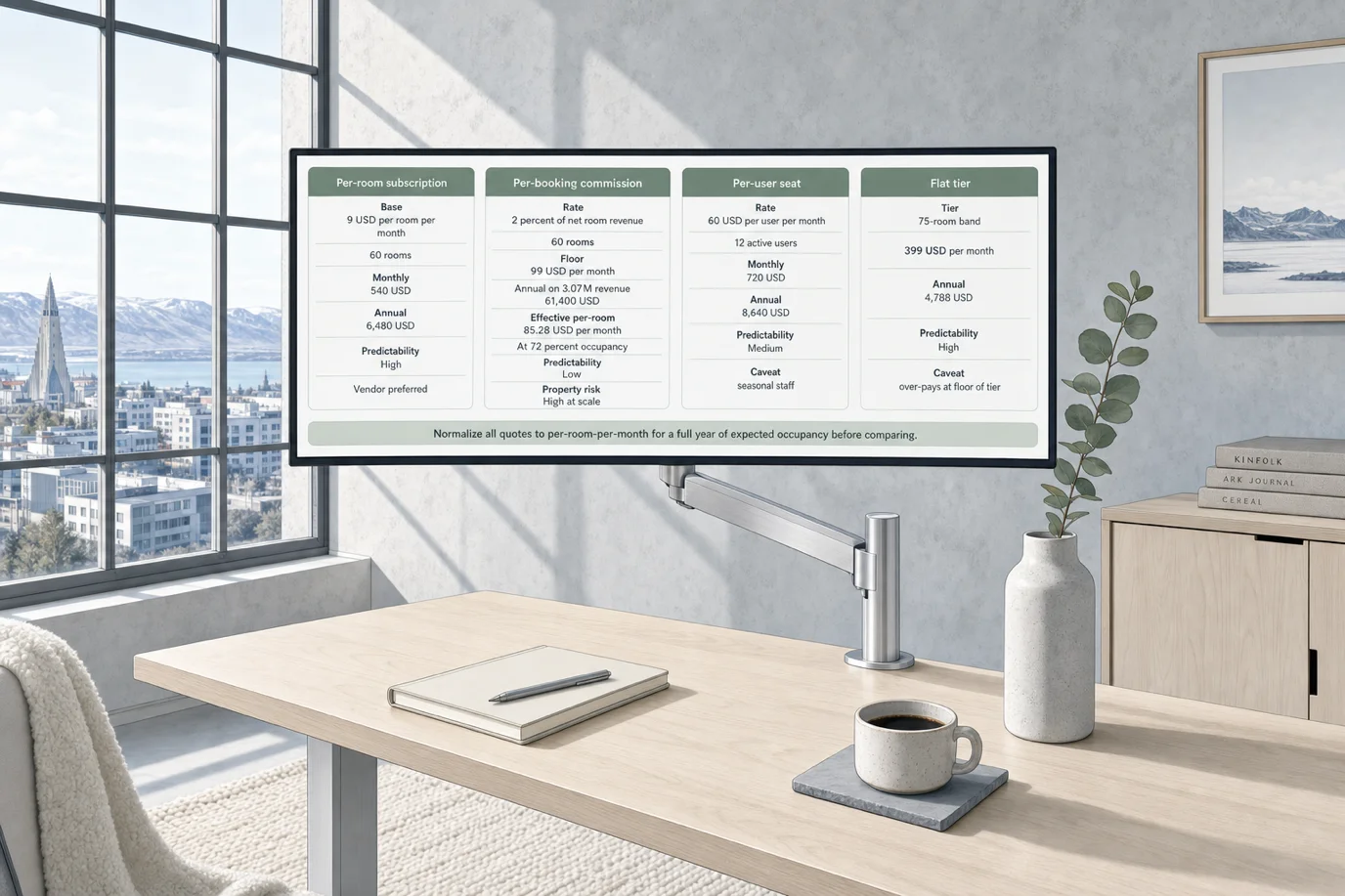
This is the dominant 2026 model. Vendors quote a flat monthly fee per saleable room, usually in the 4 to 12 USD per-room band for independent properties, with a tier system that adds modules above the base. A 60-room hotel on a 7 USD per-room base tier pays 420 USD per month, or 5040 USD per year, before any add-ons. The model is easy to compare across vendors, easy to budget, and the math holds whether occupancy is 40 percent or 85 percent.
The per-room model has three sub-flavors that matter. Saleable rooms means rooms in your inventory, occupied or not. Some vendors quote on configured rooms, which means you pay for rooms even when you take them out of inventory for renovation. A 60-room hotel doing a 12-room phased renovation across six months will pay 12 extra rooms times 7 USD times 6 months, which is 504 USD, on a configured-rooms quote that it would not pay on a saleable-rooms quote. Always confirm in writing which definition the contract uses. The second sub-flavor is the modules-included list. Some vendors include a basic channel manager, a basic booking engine, basic reporting, and PMS-only payments in the per-room base. Others charge separately for any of those, and the base tier becomes a thin desk-management layer. The third sub-flavor is the multi-property uplift. Some vendors add 10 to 25 percent on top of the per-room rate when you add a second property under the same account, justified as cross-property aggregation features. If you plan to grow to two or more properties inside the contract term, ask for the multi-property rate up front, not at the moment you open the second hotel.
Model 2: Per-booking commission
Less common in 2026 than it was in 2022, but still alive at the small-property end of the market. The vendor charges a percentage of net room revenue, usually 1 to 3 percent, with a minimum monthly floor of 50 to 200 USD to cover their cost of serving a low-volume account. The model is attractive when occupancy is low because it scales down with you, and it is the dominant model for vacation-rental hosts and small B&Bs that hate fixed costs. The model is dangerous when occupancy is high because the vendor's revenue scales with yours, and there is no natural ceiling.
The crossover math is the math every boutique hotel should run before signing a commission deal. Take your expected annual room revenue. Multiply by the commission percentage. Divide by your room count. Divide by 12. That is your effective per-room-per-month cost under the commission model. Compare it to the per-room subscription quotes you have in hand from other vendors. For a 28-room boutique at 55 percent occupancy and 180 USD ADR, the calculation is 1,007,820 USD times 0.02 divided by 28 divided by 12, which is 5.99 USD per room per month. That is competitive with a mid-range subscription. For the same property at 75 percent occupancy and 240 USD ADR, the calculation is 1,839,600 USD times 0.02 divided by 28 divided by 12, which is 10.95 USD per room per month. That is on the high end of fair, and it gets worse as the property succeeds. Many boutiques sign commission deals during a slow shoulder season and find themselves paying double the per-room equivalent eighteen months later when peak season hits.
Model 3: Per-user seat pricing
The legacy enterprise model. Common in pre-cloud PMS vendors that still serve the upper-midscale and luxury chain segment, and in some on-premise deployments that survived the cloud wave. The vendor charges 30 to 80 USD per user per month for active accounts, regardless of room count, with module add-ons priced separately. A 60-room independent with a 12-person front-desk and management team pays 6 users times 60 USD, or 360 USD per month, plus modules. The model breaks down fast for hotels with rotating part-time staff because every new hire needs a license, and inactive accounts almost never get reclaimed without a manual cleanup.
If a vendor quotes you per-user pricing, ask three questions before considering the proposal. How does the vendor handle seasonal staff that come on for 90 days and leave. What is the floor for an account before it becomes inactive and reclaimable. And does any role at the property need a paid seat that should not, like a housekeeping supervisor who only updates room status from a tablet. Vendors who answer these questions well usually have a per-room option behind the per-user quote, and the per-room option is almost always the better deal for independents.
Model 4: Flat-tier pricing
Three or four named tiers, fixed monthly price per tier, room count caps at each tier. A typical 2026 flat-tier structure is 199 USD per month up to 30 rooms, 399 USD per month up to 75 rooms, 799 USD per month up to 150 rooms, and a custom enterprise tier above 150 rooms. The model is honest and easy to budget. It is also the model most likely to over-charge small properties at the floor of a tier and under-charge large properties at the ceiling.
A 32-room boutique on the 75-room tier pays 399 USD per month, which is 12.47 USD per room. The same property on a 7 USD per-room subscription with a different vendor pays 224 USD, a 175 USD per month gap, or 2100 USD per year. Across five years, that is 10500 USD before any escalator. The gap matters most at the floor of a tier and disappears as you grow toward the ceiling. A 73-room property on the same 75-room tier pays the same 399 USD per month, which is 5.47 USD per room, and now the flat-tier is the better deal. Always check where you sit on a flat-tier curve before signing, and renegotiate when you cross a tier boundary in either direction.
Hybrid models and what they tell you about the vendor
The 2026 hybrid is base subscription plus per-room or per-transaction surcharge. A common shape is 99 USD per month base plus 4 USD per room per month for the PMS, plus 0.5 percent of payment volume processed through the integrated payment processor, plus 19 USD per month per add-on module. Hybrids look cheaper at the headline, more expensive in aggregate, and they signal a vendor who is mid-pivot from one pricing era to another, usually from flat-tier to per-room or from per-room to payment-volume.
The honest read on hybrids is that the vendor wants the long tail of payment volume revenue but cannot drop the base subscription without spooking finance. The good news is that hybrids are the most negotiable model at the table because each component is independently quoted. The bad news is that the payment-volume surcharge often hides inside the merchant services contract rather than the PMS contract, and you only see it on a settlement report two months after go-live. Always ask for a sample settlement report from a real customer of similar size before signing a hybrid that includes a payment-volume component, and confirm in writing whether the surcharge applies to gross transaction volume, net of refunds, or net of refunds and chargebacks.
How to normalize quotes across all four models
Before comparing quotes from vendors using different pricing models, convert everything to a per-room-per-month number for a full year of your expected occupancy. The conversion is mechanical but the inputs matter. Use your last 12 months of actual room revenue, not a forecast and not the last full pre-2020 year. If you have less than 12 months of post-2024 data, use a stabilized 70 percent occupancy at your published BAR for the calculation, which is the operating assumption most lenders use for hotel underwriting and a fair midpoint between optimism and conservatism.
For per-room subscriptions the conversion is the quoted rate. For per-booking commissions the conversion is annual room revenue times commission percentage divided by room count divided by 12. For per-user the conversion is total monthly user fees divided by room count. For flat-tier the conversion is monthly tier price divided by room count. For hybrids the conversion is base divided by room count plus per-room rate plus per-transaction percentage applied to expected transaction volume divided by room count divided by 12. Round to two decimal places. Now you have a single number to compare across vendors, plus the modules-included list, plus the SLA, plus the contract length and termination terms. Most independents discover at this point that the vendor with the lowest sticker price is not the vendor with the lowest five-year TCO, and the gap can be 30 to 50 percent in either direction.
The 11 hidden costs nobody breaks out on the demo
The demo is a sales motion. The procurement document is a finance motion. They look at the same product through different lenses, and the gap between them is where 35 to 60 percent of the total cost of ownership lives. None of the eleven costs below is dishonest. All of them are documented somewhere in the contract, the partner schedule, or the master service agreement. The problem is that they are scattered across documents, presented at different times in the sales cycle, and almost never aggregated into a single cost-to-serve number. The work of an honest evaluation is to surface all eleven before signature and price each one against your actual property profile.
Cost 1: Implementation and onboarding fee
The one-time fee for setting up your PMS account, importing your historical data, mapping your channel manager, and running the first weeks of training. In 2026 the honest range is 1500 to 8000 USD for an independent property between 30 and 150 rooms, depending on the size of your historical data, the number of integrations on day one, and whether you are migrating from a competing PMS or running a green-field setup. Vendors that quote zero implementation fee are either subsidizing it through a 36-month contract lock at a higher subscription, or they are providing self-serve onboarding documentation instead of human-led implementation. Both models exist. The self-serve model is fine for a small B&B or a vacation rental host, and a real failure mode for a 90-room independent doing a live cutover with twelve front-desk staff who have used the same PMS for nine years.
The implementation fee should be itemized. Real itemization looks like this. Data migration of guest profiles, reservations history, and folio history. Channel manager mapping for each connected OTA and metasearch partner. Payments processor setup with at least one test transaction posted to the folio. A sandbox environment available for at least four weeks before go-live. Two scheduled training sessions with the front desk team. A go-live weekend with vendor support reachable on call. A post-go-live check-in 30 days after cutover. Itemized fees that map to deliverables are negotiable in detail. Lump-sum fees with no breakdown are not.
Cost 2: Data migration fee
Sometimes folded into implementation, sometimes broken out. The work is exporting your historical reservations, guest profiles, folio entries, and at minimum the last 36 months of bookings from your current PMS, then importing into the new one with the field mappings tested. The fair 2026 range is 500 to 5000 USD depending on data volume and source format. A clean export from a major cloud PMS is the bottom of the range. A messy export from an on-premise legacy system with non-standard field names, inconsistent date formats, and orphaned records is the top of the range. Some vendors quote it per gigabyte of data, which is a reasonable proxy for property age and complexity.
The risk on migration is not the fee. The risk is the data integrity check, which most vendors do not include by default. A real data migration includes a reconciliation report that compares record counts and key totals between the old and new systems. Reservations count match. Guest profile count match. Folio total for the last closed month within 0.5 percent. Outstanding A/R within 1 percent. If the contract does not specify a reconciliation report, ask for one in writing as a deliverable, not a courtesy.
Cost 3: Custom integration fees
Modern PMS vendors maintain a partner ecosystem of pre-built integrations that are free to enable for the customer. The list ranges from 30 to 200 partners depending on vendor maturity, and it covers the obvious channel managers, OTAs, payment processors, revenue management tools, CRM systems, accounting platforms, and a few hospitality-specific add-ons. Anything outside the partner list is a custom integration, and custom integrations have three sub-costs. The build fee, paid once. The certification or maintenance fee, paid annually. The API call volume fee, which kicks in only at high scale.
The fair build fee for a custom integration is 800 to 4000 USD depending on the complexity of the partner API and whether the vendor's professional services team or a third-party integration specialist does the work. The annual certification fee is usually 200 to 1200 USD per integration and covers regression testing whenever either side updates an API. The API call volume fee is the part that surprises growing properties. Most PMS vendors quote a free tier of 100 to 500 API calls per minute, which is plenty for a 60-room single property with three integrations. A 200-room property with eight integrations and an active revenue management tool can easily exceed 500 calls per minute during peak demand, and the next tier is usually 1500 to 6000 USD per year. Confirm your expected call volume before signing.
Cost 4: API and webhook access fees
This is the line that has changed most dramatically since 2022. Five years ago most PMS vendors offered API access as a feature of the standard tier. In 2026, more than half of the major PMS vendors now charge separately for outbound API and webhook access, gated behind a developer tier or a partner agreement. The fee ranges from 99 USD per month for read-only API to 1500 USD per month for full read-write API with webhook support. Some vendors also charge per developer key issued, with 5 to 25 USD per month per active key.
The honest test is whether the vendor's API is genuinely a partner ecosystem, where you can build your own integrations or hire a developer to build them, or whether it is a moat designed to push you toward in-network partners. A genuine partner ecosystem documents the API publicly, lets you build a sandbox integration in a free trial, and only starts charging when you put a custom integration into production. A moat-style API charges by tier, gates documentation behind sales conversations, and requires a partner certification process even for read-only data extraction. Independent hotels with a tech-curious GM or a contracted developer should always confirm API access and pricing before signing, because 80 percent of the time the answer is the difference between a flexible technology stack and a vendor lock-in.
Cost 5: Training fees beyond the included sessions
Most PMS contracts include 4 to 16 hours of training in the implementation fee. That is enough for a single front-desk team to learn the basics and not enough for a property with rotating staff, multiple roles, or a culture of internal promotion that needs ongoing training. Vendors price additional training at 200 to 800 USD per session, with sessions typically 90 minutes to 2 hours, or as a 5000 to 20000 USD per year training package that includes unlimited sessions and a dedicated training portal.
The right answer for an independent depends on staff turnover. Properties with under 20 percent annual front-desk turnover usually do not need a training package and can buy ad-hoc sessions when they hire. Properties with above 30 percent annual turnover should price the training package against the actual cost of three or four ad-hoc sessions per year and decide which is cheaper. Properties that promote front-desk agents into supervisor or manager roles every 12 to 18 months should always negotiate ongoing training into the base contract, because each promotion creates a new role-specific training need that vendors charge separately for.
Cost 6: Support tier upgrades
The single most overlooked cost in an independent hotel PMS contract. Most vendors offer three support tiers. Basic, included with the subscription, with email support and 4 to 24-hour response times during business hours. Priority, an upgrade tier at 200 to 800 USD per month, with phone support and 1 to 4-hour response times during extended hours. Premium or 24/7, the top tier at 800 to 3000 USD per month, with named account managers and around-the-clock support. The basic tier is fine for a hotel that is open 9 to 5, which is no hotel. Hotels open at night need at least priority, and most properties default into priority during onboarding without realizing it is an upsell.
The negotiation move is to confirm in writing what level of support is included in the base subscription, and whether emergency overnight support for genuine outages is included regardless of tier. Reputable vendors include emergency overnight support for outages affecting check-in or payment processing in all tiers, because the alternative is a viral incident on social media. Vendors that gate emergency support behind a paid tier are signaling that their basic tier is a loss-leader and the upsell to priority is the actual product.
Cost 7: Reporting and business intelligence modules
The demo will show you a beautiful dashboard with revenue, occupancy, ADR, RevPAR, GOPPAR, segmentation, channel mix, and pace. Some of those are part of the base subscription. Others are part of a paid reporting tier or a separate BI module. The split is rarely clear at the demo, and the moment of clarity usually arrives 60 days after go-live when the GM asks the front desk to pull a custom report and discovers the report builder is on a 79 to 199 USD per month add-on tier.
The honest 2026 distribution is that operational reports like the daily revenue report, the night audit pack, the housekeeping status report, and the basic occupancy and ADR dashboards should be in the base. Strategic reports like segmentation, channel cost analysis, pace forecasting, and custom report builders are usually in a paid tier. The fair add-on price is 49 to 149 USD per month for a small property, 149 to 399 USD per month for mid-size, and bespoke for enterprise. Always ask for the exact list of reports included in the base subscription, in writing, with sample outputs. The list is usually 8 to 15 reports, and the gap between that list and what your operation actually needs is the size of the add-on you will be paying for.
Cost 8: Channel manager surcharge
If your channel manager is a free partner in the PMS vendor's ecosystem, you pay no surcharge. If your channel manager is a non-partner that you connect through a custom integration, you pay a surcharge that ranges from 100 to 800 USD per month depending on the volume of channel updates. Some PMS vendors offer their own native channel manager as part of the per-room base. Others bundle a partner channel manager into a higher tier. Others charge separately for each connected channel above a free limit, typically 3 to 8 channels free with each additional channel at 9 to 39 USD per month.
For a property selling on Booking.com, Expedia, Hotelbeds, and a regional GDS, with one metasearch direct ad partner and one wholesaler, that is six channels. If the vendor includes 3 free and charges 19 USD per additional channel, the math is 3 times 19, or 57 USD per month, or 684 USD per year. Across five years that is 3420 USD before any escalator, and the surcharge usually grows as you add OTAs in new markets. Always confirm the channel-count threshold and the per-additional-channel rate before signing.
Cost 9: Multi-property uplift
An independent hotel that grows from one property to two properties inside the contract term is in a stronger market position and a weaker negotiating position at the same time. The vendor knows you have already migrated, your team has already trained, and the cost of switching to a different vendor for the second property is roughly the cost of switching the first one back. The multi-property uplift exploits this. Typical uplifts are 10 to 25 percent on the per-room base, plus a 99 to 499 USD per month multi-property aggregator fee, plus implementation fees on the second property.
The negotiation move is to ask for the multi-property rate up front in the original contract, even if you do not currently have a second property. Get the discount in writing as a contractual right rather than a promise to discuss in good faith later. If the vendor refuses, that tells you the uplift is the real revenue play and the original quote is the loss-leader, which changes how aggressively you should negotiate the rest of the contract.
Cost 10: Data storage and archival fees
A growing line in 2026 PMS contracts. After 24 or 36 months, closed reservations and old folio history move from the active database to an archive tier that the vendor either charges for or makes inaccessible without an additional fee. The fee is small in absolute terms, usually 50 to 200 USD per month for a 60-room property, but it compounds across the contract length. More importantly, the archive tier sometimes carries a retrieval fee for any historical export, which becomes painful if you ever need historical data for a tax audit, a legal request, or a vendor migration.
The negotiation move is to require unlimited active data retention for the contract term, with no archive tier and no retrieval fee, in writing. If the vendor refuses, ask for the archival policy in detail and price the retrieval fees against the realistic frequency of historical data requests at your property. For most independents the answer is once or twice per year for a tax audit and a one-time bulk export at end of contract. The contract should price all three.
Cost 11: Auto-renewal escalator clauses
The single most expensive line in a hotel PMS contract that hotels never negotiate. Most 2026 contracts include an auto-renewal clause with a 5 to 10 percent annual price increase, applied automatically at each renewal unless the hotel gives 60 or 90 days notice in writing. The clause looks small. A 60-room hotel paying 7 USD per room per month at signing pays 8.61 USD per room per month after three 7 percent annual escalators, which is a 23 percent total increase across three years. Across five years at 7 percent annual escalators, the same hotel is paying 9.81 USD per room per month, a 40 percent increase from the signing rate.
The fair version of this clause is a CPI-linked escalator capped at 3 percent per year, with a one-time hard reset at year three to allow renegotiation. The unfair version is a fixed 7 to 10 percent escalator with no cap and an evergreen auto-renewal that locks you into a 36-month term unless you remember to send a written termination notice in a 30-day window. The negotiation move is non-negotiable here. Cap the escalator at 3 percent. Set the renewal term to 12 months instead of 36 after the initial term. Require an explicit opt-in for renewal rather than an automatic renewal. If the vendor refuses on all three, factor a 7 percent annual escalator into your TCO math and use it as a negotiation lever on the implementation fee or the channel manager surcharge instead.
Five-year TCO math for independents
This section is the math. Three property profiles, three vendor archetypes, five years of cost. The numbers below are honest 2026 midpoints from the 47 vendor evaluations we sat in on with independent hotels in the last 18 months. They will not match your specific quote exactly, but they will tell you where the cost actually lives and which line items move the most when you negotiate. Plug your real numbers into the same structure and you will get a realistic answer in 30 minutes.
The three property profiles are a 30-room boutique at 65 percent occupancy and 175 USD ADR, a 60-room urban independent at 72 percent occupancy and 195 USD ADR, and a 120-room resort at 68 percent occupancy and 235 USD ADR. The three vendor archetypes are a value-tier per-room subscription at 5 USD per room per month base, a mid-market full-stack vendor at 9 USD per room per month with most modules included, and a premium enterprise-leaning vendor at 14 USD per room per month with named account management and full module access. None of these is a real product. They are composites of the actual quotes we saw, anonymized to focus on the structure.
Profile 1: 30-room boutique, 65 percent occupancy, 175 USD ADR
Annual room revenue is 30 rooms times 365 nights times 0.65 occupancy times 175 USD ADR, which works out to 1,246,313 USD. Per-booking commission at 2 percent would be 24,926 USD per year, or 69.24 USD per room per month, which is plainly above the per-room subscription range and rules out the commission model immediately for this property. Stick with per-room subscriptions for boutiques at this occupancy and ADR.
Value-tier vendor at 5 USD per room. Base subscription is 30 times 5 times 12, or 1800 USD per year. Implementation fee at signing is 1500 USD. Data migration is 500 USD. Channel manager is included for 3 channels, 19 USD per additional channel, and the property uses 5 channels for a 38 USD per month surcharge or 456 USD per year. Reporting add-on is 49 USD per month or 588 USD per year because the boutique GM wants pace and segmentation. Priority support is 200 USD per month or 2400 USD per year. API access is 99 USD per month or 1188 USD per year because the property uses one custom integration with a regional GDS. Annual escalator at 7 percent applied to the subscription and the add-ons. Five-year TCO is 1500 + 500 + (1800+456+588+2400+1188) plus the same recurring lines escalated 7 percent each year, which works out to 32,475 USD across five years.
Mid-market vendor at 9 USD per room. Base subscription is 30 times 9 times 12, or 3240 USD per year. Implementation fee is 3500 USD. Data migration is included in implementation. Channel manager is bundled for 5 channels, no surcharge. Reporting is included in the base. Priority support is 99 USD per month or 1188 USD per year. API access is included for read-only, full API is 199 USD per month or 2388 USD per year, but the property does not need full API. Annual escalator at 5 percent. Five-year TCO is 3500 + (3240+1188) plus the same recurring lines escalated 5 percent each year, which works out to 28,415 USD across five years.
Premium vendor at 14 USD per room. Base subscription is 30 times 14 times 12, or 5040 USD per year. Implementation fee is 6000 USD with white-glove onboarding. Everything is included. Premium 24/7 support is included. Annual escalator at 3 percent because the contract is enterprise-grade. Five-year TCO is 6000 + 5040 plus 3 percent annual escalators, which works out to 32,810 USD across five years.
Across all three vendors, the five-year TCO for a 30-room boutique sits in a 28,000 to 33,000 USD band, which is 18,800 to 22,000 USD per room over five years, or 3760 to 4400 USD per room per year amortized. The cheapest vendor on month one is not the cheapest vendor on year five. The mid-market vendor wins this profile because its bundle structure absorbs the four most expensive add-ons. A boutique that signs the value-tier vendor on a 5 USD per room headline ends up paying more across five years than the boutique that signs the mid-market vendor on a 9 USD per room headline. This is the most common surprise in independent PMS evaluations.
Profile 2: 60-room urban independent, 72 percent occupancy, 195 USD ADR
Annual room revenue is 60 times 365 times 0.72 times 195 USD, which works out to 3,072,492 USD. Per-booking commission at 1.8 percent for a property of this size would be 55,305 USD per year, or 76.81 USD per room per month, which again rules out commission immediately. Stick with per-room subscriptions.
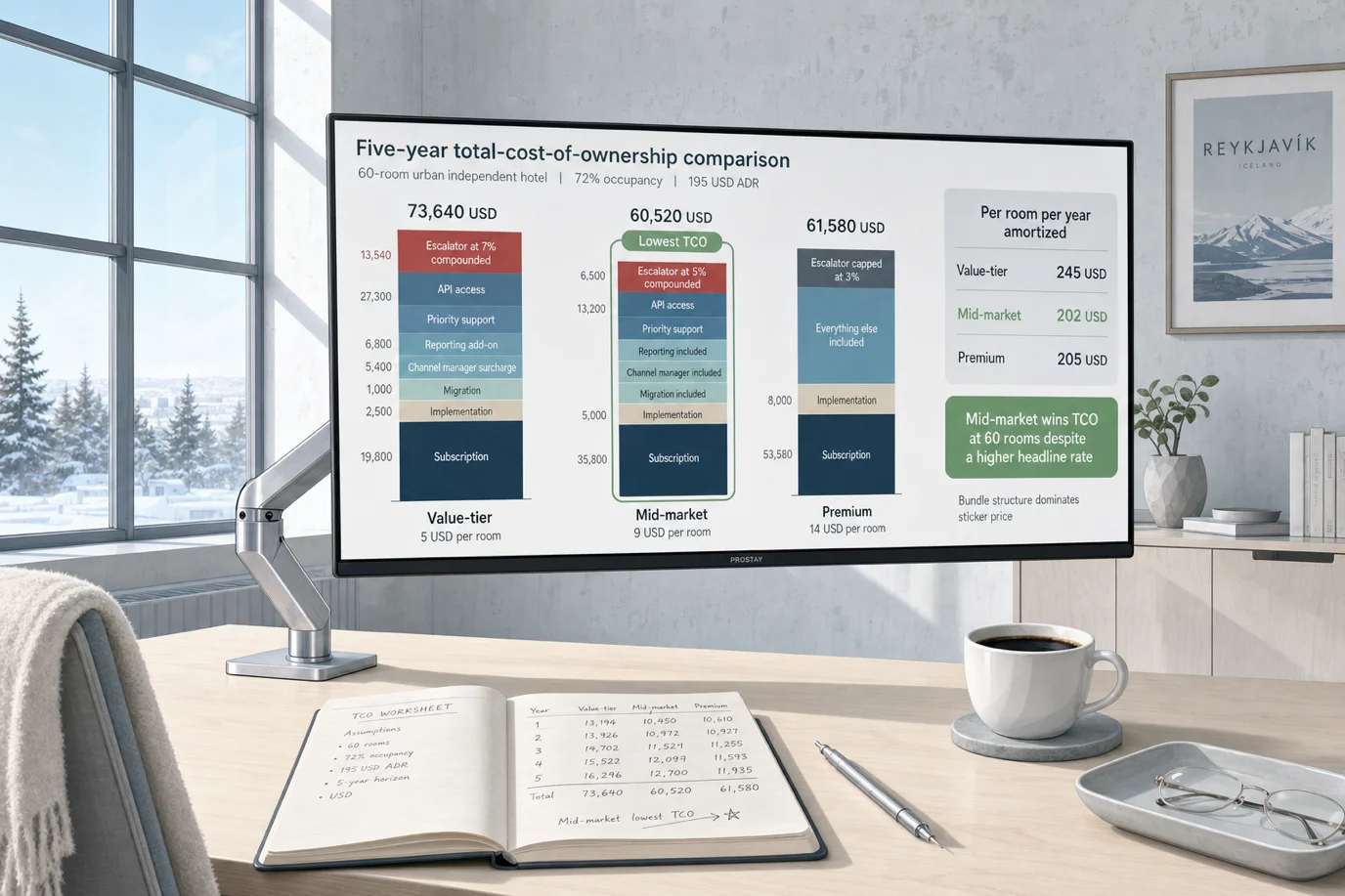
Value-tier vendor at 5 USD per room. Base subscription is 60 times 5 times 12, or 3600 USD per year. Implementation fee at signing is 2500 USD. Data migration is 1000 USD. Channel manager surcharge for 7 channels at 19 USD per additional channel above 3 is 76 USD per month or 912 USD per year. Reporting add-on at 99 USD per month or 1188 USD per year because the property is large enough to need the full report builder. Priority support at 400 USD per month or 4800 USD per year. API access at 199 USD per month or 2388 USD per year for two custom integrations. Multi-property uplift at zero because the property is single. Annual escalator at 7 percent. Five-year TCO is 2500 + 1000 + (3600+912+1188+4800+2388) plus the same recurring lines escalated 7 percent each year, which works out to 73,640 USD across five years.
Mid-market vendor at 9 USD per room. Base subscription is 60 times 9 times 12, or 6480 USD per year. Implementation fee is 5000 USD. Data migration is included. Channel manager is bundled for 7 channels, no surcharge. Reporting is included. Priority support at 199 USD per month or 2388 USD per year. API access at 99 USD per month or 1188 USD per year for read-write. Annual escalator at 5 percent. Five-year TCO is 5000 + (6480+2388+1188) plus the same recurring lines escalated 5 percent each year, which works out to 60,520 USD across five years.
Premium vendor at 14 USD per room. Base subscription is 60 times 14 times 12, or 10,080 USD per year. Implementation fee is 8000 USD. Everything is included. Premium 24/7 support is included. Named account manager is included. Annual escalator at 3 percent. Five-year TCO is 8000 + 10,080 plus 3 percent annual escalators, which works out to 61,580 USD across five years.
Across all three vendors, the five-year TCO for a 60-room urban independent sits in a 60,000 to 74,000 USD band, which is 1000 to 1233 USD per room over five years amortized to 200 to 247 USD per room per year. The mid-market vendor wins again, by a wider margin than the boutique. The value-tier vendor's bundle gaps grow with property size, because every add-on is priced per property rather than per room, and large properties absorb absorb absorb the same add-on cost across more rooms but accumulate more add-ons in the first place. The premium vendor closes most of the gap to the mid-market vendor at this size because the included module bundle is broader and the support tier is genuinely enterprise-grade.
Profile 3: 120-room resort, 68 percent occupancy, 235 USD ADR
Annual room revenue is 120 times 365 times 0.68 times 235 USD, which works out to 7,000,344 USD. The math at this size starts to favor properties willing to negotiate aggressively because vendors compete harder for the logo. Commission models are off the table. Per-room subscriptions are the play.
Value-tier vendor at 5 USD per room. Base subscription is 120 times 5 times 12, or 7200 USD per year. Implementation fee is 4500 USD. Data migration is 2000 USD because the resort has a longer history. Channel manager surcharge for 9 channels is 114 USD per month or 1368 USD per year. Reporting add-on at 199 USD per month or 2388 USD per year. Priority support at 800 USD per month or 9600 USD per year. API access at 399 USD per month or 4788 USD per year because the resort runs four custom integrations including a spa system, a banquet system, a CRM, and a regional ad partner. Annual escalator at 7 percent. Five-year TCO is 4500 + 2000 + (7200+1368+2388+9600+4788) plus the same recurring lines escalated 7 percent each year, which works out to 142,580 USD across five years.
Mid-market vendor at 9 USD per room. Base subscription is 120 times 9 times 12, or 12,960 USD per year. Implementation fee is 7500 USD. Data migration is 1000 USD because the resort has more historical complexity than the mid-market vendor's standard migration covers. Channel manager bundled for 7 channels, surcharge for 2 additional at 39 USD per month or 936 USD per year because the mid-market vendor uses a higher per-channel rate above the bundled tier. Reporting is included. Priority support at 399 USD per month or 4788 USD per year. API access at 199 USD per month or 2388 USD per year. Annual escalator at 5 percent. Five-year TCO is 7500 + 1000 + (12,960+936+4788+2388) plus the same recurring lines escalated 5 percent each year, which works out to 132,440 USD across five years.
Premium vendor at 14 USD per room. Base subscription is 120 times 14 times 12, or 20,160 USD per year. Implementation fee is 12,000 USD. Data migration is included. Channel manager is included unlimited. Premium 24/7 support is included. Named account manager is included. Custom integration support is included for up to 6 integrations. Annual escalator at 3 percent. Five-year TCO is 12,000 + 20,160 plus 3 percent annual escalators, which works out to 119,470 USD across five years.
Across all three vendors, the five-year TCO for a 120-room resort sits in a 119,000 to 143,000 USD band, which is 992 to 1192 USD per room over five years, or 198 to 238 USD per room per year amortized. At this size the premium vendor wins on TCO, not just on service quality, because the bundled module list absorbs the add-ons that destroy the value-tier and mid-market quotes. This is the second most common surprise in independent PMS evaluations. The premium vendor on a 14 USD per room headline is genuinely cheaper across five years than the value-tier vendor on a 5 USD per room headline for a property at this scale.
What the TCO math actually tells you
The pattern across the three profiles is consistent. Sticker per-room price is a poor predictor of total cost. Bundle structure dominates. Add-ons compound, especially when they are priced per property instead of per room. Annual escalators are the single most expensive line over a five-year horizon. The mid-market vendor wins on TCO for boutique and mid-size properties because the bundle absorbs the most expensive add-ons. The premium vendor wins on TCO for larger properties because the bundle scales and the lower escalator dominates the math at scale. The value-tier vendor rarely wins on TCO except for properties under 20 rooms with very simple integration needs.
The implication for an independent doing a PMS evaluation in 2026 is that you should always force a TCO comparison across at least three vendors at three different price tiers, normalize all quotes to a per-room-per-month equivalent, build out the five-year cost line by line, and only then make the decision on functional fit. The cheapest sticker price is rarely the right answer for any property over 50 rooms. The most expensive sticker price is usually the right answer for any property over 100 rooms with complex integrations. Everything in between depends on bundle structure, escalator math, and the negotiation playbook in the next section.
The 2026 negotiation playbook
Every PMS contract is negotiable. Every clause has been negotiated by some hotel before, and the vendor's contracts team has a quiet internal grid of which clauses they will bend on, which they will hold, and which they have never lost on. The job of an independent buyer is to know which is which, then push hardest on the clauses that compound across the contract length. The nine clauses below are ranked by total cost impact across a five-year contract, not by how scary they look on the page. The first three clauses are where 80 percent of the negotiable savings live.
Clause 1: Cap the auto-renewal escalator
The single most expensive line in any PMS contract for hotels that stay with the vendor for three or more years. Default is a 5 to 10 percent annual price escalator at each renewal, applied automatically. The negotiation move is a CPI-linked cap at 3 percent per year, with a hard reset at year three to allow renegotiation of the entire contract.
Vendors will resist this clause harder than any other, because the escalator is the financial assumption their unit economics depend on. Two specific moves work in 2026. Offer a longer initial commitment in exchange for the cap, for example a 36-month initial term in exchange for a 3 percent CPI cap rather than a 12-month term with a 7 percent cap. Or accept the higher escalator on the base subscription only, with a flat freeze on add-ons including support, reporting, and API. The second move is often the easier sell because vendors price add-ons cheaply at signing as a competitive lever, then lean on the escalator to recover margin over time. Freezing the add-ons takes that lever away in exchange for the longer commitment they wanted anyway.
Clause 2: Define data export rights and format
The clause that determines whether you can ever leave. Default contracts give you the right to export your data on termination, in a format the vendor chooses, within a window the vendor sets, sometimes with a per-export fee. The negotiation move is to specify the format as machine-readable JSON or CSV, the window as 90 days from termination notice, the cost as zero, the data scope as all guest profiles, all reservations history, all folio history, and all settlement history, with no archival cutoff. Get this in writing as a contractual right rather than a courtesy.
The reason this clause is so contested in 2026 is that data portability is the single biggest barrier to switching, and vendors know it. A hotel that cannot extract clean historical data has to rebuild its CRM, its loyalty program, and its tax records from scratch, which is enough to keep most properties on a vendor that has otherwise lost their satisfaction. The honest version of this clause from the vendor's side is that data export is a real cost, the vendor pays for storage and bandwidth, and the export package is a non-trivial engineering effort. Both can be true. The negotiated outcome is usually that the vendor agrees to the format and scope, includes the first export at no cost, and reserves the right to charge a documented service fee for additional exports requested within the same termination window.
Clause 3: Shorten the initial term and the renewal term
Default is a 36-month initial term and a 36-month auto-renewal. The negotiation move is a 24-month initial term and a 12-month auto-renewal. The shorter renewal is more important than the shorter initial term, because the renewal is where the escalator and the bundling decisions you accepted at signing get re-evaluated.
Vendors will trade the renewal term in exchange for either a higher initial subscription or a longer initial term. The math usually favors the trade. A 60-room independent that pays 6480 USD per year on a 9 USD per room base, accepts a 5 percent annual escalator, and stays five years pays roughly 35,840 USD across the term. The same property with a 12-month renewal can renegotiate at year two and year three, and a realistic outcome is a flat year-three rate or even a small drop to retain the account, which saves 2000 to 4000 USD across the five-year window. The 36-month renewal does not allow that conversation. Always trade for the shorter renewal.
Clause 4: Multi-property rate locked in up front
For any independent considering a second property within the contract term, the multi-property rate should be in the original contract as a guaranteed price, not a future negotiation. Default is a 10 to 25 percent uplift on the per-room base, plus a multi-property aggregator fee, plus a separate implementation fee for the second property. The negotiation move is to lock in zero uplift on the per-room base, a fixed multi-property aggregator fee disclosed at signing, and a 50 percent discount on the implementation fee for any property added inside the original term.
Vendors will resist this if you do not currently have a second property, because they assume the contingency will not happen and the multi-property rate is the upsell that pays for the discount on the original property. The negotiation move is to make the multi-property rate the primary deal-breaker in exchange for accepting a higher base rate on the original property. Most vendors will trade an extra 50 cents per room on the base in exchange for a guaranteed multi-property rate, which is a great trade for any hotel that is genuinely planning a second property.
Clause 5: Define the uptime SLA with service credits
Marketing language about 99.9 percent uptime is not a contract clause. The contract clause is a defined uptime measurement methodology, an exclusion list, a measurement window, and a service credit schedule for breaches. Default contracts often include the marketing claim with no enforceable backstop. The negotiation move is a 99.9 percent monthly uptime SLA with service credits at 5 percent of monthly fees per 0.1 percent breach below SLA, capped at 50 percent of monthly fees per month, with breaches counted in 5-minute increments rather than full hours.
The exclusions list is where the actual SLA gets defined. Reasonable exclusions are scheduled maintenance windows announced 72 hours in advance, force majeure events, and customer-side network failures. Unreasonable exclusions are unscheduled maintenance, unspecified third-party outages, and any vendor-side failure attributed to a partner integration. Negotiate the exclusions list specifically. The vendor's first draft will exclude almost everything that has actually caused outages in the last three years, which is the wrong place to start a five-year relationship.
Clause 6: Cap the API rate limit or the tier upgrade fee
Almost no independent hotel buyer asks about API rate limits at signing, because almost no independent hotel buyer expects to need them. Then the property grows, adds a revenue management tool, adds a metasearch direct ad partner, adds a CRM, and one day the front desk discovers that reservations are taking 30 seconds to commit because the PMS is throttling at the rate limit. The next conversation is the tier upgrade, which is rarely cheap.
The negotiation move is to define the API rate limit in the contract, set a fixed price for the next tier above your current usage, and cap the tier upgrade fee at a documented percentage of base subscription rather than letting it float. A reasonable contract clause is a 500 calls-per-minute base limit, a 1500 calls-per-minute next tier at 999 USD per year, and a fixed cap on subsequent tiers that escalates by no more than 50 percent at each tier. Without this clause, the vendor controls the rate limit unilaterally and can change it at any time.
Clause 7: Implementation fee tied to deliverables, not lump sum
An itemized implementation fee that maps to specific deliverables is negotiable in detail. A lump-sum fee with no breakdown is not. The negotiation move is to require itemization, with each line tied to a milestone, and to make payment contingent on milestone acceptance rather than payment in advance.
The fair structure for a 30 to 150-room independent is 30 percent of the implementation fee at contract signing, 30 percent at sandbox-environment delivery, 30 percent at successful go-live, and 10 percent at the 30-day post-go-live check-in. Vendors will push for higher front-loading because they recognize revenue at signature. The compromise is usually 50/30/20 or 40/40/20, with the final tranche genuinely contingent on the post-go-live check-in. Without milestone-based payment, an unhappy hotel has no leverage if the go-live weekend goes badly, and the vendor has no incentive to be present at the post-go-live check-in.
Clause 8: Restrict marketing and data-sharing rights
Buried in the master service agreement, almost every PMS contract grants the vendor the right to use anonymized aggregated data from your property for benchmarking, marketing, and product development. Some contracts go further and grant the vendor the right to use your property name in marketing without specific consent. The negotiation move is to restrict data-sharing to fully anonymized aggregated industry benchmarks, with no specific property attribution, and to require explicit written consent for any marketing use of your property name, customer testimonial, or case study.
This clause does not look financially expensive at signing, but it has long-tail risk. Aggregated data that includes your property's revenue, occupancy, and ADR can be sold or licensed to your direct competitors through industry research products, sometimes with reverse-engineering possible if your property is the only one of its size and segment in a given micromarket. The honest contractual answer is that anonymized aggregated benchmarks are fine, anything finer-grained requires explicit consent. Most vendors will agree to this clause without much resistance because they know it is a red-flag clause for buyers who are paying attention.
Clause 9: Currency and jurisdiction
The least sexy clause and one of the most expensive over five years for properties outside the US. PMS vendors based in the US default to USD pricing and US jurisdiction. Hotels in Europe, Latin America, Asia, and the Middle East often sign in USD without negotiating, then absorb the FX risk across a five-year contract. A 60-room hotel in Mexico paying 6480 USD per year on a 9 USD per room base is paying roughly 130,000 MXN at parity. A 15 percent peso depreciation against the dollar across the contract takes that to 149,500 MXN per year, a 19,500 MXN per year increase that has nothing to do with vendor pricing.
The negotiation move is to require the contract to be denominated in your local currency at the prevailing FX rate at signing, with a fixed exchange rate for the entire initial term. Vendors will resist because they want to push FX risk onto the customer. The compromise is usually a 12-month FX freeze that resets at each contract anniversary, with a 5 percent collar on the reset to limit volatility. For hotels in markets with historically volatile currencies, this clause is worth more than the next three clauses combined.
The three clauses most independents accept by default and regret
The first regret clause is the 36-month initial term. It feels reasonable at signing because the implementation effort is real and the vendor pitches stability. The regret arrives at month 24 when the vendor has shipped a feature you do not need at the expense of a feature you do need, the support tier you were promised has degraded, and you are 12 months from being able to leave. Always negotiate to 24 months for the initial term and 12 months for renewals.
The second regret clause is the marketing data-sharing default. It feels harmless at signing because nobody at the vendor mentions it. The regret arrives 18 months later when an industry research firm publishes a benchmark report that includes data you contributed to without realizing, and one of your competitors uses the report in a sales pitch against you. Always restrict to fully anonymized aggregated benchmarks and require consent for case studies.
The third regret clause is the automatic price escalator. It feels small at signing because the first escalator is 18 to 24 months out and the percentage looks reasonable in isolation. The regret arrives at year three when the cumulative escalator across three renewals adds 20 to 25 percent to your monthly cost, and you discover that nothing in the vendor's product roadmap justifies the increase. Always cap at 3 percent CPI-linked, with a hard reset at year three to renegotiate.
How to run the actual evaluation
The end-to-end evaluation that produces a defensible buy decision in 2026 takes about 90 days for an independent hotel, runs through three or four shortlisted vendors in parallel, and finishes with a TCO comparison spreadsheet, a contract redline document, and a recommendation memo with the trade-offs documented. Compress that timeline only if you have a hard deadline, and even then never skip the contract redline.
The 90-day shape is roughly 30 days to define requirements and shortlist vendors, 30 days to run live demos and reference calls with similar properties, and 30 days to do TCO modeling and contract redline. The deliverables at the end are a single TCO comparison table normalized to per-room-per-month across all vendors and all add-ons, a redline of each vendor's master service agreement showing where each of the nine negotiation clauses was accepted, modified, or rejected, and a written recommendation that explicitly states which trade-offs you accepted and why. The recommendation memo is the document a future GM or owner will read in three years to understand why this vendor was chosen, and that future reader will be either grateful or furious depending on whether you wrote the memo with the negotiation playbook in mind.
The cheapest sticker price is rarely the right answer. The most expensive sticker price is sometimes the right answer for the wrong reason. The right answer for almost every independent hotel sits in the middle, with a vendor whose bundle structure absorbs the add-ons that wreck a five-year TCO, with a contract that caps the escalator and shortens the renewal, and with a relationship that lets you walk in 24 months if the vendor stops being the right partner. None of this is exotic. All of it is documented somewhere. The work is forcing the documentation onto a single page, then deciding what you are paying for and what you are getting.