
Every hotelier knows the website conversation. It starts with good intentions, passes through an agency quote that costs more than a month of housekeeping payroll, survives three rounds of design feedback about the shade of the header, and ends, eighteen months later, with a site that is already dated, shows room photos from two renovations ago, and quotes prices the front desk stopped honouring in spring. Meanwhile the OTAs, who never sleep and never wait for a designer, take a fifth of every booking the property earns.
Today we are doing something about it. We are launching Prostay Instant Site, a website builder made specifically for hotels and built directly into the Prostay platform. It takes the property data you already maintain in your PMS, your rooms, your photos, your rates, your availability, and turns it into a complete, fast, SEO-ready website that you can publish this afternoon. Pick a template, arrange the blocks, connect your domain, go live. No agency, no code, no plugins, and no commission on a single booking it produces.
Why We Built a Website Builder Into a PMS
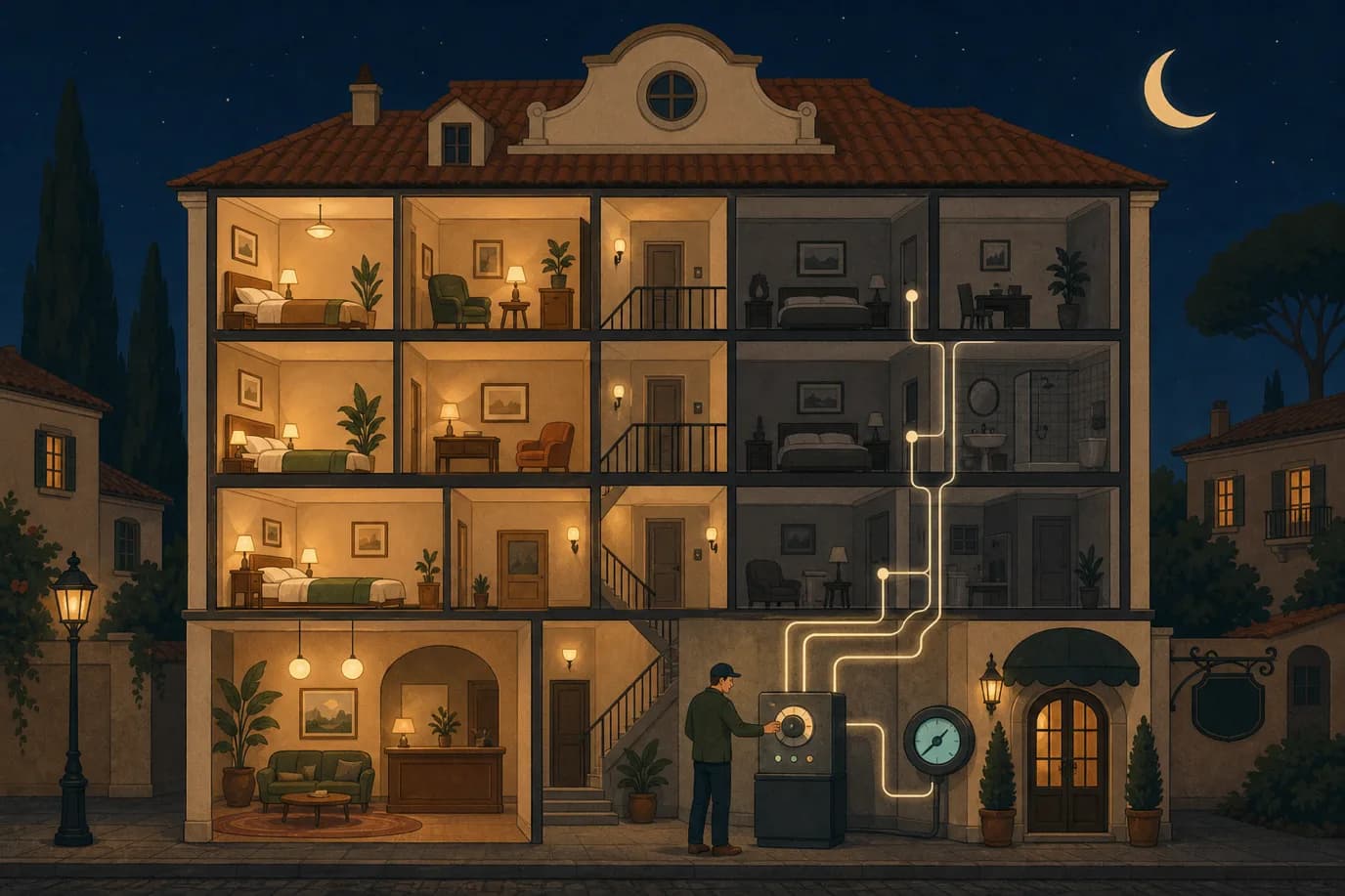
The honest answer is that we got tired of watching the same failure repeat. Prostay runs the operational heart of hundreds of properties: reservations, rates, housekeeping, invoicing, the channel connections. And again and again we saw the same pattern at the edge of that system, a website that was somebody else's job. Built by an agency that has since moved on, hosted somewhere nobody remembers the password to, running a content management system that needs security updates nobody applies, and above all disconnected: the PMS knows the current room types, the current photos and tonight's prices, and the website confidently displays none of them.
The disconnection is not cosmetic. It costs real money in three ways. First, stale content erodes trust: a guest who spots a discontinued room category or an off-season price learns to double-check everything on the OTA instead, where the information feels current. Second, slow generic websites rank poorly, so the property's own name searches drift to Booking.com, which is happy to rank for them and charge for the privilege. Third, every redesign is a five-figure project, so properties postpone them for years, compounding the first two problems.
A website builder inside the PMS dissolves all three at once. The content cannot go stale because it is not a copy, it is the same data. The pages are generated by the same engineering that keeps the booking engine fast. And a redesign is a template switch, not a procurement process. We did not build Instant Site because the world needs another website builder; there are plenty, and some are excellent. We built it because hotels do not need a website builder, they need their website to stop being a separate system.
What Is Prostay Instant Site?
Instant Site is a hotel website builder that lives inside your Prostay dashboard, next to the front desk calendar and the channel manager. When you open it for the first time it does not greet you with a blank canvas, because a blank canvas is a design job and you did not sign up for one. Instead it drafts a complete starter site from what it already knows about your property: name, description, room types with their photos and from-prices, location, contact details, currencies and policies. Your job is not to create a website from nothing; it is to review, adjust and publish one that is already substantially built.
The pieces you work with are deliberately hotel-shaped. Pages are assembled from blocks: a hero with an availability search, room listings that mirror your live inventory, photo galleries, testimonial sections, FAQ lists, a location block with the map and directions, a contact block that actually routes to the people who answer. You will not find seventeen abstract layout widgets and a shortcode manual, because a hotel website is not an abstract problem. It has a known anatomy, and the builder embraces it.
Around the editing experience sits the machinery you should never have to think about: hosting, HTTPS certificates, image optimisation, mobile rendering, caching, and the publishing pipeline that turns your edits into static pages served fast on every continent. There is no server to rent, no updates to install, no backup to remember. If the last decade of hotel technology taught us anything, it is that the products that win are the ones that remove jobs from the list rather than adding a new dashboard to check.
Six Templates, One Click Apart
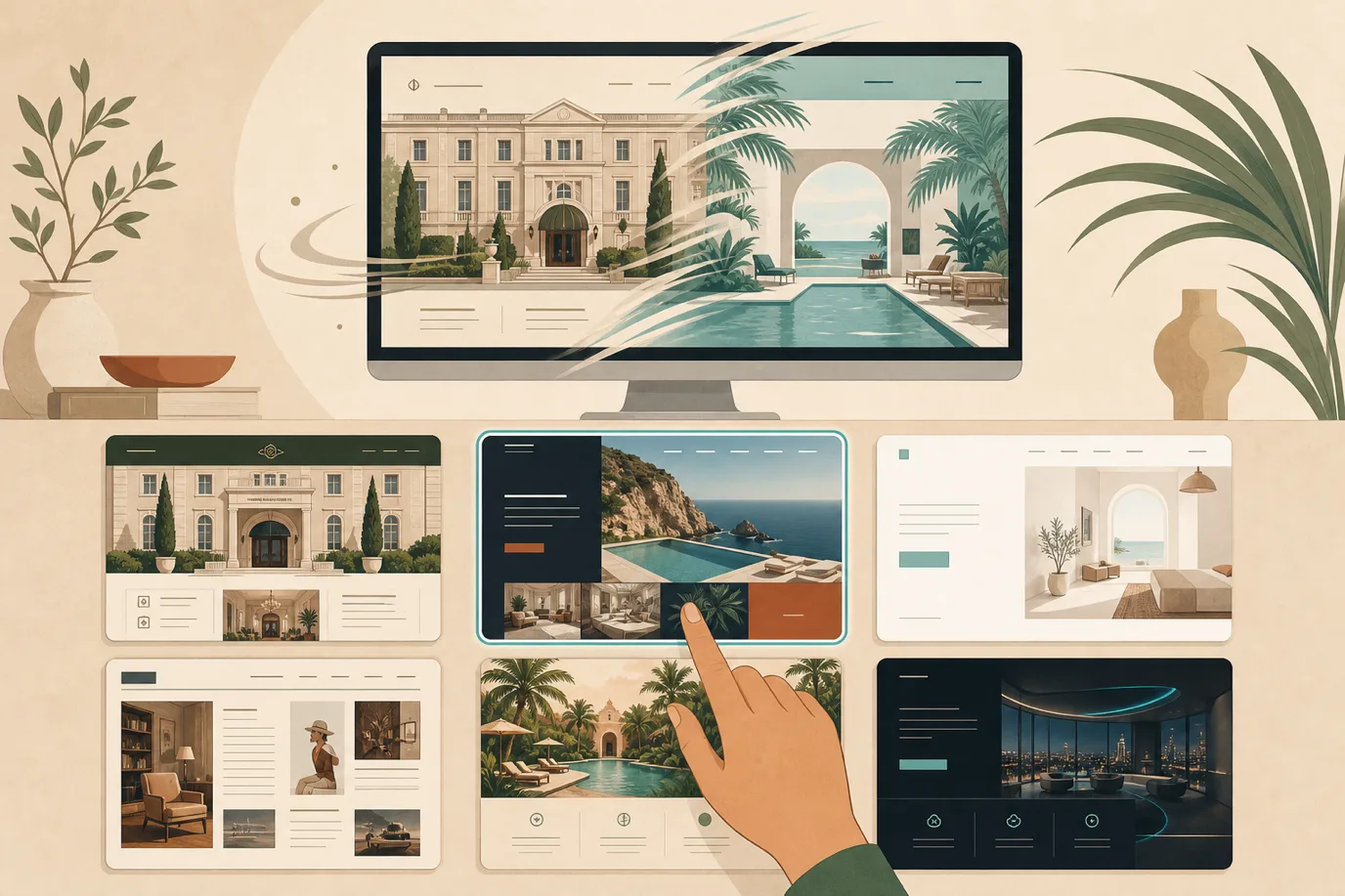
Instant Site launches with six designed templates: Classic, Modern, Editorial, Minimal, Resort and Futuristic. The names describe temperaments rather than industries, a stately serif welcome for the townhouse hotel, a bold photographic splash for the beach resort, a quiet typographic calm for the design-led bed and breakfast. Each one is a complete design system, headers, heroes, room cards, galleries, footers, buttons and forms, tuned to work together across every page and every screen size.
The important word is switching. Applying a different template restyles the entire site in one click, and nothing else changes: your text stays, your photos stay, your blocks stay in order, your rates keep flowing. The redesign that used to be a five-figure project with a six-month timeline becomes something you can try on a quiet Tuesday and revert before lunch if the team hates it. We think this changes the psychology of hotel websites more than any individual feature, because properties stop living with a look they have outgrown simply because changing it is a project.
The Block Builder: Pages Without Plugins
Underneath the templates sits the block builder, and it follows one rule: everything a hotel website needs should be a block you drag, not a plugin you install. The hero with availability search is a block. Rooms, live from the PMS, are a block. Gallery, FAQ, testimonials, map and contact, all blocks. You compose a page by stacking them, reorder by dragging, and edit text in place, the way you would expect a modern tool to behave in 2026.
What you will not do is fight the machinery that generic website platforms make hotels fight. There is no plugin marketplace where the booking widget, the gallery and the translation tool come from three vendors who have never met, each with its own subscription, update schedule and security surface. There is no theme that breaks when the platform updates. There is no shortcode syntax to memorise. The blocks are made by the same team that makes the PMS, tested against the same releases, and included in the same subscription. Boring, in the way infrastructure should be.
The starter draft matters here too. Because Instant Site begins from your real property data, the first version of every page is already populated: the rooms block shows your actual rooms, the gallery holds your actual photos, the FAQ block proposes the questions guests actually ask, drawn from sensible hotel defaults. Most properties will edit copy and swap a few images rather than build anything. The distance from opening the editor to a publishable site is measured in hours, and that is where the product got its name.
Live Rooms and Rates, Straight From the PMS
This is the feature that makes a PMS-native builder different in kind rather than degree. The rooms on your website are not copies of your rooms; they are your rooms. Names, descriptions, photos, occupancy limits and from-prices render straight from the property data in Prostay, the same records the front desk and the channel manager use. Retire a room category and it leaves the website. Update the photography and the site updates. Change your pricing and the from-prices follow, automatically, everywhere they appear.
If you have ever run a hotel website the traditional way, you know exactly which failure this kills. The website says the Garden Suite sleeps four; the PMS says it sleeps three since the sofa bed was removed. The website advertises rates from 89; the revenue manager moved the floor to 109 in March. Each mismatch is small, and each one teaches the guest the same lesson: do not trust the hotel's own website, check the OTA. A property whose website is generated from its operational truth never teaches that lesson, and that, more than any design flourish, is what makes direct bookings feel safe.
SEO From the First Publish
A hotel website has one job above all others: when someone searches for your property's name, or for a room in your town on your dates, it should be findable, fast and convincing. Most hotel websites fail at this before content even matters, for a purely technical reason: they render through heavy JavaScript that search engines index late, partially or reluctantly. Instant Site takes the opposite approach, the one search engines explicitly reward. Every publish emits static HTML, real pages with the content already in them, readable by any crawler without executing a byte of JavaScript.
Structured Data, Sitemaps and hreflang, Handled
On top of that foundation, every page ships with the technical SEO apparatus that agencies bill by the hour for: Hotel and HotelRoom structured data so search engines understand what the property and its rooms are, clean titles and meta descriptions, canonical URLs, an XML sitemap that updates itself on every publish, a robots file, and hreflang links wiring every language version to its siblings. Images are compressed and served in modern formats automatically, and the pages score the kind of speed numbers that used to require a specialist consultant.
We are deliberately not promising rankings; nobody honest can. What we promise is that the technical layer, the part that is deterministic, the part where most hotel websites quietly bleed, is simply correct by default, on every page, in every language, on every publish. Content and reputation remain your craft. The plumbing is ours.
Up to Eight Languages, One Switcher
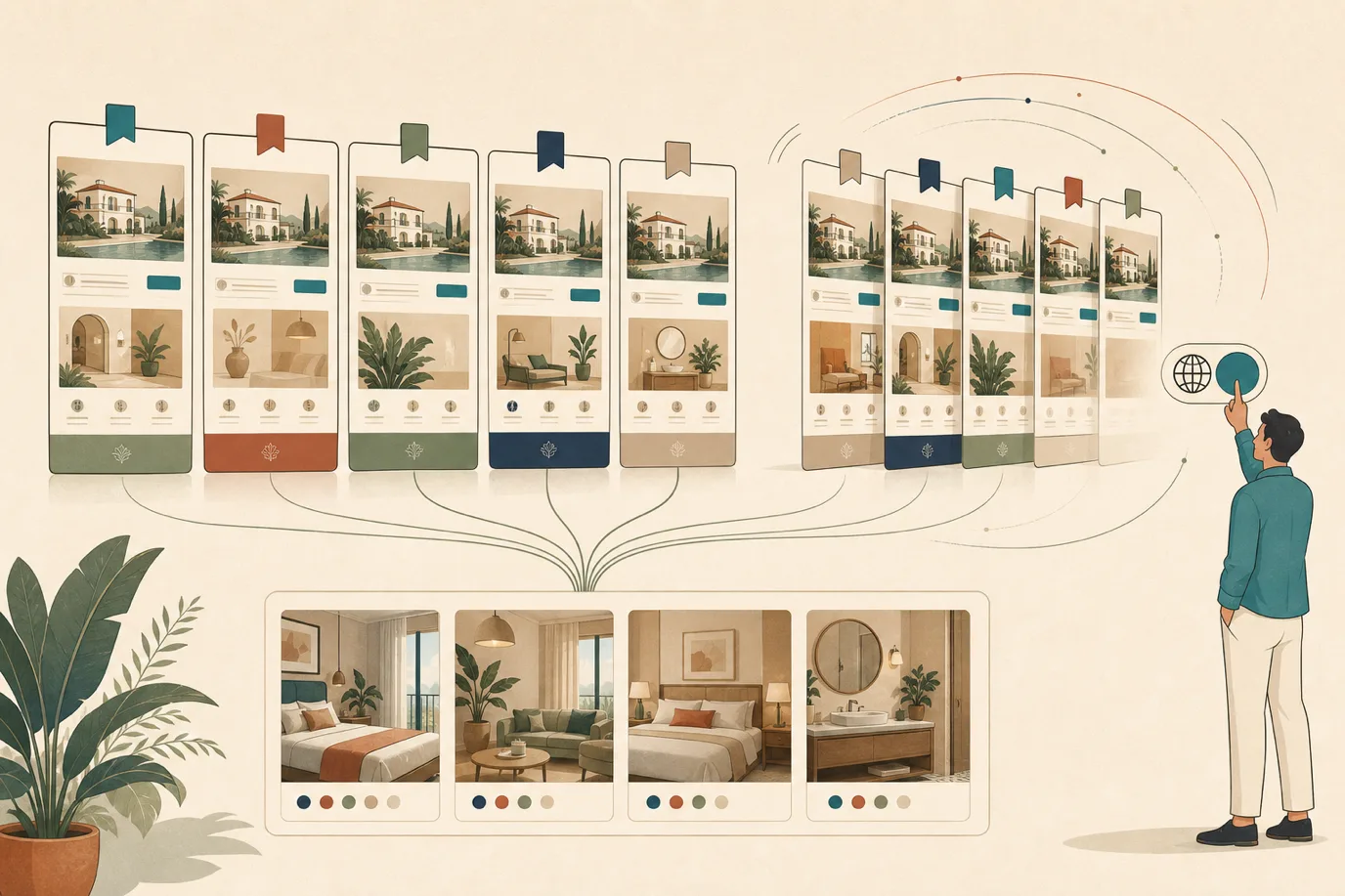
Hospitality is multilingual by definition, and hotel websites have historically handled that terribly: a translation plugin from yet another vendor, machine-translated pages that read like furniture assembly instructions, or the quiet surrender of an English-only site in a market where half the guests search in German. Instant Site treats languages as a first-class feature. You can publish your site in up to eight languages, translating any field while keeping the structure shared, so a change to the gallery or the room inventory flows to every language mirror instantly.
The built-in language switcher routes guests to their language, and the hreflang wiring underneath tells search engines which version belongs to which market, so your German pages compete in German search results rather than cannibalising the English ones. For properties in multilingual markets, this is routinely the difference between appearing in a guest's search and not existing in it. And because translation is a field-level edit rather than a parallel site to maintain, the language mirrors stay current instead of decaying the way translated sites always have.
Your Domain, Managed HTTPS
Every Instant Site begins on a free prostaysites.com address, live from the moment you first publish, which means you can build, preview and share the site internally before committing to anything. When you are ready, you connect your own domain. The editor walks through the DNS records step by step, verifies them for you, and provisions the HTTPS certificate automatically, renewing it forever after without your involvement. The green padlock, the redirects, the www and non-www question, all handled.
For properties migrating from an existing website, the sequencing matters and we designed for it: build the new site completely on the free address, review it with the team, translate it, test the booking flow, and only then point the domain. The switchover is a DNS change, not a rebuild, and the old site keeps serving until the moment the new one takes over. No downtime window, no weekend emergency, no agency on retainer for the cutover.
Connected to the Booking Engine, Built for Direct Revenue
A hotel website that cannot take a booking is a brochure, and brochures do not pay for themselves. Instant Site is wired into the Prostay Booking Engine from the first publish: the availability search in the hero, the booking buttons on every room card, and the checkout flow all run on your domain, in your branding, against your live inventory. A guest who books pays no OTA markup and you pay no commission, because the reservation travels from your website to your PMS without ever leaving your platform.
This is also where the economics of the launch get interesting for properties that already run Prostay. The booking engine you already pay for has been able to embed into any website for years; what Instant Site adds is the website itself, the SEO surface that catches the search, presents the property and feeds the funnel. The pair is designed as one machine: the site earns the visit, the engine converts it, the PMS operates it. Direct booking strategy has always been about owning that whole chain, and until today the first link was the one hotels had to buy elsewhere.
What It Costs
Instant Site is included with the Prostay All-in-One plan. Not a tier, not an add-on, not a per-visitor meter: included, the way the booking engine and the channel manager are included. There is no commission on bookings the site produces, because charging a commission on direct bookings would defeat the entire argument for having them. The free prostaysites.com address costs nothing. A custom domain costs whatever your registrar charges for the domain itself, typically the price of a modest lunch per year.
We price it this way because the alternative pricing models all misalign somewhere. Agencies charge for the rebuild, so sites decay between rebuilds. Website platforms charge per feature, so hotels run half-configured sites. Commission-based site builders tax the exact behaviour the site exists to encourage. Folding the website into the platform subscription aligns everyone: your website improves because the platform improves, and the only meter running is the one on your direct revenue.
Getting Started: From Empty Domain to Live Site
If your property runs on Prostay, Instant Site is already in your dashboard today. The path to live looks like this. Open the builder and let it draft your starter site from your property data, a few minutes of watching it assemble. Choose your template, the one-click decision you can revisit any time. Walk the pages: tighten the descriptions, swap any photos, confirm the FAQ answers, check the policies. Add your languages and translate the fields that matter most first, headlines and room descriptions before the fine print. Publish to your free address and send it to your team over coffee. Then connect your domain, let the certificate provision, and switch the DNS when everyone has signed off. Properties that started this morning have been live by the afternoon, which is precisely the promise on the label.
If you are not yet on Prostay and the website was the missing piece, this is a good week to request a demo, because the demo now ends with your actual property on an actual URL rather than a slide about one. And if you simply want to see the product in detail first, the Instant Site product page walks through templates, blocks, SEO and domains with the depth this announcement trades for breadth.
The hotel website has been broken as a category for as long as we have worked in this industry: too expensive to build, too disconnected to trust, too stale to convert, and too slow to rank. The fix was never another tool bolted onto the pile. It was making the website what it should have been all along, a live surface of the system that actually runs the hotel. That is what shipped today. We are looking forward to watching the OTA commission line on a few thousand P&Ls get smaller.