
Most hotels do not decide to move their phones to VoIP. They get told. A letter arrives from the line provider with a date on it, or the renewal quote for the ISDN circuits comes back at a number that makes the decision by itself. Either way the question stops being whether and becomes how, and how is where the money and the disruption live. What follows is a practical account of what moving a hotel's telephony onto the internet actually involves: what you replace, what you keep, how many lines you genuinely need, what it does to the connection your guests are already using, and how the link to your property management system survives the change.
The good news belongs at the top, because it is the thing most owners get wrong when they start pricing this. You are almost certainly not replacing the phones in the rooms. The handsets on two hundred nightstands, and the copper running behind the walls to reach them, can usually stay exactly where they are. What changes sits further back, at the point where lines enter the building. That distinction is also why this rarely stays a pure telecoms project, because the same copper often turns out to be carrying the lift phone, the fire panel and a card machine that has been quietly dialling out for a decade, long since superseded by taking payments through the PMS at properties that made the switch.
What VoIP Actually Changes in a Hotel
The old telephone network reserved a circuit for your call. From the moment you dialled until the moment you hung up, a path existed end to end and belonged to you, whether anybody was speaking or not. That is why lines were sold in fixed blocks, why an ISDN30 gave you exactly thirty of them, and why adding a line took weeks and a visit.
VoIP chops the audio into packets and sends them across the same connection that carries everything else. Nothing is reserved. The unit you buy stops being a wire and becomes a channel, which is a number in a provider's configuration rather than an object in your riser cupboard. That single change is where most of the practical difference comes from. Channels can be added on a Tuesday afternoon, in ones rather than thirties, and removed again when the conference season ends.
Notice what does not change. The guest lifts a handset, hears a dial tone and presses 9 for an outside line, or whatever your numbering plan uses. Reception still sees a call arrive and still transfers it to a room. Housekeeping still dials a status code. A migration done properly produces no observable difference to anybody who is not looking at the equipment, and that is the correct measure of success. Nobody has ever written a review praising a hotel's call setup latency.
One clarification worth making early, because the two get conflated constantly and it causes people to buy things they did not intend to. The word VoIP covers two separate decisions. The first is how calls reach your building, which is what this article is about. The second is where the switch that routes them lives, whether that is a box in your basement or a platform in somebody else's data centre. Those are genuinely independent choices. You can move to VoIP trunks and keep your existing on-premise switch, and plenty of hotels should. The ownership question deserves its own treatment and gets it separately.
Why the Question Now Has a Date on It
Copper telephone networks are being retired, country by country, and the reason is unglamorous. The exchanges are decades old, the people who know how to maintain them are retiring faster than they are being replaced, and running a parallel voice network alongside the data network that has already won costs money that carriers would rather not spend. This is a schedule, not a crisis. But it is a schedule with real dates, and knowing yours is the first useful thing you can do.
In the United Kingdom the public switched telephone network and ISDN are being switched off on 31 January 2027. That date has already moved once, from December 2025, after concerns about telecare alarms used by vulnerable people, and Openreach has been unusually direct about there being no further extension. Two details matter more to a hotel than the date itself. Since 5 September 2023 there has been a national stop sell, meaning you cannot buy a new copper line or, in many cases, modify an existing one, so the option of doing nothing quietly expired some time ago. And Openreach is now passing higher costs for legacy products through to providers, which arrives on your bill as a premium for a service with a shutdown date on it.
Elsewhere the picture varies more than most vendors admit. The Netherlands finished first among the larger European markets, with KPN ending standard ISDN and PSTN services on 1 September 2019. Belgium and Norway began disconnecting copper at the end of 2022. Spain completed its copper closure on 27 May 2025. France is running a staged programme that extends to 2030, and usefully for anyone with a French property, the incumbent operator Orange publishes closure calendars at commune level under the framework the regulator maintains, so your specific building has a specific date you can look up rather than a national rumour. Ireland has a published migration framework with the timing driven by programme rather than a single national deadline. In the United States there is no single date at all, because copper retirement proceeds carrier by carrier and region by region.
The practical instruction is the same everywhere. Ask your line provider two questions in writing: what is the switch-off date for the exchange serving this building, and which of the services on my account are affected. The second question is the one that produces surprises, and there is an entire section below about why.
What You Are Actually Replacing
Hotel telephony has three layers, and almost every confused quote you will receive comes from a vendor pricing a different number of them than you had in mind.
The trunk is how calls get in and out of the building. This is the layer the copper switch-off is actually about. Replacing it means swapping physical lines for SIP channels delivered over your internet connection.
The switch is the system that routes calls once they are inside: the PBX. It knows that extension 214 is a guest room, that the room is occupied, and that the kitchen may not dial internationally. Hotel PBX systems and how the brands compare is a subject in itself and is covered separately.
The endpoints are the handsets, in rooms and at the desk and in the plant room, and the cabling that reaches them.
The three are more independent than they sound. If your existing switch can speak SIP, or if a gateway can be placed in front of one that cannot, you can change the trunk alone and leave the other two layers untouched. That is the cheapest version of this project by a wide margin, and for a property whose phone system is otherwise working it is very often the right one.
The opposite version, in which the trunk, the switch and every handset are replaced together, is a capital project that happens to include a trunk change. Both are legitimate. They are not the same purchase, and the gap between them is the single biggest reason two quotes for what sounds like the same job can differ by a factor of five.
So make every proposal state, in writing and on the first page, which of the three layers it touches. If a vendor will not answer that plainly, you have learned something useful about how the rest of the project will go.
The Handsets Almost Certainly Stay
The most expensive misconception in this whole subject is that VoIP requires an IP phone in every room. It does not, and believing it does can add more to a project than everything else combined.
Think about what a full endpoint replacement actually means in a hotel. Two hundred hospitality handsets, which are not cheap because the hospitality market is small and specialised. Then an ethernet drop to every nightstand, which in a building with plastered walls and no existing data cabling to the bedside means either chasing walls in occupied rooms or accepting trunking that will look wrong in every photograph you take for the next fifteen years. Then network switches with enough powered ports to feed them all. Then the disruption of doing this room by room while the hotel keeps trading.
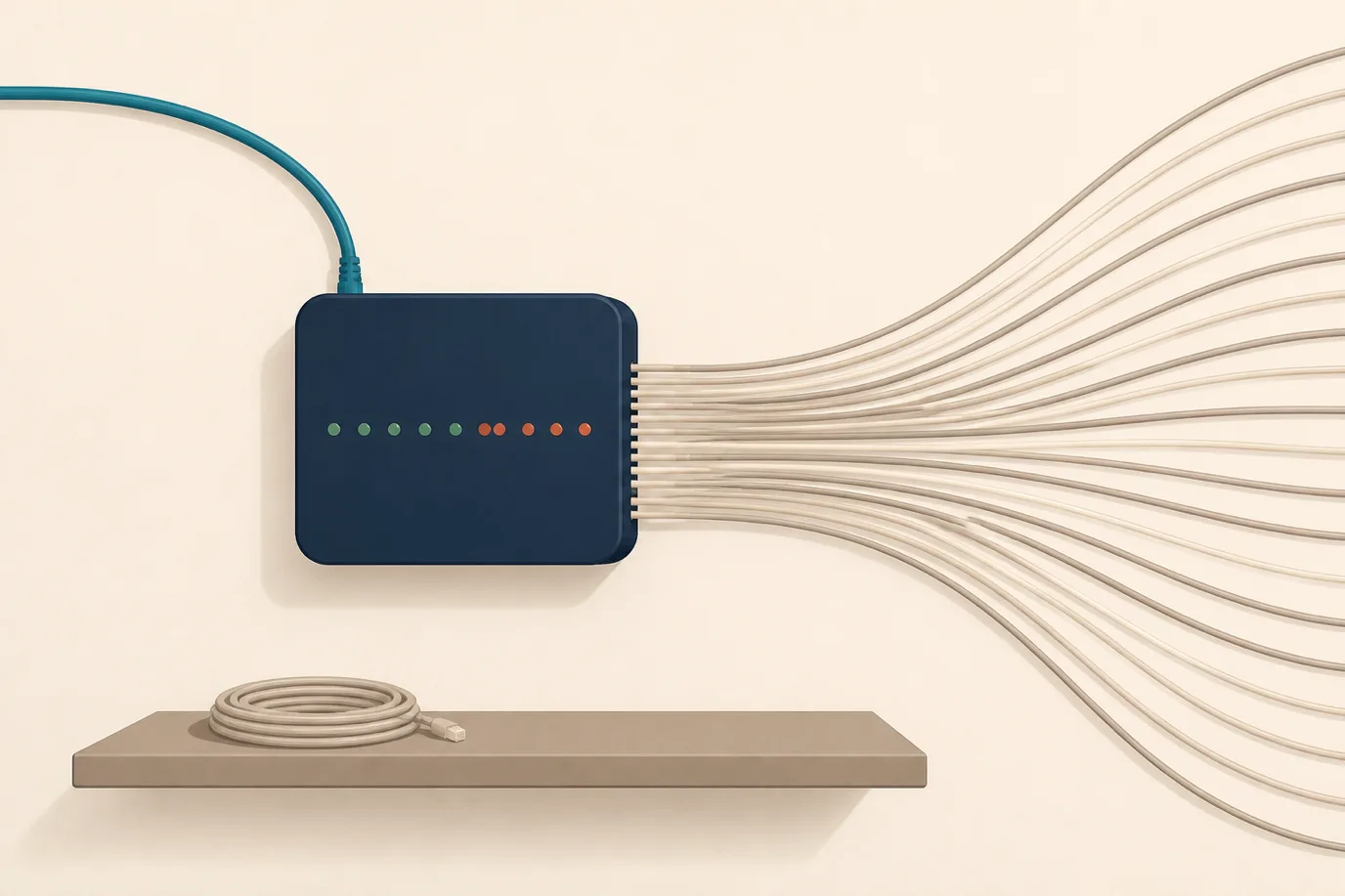
Now think about what a gateway does instead. The analogue handsets stay on the nightstands. The copper stays in the walls. A box in the riser cupboard, where that copper already terminates, presents each of those lines with a perfectly normal dial tone on one side and speaks SIP to the switch on the other. Nobody chases a wall. Nobody enters a guest room.
What a Gateway Does, in Plain Terms
Two abbreviations are worth learning because they appear on every quote and choosing the wrong one is a common and irritating error.
An FXS port provides a line to a telephone. It supplies dial tone, it supplies ringing current, and it is what you connect a handset to. Room phones need FXS ports, one each.
An FXO port is the reverse. It connects to a line coming from somewhere else, presenting itself as a telephone would. You need these only if you are keeping some copper lines and want the new system to use them, which occasionally makes sense as a fallback path.
Gateways come in densities of roughly 8, 16, 24, 32 and 48 ports, and the per-port cost sits well below the price of a single new hospitality handset, which is the arithmetic that decides most of these projects. Larger chassis units exist for properties counting endpoints in the hundreds.
Two things to test rather than assume. Message waiting indication, the lamp on the handset that tells a guest there is a voicemail, is signalled to an analogue phone in more than one way, and gateways vary in which methods they support. Confirm the lamps actually light before the installer leaves, because this is a genuinely common snag and it is invisible from a screen. And be clear that a basic analogue handset cannot display a caller's name, so if guest name display at the operator position matters to you, that lives at the switch and the operator's own phone rather than in the rooms.
None of this means you should never replace handsets. Replace them because a refurbishment has the rooms empty anyway, because the existing ones are visibly tired, or because you want USB charging on the nightstand. Those are guest experience decisions with their own justification. Just do not let them arrive disguised as a technical requirement of the trunk change, because they are not one.
SIP Channels, and How Many You Need
A SIP trunk is a relationship with a provider rather than a thing in your building. You register with them, they route your numbers to you, and the audio flows over your existing internet connection. What you actually buy is capacity, sold as channels, sessions, call paths or concurrent calls depending on whose price list you are reading. All four words mean the same thing: one call in progress.
This is a real change from what it replaces. An ISDN30 gave you thirty channels in one indivisible block, so a hotel needing thirty-two bought sixty. SIP channels are bought individually, and many providers will let you burst above your committed number and bill the overflow, which suits a business with a conference season and a quiet February.
Sizing them properly is a genuine question, and the two common ways of answering it are both wrong. Counting rooms produces an absurd number. And the office rule of thumb, one channel for every three or four staff, does not transfer, because a hotel's call pattern looks nothing like an office. Guest room extensions are idle almost all of the time. Your traffic concentrates at the switchboard, at reservations, and at whatever direct numbers you publish.
The Answer Is Already in Your Call Records
Here is the part that saves both money and argument. Your existing phone system has been writing a record of every call for as long as it has been switched on. Somewhere in that data is the exact number you are trying to estimate: the highest number of calls in progress at the same moment, during the busiest hour of your busiest week.
Whoever maintains your PBX can produce that figure, usually in an afternoon. Ask for the peak concurrency across at least a full year so it includes your seasonal maximum and any single-day spikes, a large wedding or a conference or the morning after a flight cancellation. Then round up, because traffic estimates are estimates and the cost of one spare channel is trivial next to the cost of a caller hearing an engaged tone during your busiest hour. Formally the sizing exercise is an Erlang B calculation at one percent blocking, and if you enjoy that sort of thing the maths is straightforward, but for a single hotel the measured peak plus a sensible margin gets you to the same place.
Two things to confirm with the provider once you have your number. First, that internal calls between extensions do not consume channels, which they should not, since those never leave the building, although the answer changes if your switch is hosted elsewhere. Second, what happens when you exceed your channel count: a burst charge, a busy tone, or an overflow to another route. Find out before a Saturday in July finds out for you.
What It Does to Your Internet Connection
Voice is small. This surprises people who have been told the phones will be competing with the guest network, because it sets up the wrong worry. The problem in a hotel is almost never how much bandwidth voice needs.
Codecs, and When the Choice Matters
A codec is the method used to turn audio into packets, and the choice affects both quality and how much of your connection each call occupies. The figures below include the IP, UDP and RTP headers, which is the honest way to quote them since those headers are a large proportion of a small packet.
G.711 uses 64 kbps of audio and about 87 kbps on the wire. It applies no compression, sounds as good as a traditional phone line ever did, and is the default on most SIP trunks. There are two variants, a-law used in most of the world and mu-law in North America.
G.729 compresses hard, using 8 kbps of audio and roughly 31 kbps once headers are counted, so a little over a third of G.711. It is audibly worse, particularly on music and on voices it was not tuned for, and on some platforms it carries a licence cost.
G.722 is wideband, which means it carries more of the frequency range than a telephone traditionally did, and it costs the same 87 kbps as G.711. It sounds noticeably better, but only when both ends support it, which in practice means internal calls between IP handsets rather than calls to the outside world.
Opus is the modern one, variable in rate and typically around 40 kbps in voice mode, with excellent quality for what it uses. It needs support at both ends too.
When does the choice matter? On a constrained link or a backup connection, compression buys you calls you would otherwise not have. On a normal hotel fibre it is irrelevant, and you should decline G.729 if it is offered as a way of conserving bandwidth you already have in abundance. There is one trap to watch for: if your trunk speaks one codec and your handsets speak another, something in the middle has to convert, and that transcoding consumes capacity on the switch. Getting both ends to agree on G.711 avoids an entire category of problem for the price of bandwidth nobody will miss.
Now the arithmetic that makes the point. Twenty simultaneous calls on G.711 come to roughly 1.7 Mbps in each direction. Add twenty percent for signalling and bursts and call it 2.1 Mbps. On a connection sized for a few hundred guests streaming video, that is a rounding error.
Sharing a Pipe With Three Hundred Guests
The real problem is contention, and it behaves differently from a capacity shortage.
Guest internet traffic is bursty and greedy. A dozen people starting downloads at once will fill whatever headroom exists, and everything sharing the link waits its turn. Most applications cope with waiting. Video buffers ahead and the viewer never knows. A file transfer simply takes longer. Voice cannot wait, because a packet of audio that arrives late is worthless, and a conversation is happening in real time whether the network is ready or not.
So voice needs separating rather than feeding. Two mechanisms do it, and most properties use the first.
Put voice on its own VLAN, which keeps it logically apart from guest traffic on the same physical cabling, then mark it and give it priority at the queue on your uplink. Quality of service is the general name for this, and it works, with one important limitation people rarely explain: your marking is honoured only on networks you control. Once packets reach the public internet nobody is obliged to care what you labelled them. That sounds like a fatal objection and is not, because the congestion that ruins hotel calls is almost always on your own uplink, right at the point where three hundred guests meet one circuit. That is exactly where your priority queue lives.
The second mechanism is a separate circuit for voice, which removes the argument entirely and costs a second monthly line rental for ever. It is the right answer for large properties, for anywhere the guest network is already struggling, and for anybody who would rather buy certainty than manage a queue.
One more item, and it causes more one-way audio than anything else in this article. Many routers ship with something called SIP ALG enabled, a feature that inspects and rewrites SIP messages as they pass through, on the theory that it is being helpful. It is usually not. Ask for it to be turned off, and if a provider's support desk asks you to check one thing before a diagnosis, this will be it.
What Good Sounds Like, in Numbers
Call quality arguments go nowhere because both sides are describing an impression. The useful move is to agree on four measurements before the work starts, so that afterwards there is something to point at.
One-way latency should be under 80 milliseconds and is acceptable up to about 150. Beyond that the natural gap in a conversation stretches until people start talking over each other, then apologising, then talking over each other again. Nobody says the line is delayed. They say the call was awkward.
Jitter is the variation in packet arrival, and it should be under 20 milliseconds, with under 30 tolerable. Above that, audio turns choppy or robotic. A jitter buffer smooths it out by holding packets briefly before playing them, typically 20 to 40 milliseconds at minimum and up to 80 or 160 on a bad link, but every millisecond of buffer is a millisecond of added delay. You are trading one measurement against the other, which is why fixing the network beats tuning the buffer.
Packet loss should be under 0.1 percent and is survivable up to about 1 percent. Voice tolerates a little loss because the codec conceals it. What it cannot conceal is a burst, which is why a link averaging half a percent can still sound terrible if that loss arrives in clumps.
Mean opinion score collapses all of it into one figure between 1 and 5. On G.711, 4.2 or better is good and 3.6 is roughly the floor of what people accept without complaining.
Write those into the acceptance test, or into the contract if the supplier will wear it. Then ask the provider what they measure per call and whether you can see it, because the ones with a decent platform will show you statistics for an individual call and the ones without will explain why that is not necessary.
Everything Else in the Building on a Copper Line
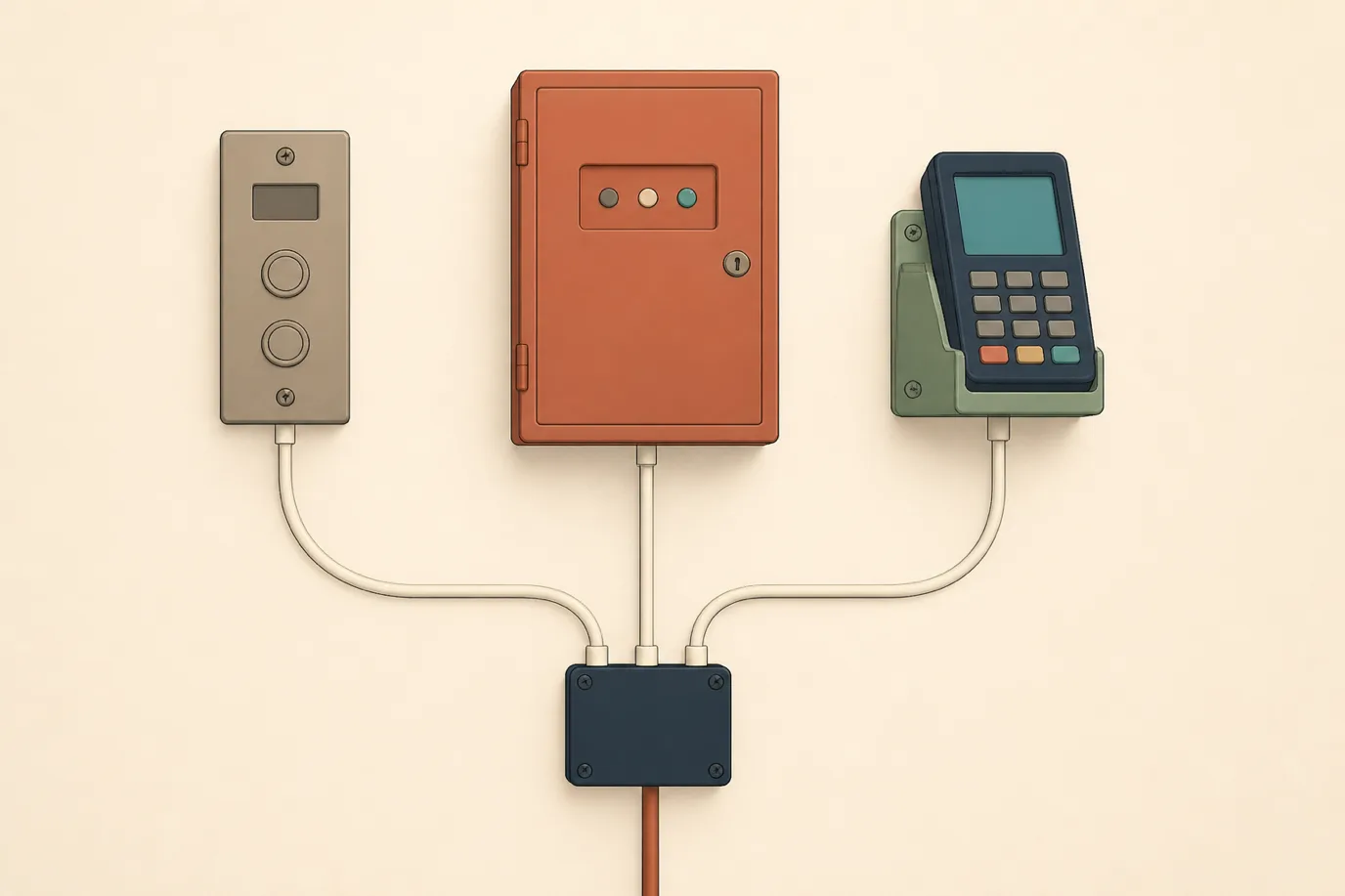
This is the section that catches hotels out, and the reason to read it early rather than on the week of the cutover. Openreach names lifts, alarms and payment terminals in its own guidance for a reason: those are the services that stop, and the people responsible for them are not in the room when the phone system is discussed.
Walk your line inventory against this list.
Lift emergency phones. Put this first and treat it as the item most likely to hurt. A working emergency phone is normally a condition of the lift's certification, so when the line dies the lift can come out of service, and a hotel with a lift out of service on a Friday has a much larger problem than a telephony fault. The lift phone is usually on a separate contract with the lift company, who do not know your telecoms project exists. Contact them yourself, early, and get the replacement path in writing.
Fire alarm panel diallers that call the monitoring centre. Same shape of problem, different contractor, and the same requirement to involve them rather than assume the phone vendor will.
Intruder alarm diallers and any monitored plant equipment that reports by phone.
Door entry at the staff entrance, the delivery bay or the back gate, which in many buildings rings an internal extension over a line nobody has documented.
Card payment terminals of the older sort that dial out to authorise. Properties that have moved card payments onto the network through the PMS have already removed this dependency without thinking of it as a telephony decision, which is the usual way it gets solved.
Emergency and help phones in plant rooms, roof access points, cold stores and basements, which exist precisely because there is no mobile signal in those places.
The fax machine, if a corporate account or a local requirement still insists on one. Fax over IP is possible using T.38 but it is fussy, and the honest first question is whether anybody still sends you one.
Out-of-hours diversions, and in older installations an occasional dial-up backup path for a system nobody has looked at in years.
The difficulty here is organisational rather than technical. Every item on that list has a different owner, a different contract and a different notice period, and no single vendor is accountable for the whole set. So the survey must trace every pair in the cabinet to something identifiable. If nobody can say what a line does, do not conclude it does nothing. Assume it does something, and find out what before the date rather than after.
What the Old Line Did for Free
An analogue telephone line carries its own power, delivered from the exchange down the same pair as the audio. That is why a plain corded phone keeps working when the building is dark, and it is a property nobody ever had to think about because it never needed managing.
Nothing in an IP system has that. The handset, the gateway, the network switch feeding it, the router and the connection into the building all need mains power. A power cut that used to leave the phones working now silences them completely.
The answer is battery backup, and the part people get wrong is scope. It is not enough to put the switch on a UPS. The chain has to hold end to end, which means the gateway in the riser, the powered network switch feeding it, the core switch, the router and the modem, all of them, at every point along the path a call has to travel. A handset on a protected circuit is still dead if a network switch three floors down is not. Work out how long you want that chain to survive, size the batteries for it, and then test it by actually pulling the power rather than by reading the specification.
Raise the lift phone here specifically, because it is the one where the answer to what happens during a power cut has to be more convincing than a shrug.
Your Main Number Is an Asset
Your main switchboard number is printed on things you cannot recall. It is on every OTA listing, on your Google Business Profile, on signage and old brochures, in confirmation emails going back years, in aggregator databases you have never logged into, and on inbound links from sites that will never update them. Losing it is not a telecoms inconvenience. It is a quiet reduction in direct bookings that you will never see in a report because the calls simply stop.
Numbers are portable, and porting is a routine, well-worn process. It is also slow, bureaucratic, and the single item most likely to move your cutover date. So start it at the beginning of the project rather than the week before.
The delays are almost always administrative. The name and address on your telephone account must match what the register holds, and at a hotel that has changed ownership, changed trading name or been rebranded, that match frequently fails on a detail nobody thinks to check. An outstanding balance will stop a port. So will a number sitting inside a contract with notice still to run. And numbers often live in blocks that must move together, which matters if you publish direct dial numbers for meeting rooms, the spa or the reservations team.
Keep the old lines running in parallel until the port is confirmed complete, if the timing allows it. And when the port lands, update the places you control: your own site, the OTA extranets, your Google Business Profile, the confirmation and pre-arrival email templates, and the printed material you are about to reorder. This sounds too obvious to write down, which is exactly why it gets missed.
The PMS Link Does Not Move Itself
The link between the phone system and the property management system is what makes hotel telephony a specialism, and it deserves attention during a trunk migration even though the trunk is not where it lives. How a hotel PBX system connects to the PMS is covered in full separately, including the protocols involved and the heartbeat that keeps the link honest.
Two rules cover most situations.
If only the trunk is changing and the switch stays where it is, the PMS link is untouched. Check it after the cutover as a matter of routine, but nothing about a new trunk should disturb it. This is another reason the minimal version of this project is attractive.
If the switch is being replaced or relocated, the interface is a separate work item with a separate licence, quite possibly at both ends, and it is the single item most likely to be missing on the day it is needed. Get it named in the proposal, in writing, with a stated owner.
If your PMS is Prostay, this part is straightforward. Prostay integrates with the hotel PBX platforms in common use, and where a property runs something less usual, custom integrations are built around what the building actually has rather than around a fixed connector list. Scope that work with both vendors at once rather than after the new system is live.
Whatever the arrangement, the acceptance test is the same short list. Check a guest in and confirm the extension unbars. Confirm the guest's name reaches the operator position. Check the guest out and confirm the extension bars again and the previous occupant's voicemail is cleared. Dial a room status code from a handset and watch it land in the PMS. Make one chargeable call and follow it all the way to a folio. Anything that fails goes on a list with a name against it, before the next floor starts.
What the Migration Actually Looks Like
The failures in these projects are predictable, which is a polite way of saying they are avoidable. Almost all of them come from doing things in the wrong order.
Start with a survey that is about lines rather than cabling. What matters is not only which pairs run where, but what each one is actually for, which is the inventory the earlier section describes. Budget a day for it, walk it with somebody who has worked in the building for years, and open every cabinet.
Then get your date in writing, and prove the network before you touch a single phone. Running a monitored test call path for a week, with the numbers from the quality section recorded across a busy Friday and a full Saturday, tells you more about whether this will work than any amount of specification reading. If the link is not good enough, that is a much better week to discover it.
The Order to Do It In
A sequence that works, and the reasons it is in this order.
Inventory every line and what it does. Get the switch-off date for your exchange in writing. Decide which of the three layers you are touching and hold vendors to it. Start the number port immediately, because it takes the longest and gates everything else. Fix the network next: the VLAN, the priority queue, SIP ALG off, and the battery backup sized for the whole chain. Install gateways alongside the existing system without removing anything, so that both paths exist at once.
Then cut over in increasing order of consequence. Back office extensions first, because a finance office losing dial tone for twenty minutes is an inconvenience rather than an incident. One floor of guest rooms next, with somebody physically walking the corridor and lifting every handset, because a phone that looks configured and does not work looks identical from a screen. Then the remaining floors. Then, on separate days and each with its own contractor present, the lift phone, the fire panel and the alarms.
Leave the old trunk live and reversible until the new one has survived a full week including a weekend and a night audit. And do not schedule the lift phone and the guest rooms for the same night. Different vendors, different sign-offs, and if both go wrong at once you will not know which failure you are looking at.

Where the Money Goes, and Where It Comes Back
The savings are real, and they are smaller and differently shaped than the brochures suggest.
The recurring saving is almost entirely in line rental rather than call charges. An ISDN30 carries a substantial monthly rental for thirty channels whether you use them or not, and the equivalent number of SIP channels typically costs a fraction of it. You also stop paying the premium that carriers are now adding to legacy copper products, which is a cost that will keep rising as the switch-off approaches. Call rates are lower too, but since guests barely make chargeable calls and your own outbound volume is modest, the absolute saving there is small and should not be doing much work in a business case.
Against that, the costs. Gateways priced per port. A new switch, if you are replacing that layer. Network work, which may include new powered switches and cabling if the existing infrastructure is old. Battery backup across the whole chain. Professional services for configuration, the numbering plan and the cutover. Occasionally a porting fee. And the survey, which is the cheapest line on the list and the one that determines the accuracy of every other line.
One cost gets underestimated more than any other. If your internet connection is not good enough to carry voice alongside guests, a second circuit is a recurring charge that can consume the entire line rental saving. Price it honestly at the start rather than discovering it after the first bad week.
The pattern that emerges is worth stating plainly. A trunk-only migration onto an existing switch usually pays for itself quickly, because the saving is recurring and the cost is mostly one-off. A full platform replacement is a capital project that must be justified by what the new platform does, not by the trunk saving. Vendors sometimes use the first to justify the second. Notice when that is happening.
When Calls Sound Bad
Faults arrive at the front desk as descriptions, not diagnoses, so it helps to know which symptom points where.
One-way audio, where you can hear them and they cannot hear you, is almost always network address translation or a firewall. SIP ALG is the first thing to check, every time. After that, confirm the media ports the provider uses are actually open.
Choppy or robotic audio is jitter. Look at what the uplink was doing at that minute, and check whether voice is genuinely being prioritised or whether somebody configured the VLAN and stopped there.
Gaps and clipped words are packet loss, and remember it is the bursts rather than the average that do the damage.
Echo almost always appears at an analogue-to-IP boundary, which means a gateway port or the electrical characteristics of an old pair. It shows up most in exactly the properties that kept their handsets, and it is usually fixable by adjusting the gateway rather than by replacing anything.
Delay and people talking over each other is latency, and it is more often in the provider's routing than in your building.
Calls that drop at a precise interval, always at 30 seconds or always at 15 minutes, are a signalling problem rather than a quality one. The exactness of the interval is the clue: session timers or a NAT keepalive expiring. Nothing that depended on bandwidth would be that punctual.
Inbound calls failing only overnight usually means the trunk registration is dropping during quiet periods, which is the same keepalive problem wearing a different hat.
The habit that resolves all of these faster than any tool is unglamorous. Write down the time and the extension, every time. Most call quality disputes are unresolvable because the complaint arrives as a general impression two days later, and by then there is nothing to look at. A timestamp turns an argument into a graph. Ask your provider whether they publish per-call statistics, because the good ones do and it shortens every conversation you will have with them.
Questions to Ask Before You Sign
Take these into the meeting and make somebody answer them out loud.
Which of the three layers does this quote cover, and what is explicitly excluded? What is the switch-off date for the exchange serving this building, and which services on my account are affected? How many channels am I buying, what happens when I exceed them, and do internal calls consume any?
Which of my existing handsets survive, how many gateway ports does that require, and have you confirmed message waiting works on my specific handset model? Have you surveyed my cabling and my line inventory, or estimated them? Which non-telephony services did that survey find, and who is contacting the lift company and the alarm contractor?
What network changes does this assume, and are they in this price or someone else's? Is voice going on the guest circuit or its own, and if the guest circuit, what have you measured? What battery backup is included, and for how long, across which equipment?
Who runs the number port, when does it start, and what would delay it? What is the rollback if the first floor goes badly? What per-call quality statistics can I see, and through what? And who supports this afterwards, with what response time written into a contract rather than a brochure?
Anyone who answers all of that without hedging is worth shortlisting. As with any tender, the hedging itself is the information.
Getting Off the Copper Without Drama
Reduced to its essentials this is a smaller project than it first appears, and the reason it goes wrong is rarely the technology.
You are changing how calls reach the building. You are probably keeping the handsets and the cabling, which removes most of the cost people fear. You need fewer channels than you think, and the number is already sitting in records your own system has been writing for years. The network needs voice separated and prioritised rather than fed more bandwidth. Your number needs porting early. And somewhere in the building there is a lift phone, a fire panel and possibly a card terminal on lines that nobody has thought about in a decade, each belonging to a contractor who does not know any of this is happening.
That last one is the difference between a quiet migration and a memorable one. The technical work is well understood and the vendors do it every week. What is not routine is the part only you can do, which is knowing what is actually connected to your building and who is responsible for each of it. Do that first, and the rest is a scheduled piece of maintenance that guests never notice, which is the whole objective.