Every month, a few hundred hoteliers somewhere in Europe quietly open a spreadsheet and start a column called "Mews alternatives". Some of them are 18 months into a two-year contract and beginning to think about renewal. Some bought Mews two years ago for a single property and are now opening a second. Some never quite settled in, and the front-desk team still complains.
This guide is for those hoteliers. It is not a hit piece on Mews. Mews is a serious product with 12,500 live properties and a real engineering team behind it. The honest question is not "is Mews good?" but "is Mews the right shape for the hotel you actually run, today, in 2026?". The two are not the same question, and the answer for a 45-room boutique in Lisbon is not the answer for a 220-room urban property in Berlin or a five-hotel group in northern Italy.
What follows is the conversation we have with hoteliers every week. When does it make sense to switch. What you should actually expect from a migration. Which two alternatives actually deserve your shortlist (and why everything else is noise). And the dozen questions you should put to every vendor before signing anything.
Who This Guide Is For (and Who It Is Not)
This guide is written for the person who actually runs a hotel. The general manager, the owner-operator, the area manager for a small group. Someone with a shift starting in two hours, who has 20 minutes to think about software, and who does not need a venture-capital-flavored explainer on "the future of hospitality tech".
It is also written assuming you are a Mews customer, an ex-Mews customer, or actively evaluating Mews against a shortlist. If you have never heard of Mews, the guide will still work. If you are 18 months into a two-year contract with renewal anxiety, you are exactly the reader we had in mind.
It is not a guide for very small properties (under 15 rooms) where a spreadsheet plus a calendar app is genuinely sufficient. It is also not a guide for branded chain properties, where the brand mandates the PMS and the decision sits with the brand head office rather than the property.
Why Hoteliers Look Past Mews in the First Place
Most of the hoteliers who reach the "alternatives" stage are not unhappy with the product itself. They are unhappy with one of four specific things, each of which is worth naming so you can decide whether the same thing applies to you.
The Two-Year Contract
Mews sells on a standard two-year contract. This is normal for the segment, and it buys you predictable pricing for the duration. It also means that if six months in you decide the product is not the right fit, you typically pay for the remaining 18 months unless you negotiated an out clause at signing.
The two-year contract is the single most common complaint we hear in vendor diligence calls. Not because two years is unreasonable for a category like this, but because it removes the natural exit pressure that keeps any vendor sharp. The honest counterweight: a one-year contract usually costs 15 to 25 percent more on the monthly fee, and many hotels still pick the cheaper two-year version and then wish they had not.
Payment Processing Lock-In
Mews Payments is a strong product, and for many hotels the integrated processing is a feature, not a bug. The problem appears when the hotel already has a long-standing relationship with a local acquirer (lower fees, deeper customer support, a banker on speed dial) and the path to keeping that processor is not as smooth as the marketing implies.
The pattern we see: hotel signs with Mews, plans to keep its existing payment processor, runs into more friction than expected, and within 12 months has migrated payments to Mews Payments mostly because the integrated path is the one that "just works". That is a legitimate trade-off, just one you should make consciously rather than by drift.
Operating-Model Mismatch
Mews is built around a particular operating model: cloud-first, automation-heavy, contactless when the guest wants it, mobile when the staff want it. That model fits city hotels, design-led boutiques and the kind of property where the night auditor is comfortable troubleshooting an API webhook before breakfast.
It fits less well for properties where the operating culture is built around a slower, more analog rhythm. Resorts where guests stay seven nights and the front desk knows everyone by name. Family-run hotels where the owner is also the night auditor and the housekeeping schedule is on a corkboard. Hostels with a single shared dorm category and a thousand bed-night moves per month. None of those are wrong. They just shape the right software differently.
Cost Creep From the Marketplace
The 800+ marketplace integrations are a Mews strength, and on paper the "no connection fees" promise is real. The cost creep comes from the apps themselves. A typical mid-market Mews property ends up subscribing to between 6 and 12 third-party apps to cover guest messaging, upsell automation, review management, business intelligence, accounting export, and so on. Each one is a separate vendor contract, a separate monthly fee, and a separate login.
By month 12, the per-room software bill is often two to three times what was modeled at signing. That is not Mews's fault, strictly speaking. It is a consequence of the best-of-breed architectural choice, which is itself a defensible choice. It is just worth modeling honestly before you sign.
When It Actually Makes Sense to Switch
Switching a PMS is one of the heaviest operational decisions a hotel makes. Done well, it pays back inside 12 months. Done badly, it costs a full season. The question to ask first is whether the underlying complaint will actually be solved by a different vendor, or whether it is a configuration problem masquerading as a vendor problem.
A short test. Write down the three specific operating frustrations you want a switch to solve. Then ask your current Mews account manager, in writing, whether each one can be fixed in the existing system. If two of the three can be fixed with a configuration change or a workflow tweak, switch is probably the wrong answer. If two of the three are architectural (the way the system is built, the commercial model, the payment lock-in), switch is on the table.
A few patterns where switching reliably pays off:
Going from 1 to 3+ properties. Mews handles multi-property well, but the pricing curve gets steep, and some unified competitors (Prostay among them) have a more favorable per-property cost at 3+. If you are actively expanding the portfolio in the next 12 months, the conversation about which platform you scale on should happen now, not later.
Bringing F&B into the same system. If you run a restaurant or bar attached to the property and want POS sales to post directly to the guest folio without a third-party integration, the unified platforms (Prostay, Cloudbeds to a lesser extent) are easier than wiring up a separate POS through the marketplace.
Shifting commercial focus to direct bookings. Mews has a perfectly capable booking engine, but the cleanest direct-booking growth stories we see are at hotels that run PMS, channel manager and booking engine on the same platform, because the rate-parity and inventory edge cases collapse to nothing when there is only one source of truth.
Replacing the payment processor. If you have decided that you want to control your own payment relationship and Mews Payments is the path of least resistance, that resistance becomes structural. Switching is sometimes the only clean way to reset.
A few patterns where switching reliably does not pay off:
You are unhappy with one feature. Every PMS in this segment will have at least three things you do not like. The grass is uniformly that particular shade of green.
Staff resistance to change. If the front-desk team learned Mews 14 months ago and the resistance to a new tool is high, you are buying a year of productivity loss with a switch. Sometimes that is the right buy. Often it is not.
You are mid-renovation or mid-rebrand. Stack the operational changes. Do not stack them on top of a PMS migration.
What "Alternative" Really Means
Most "Mews alternatives" lists conflate three categories of product, which is why they are usually unhelpful. PMS-only alternatives (Cloudbeds, Apaleo, Hotelogix, RoomRaccoon) are like-for-like cloud PMSes that plug into the same surrounding stack of channel manager, booking engine, payments and marketplace apps you already run. Unified-platform alternatives collapse all of that into a single product, on one login, with one bill and one support team. Enterprise-PMS alternatives are heavier, deeply configurable systems aimed at large branded chains and full-service single properties.
You should know which of those three you are actually shopping for before you start the demos, because the conversation, the price band and the implementation effort are completely different in each. The like-for-like PMS-only swap, in our experience, almost never solves the problem that pushed the hotel off Mews in the first place. You exchange one set of mid-market trade-offs for a similar set with a different logo on the invoice. Eighteen months later, you are running the same evaluation again.
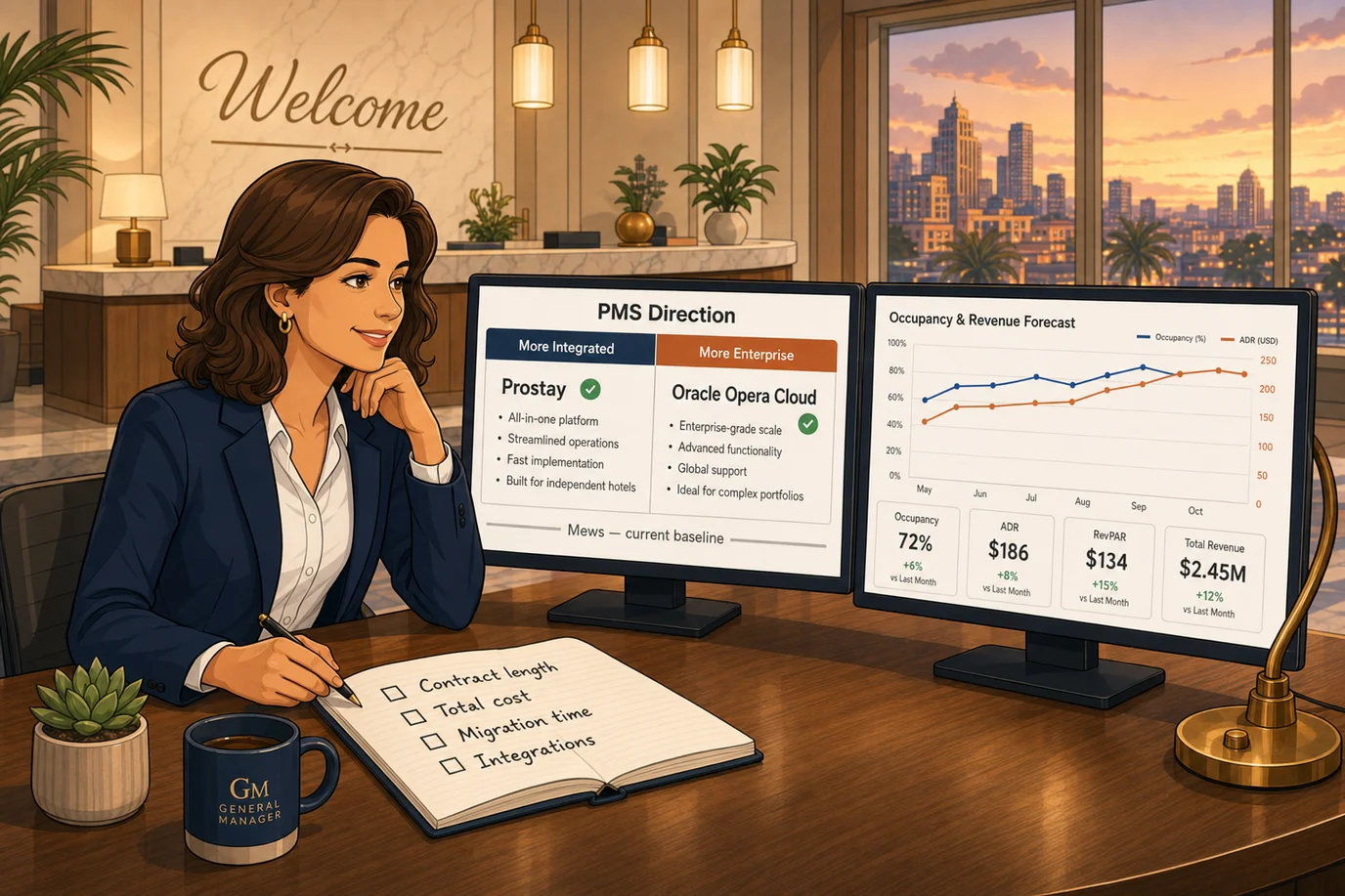
That is why this guide narrows the shortlist to the two architectural alternatives that actually move the needle. Going more integrated, with Prostay. Or going more enterprise, with Oracle Opera Cloud. Mews sits between those two. The honest question is which direction you want to move from where you are now.
The Two Real Alternatives: Prostay or Oracle Opera
The right alternative depends on the direction you want to go. If you want to collapse a stack of marketplace apps into a single platform, simplify the operation and bring the AI layer in-house, the answer is Prostay. If you genuinely need enterprise-grade depth (GDS integration, deep configuration, mature multi-property tooling for 20+ hotel groups), the answer is Oracle Opera Cloud. Anything in between is, in practice, another version of the situation you are already in on Mews.
Prostay: The Unified-Platform Alternative
Prostay is built on a single architectural bet: one platform is operationally better than a stack of nine. PMS, channel manager, booking engine, payments, point of sale, revenue management and the AI front-desk layer ship as one product, with one set of permissions, one set of reports, and one support team that can see your entire operation when you call. The unified-platform choice is the most important thing to understand about Prostay. Almost everything else follows from it.
What You Actually Get in One Subscription
The base subscription includes the PMS (front desk, housekeeping, folios, group bookings, multi-property), the channel manager (Booking.com, Expedia, Airbnb, Hostelworld, plus the smaller OTAs), the booking engine (direct rates, promo codes, packages, multi-language, multi-currency), the payment layer (tokenized cards, pre-auths, refunds, with Prostay Pay as an option but not a requirement), the point-of-sale (restaurant, bar, spa, room service, all posting natively to the folio), the revenue management layer (recommended rates, demand forecasts, parity monitoring), and the AI layer (AI front-desk assistant, AI upsell prompts, AI guest messaging in 30+ languages).
What that means on the invoice: where a typical Mews mid-market property runs the PMS subscription plus 6 to 12 marketplace apps (each a separate vendor contract, a separate monthly fee, a separate login), the same property on Prostay runs one subscription. At properties that actually use the full stack of marketplace apps, the total bill comes out meaningfully lower. At properties that genuinely use only the core PMS and one or two integrations, Mews is competitive on price and the comparison comes down to operating preference rather than cost.
Where It Wins Against Mews
Four specific places. First, total cost of ownership for properties that need the full stack, because the bundling is real and the marketplace bill goes to zero. Second, multi-property pricing, where the per-property cost curve flattens past three locations, which is the point at which most expanding groups feel the Mews curve getting steep. Third, no structural payment-processing lock-in: Prostay Pay is offered but is genuinely optional, and the alternative-acquirer path is supported in the product rather than tolerated. Fourth, the AI layer is native to the platform rather than wired through a third party, which matters less today if you do not use AI yet and matters a great deal over the next 24 months as the operating workflows shift.
The contract is also shorter by default. Prostay sells on a 12-month standard contract, with a month-to-month option at a 20 percent premium for properties that explicitly need it. That is the single biggest commercial difference from Mews, and the one most hoteliers feel first.
Where It Loses Against Mews (Honestly)
Two specific places, and we will not paper over either. First, the third-party marketplace is smaller. Mews has 800+ integrations. Prostay has, depending on how you count, roughly 80 to 120 deep ones plus a public API for the rest. If your operation depends on a specific niche app that Mews integrates and we do not, Mews is the right answer until we add the integration or you accept the API route.
Second, the brand-recognition gap is real. Mews has 12,500 live properties and a decade of category leadership. Prostay is smaller, newer in many markets, and we lose deals on "nobody-got-fired-for-buying-IBM" grounds. The honest counterargument is reference customers in your segment and size, which we are happy to provide. The dishonest version of this objection is when it shows up after a thorough evaluation as a way to avoid making the call. Both happen.
Who It Fits Best
Independent and mid-market hotels in the 25 to 300 room range, and multi-property groups with 2 to 25 hotels, where the operating model values an integrated platform over a curated best-of-breed stack. Strong fit for properties that run an F&B operation attached to rooms, because POS posts natively to the folio with no integration layer in between. Strong fit for properties pushing hard on direct bookings, because the PMS, channel manager and booking engine are the same system and the rate-parity edge cases that haunt best-of-breed stacks collapse to nothing. Strong fit for hotel groups planning to add properties in the next 24 months, because of how the multi-property cost curve scales.
Less fit for very small properties (under 20 rooms), where the simplest answer is usually a small-property specialist at a fraction of the cost. Less fit for branded chains where the brand mandates Opera or Protel. Less fit for properties whose competitive edge depends on a specific marketplace integration that Mews ships and we have not built yet.
If Prostay is on your shortlist, the Prostay vs Mews comparison page walks through the architectural and feature differences side by side, and a live demo is the fastest way to test the unified-platform model against the way you actually run a shift.
Oracle Opera Cloud: The Enterprise Alternative
Opera is the other direction. Where Prostay collapses the stack into one platform, Opera goes the opposite way: deeper configurability, more modules, longer implementation, and the pricing and operational weight that come with enterprise software. It is the right answer for a specific kind of property, and an expensive mistake for everyone else.
What Opera Brings to the Table
Opera Cloud (Oracle's hosted version of the platform, which is increasingly the default since the on-premise version is being slowly sunsetted) covers PMS, central reservations, sales and catering, distribution, food-and-beverage point-of-sale through Simphony, revenue management through OPERA Revenue Management, and the deepest GDS integration on the market through Oracle's hospitality network. It is the system most large branded chains run, because it has been the system most large branded chains have run for 25 years, and the migration cost away from it is enormous.
The configuration surface is the thing to understand about Opera. Almost anything you want to do, you can do, if you are willing to configure it. Folio behavior, posting rules, room-block management, group-booking workflows, multi-property rate strategies, channel mapping at a level of granularity Mews does not offer. That depth is the reason chains use it, and it is also the reason it is the wrong answer for most independents.
Where It Wins Against Mews
Three places. First, depth and configurability for properties that need them, particularly full-service properties with conference space, banquets, catering, spa and golf in the same operation. Mews can run those, but Opera was built for them. Second, multi-property tooling for chains of 20+ properties, where the central-reservations and central-rate layer is more mature than anything in the mid-market segment. Third, GDS depth and the global brand-integration surface, which matters if you sell into corporate travel programs or operate under a soft brand that requires GDS connectivity.
Where It Loses Against Mews
Three places, all consequences of being an enterprise product. First, implementation length. A typical Opera Cloud implementation runs 4 to 9 months. Mews lands a new property in 4 to 8 weeks. If you are switching because Mews implementation took longer than promised, Opera will be worse, not better. Second, price floor. Enterprise-tier pricing means enterprise-tier total cost. At a 70-room independent boutique, the Opera bill (license plus implementation plus the modules you actually need plus the integrations you still buy on top) often comes in at three to five times what the same property would pay on Mews. Third, the configuration burden has an ongoing cost. You will either need an in-house systems administrator who knows Opera, or a retainer with an Oracle partner who does. That cost compounds quietly across the contract term.
Oracle support is the other thing to factor honestly. It is enterprise support, which means it is structured, ticketed and SLA-bound. It is also slow by mid-market standards. If your shift culture expects a 15-minute reply on a chat window, Opera is not that.
Who It Fits Best
Single properties of 250+ rooms with a full-service operation. Branded chains that mandate it. Hotel groups of 20+ properties with significant GDS and corporate-travel exposure. Properties where the configuration depth genuinely solves an operating problem the mid-market platforms cannot solve.
It is the wrong answer for a mid-market independent buying it to "be safe". Buying Opera because the Oracle logo feels reassuring is the most expensive shortcut in the category. If the underlying complaint about Mews is operational (the contract, the payment lock-in, the marketplace bill), Opera will not solve any of those, and it will introduce a stack of new operational burdens of its own.
Choosing Between Prostay and Opera
The question that splits the two cleanly: do you want a simpler operation, or a more configurable one? Almost every hotelier evaluating both, when pushed, already knows the answer.
If you want a simpler operation, fewer vendors, one bill, one support call, and an AI layer that is built in rather than bolted on, the answer is Prostay. If your operation has genuinely outgrown what a mid-market unified platform can absorb (and that is a small minority of properties), the answer is Opera, and the additional cost is justified by the additional capability you actually use.
The trap to avoid: choosing Opera because it sounds like the grown-up choice, when what you actually need is a better mid-market platform. We see that pattern often, and it typically costs hotels two years of operating margin before they reverse course.

What to Expect From a PMS Switch
The biggest reason hotels delay a switch they have already decided on is fear of what the migration actually involves. Most of that fear is overblown, but only if you plan against the right milestones. Here is what a typical migration looks like for a 60 to 200 room independent.
Data Migration
Mews exports cleanly. You will get reservations, guests, folios, rate plans, room types, taxes and accounting data out, either via CSV or via the public API. The mapping pass on the receiving side is where the work lives. Expect two weeks of focused data work, ideally with the new vendor's implementation team and one person from your side who knows the property's quirks (which room codes are deprecated, which rate codes only apply to specific corporate accounts, which guest profiles are duplicates).
Two specific data items always cause friction. Historical folios with mixed currency or VAT exemptions need manual review. And forward bookings that span the cutover date need to be replicated cleanly in the new system, including any guest-specific notes, special requests and credit-card authorizations.
Training and Go-Live
Plan for 10 to 20 hours of front-desk staff training, split into two or three sessions, and 4 to 8 hours of focused training for the revenue manager and the GM. Most modern PMSes (Cloudbeds, Prostay, RoomRaccoon) report front-desk proficiency inside one to two shifts. Do not believe the marketing version of that number, but do believe that staff will be functional within a week and confident within three.
Run a one-week parallel period if you possibly can, where the new system is live but the old one is still accessible for reference. The cost (two months of overlapping subscription) is trivial compared to the operational risk of a hard cutover that goes sideways at 9pm on a Friday.
Integrations and Channel-Manager Handover
This is the most under-planned part of most migrations. If you are moving from Mews to another best-of-breed PMS, your existing channel manager either reconnects (more friction than the vendor will admit) or gets replaced (cleaner, more disruptive). If you are moving to a unified platform that includes a channel manager, you replace by default, which is operationally simpler.
Either way, you will be re-mapping room types to OTA rate codes, re-validating Booking.com and Expedia connections, and re-establishing GDS connectivity if you use it. Plan 5 to 10 working days for this, with the channel-manager vendor and the OTA contacts involved from day one.
For a deeper walk-through of every migration step, our complete PMS migration guide covers the full project plan, the team structure and the post-go-live checklist.
Negotiating Around the Two-Year Contract
If you are currently in a Mews two-year contract and the math says you should switch, you have three real options.
The first is to wait. If you are inside the last six months of the contract, just wait, give notice in line with the renewal terms, and switch on the natural break. Do not let the renewal auto-renew because you were too busy.
The second is to negotiate an early exit. Mews account managers have some discretion here, particularly if you commit to a clean exit timeline and reasonable transition support. It is rare to get a full waiver, but a partial credit (typically 30 to 50 percent of the remaining contract value) is achievable if you make the conversation operational rather than adversarial.
The third is to absorb the cost. If the new platform will save you meaningful money in year one (say, 12 to 18 thousand EUR for a mid-market property), paying out the remaining 6 to 9 months on a paused-use basis is sometimes the right financial trade. Run the actual math, do not assume.
One thing to avoid: signing the new vendor's contract before you have a clear exit path agreed with the current one. Doing both in parallel without coordination is how hotels end up paying two PMS subscriptions for 18 months instead of two.
Red Flags to Spot in Any Alternative You Evaluate
Most PMS evaluations go wrong in the demo, not in the implementation. The demo is choreographed. Implementation is real. A few specific red flags worth probing for, whichever alternative you are evaluating:
The demo only shows the happy path. Ask to see what happens when a guest disputes a charge, when an OTA reservation comes in with a missing field, when the connection to Booking.com drops for an hour, when a folio needs to be split three ways at checkout. Real shifts are made of those moments. If the demo does not handle them well, the product will not either.
The integration list is alphabetical, not annotated. "We integrate with 400+ apps" is meaningless. Ask which of those integrations are deep two-way syncs and which are one-way webhooks that fire on reservation creation only. The difference matters.
Pricing is "per room per month, plus". The "plus" is where the surprise lives. Get a full quote that includes payment processing fees, integration fees, premium support, training, data migration, and the cost of any modules that are not in the base price. The total should be no more than 20 percent higher than the headline number. If it is 40 percent higher, the headline number is misleading by design.
The reference customers are all in a different segment. If you are a 70-room urban boutique and the references the vendor offers are a 350-room resort and a vacation-rental manager with 200 units, the product probably does not fit you well. Ask for two references in your size and segment, and call both.
The contract has auto-renewal with a short notice window. A 60-day notice window on a 24-month contract is normal. A 90-day notice window is starting to get aggressive. A 120-day notice window is the vendor protecting itself from churn. Push back.

A 12-Question Shortlist Template
Take these into every vendor demo. Write the answers down. Compare them across vendors at the end, not during.
- What is the all-in monthly cost for a property my size, including every module I will actually use and the typical add-ons your customers run?
- What is the contract length, the auto-renewal notice window, and the early-exit terms?
- How do you handle payment processing? Can I keep my existing acquirer, and what is the friction if I do?
- Which of your integrations are deep two-way syncs and which are one-way webhooks? Which categories (CRM, BI, accounting, messaging) do I likely need beyond your core product?
- How long does a typical migration from Mews take at my property size, and what is your role versus my role?
- What is the channel-manager story? Bundled, optional, or third-party only?
- How does the system handle group bookings, multi-currency folios and VAT-exempt corporate rates?
- What is the multi-property pricing curve, if I go from 1 to 3 to 10 properties?
- Who are two reference customers in my segment and size range that I can call directly?
- What happens to my data and my integrations if I leave you in three years?
- What is the SLA on uptime, on critical bug fixes, and on support response during European business hours?
- What does the next 18 months of the product roadmap look like, and what was shipped in the last 12?
If any vendor refuses to answer half of these in writing, take them off the shortlist.
Key Takeaways
Mews is a strong product for the segment it targets. Most hoteliers looking at alternatives are not unhappy with the product, they are unhappy with one of four specific things: the two-year contract, payment lock-in, operating-model fit or marketplace cost creep.
Switching pays back when the underlying problem is architectural, not configurational. Run the three-frustration test before you start the shortlist work.
"Alternative" means three different things. Decide whether you are shopping for a PMS-only, a unified platform, or an enterprise PMS before you book the first demo. For most properties on Mews, the PMS-only swap solves nothing and the realistic shortlist comes down to two architectural directions.
Those two directions are Prostay and Oracle Opera Cloud. Prostay if you want a simpler, more integrated operation, with the AI layer built in rather than bolted on. Opera if you genuinely need enterprise depth, GDS integration and the multi-property tooling that comes with running 20+ branded hotels. Anything in between is, in practice, another version of the situation Mews already gives you.
A typical mid-market migration is 8 to 12 weeks end to end. The biggest under-planned piece is the channel-manager handover. Run a parallel period if you can.
Take the 12-question template into every demo. The vendors that answer it cleanly are the ones worth your time.
If you are evaluating Prostay as part of your shortlist, the Prostay vs Mews comparison page is the most direct next read, and a live demo is the fastest way to test whether the unified-platform model fits the way you actually want to run.