
Of all the rituals hospitality has invented, turndown service is the strangest survivor. A staff member enters an occupied room in the early evening, folds back a corner of the duvet, dims the lights, draws the curtains, leaves a chocolate on the pillow, and slips out. Seven minutes, perhaps a euro of materials. And yet ask guests decades later about the best hotel stay of their lives and a startling number will mention exactly this: coming back from dinner to a room that had been quietly prepared for sleep. Small properties tend to dismiss turndown as a luxury-chain affectation, which is a mistake worth examining, because the operational cost is minor and the memory it creates is not. The properties that do it well treat it as service design, planned in the property management system like any other housekeeping task rather than left to whoever remembers.
This guide covers the whole of it: what turndown actually involves, why such a small gesture carries so much weight, what it genuinely costs, which properties should offer it and in what form, and the operational details, timing, do-not-disturb etiquette, staffing routes, that separate a ritual guests love from an intrusion they resent. It also covers the quiet modern upgrade: using guest profiles and pre-arrival messages through a tool like Prostay Nexus to offer turndown to the guests who will treasure it and spare the ones who want their room left alone. That single distinction, offered rather than imposed, is most of what has changed about turndown in the last decade.
What Turndown Service Actually Is
Turndown is a second, shorter housekeeping visit with a completely different purpose from the morning clean. The morning service resets the room for the day: beds made taut, surfaces cleared, the room returned to its photograph. Turndown prepares the room for night: the same space, softened. The bed is opened, a corner of the duvet folded back into a crisp triangle so getting in requires no excavation of tucked sheets. Decorative cushions and the bed runner, which exist for the photograph, are stored away. Curtains close. The overhead lights go off and the bedside lamps come on. Used towels are swapped, water refreshed, and something small is left where the guest will find it: classically a chocolate on the pillow, often now a local sweet, a weather card for tomorrow, or a short handwritten note.
The name describes the founding gesture, turning down the bed covers, and the service is old enough that its origins blur into the history of grand hotels and their butlers. The famous pillow chocolate has its own legend: the Mayfair Hotel in St. Louis is usually credited, where the story goes that the manager, courting a starlet, laid a trail of chocolates ending on the pillow. Whatever the truth, the chocolate stuck because it solved a real problem: the service happens while the guest is out, and the small gift is how an invisible visit says it happened, and it happened with care.
That last point is the key to understanding everything else about turndown: it is a performance with no audience. The guest never sees the work, only the result. Which is why the details carry all the weight, and why a sloppy turndown, lights blazing, cushions dumped on a chair, fold crooked, is worse than none at all. The room either whispers that someone thought about your evening, or it does not.
Why a Folded Duvet Corner Does So Much Work
The economics of turndown make no sense until you look at when it happens. The end of the evening is when a stay is emotionally scored: guests return from dinner relaxed, unhurried, and about to spend their most vulnerable hours in your room. A gesture that lands in that window is weighted differently from the same gesture at noon. Psychologists call the broader pattern the peak-end rule, experiences are remembered by their most intense moment and their ending, and turndown is one of the few tools a hotel has that deliberately engineers the ending of every single day of the stay.
There is also the matter of what the gesture says. Anyone can clean a room; that is the contract. Returning to a room that has been prepared for your sleep says something beyond the contract: someone anticipated your next few hours and got there first. Anticipation is the entire difference between service and hospitality, and turndown is anticipation in its cheapest, most repeatable form. That is why the ritual shows up so disproportionately in reviews and in the stories guests tell: not because a chocolate is impressive, but because being thought about is.
And there is a commercial edge worth naming plainly: turndown is a differentiator precisely because most properties have abandoned it. As mid-market chains cut evening service over the last two decades, the gesture migrated from expected to remarkable. A 20-room independent that runs a beautiful evening service now offers something the 200-room corporate box down the road structurally cannot, and it costs the independent a fraction of what any comparable differentiator, a spa, a rooftop bar, a renovation, would.
The Core Service: What Happens in Those Seven Minutes
A good turndown is choreographed, not improvised. The attendant knocks, announces housekeeping, waits, knocks again, and enters only into silence. Inside, the sequence is fixed so that nothing is forgotten and nothing is touched that should not be: guest belongings are never moved beyond the minimum, never organised, never judged. The work moves from the bed outward, and the exit check is part of the routine: lamps on, overheads off, curtains fully closed with no gap, door pulled to a click.
The Turndown Checklist
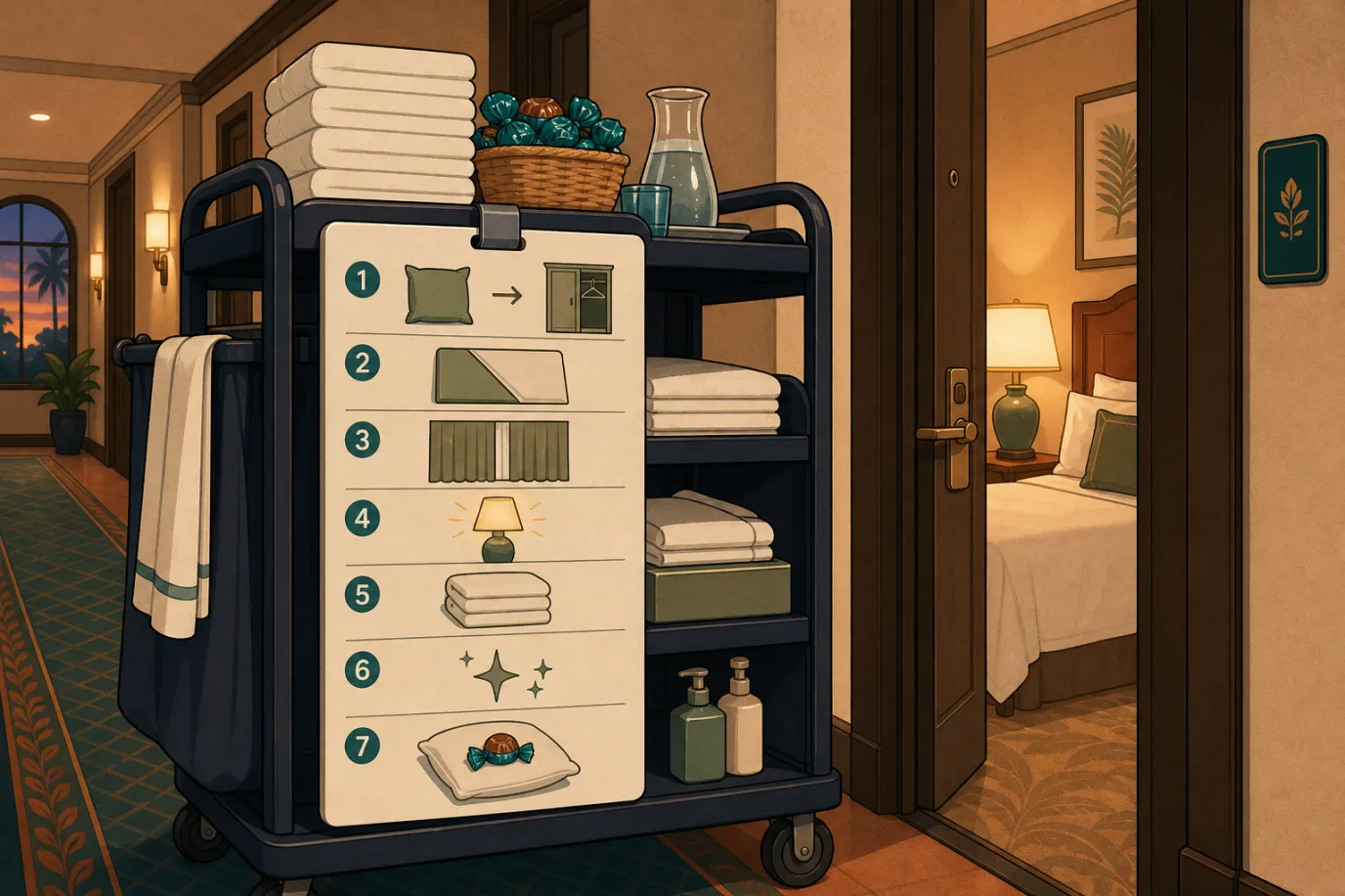
The core seven steps, in the order most services run them: one, store the decorative cushions and runner in the wardrobe, never on the floor. Two, open the bed, folding the duvet corner back at roughly 45 degrees on the side nearest the nightstand, or both sides for two guests. Three, draw the curtains completely. Four, set the lighting scene: bedside lamps on, everything else off. Five, refresh: used towels swapped, glasses replaced, water refilled or added. Six, light tidy: straighten without organising, empty visible bins. Seven, place the touch: chocolate, card, or whatever the property's signature is, positioned identically in every room, every night. Upscale additions layer onto the same skeleton: slippers paired by the bed, a mat laid beside it, television set to the calm channel, the weather card, a drawn bath on request.
The checklist matters more than any individual item on it, because consistency is what converts a nice gesture into a signature. A guest who gets the perfect fold on Tuesday and a crooked one on Wednesday has learned that Tuesday was luck. The properties whose turndown gets mentioned in reviews are never doing anything elaborate; they are doing something simple, identically, every night.
Timing and the Do-Not-Disturb Problem
The window is classically 6 to 9 p.m., but the real rule is: while the guest is out, never while they are in. The mechanics of knowing the difference are where operations earn their keep: dinner reservations made through the hotel are the best signal, keys left at the desk the second best, and in properties with room-status systems, the live occupancy view does the work. The do-not-disturb sign is absolute; a turndown that interrupts is a contradiction in terms. For rooms that could not be served, the graceful recovery is a doorknob card or a short message: we did not want to disturb you; call whenever you would like your evening service. That sentence converts a missed visit into a second offer, and guests who use it once tend to use it every night after.
What Turndown Really Costs
Turndown has a reputation for being expensive that the arithmetic does not support. The visit takes five to ten minutes per room once the routine is practised. An attendant working a steady route covers 25 to 40 rooms in an evening. For a 30-room property running full-house turndown, that is roughly two to three staff-hours per evening; for the on-request model most independents should actually run, it is often under an hour. The amenity itself is small change: a good chocolate costs less than a euro, a printed weather card costs cents, and the water was being replaced anyway.
The honest total for most properties lands somewhere between €2 and €4 of marginal cost per served room, less where an evening shift already exists for the desk or the restaurant. Put that against the alternatives a hotel considers when it wants to feel more premium: a lobby renovation, a bathroom upgrade program, an amenity brand switch, each of which costs tens or hundreds of thousands and applies to the property in general. Turndown costs a few euros and applies to tonight, to this specific guest, personally. Per unit of remembered luxury, it is likely the cheapest intervention in the industry.
The cost that is real, and worth respecting, is organisational: turndown requires an evening presence, a trained routine, and coordination about who is out of their room when. Properties where the entire team goes home at six should not pretend otherwise; for them, the occasion-based model below is the honest version. The failure mode to avoid is the middle path: announcing turndown, staffing it casually, and delivering it to a random subset of rooms on a random subset of nights. Inconsistent luxury reads as carelessness, which is worse than absence.
There is also a revenue side that softens the cost further. Turndown slots naturally into packages, the romance package, the anniversary stay, the suite rate, where it raises the package's perceived value by far more than its cost. Some properties sell it directly as a bookable extra alongside airport transfers and late checkout, and the guests who buy it are self-selecting for exactly the treatment. And the evening entry itself is a quiet merchandising moment: the breakfast card on the pillow lifts next-morning restaurant covers, the spa card placed on the night before a quiet day fills slots that would have gone empty. None of this is the reason to run turndown, but it means the service frequently pays its own modest bill.
Should Your Property Offer It?
The decision is a segment question, not a size question. Turndown earns its keep where evenings matter and stays are emotionally loaded: honeymoon and celebration traffic, romantic weekend positioning, luxury and boutique properties, resorts where guests return to the room between dinner and sleep, long-haul destinations where arrival-day exhaustion makes an evening-ready room land twice as hard. It earns little where guests barely inhabit the room: one-night business stops, airport properties, budget positioning where the rate promises no ritual and guests prefer the privacy.
There is also a real segment of guests for whom a second staff entry is a negative: privacy-minded travellers, families with a sleeping baby, anyone who has spread the contents of a suitcase across the bed. The era when turndown could be silently universal is over, and that is not a loss, because the fix produces a better service than the old default did.
The On-Request Model: Turndown for the Rest of Us
The model that fits most independent properties: turndown exists, is offered clearly, and happens only where welcomed. Mention it at check-in as a question rather than a feature tour: would you like evening service during your stay? Put it on the doorknob card and in the pre-arrival message. Flag the yeses in the system so the evening route is a list, not a guess. This concentrates the effort on guests who actively chose the ritual, which is exactly the population that will mention it in a review, and it removes the intrusion complaint entirely, because everyone served asked to be.
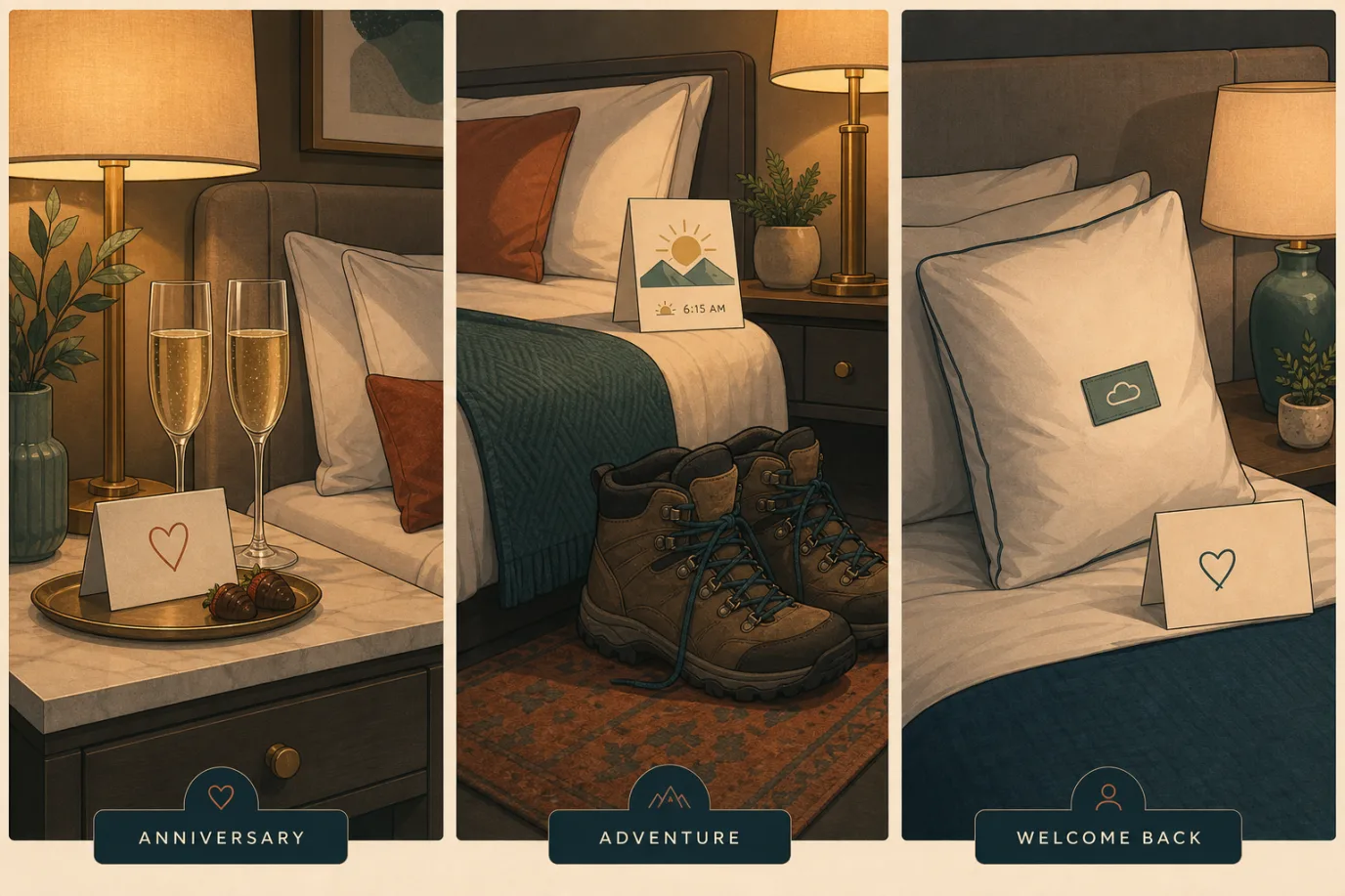
The narrower version for the smallest properties: occasion-based turndown. Run it only for flagged stays, honeymoons, anniversaries, birthdays, VIPs, suites, perhaps a bookable extra for anyone else. A front-desk evening staffer trained on the seven steps can serve the two or three flagged rooms in fifteen minutes. The effort lands precisely where the stories are told, and the property gets most of the reputational return of full turndown at a few percent of the labour.
Personalization: Where Turndown Becomes Memorable
Standard turndown is pleasant; personalised turndown is what gets photographed and posted. The gap between the two is information, and the information is usually already in the building: the reservation says it is an anniversary, the guest mentioned a birthday at check-in, the profile from last year's stay records the extra pillows and the sparkling water. Turndown is the natural delivery mechanism for acting on all of it, because the room is entered anyway and the moment is already intimate. The anniversary couple finds two glasses and a small cake card. The guest who asked about tomorrow's hike finds the weather card annotated with sunrise time. The returning guest finds the same firm pillow they requested last March, unasked.
None of this requires a butler culture; it requires that what the property learns about a guest lands somewhere retrievable, and that the evening attendant reads the notes before the route. A guest profile with three lines in it, one preference, one occasion, one detail from conversation, is enough to make a turndown feel bespoke. The compounding effect is real: personalised evening touches generate the reviews that mention staff by name, and those reviews recruit exactly the guests who value being known, who are also the guests who tip the profile fuller for next time.
A practical caution: personalisation must never reveal surveillance. Acting on what a guest told you is delightful; acting on what you inferred can be unsettling. The line is consent and plausibility: the sunrise time on the weather card is charming because the guest asked about the hike at the desk. The rule of thumb for notes in the profile: only record what the guest said or explicitly chose, and only act on it in ways the guest can trace back to their own words.
The Mistakes That Turn a Ritual Into an Intrusion
Turndown fails in predictable ways, and every failure is avoidable. Entering against a do-not-disturb sign, or knocking once and entering fast, is the cardinal sin; it converts the whole ritual into a trespass and no chocolate recovers it. Moving or organising guest belongings is the second: the service tidies the hotel's surfaces, never the guest's things, and a rearranged suitcase reads as a searched one. Timing errors are third: a 5 p.m. turndown catches guests dressing for dinner, a 10 p.m. one catches them in bed; the window exists for a reason and the room-status signals exist to refine it.
Then there are the quality failures, gentler but corrosive: the crooked fold, the cushions stacked on the luggage rack, the overhead lights left blazing, the chocolate placed on one pillow of a two-guest bed. Each is small; together they communicate that the ritual is being performed at the property rather than for the guest. And the strategic failure that contains all the others: offering turndown in marketing that operations cannot deliver nightly. The promise sets the peak-end expectation; the inconsistency then scores as a broken promise, which reviews punish far harder than the absence of the service ever would have been.
Running It Operationally: Staffing, Routes and Records
Operationally, turndown is a routing problem with a courtesy constraint. The evening list is built from three inputs: who opted in, who is flagged for occasions, and who is verifiably out. The route runs occupied-and-absent rooms first, circles back for the rest, and closes with the recovery cards on the doors that never opened. One attendant, one practised routine, one cart stocked for the whole route: towels, amenities, the signature touch, and the checklist until the routine is muscle memory.
Records close the loop. Which rooms were served, which declined, which were missed and why, thirty seconds of logging that turns next evening's route from a fresh guess into a refinement. Preferences observed during service, the guest who had moved the duvet to the sofa, the allergy note on the nightstand, flow back into the profile through whoever runs the evening. Over a season, this quiet log becomes the property's institutional memory of how its guests actually live in its rooms, which is knowledge no renovation budget can buy.
Training is the last operational piece, and it is short: the seven steps, the knock protocol, the belongings rule, and one hour of practice in an empty room until the routine takes seven minutes without the card. The useful trick is to train with a photograph: shoot the perfectly finished room once, pin it in the housekeeping area, and let every attendant compare their result against it. Standards survive better as pictures than as paragraphs, and a new evening staffer can be brought to full consistency in a single shift with a photo and a practice room.
Where Prostay Fits
The operational skeleton of a good turndown program, who opted in, who is flagged, who is out, what each guest prefers, is exactly the kind of information a property management system already holds. In Prostay, occasion flags and preferences live on the reservation and the guest profile, so the evening route is a filtered list rather than a memory exercise; housekeeping tasks can be scheduled and ticked per room, so the served-missed-declined record keeps itself; and the pre-arrival offer, would you like evening service during your stay, goes out through Prostay Nexus with the rest of the arrival messaging, on whatever channel the guest actually reads. The returning guest's pillow preference from last March is one profile lookup, not one veteran employee's recollection.
None of this changes what turndown is, seven careful minutes and a folded corner, but it changes what it costs to run consistently, and consistency is the entire game. The test for any system is whether tonight's turndown list, with occasions and preferences attached, can be in the evening attendant's hand in under a minute. If it can, the ritual scales beyond the memory of whoever founded it.
Frequently Asked Questions
The questions hoteliers ask most about turndown service, what it includes, when it happens, what it costs and whether guests still want it, answered with the same practical bias as the rest of this guide.