Hotel Housekeeping Supplies List: Cleaning Tools, Chemicals & Supplies
 Mika Takahashi
Last updated Mar 22, 2026
Mika TakahashiThere is no shortcut to a clean hotel room. No amount of elegant décor, clever marketing, or competitive pricing can compensate for a guest who finds a hair on the pillow, a smear on the bathroom mirror, or a bin that was not emptied. In the hospitality industry, cleanliness is not a feature, it is the foundation. Everything else is built on top of it.
A well-stocked, thoughtfully organised hotel housekeeping supplies list is the starting point for consistent, efficient, and thorough room cleaning. When your housekeeping staff have the right tools, the right products, and the right systems supporting them, every room is turned to the same impeccable standard, every time. When they do not, when supplies run out mid-shift, when the wrong chemical is used on the wrong surface, when the trolley is missing a critical item, standards slip, complaints rise, and your hotel reputation suffers.
This guide is a comprehensive resource for every hotel owner, hotel general manager, and hotel housekeeping manager who wants to get housekeeping right. We cover the complete supplies list, from cleaning chemicals to linens, equipment to guest amenities, and explain how each category contributes to the cleaning process. We also explore how modern property management systems, specifically Prostay, transforms hotel housekeeping from a reactive scramble into a streamlined, trackable, and consistently excellent operation.
Before diving into the list itself, it is worth understanding why getting your supplies right has such an outsized impact on your property's success.
Study after study confirms that cleanliness is the single most important factor in guest satisfaction. It outranks location, price, amenities, and staff friendliness. A spotless room earns forgiveness for a slow check-in or an ageing bathroom fixture. A dirty room poisons the entire stay, regardless of how many other things the hotel gets right.
Guest reviews on platforms like Booking.com, TripAdvisor, and Google are disproportionately influenced by cleanliness perceptions. A single mention of uncleanliness in a review can deter dozens of future bookings. Conversely, consistent praise for clean, well-presented rooms is one of the most powerful drivers of repeat business and positive word-of-mouth. Your hotel housekeeping supplies are not just operational consumables, they are the raw materials of your reputation.
A hygienic environment is not just about appearances. Guest health depends on proper sanitisation of high-touch surfaces, thorough bathroom disinfection, clean linens free of allergens and pathogens, and air quality uncompromised by mould, dust, or chemical residue. The right cleaning supplies and cleaning chemicals, used correctly, protect guests from illness and protect the hotel from liability. In a post-pandemic world, guests are more aware than ever of hygiene standards, and their expectations have risen permanently.
When cleaning staff are equipped with high-quality, well-maintained tools and a fully stocked housekeeping trolley, they work faster, produce better results, and feel more professional. When they are forced to improvise, using the wrong cloth, running back to the storeroom for forgotten supplies, or dealing with a broken vacuum, frustration builds, productivity drops, and turnover increases. A well-managed supplies list is an investment in your team as much as in your rooms.
Housekeeping supplies represent a significant recurring cost for any hotel. Without proper inventory management, waste accumulates: chemicals are over-dispensed, linens are discarded prematurely, amenities are overstocked or expire unused. A disciplined approach to supply procurement, storage, and usage, supported by technology, keeps costs under control without compromising quality.
Here is the comprehensive, category by category list of everything your housekeeping department needs to maintain guest rooms, public areas, and back-of-house spaces to the highest standard.
Cleaning chemicals are the workhorses of the cleaning process. Each product serves a specific purpose, and using the right chemical for the right task ensures both effectiveness and surface safety.
Essential cleaning chemicals include:
Important note on chemical cleaners: All chemical cleaners should be stored securely, clearly labelled, and accompanied by safety data sheets. Housekeeping staff must be trained on proper dilution ratios, contact times, and personal protective equipment requirements. Over-concentrated chemicals waste money and can damage surfaces; under-concentrated solutions fail to sanitise effectively.
The right hotel cleaning tools make the difference between a room that looks clean and a room that actually is clean. Quality tools last longer, perform better, and allow cleaning staff to work more efficiently.
Essential cleaning tools include:
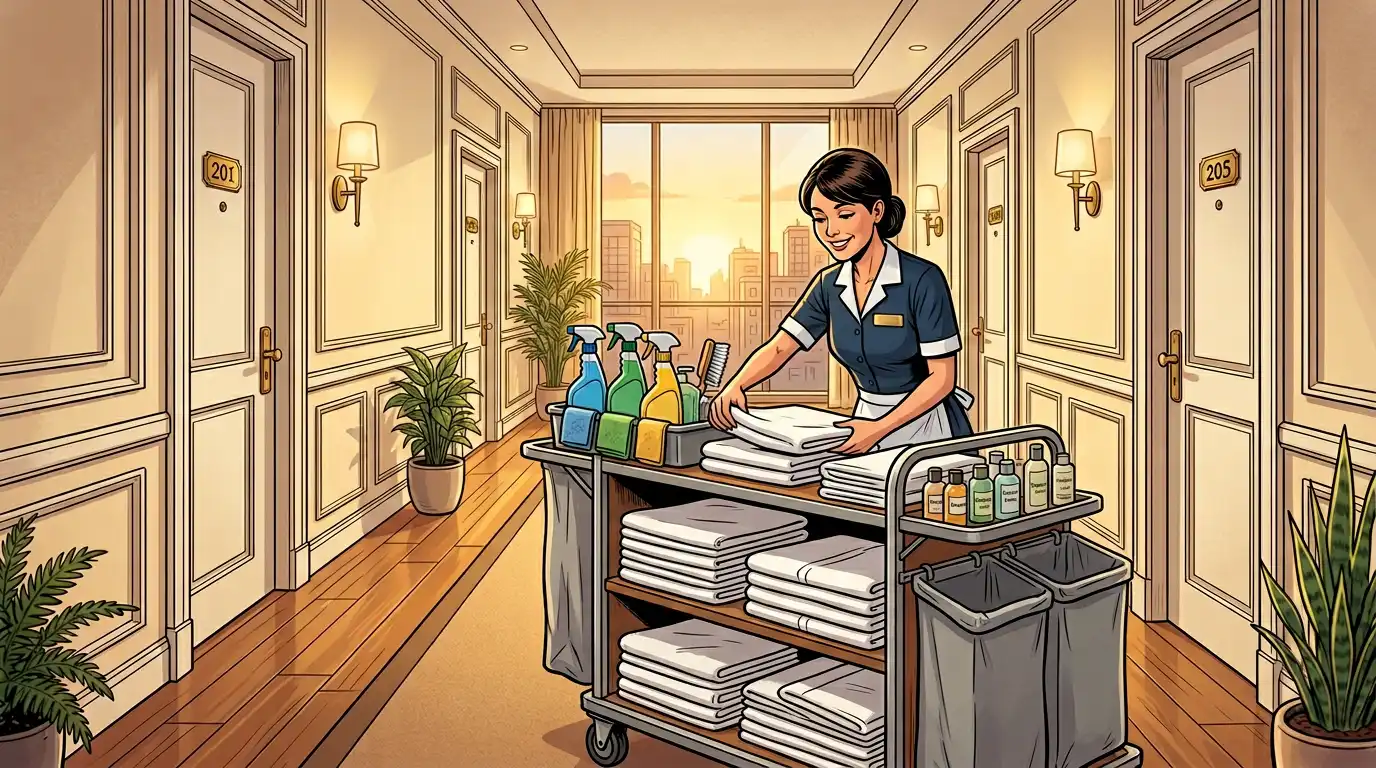
The housekeeping trolley is the mobile command centre of the room-cleaning operation. A well organised trolley eliminates wasted trips, keeps supplies accessible, and ensures nothing is forgotten.
A properly stocked housekeeping trolley should include:
Trolley organisation tips:
Linen quality and freshness are among the first things guests notice, and among the first things they mention in guest reviews if standards are lacking.
Essential linen inventory includes:
Linen management tips:
Guest amenities are the finishing touch that transforms a clean room into a welcoming one. They signal attention to detail and care for the guest experience.
Standard guest amenities include:
Beyond the bathroom, guest rooms require a range of supplies that support comfort and convenience:
Proper waste handling protects guest health, maintains hygiene standards, and supports the property's environmental commitments:
Protecting housekeeping staff is not optional — it is a legal and ethical obligation:
Beyond the daily housekeeping routine, periodic deep cleaning requires additional supplies:
Having the right supplies is only half the equation. How you organise, store, and manage them determines whether they actually translate into consistently clean rooms.
Maintain a central housekeeping store for bulk inventory, with smaller substores on each floor or wing for day to day access. This reduces the time cleaning staff spend travelling to and from the central store during shifts.
Establish minimum stock levels for every item and reorder before they are reached. Par levels should account for occupancy fluctuations, carrying the same stock during a 40 percent occupancy week as during a 95 percent occupancy week is wasteful.
Chemicals expire. Amenities lose fragrance. Linens deteriorate in storage. Rotate stock so the oldest inventory is used first, and conduct regular audits to remove expired or damaged items.
Every chemical container must be clearly labelled with its contents, dilution instructions, and hazard warnings. Safety data sheets should be readily accessible. Staff training on chemical handling must be documented and refreshed regularly.
A supplies list is only as good as the process that uses it. Here is how a well-organised housekeeping routine flows for a standard checkout room (the most thorough clean, preparing the room for the next guest):
The housekeeper checks their assignment sheet (or, with a system like Prostay, their mobile device) for the day's room list, priorities, and any special instructions. They ensure the housekeeping trolley is fully stocked before starting.
Enter the room, open curtains and windows for ventilation, and conduct a quick visual assessment. Note any damage, missing items, or maintenance issues that need reporting.
Strip all bed linen, collect used towels, empty bins, remove used amenities, and clear any guest-left items (following the property's lost and found protocol). Bag all soiled linens and rubbish.
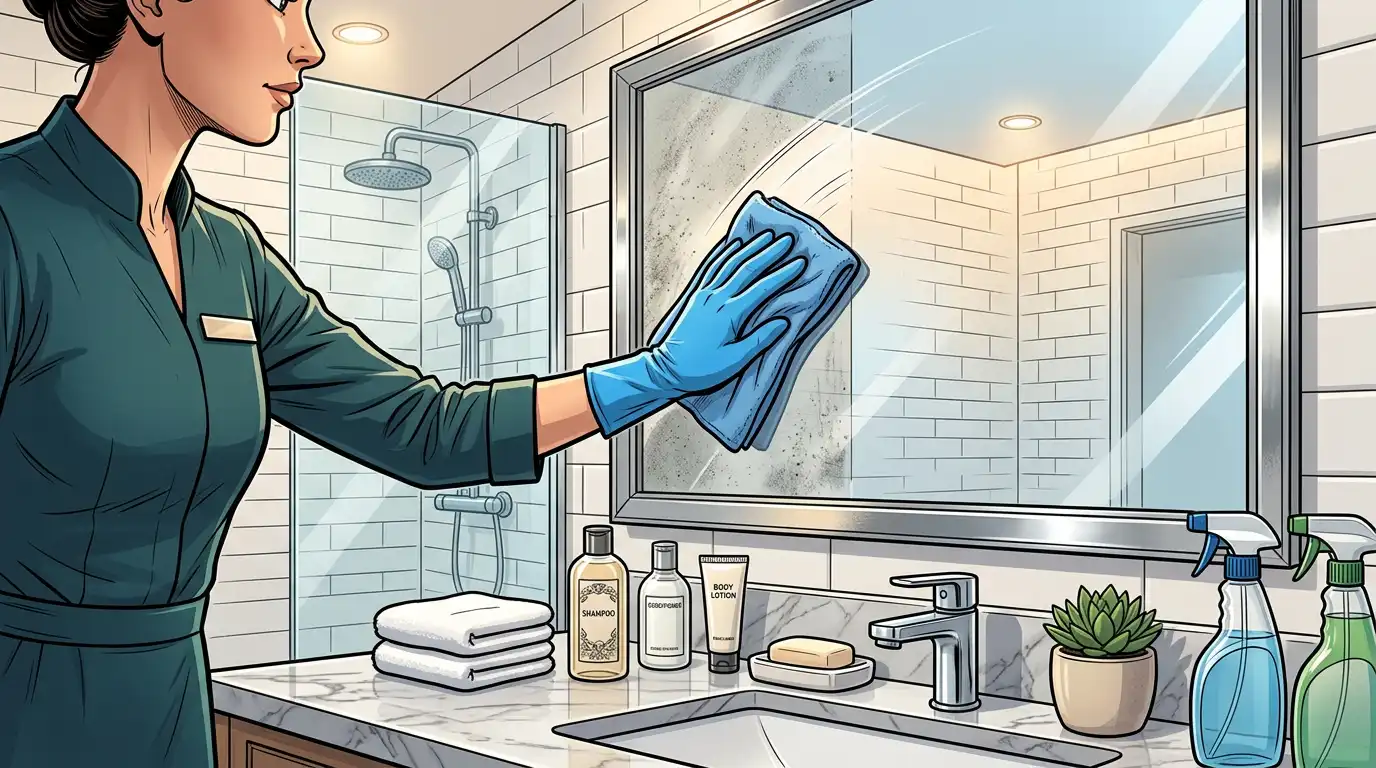
The bathroom is cleaned first while chemicals have contact time. Apply toilet bowl cleaner and bathroom disinfectant, clean the shower or bathtub, scrub the sink and vanity, wipe the mirror, mop the floor, and replace all towels, amenities, and toilet paper. Check that the drain is clear and the exhaust fan is functioning.
Dust all surfaces from top to bottom: light fixtures, air conditioning vents, shelves, headboard, desk, TV, and furniture. Wipe all surfaces with the appropriate cleaner. Clean the inside of drawers and the wardrobe. Wipe light switches, door handles, remote controls, and other high touch points with disinfectant.
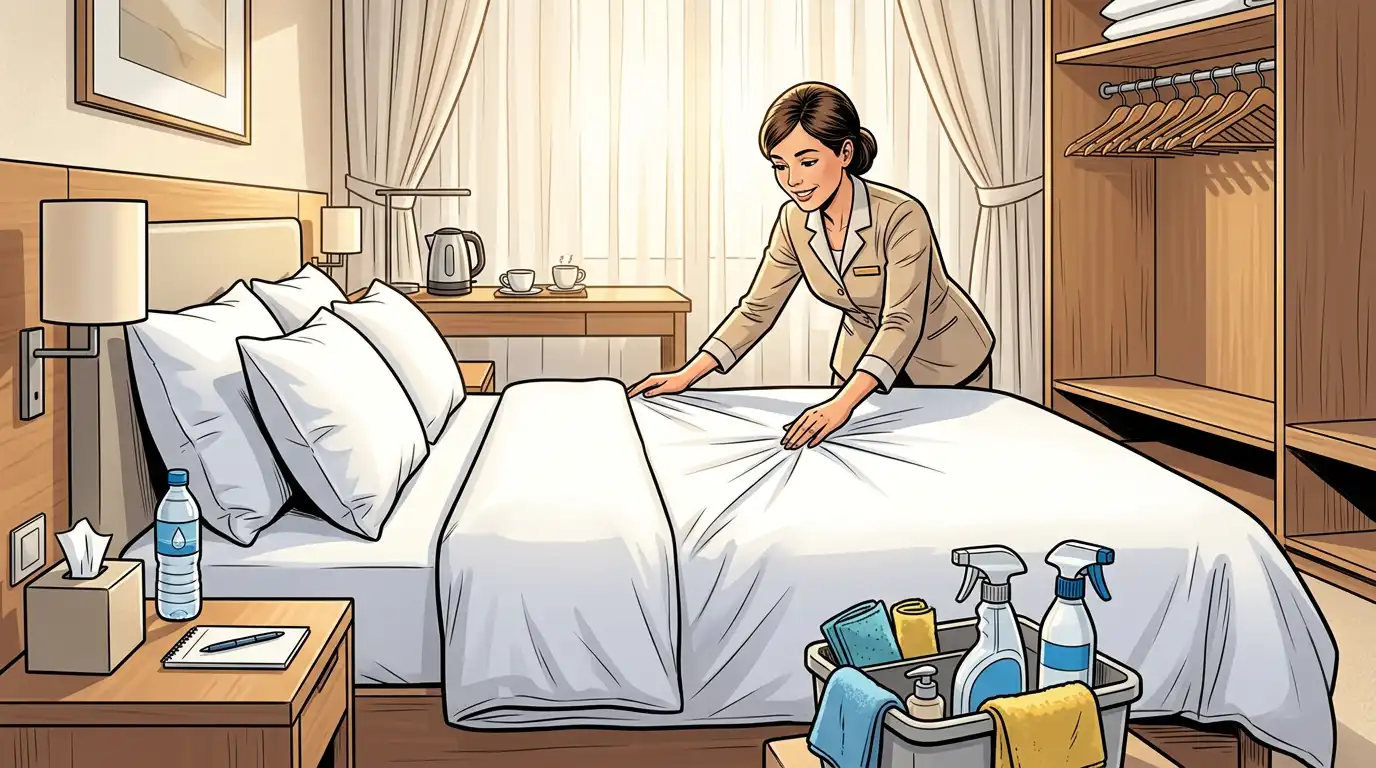
Make the bed with fresh linens according to the property's presentation standard. Check the mattress protector, inspect pillows, and ensure the bed looks crisp and inviting.
Vacuum all carpeted areas (including under the bed and in corners) or mop hard floors. Check the carpet for stains requiring spot treatment.
Place fresh amenities, stationery, tea and coffee supplies, bottled water, and any other room items according to the standard hotel housekeeping checklist. Check that the minibar is stocked (if applicable), the hair dryer works, and sufficient hangers are in the wardrobe.
Conduct a final walk-through: check every light, test the TV and remote, flush the toilet, run taps to verify hot water, set the thermostat, and give the room one last visual scan from the guest's perspective. The room is ready for the next guest.
Update the room status, this is where hotel housekeeping technology like Prostay transforms the process.
Managing a housekeeping department with paper checklists, walkie-talkies, and spreadsheet-based inventory management is like running a kitchen without a ticket system, it works until it does not, and when it fails, it fails visibly. Prostay, as a purpose-built hotel property management system, brings structure, visibility, and automation to every aspect of hotel housekeeping.
Prostay provides a live dashboard showing the status of every room on the property: occupied, vacant dirty, vacant clean, inspected, out of order, or due for departure. As housekeeping staff complete rooms, they update the status directly from their mobile device, and the front desk sees the change instantly.
This eliminates the lag that plagues manual systems, where the front desk calls housekeeping to ask if room 204 is ready, housekeeping calls back 10 minutes later, and the guest waits in the lobby. With Prostay, the moment a room is marked clean, it is available for check-in. Speed of room turnaround directly impacts revenue, particularly during high occupancy periods when every minute between checkout and the next guest matters.
Prostay allows housekeeping supervisors to assign rooms to individual staff members, set priorities (early check-in requests, VIP rooms, departures before stayovers), and track progress throughout the shift. Staff see their personal task list on their device, complete with room numbers, room types, and any special instructions (extra pillows requested, guest is celebrating an anniversary, guest noted allergies in their profile).
This structured approach replaces the chaos of verbal briefings and scribbled room lists. Every housekeeper knows exactly what to clean, in what order, and to what standard, reducing confusion, improving efficiency, and ensuring that priority rooms are turned first.
When a housekeeper discovers a maintenance problem, a dripping tap, a cracked tile, a malfunctioning air conditioner, they log it directly through Prostay with a description and, optionally, a photo. The maintenance team receives the alert immediately, and the system tracks the issue through to resolution. No more sticky notes left on the supervisor's desk, no more issues that fall through the cracks.
This closed loop reporting protects the guest experience by ensuring that maintenance problems are identified during cleaning (when the room is empty) and resolved before the next guest arrives.
Prostay captures data on room cleaning times, rooms completed per shift, inspection pass rates, and maintenance issues reported. This data allows managers to identify top performers, spot training needs, balance workloads fairly, and benchmark productivity.
Over time, this data becomes a powerful management tool. You can see how cleaning times vary by room type, measure the impact of staffing changes, and identify patterns (certain floors consistently take longer, certain room types generate more maintenance reports) that inform operational decisions.
While dedicated housekeeping supply management is complex, Prostay's operational framework helps hotel managers track consumption patterns tied to occupancy data. When you can see that your 80-room property used a specific quantity of bathroom amenities during a month of 72 percent occupancy, you can forecast needs for busier periods, prevent overstocking, and catch unusual consumption patterns that might indicate waste or pilferage.
By integrating housekeeping operations into the same platform that manages reservations, guest profiles, and revenue, Prostay gives hotel owners and managers a complete picture of how daily operations connect. The cost of housekeeping supplies is not just a line item, it is data that relates to occupancy, average stay length, guest segment, and room type, enabling smarter purchasing decisions.
Prostay's guest profile system captures preferences that directly impact housekeeping: extra pillows, hypoallergenic bedding, no turndown service, specific minibar preferences, or requests for additional amenities. When a returning guest books, their preferences are automatically flagged in the housekeeping assignment, ensuring the room is prepared exactly as they like it before they arrive.
This level of personalisation, powered by data rather than relying on staff memory, elevates the guest experience from satisfactory to exceptional, and exceptional experiences drive the repeat bookings and positive guest reviews that sustain a hotel's success.
Housekeeping does not operate in isolation. The front desk needs to know when rooms are ready. Maintenance needs to know about reported issues. Management needs to see productivity data. Prostay connects all of these functions within a single platform, eliminating the phone calls, radio chatter, and manual status boards that slow down traditional hotel operations.
When a guest calls the front desk to request extra towels, the request can be entered into Prostay and routed to the housekeeper assigned to that floor. When a VIP is checking in early, the front desk can flag the room as priority and the housekeeping supervisor sees it immediately. This real-time communication ensures that every department is working from the same information, at the same time.
Supplies, tools, and technology provide the foundation, but the ultimate determinant of housekeeping quality is culture. The best-equipped housekeeping department in the world will underperform if the team does not take pride in their work and feel supported by management.
Every new housekeeper should complete a thorough training programme covering cleaning tasks, chemical safety, linen standards, amenity placement, and the property's specific presentation standards. Training should not be a one-time event, regular refreshers, spot checks, and team meetings keep standards sharp and give staff the opportunity to raise concerns or suggest improvements.
Housekeeping is physically demanding, often invisible work. The best hotels recognise this by ensuring fair compensation, reasonable workloads, and genuine appreciation for the team's contribution. A housekeeper who feels valued will consistently deliver better results than one who feels overlooked.
Regular room inspections, by supervisors and by management, provide accountability and coaching opportunities. Inspections should be constructive, not punitive. When issues are found, the response should be retraining and support, not blame. When rooms are perfect, recognition should follow.
Guest reviews mentioning cleanliness, positive or negative, should be shared with the housekeeping team. Positive feedback is motivating and reinforces good habits. Negative feedback, when addressed constructively, drives improvement and shows the team that their work directly impacts the hotel's success.
Modern guests increasingly expect hotels to demonstrate environmental responsibility, and housekeeping is one of the most impactful areas for sustainable practices:
Prostay supports these initiatives by tracking linen reuse opt-ins at the guest level, measuring consumption patterns that inform sustainability reporting, and providing the operational framework to manage green housekeeping programmes consistently across the property.
Housekeeping supply costs vary by property size, star rating, location, and occupancy, but as a general benchmark:
Tracking these costs against occupancy and revenue, which Prostay's reporting makes straightforward, allows hotel owners to understand their true cost-per-occupied-room for housekeeping and benchmark it against industry standards.
A comprehensive hotel housekeeping supplies list is not a document you create once and file away. It is a living operational tool that evolves with your property, your guests' expectations, and the products available in the market. Review it quarterly, audit your stock regularly, listen to your housekeeping staff about what works and what does not, and invest in quality where it matters most.
The connection between well-stocked housekeeping and guest satisfaction is direct and measurable. Every fresh towel, every streak free mirror, every perfectly made bed, and every spotless bathroom floor is a statement about your property's standards. These are the details that guests notice, remember, and write about in their reviews. They are the details that determine whether a first-time guest becomes a repeat guest, and whether your hotel reputation grows or erodes.
With the right supplies, well-trained cleaning staff, a disciplined housekeeping routine, and a property management system like Prostay connecting every task, every room, and every team member into a single coordinated operation, housekeeping transforms from a cost centre into a competitive advantage. It becomes the silent engine that drives guest satisfaction, protects your reputation, and ensures that every room is ready, truly ready, for the next guest.