RevPAR vs ADR: Understanding the Key Differences
 Mika Takahashi
Last updated Dec 8, 2025
Mika TakahashiEver wondered why a hotel charging $300 per night might still struggle financially, while another charging $200 pulls in solid profits? The answer often lies in grasping the key differences between two essential hotel industry metrics: RevPAR and ADR. Though both measure aspects of hotel revenue, they tell very different stories about a property's financial health and success in the market.
In the hospitality industry, revenue management depends heavily on key performance indicators that influence pricing strategies, operational choices, and investment decisions. Among these, RevPAR (Revenue Per Available Room) and ADR (Average Daily Rate) are fundamental tools. Yet, many hotel managers and professionals find themselves unsure about when and how to use each one effectively.
This guide breaks down the core differences between RevPAR vs ADR, giving hotel managers the insights they need to optimize revenue performance and make smart, data-driven decisions that boost profitability in today’s competitive hotel landscape.
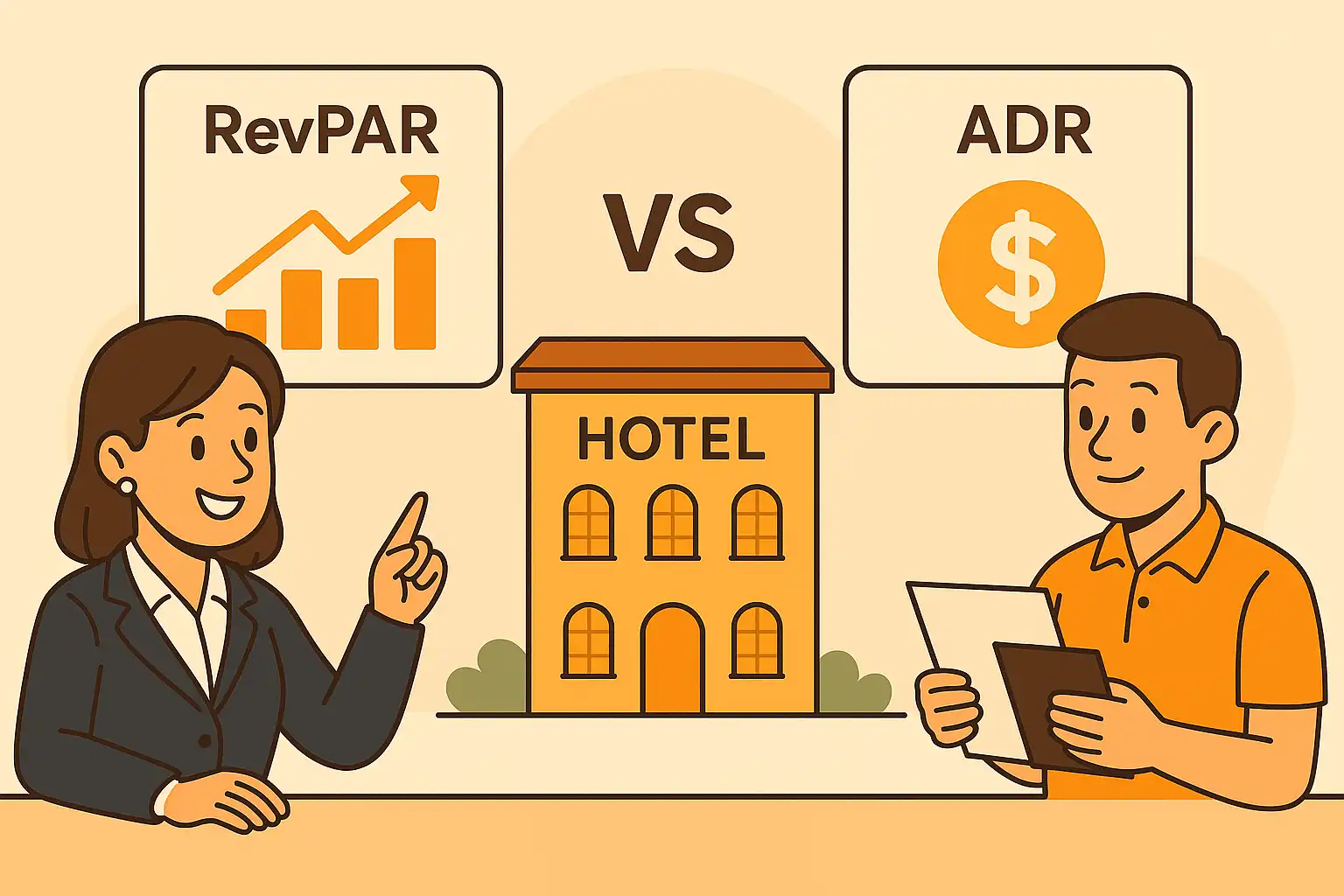
Both RevPAR and ADR are vital hotel revenue metrics, but they focus on different sides of the revenue picture. Understanding this is key to effective hotel management and revenue generation.
ADR, or Average Daily Rate, tells you the average price guests pay per occupied room. It looks only at the rooms sold, calculating the average rate without considering unsold rooms or occupancy levels. This makes ADR a useful measure of how well your pricing strategy performs for actual room sales.
On the other hand, RevPAR, or Revenue Per Available Room, measures revenue across all the rooms a hotel has available — whether they’re occupied or not. This metric blends both your average rate and your hotel’s occupancy to give a fuller picture of how well you’re generating revenue from your entire inventory.
The big difference? ADR doesn’t factor in occupancy, while RevPAR combines rate and occupancy to show overall revenue efficiency. For example, a hotel with a $200 ADR and 70% occupancy has a RevPAR of $140, illustrating how RevPAR provides context that ADR alone misses.
This distinction matters a lot when shaping revenue management strategies. A hotel might boast a high ADR but suffer from low RevPAR because of poor occupancy — so knowing both numbers is crucial for a well-rounded revenue analysis.
Average Daily Rate represents the average revenue earned per occupied room, night by night. It’s a straightforward way to gauge how effective your pricing strategy is. The formula is simple: total room revenue divided by the number of rooms sold equals ADR.
For example, imagine your hotel pulls in $15,000 in room revenue from 75 rooms sold. That means your ADR is $200. This figure helps you understand how well your rates are performing for the rooms you actually rent out.
ADR focuses only on rooms sold — it doesn’t account for empty rooms. This makes it especially handy for evaluating your pricing integrity, brand positioning, and how successful your rate strategies are within your target market.
Several factors shape the ADR your hotel can achieve:
ADR is great for quickly understanding pricing performance. It’s easy to calculate, track over time, and compare across properties or market segments. You can spot trends, evaluate pricing tactics, and benchmark against competitors.
But ADR has its limits. Because it ignores unsold rooms, it can give a skewed picture. For instance, a hotel with a high ADR but low occupancy might actually be struggling to generate revenue overall.
Also, ADR can be misleading during very low or very high occupancy periods. High ADR during slow times might mean your prices are too steep, while low ADR during busy times could signal missed revenue chances.
RevPAR measures the revenue a hotel generates per available room, regardless of whether the room is occupied. It offers a more complete view of your property’s revenue performance by combining your average rate and your hotel’s occupancy.
You can calculate RevPAR two ways: multiply ADR by occupancy rate, or divide total room revenue by total available rooms. For example, a hotel with a $200 ADR and 70% occupancy has a RevPAR of $140. Alternatively, if the hotel generates $15,000 from 100 available rooms, the RevPAR is $150.
This dual method highlights RevPAR’s strength: it balances rate and occupancy to show overall revenue efficiency. Unlike ADR, which looks only at sold rooms, RevPAR includes the impact of empty rooms on total revenue.
RevPAR gives hotel managers a clearer picture of revenue by including both how much you charge and how many rooms you fill. This makes it essential for strategic revenue management.
RevPAR depends on many factors that affect both pricing and occupancy:
RevPAR offers a more holistic view of revenue performance than ADR alone. It’s excellent for benchmarking, forecasting, and evaluating how well you’re monetizing your inventory.
But RevPAR doesn’t include non-room revenue streams like food, beverages, spa services, or other ancillary sources that also contribute to your hotel’s profitability.
It also ignores operating costs, so a high RevPAR doesn’t necessarily mean strong profits. Plus, changes in room count can make comparisons tricky over time.

Let’s break down the main differences side-by-side:
| Aspect | ADR | RevPAR |
|---|---|---|
| Focus | Average price per occupied room | Revenue efficiency across all rooms |
| Calculation | Room revenue ÷ Rooms sold | ADR × Occupancy OR Revenue ÷ Available rooms |
| Scope | Occupied rooms only | All available rooms |
| Occupancy Impact | Ignored | Integrated |
| Revenue Optimization | Rate optimization | Total revenue optimization |
ADR zeroes in on the average price for rooms sold, ignoring occupancy. It’s great for evaluating pricing strategies independent of demand.
RevPAR, meanwhile, measures how efficiently you generate revenue from every available room, factoring in occupancy. It paints a fuller picture of your hotel's revenue generation.
Occupancy impact is the biggest difference: ADR ignores it, while RevPAR makes it central.
For revenue optimization, ADR guides rate-setting, while RevPAR helps maximize total revenue by balancing rate and occupancy.
Here are two examples that show why knowing both metrics matters:
Scenario 1: High ADR, Low Occupancy A luxury hotel charges $300 per night (ADR) but fills only 40% of rooms, resulting in a RevPAR of $120. Despite the high rate, poor occupancy means revenue per available room is low.
Scenario 2: Moderate ADR, High Occupancy A business hotel charges $200 per night but fills 80% of rooms, yielding a RevPAR of $160. Lower ADR but better occupancy leads to higher revenue per available room.
The second hotel generates 33% more revenue per available room despite a 33% lower ADR, showing why RevPAR is often the primary metric for revenue management.
These examples suggest strategic moves: the luxury hotel might lower rates or boost marketing to increase occupancy, while the business hotel could explore raising rates during peak times.
For the best results, use ADR and RevPAR side by side. ADR shows how well pricing works on sold rooms, while RevPAR reveals overall revenue performance including occupancy.
Tracking both helps spot whether revenue issues come from pricing, demand, or both. It also uncovers seasonal patterns and market shifts to guide your strategy.
Benchmarking both against competitors gives a full picture of where you stand in rate, occupancy, and revenue generation.
Understanding how ADR and RevPAR relate improves your decision-making:
For example, dropping ADR from $250 to $220 might increase occupancy from 60% to 85%, boosting RevPAR from $150 to $187 — a 25% increase in revenue per available room.
Use competitive data to compare your ADR and RevPAR with similar hotels. This helps identify if you lead or lag in pricing, occupancy, and revenue.
Metrics like ADR Index (ARI) and Revenue Generation Index (hotel RGI) measure how you stack up against your market.
Tracking monthly and yearly trends reveals seasonal strengths or weaknesses to adjust your strategy.
Consider advanced metrics like TRevPAR (Total Revenue Per Available Room) and GOPPAR (Gross Operating Profit Per Available Room) for a fuller view that includes other revenue streams and profitability.

While ADR and RevPAR are essential, other metrics provide deeper insights:
These advanced metrics help you understand your hotel’s financial health and guest behaviors better, guiding smarter revenue management and investment decisions.
Implementing these metrics requires good data systems and collaboration across departments to capture all revenue and cost details accurately.
Knowing the difference between RevPAR vs ADR equips hotel managers with powerful tools to optimize revenue and make informed decisions. ADR tells you about pricing success on rooms sold, while RevPAR offers a broader view of revenue from your entire inventory.
Together, these metrics help you balance pricing and occupancy to maximize your hotel’s profitability. As the hospitality industry evolves, mastering these and advanced metrics like TRevPAR and GOPPAR gives you a competitive edge through smarter, data-driven revenue management.
The key is to measure, analyze, and act—building a sustainable strategy that drives superior revenue generation and guest satisfaction in a competitive market.