Hotel PMS and Channel Manager: Integration & Distribution
 Mika Takahashi
Last updated Mar 19, 2026
Mika TakahashiThe modern hospitality landscape runs on two pillars of technology: the property management system and the channel manager. Individually, each solves a critical operational problem. Together, properly integrated, they form the backbone of a hotel or rental property's entire commercial engine, automating everything from hotel reservation management to real-time synchronisation of room availability across dozens of platforms simultaneously.
Yet despite how essential these tools have become, a surprising number of hoteliers, guesthouse owners, and property manager operators still run them as separate, loosely connected systems, or worse, rely on one without the other. The result is predictable: double bookings, missed revenue, manual data entry that consumes hours every week, and an inability to compete effectively across the multiple booking platforms where today's travellers search and buy.
This guide explains exactly what a hotel PMS and channel manager do, how they differ, why channel manager and PMS integration matters, and how to choose the right combination for your property, whether you operate a boutique hotel, a vacation rental business, or a portfolio of properties across multiple cities.

A property management system PMS is the central operating software for any accommodation business. Think of it as the digital nerve centre that manages the day-to-day running of your property. Every reservation, every guest interaction, every housekeeping task, and every financial transaction flows through it.
Core functions of property management software include:
At its most fundamental level, a PMS handles reservation management, accepting, modifying, and cancelling bookings. It maintains your master calendar, showing which rooms or units are occupied, which are available, and which are blocked for maintenance. Every booking, regardless of its source, should ultimately live in your PMS as the single source of truth.
Modern property management software goes far beyond a digital ledger. It manages guest communication across the entire journey: pre-arrival emails with check-in instructions, automated messages during the stay, post-checkout review requests, and marketing follow-ups for repeat visits. Centralising guest communication within the PMS ensures nothing falls through the cracks and creates a consistent brand experience.
Your PMS tracks room inventory in real time, not just availability, but the status of each unit. Is it clean, dirty, inspected, out of order? Housekeeping teams receive task lists directly from the system, and front desk staff can see at a glance which rooms are ready for the next guest. This coordination is essential for properties of any size but becomes critical as you scale.
A good PMS generates performance reports covering occupancy rates, average daily rate (ADR), revenue per available room (RevPAR), and dozens of other metrics that inform strategic decisions. These performance reports give owners and managers the data they need to understand what is working, what is not, and where to focus their efforts.
Many modern PMS platforms include built-in revenue management tools or integrate tightly with dedicated revenue management systems. These tools analyse demand patterns, competitor pricing, market events, and historical data to recommend or automatically set dynamic pricing that maximises revenue without sacrificing occupancy.
If the PMS is your property's brain, the channel manager is its voice, broadcasting your availability, rates, and content to the outside world and listening for bookings that come back.
A channel manager connects your property to multiple booking platforms simultaneously. Instead of logging into Booking.com, Expedia, Airbnb, and a dozen other sites individually to update rates and availability, you update once in the channel manager, and it pushes the changes to all connected channels instantly.
The mechanics are straightforward but powerful:
A robust channel manager supports a wide range of distribution channels:
The more connected channels you maintain, the wider your multi-channel distribution reach, and the more essential the channel manager becomes in keeping everything synchronised.
A common point of confusion, especially for operators new to hospitality technology, is the distinction between a PMS and a channel manager. While they work together, they serve fundamentally different purposes. Understanding the PMS vs channel manager distinction is essential for making informed technology decisions.
Both systems deal with reservations and availability, which is precisely why channel manager and PMS integration is so important. Without integration, you end up entering the same data twice, creating opportunities for human error and delays that lead to the dreaded double bookings.
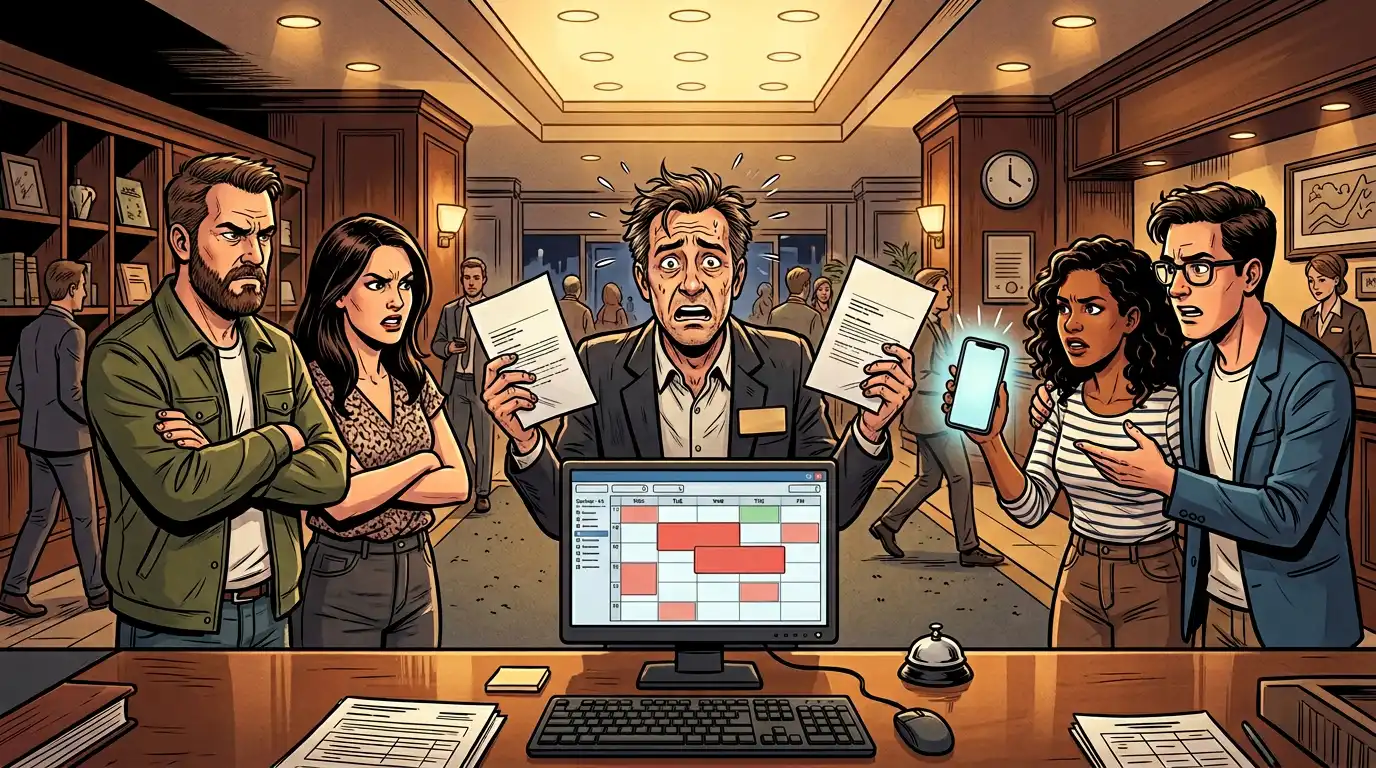
Running a PMS and channel manager as separate, unconnected tools is like having a brain and a voice that do not communicate. The brain knows the room is booked, but the voice keeps telling the world it is available. By the time someone manually updates the other system, another guest may have already booked the same room on a different platform.
Channel manager and PMS integration solves this by creating a seamless two-way data flow:
When a reservation is made on any channel, the integrated PMS channel manager system instantly updates availability everywhere. The booking appears in your PMS calendar, and the channel manager simultaneously closes that inventory on all other platforms. The window for double bookings shrinks from hours (in a manual workflow) to seconds.
For any property manager handling more than a handful of units, eliminating double bookings is not a convenience, it is a necessity. Every double booking costs you a guest, a review, and potentially a platform penalty.
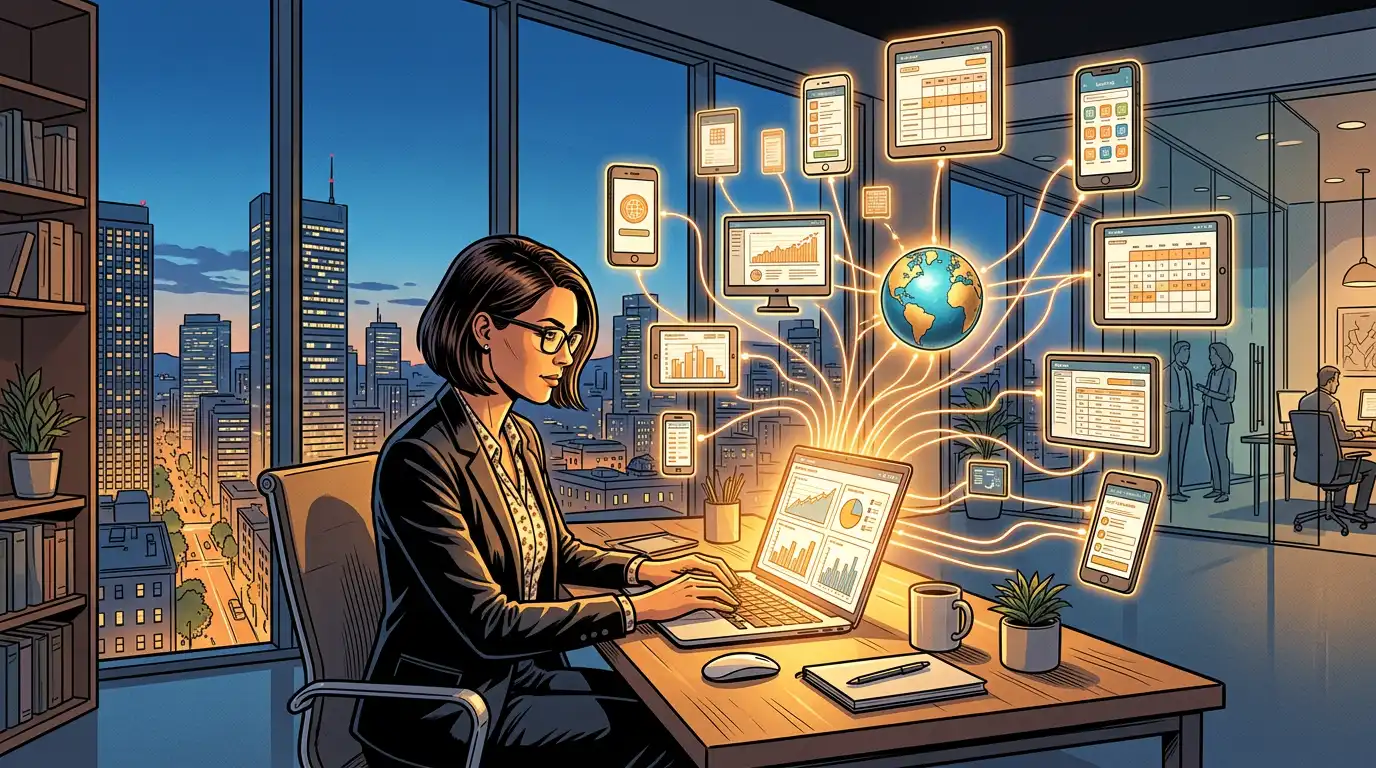
Without integration, every rate change, availability adjustment, or restriction update must be made in both systems, and often on each OTA individually. A property manager with 20 units across five platforms is looking at dozens of manual updates for a single price change. With a properly integrated PMS and channel manager, a single update in the PMS automatically propagates to every channel within seconds.
Dynamic pricing, adjusting rates in response to demand, competition, seasonality, and events, is impossible to execute effectively through manual processes. By the time you have logged into five platforms and updated rates on each, the market has already moved. An integrated PMS channel manager system applies dynamic pricing rules once and pushes them everywhere simultaneously, ensuring your rates are always competitive and optimised.
With full channel manager integration, every booking, regardless of origin, flows into your PMS automatically. There is no need to manually enter OTA reservations, no risk of transcription errors, and no delay between booking and confirmation. Your reservation management workflow becomes a single, unified process rather than a fragmented patchwork.
Effective revenue management depends on accurate, real-time data. An integrated PMS and channel system provides it: occupancy data from the PMS, channel performance data from the channel manager, and performance reports that combine both to show where revenue is coming from, where it is leaking, and where opportunity lies.
One of the most powerful benefits of a properly integrated hotel PMS and channel manager setup is the ability to drive more direct bookings through your own website.
Here is how it works: your channel manager connects not only to third-party OTAs but also to your own booking engine, the reservation widget embedded on your property's website. When a potential guest finds you through an OTA, sees your brand, and visits your website directly, the booking engine powered by your integrated system offers them real-time availability and rates, often at a slight discount compared to OTA prices (since you are saving the commission).
The PMS and channel manager integration ensures that:
Every direct booking you capture saves you the 15–25% commission that OTAs charge. Over a year, shifting even 10–15% of your bookings from OTAs to direct can represent tens of thousands in saved commissions. A strong booking engine backed by integrated property management software and channel management tools is the foundation of this strategy.
Not all management software is built equally, and the right choice depends on the size, type, and complexity of your operation.
If you operate a property with fewer than 20 rooms, look for an all-in-one platform that combines PMS and channel manager functionality in a single interface. This avoids the complexity and cost of maintaining two separate systems and ensures native integration without third-party middleware. Key features to prioritise: simplicity, mobile access, built-in booking engine, and support for the OTAs dominant in your market.
Properties with 20 to 100 rooms typically need more robust property management software with dedicated modules for housekeeping, revenue management, guest communication, and group bookings. At this level, a dedicated channel manager with broad OTA connectivity and global distribution systems access becomes important. Ensure the channel manager integration with your chosen PMS is certified and two-way, not a one-directional data feed.
A vacation rental business has different needs from a traditional hotel. You may manage properties across multiple booking platforms that skew heavily toward Airbnb and Vrbo rather than traditional OTAs. Look for a PMS channel manager combination that excels on short-term rental platforms, supports multi-property management, handles varied check-in/check-out times, and integrates with smart locks, cleaning scheduling, and guest communication tools designed for self-service stays.
A property manager overseeing dozens or hundreds of units across different locations needs enterprise-grade channel management with centralised dashboards, portfolio-wide performance reports, consolidated revenue management, and the ability to manage room inventory across properties from a single login. Scalability and API flexibility are critical at this level.
When assessing PMS and channel manager options, use this checklist:
The entire value of channel management hinges on speed. Ask how quickly availability updates propagate to connected channels after a booking is made. The best systems achieve real-time synchronisation within seconds. Anything slower than two minutes introduces unacceptable double booking risk, especially for properties with limited inventory.
How many distribution channels does the channel manager support? More importantly, does it connect to the specific online travel agencies OTAs, global distribution systems, and platforms that matter for your market and guest profile? A channel manager with 300 connections is useless if it does not include the three platforms that drive 80% of your bookings.
True channel manager and PMS integration is bidirectional. Rates, availability, and restrictions flow from the PMS to the channel manager and out to channels. Bookings flow back from channels through the channel manager into the PMS. Guest details, payment information, and special requests should all transfer automatically. Verify the depth of integration, some connections pass only basic data, leaving you to manually handle the rest.
Your booking engine is your direct sales channel. Evaluate it as critically as you would any revenue-generating tool. Is it mobile-optimised? Does it support promo codes, packages, and upsells? Is it fast and visually consistent with your brand? Does it show real-time room availability and support secure payment processing? A weak booking engine undermines your entire direct bookings strategy.
Does the system support dynamic pricing natively, or does it integrate with third-party revenue management tools? Can you set automated rules based on occupancy thresholds, lead time, day of week, and seasonality? Dynamic pricing is no longer a luxury, it is a baseline expectation for any competitive accommodation business.
Both your PMS and channel manager should produce actionable performance reports. From the PMS side: occupancy, ADR, RevPAR, guest demographics, and operational metrics. From the channel management side: bookings by channel, revenue by channel, cancellation rates by channel, and commission costs. Combined, these reports power smarter revenue management decisions.
Automated guest communication, pre-arrival instructions, in-stay check-ins, post-departure review requests, saves hours of manual messaging and improves the guest experience. Evaluate whether these tools are built into the PMS, available as add-ons, or handled by third-party integrations.
The cheapest management software is rarely the most cost-effective. A system that costs $50 less per month but causes three double bookings a year has paid for the premium option in refunds, penalties, and lost reviews. Evaluate total cost of ownership, including the cost of problems the software prevents.
Two excellent standalone systems that integrate poorly will cause more problems than two good systems that integrate seamlessly. Before committing, ask for references from properties that use the same PMS and channel manager combination and specifically ask about integration reliability.
Connecting to every possible OTA from day one is tempting, but each connected channel requires management, content updates, rate parity monitoring, review responses, and platform-specific policies. Start with three to five core distribution channels, optimise your presence on each, and expand gradually as your channel management workflow matures.
Many operators connect to multiple online travel agencies and stop there, treating OTAs as their sole booking source. This is expensive and strategically vulnerable. From day one, invest in your booking engine, your website, and marketing that drives more direct bookings. The integrated PMS channel manager system makes this operationally seamless, but you still need to drive the traffic.
Property management software and channel management tools are only as effective as the people using them. Budget time for thorough training, create standard operating procedures, and designate a team member as the internal system expert. Undertrained staff will revert to manual workarounds, negating the efficiency gains the technology was meant to deliver.
The hospitality technology landscape is evolving rapidly, and several trends are reshaping how hotel PMS and channel manager systems work:
Machine learning is moving dynamic pricing from rule-based automation to predictive intelligence. Future systems will analyse competitor rates, local event calendars, weather forecasts, search demand, and booking pace to set optimal pricing automatically, adjusting multiple times per day across all distribution channels without human intervention.
As PMS and channel manager systems deepen their integration, the guest profile is becoming truly unified. A guest who booked through Booking.com last year and directly this year is recognised as the same person, with preferences, history, and communication records merged into a single profile that informs personalised guest communication and service delivery.
The future of property management software is open and modular. Rather than monolithic platforms that try to do everything, the trend is toward best-of-breed tools connected through robust APIs. Your PMS, channel manager, revenue management tool, guest communication platform, and booking engine may come from different providers but function as a seamless whole through deep channel manager integration and standardised data exchange.
New distribution channels continue to emerge, social media booking features, voice search through smart assistants, AI travel planners, and niche platforms targeting specific traveller segments. A flexible channel manager with broad connectivity and rapid onboarding of new channels will be essential for staying visible where tomorrow's guests are searching.
The choice of PMS and channel manager is one of the most consequential technology decisions a hospitality operator makes. It affects every reservation, every guest interaction, every financial report, and every revenue opportunity. Getting it right means smoother operations, fewer double bookings, smarter revenue management, stronger hotel multi-channel distribution, and a clear path to capturing more direct bookings.
The operators who thrive in today's competitive market are not necessarily the ones with the biggest properties or the best locations. They are the ones with the best systems, the ones whose channel manager and PMS integration works flawlessly, whose real-time synchronisation eliminates errors before they happen, and whose performance reports turn data into decisions.
The technology exists today to run your property with a level of precision and automation that was unimaginable a decade ago. The question is not whether to integrate your PMS and channel manager, it is how quickly you can get it done.