Hotel Organizational Structure: Hotel Hierarchy and Management
 Mika Takahashi
Last updated Sep 15, 2025
Mika TakahashiRunning a hotel isn’t your typical 9-to-5 job—it’s a round-the-clock operation that demands smooth coordination across departments, staff shifts, and guest interactions at every hour. Because hotels operate 24/7 and focus heavily on guest satisfaction, having a solid hotel organizational structure isn’t just helpful—it’s essential.
Think of the hotel organizational structure as the backbone of your property. It connects every role, from the general manager right down to the front desk staff, laying out clear lines for communication, accountability, and decision-making. Whether you’re managing a cozy boutique inn or a sprawling resort, knowing how to organize your team effectively can be the difference between chaos and smooth sailing.
In this guide, we’ll walk you through everything you need to understand about hotel organizational structure—from the basics to practical tips that boost both operational efficiency and guest happiness.
At its core, a hotel organizational structure is a hierarchy that spells out who does what and who reports to whom within your hotel. It’s the framework that channels authority from senior management down through the various departments and individual roles, making sure daily operations run like clockwork.
Usually, this structure is shown in an hotel organizational chart—a visual map of how departments connect and communicate to deliver great guest experiences. These hotel organizational charts help staff see the big picture and understand their place within it, clarifying reporting lines and teamwork across the property.
What sets hotel organizational structures apart from other businesses is the nonstop nature of hotel operations and the laser focus on guest service. Hotels must deliver consistent quality across multiple shifts, coordinate between departments like housekeeping and front office, and respond swiftly to guest needs any time of day. That means your structure needs to encourage fast communication, clear accountability, and smooth collaboration between departments.
A well-thought-out hotel organizational structure is the foundation for running a great hotel. It affects everything from how happy your guests are to how well your finances hold up. The benefits go way beyond just organizing your staff—they make a real difference in how your hotel performs.
Here are some key perks of having an effective hotel organizational structure:
• Better Guest Satisfaction: When everyone knows their role, guests get consistent, smooth service at every touchpoint—from check-in to housekeeping.
• Improved Operational Efficiency: Clear responsibilities cut down confusion, avoid duplicated work, and keep day-to-day operations humming.
• Stronger Staff Retention and Career Growth: Transparent reporting lines and advancement paths help employees see their future and stay motivated.
• Effective Crisis Management: Well-defined communication channels mean quick, coordinated responses when unexpected issues arise.
• Better Financial Control: When departments are accountable for their budgets, managing costs and maximizing revenue becomes easier.
• Streamlined Communication: Direct communication between departments prevents bottlenecks and ensures important info reaches the right people fast.
Guest satisfaction truly benefits when staff understand their roles and collaborate effortlessly. This means smoother guest check-ins, faster room service, and quicker problem-solving—all translating into positive reviews and repeat visitors.
On the financial side, properties with clear hotel organizational structures tend to have stronger hotel revenue management and better cost control. Department heads can manage their budgets confidently, and senior leaders get accurate reports to make informed decisions.
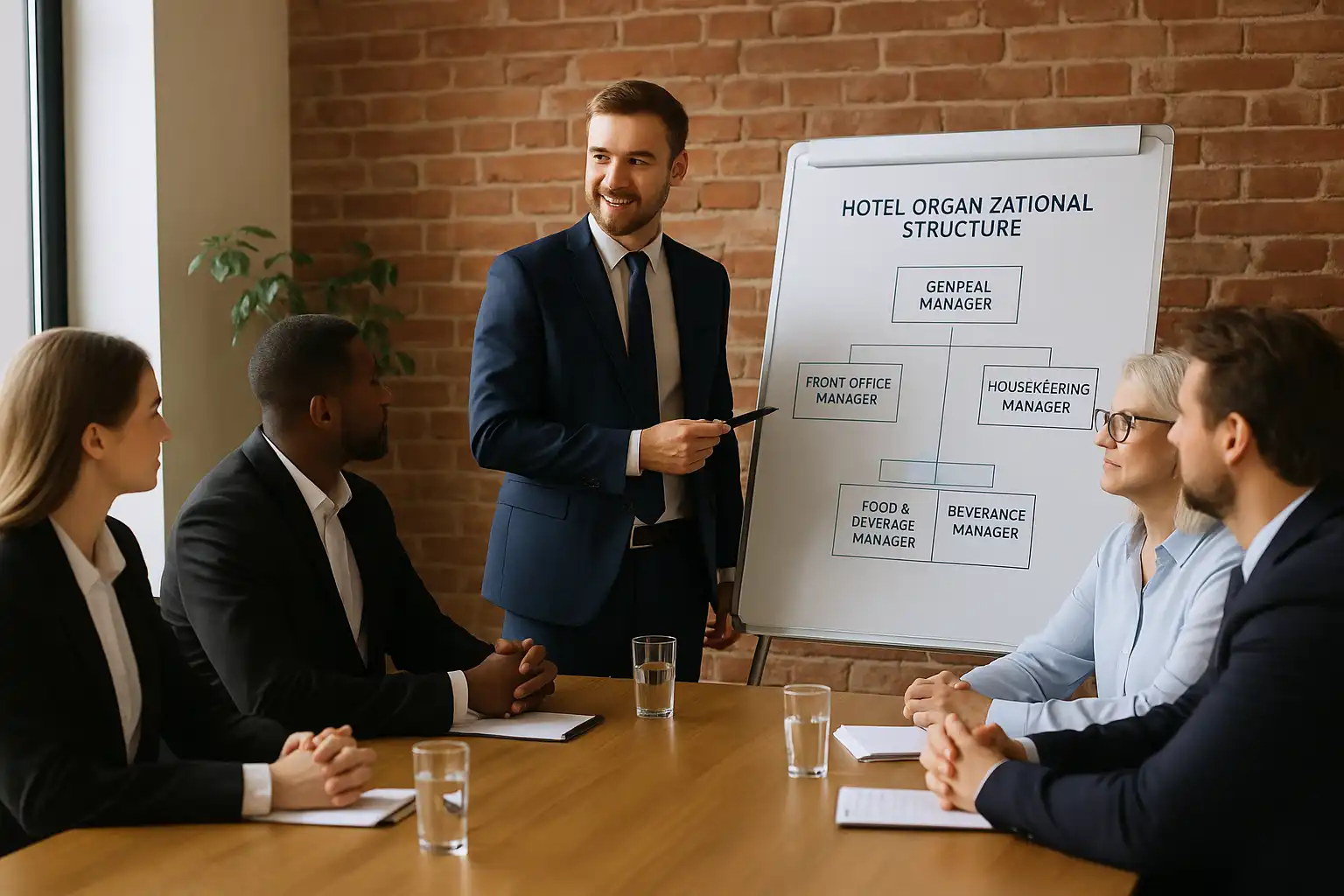
Hospitality properties come in all shapes and sizes, and so do their hotel organizational structures. Different structures suit different property sizes, service levels, and operational needs. Here’s a quick look at the most common types:
This is the classic top-down setup, with the general manager at the top and a clear chain of command flowing through department heads to operational staff. It’s perfect for large hotels and international chains like Marriott or Hilton, where standardized procedures and multiple management layers keep things running smoothly.
Pros:
Cons:
Here, the hotel is divided into specialized departments like Front Office, Housekeeping, Food & Beverage, and Sales & Marketing. Each department is led by experts focused on their area. This setup works well for medium-sized hotels with diverse services but fewer management layers.
While specialization boosts departmental efficiency, it can sometimes create silos that hinder cross-department communication, potentially impacting the guest experience.
The matrix structure blends functional and project-based reporting. Employees report to both their department head and project managers, which is handy for hotels with big events or multiple revenue streams.
For example, during a large conference, staff from Sales, Food & Beverage, Housekeeping, and Engineering might all report to an event manager while maintaining ties to their departments. This boosts flexibility but requires clear communication to avoid confusion.
Flat structures cut down on management layers, promoting direct communication between the general manager and front-line supervisors. This is common in boutique hotels, B&Bs, and smaller properties under 50 rooms.
It speeds up decision-making and empowers employees but might limit career progression and create role ambiguity as staff juggle multiple responsibilities.
Knowing the main departments helps you see how each contributes to the hotel’s success. Every department plays a vital role in delivering great guest experiences while keeping operations efficient.
The executive team sets the hotel’s direction and oversees overall performance, financial health, and long-term planning.
These departments directly bring in money through guest services and amenities.
These teams keep the hotel running smoothly behind the scenes.
The size of your hotel shapes how complex your organizational structure needs to be.
Small hotels often have flat structures with 10-25 employees. The general manager wears many hats, sometimes acting as operations manager and sales director. Staff are cross-trained and flexible, often juggling multiple roles.
Reporting lines tend to be straightforward, with the general manager directly overseeing department supervisors. This setup fits boutique inns, independent hotels, and B&Bs where personalized service and flexibility matter most.
Medium-sized hotels shift to functional structures with clear department heads. Staff numbers grow to 25-100, so more formal coordination and communication channels are needed.
Assistant managers start appearing in key departments to help oversee operations. HR and accounting functions become more defined, supporting the hotel’s growing complexity.
Examples include select-service hotels and resorts with diverse amenities.
Large hotels use hierarchical or matrix structures with multiple management layers to handle complex operations. Staff numbers exceed 100, requiring specialized roles like revenue managers, event coordinators, and training managers.
These hotels often have several assistant managers and supervisors for each department, ensuring tight control and smooth service delivery.
Examples include full-service luxury hotels and convention centers.
Building a useful hotel organizational chart takes planning, design, and regular updates.
Start by assessing your current operations and listing all roles. Get input from department heads and senior staff—they know where communication gaps or inefficiencies might be hiding.
Think about future growth too. Your structure should be flexible enough to handle renovations, new amenities, or more guests without needing a full overhaul.
Pick a chart style that fits your hotel’s complexity. Hierarchical charts work well for traditional setups, while matrix charts better show cross-functional teams.
Include job titles, department names, and brief role descriptions so everyone understands who does what. Using tools like Lucidchart or Microsoft Visio can make creating and updating charts easier.
Test the chart with staff before rolling it out. Their feedback can help you spot confusing parts or missing info.
Review your chart regularly—ideally quarterly—to keep it current. Update it immediately when roles change or new positions are created.
Make sure everyone knows where to find the latest version, whether on your intranet or shared drives, so staff always have access to up-to-date info.
The sample hotel organizational structure presented here provides a clear overview of the hierarchy and key roles within a typical hotel. At the top is the General Manager (GM), who oversees overall operations, financial management, and guest satisfaction. Supporting the GM is the Assistant General Manager or Resident Manager, who supervises various departments to ensure smooth day-to-day functioning.
The structure is divided into core hotel departments, each led by department managers responsible for their specific areas. The Rooms Division includes the Front Office Manager and their team, handling guest services such as check-in/out, reservations, and concierge support. The Housekeeping department, headed by the Executive Housekeeper, manages room cleanliness, laundry, and overall room readiness... and so on so forth.
| Level | Role / Department | Key Responsibilities |
|---|---|---|
| Top Management | General Manager (GM) | Oversees all operations, budgets, guest satisfaction |
| Assistant GM / Resident Manager | Supports GM, supervises departments | |
| Rooms Division | Front Office Manager | Front desk, reservations, concierge, guest services |
| Receptionists / Guest Services | Check-in/out, billing, guest requests | |
| Reservations Team | Manage bookings, OTAs, direct reservations | |
| Concierge / Guest Relations | Personalized guest services, local assistance | |
| Housekeeping | Executive Housekeeper | Cleaning, laundry, room readiness |
| Room Attendants | Daily room cleaning, upkeep | |
| Laundry Staff | Linens, uniforms, guest laundry | |
| Food & Beverage | F&B Manager | Restaurants, bars, banquets, catering |
| Restaurant/Bar Manager | Outlet-level supervision | |
| Chefs & Kitchen Staff | Food prep, menus, hygiene | |
| Servers / Bartenders | Food & beverage service | |
| Sales & Marketing | Sales & Marketing Manager | Contracts, group bookings, events, promotions |
| Marketing Executives | Social media, branding, campaigns | |
| Finance | Finance Manager / Controller | Budgets, payroll, financial reporting |
| Accounting Clerks | Billing, accounts, daily revenue | |
| HR | HR Manager | Recruitment, training, employee relations |
Even the best organizational structures face bumps along the way. Here are some common issues and how to tackle them:
Information can get lost between management layers, leaving front-line staff out of the loop. This leads to inconsistent service and unhappy guests.
Fix this with daily briefings, real-time digital messaging tools, and clear escalation procedures for urgent issues.
When staff aren’t sure about their responsibilities or who to report to, tasks get duplicated or missed.
Clear job descriptions, regular training, and tools like RACI matrices help everyone understand their roles and decision-making authority.
Hotels often add temporary staff during busy seasons, which can disrupt established structures.
Create separate seasonal charts, cross-train permanent staff, and provide orientation for temporary workers so they know how to fit in.
To get the most from your structure:
The best hotel organizational structures strike a balance between efficiency and flexibility, helping properties deliver consistent guest experiences while adapting to change.
Investing time in building and maintaining the right structure pays off with happier staff, delighted guests, and stronger financial results. As the hospitality world evolves, hotels with solid organizational frameworks will be ready to meet new challenges and seize fresh opportunities—all while keeping guest service front and center.