Hotel Front Desk Operations 101
 Mika Takahashi
Last updated Jan 13, 2026
Mika TakahashiFirst impressions are created and relationships that endure a long time are built with front desk operations. The hotel front desk staff sets the tone for everything that happens after guests arrive fatigued from a long flight or eager about a weekend break. If you do this well, you'll have loyalty, good reviews, and repeat bookings. If you make a mistake, no amount of luxuries can make up for it.
In addition to making guests happy, hotel front desk operations have a direct effect on your bottom line. This is where upselling happens, where billing is kept accurate, and where operational coordination makes sure that everything on the property runs well. The front desk in modern hotels isn't just a counter; it's the control tower that handles arrivals, requests during the stay, and departures while working with housekeeping, maintenance, and all the other departments.
Things are different for hotel staff now than they were only a few years ago. The labor shortage that started in 2022 has not yet recovered. People increasingly expect quick answers by SMS or WhatsApp, not simply phone calls. The move to contactless and mobile workflows after COVID isn't just a fad; it's the new normal. Because of these demands, it's important to work smarter, not simply harder.
Prostay is a hotel management system that was made not just for independent hotels and small hotel groups but to large hotel chains alike to make front desk work easier. It has everything your front desk needs in one system, including PMS, a channel manager, a booking engine, guest messaging through Prostay Nexus, point-of-sale with Tableview, and AI tools for operations.
This hospitality blog article covers all the front desk tasks that need to be done throughout a guest's stay, including preparing for their arrival, checking them in, providing service during their stay, checking them out, following standard operating procedures (SOPs), using technology, and best practices for managing the front desk.
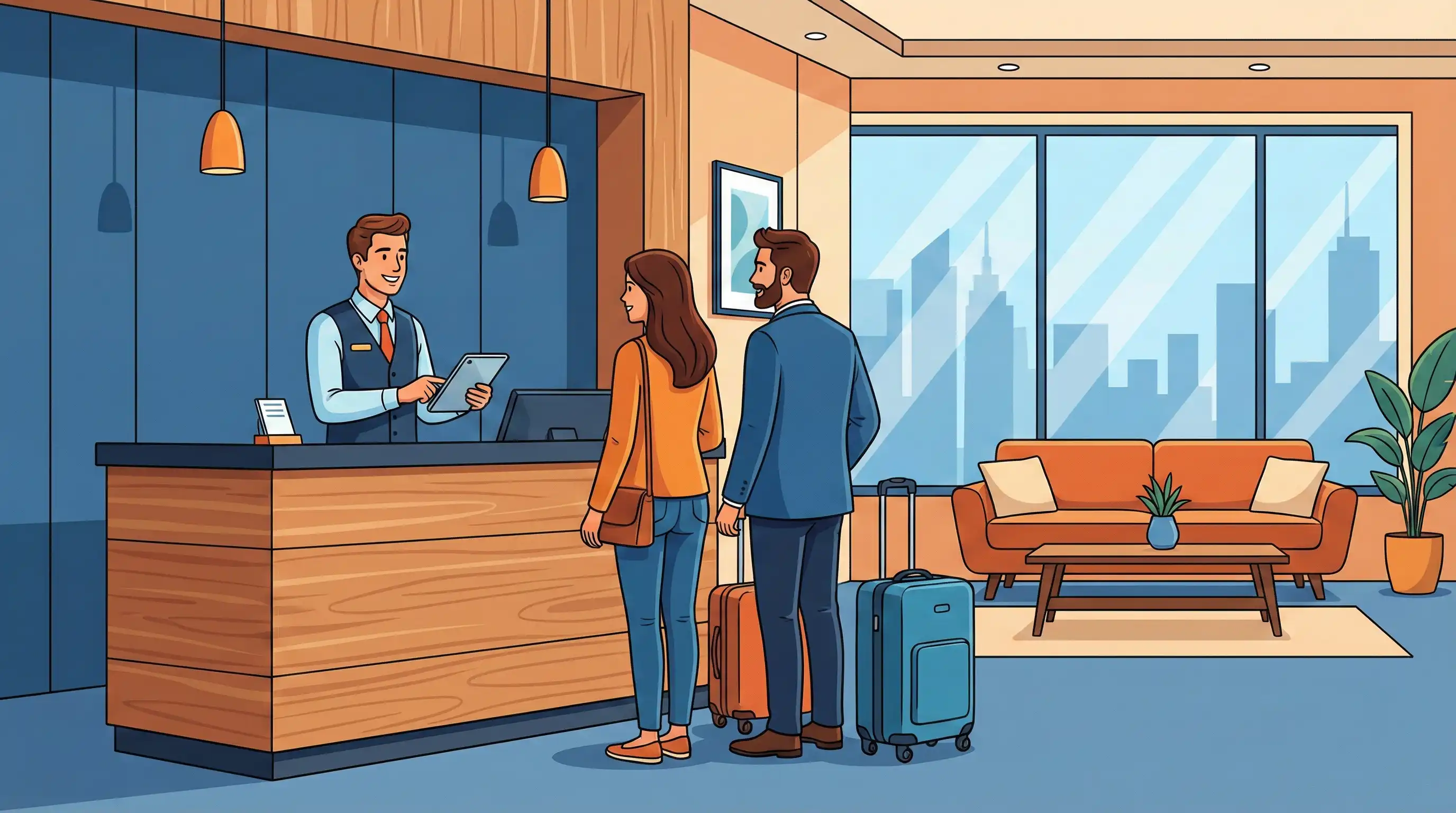
Depending on where guests are in their journey, the hotel front desk operations has different duties. Here is a short list of responsibilities broken down into four main phases:
Pre-Arrival
Arrival
In-Stay
Departure
The 24 to 72 hours before a guest comes are very important for making check-in easier and preventing calamities caused by overbooking. At this point, your hotel front desk staff may stop problems before they happen instead of responding to them.
A modern PMS like Prostay can automate a lot of this work before the guest arrives. You don't have to do anything to send out confirmations, reminders, and links to check in early. The most important thing is to handle all of the tasks that need to be done before arrival in one system. This will keep you from having to use spreadsheets and enter data twice, which can lead to mistakes.
A channel manager should send all of your reservations in real time to your PMS. This includes reservations made through OTAs like Booking.com, Expedia, and Airbnb, as well as those made directly through your website and by walk-ins. This gets rid of the need for manual updates, which might cause double bookings during busy times.
Room allocation strategies matter more than many hotels realize:
Payment card information must be tokenized and processed through gateways that meet PCI standards. Don't keep card numbers on paper or in email conversations. Your PMS should take care of this safely.
Mark important dates in the system, such New Year's Eve, big local events, and conferences, when the chance of overbooking is higher. During these times, stronger prepayment procedures and better monitoring of prospective reservations are usually needed.
Hotels can send secure pre-arrival forms with guest information, ID uploads where allowed by law, and expected arrival times directly from Prostay or other PMS tools. This gathers information before guests arrive, which speeds up and personalizes check-in.
Pre-authorizing cards 24 to 48 hours before arrival does two things: it cuts down on no-shows and makes check-in go much faster. When payment is already verified, the staff at the counter may focus on welcome customers instead of processing payments.
Practical examples of pre-arrival data collection:
If a prepayment or deposit is still due the day before arrival, automation rules can send reminders. This way, your front desk staff won't have to chase payments during busy check-in times.
A simple template structure works for good pre-stay communication:
Confirmation email (immediately after booking)
Pre-arrival email (3 days before)
Morning-of-arrival reminder
Every message should have useful information, such links to digital guidebooks, Wi-Fi basics, and FAQs that address frequent issues before guests ask them.
Using Prostay Nexus or a similar guest messaging service to start a WhatsApp or SMS chat before the guest arrives makes it easy to get unique requests. This proactive way of meeting guest requirements before they arrive can cut down on calls to the front desk by 30–40%, which frees up workers during busy times.
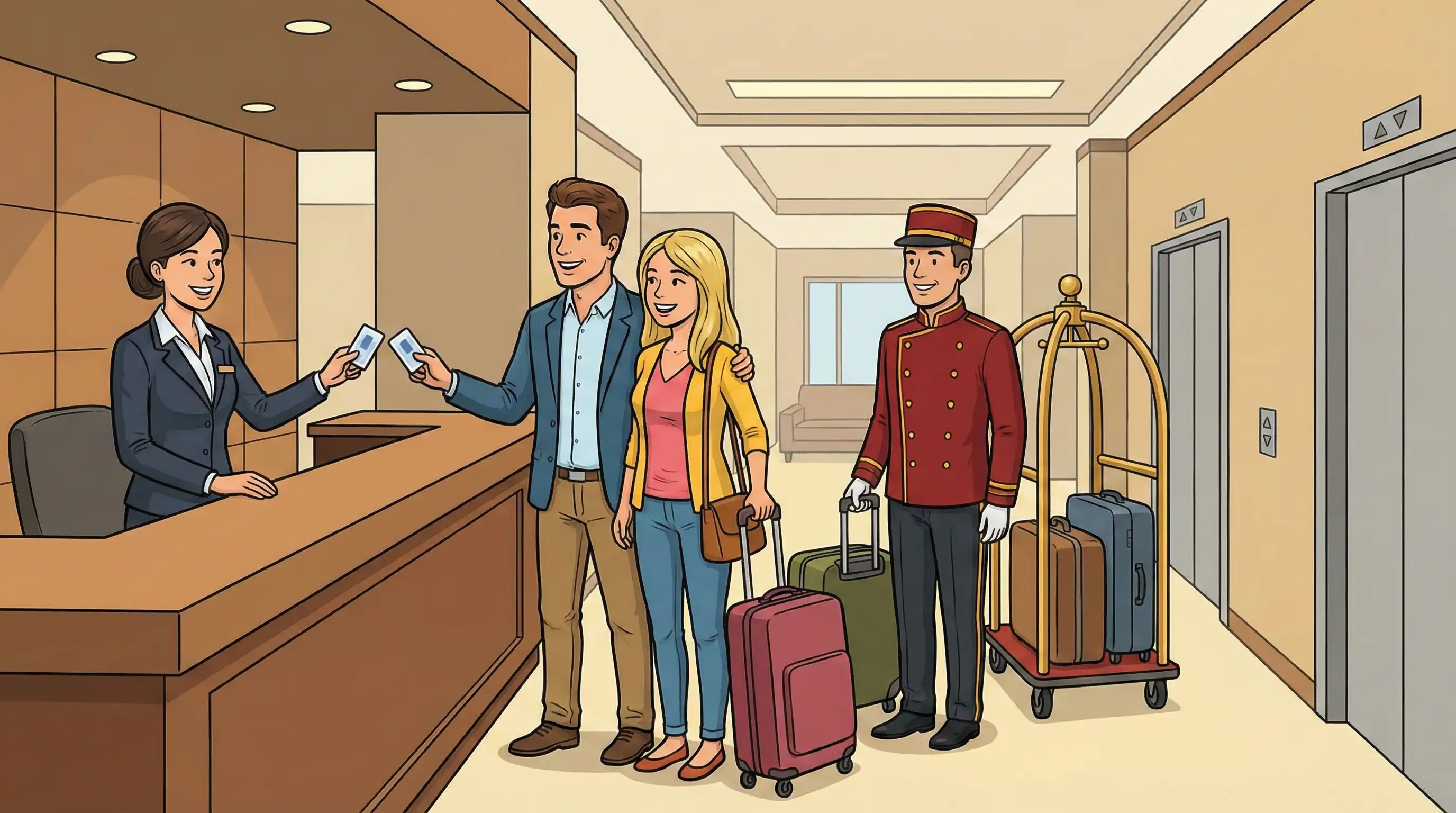
Guests come from all over the place. Some are fatigued from long flights, some are rushed from back-to-back meetings, and some are eager about their holiday. The initial five minutes at the front desk are really important, no matter how they feel. A smooth and friendly check-in process shows that they made the right choice in staying with you. A frustrating one makes them mistrust everything about their stay.
The goal at busy times is to keep the average check-in time for each party to 3 to 5 minutes. This needs a mix of technology, process design, and well-trained front desk staff who can handle a variety of circumstances.
Modern hotels provide several ways for guests to check in to meet their hotel front desk necessities:
A well-designed check-in process follows a clear, step-by-step flow:
During check-in, get or confirm the guest's email address and permission to talk to them. This makes it possible to send marketing and transactional messages in the future that lead to direct bookings.
Practical tips for managing high-volume check-in periods:
Imagine a Friday night in a city hotel with 100 rooms and a lot of OTA traffic. A lot of guests come between 4 and 7 p.m. When there aren't clear processes, guests have to wait longer, complaints grow, and the desk staff is more stressed.
A cloud PMS with a built-in booking engine and channel manager stops overbookings, which are what cause check-in delays. Your front desk staff never has to explain why a confirmed reservation doesn't have a room when room availability is updated in real time across all channels.
Pre-checking in via a mobile device or the web changes the way you arrive. Before they arrive, guests fill out their information, sign digital registration cards, and upload their IDs. The front desk just has to give customers their keys when they arrive, which takes 60 seconds instead of 5 minutes.
AI-powered technologies can recommend extras upon check-in based on how long you stay and how many others are staying:
Guest messaging tools provide automatic welcome messages with the room number, Wi-Fi password, and digital compendium just after check-in is done in the PMS. This cuts down on the "where do I find..." questions that get in the way of the front desk's work.
People make experiences, but technology manages transactions. When you arrive, you should follow these front desk rules:
Standard scripts help desk agents handle common situations consistently:
Early arrivals when rooms aren’t ready: “Welcome! Your room is still being prepared, but we’d be happy to store your luggage and offer you a complimentary coffee in our lobby café while you wait. We’ll message you as soon as it’s ready.”
Sold-out nights with walk-ins: “I’m sorry, but we’re fully booked tonight. Let me check availability for tomorrow, or I can recommend a partner property nearby that may have rooms.”
Always give customers a concrete answer, like letting them store their bags, enter the lobby, or get discounts at the café while they wait for their rooms. Always provide guests a next step.
Write down any promises given at check-in right in the PMS notes. If you pledge to let people check out late on July 14 at 2 p.m., every shift must be able to observe and keep that promise.
After check-in, the hotel front desk team is your concierge, problem solver, and information center for the rest of your stay. First impressions are important, but how fast you deal with problems throughout a stay might have a bigger effect on ratings than a faultless welcome.
Tracking is what makes operations good instead of outstanding. Instead of using post-it notes or radios that leave gaps between shifts, centralized solutions like Prostay make sure that every request is registered, tracked, and closed.
Handling guest complaints effectively follows a structured approach:
Specific examples your hotel front desk team will encounter:
| Issue | Immediate Action | Follow-Up |
|---|---|---|
| Noisy room on Saturday night | Offer room move or noise complaint to security | Check next morning, offer gesture of goodwill |
| Air conditioning failure | Send maintenance immediately, offer portable fan or room move | Confirm repair, check comfort level |
| Wi-Fi connectivity issues | Restart router remotely, dispatch IT if needed | Verify connection restored |
| Minibar overcharge dispute | Review POS records, credit if error confirmed | Document for future reference |
Every problem should be recorded as a task in the PMS or service management module, with a department in charge (engineering, housekeeping, F&B) and a clear due date. This makes people responsible and makes sure that nothing gets missed.
Many visitor problems are reported and fixed without guests having to come to the desk in person thanks to guest messaging by WhatsApp, SMS, or webchat. This makes things easier for guests and cuts down on crowding in the lobby.
The PMS has to know the live room status—clean, dirty, inspected, or out of order—in order to make accurate promises concerning early check-ins and room changes. Front desk staff make promises that cleaning can't keep if they don't have real-time data.
Prostay and other similar programs offer housekeeping apps that let you get updates right away. Room attendants use their phones to mark rooms as clean. Supervisors check and provide their approval. The front desk notices the change right away, with no phone calls or misunderstandings.
Real-world coordination examples:
The hotel front desk operations should be able to see maintenance tickets in real time and explicitly tell visitors when they may anticipate the problem to be fixed. "We'll look into it" is not as good as "Our engineer is on the way and should have this fixed in 30 minutes."
In-stay upselling drives incremental revenue without acquisition costs. Front desk agents should actively promote:
Use PMS data to target offers intelligently:
| Condition | Offer |
|---|---|
| Rainy forecast | Last-minute spa appointments |
| Low next-day occupancy | Late checkout at discounted rate |
| Midweek business travelers | Dinner-and-drink package |
| Families with children | Kids activity booking |
One system should give hotel front desk staff easy access to availability and prices. Calling each department to confirm spa appointments or restaurant tables slows things down and makes clients angry.
Prostay's reporting can show how much money each front desk agent makes from upselling, which helps with incentive programs and performance assessments that keep the staff motivated.
The PMS timeline must include all passenger interactions that affect billing, room status, complaints, or promises. This makes it possible for every staff member to look up the same information.
An effective shift handover includes:
Instead of handwritten logs that can get lost or hard to read, use standardized digital handover forms in the PMS or intranet. Time-stamped notes are important for settling disputes because chargebacks and complaints after a stay typically need proof from weeks before.
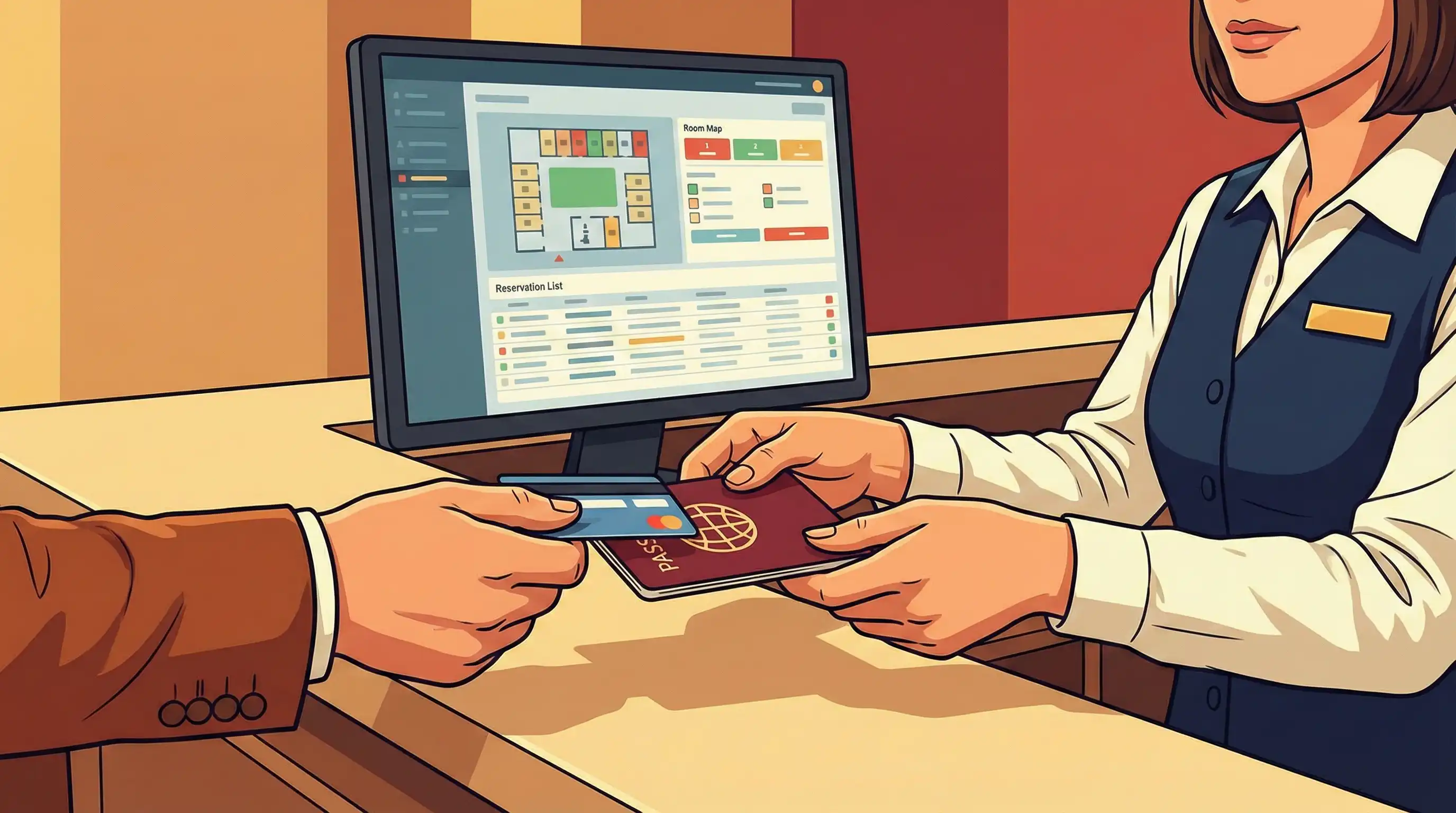
The last touchpoint on the property is checkout, which has a big effect on online reviews and direct rebookings. Guests will remember their stay fondly if they leave on time. A frustrating one, such contested charges, long waits, or misunderstanding, wipes off any goodwill that was built up during the stay.
Modern hotels should offer multiple checkout options:
Fast checkouts have a direct effect on how quickly rooms are ready for guests that arrive the same day. Housekeeping can start earlier and guests can check in earlier when they leave swiftly.
The basic checkout steps:
For accurate billing, all POS systems, including those in restaurants, bars, spas, and room service, need to be connected to the PMS in real time. By the time a guest checks out at 11 a.m., the drink they ordered at 10 p.m. should be on their folio.
Set operational cut-off times for late fees. For instance, minibar inspections should be done before 11:00 PM so that last-minute additions don't slow down checkout in the morning. This cuts down on arguments and having to send another bill after leaving.
There should be clear signs in the elevator, lobby, and before leaving indicating checkout times and options. messages—reduces front desk congestion at 11:00 when many guests try to depart simultaneously.
Checkout is the right moment to ask two simple questions:
These short conversations often bring up problems that people never formally complained about. If you can, talk to them right away. A small act of kindness at checkout can stop a bad review.
Surveys provided by email or SMS within 24 hours of a stay get more responses than surveys sent days later. When the PMS status switches to "checked out," these should happen automatically.
A smart approach to reviews:
| Guest Sentiment | Action |
|---|---|
| Very satisfied | Direct to Google, Booking.com, or TripAdvisor review |
| Neutral | Send feedback survey for internal improvement |
| Dissatisfied | Route to private channel with manager follow-up |
Prostay keeps guest preferences and opinions in one place, which makes it possible to send customized loyalty offers for future direct bookings. You can allocate the right accommodation ahead of time when a guest who enjoys corner rooms with views of the city books again.
Written SOPs are important for making sure that shifts, properties, and new hires all do things the same way. Without them, the quality of service depends on who is working. With them, every guest has a great experience, no matter when they arrive or who greets them.
SOPs shouldn't merely be in printed binders that no one opens; they should be in a shared digital space, like an intranet or PMS knowledge base. Make them easy to find, change, and get to from any device.
Good SOPs cover both the stages in a process and the way people act when they are providing a service. For example, they set response time goals, the tone of communication, and the measures to take when problems are too big for the front desk to handle.
Core SOP topics every hotel needs:
Make sure that hotel front desk agents (FDA) and managers are involved in writing SOPs. They know more about how things work in the actual world than management theory. SOPs that don't get input from people on the front lines often leave out important stages or ask for things that aren't possible.
Add screenshots or brief screen recordings that show how to do things in the PMS or messaging tools. Visual guides cut down on training time and provide people something to look at when they need to learn how to do something odd.
Use version control and look over your SOPs at least twice a year. Policies change, technology changes, and methods that made sense six months ago might not work anymore.
Front desk training should blend system skills with soft skills:
System Skills
Soft Skills
Structure a 30-day onboarding program for new front desk agents:
| Week | Focus |
|---|---|
| 1 | Shadowing experienced agents, system login and navigation |
| 2 | Supervised check-ins and checkouts with mentor present |
| 3 | Independent shifts with mentor on call |
| 4 | Solo shifts with daily debriefs |
Key KPIs to track for desk operations:
Prostay's reporting gives hotel groups front desk-level analytics for numerous properties, which makes it easy for front desk managers to find out who needs training and who is doing the best work.
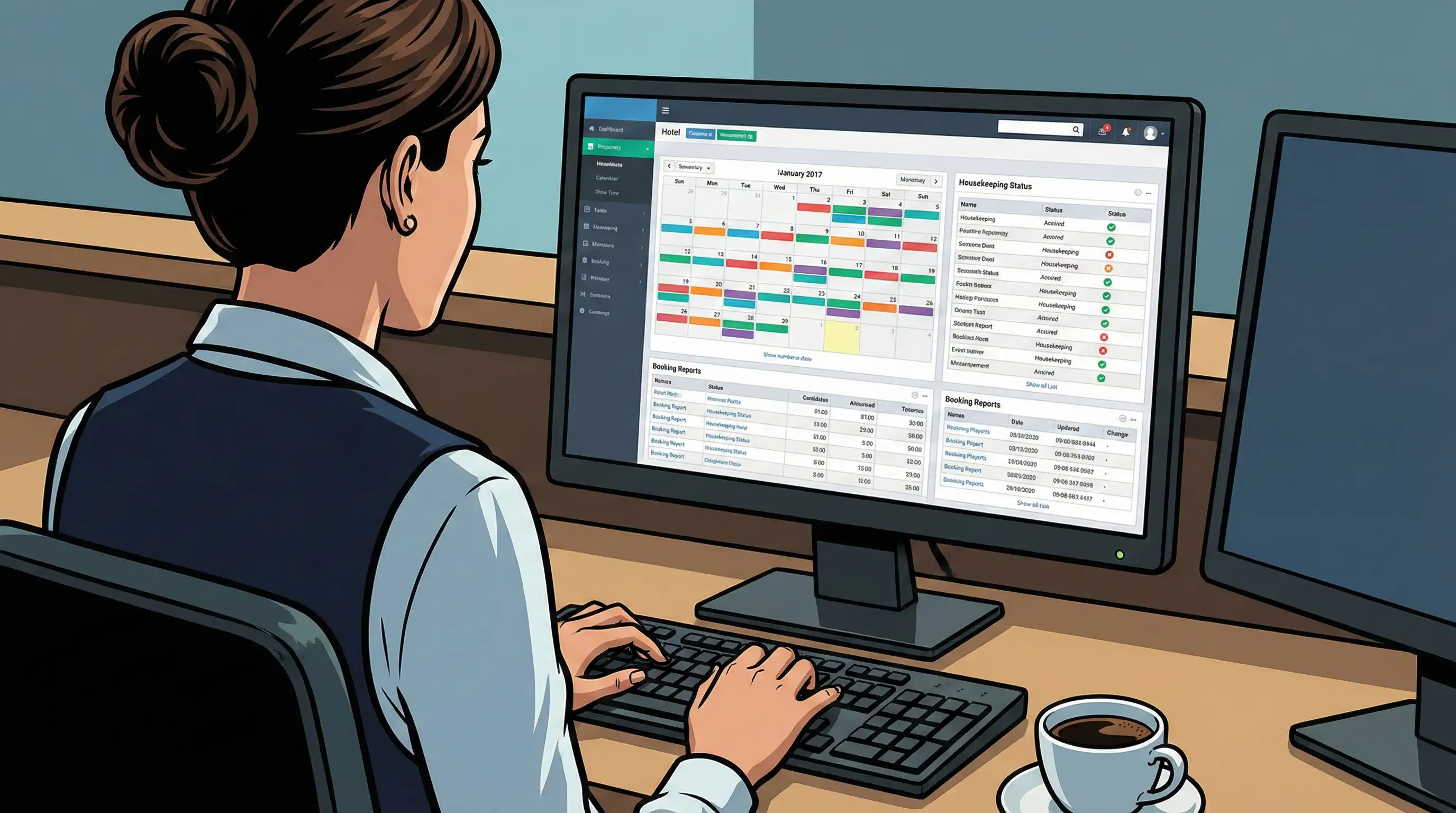
Independent hotels can now use technologies that was only available to big companies. Integrated PMS, AI chat, mobile check-in, and centralized analytics are now available to everyone, not just businesses. The correct technology stack changes the way the front office works from putting out fires to providing service before problems happen.
Prostay brings all of these features together on one platform, so you don't have to deal with multiple systems that don't talk to each other.
The main database for rooms, reservations, rates, and guest profiles is a cloud PMS. Staff can use it from any device that is linked to the internet, such as a desktop computer at the front desk, a tablet in the lobby, or a smartphone for managers who are on the go.
The channel manager keeps availability and prices up to date across all OTAs in real time. Booking.com, Expedia, and Airbnb all block a room as soon as it sells. No more double bookings that make checking in a hassle and cost a lot of money to fix.
The booking engine is the part of your hotel's website where people may book directly. Front desk agents can use it to give guests the best rates and highlight the benefits of booking directly, such as lower rates, more flexibility, or extra privileges.
Prostay puts these components together so that front desk agents can use one system. No transferring between systems, no having to enter data again, and new hires may learn faster.
Unified guest messaging puts all of your emails, texts, WhatsApp messages, and website chats into one inbox. Front desk agents can handle more than one conversation at a time without having to switch tools, and the guest's conversation history stays with them during their stay.
AI-powered assistants are always available to answer common questions:
When AI can't answer a query, the conversation moves up to human personnel, who can see the whole picture.
Automated flows reduce repetitive work:
| Trigger | Automated Action |
|---|---|
| 72 hours before arrival | Send pre-arrival form and pre-check-in link |
| Second night of stay | Send spa or dining upsell offer |
| Morning of departure | Send checkout reminder with folio preview |
| Status changes to “checked out” | Send feedback survey |
This automation frees agents to focus on high-value personalized guest interactions and in-person service where human touch matters most.
Small hotel groups or portfolios might make it easier to book rooms, set pricing, and report on several properties. A front desk supervisor in a city headquarters may keep an eye on live arrivals and occupancy at three suburban properties from one dashboard.
Centralized reporting makes it easier for management to see where properties need training or where their performance is lacking. A lot of disputes at one place could mean that there are problems with the billing process. Slow check-in times at another place can mean that there aren't enough workers during busy times.
Prostay is made for this kind of situation with several properties. It has property-level permissions that let each hotel run its own business while group leadership can see all the data from all the properties.
The hotel front desk manager or supervisor is in charge of guest satisfaction, keeping staff, and training new staff. Strong leadership keeps things running smoothly and keeps personnel motivated, even when things are tough.
The problems that came after the epidemic are still real: more turnover, the need for cross-training, and the requirement to handle both front-office and back-office activities. Leaders who deal with these issues ahead of time make their teams stronger.
The ideal front desk profile combines:
Flexible scheduling strategies anticipate patterns:
Cross-training people to do both front desk and simple reservations or concierge work keeps things running smoothly at busy times. When there are a lot of calls, desk agents can help the reservations team. They can help with concierge duties when the lobby is calm.
Look at your staffing plans every three months based on how many people are staying in the hotel. What works in the first quarter may not work for summer travel.
Typical stress sources for front desk staff:
Better tools ease the stress on the front lines. A concentrated inbox means fewer times when you have to stop what you're doing. AI answers manage everyday questions. Mobile check-in makes lines shorter. Integrated systems make it easier to get what you need by doing rid of the need to seek through many platforms.
Set up regular debriefs following busy times like summer weekends, the Christmas rush, and big events. While the memories are still fresh, go over what went well and what could be better.
Clear escalation frameworks provide agents the authority to make decisions. Set rules for when they can provide guests free breakfast to make up for complaints, when they can approve room modifications, and what needs management approval. Agents who feel trusted make better choices and are less stressed.
Building hotel front desk operations that deliver consistent high guest satisfaction requires attention to three pillars:
Independent hotels and small groups may now give guests the same or better experience than big corporations. The gap in technology has closed. Prostay and other platforms now offer an all-in-one PMS, channel manager, booking engine, and guest messaging system that used to only be available to large companies with big budgets and IT teams.
The perfect mix of automation and personal touch makes operations run smoothly without losing the individualized treatment that makes independent properties stand out.
Are you ready to see how current front desk technology could change the way you do business? Ask for a demo of Prostay to see how automation, AI, and connected technologies can make your guests' stay easier from booking to check-out.