Hotel Central Reservation System: Guide for Modern Hotels
 Mika Takahashi
Last updated Jan 20, 2026
Mika TakahashiManaging hotel reservations entails keeping pricing the same and making sure rooms don't become double-booked while dealing with bookings via Booking.com, Expedia, your own website, corporate travel brokers, phone calls, and walk-ins.
This is a recipe for disaster if you don't have the correct hotel central reservation system.
A hotel central reservation system (CRS) solves this problem by being the main hub for all activities related to selling your rooms. It is the only place where you can be guaranteed that when a guest books a room on an OTA at 2 AM, the room is immediately blocked everywhere else.
In this tutorial, we'll explain what a central reservation system (CRS) does, why it's important for your business, and how to pick the right one for your property, whether you own a small hotel, a vacation rental portfolio, or a growing group of properties.

A hotel CRS is cloud-based software that lets you manage your room rates, availability, and reservations from all the places you sell rooms. This encompasses a lot of different things, like your direct booking engine, call centers, and even guests who stroll in at the front desk.
Think of it as the main hub that knows exactly what you have in stock, how much it costs, and where you can book it, all in real time.
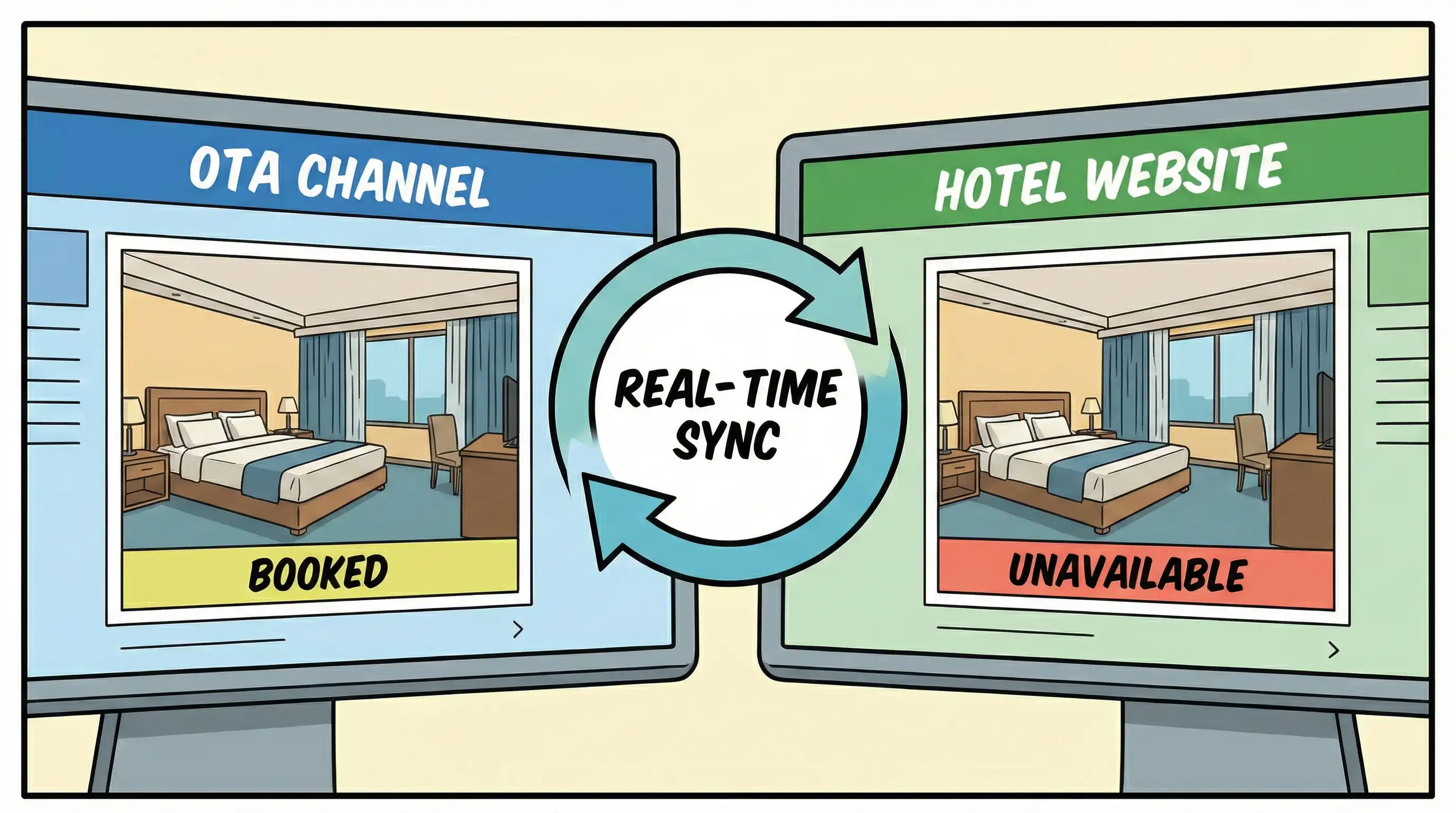
You can use APIs to connect the CRS to your hotel's PMS (property management system), channel manager, and booking engine. The CRS updates availability in all other rooms within seconds of a sale. This real-time availability sync is what stops the hospitality industry from having to deal with overbookings that used to happen all the time before modern systems were in place.
In today's technological stacks, like Prostay, CRS features are generally built into a single hotel platform instead of being a separate product. This means that independent hotels, resorts, hostels, and groups of properties may easily handle reservations from one screen without having to deal with various vendors.
Core CRS capabilities at a glance:
Your hotel distribution will be a jumbled mess without a CRS. You're changing rates by hand on Expedia, then Booking.com, then your own website, all while praying that the travel agents who call your front desk have the right information. Every time a system isn't connected, there is a chance for double bookings, rate mismatches, and wasted money.
A central reservation system prevents this mess by making sure that rates and room availability are the same on all channels at all times.
The effect on the guest experience is immediate: fewer mistakes when booking, instant confirmations, and precise availability even during busy times or big local events. Guests don't show up to find that their room has been sold to someone else, which is one of the worst things that can happen to a hotel.
For hotels who still use spreadsheets, manually update their OTA extranet, or use solutions that don't talk to each other, the hotel central reservation system is a very important step in going digital. It's the base that lets hotels compete well in a market where consumers want booking to go smoothly.
Why a CRS is critical for modern hotel operations:
The practical benefits of a CRS may be seen in the everyday operations of hotels, from the front desk to the monthly reports from the revenue manager. Instead of vague "efficiency gains," these are real changes that hotel managers see within weeks of putting them into action.
The four most important benefit pillars are:
Let’s break down each one.
A CRS puts together a single history of each guest from all of their bookings. You can see all of a person's preferences and past stays in one spot, no matter if they book through an OTA, your direct booking engine, or a corporate travel agent.
This lets hotels offer individualized services that really matter. You can note that a guest who comes back often prefers a king bed, always asks for a late check-out, or travels a lot for work in the first quarter. The CRS sends these facts to your hotel's PMS, which then sends them to the front desk staff before the passenger even arrives.
Real-time availability also cuts down on those awkward "we don't have that room type" talks at check-in. When inventory is correct across all channels, guests get what they booked, no questions asked.
The CRS also lets you make customized offers based on how people act. You may make upsell offers (such late checkout, breakfast packages, and hotel upgrades) based on guest data and booking trends instead of just guessing.
Guest-centric benefits:
The hotel central reservation system brings together hotel reservations from all over the place, including OTAs, GDS, metasearch (Google Hotel Ads, Trivago), your brand website, phone calls, emails, and walk-ins. Everything goes into one system.
From one calendar or dashboard, hotel workers may see all of the visitors who will be arriving, staying, and requesting services in the future. You won't have to enter into five separate OTA extranets, check a spreadsheet of phone bookings, and hope that nothing gets lost.
This is especially useful when there are multiple properties involved. A single hotel central reservation system can handle reservations for 5, 20, or 50 locations under one brand, giving you centralized visibility and control over each property.
What your reservation team sees in one screen:
Before CRS automation, revenue managers had to spend hours each week changing rates by hand on each OTA extranet. Change your rate for the weekend? You should log into Booking.com, Expedia, Agoda, your website admin, and any other places where you send out information. If you miss one, you are breaking the rules of rate parity.
With a CRS, you can adjust rates and availability for all distribution channels from one place. You can change a rate once, and it will spread to all places in seconds.
This automation gets rid of common administrative headaches like overbookings caused by sync delays, uneven rates between channels, outdated room types still showing up on an OTA, and missing cancellation updates that keep inventory blocked.
Here's a real-life example: when a group block is released because the wedding party got smaller, the CRS automatically sends the extra rooms to all of the related channels. No need for manual intervention.
Time and cost savings outcomes:
A hotel central reservation system gives you unified reservation data that really helps you manage your business. You can monitor pickup by channel, booking lead times, stay trends, and segmentation (corporate, leisure, OTA, direct bookings) all in one place without having to export data from five different systems.
This information helps you make judgments about dynamic pricing, whether you do it by hand or with revenue management system tools and AI pricing engines. You can observe that direct bookings take longer to fill and have higher ADR, while last-minute OTA bookings cover voids but at lower prices.
In this case, real-life uses are important. In 2026, you might change the prices for a big conference in your city, make weekend packages at slow times, or set minimum stay limits on busy days. All of these decisions would be based on CRS analytics instead of gut instinct.
Prostay leverages this information to create centralized dashboards that allow hotel owners change their rate plans, bundles, and limits based on how well they are doing.
Key reports every GM and revenue manager should expect:
Knowing how the data flows helps you understand how a CRS works in real life. This is what the basic structure looks like: PMS ↔ CRS ↔ Channel Manager ↔ OTAs/GDS/Metasearch ↔ Guests.
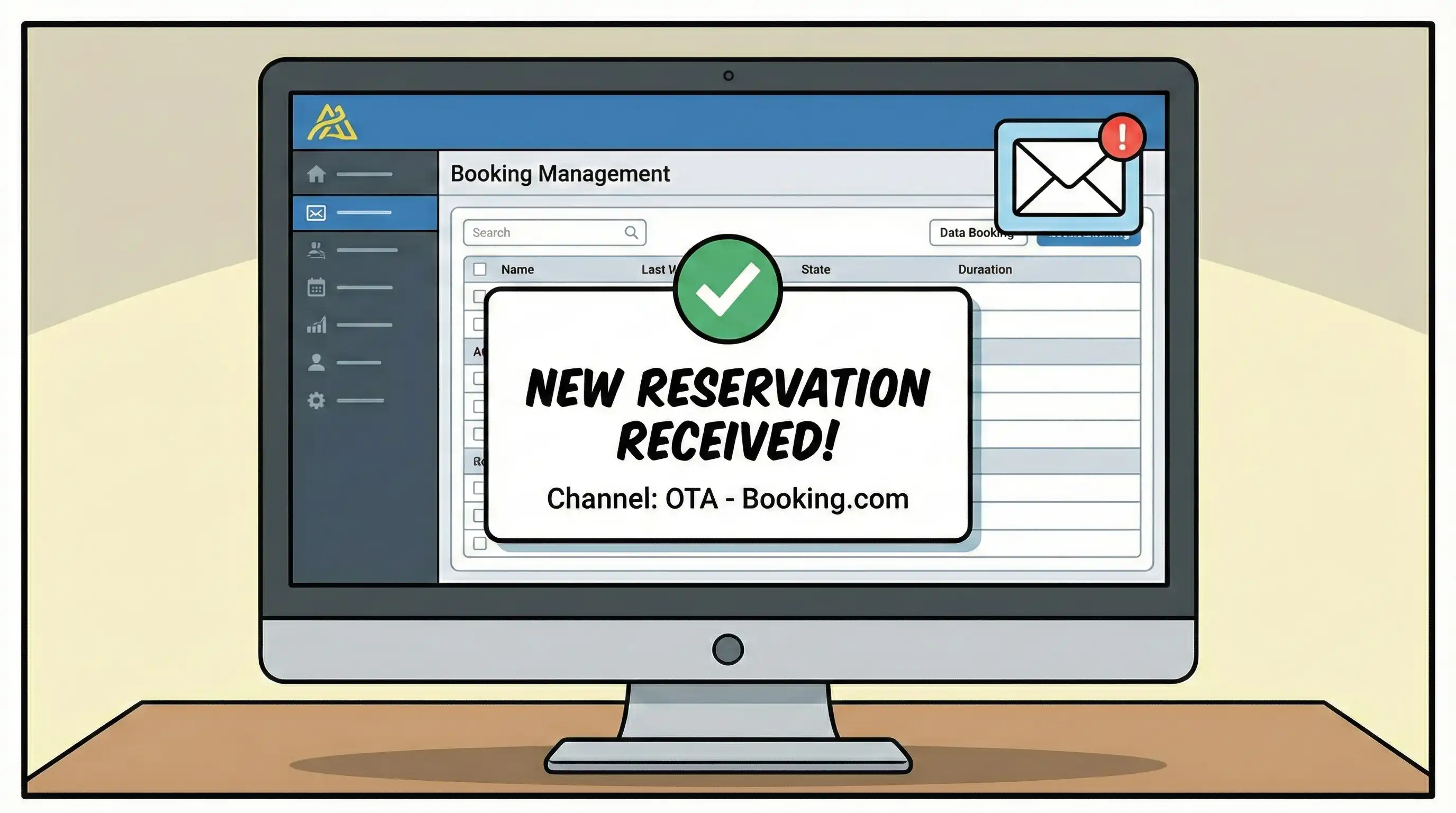
When someone books a hotel through an OTA, the booking is made in the hotel central reservation system, the number of available rooms goes down right away, and the reservation details are sent to the PMS in real time. Housekeeping can see that the room has to be cleaned, the front desk has the arrival information, and all other channels now show that one room is no longer available.
When a hotelier changes a tariff or closes a room type in the CRS, the change is sent to all associated channels right away. Since roughly 2020, current systems have used API-based real-time syncing instead of the old batch update method, which may take hours for changes to spread.
The booking journey from search to check-in:
It's important to know the difference between PMS and CRS responsibilities. Your property management system takes care of everything that happen on the property, like checking in and out, housekeeping, guest folios, billing, and front desk tasks. The CRS takes care of distribution by sending rates, inventory, and availability to the outside world.
These systems stay in sync thanks to two-way interaction. The hotel central reservation system transmits reservations to the PMS, and the PMS sends back information on live inventory status and room availability to the CRS. When housekeeping marks a room as "out of order" in the PMS, the CRS shows this in the available inventory.
Some of the usual data fields that are synced between systems are the arrival and departure dates, the kind of room, the rate code and amount, the guest's name and contact information, the payment status, and any special requests.
Platforms like Prostay offer built-in PMS–CRS–channel manager connectivity, which is better than using fragile third-party bridges that might cause data mismatches or delays in syncing. When these systems share a single data layer, the problems with reconciling data that come up in configurations with several vendors go away.
What must sync reliably between PMS and CRS:
A hotel central reservation system connects to the main places where rooms are sold. This comprises online travel agencies (OTAs) like Booking.com, Expedia, and Airbnb for some groups, global distribution systems (GDS) like Amadeus, Sabre, and Travelport, and metasearch platforms (Google Hotels, Trivago, and Tripadvisor).
These different channels get rate plans, restrictions (such minimum stays and non-refundable policies), and promotions from the CRS. The CRS decides what each channel can see. For example, you could only provide package rates on your direct channels or just negotiated corporate rates through GDS.
For certain hotels, the channel management part is a separate tool that lies between the CRS and external channels. Unified platforms integrate these tasks, making things easier for operators who don't want to deal with several providers.
Channel types connected to a typical CRS:
Terms used in hospitality technology typically mean the same thing, and many current platforms combine several functions into one. When looking at solutions, this can be confusing. Is a channel manager the same as a CRS? When does the PMS stop and the CRS start?
This part explains the differences between PMS, CRS, a booking engine, a channel manager, and a GDS. Knowing the differences between these things can help you decide if you need separate tools or an integrated stack.
Some independent hotels buy them as distinct tools from other companies. Prostay and other newer systems offer an integrated stack where these functions work together without needing any further software.
The property management system includes things that happen inside the building, like room status, housekeeping tasks, guest profiles, billing, folios, and front desk procedures. Your hotel staff utilizes it every day to do things on the site.
The hotel central reservation system scope includes your brand website and external channels, as well as inventory, prices, and availability. It's about controlling central reservations, or how rooms are sold and sent out to the globe.
The easiest way to think about it is that PMS is about "what happens inside the building," and CRS is about "how rooms are sold and by whom."
Prostay's PMS and CRS share a single data layer, which gets rid of the problems that come up when these systems are from different suppliers and need to be reconciled.
Key contrasts:
Guests can choose dates, room kinds, see pricing, and confirm reservations using the booking engine on a hotel's website. It's what the guest sees and does when they book directly.
The CRS works behind the scenes, sending real-time rates and availability to the direct booking engine and getting completed bookings back. The booking engine is like a store, and the CRS is like a system for managing inventory and orders.
Most modern booking engines come with or are closely linked to CRS tools. For instance, Prostay's direct booking module gets availability straight from the same data layer that OTAs and GDS use.
Example booking flow:
Who uses what:
A channel manager is a tool that sends inventory and rates to many OTAs and then brings reservations back. The distribution pipe is what links your hotel to the OTA ecosystem.
A CRS has a greater range. It does more than just distribution. It also handles central reservation rules, multi-property logic, corporate contract prices, group bookings, and is the only place where all reservation data is stored.
Some companies supply channel managers that work on their own and then connect to a different CRS or PMS. This works, but it makes integration harder and could cause problems.
As part of its single CRS/PMS distribution layer, Prostay features channel management. This makes things easier for smaller hotels who don't want to deal with different vendor relationships.
Comparison:
| Aspect | Channel Manager | CRS |
|---|---|---|
| Primary role | Distribute to OTAs | Centralize all reservations |
| Scope | Rate/availability sync | Full reservation management |
| Users | Revenue/distribution team | Reservations, revenue, operations |
| Data handled | Rates, inventory, bookings | Rates, inventory, bookings, guest data, groups |
Global distribution systems (Amadeus, Sabre, Travelport) are large travel agent networks primarily used for corporate bookings and travel management companies (TMCs). They aren't systems owned by hotels; they're distribution markets.
A CRS connects to one or more GDS platforms so that travel agents all around the world can see hotel availability. Agents use the GDS to look for and book rooms, and the CRS lets the hotel keep track of what rooms are available and how much they cost.
In practice, the CRS sends Amadeus pricing and availability. Amadeus helps travel agents find hotels in your city. An agent makes a reservation using Amadeus. The booking goes back to your CRS and then goes into your PMS for operations.
Roles in corporate distribution:
Not all CRS solutions are made the same way. The best decision depends on the size of the property, how advanced the technology is, the budget, and the structure of the portfolio.
Standalone CRS, integrated CRS in all-in-one platforms, cloud-based systems versus legacy on-premises systems, and single-property versus multi-property configurations are some of the main differences.
Independent hotels usually prefer cloud-based CRS solutions since they cost less up front, can be accessed from anywhere, and get regular feature updates without needing IT help.
Standalone CRS products sit between the PMS and channel manager as an independent layer. These are often legacy systems or specialist solutions used by large chains with complex requirements.
Pros:
Cons:
A standalone CRS might make sense for large groups with different PMS brands at each property, or chains with highly customized distribution requirements that off-the-shelf integrated platforms don’t accommodate.
Modern SaaS solutions like Prostay bring together PMS, CRS, a booking engine, a channel manager, and guest messaging into one platform. This is the method that is becoming more popular with individual hotels and regional groupings.
There are a lot of benefits, such having one contract, one support team, all the data in one place, quicker staff training, and a far lower risk of integration. There is no need to reconcile when your CRS and PMS use the same database. A booking is a booking everywhere.
This strategy is good for independent hotels, hostels, vacation rentals, and regional groups who want to get things up and running quickly and with fewer moving pieces. You're not spending months on integration projects or dealing with four distinct providers.
Integrated systems still have APIs that can be used for more complicated tasks, including adding bespoke features to a website or connecting to certain tools when necessary.
Benefits of integrated CRS platforms:
Cloud-based CRS systems are browser-based, can be accessed from anywhere with an internet connection, use subscription pricing, and get regular upgrades to its features automatically.
On-premises CRS solutions are set up on servers that are located on the property or in the corporate data center. These are typical in older hotel chains or places where the infrastructure needs to be kept up.
The benefits of cloud-based systems are evident: they allow for remote management (which is necessary for overseeing multiple properties), simpler updates without IT projects, better security standards from specialized vendors, and the potential to grow without having to buy new hardware.
Prostay is completely cloud-based and built for teams who work from different locations and manage several properties.
Cloud vs. on-prem trade-offs:
| Factor | Cloud-Based | On-Premises |
|---|---|---|
| Access | Anywhere with internet | Local network only |
| Updates | Automatic, regular | Manual IT projects |
| Upfront cost | Low (subscription) | High (hardware + licenses) |
| Scalability | Easy | Requires infrastructure |
| IT requirements | Minimal | Significant |
| Data control | Vendor-managed | Self-managed |
Some CRS solutions are made to work best with just one property. This is OK for a small, independent hotel, but they don't have the tools needed for managing a portfolio.
Multi-property CRS solutions are designed to handle dozens or even hundreds of properties. They do this by using centralized pricing strategies, common corporate contracts, cross-selling across sister properties, and consolidated reporting.
Some real-world examples are city clusters (three hotels in London under one brand), resort groups in different places, or management corporations that run several independent properties.
Prostay lets organizations manage several properties with property-level flexibility and brand-level regulations. This lets groups stay consistent while also being able to adjust to local market conditions.
Must-have features for multi-property CRS:
Managing rates, managing distribution and channels, processing reservations, managing room inventory, and reporting are some of the key things that a CRS does. When looking at CRS choices, don't just tick off features on a vendor's list. Instead, think on how each one works in real life.
A CRS should support a number of rate schemes, such as BAR (best available rate), corporate negotiated rates, packages, non-refundable rates, rates for members exclusively, and promo codes. A modern distribution strategy needs this kind of flexibility.
Some of the most important features are regulations for changing prices, limits on how long you may stay, limitations for when you can't arrive or leave, blackout periods, and managing promo codes. These technologies allow revenue managers use revenue management tactics without having to do things by hand.
When connected to specialized revenue management systems or AI pricing engines, rates can be automatically changed based on demand, competitive positioning, and the speed of bookings. This is where technology helps hotels make the most money without having to do things by hand all the time.
With Prostay, you can make changes to rate strategies from one place, and they will quickly show up in the PMS, OTAs, and direct channels. You don't have to log into numerous systems.
Rate capabilities a modern CRS must include:
The CRS decides which channels show specific sorts of rooms and tariff plans. You could send all of your room types to Booking.com but only suites to a high-end OTA. A corporate rate might only be available on GDS, whereas a flash sale might only be available on your own channels.
Channel-specific parameters include allocations (which limit the number of rooms an OTA can sell), blackout dates, channel-only deals, and parity checks to make sure that rates stay the same when they need to.
When the PMS marks rooms as out of service, adds new room inventory, or modifies the types of rooms that are available, the system automatically syncs. This stops situations where an OTA keeps booking a room that you've shuttered for repairs.
Capabilities that prevent overbookings and under-selling:
In a CRS, people make, change, and cancel reservations every day. They also add remarks and guest preferences, deal with no-shows, and assign rooms. The idea is for the reservation agent to have an easy time booking.
A lot of hotels really need help with group bookings. This contains room blocks with set numbers of rooms, release dates (after which unsold rooms go back into the general inventory), group rate codes, rooming lists, and billing settings for weddings, conferences, tour groups, or business events.
For example, think about running a 50-room corporate group across two sibling locations that share inventory. The CRS takes care of the block, keeps track of pickups, releases rooms that haven't sold by the date set, and makes sure that the front desk at each hotel has the right information.
Integration with secure payment processing takes care of deposits, pre-authorizations, and refund rules, which then go to PMS and finance systems.
Group-related capabilities:
The CRS is the only place to find out about available rooms, room kinds, and restrictions. The CRS gives the hotel manager the final response when they inquire, "How many rooms do we have available this weekend?"
Some important features are stop-sell (closing a room type or the whole property), minimum and maximum length-of-stay criteria, and PMS sync for managing rooms that are out of order. The CRS shows right away when maintenance closes a room.
Some systems let you make derived or virtual room kinds for marketing reasons without messing up the PMS's operational inventory. For instance, a "Romance Package" accommodation type that is really just a regular king room with extra features.
Centralized inventory controls stop situations when one channel sells out of a limited room type while others still show that they have rooms available.
Concrete inventory rules to manage:
Some important CRS statistics are bookings by channel, pickup reports that compare the pace to the budget or the previous year, cancellation and no-show percentages, ADR and RevPAR by source, and lead time analysis that shows how far in advance certain segments book.
These analytics help you decide which OTAs to focus on first, which markets to promote, and how to move room sales toward direct bookings, which is where you keep more of the money.
Dashboards should be easy for revenue managers and GMs to utilize every day. They should provide not only historical data but also forward-looking occupancy rates and revenue estimates.
Prostay's consolidated dashboards show hotel management all they need to know by combining PMS operational data with CRS distribution measures. They don't have to export data from several systems.
Specific report types to expect:
Hotels will focus on two main things: cutting down on OTA dependence and increasing direct bookings. OTA commissions are usually between 15% and 25% of hotel income. When clients book directly, this money stays with you.
A CRS gives your hotel's own booking engine access to the best rates and special pricing plans or packages. When a guest goes to your website, they see rates and inventory in real time from the same system that feeds OTAs. However, you can only offer direct-only incentives.
Member discounts, promotional codes, bundled experiences (such spa treatments, dining credits, and late checkout), and loyalty program rates are all examples of direct-only offers that the CRS controls. You regulate channel-specific rate distribution, so these don't show up on OTAs.
Prostay links CRS data with guest messaging (Prostay Nexus) and POS systems (Tableview) to make full hotel commerce journeys. A guest books directly, gets tailored messages before they arrive, and has their dining choices available when they get there—all thanks to unified guest data.
Tactics supported by CRS data for driving direct reservations:
To choose a CRS, you need to think about your budget, your current tech stack, the size of your property, the mix of distribution channels, and the technical expertise of your staff. There isn't a single answer that works for everyone, but there are clear ways to tell the difference between good answers and bad ones.
Must-have checklist items:
Common pitfalls when choosing a CRS:
Prostay is a single platform that came out in April 2025. It combines PMS, CRS, a channel manager, a booking engine, and guest messaging into one system that is perfect for running a modern hotel. Hotels get integrated hotel management from day one instead of having to put together a tech stack from different vendors.
Some of the things that set Prostay apart are modular pricing (you only pay for what you use), AI-assisted operations, multi-property dashboards with property-level control, and a strong focus on getting direct bookings through an optimized direct booking engine.
The best CRS for your property will vary on its specific demands, but the goal is the same for all of them: sell more rooms, do less manual work, and make sure guests are happy at every point of contact.
Prostay's staff can show you how modern CRS features work with PMS, channel management, and guest messaging whether you're thinking about moving to a unified platform or looking at your present tech stack. Ask for a demo to learn how centralizing reservations and hotel commerce works in real life for hotels like yours.