Hotel Cashflow Management: Guide to Hotel Cash Management
 Mika Takahashi
Last updated Mar 10, 2026
Mika TakahashiHotel cashflow management is one of the most important parts of running a property. Revenue can be strong on paper, but without solid hotel cash management, you can still run out of cash to pay staff, suppliers, and bills. Understanding cash flow, forecasting, and daily cash handling helps you keep the property healthy and profitable. Maintaining healthy cash flow is critical for operational stability in the hospitality industry, where seasonal fluctuations and high operational costs present unique challenges.
With this blog article we explain how hotel cashflow management works, what to track, how to manage cash day to day, and how technology can support it. Leveraging technology and modern financial management tools can streamline financial processes and support better hotel cashflow management.
Modern hotel financial software and tools can automate much of the cash flow management process, providing real-time insights and improving efficiency.

Hotel cash flow management is the process of planning, monitoring, and managing cash flow that moves in and out of your property. Cash flow is the lifeblood of any hotel business—effective cash flow management is essential for meeting financial obligations and supporting growth. It includes:
Financial operations in hotels involve planning, monitoring, and optimizing cash inflows and outflows to ensure liquidity.
Revenue and profit are different from cash. A hotel can be profitable on paper but still face cash shortages if payments arrive late or expenses are due before income is received. To optimize cash flow, hotel cash management must balance immediate liquidity with long-term profitability by controlling operating costs and enhancing revenue collection.
Hotels face several cash flow challenges:
Seasonal fluctuations - Occupancy and revenue vary by season. Low-season cash flow can be tight even if the year is profitable. These seasonal fluctuations in demand and revenue require careful planning to ensure operational continuity.
Fixed costs - Payroll, rent, and debt payments are due regardless of occupancy. These must be covered even when revenue drops.
Timing mismatches - OTAs and corporate clients may pay 30–60 days after stay. Staff and suppliers often need payment within days or weeks.
Working capital - You need cash for inventory, prepaid expenses, and short-term obligations. Without it, operations suffer.
Unexpected events - Repairs, cancellations, or economic shocks can create sudden cash needs.
Strong hotel cashflow management helps you anticipate these pressures and keep enough liquidity to operate smoothly. Effective cash flow management strategies are essential for maintaining financial stability and navigating seasonal fluctuations in the hospitality industry.
Understanding the cash flow cycle helps you see where delays and risks occur.
| Stage | What Happens | Typical Timing |
|---|---|---|
| Guest books | Reservation created | Days to months before stay |
| Guest stays | Revenue earned | Check-in to check-out |
| Payment collected | Cash or card charged | At check-out or before |
| OTA/corporate payout | Funds received from third parties | 7–60+ days after stay |
| Supplier payment | Invoices paid | 14–30 days after delivery |
| Payroll | Staff paid | Weekly, biweekly, or monthly |
| Debt service | Loan payments | Monthly |
The gap between when you earn revenue and when you receive cash, and between when you incur costs and when you pay them, defines your cash conversion cycle. The cash conversion cycle measures the time it takes for investments in resources to return as cash from guests, reflecting both the real or virtual movement of money within the hotel operation. Understanding cash flow patterns over time can help identify potential bottlenecks and optimize cash management. Shorter cycles improve liquidity; longer cycles increase the need for reserves and credit.
Operating cash flow is cash generated from core operations: room revenue, F&B, and other operating income minus operating expenses (excluding financing and investing activities). It shows whether the business generates enough cash from operations to sustain itself.
A positive operating cash flow that grows over time is a good sign. Maintaining a steady and positive cash flow is crucial for the ongoing financial health and sustainability of the hotel, ensuring you have sufficient liquidity to meet obligations and invest in growth. A negative or declining operating cash flow suggests you may need to rely on financing or reserves.
The cash conversion cycle measures how long it takes to turn operations into cash:
Cash conversion cycle = Days inventory outstanding + Days sales outstanding − Days payables outstanding
For hotels, this often focuses on:
Effective inventory management, such as just-in-time (JIT) ordering for perishables, helps manage inventory expenses, minimize waste, and contributes to stable cash flow by ensuring you don’t tie up cash in excess stock.
A shorter cycle means faster cash generation. Reducing DSO and extending DPO (within supplier terms) improves cash flow.
| Ratio | Formula | What It Indicates |
|---|---|---|
| Current ratio | Current assets ÷ Current liabilities | Ability to cover short-term obligations |
| Quick ratio | (Current assets − Inventory) ÷ Current liabilities | Liquidity without selling inventory |
| Cash ratio | Cash ÷ Current liabilities | Immediate cash coverage |
These ratios help you see how much cushion you have. A current ratio above 1.0 is generally healthy; below 1.0 may indicate stress.
Cash reserves are the amount of liquid cash you hold for emergencies and shortfalls. A common rule of thumb is 3–6 months of operating expenses. The right level depends on seasonality, debt, and risk tolerance.
It's important to establish a contingency fund by setting aside 5–10% of monthly profits. This dedicated reserve helps cover emergency repairs or handle seasonal downturns, ensuring your hotel remains financially stable during unexpected events.
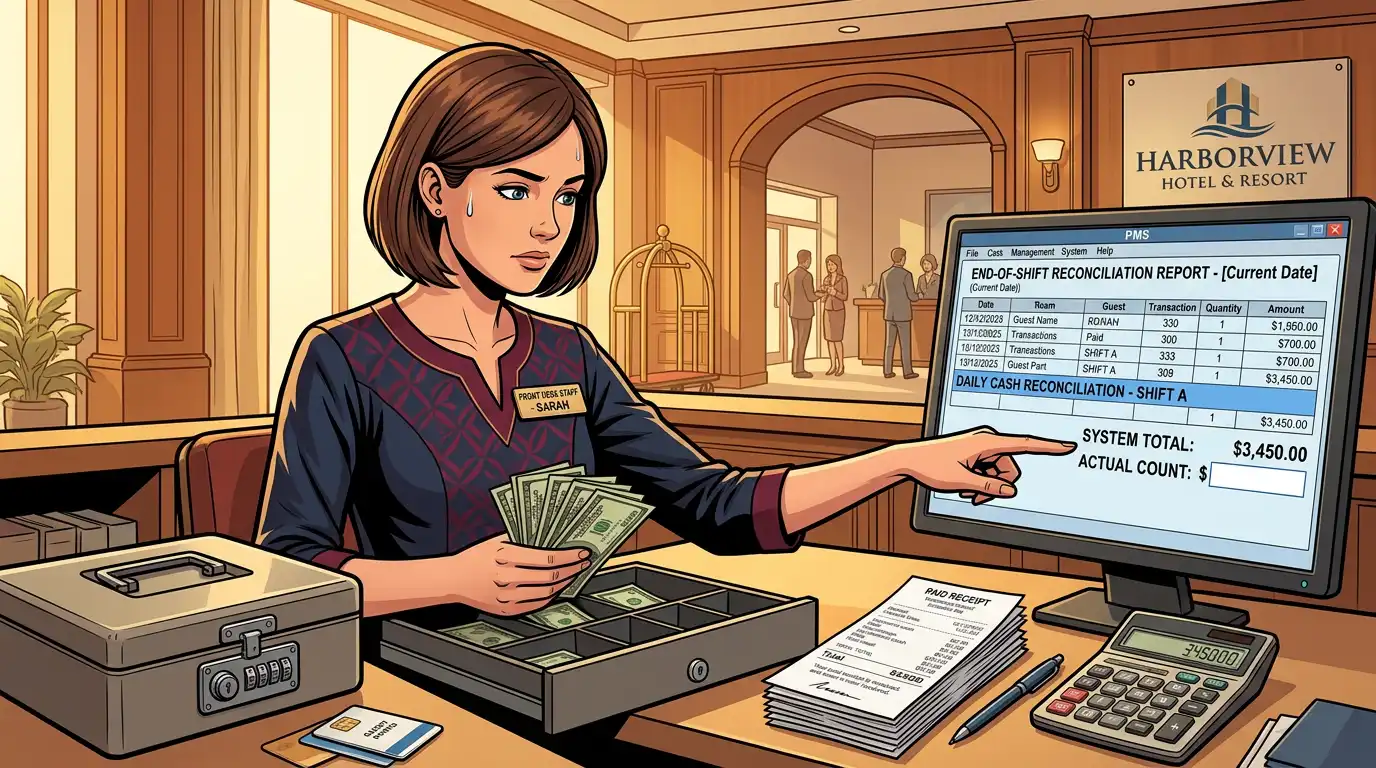
Front desk staff handle cash, cards, and other payments daily. Strong hotel cash management requires clear procedures:
Cash floats - Each till should have a set float. Count at shift start and end, and reconcile against transactions.
Transaction recording - Every payment should be recorded in the PMS immediately. Delayed or manual recording leads to errors and discrepancies.
Secure storage - Cash should be stored in a safe or locked drawer. Access should be limited and logged.
Handover procedures - Shift changes should include a formal handover: count float, reconcile, and document any variances.
Reconciliation - Daily reconciliation of cash, card, and other payments against PMS and bank deposits. Discrepancies should be investigated promptly.
Integrating mobile payment apps and mobile payment solutions at the front desk accelerates cash inflows, improves liquidity, and limits cash flow disruptions. Online booking systems further support faster payments and enhance overall cashflow management.
A cloud-based PMS like Prostay centralizes transactions and supports accurate, real-time recording. This reduces manual errors and makes reconciliation faster.
Revenue collection varies by channel:
| Channel | Typical Payment Timing |
|---|---|
| Walk-in / direct | At check-out (cash or card) |
| Direct booking | Often at check-out or prepaid |
| OTAs (Booking.com, Expedia) | 7–45 days after stay |
| Corporate / travel agents | 30–60 days after stay |
| Groups / events | Deposit + balance, often 30 days before/after |
Understanding these timings helps you forecast when cash will arrive. OTA and corporate payouts are a major source of delay; planning for them is essential.
Integrating a payment gateway with your hotel booking engine allows hotels to take deposits via credit or debit card at the time of booking, ensuring faster cash inflows and supporting more effective hotel cashflow management.
Accounts receivable (AR) is money owed to you by guests, OTAs, and corporate clients. Effective AR management includes:
Aging reports - Track receivables by age (e.g. 0–30, 31–60, 61–90 days). Focus on older balances first.
Follow-up - Proactive reminders for overdue invoices and regular follow-ups on overdue payments are essential to ensure timely collections and prevent cash flow disruptions. Escalate when necessary.
Credit policies - Clear payment terms for corporate and group clients help improve the accounts receivable process and minimize payment delays. Limit exposure to slow payers.
Prompt invoicing - Promptly invoicing customers and implementing strategies to streamline invoicing can shorten payment lag times and improve cash flow.
Payment incentives - Offering payment incentives can encourage clients and guests to pay their bills on time, further improving cash flow.
Integration with PMS - Your PMS should support AR tracking and aging. Manual spreadsheets are error-prone and time-consuming.
Reducing DSO improves cash flow. Even a few days’ improvement can make a noticeable difference.
Accounts payable (AP) is money you owe to suppliers, utilities, and other vendors. Smart AP management includes:
Payment terms - Negotiate terms that align with your cash flow (e.g. net 30).
Payment scheduling - Pay on time to avoid late fees, but avoid paying early when cash is tight.
Prioritization - Pay critical suppliers (utilities, key vendors) first when cash is limited.
Approval workflows - Require approval for larger payments to prevent errors and fraud.
Effective hotel cashflow management also depends on cost control and managing operating costs. Controlling operating costs is vital for maintaining positive cash flow, as high operational expenses can eat into profits. Typical operating expenses in hotels include payroll, utilities, OTA commissions, rent or mortgage, and variable costs like maintenance.
Extending DPO within agreed terms can ease cash flow, but only if it doesn’t damage supplier relationships.
Cash flow forecasting estimates future cash inflows and outflows. It answers: will we have enough cash next week, next month, or next quarter? To accurately forecast future cash needs, hotels should utilize historical data and market trends to predict potential cash gaps and adjust spending accordingly.
Inflows:
Outflows:
| Horizon | Purpose |
|---|---|
| 1–4 weeks | Daily/weekly cash position, short-term decisions |
| 1–3 months | Monthly planning, seasonal preparation |
| 3–12 months | Annual planning, financing, and investment |
Start with a 13-week (quarterly) rolling forecast. Update it weekly or monthly as actuals come in.
Historical occupancy, revenue, and expense patterns are the base for forecasts. Your PMS should provide:
Analyzing cash flow patterns and trends over time helps improve the accuracy of hotel cashflow management forecasts by identifying income and expense behaviors, allowing you to anticipate fluctuations and optimize financial planning.
Prostay and similar systems give you the data needed to build and refine forecasts. The more accurate the data, the more reliable the forecast.
Create scenarios for different outcomes:
Scenario planning shows how much buffer you need and when you might need to cut costs or arrange financing.

A budget sets planned revenue and expenses. Variance analysis compares actual results to the budget.
| Variance Type | What It Means |
|---|---|
| Favorable revenue variance | Actual revenue > budget; positive for cash |
| Unfavorable revenue variance | Actual revenue < budget; negative for cash |
| Favorable expense variance | Actual expenses < budget; positive for cash |
| Unfavorable expense variance | Actual expenses > budget; negative for cash |
Regular variance analysis helps you spot trends early and adjust. If revenue is below budget, you may need to tighten spending or accelerate collection. If expenses are above budget, you may need to reduce costs or improve revenue. Monitoring financial performance through regular variance analysis supports better cash flow management and helps ensure your hotel’s overall financial health.
Integrating your PMS with accounting and reporting tools makes variance analysis easier and more timely.
Technology supports hotel cash management in several ways. Leveraging technology and modern cash flow management solutions, such as automated financial software, cloud-based platforms, and integrated systems—can automate processes and provide real-time insights for better financial management. Using these tools, hotels can streamline daily revenue tracking, payroll, accounts payable, and receivables, ultimately enhancing cash flow management and operational efficiency.
A cloud-based PMS provides real-time data on:
Automated accounting software is simplifying bookkeeping for many hospitality businesses and providing real-time financial insights. By integrating these tools, hotels gain real time visibility into their cash flow and overall financial health, supporting better decision-making and proactive management.
Real-time visibility reduces the lag between what happens and what you see. You can react faster to cash flow issues.
Automated reconciliation matches PMS transactions with bank feeds and payment gateways. It reduces manual work and errors, and speeds up the close process.
Dashboards can show:
Comprehensive financial reporting and access to accurate financial data are essential for monitoring hotel cashflow management and making informed decisions.
Having this at a glance supports quicker decisions. Prostay and similar systems can surface these metrics so you spend less time in spreadsheets.
PMS-to-accounting integration ensures revenue and receivables flow correctly into your general ledger. This improves accuracy and reduces double entry. Integrated property management systems streamline financial operations by automating real-time financial reporting and cash flow control, improving overall efficiency in hotel cashflow management.
Build and maintain cash reserves for low seasons and emergencies. Maintaining a cash reserve acts as a buffer against unexpected financial challenges or periods of low occupancy. Aim for at least 3–6 months of operating expenses, adjusted for your property’s risk and seasonality.
Review cash position and forecasts regularly, daily for small properties, weekly or monthly for larger ones. Leveraging technology such as financial dashboards or ERP systems helps you gain real time visibility into cash flow, enabling proactive management and faster response to potential issues. Early warning helps you act before problems become critical.
A cash flow statement shows cash from operating, investing, and financing activities. It complements the P&L and balance sheet by focusing on actual cash movement. Use it to understand where cash comes from and where it goes. By analyzing cash flow patterns over time, you can identify trends in income and expenses, which helps inform better financial decisions and supports long-term hotel cashflow management.
Ignoring timing - Focusing only on revenue and profit, not when cash is received and paid.
Underestimating seasonality - Not planning for low-season shortfalls.
Poor AR management - Letting receivables age without follow-up.
Overlooking fixed costs - Forgetting that payroll, rent, and debt are due regardless of occupancy.
Neglecting debt management and debt financing - Failing to regularly review debt agreements, refinance under favorable terms, or set aside funds for loan repayments can lead to high interest payments and overwhelming repayment schedules. Ineffective debt management creates cash flow problems and threatens long-term financial stability.
No forecast - Operating without a cash flow forecast increases the risk of surprises.
Manual processes - Relying on spreadsheets and manual reconciliation increases errors and delays.
Insufficient reserves - Having too little cash for downturns or emergencies.
Avoiding these mistakes improves both short-term liquidity and long-term stability.
Hotel cashflow management is essential for financial health. It requires understanding the cash flow cycle, tracking the right metrics, managing daily cash handling, forecasting, and using technology to support visibility and efficiency.
Strong hotel cash management means adequate reserves, controlled receivables and payables, and regular monitoring. Tools like Prostay can centralize data, improve reconciliation, and support better decisions.
Successful financial management, revenue management, and effective resource allocation are crucial for maintaining long-term financial health and stability. Diversifying revenue streams—including ancillary revenue from services like dining, events, or spa treatments—can increase cash flow and enhance financial resilience. Implementing dynamic pricing strategies and adjusting room rates based on demand and competition help maximize revenue and support overall financial performance.