Hospitality Call Center Services: 24/7 Hotel Booking Support
 Mika Takahashi
Last updated Dec 18, 2025
Mika TakahashiA hospitality call center is a dedicated hub that manages reservations, guest services, and issue resolution for hotels, resorts, vacation rentals, and travel brands. In 2026, it stands as one of the most vital channels for driving revenue and enhancing the guest experience within the hospitality industry.
Unlike generic call centers, hospitality call centers are closely connected with hotel systems and staffed by agents who serve as both customer service experts and sales professionals. These centers handle hotel communication through phone calls, email, webchat, SMS, and social messaging—covering every way a potential guest might reach out before, during, or after their stay.
This article zeroes in on three key goals:
Real-world examples abound. Independent boutique hotels in New York tap into centralized call center services to stand tall against major chains. Resort groups in Florida rely on 24/7 support to assist international travelers calling from different time zones. Vacation rentals in California count on well-trained agents to manage complex multi-property bookings that self-service websites often can’t handle.
The voice channel still converts at an impressive 40–50% for high-intent travel inquiries, making it a “direct booking superpower” unmatched by any other direct channel.
When a guest picks up the phone, they’re showing serious intent. The question is: does your hospitality business deliver consistent, revenue-generating service—or do those valuable chances slip through the cracks?

Today’s hospitality call center services go way beyond just answering phones. They’re a full-service operation touching nearly every step of the guest journey—from the first inquiry all the way through post-stay follow-ups.
Here’s a quick look at the main service areas a well-run center covers:
This multi-channel approach means guests can reach out however they prefer, while your team keeps a unified view of every interaction.
Reservation calls are where hospitality call centers make the biggest impact on revenue. Every inbound inquiry is a potential booking—and a chance to increase its value.
Call center agents tap directly into live inventory and rate plans from the hotel PMS or CRS, so they can provide accurate pricing in real time. This avoids the frustrating “let me check and call you back” experience that often kills conversions.
Revenue-boosting strategies include:
Here’s an example: A guest calling about a weekend in Miami for two nights might be persuaded into a 3-night stay with a spa package and rooftop dining—tripling the revenue from that single call.
Agents are trained to follow structured sales scripts while keeping your brand voice and providing personalized service. The goal isn’t to be pushy—it’s to help guests create an even better trip.
Hotels face a unique challenge: guests call around the clock, but front desk teams can’t always be there to answer. That’s where call centers fill the gap.
Typical situations needing call center support include:
Service levels are critical. Industry standards aim for 80% of calls answered within 20–30 seconds. Every missed call is a lost chance at revenue and a potential blow to your brand reputation.
Hotels can customize routing—for instance, sending only unanswered or queued calls to the call center while keeping VIP or loyalty elite calls with the in-house team.
Hospitality call centers do more than bookings—they protect your brand by resolving problems before they turn into bad reviews.
Common guest issues handled include:
Call centers follow clear escalation workflows to maintain service quality:
For example: A summer weekend overbooking could spark a bad review. Instead, a skilled agent rebooks the guest at a sister property, arranges free transport, and adds a future stay credit. The guest leaves happy—and the negative review is avoided.
Detailed call notes get added to CRM or PMS guest profiles, ensuring continuity for future stays and enabling proactive follow-ups.
Deciding whether to manage your hospitality call center in-house, outsource to a specialized partner, or blend both approaches is a major strategic choice for any hospitality business.
In-house call centers are owned and operated by the hotel or brand itself, often situated on-site or in a corporate office. For example, a U.S. hotel chain might run a regional hub in Dallas that supports multiple properties across several states.
Outsourced call centers, on the other hand, are handled by expert providers whose agents are specially trained in hospitality scripts and have direct access to your property’s PMS, CRS, and CRM systems. Outsourcing has become increasingly popular as hotels look to save costs and gain flexibility.
Hybrid models combine the best of both worlds: your on-property team handles daytime and VIP calls, while outsourcing partners take care of overflow, after-hours, and international time zones.
| Factor | In-House | Outsourced | Hybrid |
|---|---|---|---|
| Control | Highest | Lower | Balanced |
| Cost Structure | Fixed payroll/benefits | Per-minute or per-reservation | Mixed |
| Scalability | Limited | High | Flexible |
| 24/7 Coverage | Expensive to staff | Built-in | Selective |
| Brand Alignment | Strongest | Requires training | Variable |
Outsourcing offers operational perks like multilingual support, 24/7 coverage across US, Europe, and APAC time zones, and the ability to quickly scale up during busy seasons without the burden of permanent hires.
There are times when it makes sense to keep reservations and guest communications within your own team:
Even in-house teams gain from using enterprise-grade contact center software and AI tools to boost efficiency, training, and reporting.
For many properties, hotel outsourcing strikes the right balance between cost, coverage, and service quality. Situations where outsourcing shines include:
Outsourcing providers typically offer flexible month-to-month agreements and adjustable seat counts, allowing you to double capacity during peak seasons and scale back in quieter times. They also bring specialized training, quality assurance, and analytics that many individual properties can’t easily build internally.
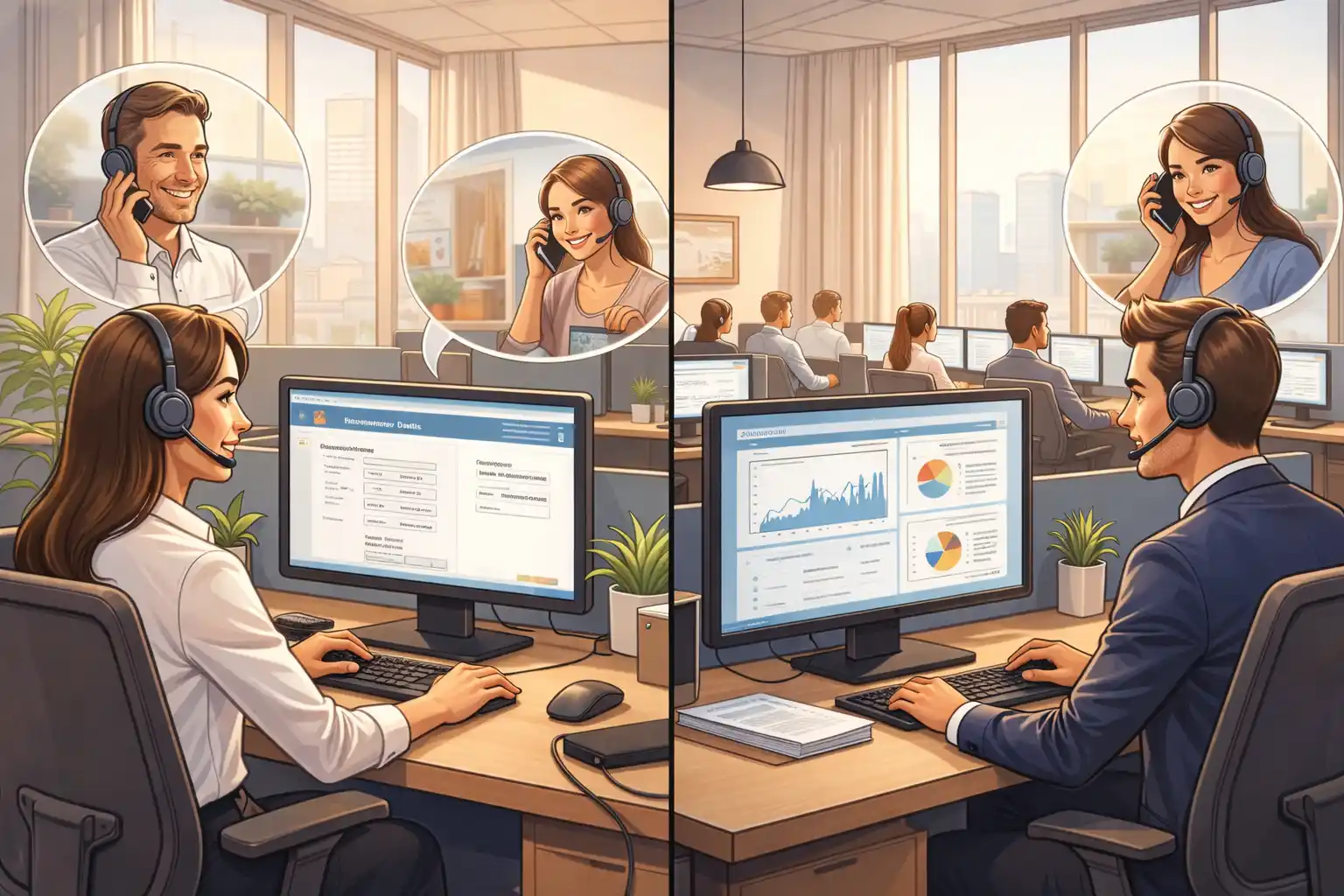
Behind every great hospitality call center is a powerful technology setup that enables fast, personalized service and accurate reporting. Without the right tools, even the best agents can struggle.
Key systems in a modern hospitality call center include:
Cloud-based contact center solutions became widespread around 2018 and saw rapid adoption during the travel industry rebound from 2020 to 2022. Today’s platforms support AI features, call recording, real-time dashboards, and omnichannel routing—all in one interface.
Common integrations include Prostay, Opera PMS, SynXis CRS, and Salesforce or HubSpot CRM, ensuring agents have real-time availability and a full guest history the moment they answer a call.
Generic call center platforms just don’t cut it for hospitality. You need software that “speaks your language” with built-in support for travel industry concepts like:
This deep integration empowers agents to upsell and cross-sell intelligently. For example, an agent can spot that a returning guest always prefers ocean-view rooms and offer an upgrade proactively.
Hospitality-focused platforms reduce call handling times and errors compared to forcing hotel operations into generic call center tools designed for other industries.
What gets measured gets improved. Leading hospitality call centers track both operational and commercial metrics to monitor performance:
| Metric Type | Key Measures |
|---|---|
| Operational | Speed to answer, abandonment rate, average handle time, first contact resolution |
| Commercial | Conversion rate, revenue per call, upsell revenue, average booking value |
| Experience | Customer satisfaction scores, Net Promoter Score (NPS), complaint resolution rate |
Call recording and screen capture help with coaching and quality control. Best-in-class centers hold monthly QA reviews and calibration sessions where supervisors score calls against clear standards.
Tracking reasons for no-booking outcomes (price objections, sold-out dates, decision pending) fuels remarketing efforts. For instance, if 30% of non-bookers cite price, that insight helps revenue managers adjust strategies.
Hotels can benchmark their performance against industry standards published annually by travel technology vendors to identify gaps and set realistic improvement goals.
Between 2022 and 2025, AI shifted from experimental to mainstream in hospitality contact centers, transforming how hotels deliver high-quality guest experiences at scale.
The guiding principle: AI enhances human agents rather than replaces them. Automation handles routine tasks and surfaces insights during calls, while people provide empathy and solve complex problems.
Successful hotel brands combine:
Even small independent hotels can now access AI tools through cloud contact center platforms without costly custom builds. This democratization helps budget and midscale brands control costs while maintaining 24/7 coverage.
Conversational AI works across voice and digital channels to handle routine guest questions without human intervention:
The goal isn’t to cut out human contact—it’s to free agents to focus on conversations that truly need human judgment and emotional intelligence.
AI also boosts human agent quality and productivity through:
Research shows 86% of contact center employees feel they lack sufficient resources to serve customers well. AI tools close this gap by delivering relevant information instantly.
AI combined with unified guest data unlocks personalization at scale:
Well-crafted personalization drives higher conversion rates and builds stronger brand loyalty. International travelers appreciate agents who already know their time zone and language preferences.
The voice channel isn’t just a way to make sales—it’s a goldmine of marketing insights. Every call brings valuable data that can power future campaigns and help turn callers who don’t book right away into loyal customers down the line.
Here are some key truths about phone-based hospitality sales:
Imagine a potential guest calling about a $5,000 resort vacation but not quite ready to commit. That lead is too valuable to lose—it deserves to be captured and nurtured carefully.
By capturing leads in a structured way, you can turn calls that don’t result in immediate bookings into future revenue. On nearly every call without a confirmed reservation, agents should collect key details like:
Using standardized note fields—covering occasion, party size, room preferences, date flexibility, and any objections—helps keep things consistent.
Then, follow-up workflows can work their magic:
For example: a caller who declined a May 2025 rate because of price might receive a June promotion matching their budget. They call back within 48 hours and book—turning a lost opportunity into second-chance revenue.
Knowing which marketing efforts drive calls helps you spend smarter:
Different channels—travel agencies, metasearch sites, direct marketing—send callers with varying booking potential. Attribution data reveals which sources bring in callers most likely to convert and at what booking value.
Guests don’t think in silos—they expect a seamless experience. Your phone call data should sync automatically with web forms, email marketing, and loyalty programs.
For instance, a caller interested in a New Year’s Eve package but who doesn’t book right away might:
This kind of integrated journey—from ad click to call to follow-up email to repeat business—creates higher lifetime value than treating channels separately. In 2025 and beyond, hotels can automate campaigns that combine voice and digital behaviors to great effect.

Picking the right hospitality call center solution is a big decision that shapes guest experiences and revenue for years to come. It requires careful thought.
Hotels should evaluate two main aspects:
Before a full rollout, consider running pilots or limited trials—maybe starting with one region or night-shift calls for 90 days to measure success.
Set clear success metrics ahead of time, such as:
Decisions made in 2024 and 2025 will influence your call center’s performance for the next 3 to 5 years, so build your training, processes, and integrations carefully.
When evaluating options, focus on both tech and service quality:
Coverage and language:
Integration requirements:
Technology features:
Brand alignment:
Understanding pricing helps you compare providers fairly:
| Pricing Model | Best For | Considerations |
|---|---|---|
| Per-minute billing | Low call volume, variable demand | Costs fluctuate with usage |
| Per-reservation fees | Revenue-focused alignment | Incentivizes driving bookings |
| Per-seat monthly | Predictable dedicated capacity | Fixed cost regardless of call volume |
| Hybrid approaches | Balanced risk and reward | More complex to manage |
Contracts vary widely. Many providers offer flexible month-to-month or 12-month terms, which are easier to adjust than long multi-year deals. Be sure to clarify what’s included:
Build a 12-month ROI forecast based on realistic assumptions about average booking values, expected conversion lifts, labor savings, and reduced OTA commissions thanks to more direct bookings.
Well-run hospitality call centers deliver measurable results that justify investment:
| Outcome | Typical Range |
|---|---|
| Direct phone revenue increase | 10–25% |
| Reduction in missed/abandoned calls | 20–40% |
| Guest satisfaction improvement | 5–15 points |
| OTA commission savings | Varies by direct booking mix |
A midscale chain reduced abandoned calls from 18% to under 5% across 2023–2024 by implementing overflow routing and after-hours coverage. That translated to thousands of additional reservations captured annually.
Phased implementation reduces risk and builds organizational buy-in:
Involve front desk teams, revenue managers, and marketing leaders from the start. The call center works best when integrated with broader commercial strategy.

For hotels planning a hospitality call center project, here’s a concrete action sequence:
Step 1: Audit current call handling
Step 2: Define KPIs and baseline them
Step 3: Select technology and/or outsourcing partner
Step 4: Train agents thoroughly
Step 5: Run a 60–90 day pilot
A modern hospitality call center transforms every inquiry into an opportunity for revenue, loyalty, and memorable service. When guests reach out—whether at 3 a.m. about a last-minute getaway or during peak seasons to plan a family reunion—your team helps shape their entire perception of your brand.
Combining skilled agents, hospitality-specific technology, and AI leads to higher direct bookings, better customer satisfaction, and stronger repeat business. The properties that stay ahead will be those that treat their call center as a strategic revenue engine, not just a cost center.
Review your call performance data now. Look at abandonment rates, conversion rates, and revenue per call. If there’s room for improvement—and there almost always is—prioritize call center optimization in your upcoming budget cycles. The investment pays dividends in loyal guests, higher margins, and exceptional service that sets you apart in a competitive market.